Tragedy strikes Harry’s family leaving him with nothing but sorrow, grief, and a mysterious box whose contents leave him shaken to the core. Everything he thought he knew about his father teetered on the edge of lies. Despite this, he decides to carry out his late father’s final to meet up with some of his old friends whose fathers had been best friends with his own - for a traditional camping trip their fathers had taken annually in years passed. But what they find up there in the Appalachian Mountains, and the mysterious circumstances that sent them there, reveal that their fathers had kept a terrible, deadly secret. And now that burden is theirs, and they must pay the price.
William F. Gray is the bestselling author THE DEVIL WITHIN US ALL, a small town horror novel inspired by the evil average people are capable of on an everyday basis. Taking cues from his own experience and the world at large, Gray creates horror that attempts to worm itself into your heart as well as your mind. His self-published debut THE MAN BEHIND THE DOOR tackles themes such as grief, trauma, and addiction through the lens of a ghost story, the main character of which is inspired by his own late father, while his latest effort OUR FATHERS' BURDEN is Appalachian horror that focuses on the stigma that still surrounds mental health issues, especially amongst men.
He currently lives in West Virginia with his wife, son, and daughter while working as a Lead Pharmacy Technician. His hobbies include reading, playing video games with his wife, and playing music.
My thanks to Wicked House Publishing, William F. Gray and Netgalley. Wicked House puts out some really great shit. They just do. I'm kinda appalled by how much I like their stuff. Mostly because I'm going to eventually want to read more, and it will eventually fail. This story though? Weird shit. I just happen to like weird shit! I began reading this with a sort of excitement.. I thought Windigo. Windigo and Vampires scare the poo outta me. Matter of fact, they are my favorite tropes. But, this is not my ideal windigo. Shit, matter of fact it wasn't a Windigo at all. Just some random dude author putting his take on it. Really, that's all this was. Not going to lie and tell you that this was crap. It sure as hell wasn't. I liked this story. I liked it enough to be hurt by the deaths. My biggest issue was with the fact that I "could have" loved these characters more. This whole story was good. It would have been better if the author had known his Windigo lore. Still? Pretty damn good! I expected everyone would die. Not everyone did. I guess I ended up just about loving this tale! And yes. For me, it was a fantabulous tale. It wasn't my ideal Windigo, but it was worthy. Heck ya' I will read more from this author.
I can see where the author was going with this story and the idea was pretty good. Unfortunately for me most of the characters remained entirely interchangeable for the pretty much the entirety of the book. They needed something more to make them distinctive and they never really got it and to top it off they all had really ordinary names so there really was nothing for me to latch on to remember who was who and who did what. Normally I'm all about a snappy pacing but here I thought it actually detracted from the story and what the author was trying to do with it.
Our Father’s Burden will have you thinking twice about that next camping trip. Gray gives us one hell of a creature feature, but it’s so much more than that. It’s a story full of grief, loss, and how we struggle to overcome them. You don’t want to miss this one!
Our Father’s Burden turns grief, generational trauma, and depression into one monstrous creature in the woods. Some things you can run from, but some you’ll have to face over and over again until you resolve them. With a tight pacing, and well developed character arcs, Gray proves once again why he’s a name to watch in the indie horror scene.
When Harry‘s dad and his four best friends all die due to different forms of suicide in their last wish is for their sons to go on their annual camping trip Harry who wasn’t close to his dad doesn’t want to go but because it was his dad‘s last wish he decides to do just that but before he does his mom shows him something that his dad left for just him he learned it’s a box of cassette tapes that he’s only to listen to when he’s with the other guys at the camp. When he gets out to the camp with Lou Dennis bob and Dave he first realizes why he never wanted to go on the annual camping trip and how much some of these guys get on his nerves but after they listen to the first tape they learn about the burden their fathers have been carrying for 30 years and that they have now knowingly passed to their boys. What they are about to endure is a nightmare that not all of them will come out of and those who do will not be the same. Let me just say although this is a horror story I want to say I thought was so awesome that in the end those who are left will in one way or another become better men the father‘s never told a soul about the burden they carried because they didn’t want to be laughed at but by doing that they taught their sons a lesson and that is it’s OK to ask for help. This was an extremely awesome horror story and a great literary achievement because asking for help is not something men tend to do insult to have a book where they face a monster and their own shortcomings was a great idea I think this is a truly awesome book and if you like horror books and books that make you think then you’ll definitely love Our Fathers Burden. As soon as I am done with this review I am definitely going to see what other books this author has to offer because this truly was a horrible that was original in written with great imagination and care. I loved Don’s story and felt so bad for Dave but then again I felt bad for all of them… Well Dennis not so much lol! Please forgive any mistakes as I am blind and dictate my review I want to thank wicked house publishing and NetGalley for my free arccopy.
Our father’s burden follows five men who set out on an annual camping trip after the recent passing of one of their fathers.
The deceased father left a note with instructions on where to go along with recorded tapes from the rest of the groups fathers that detail secrets that have been kept over many years. Unfortunately for them they don’t follow specific date instructions and set out a week later which is key to the plot and results in being a huge mistake.
What starts as a slow burn picks up pace when we are introduced to horror aspects including creepy creatures and deserted woodland settings.
There’s a lot of subtext to mental health related topics and the author definitely used a unique writing style. I feel some readers will eat this book up and others may dislike if for the same reason.
Thank you to NetGalley and Wicked House Publishing for an advanced copy!
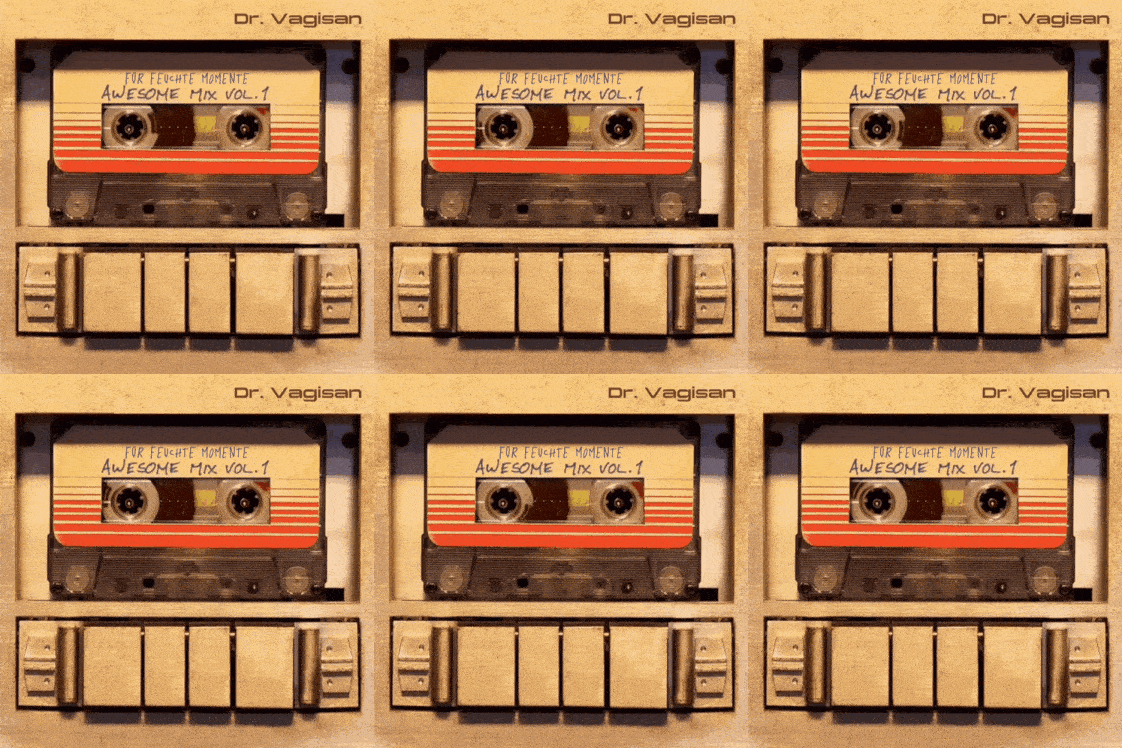
Harry Denmon was done going to the the Woods every year with his Dad and their friends. He didn't care for the tradition of the 'Annual Hunting Trip'. But years later his father Don dies and leaves Harry a shoebox, in it are five Cassette Tapes and a carefully folded piece of paper in which Don explains that his last wish for Harry is to keep the Tradition at all costs. And that as soon as the 5 men are together (and have set up camp at their typical hunting spot) they each need to listen their Tapes.
So Harry invites the other four men up into the Appalachian Mountains, all of them are the Sons of his late father's hunting buddies. Bob Winter, Dave Keller, Lou Richards & Dennis Short will be Part of this game. They will meet there for the Trip, but with one exception… Instead of going to their typical hunting site on the Sunday before Thanksgiving, they will meet there on the Day after Thanksgiving. New Generation… new twist on a Tradition. What could go wrong, right?
The Book started slow enough and with a flashback into the Year 1993 (for me personally a Year of Desaster!) And then after a fat Bang… it all goes down. (In a good way, mind you)
To our 'amusement', the five men are given a hard time by the Author and definitely not enough munition to face this shitty Situation in which they find themselves very quickly.
I liked the fact, that we could see a change in their Characters in the Course of this Book. Gray did very well to capture these changes! My very personal favourite out of these guys was Bob, don't ask me why exactly but I was rooting for him all the time! Though, at one Scene I was even sorry for the one of the bigger Arseholes out of these 5 blokes, the way the Author wrote that Scene had something inside me feel sorry for him.
The story itself, hmm… it was not wholly what I was thinking to find BUT in the End it worked out for me very well. You get good old-school Horror and even a 'Flashback' to 1987 (another 'Desaster Year' of mine. Thank you Mr. Gray. Are you a Psychic?). You get Fear and Panic, you get lots of Blood, you get Monstrosities in the Dark. What else could one wish for?
Now quickly onto something else regarding the Book. I liked³ the Interior Art, how sections and scene changes in the Chapters were separated with Cassette Tapes. Loved it!!
Our Fathers' Burden is a terror in the woods type creature feature. If you like those you'll probably enjoy this one. Five men who grew up taking part in an annual hunting trip with their fathers are reunited after the last living father kills himself and leaves behind a mysterious box of cassette tapes with a final wish that his son gather the other men together in the Appalachian Mountains to listen to them at their old hunting spot.
It's hard for me to review this without giving too much away so I will just say it touches on depression, grief, and deep dark secrets on top of the horror aspects. There's a lot going on and much to unpack in this book. Sometimes I lost track of who was who and which son belonged to which father or who was the most dysfunctional. The flashbacks didn't really help me get to know the fathers or sons any better. They seemed nearly interchangeable to the point that maybe one or two characters could have been eliminated from the story altogether. All in all, it is worth a read if you enjoy this type.
This was my first time reading a book from William F. Gray. I went in blind and didn’t read the synopsis. I really liked doing that so everything is fresh and I have no preconceived notions. I am so pleased that I did because this tumultuous pitch-black beast of a book was mind-blowing. The hallucinatory novel had me on the edge of my seat and then some. This book brought the reader into the grief and depression of each guy man. It showed how they overcame painful and demanding obstacles that were in their way, realistically, figuratively, and emotionally. I liked in the authors note that he mentioned that men in older generations held their emotions inside and bared the responsibility their generation. I still think that is true in today’s society. This is a very powerful book that will grab at a persons heart. I am very excited to read more from him!
Thank you to NetGalley, William F. Gray, and Wicked House Publishing for providing me with a free ebook in exchange for an honest review.
Really enjoyed this one. I love a good creepy woods story almost more than the haunted house trope, these days. It kept me interested the whole time and I loved the character development. It had a touch of a sci fi feel toward the end, but, I can’t say for sure, when it comes to things that we know little about. It wasn’t over the top.
Fans of "The Ritual" by Adam Nevill will love this book! A gripping and horrifying read. Five old friends father's die, one by dementia months earlier and the other four by suicide all within 48 hours. They all have the same request, go on their annual hunting trip together and listen to the tapes. What they find out in the familiar Appalachian mountains is a secret darker than they could have imagined.
I love a good wendigo story! This one had a good twist to it that made the story that much more enjoyable. Once Dave finds the other campground there is a constant sense of dread and tension. I was kept hooked and wondering what the next move was. The nursery rhyme was fantastic and will be stuck in my head for the foreseeable future.
"When thanks is given To the mountain, do not go Unless you want to get eaten By the awakened Wendigo."
Some thoughts: *This would be the perfect book to read while camping or staying in a cabin. I wish I could have had that experience my first time reading it. *I liked the initial tension between all of the men before everything went down. It felt realistic given the past and current circumstances. * The hate on Dennis was real. He wasn't the best but damn. *I get the moral reason why their fathers carried the tradition. But I would be damned if I carried it on. That'd be the last time you would hear of me going up to those mountains. *Some parts were a bit hard to follow with all different information and characters being thrown at you. *Given how the Wendigo was "cased" in the cave will there be another one eventually? *The fathers leaving this huge responsibility without a single mention of it beforehand is pretty screwed up on their part. Killing themselves to try to force that responsibility on the men is even worse. *I'm glad not everyone had a happy ending. There is no way all of the average men would come out of that situation unscathed. *The deeper message that the Wendigo was essentially disguised as was great and is something the readers should think of in their own lives.
Would definitely recommend.
Many thanks to Netgalley, Wicked House Publishing and William F. Gray for a copy of the book. All opinions are of my own
This entire review has been hidden because of spoilers.
Wow what a ride and we jump deep into the crazy trip of camping like their fathers to see what they all were hiding from the sons. All 5 dads are dead and now want their sons to take on the burden they have dealt with year after year. The way the book bounced between present and past was a great way to connect the sons to the fathers and fill us in on the whys and hows.
The characters were well developed and the use of the monsters ability to use the humans fear to weaken them was a nice touch. The setting of the Appalachian was perfect because the mountains has many places where a creature could live and go unnoticed because of the lack of people in the area.
I didn’t like how the author used fuck in almost all of the dialogue between the men. Not because of the word it’s self but because there should have been a variety of words. Otherwise, it was well written and maybe he personally decided to do this to show that they were unhinged.
Thank you to NetGalley & Wicked House Publishing for the ARC in return for an honest review.
First of all, I’d just like to say I absolutely tore through this book in almost one sitting. The story grabbed me from the first pages, and did not let up until the very end. The first pages lay out a mystery that reels you in immediately, and throws you into a world where “monster” can take on a number of meanings. We’re quickly introduced to five childhood friends, now adults, who have long since abandoned an annual hunting trip with their collective fathers. After receiving a cryptic message, all of their fathers die suddenly with one last request-- go on one last camping trip to honor them.
Of course, there’s more to it than that. Our protagonist Harry’s father also left him with a box of cassette tapes, promising to reveal a dark secret that’s plagued these old men’s lives for decades, and an explanation as to why they killed themselves.
I’m hesitant to get any deeper into the plot of the story, because it’s a terrifying and emotional tale that I think readers should experience going in as blind as possible. Our Fathers’ Burden is undoubtedly a horror story with exciting action and unpredictable twists. As far as trigger warnings: there is gore, there is something terrifying lurking in the woods, there is a lot of talk about suicide. It’s dark, but never revels in despair.
What I’d rather focus on is how incredibly deft Gray is at weaving together a compelling, character-focused narrative that tackles some really complex, and occasionally ugly aspects of the human condition. None of these men are perfect. In fact, some of them are about as broken as you can get. Each has their own story of trauma, guilt, and the depression that follows. Each has an earnest and believable reason why their lives have pulled them away from each other, and from their fathers. And yet, you can't help but root for not just one of them, but all of them as they discover the dark secret their fathers hid for decades, as they learn how to share their own. There is something evil in the woods, and while it is scary by its own merit, it also forces these men to hold mirrors to themselves, and examine how and where their lives went wrong.
This book handles trauma in a way that often feels like a gut punch to the reader, mostly because these characters feel so real. What's even more important, is how most of them feel completely lost, as they genuinely try to find a way to mend their lives. Even after I learned about some of the truly terrible skeletons in their closets (I’m looking at you Dave), I still couldn’t help but root for them because by that point I understood not only their guilt, but their earnest desire for personal growth (or in some cases, accountability). The story also handles male generational trauma in a way few authors can accomplish, shining a hard light on the mentality of the “strong fathers” who came before us. These fathers are men who bottled up their feelings, their fears, and their own dark secrets, who would rather die than risk being vulnerable. At the risk of being vulnerable myself, I grew up with a father who could have walked straight out of this book. Their mentality, the way we learn about them, through tapes and flashbacks, only furthers to build our attachment to the core five characters, and feels genuine every step of the way.
As a metaphor for guilt and depression, this book absolutely soars. Gray manages to seemingly effortlessly cross an extremely tight rope regarding suicide, and a host of other terrible deeds. In other hands, this story could have become a descent into utter hopelessness. Instead, he finds a way to lift these characters up in their darkest hour, to find redemption and salvation by proving that every person is capable of growth, if only they can allow themselves to open up enough to be honest with themselves, their friends, and family. This was the first book I’ve read by William F. Gray, but you can be darn sure it won’t be the last.
Wow what a ride and we jump deep into the crazy trip of camping like their fathers to see what they all were hiding from the sons. All 5 dads are dead and now want their sons to take on the burden they have dealt with year after year. The way the book bounced between present and past was a great way to connect the sons to the fathers and fill us in on the whys and hows.
The characters were well developed and the use of the monsters ability to use the humans fear to weaken them was a nice touch. The setting of the Appalachian was perfect because the mountains has many places where a creature could live and go unnoticed because of the lack of people in the area.
I didn’t like how the author used fuck in almost all of the dialogue between the men. Not because of the word it’s self but because there should have been a variety of words. Otherwise, it was well written and maybe he personally decided to do this to show that they were unhinged.
Thank you to NetGalley & Wicked House Publishing for the ARC in return for an honest review.
As a loyal Mountaineer and WVU grad, I gravitate towards any story that takes place in West Virginia/Appalachia. This horror novel is a wilderness survival story set against one's inner and external demons, and it delivered on many levels. A monster based on mountain folklore. An annual hunting trip amongst friends who share a dark secret. The legacy they leave their sons who are battling their own conscience. This is more than a scary story to tell around campfires. It is a metaphor that needs to be unraveled, and characters need to find their own redemption. What I particularly liked about this book is that the author managed to weave a complex tale without slapping in horrifying scenes just for shock value. Everything was included for a reason, no more and no less.
When I got to the end and read that the author's day job is a pharmacy tech at an independent pharmacy in West Virginia, this pharmacist's day was made, Bravo my colleague!
Thank you to NetGalley for the opportunity to read and review this ARC.
*there may be some spoilers in this, so proceed with caution*
I was fortunate enough to read the ARC of Our Fathers' Burden by William F Gray thanks to NetGalley & Wicked House Publishing. My initial rating was a 2-2.5/5 ★ - but after some ruminating, I think this book gets closer to a 3 ★ star rating from me, as I did enjoy my time reading it and there were many things I liked about it.
Our Fathers' Burden follows 5 young men who go on a trip to the mountains together following the tragic death of all of their fathers. The trip was one that their fathers all went on every year, and after their passing they each left notes to their sons requesting that they continue the tradition in their memory. As the story goes on, it's revealed through the horrors in the mountains that each of the main characters are struggling with grief, addiction, turmoil, and other stressors in their lives. Will they be able to heal from these things? Or will they succumb to the same fate as their fathers before them?
For some context, I started reading this a few short months after my Meme (who was more of a parent to me than a grandmother) had suddenly passed, and so I immediately related to Harry while he was grappling with regret, guilt, and grief after the sudden loss of his father. Some of my favorite horror novels and movies are ones that use horror as a metaphor for grief - so I was immediately interested in this concept. That being said, some of the writing was a bit plain for me. It was an easy read - I finished it all in one sitting. There were some parts that were gripping and so intense, I couldn't stop reading. When we first meet the creature, I was on the edge of my seat. I thought the suspense was great, but I often found myself longing for more description. Many of these moments of action and intensity were overshadowed by how slow and drawn out some other parts were, or they were undercut because the writing in those areas felt rushed and even a bit unfinished (I especially felt this way about the ending - it felt like Gray was rushing to the finish line here.)
Ultimately, I think Our Fathers' Burden had a cool concept but some rocky execution. It reminded me a lot of the film The Ritual, which similarly explores facing the monster that is grief through a trip to the mountains. It had so much potential, but could have been fleshed out more and I think the horror could have been much more effective if it was paced differently.
I was initially interested in each of the 5 main characters, but they all have a very similar voice and most of them weren't developed enough to truly care about them (the one exception being Harry). I wish the book did more showing instead of telling (not just in the instance of the characters, but with the horror and the general plot as well) - it would have benefited the reader to be able to see each of these characters' personalities through their speech patterns and direct actions, to be able to feel true fear about the creature and the dire situation these men are all in. On top of generally lacking a care for the characters, it didn't feel like the stakes were high enough for me to be invested in their survival or rooting for the main 5 in any meaningful way. This is a much shorter novel than the ones I usually read, so I understand that Gray had to be picky about what was and wasn't included. That being said, I would have gladly taken 50-100 more pages to see this more thoroughly developed and get to know the characters a bit better! But that's my personal preference as a reader - if you like a lot of detail and for your books to go more in depth with the characters, this may not be for you. If you're looking for a quick read that doesn't spend too much time in any one area, you might like this better!
All of this being said, I thought the way that Gray tied up each of the character's endings and personal healing was solid. I think it would have been more satisfying if that pay off had felt more earned & the suspense built up more. I love that we get some good endings and some justice. I thought that some of the best horror in this novel was the horrors that some of the main characters had perpetrated or experienced, and I thoroughly enjoyed the way each story line & the overarching story was wrapped up.
Overall, a quick and decent read, but a bit average and not as descriptive or scary as I prefer my horror to be - I think this had more to say than it did and I wish it had been pushed further. Unfortunately, I also noticed several editing & spelling errors throughout the book (even in the author's note), which did pull me out of the story in a few cases. From what I've seen in some quick research, Gray is a relatively new author. I really enjoy what he's trying to say, even if I struggled a bit with how he said it / how it was organized. I'd be interested to read more of his works as his writing & flow develops!
As an added note, I just wanted to offer a critique of the illustrations / images in the book. This is a bit nitpicky and ultimately at the author's discretion, but I wish that the little cassette tapes between sections were illustrations instead of photographs - same with the text message bubbles. I'm really into the ink blots/watercolor splashes throughout the book, and I think it would've been a lot more cohesive for me if the cassette tapes and other images had more of a hand drawn / water color feel. I also didn't think it needed so many cassette tapes, they did get distracting for me at times - I think they would've done better as chapter headers with a simple icon between sections of chapters, but that's my preference.
I went into this book not knowing what it was about or reading the blurb.
I’m so glad I did because I was completely wrong about what it was about and I really enjoyed the storyline.
5 men go on a yearly trip after all their dads die upon their request but they do not know what waits for them in the woods.
This book pulled me in and didn’t let go until the very end. I was on the edge of my seat the whole time. Once this book goes it goes until the end. I could picture everything in my head the whole time.
It was great to get the POVs of the sons and the fathers to really get the whole story.
“When thanks is given To the mountain, do not go, Unless you want to get eaten, By the awakened Wendigo.”
If you love: 🔺What Waits in the Woods 🔺 Creature Horror
Our Father’s Burden is a wilderness horror story of an ancient tradition and a new generation picking up the reins.
This is an extremely fast moving book and I found that the cast of characters was just a little too large to keep up with. I kept getting names confused and forgetting who’s father was who’s. Because of that, I also lost a bit of the suspense.
The topics of mental health and addiction were very interesting and well done and I thought the plot was great. I loved the idea of “passing the torch.” This is a good read for fans of wilderness horror, I read it in a sitting and had a pretty good time!
⭐⭐⭐
Available February 16, 2024
Thank you to Netgalley and Wicked House Publishing for an advance review copy of this book in exchange for my honest review.
This started out so strong. I was absolutely devouring it. But there are three different timelines and about ten characters to keep track of and all too quickly things got confusing. I wish things had been more clear when head and time jumping and better organized. There were also some editing mistakes that further confused things.
This story has a lot of potential. Less is more to keep up the mystery and suspense. A lot of work needs to be done on pacing as well. Tense scenes lost their edge-of-seat quality because they were too slow.
As a loyal Mountaineer and WVU grad, I gravitate towards any story that takes place in West Virginia/Appalachia. This horror novel is a wilderness survival story set against one's inner and external demons, and it delivered on many levels. A monster based on mountain folklore. An annual hunting trip amongst friends who share a dark secret. The legacy they leave their sons who are battling their own conscience. This is more than a scary story to tell around campfires. It is a metaphor that needs to be unraveled, and characters need to find their own redemption. What I particularly liked about this book is that the author managed to weave a complex tale without slapping in horrifying scenes just for shock value, Everything was included for a reason, no more and no less.
When I got to the end and read that the author's day job is a pharmacy tech at an independent pharmacy in West Virginia, this pharmacist's day was made, Bravo my colleague!
Thank you to NetGalley for the opportunity to read and review this ARC.
This book is filled with tragedy, dread, heartbreak, terror, and horror.
It’s a very powerful, atmospheric book that I think William F. Gray did a phenomenal job in setting the perfect atmosphere for.
Reading this book gave me goosebumps, and filled me with a feeling of absolute panic and fear for our characters as they’re trying to survive.
The writing was absolutely beautiful and flawless. I don’t want to give too much away, but even before I read the authors note, I understood what the author was trying to accomplish with the monster. And, I think he did it perfectly.
I loved the character development. It was beautiful towards the end, we see just how much they’ve grown as people.
Dare I say, this has become a favorite of mine already? Yes, I dare. Because it’s absolutely a phenomenal book that I think everyone should read.
This book comes out February 16th, so keep your eyes open for it, and definitely snag it up because it’s absolutely worth it 👏🏻👏🏻
I want to thank the author, Netgalley, and Wicked House Publishing for allowing me to read an ARC of this book!
"Our Fathers' Burden" is a gory, blood-filled feast of a novel, with lots of head-chomping, limb-flailing, body-slinging carnage, as a group of men face the beast in the woods that their daddies' tried to warn them about. Complete with a six-pack of audio cassette tapes, each personalized for the son.
Things would have turned out a lot differently if only they knew how to follow directions.
I enjoyed the different timelines portrayed within the novel, and the focus on mental illness, which is treated so negligently for men in the United States. Warning that there are lots of discussions about suicides in this book.
I didn't get the "green glow" (I was thinking wtf aliens? at one point), and would have preferred if this were not a wendigo story, because it didn't seem to have the native evil spirit atmosphere that makes these creatures of the woods so fearsome. But all in all, I enjoyed the story and will definitely pick up more books by this author!
A group of boys and their fathers take an annual camping trip to the Appalachian Mountains. Nothing seemed out of the ordinary until the boys grew older and found out the real reason for the camping trip.
Our Fathers’ Burden is a creature feature packed full of action, terror, loss, and grief. There was never a dull moment in this book. I found it to be atmospheric, which I love. The buildup creates a lot of mystery and all the pieces falling into place reveal things I never expected. The ending also brings another element of surprise that will really make you think.
Harry was my favorite character but all of them were good and added so much to the story. The tension between them was believable, as were their own personal struggles. Gray did a wonderful job with them. This is an author I will definitely be watching, and I look forward to reading more of his work.
3.5 stars SO this is the type of books you get to hate on a lot of the character, but also feel bad for them at the same time. What would cause a group of friends to commit suicide within a few days of each other? This mystery is what we get for the first portion of the book and I still dont fully get why. While I enjoyed the story and the writing, I found it bizarre how no one even tries to tell the truth sooner. Like drag someone up to that mountain and show them the truth!! And why would they take their kids there yet never tell them? Lots of questions kept this from being a true 4 star read Yet I loved the story, the human connections and the grief they suffer through. I appreciate the realistic, imperfect characters. In fact we get the opposite. We get to see the scummy side of humans a bit.
Be careful picking this one up, this book is far more than just a "creature feature". Five men who grew up visiting the Appalachian every year with their fathers return when all of their fathers suddenly pass. Their final wish being that they return to the tradition. Gray weaves so many important topics into this story. Generational trauma, depression, alcoholism, adultery, police brutality/ coverups... the list goes on. The thought and care put into creating these characters was fully evident. I could feel a connection to each character in this book, even those with particularly dark pasts. Is this book the best monster book I've ever read?... no. Was it worth the read? Yes.
Thank you to Wicked House Publishing for an advanced copy. All opinions expressed are my own.
3.5* Interesting plot which kept me engaged and entertained, but the many characters in this story were very confusing to me, and at the end I still didn't have a complete overview of who was who and who did what to be honest. I listened to the audiobook and I know that this type of confusion is one of the regular issues with doing audio instead of reading the book, so I guess this one would probably have worked better for me reading it with my eyes.
Nonetheless I liked it! I would have loved some more fleshing out of the details, especially about the way the fathers tackled the burden they took upon themselves.
All in all a nice little cryptic horror which keeps your attention from beginning to the end
Another book about things going wrong in the forest, which seems to be a theme for me this year. This was a great book with a good amount of foreshadowing and foreboding that made me a bit nervous to be in the woods with these guys.
Thanks to Netgalley and Wicked House Publishing for this ARC.
Gray has seriously impressed me with this story, and his previous book “The Devil Within Us All”.
This Appalachian horror story starts off strong and continues to thrill the reader till the very end. You’ll get more than enough blood and action, with desperate characters trying to survive a terrifying night in the wilderness.
The author does a great job explaining his thought process for creating the plot and characters at the end of the story- I appreciated this as I’m always curious about how aspects of the story came about.
All the characters were unique, some you loved, some you weren’t supposed to like, and some who were redeemed through their actions. My favourite actually ended up being Bob- he really seemed like he had true grit despite his life circumstances.
Thank you to the author, NetGalley, and Wicked House Publishing for a copy!
I am at war with myself over what to think about this one. At it's core, this creature feature digs into fallable humans and their various multigenerational missteps. It's solid content with an interesting theme.
I found the various characters and hopping back and forth in time to be a bit jarring and hard to follow. I was mixing characters up most of the way through the book.
Still, I appreciated the quick pace and thought the monster was violent, odd, and that it fit well into its environment. Things were action packed for about 70% of the book. Stuff starts and then never really stops happening until the book comes to its messy resolution.
But, I'm left with questions. There's just so much packed into the book that I wish it was a little longer so things could really be flushed out. What was on those other tapes? Inquiring monsters want to know!
Overall, I did enjoy my read and I was invested in the narrative. I hope you'll give it a chance.