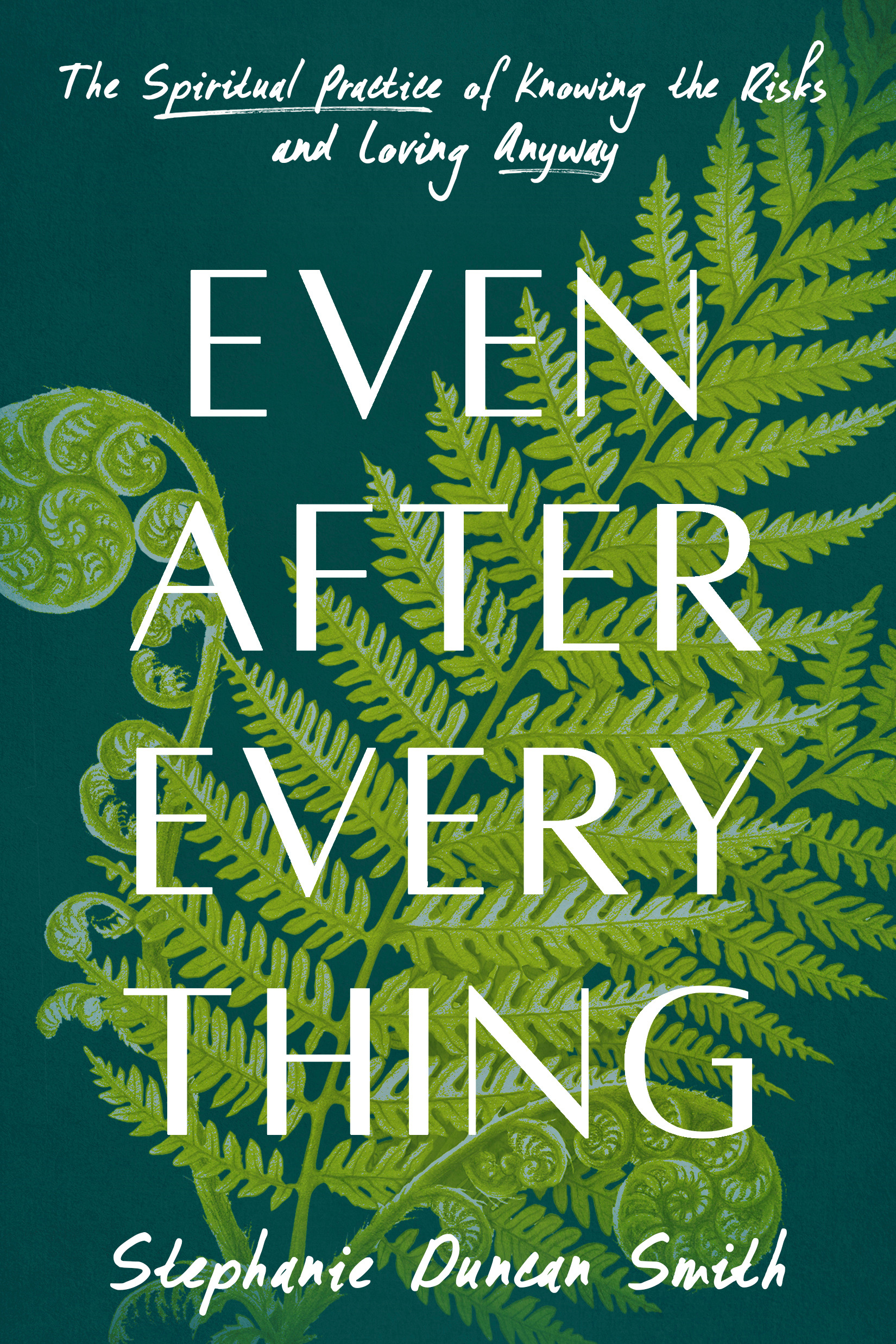
A gorgeous memoir that honors life’s deep griefs, great joys, and unsettled in-betweens through every sacred season, assuring us that we are never alone
Exquisitely told and urgently resonant, Even After Everything is a love letter to anyone who has opened their heart only to be hurt. Stephanie Duncan Smith proposes that it’s not through grit or forced resilience that you will find a way forward, but through receiving the full spectrum of our lives, just as we receive the empathy of God-with-us in every moment.
Duncan Smith’s disorientation began when she lost her first pregnancy on the winter solstice, just as the world readied to celebrate its most historic birth on Christmas. Then a new yet uncertain pregnancy unfolded parallel to the pandemic, until nearly one year to the day of her loss, she gave birth to her daughter at the peak of mortality in their city. These contradictions compelled Duncan Smith into a desperate search for steadiness, which she found in the liturgical year as a grounding force and the promise that we are seen by God in every season.
In Even After Everything, Duncan Smith traverses the church’s circle of time and reorients herself and us in the sacred story told through Advent, Epiphany, Lent, Holy Week, and Ordinary Time. She reveals the sacred year—through its endless interplay of love, loss, risk, and resurrection—as a mirror to the human experience, an anchor for turbulent times, and a womb strong enough to encompass every human care. At its heart lives the promise of God-with-us, inviting us into the spiritual practice of taking courage in the trust that we are accompanied in everything, and love will always have the last word.
I thought this was so deep, raw, and beautiful. Really brought me closer to understanding but also showed me how resilient the author is. I need to be more resilient through life's trials as well. This was so heartbreaking but also inspiring. Thank you for writing this down and sharing it with the world. This was beautiful and helpful!
I won this ARC from a Goodreads giveaway. All of the statements above are my true opinions after fully reading this book.
Wow! The poetic, beautiful way Stephanie writes draws you in. I appreciate her honest thoughts and feelings working through pregnancy loss and becoming new parents. I learned so much about Jesus and the liturgical year. Beautifully written and will stick with me for a long time!
An absolutely brilliant and needed book. Its central message is so rock-solid that it could even withstand the author's gullibility to propaganda, and that's saying a lot.
I really struggle to rate memoirs because they are such personal work. But I would say that the audience for this one feels really limited to Christian women who can read about both miscarriage and successful pregnancy without being triggered. That is a narrow window.
Nonetheless, she is a beautiful writer and I loved the thread of the liturgical calendar throughout the book!
Thank you to the publisher and NetGalley for this ARC! TW: pregnancy loss
I don’t give ⭐️ ratings to memoirs because I feel a little icky rating someone’s life, but I promise this was a great book!
I am reading this as someone who has not experienced pregnancy loss, but is not naive enough to think it could never happen to me. I’m reading this as someone who is not yet pregnant or a mom, but enjoys hearing stories from other women and learning as much as I can. And I’m reading this as someone who does not come from a liturgical Christian tradition, but absolutely loves the beauty and the reverence that comes with the more traditional aspects.
I loved this book so much. the stories, the words, the wisdom, the metaphors, the ties to scripture. I can’t wait to get my hands on a physical copy of this book and copy all of my kindle highlights and notes into it to better come back to and remind myself of the truths within these pages.
There are two themes that I remember so well and want to reference in the review to give you an idea of what’s in this memoir: 1. Staying with your breath. Stephanie was learning how to breathe and move her body in ways that will help prepare her for birth. Much like the answer and the best tactic in birth preparation is breathing techniques (something we’ve done our entire life), the answer to all of life’s “contractions” is God who’s been there with us this entire time. (Aka the breath of life!) 2. The entire premise of the cyclical Christian calendar and the cycles in our lives throughout this book was beautiful. The Christian calendar has highs and lows like our lives have highs and lows. At the low point of Jesus’ crucifixion, he follows it up with the resurrection. With what Mary went through for being unwed and pregnant and the birthing pains she endured, Jesus was born. In these same ways, God is with us through the lows and the highs as we continue looping through our cyclical life.
This book came at the perfect time of year for me and I’m so grateful to have read it. It is a deeply thoughtful book about the rhythms of life and faith that are connected so closely to the life of Christ and the liturgical calendar but also to stories of pregnancy, pregnancy loss, birth, and post partum. It is a unique book but I appreciated this and found myself highlighting a lot. I truly wish this book all the success! It just came out so make sure to pick it up! Thanks to netgalley and the publisher for the advanced copy. Oh and there is a wonderful thread from A Wrinkle in Time woven from start to finish.
A beautiful memoir that highlights the great risk of love. The author overlaps her own stories of love, loss, grief, joy, and hope with the liturgical seasons. This was especially poignant to me as I lost my mom on the winter solstice, the darkest night of the year, and 4 days before the joyful season of Christmas. As she walks through each season, she notes how they align and contrast with our current life seasons, and how that can look so different year to year, but woven throughout all the seasons is a God who is always with us.
Her writing is brilliant, which makes sense because she works in the publishing world. The way she tied her grief with the rhythms of the liturgical calendar was just beautiful. I don’t think this book is for everyone, but I VIBE with her.
I am speechless. This book does so much, and does it with some of the most beautiful and insightful prose I've read recently. In this book is:
~ the story of a woman's miscarriage and subsequent pregnancy ~ insights into the rhythm and meaning of the Christian liturgical year, connected with the author's own experience within that significant year ~ descriptions of the marvels of the female body that I never knew and could not imagine ~ details from the fields of astronomy, hydrology and philosophy that made her word pictures all the more awe-inspiring ~ reflections on the Incarnation, life, death and Resurrection of Jesus Christ ~ thought-provoking insights that will stay with me.
Instead of writing a lengthy review, I think sharing the author's words will make a much greater impact and recommendation for this book. Some of the (100 or so!) quotes I marked:
~ From the beginning of Advent through the end of its cycle in Ordinary Time, the liturgical year tells a story that mirrors this drama of the human experience: the wonder of new life, the unknowing of the in-between, the death of hope, living hell, and the astonishment of new beginnings. Much like our lives, sacred time is studded with the striking polarities of love, loss, and liminality. This is a story that holds ashes and ascension, silent nights and bitter betrayals, bread and wine and burial spices, weddings and God in human voice crying, “Why?” The one thing this story will not do is skim the surface. This story does not skip tracks, not look away when the scene gets intense… God is every gradient of the color wheel that composes a life.
~ In pregnancy, the uterus does something no other muscle can do - it expands five hundred to a thousand times its original size to make room for new life. How much more did God expand when he said, “Let us make room for the future of humankind”?
~ The God who imagines galaxies siphons such exponential being down, down, down into a molecule-small kingdom. The Maker consents to being made, and he makes his sanctuary the body of a woman. If Genesis tells the story of the birth of time, then Advent tells the story of time being reborn, casting woman as genesis, her womb as the place where the worlds were made.
~ To love someone is firstly to confess: I am prepared to be devastated by you. .. God made himself vulnerable to devastation. Rather than confining communion to within the Trinity - a closed circle forever - God loosed the world open to love and all its contingencies. God said yes anyway, and breathed this divine yes into our lungs, giving us being and setting the whole story in motion. We are here because God - for all love, and against all risks - decided for life, in defiance of death.
~ When joy feels too impossible, too risky to receive, we let fear take over to write the end of the story. When we are unwilling to be surprised by life’s goodness, we find ourselves like the disciples: locked away, hiding from life itself, barricading the doors against joy, which we deem as a threat instead of a gift. So we throw down the dead bolt, and live lives that are formed by chronic bracing.
~ The resurrection lets us in on the great joke that is nothing less than this: The way of all things under the rule of entropy is broken. Where linear time and space decree the story end in a full stop with the last breath, the resurrection rolls the stone like an ellipsis, and boldly continues the story.
If you love beautiful contemplative writing, are curious about the rhythms of the liturgical year, are interested in marveling at the experience of pregnancy and childbirth, and want to explore the fullness of human emotions, including grief and joy, I highly recommend this book.
Love love loved this. Oh my goodness. Her writing is so beautiful, the parallels and metaphors she weaves together — especially as it relates to pregnancy loss, growing a child, and bringing them into the world — were especially moving for me in this season. But you certainly don’t have to be pregnant or a parent to be moved by this tender memoir. I also low key love that it took her seven years to write it (her words, not mine). Just a testament to the slow growth and goodness of letting what needs to be said take shape, to live the story you’re living and give it time to gestate.
You know how people sometimes say, “*insert author*’s writing is so good that I could read anything they write, even a shopping list.”? This is how I feel about Stephanie’s writing. I even read through her ending acknowledgments (which I often skip) and there was just as much care and beauty put into those pages as there was the rest of the book.
Even After Everything is a unique memoir of womanhood and motherhood and all the gain and loss that implies. The book simultaneously follows the liturgical calendar, and throughout, Stephanie sprinkles deep wisdom.
Her words are like a balm to the soul, healing parts of me that I didn’t know needed healing.
My friend Kellie sent me this several months ago and I meandered through it mostly because it was a tough read for me. Stephanie makes the pretty and painful parts of motherhood feel sacred.
This book reads like poetry. It hurts so good. I picked it back up this week, and I’m grateful I had the inclination to finish it the week of Easter. It felt like a perfectly metaphorical bow for this read. This literature is gold, and I would highly recommend!
What a beautiful, complex, layered book is Even After Everything by Stephanie Duncan Smith. Two caveats for readers. Smith is a believer and her faith is imbued throughout the text. A reader can certainly benefit from her ideas without sharing her faith, but the faith is leading the content in most ways. Also, she talks frankly and passionately about pregnancy and miscarriage. If as a reader you are in an uncertain place here, proceed with this knowledge. I am a long way from pregnancy. The lessons she teaches (and I don’t think she’d prefer that wording) are universal. I am finding it difficult to encapsulate the thesis of the book simply (beautiful and complex, right?). Smith discusses the need to love and hope even in the face of loss and inevitable death. She frames her discussion around the church’s liturgical calendar - arguing that we try to live in a linear way when the world invites us to live in a cyclical way: the seasons, the liturgy, women’s monthly cycles.
I love this way of thinking. Raised a United Methodist, I have long had my worship framed by the liturgical calendar, but Smith’s insight takes it from a frame to a philosophy, and I am here for it. I have learned over a long period and with good counseling that for me grief is, in fact, cyclical (not what I was taught in Psych 101) and that trying to power through it with “positivity” was not working for me. I had not, however, made the connection to the cycle of liturgy that organizes my faith life. She points out how the loss is baked in and that we acknowledge it yearly. And suggests that we gain wisdom each time we move through cycles. I love that. Her reasoning is compelling and the idea is beautiful and points to a more hopeful way to experience loss and turmoil. Can I just advise you to read the book?
For me, the use of poetry and literature to support Smith’s ideas is very powerful. I have long believed that literature can clarify so much about life if we would just allow it to do so. She also quotes other research and thinkers. She creates these beautiful metaphors based on her personal experience. I value her transparency very much. She, then, uses the stories and experiences of others to expand her ideas. Finally, she anchors these ideas with literature and research, speaking to the universality of them. Oh how Smith speaks to the English teacher’s heart here. Also, I love liturgy and church history. I cannot celebrate the joy of Easter without reflection on sacrifice during Lent. I love the advent approach to Christmas. I have been told by more evangelical friends that this approach seems quite old fashioned and out of step, but how it works for me.
I am fascinated by the fact that I have read about women’s cycles and periods in two different self help books in the last two weeks. Folks, we have ignored them long enough. When Smith wrote of the conditioning we have to be quiet and perhaps a little ashamed of our cycles, I felt it more deeply than I expected - do you remember trying to get to the bathroom at school - hiding the necessary supplies somehow? In The PLAN, Kendra Adachi, urges us to build our cycles into our planning - embracing the high and low energy times. Smith uses them as another illustration of how life, living and dying-hope and loss, is about cycles. Accepting the cycles instead of ignoring them is a key to a more effective life. I’d love to have had these insights as a much younger woman - I’d love to have passed them on to my daughter.
I am grateful to Stephanie Duncan Smith’s Even After Everything for deepening my liturgical life and increasing my propensity to love and to hope in a difficult world. I appreciate how she encourages her readers to reframe how we live. I am thankful for the reminder that God will meet us where we are. I recommend this title most highly. Thank you to NetGalley and Convergent Books for allowing me to read an advanced reader copy in exchange for an honest review.
I was raised to consider Catholicism and Christian denominations as suspect, and the older I become, the more I realize that there is beauty in each of the different ways that people worship and respond to God.
After a lifetime of having my Friday nights and Sunday mornings and afternoons dominated by youth group and church, I decided to experiment with staying in for an entire semester during my senior year of college. It was wintertime, and I was tired of it all: I had started attending a different church than the one I was grew up in and I hadn't found any community; the cold, dreary grey of the season was a highly unmotivating factor; and honestly, I wondered if anyone would miss me or reach out to check up on me. (No one did.) For ten weeks, I slept in on Sundays, and it was novel and freeing for the first few weekends-- getting to take my time in the mornings, no place to be or get dressed up for, finally getting to experience in my 20s what I imagine people who didn't go to church got to do their whole childhood.
And then, surprisingly enough, I found myself missing the weekly rhythm. I didn't want to go back to the church that I had dipped my toe into (mostly, I didn't want to have to walk to the parking garage, warm up my car, and drive somewhere) so I decided to check out the local Catholic church on campus that was within walking distance. I was out of the church rhythm for a couple of months by that point and had lost track of time-- it turns out the weekend I chose to go back to church was Palm Sunday, and each person walking into service was given a literal palm leaf to wave around and hold onto.
I remember walking into an atmosphere of stained glass, and the high ceilings and build of the structure immediately imbued the air with an automatic sacredness. I took a seat in the back, and bemusedly observed the kneeling and ritual, feeling like an anthropologist observing another culture, taking field notes down in my head. It was familiar-adjacent enough for me to feel comfortable in the crowd, but also just enough out of my comfort zone for me to feel like this was a meaningful first step towards making my way back to a faith that had been worn down and stagnated.
Having been raised in a non-denominational Chinese church for almost two decades at that point, I had no idea what to expect, but I definitely did not anticipate being refreshed by the experience. Even now, when I think about that auspicious morning, I remember my visceral and inadvertent head-tilt when I heard the priest and another member of the congregation do a call-and-response type of reading, with the congregant reading as the narrator ("And God said") and the priest being the literal voice of God in the passage. I had never heard the Bible in that way, like it was an actual story, with different people voicing different parts, and I will forever remember that moment as when my faith started stirring from a hibernation borne of complacency from years of routine.
All of that is a long preamble to the appreciation and awe I have for this book, the premise of which is rooted in Catholic tradition and views-- and also, somehow, weaves in a celebration of the female body and all that it is uniquely created to do. Stephanie Duncan Smith is a beautifully observant and deeply profound writer, and reading this book is on par with the one time I attended a Palm Sunday service at a Catholic church. Getting to learn more about sacred time, ordinary time, Advent, Epiphany, and the pairing of life's joys and grief with the ebb and flow of the liturgical year-- even when there is daily evidence all around us that would suggest otherwise, God truly is for us and with us, and He really is good and loving. What a gift it was to read this special and incredible book.
When I picked Even After Everything up recently, my kindle app asked me if I wanted to pick up where I left off…six months ago. I knew I had dropped it a long time ago and I realized then that I had dropped it in the wake of the election. Weirdly, a book about navigating grief aligned with the church year was not what I wanted to read when I was…navigating grief.
I picked it up again because I wanted to clear older titles from my NetGalley backlog, and I am still navigating grief. The things this government is doing to our country and the world and all the Christians spewing hate is a lot. But while I thought I was picking it up to clear that backlog, my tears as I read these words made me think the Holy Spirit had a little something to do with the prodding to start reading again.
“Here’s what stays with me: The story of God moves through the longest night, but it always ends at a kindred, candlelit table. The story might begin in the void, but it will always end in communion….
Because of the resurrection, I believe all things shall be made new. I believe that at the end of the world, there is a table set in love. But I also believe that this side of all-things-new can be hell. Nothing in the Christian story makes this proclamation more plainly than Holy Saturday. And no one has felt this human pain more deeply than Christ himself. …
Morning will break. The alleluias will be returned to us, but make no mistake: The here and now can be a hellscape, strewn over with the shrapnel of broken alleluias. But perhaps this is the strange gift of Holy Saturday: This longest night might become the place where our shattered hopes, how-could-you cries, and spiral-out fears find an honest home. And for all our high vigilance and wounded waiting, we might take heart to know God is with us even in the hellscape.
Holy Saturday does not gloss over nor deny our broken reality, and invites us to name it plainly. It is a day that pronounces our longings and laments belong not only to God, but are holy to God, just as it renounces any claim that these honest expressions are somehow incompatible with the hope that we have. Holy Saturday calls counterfeit on any toxic positivity with which the cross might be vandalized.
It is a tragedy to lose, yes. But it is also a tragedy to spend a life bracing against all given good, dead bolting the door against the bliss that longs to be lived.”
This book met the moment for me. It is painful to be a person, but how rich it is to live our lives through the cycle of the church year. Resurrection always comes.
“The promise has never been smooth nor safe passage. The divine promise is presence. Wherever we find ourselves in the drama of mortal time, the immortal God makes with us a covenant of constancy.”
If you have walked through miscarriage, secondary infertility or suffering of any sort as a woman, allow me to press this book into your hands. I read this as a sort of Advent devotional which was just perfect. It’s a meditation of life / death / suffering in light of the liturgical calendar. The author is Anglican.
“the range of the liturgical story becomes for us one of its greatest gifts, expressing the radical empathy of God with us in every human moment— the IAM incarnate in our joy, fear, sorrow, and surprise.”
“Sacred time tells the subversive story of hope in which every requiem will ultimately give way to resurrection, and this hope can be a profoundly steadying force amid the traumas and terrors of our here and now.”
“Mortal time is heavy, bearing the weight of infinite vectors and variants-some bright and beautiful, some unbearable. Mortal time is freighted with love, yes, but also loss and liminality, and so the heart is kept in constant calculus.”
“There is freedom in such acceptance of our finitude. If we are limitless, how quickly this slips into becoming beholden. If we are limitless, we are on the hook to make the most of our own power at all times.”
“Hope is embedded in the cycle of seasons: Spring will come again. But the Christian hope runs even deeper: Ultimately, spring will come to stay. We are not asked to trust the cycling of the seasons simply because it is the natural way of things. Our trust is grounded in the assurance that reality itself- everything we consider "natural" now—will be re-storied by resurrection.”
An invitation to encounter presence and hope in every season of the liturgical year. This book was so rich in metaphor and intentional language that it took me a long time to read. But wow, so worth it. Even as Duncan Smith explores mystery, conflict, and pain, she also invites the reader to stay present to their own story, body, and needs, declaring that God invites us to do the same, and that the liturgical year gives us seasons and spaces that can hold it all.
“The range of the liturgical year presents itself to us as one of its greatest gifts. There is nowhere for us to go that God is not. There is no experience of love, loss, or liminality that is stranded outside of this divine witness and with-us empathy.”
This book contains extended explorations of pregnancy, pregnancy loss, and motherhood, which could be difficult for some.
Sometimes I finish a book so beautiful, I struggle to find words to describe it. Even After Everything is just such a book. Over and over I was moved by the depth of the author's insights as the liturgical year is juxtaposed with the highs and lows of life and love. Although this story is told through the lens of miscarriage, pregnancy, and parenthood, it is truly about the risks inherent in love and how God took those risks for us. I highlighted so much in this book, but this quote from the second chapter sums it up so well:
"This is the constant calculus of the heart: The more we love, the more we stand to lose. Love against risk is the inaugural and enduring paradox--God faced it first, and now, so do we."
This is a poetic book comparing the liturgical year (Advent, Epiphany, Lent, Holy Week, and Ordinary Time) with the author’s personal life and events within.
What I loved: Like @tishharrisonwarren’s book, A Prayer In The Night, I love how this drove me deeper into learning about the Church’s calendar, something I have not learned a lot about as a nondenominational Christian. Smith writes beautifully and weaves words like poetry throughout this book. I especially LOVED Smith’s reflections on miscarriage and loss.
What I didn’t love: There were a few things that made this book one I wouldn’t highly recommend. At one point, Smith describes a ritual she does, where she crosses herself and says, “I am beloved, I am baptized,” and lastly, “I am badass.” I feel like this is contrary to the Christian message: that I am a Child of God, in need of, and thankful for, my redeemer. There are a few more quotes throughout that didn’t seem entirely scriptural or come from solid sources. One example is a quote by Meister Eckhart saying, “We are all meant to be mothers of God. For God is always needing to be born.” The last point that I would caution is to anyone coming at this book who is hurting from a miscarriage. The last half of the book is about Smith’s pregnancy following her miscarriage, preparation for birth, birth, and recovery. I think this would have stung in the wake of my miscarriages while looking for words of healing and support in the pain of the unknowns.
Thank you Stephanie Duncan Smith and Convergent for the complimentary copy of this book - all opinions are my own ❤️
Some favorite quotes 👇🏼
“Being told that death has happened inside of you while you are still alive is not something the body ever forgets.”
“The possibility of loss was a constant presence, quietly shadowing my every move.”
“I hope I’m never over the realness of loving another, even if this means enduring loss. I hope I’m never over the depths and empathy that love through loss has awakened in me.”
This is just beautiful. I have some quibbles with theological and stylistical differences, but this book touched my soul and filled me with awe at being created a woman--even though that was not the main point of the book.
I'll simply share the paragraph that made me cry, to whet your appetite. "Human pain is the call--every nerve ending crying out. The Incarnation is the response--every mirror neuron of God firing, volcanic in awakening. God hears the crash and cries of our great fall and, like a mother, comes running. Emmanuel rushes through time and space to be not just near our hurt, but human with us in it." 😭
This was a treasure of a book. I stumbled over its description anytime I discussed it, but at its core it depicts how the Christian liturgical calendar applies to our own life, and how we are supported / understood in both joy and grief. At times, its language was a bit too flowery or plodding, but I overall greatly enjoyed and will return to again and again.
Absolutely gorgeous writing, though I did find myself, in the words of a friend, 'theologically squinting' at multiple points throughout. The idea of liturgical time being the tesseract that pinches our present and eternity together à la "A Wrinkle in Time" has literally been keeping me awake at night.
I was drawn to this book because of the way she tells her story within the Church’s liturgical calendar. The way she wove the two together was stunning. If you like raw and honest memoirs, I recommend this one.
I do want to add the content warning that this is a book about pregnancy loss.
As someone also working through my own complex grief, I found this book to be really helpful. It made me feel less alone in some of the low points since my loved one’s passing. Beautifully written from the heart.
This is truly a gorgeously written memoir as the summary states. The author experiences both miscarriage and birth within a one year liturgical calendar and her beautifully crafted words caused me to stop and ponder many times. I highly recommend.
This book is a good to read if you have gone through miscarriage. I like that she reminds us to be present and to seek God even when you go through things. Its ok to ask for help and speak what you want and need. To trust.