What if you only had one month to live? How would you make each day meaningful? How would you relate to others differently? What would you do to make the rest of your life really matter?
With eye-opening insights and soul-inspiring truths, One Month to Live will challenge you to embrace the life God has entrusted to you and you alone, and to live it out moment by moment with wholehearted authenticity, honesty, and integrity.
Each chapter overflows with inspiring quotations, colorful true stories, and questions for reflection. The four sections, which can be read over four weeks, help you examine the core areas inside you that long to be exercised and how you’re made to live passionately, love boldly, learn from your mistakes, and leave a legacy that endures for generations after you’re gone. Complete with uplifting action points, each of the thirty chapters– one per day in a life-changing month–offers you fresh strategies for overcoming habits that mire you in mediocrity.
Open yourself to the challenge of embracing your mortality and being empowered to live each day engaged in being fully alive.
What would you do if you learned you had just one month left to live?
This book is an incredible Christian perspective that seeks to answer that question.
There is no time to waste, so it is important to make sure that we are living passionately, loving completely, growing humbly and living boldly here on earth. What do you want your legacy to be?
This was a great way to kick of 2021. Each chapter offered strategies and tips in order to make sure that we are living life to the fullest right now, and not waiting for “someday” to start truly living.
I’ve found that I’m always waiting for someday. Someday, I’ll travel the world. Someday, I’ll spend more time with my family and friends. Someday, I’ll start doing what I’m passionate about.
Life is short. Someday may never come. It’s time to start living for today.
I really enjoyed this book. I listened as an audiobook from the library. This is one of those books that you need to take your time on and reflect, no just gobble it up, so the two week check out at the library was not the way to go. The authors want us to live life so that we are always prepared to meet God, not just reassess our lives at the end of it. I would like to purchase this in print so that I can work on the daily challenges in writing.
It's not that bad...it is very religious...but the ideas or concepts are good. the whole entire thing is you know how everyone always says live as if today is your last...but nobody ever really does...sooo hence the book....it's meant to help you realize or change your way of live so that you live the way you want to live the way you would live if you have one month to live...it starts off a bit slow but the further in the better it gets...and the majority of it is like things that i think we all know but don't apply or apply for a short period of time but then let it go because of something irrelevant. I think it is better done via a workshop or class sort of, but reading it on your own is fine it is a quick read but the whole point is you read one day a day....ie one chapter a day.
Overall it wasn't bad, the writing wasn't great or anything but it wasn't about that it's the kind of book that's about the message as oppose to the technique of it. But regardless it wasn't bad at all.
We had this book for years but I never noticed it or thought I wanted to read it. I was just recently diagnosed with Stage 4 Esophageal cancer so of course the title jumped out at me and I read it immediately. It was full of great advice and inspiration, but I’ll be reading the final section a few more times as it really impacted me.
I consider my marriage to be just as strong and happy as the day we were married, but I also believe that a good thing needs to be continuously nourished in order the thrive. The title of this book intrigued me, as well as the challenge it presented to focus on a relationship for the next 30 days, so coincidentally ending just before Valentine’s Day.
This book has been a joy and a pleasure to read every night, and food for my soul. The short and inspirational read was the treasured moment I longed for at the end of every day.
With the book being broken down into 30 segments, the portion to read every night was only a few pages, which I thought was perfect. It ended with several challenges—something to think about, write about, or do. A great “So What” moment at the end of the chapter to wrap it all up, and really apply to your key relationship(s).
The first few chapters help you diagnose the relationships you want to improve, offering encouragement to those who feel a relationship is beyond repair, and pinpointing what things to think about with some proactive suggestions. I love that most of the readings and daily challenges revolve around changing the way we look at our relationship, looking inward at our role with much self-assessment. I am always drawn towards self-help and DIY books, so the approach is one I agree with and gravitate towards. I don’t know if it was intentionally written this way, but the focus of the book so ingeniously and subtly shifts from the problem that lies between you and another person, to an inspirational motivating quest about how you would treat the last days of your life if you only had 30 days to love. I started reading thinking about the things I wanted to change or fix in my marriage, to feeling so empowered about the things I can change about myself to be happier, stronger, and better!
Perhaps my favorite part of the book is the sweet religious insight about relationships and character traits of our Savior, Jesus Christ, throughout the book. These are so seamlessly presented in a way that feels completely applicable and personally touching, and not at all in a preachy manner. Usually I am somewhat disappointed in the way Christian books cram scripture anywhere they can, but these short and sweet thoughts were so pleasant to come across.
This book is written so well! The authors give caring advice, relevant personal short stories, and genuine concern for the readers. I felt it was 100% applicable, and I am considering making this book a yearly read for myself, pulling it out on every January 14th until February 14th.
Well done, authors Kerry & Chris Shook. A truly excellent and inspirational read. Thank you for enriching my marriage!
I'm being generous giving this four stars. It's more like a 3.5 or 3.75 star rating, but I'll be gracious (if you can pardon the pun).
If I compare this to The Purpose Driven Life: What on Earth am I Here for?, which I've read multiple times, it pales even more. While not a 'bad' read by any means, it missed the mark with me because I already live this way, as best I can. And, as the authors pointed out in the final chapter, that's the beauty of living, really living, a Christian life - you shouldn't have to change what you're already doing right because you are striving towards Christ's example.
I definitely recommend this book to seekers or new or struggling Christians. In fact, I'm going to give my copy away to a likely prospect in the hopes of helping them see the light and spread the eternal good news.
This book asked me to make a list of things I would do if I had 30 days left to live. Quit my job, travel the world, and eat ice cream made the list. This book was supposed to help me achieve these things to live life more fully, I guess. But I don't have just 30 days left. I have a lot. and if I quit my job then I'll have no money to travel. And if I eat ice cream a lot, I'll get fat. Hmm. Guess I'm supposed to fill my life with something else that will give me the same high as those things.
Forget about all of the negative God comments shared in some reviews. Get the message! Really makes you wake up! The analogies alone knocked me off my seat. At one point I couldn't get passed day 5. It wasn't the last place I got stuck. Some of the reality was tough to deal with because it made me deal with stuff I wasn't ready to confront. This book changed my life because I wanted/needed to get perspective. Time is winding up.
Great advice for those seeking guidance on how to find more fulfillment in life. There are a lot of tie-ins to biblical teachings and hood reminders of God’s will for our happiness and desire for us to care for one another. I loved it, 5 stars.
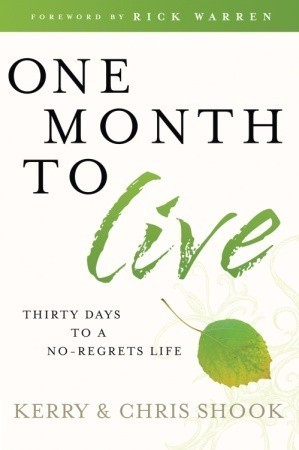
"One Month to Live: Thirty Days to a No-Regrets Life," by Kerry and Chris Shook, is a thirty-day challenge as follows: "If you only had one month to live, what would you change."
The book is separated into 4 parts: live passionately, love completely, learn humbly, and leave boldly. The chapters are designed as daily readings through a 30-day month. Both Kerry and Chris Shook write together, and this is what they conclude:
"You have been given an extraordinary gift--your life. You have an exceptional calling--to be the very best you God created you to be. Your goal is to unwrap this gift and use all that you've been given in the pursuit of what matters most--loving God and loving other people." (page 221).
Unfortunately I found the majority of the book tedious, shallow and boring. The anecdotes and stories seemed contrived and fake, and did not bring any substance to the book whatsoever. The best section of the book was the last, and in the last two chapters you find the bulk of what is truly important--Jesus Christ as the ultimate example.
The significant problem with the book, as with all self-help books, is that it assumes that if you were to live your life as though you had a month to live, everything would be better. Jesus is the perfect example of how to live our lives, and yet, He died a tragic death betrayed by all those he came to save, and all those he loved. The authors would have been better to focus on how best to find joy in every circumstance rather than always asserting that life itself can be better.
Generally I wouldn't recommend the book.
I received this book for free from WaterBrook Multnomah Publishing Group for this review.
I read this book as part of a campaign going on at my church. A couple of the sermons were going to be based on it, so I figured - yeah, I can give 30 days to this book.
The book was a little slow for me to get through. Yes, obviously it's a religious book, centered in a life lived with no-regrets through Jesus. Did I take anything life-changing from this book? Not particularly; three years later, I can't give you a single point from the book that changed my life - but that's just my personal experience.
The premise is, what would you do if you only had thirty days to live? How would you start living your life? At the time I read this, I was looking for a book that would really help me get over my "midlife crisis" (which three years later I'm still going through)... the whole "what am I here for" and "is this all my life is going to be" fears we all experience. The ones that run through my head when I worry I'm not amounting up to everything I dreamt I would be. It's a self-help book, yes, but didn't help me work through any of those issues.
In fact, it really didn't help me change my life into living "every day as if it were my last." I didn't find anything in the book to tangibly change how I lived, besides the reminder to trust Jesus with your life and that God has a plan for me. Having grown up in a "purpose-driven church," I've heard that for the last 15 years. Nothing new.
Overall, if you're trying to find something new and revolutionary (when, let's be honest, everything out there is new compilations of the best of what has come before), this probably won't get you very far. I'd suggest starting out with the "Purpose Driven Life," if that's the type of read you are needing.
I'm getting tired of Christian books that barely mention the Bible. This book quotes famous people more than it quotes the Word of God.
However, it was a good inspirational book. Really makes you think about your priorities - if you only had one month to live, would you live differently?
The other thing that bothered me is how disjointed the chapters were. Yes, they were organized into sections (Live Passionately, Love Completely, Learn Humbly, Leave Boldly). But within those sections, each chapter was vastly different, and often didn't seem like it really connected with the other chapters in the same section.
If you're looking for an easy, self-help type devotional to read each night before bed, this is great. But if you're looking to really learn more about God, you should go elsewhere.
Moved by its title, thinking it had to do with having only 30 days to live, I found this self-help book to be a challenge of daily living to one's fullest potential. Its a book that can be with us for life, with its daily chapters (I choose to read it through and then come back to work on each of its 30 chapters for one week at a time to make that practice a habit to live with) offering insights for reflection and the challenge to make the result a part of our self, changing our life for the better one habit at a time.
It definitely changed my life, still far from perfection, but certainly better for having both read and then put into practice the concepts of fulfilled and happy living.
It became immediately apparent that the authors are ministers, but I was willing to hear out religious references if there was other valuable content. I did indeed find a few tasty morsels of insight early on, but, alas, they ladled on a religious gravy that so smothered every chapter that it overwhelmed the taste of everything else. Chapter 3 opened with a long diatribe on Jesus and made it evident that the authors’ primary purpose was to proselytize. That’s when I slammed the church door shut. If I did have only one month to live (or a thousand), I won’t waste it reading this book.
If you knew you had one month to live, how would that change the way you spend your time? One Month to Live by Chris and Kerry Shook takes this question and turns it into a challenge, urging readers to stop waiting for the right moment and start living fully now. The book is structured around four guiding principles—Live Passionately, Love Completely, Learn Humbly, and Leave Boldly—each offering practical steps, thought-provoking exercises, and biblical wisdom. What stood out most to me was how actionable the book is. This isn’t just a motivational read; it’s a call to take immediate, tangible steps toward living a no-regrets life. I can see myself returning to this book as a checkpoint whenever I need to recalibrate my priorities and refocus on what truly matters.
The first principle, Live Passionately, is about breaking free from the routine of simply existing and embracing life with intention and urgency. It’s easy to get caught up in the day-to-day grind, pushing dreams and meaningful pursuits to the back burner with the idea that we’ll get to them “someday.” But what if someday never comes? Reading this, I found myself thinking about the things I always say I’ll do when I have more time—projects I want to take on, trips I want to take, experiences I want to have. This principle challenged me to start making space for those things now, rather than assuming I’ll get to them later. Passionate living isn’t about being reckless or impulsive; it’s about making sure my time is spent in ways that align with my deepest values. In my own life, this means prioritizing experiences that bring joy and fulfillment, making sure I’m not just busy but engaged in things that truly matter, whether that’s investing in meaningful work, strengthening friendships, or taking on new challenges that push me to grow.
The second principle, Love Completely, was perhaps the most convicting. If I had limited time, I wouldn’t let a single day go by without making sure the people I care about knew exactly how I feel about them. But why should I wait until time is short to do that? This principle is about being fully present, expressing love openly, and not allowing conflicts or grudges to linger. I was especially struck by the idea that most people, when faced with the reality of death, suddenly find the courage to say what they’ve always wanted to say. But what’s stopping me from doing that now? I realized I need to be more intentional in showing appreciation to those around me—not assuming they know how I feel, but telling them. I also need to be more proactive about reconciliation, choosing to forgive and extend grace rather than allowing unresolved tensions to fester. In my relationships with family, friends, and colleagues, I want to practice this principle by making gratitude a habit, taking the time to affirm and encourage people, and making sure I never leave important words unsaid.
The third principle, Learn Humbly, was a reminder that life’s greatest lessons often come through challenges, but only if I’m willing to be teachable. The book emphasized that humility isn’t about thinking less of yourself; it’s about recognizing that you always have more to learn. This hit home for me because I know I can sometimes push through struggles without pausing to reflect on what they’re teaching me. Whether in my personal life or professional work, I want to cultivate a mindset that embraces growth rather than resisting it. Instead of seeing difficulties as setbacks, I want to start asking, “What is this situation revealing to me?” Whether that’s learning from mistakes, seeking feedback, or remaining open to different perspectives, humility allows me to grow in ways that pride never will. Practically, this means making time for reflection, being willing to ask for help when I need it, and staying open to correction rather than being defensive.
The final principle, Leave Boldly, is about living in a way that ensures I will have no regrets when my time is up. It’s easy to put off thinking about legacy, assuming it’s something to consider later in life. But the truth is, every decision I make now shapes the impact I leave behind. This book made me reflect on what I want to be remembered for and whether my current actions align with that vision. Am I investing in things that will outlast me? Am I using my time and talents in ways that create a lasting impact? The book emphasizes that bold living isn’t about grand gestures—it’s about consistently making choices that contribute to something greater than myself. For me, this means prioritizing relationships, mentoring others, serving where I can make a difference, and ensuring that I’m building something meaningful rather than just going through the motions.
Reading One Month to Live left me with a sense of urgency but also hope. It challenged me to examine whether I’m truly living or just moving through life on autopilot. It reinforced the importance of making time for what matters, expressing love freely, staying humble in the face of growth, and living with the end in mind. If I ever find myself getting caught up in distractions or losing sight of what’s important, I want to return to this book as a reminder to realign my life with these principles. It’s a book that doesn’t just offer wisdom—it calls for action. If you’re feeling stuck, overwhelmed, or simply want to make sure you’re living in a way that counts, I highly recommend reading this and taking its lessons to heart.
I enjoyed this book tremendously, it really opened my eyes to a different way of living my life.....more intentionally for sure....😊 ...overall this is not the type of book you shelve and that's it your done...this book brings life to your life 💫 amazing!!! ( in my Oprah Winfrey voice).
This book gets down to a deep level making a reader evaluate one's relationship and life with the goal of helping the reader create a more meaningful life.
there's nothing to review more..i just love all the quotes from famous people and also the quotes of the Bible in this book. However, its still a good inspirational book. The closest relationship doesn't mean is your couple or wife/husband, it also be as your friend and siblings...and also, your parents.
I admire a quote on page 81: "We exaggerate yesterday. We overestimate tomorrow. But we vastly underestimate today! hen your mind is focused on yesterday, your heart will be filled with regret from past. When your mind is focused on tomorrow, your heart will be filled with anxiety about the future. When your mind is focused on today, your heart will be filled with hope. If you change what you do today, your life will change."
Nevertheless, this book really inspire me about life and realize me that we're not alone.
What if? I've reached the age where grey silver is beginning to lighten my brunette hair. Bifocals are a necessity. My mother died young, just 51. How long do I have? How long do you have? I selected this book to begin my year; because, I want to make my remaining days, months, and years meaningful for Jesus Christ, for me, for my family, and for those whom the Lord puts in my path.
The book is to be read over the course of thirty days. That's a challenge for me; because, if I like a book, I often want to plow through it in a matter of a few days or even a few hours. Dividing into daily readings gives a bit more time for reflection. Ideally, this is a book that you journal your way through. Each chapter has Make It Count Moments and Make it Last for Life questions that cause you to reflect on your life and how you're living it.
A good devotional study book that I would recommend completeling in some form of a small group. The title is self explanatory, but the premise of the books focuses on four principles (Live passionately, love completely, learn, humbly, and love boldly). Coauthors Kerry and Chris dive into each principle in a daily devotion that takes less 15 minutes to read. I journal each day making my average time about 30 minutes. Each day provides ample reflection questions to write about. That actually was a drawback I found with the book. Between the in moment reflection questions and actions at the end of each chapter the book can become a little overwhelming. That is not to take away the reflection time needed. Regardless, I could see myself reading this book again as part of a future small group.
Through this book, you will dive into what it means to truly live like there is a stopwatch. You will live like there are only thirty days left. You will be challenged to reanalyze your priorities and your commitments to see if they truly align with what you believe is right through Christ. Today is that “someday” you are searching for, so go out and live your life to the fullest.
“Your time on earth is limited. Shouldn’t you start making the most of it?”
This was a boring read. My church and I read it for 30 days. It took me 35 days to read. We read a chapter a day. I though the chapters were too long. It wasn’t an easy read at all. I had to force myself to read it. It talks about how to live its leach day like it’s your last. Live passionately. If I were to read it again, I would read it 3 times a week. A chapter in 2 days.
I think this book didn’t work for me because I’m already living a full life. Basically the by day 2 when it asked if I really had 30 days to live what would I stop doing and my answer was “stop reading this book”. Again to be fair I’d given up many distractions in my life already
I realised I don’t really read devotional books. I usually pick them up do a few days and never come back. I did get to the end of this one. The first third of this book I liked the most. I’m not sure if it was just me trying to get through it or if the last 2/3 was just not as engaging.
This is a good book to read in a regular basis not just a one time read. I shared a lot of quotes from this book with others and I found it to have a great balance of inspiration and practicality.