

What do you think?
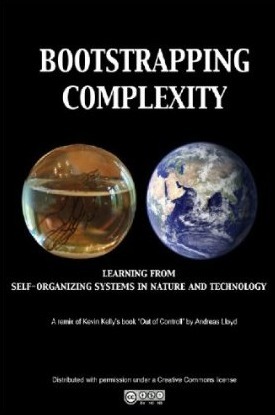
Bootstrapping Complexity
This book tells you how to understand networks such as the internet and social networks. However it was written long before Facebook, or even the web, existed so it explains the principles of networks by examples in biology -- like a beehive, a rain forest, or immune system. It tells the story of how feedback loops can create new phenomena and govern old ones, and why letting innovations like a social network be "out of control" is a good thing. The author also visits technological labs and reports on what they discover as they try to create artificial intelligence from dumb chips, or robots from insect-like parts, or complex organizations from simple ones. If you want to understand how the hive-mind of Twitter or Wikipedia works, this is the best book on the subject. It is an abridged version of the original, Out of Control, edited to focus on the chapters that tell how to "bootstrap" large complex systems and to engineer governance in non-governable networks. While written 18 years ago, the examples and wisdom are timeless.
155 pages, Kindle Edition
First published June 26, 2011
About the author
Kevin Kelly
139 books1,621 followersKevin Kelly is Senior Maverick at Wired magazine. He co-founded Wired in 1993, and served as its Executive Editor from its inception until 1999. He is also editor and publisher of the Cool Tools website, which gets half a million unique visitors per month. From 1984-1990 Kelly was publisher and editor of the Whole Earth Review, a journal of unorthodox technical news. He co-founded the ongoing Hackers' Conference, and was involved with the launch of the WELL, a pioneering online service started in 1985. He authored the best-selling New Rules for the New Economy and the classic book on decentralized emergent systems, Out of Control."
Ratings & Reviews
Friends & Following
Create a free account to discover what your friends think of this book!
Community Reviews
Displaying 1 - 1 of 1 review
August 7, 2026
Written in 1993, the book is an abridgment of another, bringing Mr. Kelley’s work to be more accessible for a wider audience. It shares the paths of understanding complex systems, bioengineering, and the irrational exuberance of computer scientists then and now. Cringe worthy sections on the early dismissal of questions like “now that we see the path to agentic artificial intelligence, should we create it?”
It ends with the nine rules for playing God and five expected philosophical or paradigm changes that will result. I don’t think biological/ecological systems, the real ones, are getting the centrality or pedestal imagined.
Like with climate change, we knew decades ago what harm we were doing and how to stop it. Same path with AI. But as the book points out biological systems research shows individuals within a community will not always do what is in the best interest of the species. Many of the individuals described in the book felt that’s ok because the chaos within complex systems is what feeds evolution and innovation and emergence of new properties as the system seeks to minimalize the perpetual state of disequilibrium. A state for the planet that, until our interference, changed at a pace that allowed nature as we know it to exist. Some of people in the book felt it was almost our obligation to create a cyborg species as the next ‘’progression” in evolution.
Scary stuff.
It ends with the nine rules for playing God and five expected philosophical or paradigm changes that will result. I don’t think biological/ecological systems, the real ones, are getting the centrality or pedestal imagined.
Like with climate change, we knew decades ago what harm we were doing and how to stop it. Same path with AI. But as the book points out biological systems research shows individuals within a community will not always do what is in the best interest of the species. Many of the individuals described in the book felt that’s ok because the chaos within complex systems is what feeds evolution and innovation and emergence of new properties as the system seeks to minimalize the perpetual state of disequilibrium. A state for the planet that, until our interference, changed at a pace that allowed nature as we know it to exist. Some of people in the book felt it was almost our obligation to create a cyborg species as the next ‘’progression” in evolution.
Scary stuff.
Displaying 1 - 1 of 1 review