

What do you think?

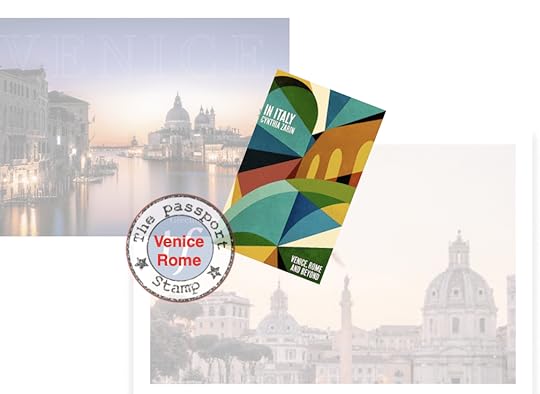
In Italy: Venice, Rome and Beyond
From acclaimed poet and New Yorker writer Cynthia Zarin comes a deeply personal meditation on four Italian spaces.
Here we encounter a writer deeply engaged with narrative in situ – a traveller moving through beloved streets, sometimes accompanied, sometimes solo. With her we see anew the Venice Biennale, the Lagoon and San Michele, the island of the dead; the Piazza di Spagna, the Tiber, the view from the Gianicolo; the pigeons at San Marco and the parrots in the Doria Pamphili.
Zarin's attention to the smallest details, the loveliest gesture, brings Venice, Rome, Assisi and Santa Maria Maggiore vividly to life for the reader.
Here we encounter a writer deeply engaged with narrative in situ – a traveller moving through beloved streets, sometimes accompanied, sometimes solo. With her we see anew the Venice Biennale, the Lagoon and San Michele, the island of the dead; the Piazza di Spagna, the Tiber, the view from the Gianicolo; the pigeons at San Marco and the parrots in the Doria Pamphili.
Zarin's attention to the smallest details, the loveliest gesture, brings Venice, Rome, Assisi and Santa Maria Maggiore vividly to life for the reader.
135 pages, Paperback
First published October 23, 2023
About the author
Cynthia Zarin
21 books35 followersCynthia Zarin is the author of five books of poetry, as well five books for children and a collection of essays. She teaches at Yale and lives in New York City.
Ratings & Reviews
Friends & Following
Create a free account to discover what your friends think of this book!
Community Reviews
Displaying 1 - 30 of 37 reviews

January 21, 2024
Some backstory on this book - a very nicely wrapped package arrived from a London bookshop with a note that just said “We hope you enjoy this as much as we did!” No name, nothing else. So I read it, and I hope I was able to live up to the challenge and enjoy it as much as ‘they’ did!
I had thoughts, but before making it about me, this is a really well done collection of essays. The first, despite like Assisi and Rome more than Venice, is rhetorical one I connected with most, so the rest of my thoughts are from that one. Anyways the overarching thought was that it was refreshing to see so many of my thoughts on travel reflected back to me in halves and pieces, and it made me want to wander around some.
- she paints a picture of tourist Venice, visitor Venice, and then long-term guest Venice, without ever reaching locals Venice (despite probably thinking she has & certainly trying to), and just reminded me of times in Siena where I got the pictures of local Siena but only ever saw them as a guest and visitor, but those pictures are what I remember from time traveling and exploring.
- “Someone says…’it is impossible to get over this.’ I look at him in the half light and wish it were true”. So one of my least favorite travel stops ever was going to Venice after studying abroad and I spent half of the time writing in my room bc I was tired of being foreign and tired of bending my life to fit another culture (and didn’t drink coffee or alcohol so I couldn’t just find a table to sit and hang at bc I had nothing to order). I went back w/ Jen and was floored that I had this negative view of the city bc it truly is incredible, but I was just being an entitled child and let myself get used to the beauty rather than continue to enjoy it. I did listen to an excellent audiobook on that leg of the trip tho.
- Venice rly is a great and easy place to get lost
If anyone read this far, I’m surprised and impressed.
I had thoughts, but before making it about me, this is a really well done collection of essays. The first, despite like Assisi and Rome more than Venice, is rhetorical one I connected with most, so the rest of my thoughts are from that one. Anyways the overarching thought was that it was refreshing to see so many of my thoughts on travel reflected back to me in halves and pieces, and it made me want to wander around some.
- she paints a picture of tourist Venice, visitor Venice, and then long-term guest Venice, without ever reaching locals Venice (despite probably thinking she has & certainly trying to), and just reminded me of times in Siena where I got the pictures of local Siena but only ever saw them as a guest and visitor, but those pictures are what I remember from time traveling and exploring.
- “Someone says…’it is impossible to get over this.’ I look at him in the half light and wish it were true”. So one of my least favorite travel stops ever was going to Venice after studying abroad and I spent half of the time writing in my room bc I was tired of being foreign and tired of bending my life to fit another culture (and didn’t drink coffee or alcohol so I couldn’t just find a table to sit and hang at bc I had nothing to order). I went back w/ Jen and was floored that I had this negative view of the city bc it truly is incredible, but I was just being an entitled child and let myself get used to the beauty rather than continue to enjoy it. I did listen to an excellent audiobook on that leg of the trip tho.
- Venice rly is a great and easy place to get lost
If anyone read this far, I’m surprised and impressed.

January 9, 2024
this is a beautiful collection of essays, of ruminations on Italy, life, love and distance, temporal or physical. it reads so lyrically, each section spreads out before you like a watercolour. honestly, I could've kept reading and I wish it was longer.

June 8, 2025
This should’ve stayed in the form of a private diary

July 27, 2026
I enjoyed following this book as I was in Italy, I started it in Venice after I had already been in Rome so I enjoyed the content it was short and sharp and felt it captured the experience of being in Italy well.
March 29, 2024
A lovely little trip to Italy.
February 27, 2024
Language never fails quietly. It fails noisily.
November 29, 2025
I was at Daunt Books in the summer of 2024. It was maybe a week before I would be sweating my whole face off in Italy. I was just browsing and landed on a page - I can't remember the exact quote now but I immediately had to buy it. Nice simple read but nothing life-changing like I'd hoped it would be!
November 26, 2025
obscene amounts of empty name dropping, graphomania-long sentences without substance, and no beauty in language
August 22, 2025
Fleeting impressions, observations of travel. Beautiful descriptions of places in Italy while reflecting on absent or past lovers.
The writer has an annoying habit though of separating herself from tourism - that she somehow is not part of the tourism class (because she is upper class?). She talks about tourists, but she is not one. And her descriptions of being part of Rome physically were beautiful but at the same time very annoying. She lives in America and I assume is American - and much of her experience is describing / looking at Italians, but from quite a distant position, with a tone that she has more ownership or understanding of places than the people that live there. She is afforded the luxury of spending a lot of time in Italy, but it sort of reminded me of the grand tour - Europe as a rich persons playground without the social or political.
Offers a glimpse into the world that Tom Riley wanted to be part of - where every city you stay in either a friends beautiful apartment or a charming and expensive hotel.
I enjoyed the descriptions of what she was seeing but also annoyed by the extreme yearning for absent people that seem to be quite frankly, arseholes.
(I did note down though some places to see when next in Venice - where I will undeniably be a tourist)
The writer has an annoying habit though of separating herself from tourism - that she somehow is not part of the tourism class (because she is upper class?). She talks about tourists, but she is not one. And her descriptions of being part of Rome physically were beautiful but at the same time very annoying. She lives in America and I assume is American - and much of her experience is describing / looking at Italians, but from quite a distant position, with a tone that she has more ownership or understanding of places than the people that live there. She is afforded the luxury of spending a lot of time in Italy, but it sort of reminded me of the grand tour - Europe as a rich persons playground without the social or political.
Offers a glimpse into the world that Tom Riley wanted to be part of - where every city you stay in either a friends beautiful apartment or a charming and expensive hotel.
I enjoyed the descriptions of what she was seeing but also annoyed by the extreme yearning for absent people that seem to be quite frankly, arseholes.
(I did note down though some places to see when next in Venice - where I will undeniably be a tourist)
September 25, 2025
It was fine, sparks of interest

March 1, 2024
Although I rarely travel abroad these days, Italy remains a favourite holiday destination, steeped in a cultural history I find endlessly fascinating. As such, this gorgeous collection of personal essays on Italy by the American writer Cynthia Zarin was always going to captivate me. Zarin is a poet, and these short pieces, weaving together elements of travel writing, personal reflections and touchstones from the world of literature, are expressed in an evocative, meandering style. Lovers of Lauren Elkin’s work – particularly No. 91/92: notes on a Parisian commute and Flâneuse – will find much to enjoy here. Ditto Valeria Luiselli’s meditative essay collection, Sidewalks, and Deborah Levy’s beautiful Living Autobiography trilogy, both of which sprang to mind as I read Zarin’s dreamy, lyrical book.
In Italy comprises four personal meditations of varying length – one on Venice (Serene), two on Rome (Roma and Angels) and one on the Basilica di San Francesco d’Assisi (Basilica) – all wonderfully immersive and pleasurable to read. If you like wandering around cities, meandering down alleyways – both literal and metaphorical – In Italy is a book for you.
Zarin writes openly about how certain places evoke deep-seated memories, reminding us of previous visits, old relationships and long-held regrets. Both Seren and Roma are haunted by the ghosts of former (or soon-to-be-former) lovers, flitting through the author’s mind as she moves around these cities. Ostensibly, Zarin has returned to Venice to attend a party in honour of the Joseph Brodsky Foundation – a visit she hopes to write about for a literary magazine. But alongside her main purpose, Zarin has another, more personal reason for the trip. A troublesome relationship is dying, ushering in a transition period and the need for some space to think.
I had come to Venice because I was preparing to break my own heart, and I needed another version of love. (p. 52)
The man – whom she refers to as ‘Bronzino’ because he looks like a portrait by the renowned Mannerist artist – has declined to accompany her to Venice, citing the visit as ‘another thing they cannot do together’. Naturally, Zarin feels deeply hurt by this rejection. Nevertheless, the reader suspects she will be much better off without this prima donna, free of his infuriating text messages and complex romantic entanglements.
Six months before, I had fallen in love with an old friend, an acquaintance, really, a friend of friends, who sometimes had come to dinner with a woman to whom he was or wasn’t married, with whom he did or did not live. There was no end to the complications. (p. 5)
Zarin knew Joseph Brodsky and his wife, Maria, before the poet’s death in the mid-1990s. In fact, Zarin and Maria had given birth to their daughters at roughly the same time, often meeting up in New York as the girls were growing up. In one of the most affecting sections of the book, Zarin writes movingly of her regrets at not attending Brodsky’s burial on the island of San Michele, the ghosts of another broken relationship resurfacing in her mind.
To read the rest of my review, please visit:
https://jacquiwine.wordpress.com/2024...
In Italy comprises four personal meditations of varying length – one on Venice (Serene), two on Rome (Roma and Angels) and one on the Basilica di San Francesco d’Assisi (Basilica) – all wonderfully immersive and pleasurable to read. If you like wandering around cities, meandering down alleyways – both literal and metaphorical – In Italy is a book for you.
Zarin writes openly about how certain places evoke deep-seated memories, reminding us of previous visits, old relationships and long-held regrets. Both Seren and Roma are haunted by the ghosts of former (or soon-to-be-former) lovers, flitting through the author’s mind as she moves around these cities. Ostensibly, Zarin has returned to Venice to attend a party in honour of the Joseph Brodsky Foundation – a visit she hopes to write about for a literary magazine. But alongside her main purpose, Zarin has another, more personal reason for the trip. A troublesome relationship is dying, ushering in a transition period and the need for some space to think.
I had come to Venice because I was preparing to break my own heart, and I needed another version of love. (p. 52)
The man – whom she refers to as ‘Bronzino’ because he looks like a portrait by the renowned Mannerist artist – has declined to accompany her to Venice, citing the visit as ‘another thing they cannot do together’. Naturally, Zarin feels deeply hurt by this rejection. Nevertheless, the reader suspects she will be much better off without this prima donna, free of his infuriating text messages and complex romantic entanglements.
Six months before, I had fallen in love with an old friend, an acquaintance, really, a friend of friends, who sometimes had come to dinner with a woman to whom he was or wasn’t married, with whom he did or did not live. There was no end to the complications. (p. 5)
Zarin knew Joseph Brodsky and his wife, Maria, before the poet’s death in the mid-1990s. In fact, Zarin and Maria had given birth to their daughters at roughly the same time, often meeting up in New York as the girls were growing up. In one of the most affecting sections of the book, Zarin writes movingly of her regrets at not attending Brodsky’s burial on the island of San Michele, the ghosts of another broken relationship resurfacing in her mind.
To read the rest of my review, please visit:
https://jacquiwine.wordpress.com/2024...

March 18, 2024
Incredibly beautiful poetic, crystalline writing. Wandering through gorgeous cities, greeting the memories, past selves and their ghostly yearnings/loves/desires/appetites. is exactly what I love to do and read about it. An ideal palate cleanser for a troubled mind. I don't even like Rome!
On Elizabeth Bowen:
'Her novels take as their subject how things, big and small, go awry. In The Death of the Heart, a masterpiece of concision, she asks, 'Who is ever adequate? We all create situations each other can't live up to, and then break our hearts at them because they don't.' From Rome she writes to Ritchie, 'Every day at all times and places, I think of you.' A month into her stay, 'I am walking Rom like a maniac. Not at random. I work out a route every day.' She buys street maps, folding and unfolding them until they tatter.'
'The lit-up, dilapidated wedding cake of the Colosseum is almost close enough to touch. a table inside is set with couscous, a platter of bresaola, and a Parma cheese, soft as ricotta curds, soaked in vin santo. The taste os of yeast and decay. I present my offering: stem ginger biscuits bought early that morning, in London, on the way to the airport, after a weekend when I pretended not to know whether to go or stay, and thinking as usual that it made a difference.'
'Rome is a city of unrequited passions, of things going wrong, of streets that head nowhere that once headed somewhere, of ruins and headless statues...the story repeats itself. Or, as Bowen wrote, 'Experience isn't interesting until it begins to repeat itself. In fact, till it does that, it hardly is experience.' When does one know it is time to leave, what clockface names the hour?'
'Confine yourself to the present, Aurelius says. How many tenses can there be? The past, perfect and imperfect. The sky over the bridge is watered silk, a Caravaggio sky, full of darkling clouds, streaked with green. In Rome, said Bowen, the sun is the yellow of white wine....Pinned here in a city ruled by spirits, as though if I sat long enough - there is the little girl again, wearing a blue dress tonight, not a yellow one. Do they come every evening? - I could discover the mysteries of the universe. Impossible to end elsewhere. O my darling.'
On Elizabeth Bowen:
'Her novels take as their subject how things, big and small, go awry. In The Death of the Heart, a masterpiece of concision, she asks, 'Who is ever adequate? We all create situations each other can't live up to, and then break our hearts at them because they don't.' From Rome she writes to Ritchie, 'Every day at all times and places, I think of you.' A month into her stay, 'I am walking Rom like a maniac. Not at random. I work out a route every day.' She buys street maps, folding and unfolding them until they tatter.'
'The lit-up, dilapidated wedding cake of the Colosseum is almost close enough to touch. a table inside is set with couscous, a platter of bresaola, and a Parma cheese, soft as ricotta curds, soaked in vin santo. The taste os of yeast and decay. I present my offering: stem ginger biscuits bought early that morning, in London, on the way to the airport, after a weekend when I pretended not to know whether to go or stay, and thinking as usual that it made a difference.'
'Rome is a city of unrequited passions, of things going wrong, of streets that head nowhere that once headed somewhere, of ruins and headless statues...the story repeats itself. Or, as Bowen wrote, 'Experience isn't interesting until it begins to repeat itself. In fact, till it does that, it hardly is experience.' When does one know it is time to leave, what clockface names the hour?'
'Confine yourself to the present, Aurelius says. How many tenses can there be? The past, perfect and imperfect. The sky over the bridge is watered silk, a Caravaggio sky, full of darkling clouds, streaked with green. In Rome, said Bowen, the sun is the yellow of white wine....Pinned here in a city ruled by spirits, as though if I sat long enough - there is the little girl again, wearing a blue dress tonight, not a yellow one. Do they come every evening? - I could discover the mysteries of the universe. Impossible to end elsewhere. O my darling.'
April 21, 2024
Pretty good, probably 3.75 stars
I liked the honest writing, (some) vivid descriptions, very candid and emotionally focused - I couldn't necessarily relate too much to the authors life, but I could to her experience of Venice which I found universal, touching and unifying.
Quote: "Alighting on the pediments over the high recessed doors are four languorous angels, two on each side, who look as if they have touched down for a picnic; one has a pipe in his hands, the other can't be bothered to do anything but purse his mouth to whistle. They take no notice of the penitents below, as if for them we barely exist, ghosts of ghosts, replacing one after another as they watch, century after century."
Quote: "Months ago, at the beginning of the year, we went to the very end of the Cape and looked for shells and bracken. I said, the next time I drive down this road my father will be dead. And in the evenings at the hotel, we watched hours of a film that led to only one thing: an ending."
I liked less the constant name-dropping and listing of Italian places with virtually no explanation or elaboration on the places themselves (not all of us have been to Rome 20 times Cynthia) and lack of self awareness in places.
Quote: "Its travertine marble facing was recycled for the façade of the Palazzo della Cancelleria; the red granite columns for the Basilica di San Lorenzo. But, in the streets between the Largo Argentina and the Campo de' Fiori, you can trace wat may be the curve of the old arena, along the arm of the Via dei Chiaivari" - I'm unable to picture any of this as it means nothing to me.
Overall glad I read it, it had its moments for sure, it made me want to go to Rome anyway.
I liked the honest writing, (some) vivid descriptions, very candid and emotionally focused - I couldn't necessarily relate too much to the authors life, but I could to her experience of Venice which I found universal, touching and unifying.
Quote: "Alighting on the pediments over the high recessed doors are four languorous angels, two on each side, who look as if they have touched down for a picnic; one has a pipe in his hands, the other can't be bothered to do anything but purse his mouth to whistle. They take no notice of the penitents below, as if for them we barely exist, ghosts of ghosts, replacing one after another as they watch, century after century."
Quote: "Months ago, at the beginning of the year, we went to the very end of the Cape and looked for shells and bracken. I said, the next time I drive down this road my father will be dead. And in the evenings at the hotel, we watched hours of a film that led to only one thing: an ending."
I liked less the constant name-dropping and listing of Italian places with virtually no explanation or elaboration on the places themselves (not all of us have been to Rome 20 times Cynthia) and lack of self awareness in places.
Quote: "Its travertine marble facing was recycled for the façade of the Palazzo della Cancelleria; the red granite columns for the Basilica di San Lorenzo. But, in the streets between the Largo Argentina and the Campo de' Fiori, you can trace wat may be the curve of the old arena, along the arm of the Via dei Chiaivari" - I'm unable to picture any of this as it means nothing to me.
Overall glad I read it, it had its moments for sure, it made me want to go to Rome anyway.

April 26, 2024
Short travelogue - Venice, Rome and beyond...
3.75*
What a delightful travelogue of lyrical observation. If you have been to either Venice or Rome (or, Assisi for that matter, also briefly included), you will find the level of detail and scrutiny beguiling and riveting.
The author moves around the cities, almost stealthily, imbibing the atmosphere and recreating her impressions for her readers. It isn’t a glossy rendering of place but she is skilled at imbuing her accounts with acuity and perception:
“The treasures of Venice are like dreams told before breakfast. When they leave the light of La Serenissima they turn to dross…” How often have any of us bought a little keep-sake and then reflected on the wisdom of the purchase, once home!
She captures the very essence of the place she is describing, as you walk the streets and inhale the atmosphere in her company. In Rome she ponders that the city feels like a very masculine city, whereas Venice, in contrast, is more feminine.
My interest was particularly piqued when I discovered that she and a friend visited Vino Olio on the Via dei Banchi in Rome, a bar-cum-eatery just off the Via Giuglia – I just love it when you are pulled into a book in this way and I was wonderfully transported back to a beautiful evening of casual dining as the sun set….. and that is what #literarytourism is all about! You can read our review about the restaurant on TripAdvisor.
This is a little gem of a book that will take you to all kinds of nooks and crannies across Italy and transport you back if you have been; maybe even inspire you to want to visit.
3.75*
What a delightful travelogue of lyrical observation. If you have been to either Venice or Rome (or, Assisi for that matter, also briefly included), you will find the level of detail and scrutiny beguiling and riveting.
The author moves around the cities, almost stealthily, imbibing the atmosphere and recreating her impressions for her readers. It isn’t a glossy rendering of place but she is skilled at imbuing her accounts with acuity and perception:
“The treasures of Venice are like dreams told before breakfast. When they leave the light of La Serenissima they turn to dross…” How often have any of us bought a little keep-sake and then reflected on the wisdom of the purchase, once home!
She captures the very essence of the place she is describing, as you walk the streets and inhale the atmosphere in her company. In Rome she ponders that the city feels like a very masculine city, whereas Venice, in contrast, is more feminine.
My interest was particularly piqued when I discovered that she and a friend visited Vino Olio on the Via dei Banchi in Rome, a bar-cum-eatery just off the Via Giuglia – I just love it when you are pulled into a book in this way and I was wonderfully transported back to a beautiful evening of casual dining as the sun set….. and that is what #literarytourism is all about! You can read our review about the restaurant on TripAdvisor.
This is a little gem of a book that will take you to all kinds of nooks and crannies across Italy and transport you back if you have been; maybe even inspire you to want to visit.

June 22, 2025
I picked this book up in Darlinghurst Vinnies yesterday for $2 before it closed forever (no Vinnies on Nth Oxford St this morning). I read it because I am ill, and because one of the prompts for Dymocks's Reading Challenge is 'A Book Read Entirely From the Comfort of Your Bed'.
It was pleasant. A little bit difficult to understand at times as I only know Italy through E.M. Forster's writing and the hit 2010 film 'Letters from Juliet' which I watched 8 years ago, and because I don't speak Italian. The ending was nice, as I think it explained who the 'ghost' was (may be wrong)? If someday I find myself in Italy I will probably read it again, and gain a deeper appreciation for the work. The almost stream-of-consciousness style requires a presentness and attention to detail which I unfortunately couldn't achieve because of the head-splitting migraine I've been fighting all day.
I think perhaps this book is like a decadent piece of Dubai chocolate. Best enjoyed in small amounts so it doesn't overwhelm the tastebuds and can be savoured.
-----
My very honest take on this book:
Notice how the review above makes little to no real reference to the book, and comes across as self-absorbed? It is more about the writer of the review than the actual book.
This is how I felt about 'In Italy'. It did come across as just a bit self-absorbed. But perhaps I am just in an irritable mood because of aforementioned headache.
It was pleasant. A little bit difficult to understand at times as I only know Italy through E.M. Forster's writing and the hit 2010 film 'Letters from Juliet' which I watched 8 years ago, and because I don't speak Italian. The ending was nice, as I think it explained who the 'ghost' was (may be wrong)? If someday I find myself in Italy I will probably read it again, and gain a deeper appreciation for the work. The almost stream-of-consciousness style requires a presentness and attention to detail which I unfortunately couldn't achieve because of the head-splitting migraine I've been fighting all day.
I think perhaps this book is like a decadent piece of Dubai chocolate. Best enjoyed in small amounts so it doesn't overwhelm the tastebuds and can be savoured.
-----
My very honest take on this book:
Notice how the review above makes little to no real reference to the book, and comes across as self-absorbed? It is more about the writer of the review than the actual book.
This is how I felt about 'In Italy'. It did come across as just a bit self-absorbed. But perhaps I am just in an irritable mood because of aforementioned headache.
June 3, 2025
The prose is lovely, some wonderful sentences in here, but this didn't click for me. When I read something that is presented as travel literature, I want it to answer the question, "what's it like there?" When I read (say) Jan Morris or Dervla Murphy, I feel like I get satisfying answers to that question. With this book, I feel like Italy was just a setting for the author to explore her favorite topic, which is herself.
Sure, she dutifully described some churches and sunsets, and name-checked plenty of streets and landmarks in a self-consciously knowing manner. But this book is more about the author's relationships and her self-doubts than about the people, architecture, history, food, music, language, landscape, or anything else to do with Italy. That's not travel or place writing, it's memoir - and that's fine if you wanted and expected a memoir, but I didn't. (And it didn't help that the author seems to be the kind of person who experiences the same romantic & personal trials as everyone else, but thinks that theirs are somehow more complicated, painful, or interesting.)
So if you want to read something where Italy itself is the protagonist, this isn't it. But the author is talented, and if you like the "Eat Pray Love" genre of self-exploration in a foreign setting, then you'd probably enjoy this book.
Sure, she dutifully described some churches and sunsets, and name-checked plenty of streets and landmarks in a self-consciously knowing manner. But this book is more about the author's relationships and her self-doubts than about the people, architecture, history, food, music, language, landscape, or anything else to do with Italy. That's not travel or place writing, it's memoir - and that's fine if you wanted and expected a memoir, but I didn't. (And it didn't help that the author seems to be the kind of person who experiences the same romantic & personal trials as everyone else, but thinks that theirs are somehow more complicated, painful, or interesting.)
So if you want to read something where Italy itself is the protagonist, this isn't it. But the author is talented, and if you like the "Eat Pray Love" genre of self-exploration in a foreign setting, then you'd probably enjoy this book.

March 15, 2026
Short, impressionistic but frustrating essays that occasionally vividly conjure the place visited, but too often provide half of an anecdote from the author’s life, in New York or in the past.
The author is very privileged which jarred, and once the illusion of similarity of experience was lost, it detracted from my enjoyment, as I kept becoming aware of her privilege and noticing it. I myself am privileged and the authors I read are nearly always privileged, but I am not usually made so jarringly aware, and not in a good way.
I googled this factoid “ ...the pre-Indo-European word for elevated plain, albion” and find that this section of Zarin’s book is paraphrased to/from the Wikipedia entry about the Tiber! Feels cheapened, but why should it as this section about the Tiber was interesting to me before I was aware that it was potentially lifted from Wikipedia?
The author is very privileged which jarred, and once the illusion of similarity of experience was lost, it detracted from my enjoyment, as I kept becoming aware of her privilege and noticing it. I myself am privileged and the authors I read are nearly always privileged, but I am not usually made so jarringly aware, and not in a good way.
I googled this factoid “ ...the pre-Indo-European word for elevated plain, albion” and find that this section of Zarin’s book is paraphrased to/from the Wikipedia entry about the Tiber! Feels cheapened, but why should it as this section about the Tiber was interesting to me before I was aware that it was potentially lifted from Wikipedia?
July 14, 2024
I enjoyed the way Zarin moved to study each stone closely, stepping back to touch on the story of each block and each painting. We step into every church she does, see the streets at the exact time of day she walked the streets, during the same month. We are with her the whole way and I enjoyed how her personal history was wrapped up in the history of Venice or Rome, of every chapel she stepped into. The personal became the historical and the historical became a part of her person. It was a short read that felt like little moments in each city that because of how specific they were to Zarin, I felt that each moment could be mine as well.
July 4, 2024
It was a very quick read, very indie and short. It felt very conversational and chatty, which made it easy to connect with. There’s a bit of a vibe to this book—it feels like the author is a little lost, lost in the city and lost in herself, but in a way that anyone can relate to at certain points in our lives. The only reason I didn’t rate this five stars is because there wasn’t necessarily a plot or story. It felt more like someone’s inner thoughts and experiences on a trip, and at some point, I questioned the purpose of the book. However, it still captures a tourist journey in Italy.

July 19, 2024
I want to say something pithy, like "how the rich live, as seen by a poet" because the writing makes me wish that I could see things with such detail and record them with such clarity. The 4 essays have wonderfully evocative passages which conjure up parts of Italy that I've visited although I've not been to those kind of parties, nor spent that much time in churches, nor have a relationship that's on the rocks, and so in the end I'm left feeling ambivalent.
September 9, 2024
A good replacement for a holiday this year.
Felt like being guided by the hand through the street of various Italian locations through both space and time. Zarin explores the palimpsest of Italian culture wherein various different time periods have all coalesced in the present moment with various footholds still in the immediate environment.
Short and sweet. The first story was easily my favourite.
Felt like being guided by the hand through the street of various Italian locations through both space and time. Zarin explores the palimpsest of Italian culture wherein various different time periods have all coalesced in the present moment with various footholds still in the immediate environment.
Short and sweet. The first story was easily my favourite.

December 14, 2024
After just coming back from being abroad in Rome for a semester, this book felt like a warm hug because I already miss it so bad. Zarin does a great job painting a picture of these Italian cities and making them come alive. I really felt like I was walking alongside her. I wish at points that there was a bit more to the story than just these beautiful descriptions of the cities but otherwise this was really special.
May 22, 2024
I had never read a collection of essays before. I enjoyed it. It was cool to read about places ive been with Venice, Rome, and Santa Maria maggiore. I read it in about four hours, which may be a lot to some for a book with 130 pages, but for me, it’s quick. I enjoyed it, it was like a trip back to Italy
May 3, 2024
Well worth the read for the essay on Rome alone. It was such a beautiful piece with lyrical writing that really brings the city alive. Felt like I was there with the author. All essays blend observations with personal narrative, exquisitely written.
April 12, 2024
Beautifully evocative reminiscences, especially of beloved Roma, my spiritual home.

June 2, 2024
A pleasant travel book - found on the Daunt’s table. But nothing especially memorable
June 15, 2024
Very good book for someone who likes Italy. It describes the melancholic emotions of relationship gone wrong/the fading of lust and the loss of youth. These emotions are then embedded into the descriptions of Italy during different seasons and the summertime lull of loneliness.

August 5, 2024
Such a beautiful little book! I still don't know who gave me this for my birthday but I would really like to thank them!

October 25, 2024
Boring and random and jarringly disjointed

December 11, 2024
4.5 stars..almost as good as Jan Morris's classic 'Venice' book.
Acutely observed, lyrical & reflective.
Acutely observed, lyrical & reflective.
Displaying 1 - 30 of 37 reviews