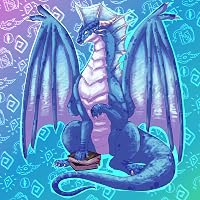
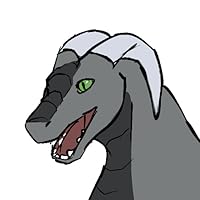
Naydrus is a dragon born to immense parents who live with and serve humans. When the dragonling hatches, it is revealed that she doesn't look anything like her family and she has a passion for fighting. However, she also carries a deep hatred for the hominid 'caretakers'. This inspires her escape from the city through the sewer system and find other dragons that share her mindset. However, the world is a big place and very old. Much has happened and continues to happen without Naydrus being aware of it, causing her to cross paths with dangerous individuals and end up in hazardous locations.
Born (or rather, hatched) different from her dragon siblings, Naydrus grapples with her identity and despises dragonkind's apparent subservience to humans, the latter an influence of her ancestral memories. She runs away from her birthplace, away from her siblings and parents, in search of like-minded dragons elsewhere, encountering a fair amount of trouble on the way...
Being born different is not a new premise, but the protagonist's immediate development of a hatred for humans and dragons serving them piqued my curiosity. Images or memories from her time in the egg tell Naydrus that humans are the enemy, and she accepts this as truth unhesitatingly. However, as the reader, I thought Naydrus's ire and escape from humans feel unconvincing, especially as the dragons around Naydrus appear to be treated kindly. Even the death of a dragon acquaintance, the impetus that finally drives her to make an escape, felt like it should have been expected, considering that dragon's chosen line of duty. Naydrus's worldview is interesting, but perhaps more could be developed to make the reader relate to her better.
That aside, later events lead Naydrus to encounter new and intriguing characters as well as a window into the past and the origin of all dragons. The ending leaves her at a better place, and I look forward to finding where the sequel will take her to next.
Behind some rough edges in form, the story and Naydrus' perspective as an infant are well delivered. Her rightfully limited understanding of her world, and the events that mark her early life, hint at a promising lore that piqued my curiosity. Her feisty and impulsive character and her differences setting her apart, are making her interactions more appealing as she can create herself quite a few balls of trouble, while being an endearing character of her own (as long as you don't let your fingers stry too close). As said first, some syntax, grammar and minor inconsistencies are there, but nothing I couldn't tune out, leaving an overall nice read. Enough to follow with the sequels and see how that goes.
Reverting Scales is a criminally underappreciated story. It has some of the issues inherent to many debut works, but it’s also notable for its well-written protagonist and unusual premise.
In its world, dragons benefit from their remarkable adaptability and access to their ancestral memories. This is an intriguing notion that is further expanded throughout the story, with the two books in the series offering occasional glimpses into the origin of all dragonkind and how it ties into other mysterious happenings in the world.
While most dragons’ ancestral memory only goes back a few generations, our protagonist, Naydrus, can hear the voices of primordial dragons, and those voices warn her that humans are not to be trusted. This is something she takes to heart and refuses to let go of with the stubbornness of a hatchling. In this, in my opinion, lies the greatest strength of the story’s protagonist: this stubborn conviction, through careful maneuvering on the author’s part, comes off as genuine and makes the character feel much more alive.
The story creates some nuance by underlining that, while the relationship between dragons and humans is mutually beneficial, one side is clearly benefiting more than the other. In this way, it avoids making its protagonist’s stance entirely misguided, but still highlights that she is being unreasonable, opening the way for interesting interactions and further character growth.
Reverting Scales also has some problems. The prose is a bit odd at times, and some narrative elements can feel underdeveloped. Certain plot points seem to suddenly appear out of nowhere, only to be discarded just as quickly once they are no longer needed. This makes the story feel a bit unbalanced and leaves occasional gaps in the worldbuilding.
All in all, Reverting Scales lacks some polish, but the book more than makes up for it with genuine characters and intriguing plot elements. I particularly enjoyed seeing Naydrus grow through reluctantly shedding her preconceptions. This ability to change is what makes her stubbornness feel endearing rather than grating; and it was one of the main reasons I liked the story as much as I did.
This tale about the childhood of a dragon is a solid start to the series, but has a lot of problems with its prose. A bad descriptive voice and a flat setting are mitigated somewhat by a delightful main character and a fair plot. This book is an odd one, to say the least.
In it, we follow the life of Naydrus, starting when she's in the shell. We do the whole generational knowledge thing we've seen in many other dragon books, except Naydrus receives odd visions in the egg no other dragon does: A knowledge of the old dragon gods and a ancestral hatred of humans. She is born into a world in which dragons and humans work closely alongside each other, and goes on a real adventure to escape it! From here, Naydrus . This is a fairly solid plot that I enjoyed decently, but there were a few plot holes that bothered me. But otherwise, the plot worked, at least.
The best part of this book is the main character and how she reacts to things. This is not a humorous series, but Naydrus is just so dang funny. In a world of dragons who are generally even tempered and rational beasts, she is a barely restrained violence machine powered by a pathological hatred of the concept of society. Like, at one point, she conjures a mental image of humans and dragons putting flowers in each other's hair/horns and gets really mad about it! She clashes with the setting she's in so intensely it's just so fun to watch her react to normal things with frothing hatred. There's two types of dragon society at play in the book, one that lives under the rule of humanoid rulers and another that . In the former societies, the book can't decide if they're exactly as Naydrus fears, with chattel slavery for dragons, or if they're a normal Renaissance-period society with a lot of social hierarchy, where ultimately the dragons are treated perfectly normally by their human peers. I lean towards the latter because it's more supported by how people act rather than what the book says, and it's more funny that way. (To explain the joke in the title: She think she's in the same position of Bayloo, the dragon protagonist of the Remembered War series. She definitely is not). The latter societies are . Anyways, this series isn't humorous in tone, so don't get me wrong, but Naydrus definitely was the star of the show for how much she clashes with anything going on, perhaps unintentionally. Sometimes, however, the book has to bend over backwards to avoid Naydrus getting herself killed, as she is not very good at violence despite loving committing acts of it, and some of the things she does are definitely out of character to keep the narrative moving.
The biggest problem with these books is the prose. It's such a problem. The book revels in descriptions using intentional alienation of terms. Considering the main character is just born, and is generally unwilling to learn anything about the world, this makes sense, but the problem is the prose is also bad at describing things clearly, which in combination produces almost actively hostile prose that at multiple points completely misled me about what was happening. I've never discovered that I was completely wrong in my interpretation of basic events multiple times before reading this series. It gets pretty dire. What doesn't help, either, are the constant typos. This book needed more editing.
The worldbuilding both loves expanding on itself and is utterly shallow. The protagonist doesn't care about the world around her, so you never get to learn about any details of the world, and you get the hunch that there actually isn't much depth to it, a world a mile wide but an inch deep. They introduce different humanoid species that sound cool but you almost never see how their societies differ, and the prose can't even effectively describe what they look like at all. There are also a confusingly wide array of dragon species, again difficult to picture, who all kinda just act the same and all live together regardless. The world feels disjointed, with things just kinda existing, and the parts of the world just don't interact with each other. It doesn't feel lived in, it feels like setpieces for Naydrus to blow past in service of the next. I liked what I read of the cosmology and the core of the world's myth, but you only get it very abruptly in the end of the book, and it really doesn't go on to influence major events.
Overall, it was a good enough story that was occasionally entertaining, but so many things felt a bit disjointed with each other. It's fine, and I can't recommend any other books exactly like it, so you could say it's unique, but I can definitely recommend better dragon books in general. Still, I didn't hate it, and hope the series improves from here.
This is the third book so far I have decided to try out from a Reddit post. While I am not a super fan of dragons, so far I have never read a book from the POV of a dragon I disliked and decided to read the first 10% free sample.
So far, the book focuses on the birth of a female baby dragon named Naydrus who is only a few days old and already exhibiting signs her intelligence, aggresiveness and sense of self are far more developed than her littermates, causing her immense irritation. Her parents are loving, yet also confused about why she is speaking so soon and has a physical trait that stands out: instead of having flat hoofs (I assume like a Brontosaurus, perhaps?), her feet have sharp claws like a Velociraptor.
Even though both books are quite different, Reverting scales reminds me a lot of Heart of Fire by Raina Nightingale. Both books star a baby female dragon that is much more aware of the oppressive social status of dragons while living under the yoke of their handlers (in this book humans and in Raina's book elves) and all signs point Naydrus is going to end up running away. The main differences between both books is that in Heart of Fire, all dragons have higher than average intelligence, but elves use magic for subjugation. In this book, it seems dragons have average intelligence with docile personalities, quite possibly from domestication similar to dogs, and Naydrus is the result of an unexpected mutation. To me, this whole story concept is really cool which I seldom ever see in fantasy books.
Even though I feel chapter 1 is very slow and would have benefitted from reaching the birth scene sooner to more easily grab my attention, the book is picking up nicely from chapters 2 & 3. I will assume things will only get better as Naydrus's yearning for freedom brings forth story conflict. Some bits of text regarding eating food could have used a bit more clarity, but I didn't have much difficulty following along the story and am getting good vibes from the personalities of Naydrus's parents and their human handlers. The addition of having dragons nibble on rocks with metals for growing healthy scales is a really awesome touch. Me likey stories with dragons eating rocks!
Typos wise I found three of them within the first 10%. Most of them are the homophome kind that will be missed by spellcheck. Such as "The male dropped next to his mate, tired by the hunt and eager to have his next male when he'd open his eyes again." Would be a real good idea to use a dictation software to listen to the book because visually they are the kind of typo even a proofreader might miss unless they were paying close attention.
I usually don't read blurbs until after I finish the book (it is apparently a strange quirk of mine), but I do think this blurb could use more punch to lure readers with a hook. The blurb's passive writing is actually quite a stark contrast to the book which is much more immersive. I quite enjoyed the lineart of the cover, but feel the dark background makes the art fade and is difficult to see when minimized. Typography is impossible to see from a distance and will probably be tenfold harder to see if the cover was converted to greyscale. The lineart certainly gives good Middle Grade vibes, which is probably the right reader age group for this book. With a revamped cover where the colors are in full display, it would look, really, really awesome despite the huge cost investment.
---
Update: As I mentioned before, I enjoyed the sample and wanted to finish the book. And wow, if I had known beforehand I was going to enjoy the book this much, I would have bought a copy much sooner. Despite the clarity issues, the book just kept on getting better & better. Most of the clarity issues early in the book are because Naydrus is (immeasurably) ignorant about the world. Being clouded by her hatred of all bipeds for seemingly no reason, she lets her anger cloud her judgement and ends up in problems fairly often. Even fellow dragons find her to be rather intolerable and belittle her a lot.
We get to meet various different dragon species as the story goes by. Her parents and siblings are a sort of chunky rock dragons called cercreau, while we meet more agile white D.er, 4 winged lotkis (uhhh, I spelled that one wrong), spiky blue ones calle Kohals, also chunky yellow ones I think sclerols and even a dragon species that needs to wear steampunk inspired facemasks called felhs because they can only breathe air inbued I suppose with carbon dioxide. The book mentions there are also semiaquatic dragon species but we never get to meet any. It would have been wonderful to get a glossary with artwork of each species and some traits at the end of the book to avoid some spoilers.
Naydrus starts to see some moments of her rigid worldview crashing when she meets a human that is a sort of dragon worshiper named Gar. We don't know much about him, but he's like, really, really adamant in keeping her safe. I liked him a lot.
It's a bit hard to continue saying more about the book without spoiling much more, but I am pleasantly surprised by the vivid imagination from the author to create such a fascinating world in just a bit over 300 pages. In reality, I feel the book is much shorter because it reads so fast. If the book is within the 60,000 word limit, I really hope the author considers signing this book up for the SFINCS contest because I have a hunch it will do very well in the competition. Or in the very least, it will bring much more eyes that are interested in a refreshing yet still familiar Coming of Age dragon adventure that is apt for Middle Grade readers.
Despite the typos, I believe the book deserves its 4.5 stars and will most certainly read book 2 soon.