

What do you think?

A Place Called Yellowstone: The Epic History of the World's First National Park
This epic history of America’s first national park explores how a remote Western landscape became an iconic symbol of our country and its vast wilderness so influential to our understanding of the natural world.
It has been called Wonderland, America’s Serengeti, the Crown Jewel of the National Park System, and America’s Best Idea. But how did this faraway landscape evolve into one of the most recognizable places in the world? As the birthplace of the national park system, Yellowstone witnessed the first-ever attempt to protect wildlife, to restore endangered species, and to develop a new industry centered on nature tourism.
Yellowstone remains a national icon, one of the few entities capable of bridging ideological divides in the United States. Yet the park’s history is also filled with episodes of conflict and exclusion, setting precedents for Native American land dispossession, land rights disputes, and prolonged tensions between commercialism and environmental conservation. Yellowstone’s legacies are both celebratory and problematic. A Place Called Yellowstone tells the comprehensive story of Yellowstone as the story of the nation itself.
It has been called Wonderland, America’s Serengeti, the Crown Jewel of the National Park System, and America’s Best Idea. But how did this faraway landscape evolve into one of the most recognizable places in the world? As the birthplace of the national park system, Yellowstone witnessed the first-ever attempt to protect wildlife, to restore endangered species, and to develop a new industry centered on nature tourism.
Yellowstone remains a national icon, one of the few entities capable of bridging ideological divides in the United States. Yet the park’s history is also filled with episodes of conflict and exclusion, setting precedents for Native American land dispossession, land rights disputes, and prolonged tensions between commercialism and environmental conservation. Yellowstone’s legacies are both celebratory and problematic. A Place Called Yellowstone tells the comprehensive story of Yellowstone as the story of the nation itself.
432 pages, Hardcover
Published October 8, 2024
Ratings & Reviews
Friends & Following
Create a free account to discover what your friends think of this book!
Community Reviews
Displaying 1 - 30 of 87 reviews

January 18, 2025
The story of Yellowstone began with a singular geography that gave rise to a landscape filled with fantastical geothermal features and a distinctive array of wildlife. For at least 11,000 years Indigenous peoples knew it as a homeland filled with essential mineral resources, opportunities for hunting and gathering, and sites with medicinal and spiritual value. In the nineteenth century, the high altitude and long winters kept Euro-American settlers and explorers at bay and, in doing so, provided a refuge for wildlife hunted to extinction elsewhere. In time, these unique qualities, combined with their perceived economic and political value, would help usher something new into the world, the first ever national park.There is no place on Earth quite like Yellowstone. This much is clear, and always has been.
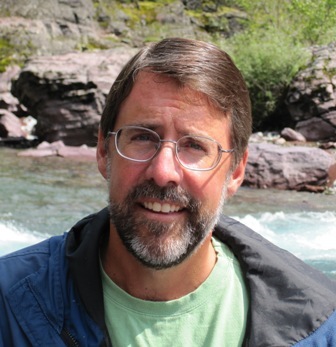
Randall K. Wilson - Image from Gettysburg College
Randall Wilson offers a long historical take on a place that has been called America’s Serengeti, a unique geological expanse that makes up what is now Yellowstone National Park. The landscape includes a vast caldera, not a dormant volcano, but one that has gone boom multiple times. And at an impressive scale.
Deafening noise. Blinding, incinerating heat. A release of power beyond any scale of human experience. The eruption remade the continent: Erasing all life in its immediate path. Pulverizing, clogging, and burying the old topography. Blotting out the sun. Altering the climate…swallowing entire mountains…. The “hot spot” it left allows magma to continue to accumulate below the surface, pushing the Yellowstone Plateau up almost 2,000 feet.About two million years ago, it blasted over 600 cubic miles of debris into the sky. As a point of reference, Krakatoa managed only a measly 36. It got the urge again 1.3 million and 600,000 years ago. Next time up is somewhere between now and fifty thousand years from now. You might want to plan that visit sooner rather than later. Sweetie, do your feet feel warm?
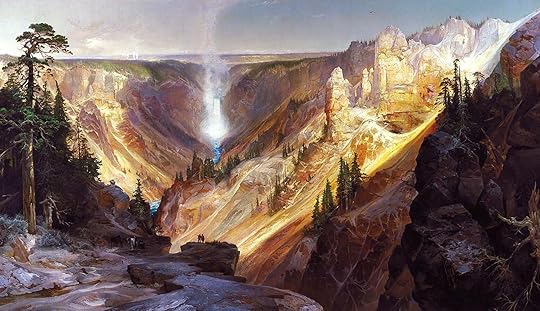
The Grand Canyon of the Yellowstone – Thomas Moran – 1872 - Image from Wiki
The history here is mostly of European and American interaction with what is now greater Yellowstone. While there is respect and attention given to its earlier human history, from 13,000 years ago to AD 1800, from the Clovis culture, people who arrived in the last ice age, through the melting of a half mile ice cap, to the growth of habitation from 7500 BCE,
For more than 11,000 years, Native Americans treated Yellowstone as a homeland, a place treasured for its abundant high-quality obsidian, seasonal hunting and gathering, and the spiritual and medicinal value of its geothermal features.the story of Native American experience is told mostly as one of how the indigenous were driven from the area. The focus is on exploration, discovery and development by those later arrivals.
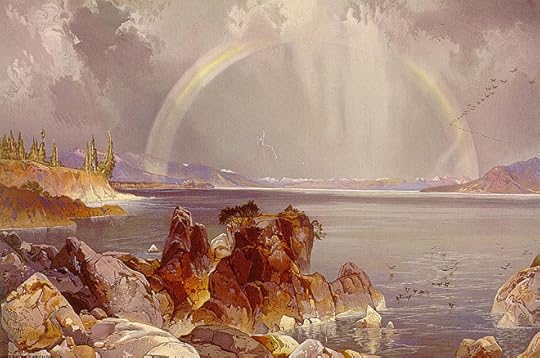
Yellowstone Lake – by Thomas Moran - from National Parks Association
The earliest Europeans managed to catch bits and pieces of it over several decades, taking their time about officially “discovering” the place. Of course, by the time such “discovery” was finally recognized people had already been setting up businesses there.
In a way, Wilson’s detailed historical accounting fits with the saying “laws, like sausages, cease to inspire respect in proportion as we know how they are made.” (it is from an American poet named Saxe, not Otto von Bismarck). It is a tale of tensions, between indigenous peoples and western explorers and settlers, between states eager to control the land the park would and did encompass and supporters of park designation, between competing railroad barons looking to provide a draw for their services and rail lines to bring people to them, between hotels eager to draw visitors, and tourist enterprises seeking to monopolize all the services within the park, between commercial interests and ecological preservation, miners eager to dig, loggers eager to cut, ranchers eager to protect their herds from predators, hunters eager to hunt unimpeded by regulations, and preservationists determined to protect, sustain, and grow iconic species.
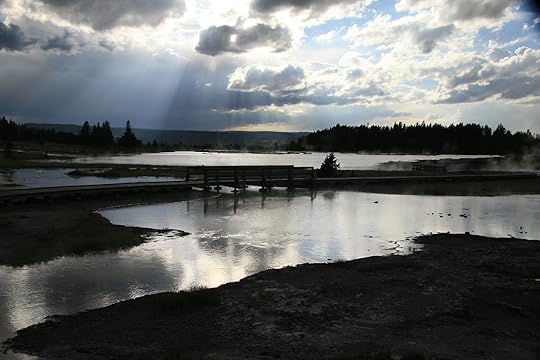
God Light in Yellowstone - my shot-clickable
Yellowstone was designated a national park in 1872. In 1903 the northern entrance, in Gardiner, Montana, saw the completion of a stone entrance gate. Teddy Roosevelt, then on a national tour, gave a speech at the laying of the cornerstone. On what became known as The Roosevelt Arch, there is a plaque that proclaims, quoting the legislation, that the park was established “For the Benefit and Enjoyment of the People.” This begs a definition, of course, of which people. Only the well-to-do were able to really see the park for much of its early life.
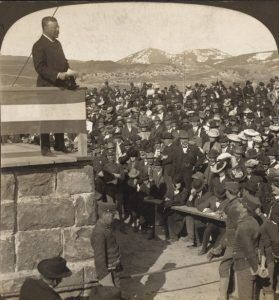
Teddy Roosevelt speaking at the opening of the northern entrance in 1903 - image from Yellowstone Forever
It is tempting to consider Yellowstone solely for the availability of stunning beauty, for tourism, and the landscape does not disappoint, but it can also enhance one’s knowledge of and appreciation for the place to learn a bit about how it came to be.
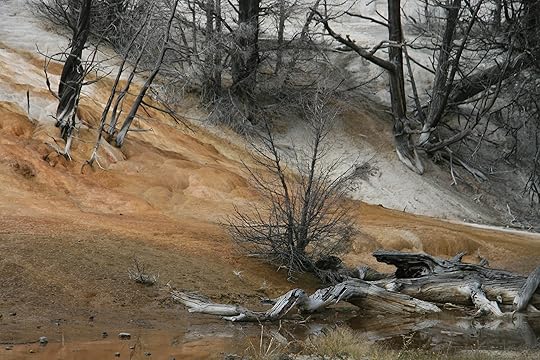
The Savage Beauty of Yellowstone - my shot - clickable
You may have questions about the history of the park.
Who were the American/European people who explored and mapped Yellowstone?
How did Yellowstone become the first national park to be designated?
How long did it take from conceptualization to passage of the National Parks law?
Who were the players, pro and con? What were their issues?
Who were the people, artists and politicians, influencers of their time, who brought it to national attention? How did they do that?
There will be answers.
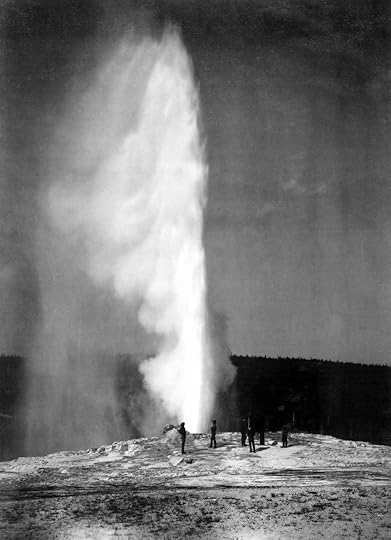
Old Faithful erupting - image from The National Parks: America’s Best Idea - shot by William Henry Jackson 1878-1885
Even within each interest group, though, there is diversity. Groups that can be seen as being of benign intent display fissures, and there were far too many occasions when desire and impulse proceeded in the absence of, or in direct contradiction to, science. There have been misguided attempts to eradicate species, and equally misguided introductions of new species that outcompeted and supplanted locals. There have even been attempts to protect species that were in no need of protection. But there have been successes as well. Yellowstone offers a story of preservation, from its earliest to its most recent days, saving threatened bison, attending to declining elk, and reintroducing wolves, after having targeted them for so long.
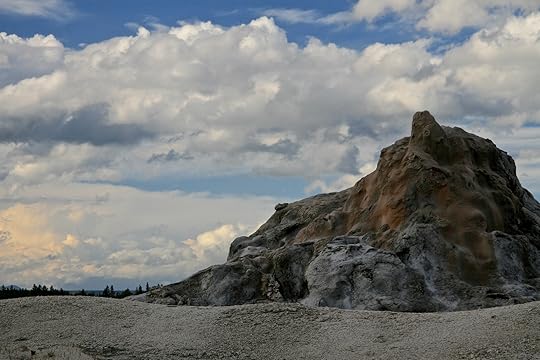
White Dome Geyser - my shot - clickable
I was fortunate to have been able to visit the park in 2010, and was blown away, metaphorically, of course. The other-worldly sights are world-class-stunning and many have been made easily accessible for non-back-country sorts like me. If you have not had the chance to visit, I cannot recommend adding it to your bucket list strongly enough.
Yellowstone has been embedded into our national consciousness, making plenty of appearances in popular entertainment. As for films set there, Wikipedia identifies a baker’s dozen They include such classics as Lobster Man From Mars, Beavis and Butt-Head Do America, and Sharknado: The 4th Awakens. Makes us proud to be Americans. The recent series, Yellowstone, focuses on the place, but it turns up in other programs as a supporting player. Fans of Resident Alien will note that the author has completely ignored the unpleasantness that the Grays are up to in Yellowstone. Can they be stopped?
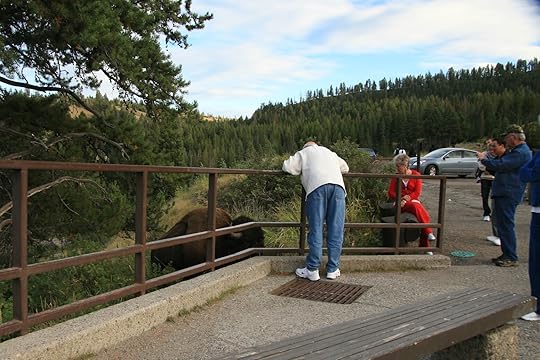
The Buffalo Hunters - what shooting bison looks like today, well, in 2010 - the group scattered rather quickly once that bad boy clambered into the parking lot - my shot – clickable
Whether or not you have been or plan to visit, Wilson’s history has much to offer: a glimpse of our geological past, a detailed reporting of its history as it pertains to human habitation, and an incisive take on the Byzantine politics of Yellowstone becoming a park. There are plenty of tales. Wilson is a gifted story-teller, who has made what could seem dry material quite engaging and entertaining, offering a no-holds-barred look at the conflicts, resolutions, and ongoing challenges and opportunities presented by this first national park in the world, and the greatest example of America’s Best Idea.
The dream of a Greater Yellowstone—the vision shared by Horace Albright, John D. Rockefeller Jr., Struthers Burt, Maud Noble, and countless others stretching back to George Grinnell and General Sheridan—has today been realized, not as a single expanded Yellowstone National Park but as a mosaic of different federal, state, and private lands comprising the Greater Yellowstone Ecosystem. With Yellowstone at its core, the area includes Grand Teton National Park, the National Elk Refuge, seven different national forests, and an assortment of other conservation areas.Review posted - 01/24/25
Publication dates
----------Hardcover – 10/8/24
----------Trade paperback - 10/21/25
I received a hardcover of A Place Called Yellowstone from Counterpoint in return for a fair review. Thanks, KM.


This review will soon be cross-posted on my site, Coot’s Reviews. Stop by and say Hi!
=============================EXTRA STUFF
Wilson’s personal and Gettysburg College pages
Profile – from Counterpoint Press
RANDALL K. WILSON, PhD, is a professor of environmental studies at Gettysburg College, where he teaches courses on environmental policy, natural resource management, sustainable communities, and the geography of the American West. He has served on the USDA Forest Service’s National Science Panel and on the board of directors for the Rural Geography Specialty Group within the Association of American Geographers. He earned a Fulbright Fellowship to the University of Vienna. His book America’s Public Lands: From Yellowstone to Smokey Bear and Beyond was named an Outstanding Academic Title from Choice Reviews and won John Brinckerhoff Jackson Prize from the Association of American Geographers.My reviews of other relevant books
-----American Wolf by Nate Blakeslee – on reintroduction of wolves to Yellowstone
----- Paradise by Lizzie Johnson – on a California town devastated by wildfire – relevant to the 1988 Summer of Fire in Yellowstone
Items of Interest from the author
-----Kosmos Journal - When Wolves Returned to Yellowstone - Twenty-five Years On: How Food Chains Impact the Wild
-----Lithub - A Geological Time Bomb: Remembering the Night That Yellowstone Exploded
Items of Interest
-----Yellowstone Park Lodges - How Art Led to the Creation of Yellowstone National Park
-----National Parks Conservation Association - Thomas "Yellowstone" Moran: Influencing Change with Art
Among the 32 members of the survey was guest artist Thomas Moran. The 40-day expedition allowed Moran, along with photographer William Henry Jackson, to visually document over 30 different sites, including present-day Old Faithful, Hayden Valley, and Grand Canyon of the Yellowstone. This unique partnership with Moran and Jackson was critical to Hayden, who included their art in a comprehensive report to Congress. Jackson’s black and white photos documented Yellowstone’s unique geological formations while Moran’s paintings and watercolors captured its diverse and extravagant colors.-----Google Arts and Culture - Yellowstone National Park - stunning overhead winter views of the parik
-----Scheduled Adventures - Yellowstone Tour - this is part one of a four part video tour
-----Sierra Club - Grizzly Bears Saved by Lindsey Botts – 1/8/25
-----Public Domain Review - Mudpots and Fumaroles: Lithographs of Yellowstone’s Thermal Springs (1883) - Before the paintings
-----Yellowstone Forever - HISTORY OF THE ROOSEVELT ARCH
-----Professor Buzzkill - Otto von Bismark, “Laws are like sausages. It is best not to see them being made.” Quote or No Quote? traces it to the American poet, John Godfrey Saxe (1816-1887).
Saxe, a popular poet in the mid-19th century, is mostly remembered today for setting the ancient parable from India about the blind men and the elephant to verse, and making the story popular in the United States. (I have put the full poem in the blog on our website.)-----Ken Burns - For a brief history of Yellowstone, check out Burns’ concise synopsis - If you have not had the pleasure Burns’ series about our National Parks is magnificent, not to be missed
The law and sausages idea was attributed to Saxe as early as 1869, and that’s the first appearance of that phrase. What he said was, “laws, like sausages, cease to inspire respect in proportion as we know how they are made.”
-----National Park Service - America’s Best Idea Today - on the source of the quote

November 23, 2025
Randall Wilson is a professor of environmental studies at Gettysburg College in Pennsylvania. His 2024 nonfiction book A Place Called Yellowstone is a comprehensively-researched history of Yellowstone National Park, the United States' oldest (but by no means largest) National Park spanning 3500 acres across Wyoming, Idaho, and Montana. Wilson explores the geological as well as sociological history of the park, from how early American explorers discovered the region, how indigenous peoples were forced off of the land, how the US government established the area as both a protected ecosystem and a sometimes-precarious-choose-your-own-adventure tourist attraction (I didn't realize tourists used to be able to feed various wild animals!) and various environmental and sociocultural factors continuing the impact the region today. Though the book is quite lengthy (432 page book/15 hour audiobook), I found it interesting, engaging, and informative; I'd definitely recommend it to audiences interested in any of the topics discussed above.
Further reading: the American West, National Parks, etc.:
Dear Bob and Sue by Matt and Karen Smith - a retired couple's adventures across all US National Parks
Desert Solitaire by Edward Abbey
Born of Lakes and Plains: Mixed-Descent Peoples and the Making of the American West by Anne Hyde
Letters of a Woman Homesteader by Elinore Pruitt Stewart
My statistics:
Book 349 or 2025
Book 2275 cumulatively
Further reading: the American West, National Parks, etc.:
Dear Bob and Sue by Matt and Karen Smith - a retired couple's adventures across all US National Parks
Desert Solitaire by Edward Abbey
Born of Lakes and Plains: Mixed-Descent Peoples and the Making of the American West by Anne Hyde
Letters of a Woman Homesteader by Elinore Pruitt Stewart
My statistics:
Book 349 or 2025
Book 2275 cumulatively

October 2, 2025
Thank you, NetGalley, for granting me a free copy of this audiobook in exchange for an honest review.
This is one of those books that makes me question my own good judgement. As you can see, the reviews for A Place Called Yellowstone: The Epic History of the World's First National Park are almost uniformly positive. And in truth, this book has it all, as far as history goes: stretching all the way back to prehistoric times, taking us through the days of frontiersmen and the Wild West, as well as land disputes with local Native American tribes, the decision-making behind inaugurating Yellowstone as the nation's first national park, and the state of the park today. It also explores some of the ecology, natural disasters, and conservation efforts associated with Yellowstone. Yet in spite of all of this, I found A Place Called Yellowstone painfully dull, to the point where listening to it became a chore.
This is one of those books that makes me question my own good judgement. As you can see, the reviews for A Place Called Yellowstone: The Epic History of the World's First National Park are almost uniformly positive. And in truth, this book has it all, as far as history goes: stretching all the way back to prehistoric times, taking us through the days of frontiersmen and the Wild West, as well as land disputes with local Native American tribes, the decision-making behind inaugurating Yellowstone as the nation's first national park, and the state of the park today. It also explores some of the ecology, natural disasters, and conservation efforts associated with Yellowstone. Yet in spite of all of this, I found A Place Called Yellowstone painfully dull, to the point where listening to it became a chore.

June 26, 2026
„Yellowstone. Biografia parku” nie jest klasycznym przewodnikiem ani książką przyrodniczą. To rozbudowana, chronologiczna opowieść o narodzinach, dojrzewaniu i współczesności pierwszego parku narodowego na świecie. Autor traktuje Yellowstone jak żywy organizm, którego losy splatają się z historią Stanów Zjednoczonych, zmianami społecznymi, politycznymi i naukowymi.
Książka jest konsekwentnie prowadzona chronologicznie. Wilson rozpoczyna od czasów poprzedzających utworzenie parku, pokazuje proces polityczny i społeczny, który doprowadził do objęcia tych terenów ochroną, a następnie prowadzi czytelnika przez kolejne dekady sporów, błędów i sukcesów. To opowieść nie tylko o gejzerach czy spektakularnych krajobrazach, ale przede wszystkim o ludziach m.in. politykach, naukowcach, przedsiębiorcach, strażnikach i wizjonerach, którzy na różne sposoby wpływali na kształt Yellowstone.
Autor bardzo wyraźnie pokazuje, że historia parku jest jednocześnie historią zmieniającego się stosunku człowieka do natury. Początkowo przyroda traktowana była przede wszystkim jako zasób i atrakcja turystyczna. Przez dziesięciolecia podejmowano decyzje, które dziś wydają się niezrozumiałe. Tępiono drapieżniki, gaszono wszystkie pożary, ingerowano w ekosystem poprzez introdukcję obcych gatunków. Dopiero rozwój ekologii jako nauki pozwolił spojrzeć na Yellowstone jako na skomplikowany organizm wymagający możliwie najmniejszej ingerencji człowieka. Szczególnie interesująco wypada opis powrotu wilków, ochrony bizonów czy zmiany podejścia do naturalnych pożarów po katastrofalnym Lecie Ognia w 1988 roku.
Wilson nie ogranicza się jednak wyłącznie do historii ochrony przyrody. Równie dużo miejsca poświęca konfliktom społecznym i ekonomicznym. Pokazuje napięcia między ochroną środowiska a komercjalizacją, między elitarną turystyką a ideą powszechnego dostępu do parku, a także przypomina o wypędzeniu rdzennych mieszkańców z terenów, które przez pokolenia były ich domem. Dzięki temu Yellowstone przestaje być jedynie pięknym krajobrazem z pocztówek, a staje się symbolem amerykańskich sukcesów, ale również błędów i moralnych dylematów.
Trzeba przyznać, że książka ma trochę akademicki charakter. Wilson pisze rzeczowo, spokojnie i z szacunkiem dla źródeł. Nie szuka taniej sensacji ani emocjonalnych uproszczeń. Jednocześnie potrafi budować sugestywne obrazy i celnie podsumowywać znaczenie opisywanych wydarzeń. W wielu fragmentach wyraźnie widać reporterską umiejętność łączenia faktów z refleksją, dzięki czemu książka nie jest wyłącznie zbiorem dat i wydarzeń.
Moim zdaniem to książka, którą warto czytać powoli, dając sobie czas na przyswojenie informacji. Nie da się ukryć, że bez skupienia bywa wymagająca. Autor operuje ogromną liczbą nazwisk, instytucji, dat i szczegółowych wydarzeń. Dla czytelnika niezainteresowanego historią amerykańskiej ochrony przyrody momentami może być to przytłaczające. Niektóre rozdziały przypominają trochę opracowanie historyczne, w którym trzeba zachować skupienie, aby nie pogubić się w gąszczu kolejnych postaci i decyzji administracyjnych.
Choć trudno mówić tutaj o fabule w tradycyjnym znaczeniu, Wilson konstruuje narrację tak, aby kolejne wydarzenia logicznie wynikały z poprzednich. Konflikty dotyczące turystyki, ochrony zwierząt, zarządzania pożarami czy współczesnych zmian klimatu tworzą wielowątkową historię, której bohaterem pozostaje sam park. Dzięki temu czytelnik obserwuje nie tylko rozwój Yellowstone, ale również ewolucję ludzkiego myślenia o przyrodzie.
Wilson chce nam pokazać, że Yellowstone nie jest zamkniętym rozdziałem historii. Problemy, które pojawiały się ponad sto lat temu, pytania o to, komu park ma służyć, jak pogodzić ochronę przyrody z turystyką oraz jak reagować na zmiany klimatyczne pozostają aktualne również dziś. Książka staje się więc nie tylko biografią jednego miejsca, lecz także opowieścią o dojrzewaniu społeczeństwa do odpowiedzialności za środowisko naturalne. Yellowstone. Biografia parku to imponujące pod względem merytorycznym opracowanie, które zachwyca skalą zgromadzonej wiedzy i umiejętnością ukazania jednego miejsca jako zwierciadła historii całego kraju. To książka, która uczy, skłania do refleksji i pokazuje, że nawet najpiękniejsze krajobrazy są efektem nieustannej walki między naturą, polityką i ludzkimi ambicjami.
Książka jest konsekwentnie prowadzona chronologicznie. Wilson rozpoczyna od czasów poprzedzających utworzenie parku, pokazuje proces polityczny i społeczny, który doprowadził do objęcia tych terenów ochroną, a następnie prowadzi czytelnika przez kolejne dekady sporów, błędów i sukcesów. To opowieść nie tylko o gejzerach czy spektakularnych krajobrazach, ale przede wszystkim o ludziach m.in. politykach, naukowcach, przedsiębiorcach, strażnikach i wizjonerach, którzy na różne sposoby wpływali na kształt Yellowstone.
Autor bardzo wyraźnie pokazuje, że historia parku jest jednocześnie historią zmieniającego się stosunku człowieka do natury. Początkowo przyroda traktowana była przede wszystkim jako zasób i atrakcja turystyczna. Przez dziesięciolecia podejmowano decyzje, które dziś wydają się niezrozumiałe. Tępiono drapieżniki, gaszono wszystkie pożary, ingerowano w ekosystem poprzez introdukcję obcych gatunków. Dopiero rozwój ekologii jako nauki pozwolił spojrzeć na Yellowstone jako na skomplikowany organizm wymagający możliwie najmniejszej ingerencji człowieka. Szczególnie interesująco wypada opis powrotu wilków, ochrony bizonów czy zmiany podejścia do naturalnych pożarów po katastrofalnym Lecie Ognia w 1988 roku.
Wilson nie ogranicza się jednak wyłącznie do historii ochrony przyrody. Równie dużo miejsca poświęca konfliktom społecznym i ekonomicznym. Pokazuje napięcia między ochroną środowiska a komercjalizacją, między elitarną turystyką a ideą powszechnego dostępu do parku, a także przypomina o wypędzeniu rdzennych mieszkańców z terenów, które przez pokolenia były ich domem. Dzięki temu Yellowstone przestaje być jedynie pięknym krajobrazem z pocztówek, a staje się symbolem amerykańskich sukcesów, ale również błędów i moralnych dylematów.
Trzeba przyznać, że książka ma trochę akademicki charakter. Wilson pisze rzeczowo, spokojnie i z szacunkiem dla źródeł. Nie szuka taniej sensacji ani emocjonalnych uproszczeń. Jednocześnie potrafi budować sugestywne obrazy i celnie podsumowywać znaczenie opisywanych wydarzeń. W wielu fragmentach wyraźnie widać reporterską umiejętność łączenia faktów z refleksją, dzięki czemu książka nie jest wyłącznie zbiorem dat i wydarzeń.
Moim zdaniem to książka, którą warto czytać powoli, dając sobie czas na przyswojenie informacji. Nie da się ukryć, że bez skupienia bywa wymagająca. Autor operuje ogromną liczbą nazwisk, instytucji, dat i szczegółowych wydarzeń. Dla czytelnika niezainteresowanego historią amerykańskiej ochrony przyrody momentami może być to przytłaczające. Niektóre rozdziały przypominają trochę opracowanie historyczne, w którym trzeba zachować skupienie, aby nie pogubić się w gąszczu kolejnych postaci i decyzji administracyjnych.
Choć trudno mówić tutaj o fabule w tradycyjnym znaczeniu, Wilson konstruuje narrację tak, aby kolejne wydarzenia logicznie wynikały z poprzednich. Konflikty dotyczące turystyki, ochrony zwierząt, zarządzania pożarami czy współczesnych zmian klimatu tworzą wielowątkową historię, której bohaterem pozostaje sam park. Dzięki temu czytelnik obserwuje nie tylko rozwój Yellowstone, ale również ewolucję ludzkiego myślenia o przyrodzie.
Wilson chce nam pokazać, że Yellowstone nie jest zamkniętym rozdziałem historii. Problemy, które pojawiały się ponad sto lat temu, pytania o to, komu park ma służyć, jak pogodzić ochronę przyrody z turystyką oraz jak reagować na zmiany klimatyczne pozostają aktualne również dziś. Książka staje się więc nie tylko biografią jednego miejsca, lecz także opowieścią o dojrzewaniu społeczeństwa do odpowiedzialności za środowisko naturalne. Yellowstone. Biografia parku to imponujące pod względem merytorycznym opracowanie, które zachwyca skalą zgromadzonej wiedzy i umiejętnością ukazania jednego miejsca jako zwierciadła historii całego kraju. To książka, która uczy, skłania do refleksji i pokazuje, że nawet najpiękniejsze krajobrazy są efektem nieustannej walki między naturą, polityką i ludzkimi ambicjami.

April 25, 2025
Outstanding work. One of the best histories—about anything—I’ve read. While its thoroughness is remarkable the book doesn’t read like an academic treatise. It’s deserving of five stars, but…. It really needs some good maps. There are maps but they’re all small and poorly reproduced in black and white. But it’s still a great read.

April 4, 2026
i loved this!!! i always love learning more about my favorite place on earth and its complex history, legacy, and management into the present day. this was an extremely informative and well-researched book, but what i most appreciated was the writing style. nonfiction can often fall into the realm of dryyyyyyy boring prose, but the writing in this book was very engaging and balanced scientific insights, political drama, and individual narratives in a cohesive and compelling way.

December 16, 2025
You know those books that you don't want to end? This is one of those.
This book covers (briefly) the entire history of Yellowstone. It's informative while still being approachable and easy to read.
I thoroughly enjoyed this book and would recommend it to anyone interested in learning more about the world's first National Park.
This book covers (briefly) the entire history of Yellowstone. It's informative while still being approachable and easy to read.
I thoroughly enjoyed this book and would recommend it to anyone interested in learning more about the world's first National Park.
May 6, 2026
Really incredible. great basis for understanding the history and the eras of the park as well as general politics around modern conservation in the american west. i had to force myself to get through it at times because it made me so angry but there’s a lot of important history in here that needs to be remembered

September 23, 2026
An interesting non-fiction book about the history and issues of Yellowstone National Park ( my favorite place on Earth). The author does a decent job of explaining how the park was discovered and how it ultimately became the first national park. The book includes coverage of wildlife management including the re-introduction of the wolf ( so much politics on that issue), bison and elk herd management as well as information on the great fires in the late 1980’s ( dispels misunderstandings of those that blame fires on the park’s policy of “let it burn”).

July 12, 2025
Enjoyable book with very detailed writing that pulls a lot of threads together. (Makes sense, the author is a geographer! ) lots and lots of details. I enjoyed the second half about ecosystem management more than the middle about explorers and political grift.
Recommend if you love nonfiction
Recommend if you love nonfiction

September 17, 2026
A wonderful book on the history of our furst national park! Yellowstone is truly amazingly beautiful.


July 29, 2026
so eternally grateful and happy and amazed i get to LIVE HERE

March 20, 2026
I read this book prior to my trip to Yellowstone. It gave me a lot of history of the park. I wish there were more detailed maps of the park because there was a lot of references to specific areas of the park but it was difficult to put that all in perspective.

August 11, 2025
This review only covers thru page 120 (1806-1879) and then I skipped to modern times (1961-2022) due to time limitations. This is a great book for those interested in western history as well as the history of our second oldest park (Yosemite was #1 in 1864). Various colorful characters and stories illustrate the early (19th century) history of the park. John Colter, former member of the Lewis & Clark expedition in 1805-1806, probably discovered Yellowstone, the Tetons and Jackson hole in 1807-1808. Jim Bridger made a trip in 1850 and was the first to (orally) describe the region, but the discovery never made it to "reputable" circles. Then Kemble Warren (of Civil war Little Round Top fame) made expeditions in the late 1850s, taking along geologist Ferdinand Hayden, a late 20s naturalist, who later in 1871 did another expedition/survey. The survey consisted of some 50 men which included notables such as painter Thomas Moran and famous frontier/Civil War photographer William Henry Jackson. These expeditions filled out the West's maps but not Yellowstone itself. Later in the 1860s various mining expeditions came closer to Yellowstone. Henry Washburn, retired Indiana congressman and general, in 1870 headed the Washburn-Langford-Doane Expedition to explore what would become Yellowstone National Park. Mount Washburn, located within the park, is named for him. A great story of survival resulted from this expedition- that of Truman Everts - is told in this chapter. After falling behind the rest of the expedition on September 9, 1870, Everts lost the packhorse which was carrying most of his supplies. He survived on a thistle which was named after him. He survived 37 days in September into October. His appearance was startling: " not a bear, not loke any animal I had ever seen,making a low groaning noise, crawling upon its knees and elbows.."
Part IV of the book was the most interesting as it covers subjects such as feeding of bears, grizzly bear and gray wolf listing under the ESA of 1973, recovery of the gray wolf in 1995 release, the politics of wildlife management from the 60s thru the modern times, the great fire of 1988 which burned 700,000 acres , and other topics.
A great final tale is the discovery of an enzyme (Taq polymerase) in the thermal pools of Yellowstone in a bacterium. The polymerase chain reation (PCR) was developed based on this, and Mullis earned a Nobel Prize in 1993. Climate change now threatens the park (and our world). The reduced production of whitebark pine nuts is imparing the ability of the grizzly bear populations to survive harsh winters. Visitation continues to climb, with 4-5 million visitors annually. Political pressures (Trump) threaten funding for our national parks. The White House’s suggested budget for next year demands a 30% cut in NPS funding, a reduction that would decimate many of the agency’s core functions.
I recommend the book for anyone that enjoys history, especially western history and our national park history.
Part IV of the book was the most interesting as it covers subjects such as feeding of bears, grizzly bear and gray wolf listing under the ESA of 1973, recovery of the gray wolf in 1995 release, the politics of wildlife management from the 60s thru the modern times, the great fire of 1988 which burned 700,000 acres , and other topics.
A great final tale is the discovery of an enzyme (Taq polymerase) in the thermal pools of Yellowstone in a bacterium. The polymerase chain reation (PCR) was developed based on this, and Mullis earned a Nobel Prize in 1993. Climate change now threatens the park (and our world). The reduced production of whitebark pine nuts is imparing the ability of the grizzly bear populations to survive harsh winters. Visitation continues to climb, with 4-5 million visitors annually. Political pressures (Trump) threaten funding for our national parks. The White House’s suggested budget for next year demands a 30% cut in NPS funding, a reduction that would decimate many of the agency’s core functions.
I recommend the book for anyone that enjoys history, especially western history and our national park history.
April 6, 2025
This is an interesting overview of the place. It's not trying to be a thorough history of each detail or each park administrator, or each reform. It looks at some key moments and issues and reforms in the modern history of Yellowstone.
For me, the most interesting part was the pre-park period, when Yellowstone wasn't common knowledge. Wilson writes of attempts to "discover" Yellowstone (which basically means publicize it). The Native Americans clearly knew of it. Jim Bridger knew of it and tried to tell people of it, with some success. Some early expeditions went there or near there. Finally, a guy got lost there for 37 days, and his account helped put it over the top. Then the question of what to do with it came up. Modeled on a previous law that designated Yosemite a state park for California, Congress passed a law making Yellowstone a national park - the first such in any nation in the world. The driving force behind it were railroad companies, who thought they could monetize it with tourists.
The place went through several controversies. Initially, the white man made up the idea that Native Americans wouldn't go there because they were afraid of the geothermal activity. This was crap, as shown by the Nez Perce War, and other Indian fights. So the white man banned natives from Yellowstone. The place was a park, with little to no staff, so the army was told to run it for a few decades. It had the last wild buffalo herd, leading to the first effort to conserve a species in the US - and it worked. It's a park for the people - but which people? Only locals or the well off could really visit it. Cars came about. The NPS was founded. An effort to expand the park led to decades of controversy, leading eventually to the creation of Grand Teton National Park, several neighboring national forests, and a Wyoming carve out from the Antiquities Act. Early park leaders encouraged people to feed the animals, which turned out to be a really bad idea. The great 1988 fires led to a reappraisal of the role that fires play in the natural cycles of conservation. The wolf is our favorite animal to demonize, but reintroducing them turned out well, even helping firm up the rivers and lakes of Yellowstone. Some buffalo were taken out to a wide open space by Indian reservations in northern Montana. The place closed three times: 1) the 1988 fires, 2) COVID, and 3) a global-warming caused flood in 2022. The gold standard COVID test was inspired by Yellowstone, specifically a guy looking at the geysers, learning the colors come from bacteria and inspiring him to investigate microbes that live in certain conditions.
It's a very good book. The back half became a little too episodic for me, especially after the early chunk having a more clear narrative throw-line, but it's very good overall.
For me, the most interesting part was the pre-park period, when Yellowstone wasn't common knowledge. Wilson writes of attempts to "discover" Yellowstone (which basically means publicize it). The Native Americans clearly knew of it. Jim Bridger knew of it and tried to tell people of it, with some success. Some early expeditions went there or near there. Finally, a guy got lost there for 37 days, and his account helped put it over the top. Then the question of what to do with it came up. Modeled on a previous law that designated Yosemite a state park for California, Congress passed a law making Yellowstone a national park - the first such in any nation in the world. The driving force behind it were railroad companies, who thought they could monetize it with tourists.
The place went through several controversies. Initially, the white man made up the idea that Native Americans wouldn't go there because they were afraid of the geothermal activity. This was crap, as shown by the Nez Perce War, and other Indian fights. So the white man banned natives from Yellowstone. The place was a park, with little to no staff, so the army was told to run it for a few decades. It had the last wild buffalo herd, leading to the first effort to conserve a species in the US - and it worked. It's a park for the people - but which people? Only locals or the well off could really visit it. Cars came about. The NPS was founded. An effort to expand the park led to decades of controversy, leading eventually to the creation of Grand Teton National Park, several neighboring national forests, and a Wyoming carve out from the Antiquities Act. Early park leaders encouraged people to feed the animals, which turned out to be a really bad idea. The great 1988 fires led to a reappraisal of the role that fires play in the natural cycles of conservation. The wolf is our favorite animal to demonize, but reintroducing them turned out well, even helping firm up the rivers and lakes of Yellowstone. Some buffalo were taken out to a wide open space by Indian reservations in northern Montana. The place closed three times: 1) the 1988 fires, 2) COVID, and 3) a global-warming caused flood in 2022. The gold standard COVID test was inspired by Yellowstone, specifically a guy looking at the geysers, learning the colors come from bacteria and inspiring him to investigate microbes that live in certain conditions.
It's a very good book. The back half became a little too episodic for me, especially after the early chunk having a more clear narrative throw-line, but it's very good overall.

August 19, 2026
107/52/2026
"Yellowstone. Biografia parku" Randall K. Wilson Filia #recenzja #współpracabarterowa #współpracareklamowa #Yellowstone #bookstagrampolska
O Yellowstone
Yellowstone jest parkiem narodowym w Stanach Zjednoczonych na terytorium stanów Wyoming, Montana i Idaho. Jest to najstarszy park narodowy na świecie. Słynny z gejzerów, gorących źródeł, wulkanów błotnych, fumaroli i wodospadów.
To właśnie Yellowstone poświęca swoją książkę Randall K. Wilson. Książka składa się z czterech części, w której autor omawia wydarzenia powiązane z powstaniem, odkrywaniem, poznawaniem, walką o ziemie parkowe, niszczeniem przyrody, zabijaniem gatunków zwierząt, odbudowywaniem, odtwarzaniem populacji wilków czy bizonów.
Szczerze sięgając po tę biografię, spodziewałam się czegoś innego, że autor poprzez lekturę książki zabierze mnie w podróż po parku i pozwoli odkrywać jego cuda, widoki, mieszkańców, że poczuję się jak wtedy gdy zasiadałam i oglądałam za dzieciaka programy przyrodnicze kręcone przez BBC. Niestety czytelnik otrzymuje zupełnie coś innego. Autor skupia się na sferze politycznej, gospodarczej, turystycznej, a w ostatniej części na ekologicznej. Omawia walkę wszystkich ze wszystkimi o wszystko co związane z Yellowstone. Pokazuje głupotę ludzi, którzy najpierw bezmyślnie zniszczyli populację czy to wilków czy to bizonów, a potem podejmowali działania zmierzające ku odbudowie tych gatunków na terenie parku, co także wiązało się z wieloma sprzeciwami i sporami. Zdarzają się momenty ciekawe jak choćby opis odłączenia się od grupy Trumana Evertsa i samotna walka o przetrwanie przez 37 dni w głuszy Yellowstone czy cudowne przeżycie George'a Cowana po ataku Nez Perce czy pokazanie głupoty ludzkiej w kwestii dokarmiania dzikich zwierząt, niedźwiedzi baribal i robienie z tego pokazów dla turystów... Opis walki z pożarem w latach 1988-1989 czy walka o odtworzenie populacji wilków i bizonów i wprowadzanie ich z powrotem na tereny parku. Ale to za mało by książka w pełni zachwyciła, przynajmniej mnie. Jest to publikacja kierowana do osób, które naprawdę są wkręcone w historię Yellowstone, publikacja dla koneserów i znawców tematu. Przyznam, że gdyby nie audiobook na Legimi nie przebrnęłabym przez całość, choć to zaskakujące bo ja po audiobooki naprawdę sięgam bardzo rzadko. Decyzję co do sięgnięcia po biografię Yellowstone pozostawiam Wam.
Za egzemplarz do recenzji dziękuję wydawnictwu Filia Literacka.
"Yellowstone. Biografia parku" Randall K. Wilson Filia #recenzja #współpracabarterowa #współpracareklamowa #Yellowstone #bookstagrampolska
O Yellowstone
Yellowstone jest parkiem narodowym w Stanach Zjednoczonych na terytorium stanów Wyoming, Montana i Idaho. Jest to najstarszy park narodowy na świecie. Słynny z gejzerów, gorących źródeł, wulkanów błotnych, fumaroli i wodospadów.
To właśnie Yellowstone poświęca swoją książkę Randall K. Wilson. Książka składa się z czterech części, w której autor omawia wydarzenia powiązane z powstaniem, odkrywaniem, poznawaniem, walką o ziemie parkowe, niszczeniem przyrody, zabijaniem gatunków zwierząt, odbudowywaniem, odtwarzaniem populacji wilków czy bizonów.
Szczerze sięgając po tę biografię, spodziewałam się czegoś innego, że autor poprzez lekturę książki zabierze mnie w podróż po parku i pozwoli odkrywać jego cuda, widoki, mieszkańców, że poczuję się jak wtedy gdy zasiadałam i oglądałam za dzieciaka programy przyrodnicze kręcone przez BBC. Niestety czytelnik otrzymuje zupełnie coś innego. Autor skupia się na sferze politycznej, gospodarczej, turystycznej, a w ostatniej części na ekologicznej. Omawia walkę wszystkich ze wszystkimi o wszystko co związane z Yellowstone. Pokazuje głupotę ludzi, którzy najpierw bezmyślnie zniszczyli populację czy to wilków czy to bizonów, a potem podejmowali działania zmierzające ku odbudowie tych gatunków na terenie parku, co także wiązało się z wieloma sprzeciwami i sporami. Zdarzają się momenty ciekawe jak choćby opis odłączenia się od grupy Trumana Evertsa i samotna walka o przetrwanie przez 37 dni w głuszy Yellowstone czy cudowne przeżycie George'a Cowana po ataku Nez Perce czy pokazanie głupoty ludzkiej w kwestii dokarmiania dzikich zwierząt, niedźwiedzi baribal i robienie z tego pokazów dla turystów... Opis walki z pożarem w latach 1988-1989 czy walka o odtworzenie populacji wilków i bizonów i wprowadzanie ich z powrotem na tereny parku. Ale to za mało by książka w pełni zachwyciła, przynajmniej mnie. Jest to publikacja kierowana do osób, które naprawdę są wkręcone w historię Yellowstone, publikacja dla koneserów i znawców tematu. Przyznam, że gdyby nie audiobook na Legimi nie przebrnęłabym przez całość, choć to zaskakujące bo ja po audiobooki naprawdę sięgam bardzo rzadko. Decyzję co do sięgnięcia po biografię Yellowstone pozostawiam Wam.
Za egzemplarz do recenzji dziękuję wydawnictwu Filia Literacka.
September 6, 2026
Należę do pokolenia, dla którego wyjazd i zamieszkanie w USA to był szczyt marzeń. Ktoś kto był, albo miał tam rodzinę, to był KTOŚ. Potem przez wiele lat pragnęłam pojechać na wycieczkę, by zobaczyć jak najwięcej legendarnych miejsc. Marzył mi się przede wszystkim Nowy Jork, a najlepiej samochodowa wycieczka przez wszystkie stany po kolei. Na liście marzeń był też rzecz jasna także park Yellowstone. Można o nim czytać, można oglądać zdjęcia czy filmy, ale to nie odda jego piękna tak, jak zobaczenie go na żywo.
Książka zabiera nas w podróż po historii pierwszego parku narodowego na świecie. Tytuł sugeruje, że będzie to opowieść o jednym z najbardziej niezwykłych zakątków Ameryki, ale otrzymujemy znacznie więcej. Poznajemy Yellowstone od czasów, gdy były to dzikie, nieprzebyte tereny Zachodu, aż do chwili gdy park stał się symbolem ochrony przyrody i jednym z najbardziej rozpoznawalnych miejsc na świecie. Dowiadujemy się, jak rodziła się idea parku narodowego i dlaczego właśnie Yellowstone odegrało w niej tak ogromną rolę. Autor nie próbuje jednak pokazać parku jako pięknej pocztówki. Za zachwycającymi krajobrazami, gejzerami, gorącymi źródłami i dzikimi zwierzętami kryje się również trudna historia. Konflikty, walka o ziemię, wykluczenie rdzennych mieszkańców i decyzje, które z dzisiejszej perspektywy trudno uznać za właściwe. Dzięki temu, Yellowstone nie jest jedynie symbolem sukcesu ochrony przyrody, ale jest miejscem pełnym sprzeczności. Z jednej strony zachwyt nad naturą, z drugiej świadomość, że historia ochrony przyrody wcale nie jest tak piękna i prosta, jak mogłoby się wydawać.
Książka ta nie jest przewodnikiem turystycznym, lecz opowieścią o miejscu, które zmieniło sposób, w jaki patrzymy na przyrodę. Za każdym gejzerem, lasem czy stadem bizonów kryje się historia, o której nie zawsze pamiętamy. Na pewno jest to ciekawa i zaskakująca lektura. A jeśli lubicie książki o przyrodzie, historii i niezwykłych miejscach, zdecydowanie warto po nią sięgnąć.
Książka zabiera nas w podróż po historii pierwszego parku narodowego na świecie. Tytuł sugeruje, że będzie to opowieść o jednym z najbardziej niezwykłych zakątków Ameryki, ale otrzymujemy znacznie więcej. Poznajemy Yellowstone od czasów, gdy były to dzikie, nieprzebyte tereny Zachodu, aż do chwili gdy park stał się symbolem ochrony przyrody i jednym z najbardziej rozpoznawalnych miejsc na świecie. Dowiadujemy się, jak rodziła się idea parku narodowego i dlaczego właśnie Yellowstone odegrało w niej tak ogromną rolę. Autor nie próbuje jednak pokazać parku jako pięknej pocztówki. Za zachwycającymi krajobrazami, gejzerami, gorącymi źródłami i dzikimi zwierzętami kryje się również trudna historia. Konflikty, walka o ziemię, wykluczenie rdzennych mieszkańców i decyzje, które z dzisiejszej perspektywy trudno uznać za właściwe. Dzięki temu, Yellowstone nie jest jedynie symbolem sukcesu ochrony przyrody, ale jest miejscem pełnym sprzeczności. Z jednej strony zachwyt nad naturą, z drugiej świadomość, że historia ochrony przyrody wcale nie jest tak piękna i prosta, jak mogłoby się wydawać.
Książka ta nie jest przewodnikiem turystycznym, lecz opowieścią o miejscu, które zmieniło sposób, w jaki patrzymy na przyrodę. Za każdym gejzerem, lasem czy stadem bizonów kryje się historia, o której nie zawsze pamiętamy. Na pewno jest to ciekawa i zaskakująca lektura. A jeśli lubicie książki o przyrodzie, historii i niezwykłych miejscach, zdecydowanie warto po nią sięgnąć.
September 11, 2024
A Place Called Yellowstone is not a traveler’s guide, is not a hiking guide, is not a tourism guide. What it is is an excellent, concise, informative and often vivid history of how Yellowstone became Yellowstone. That how encompasses a range of elements: it’s geography and topography, its early exploration by both indigenous and non-indigenous people, its arrival as the first National Park and how that happened, obstacles it had to overcome to remain a “park for the people”, and finally how its ecology has been managed and mismanaged whether we’re talking its treatment of bears, the reintroduction of wolves, the increase in bison, the changes in how wildfires are dealt with. And Wilson doesn’t shy away from the uglier elements either: the expulsion of native people from their traditional home and/or hunting grounds, the rapacity of profiteers, the corruption that some of its stewards became entangled in.
It's a thorough exploration. True, some may find it too thorough perhaps in parts as names and legislative acts can start to pile up, and years may be difficult to keep straight at times, but I don’t think Wilson expects anyone to remember all those details. It’s all about covering things fully and placing them in a full context, which I personally appreciated even if now and then I wondered “did I really need to know that person?” Nor is this a dull recitation of facts: dates and names. There ae lots of vivid passages and sections throughout. A compelling story of one explorer who got separated and had to survive for weeks on his own, several vivid, tautly related stories involving an earthquake and a forest fire.
Yellowstone is one of our favorite places. I’ve been there now nearly a dozen times. Wilson’s book gave me a wonderful new view and context on the place, which will allow me to appreciate it all the more during our next visit. Highly recommended.
It's a thorough exploration. True, some may find it too thorough perhaps in parts as names and legislative acts can start to pile up, and years may be difficult to keep straight at times, but I don’t think Wilson expects anyone to remember all those details. It’s all about covering things fully and placing them in a full context, which I personally appreciated even if now and then I wondered “did I really need to know that person?” Nor is this a dull recitation of facts: dates and names. There ae lots of vivid passages and sections throughout. A compelling story of one explorer who got separated and had to survive for weeks on his own, several vivid, tautly related stories involving an earthquake and a forest fire.
Yellowstone is one of our favorite places. I’ve been there now nearly a dozen times. Wilson’s book gave me a wonderful new view and context on the place, which will allow me to appreciate it all the more during our next visit. Highly recommended.
December 22, 2025
An incredible book. Wilson’s writing style is how I want to write. It’s how so many historians try to write—and fail. But he did it. And it is magnificent. This book is the perfect blend of history and humor. The first examples of humor that come to mind are the story about Truman Everts in Chapter 7 and reference number two for Chapter 1 (“Not kidding.”). Outside of the humor, I found Wilson’s take on wilderness fascinating. Though he didn’t define it, his descriptions of it implied his thoughts about the idea of wilderness, which reminded me of the discussions about wilderness we had in history class this past semester.
Also, I think I may have found a typo in this book—if someone could confirm/deny that would be great. On page 325, Wilson writes, “Elk have also been impacted by population increases of grizzlies and mountain lions and extended periods of draught related to climate change.” By “draught,” does he mean “drought”?
That aside, I also really enjoyed the focus on wildlife in the back end of the book. I had no idea how precarious the wildlife situation in Yellowstone was. And it was crazy to learn that a lot of the fighting about wolves and bison occurred well after I was born and I just didn’t pay any notice to it. Even though I’ve always been fascinated by the reintroduction of wolves at Yellowstone!
Anywho, I think this book is the gold standard for history writing. I might have to recommend it to my history professor after the break. I wish I could read it for the first time again!
Also, I think I may have found a typo in this book—if someone could confirm/deny that would be great. On page 325, Wilson writes, “Elk have also been impacted by population increases of grizzlies and mountain lions and extended periods of draught related to climate change.” By “draught,” does he mean “drought”?
That aside, I also really enjoyed the focus on wildlife in the back end of the book. I had no idea how precarious the wildlife situation in Yellowstone was. And it was crazy to learn that a lot of the fighting about wolves and bison occurred well after I was born and I just didn’t pay any notice to it. Even though I’ve always been fascinated by the reintroduction of wolves at Yellowstone!
Anywho, I think this book is the gold standard for history writing. I might have to recommend it to my history professor after the break. I wish I could read it for the first time again!

November 17, 2024
Historian Mark Spence has documented the process of dispossession in parks ranging from Yosemite to the Grand Canyon; from Glacier to the Everglades; and from Mesa Verde to the Badlands. Most commonly, those removed were Native Americans, but in some cases, other racial minorities or poor whites were evicted, as in Shenandoah and Great Smoky Mountains National Parks. With some notable exceptions, mostly in Alaska but also in parks established in recent decades, the history of our national parks has been the protection of places largely devoid of human inhabitants, giving rise to notions of wilderness as “unpeopled” landscapes. Such things are yet another powerful legacy of Yellowstone.
It is inescapably true that indigenous people were forced off lands in massacres, genocide, and forced marches to create the lands of our national parks, and so it is hard to call that story "epic," even as the author does try to call it out here and there and by not making heroes of the men who carried out the devastation and lies. I haven't read it, but George Black's Empire of Shadows also uses the terms Epic History of Yellowstone, just from 2012. The beginning starts out strong, with the geologic and ancestral inhabitants, but soon devolves into a recitation of facts that is nowhere near a story. Indigenous historians are the most suited to writing books like this, and changing the white centered narrative of being "epic."
It is inescapably true that indigenous people were forced off lands in massacres, genocide, and forced marches to create the lands of our national parks, and so it is hard to call that story "epic," even as the author does try to call it out here and there and by not making heroes of the men who carried out the devastation and lies. I haven't read it, but George Black's Empire of Shadows also uses the terms Epic History of Yellowstone, just from 2012. The beginning starts out strong, with the geologic and ancestral inhabitants, but soon devolves into a recitation of facts that is nowhere near a story. Indigenous historians are the most suited to writing books like this, and changing the white centered narrative of being "epic."

December 23, 2025
My thoughts:
-absolutely insane depth of knowledge on history of Yellowstone, federal land politics/policies, firsthand accounts
-doesn’t always read as a ‘history’ book; you can hear some characters’ inner thoughts and feelings as they go through certain scenes/scenarios
-there are SO MANY NAMES/PEOPLE (could be overwhelming at times)
-cool to learn how so many modern western cities/towns got their names
-I thought the role of indigenous people could have been addressed ~a bit~ more, although it still definitely was addressed. Some of the “mountain men” were married several times to indigenous women or were fluent in native languages and that was kind of swiftly mentioned and could’ve been explained further BUT I get that this wasn’t necessarily the intent of this book. The Nez Perce war had a whole chapter and it did go into some depth. I think it’s just my own curiosity
-it wasn’t always super riveting to me as a whole. I found the first half of the book to be more interesting than the second (the first half is more history/founding/Westward-Ho and the second half is very politics-heavy federal land jargon with animal habitats thrown in)
-would love this author to have teamed up with a map nerd and made some insanely detailed maps. The few black and white ones were fine, but I did enjoy the pictures in the middle
I want to give this 4 or 5 stars for how good this author is and the content itself but for me personally as a read I’ll say 3.
-absolutely insane depth of knowledge on history of Yellowstone, federal land politics/policies, firsthand accounts
-doesn’t always read as a ‘history’ book; you can hear some characters’ inner thoughts and feelings as they go through certain scenes/scenarios
-there are SO MANY NAMES/PEOPLE (could be overwhelming at times)
-cool to learn how so many modern western cities/towns got their names
-I thought the role of indigenous people could have been addressed ~a bit~ more, although it still definitely was addressed. Some of the “mountain men” were married several times to indigenous women or were fluent in native languages and that was kind of swiftly mentioned and could’ve been explained further BUT I get that this wasn’t necessarily the intent of this book. The Nez Perce war had a whole chapter and it did go into some depth. I think it’s just my own curiosity
-it wasn’t always super riveting to me as a whole. I found the first half of the book to be more interesting than the second (the first half is more history/founding/Westward-Ho and the second half is very politics-heavy federal land jargon with animal habitats thrown in)
-would love this author to have teamed up with a map nerd and made some insanely detailed maps. The few black and white ones were fine, but I did enjoy the pictures in the middle
I want to give this 4 or 5 stars for how good this author is and the content itself but for me personally as a read I’ll say 3.
September 20, 2025
A Place Called Yellowstone: The Epic History of the World’s First National Park by Randall K. Wilson is a fascinating comprehensive historical account of America’s first national park. The narration by Phil Theon was exciting, and his pace moved the narrative along without dragging.
Having visited Yellowstone National Park twice, I loved hearing the history behind this magnificent national treasure. I felt as though I could see the geographical features revealing their magic - mud pots bubbling, geysers erupting, hot springs boiling, and the river flowing.
I was surprised how many legislative battles were waged over the park by men wanted to make a buck - and the mismanagement that occurred as a result.
Some of my favorite sections:
- John Colter’s narrow escape
- The capture of the infamous bison poacher Edgar Howell
- The finger pointing for perceived failures in the park
- The protection of the bison, bears, and wolves that saved them from extinction
- George Cowan’s unbelievable survival
- Dangerous animal and human encounters
- The conflagration of 1988
- The effect of the reintroduction of predators
- Indigenous people and their relationship with park
Thank you to HighBridge Audio and NetGalley for providing an advanced review copy of the audio version of this title for an honest review.
Having visited Yellowstone National Park twice, I loved hearing the history behind this magnificent national treasure. I felt as though I could see the geographical features revealing their magic - mud pots bubbling, geysers erupting, hot springs boiling, and the river flowing.
I was surprised how many legislative battles were waged over the park by men wanted to make a buck - and the mismanagement that occurred as a result.
Some of my favorite sections:
- John Colter’s narrow escape
- The capture of the infamous bison poacher Edgar Howell
- The finger pointing for perceived failures in the park
- The protection of the bison, bears, and wolves that saved them from extinction
- George Cowan’s unbelievable survival
- Dangerous animal and human encounters
- The conflagration of 1988
- The effect of the reintroduction of predators
- Indigenous people and their relationship with park
Thank you to HighBridge Audio and NetGalley for providing an advanced review copy of the audio version of this title for an honest review.

July 8, 2026
Yellowstone
Biografia parku
Park Narodowy Yellowstone jest jednym z ważniejszych pomników przyrody jeśli chodzi o skalę światową. Niemal każdy o nim słyszał. Dlatego bardzo chciałam poznać głębiej jego historię. I ta książka mnie nie zawiodła. W niezwykle intrygujący i jednocześnie przystępny sposób przedstawiła historię powstawania a także rozwoju tego niesamowitego miejsca. Warto podkreślić, że Yellowstone jest wyjątkowy nie tylko przez swoje gorące źródła. To także pierwszy park, który powstał w Stanach Zjednoczonych Ameryki.
Książka nie bez powodu nazywa się biografią. Autor opowiada historię parku, tak jak opowiada się historię człowieka. Od narodzin, aż do dziś. Mimo, że biografie często kojarzą się nam z nudnymi faktami, to w tym przypadku nic bardziej mylnego. Wszystko jest zaprezentowane niezwykle interesująco, wręcz zapiera dech z piersiach. Historia ta miejscami porywa i nie pozwala się od niej oderwać. Język jest przecudowny. To również było ogromnym atutem. Sprawiło, iż nie sposób się było nudzić. Czytanie było niezwykłą przyjemnością. Lektura nie tylko zaskakuje nas intrygującymi faktami. Również kunszt artysty, to jak plastycznie przedstawia obraz parku, sprawia iż czułam się jakbym sama była w tym magicznym miejscu. A takie wrażenie jest zdecydowanie najważniejsze.
Biografia parku
Park Narodowy Yellowstone jest jednym z ważniejszych pomników przyrody jeśli chodzi o skalę światową. Niemal każdy o nim słyszał. Dlatego bardzo chciałam poznać głębiej jego historię. I ta książka mnie nie zawiodła. W niezwykle intrygujący i jednocześnie przystępny sposób przedstawiła historię powstawania a także rozwoju tego niesamowitego miejsca. Warto podkreślić, że Yellowstone jest wyjątkowy nie tylko przez swoje gorące źródła. To także pierwszy park, który powstał w Stanach Zjednoczonych Ameryki.
Książka nie bez powodu nazywa się biografią. Autor opowiada historię parku, tak jak opowiada się historię człowieka. Od narodzin, aż do dziś. Mimo, że biografie często kojarzą się nam z nudnymi faktami, to w tym przypadku nic bardziej mylnego. Wszystko jest zaprezentowane niezwykle interesująco, wręcz zapiera dech z piersiach. Historia ta miejscami porywa i nie pozwala się od niej oderwać. Język jest przecudowny. To również było ogromnym atutem. Sprawiło, iż nie sposób się było nudzić. Czytanie było niezwykłą przyjemnością. Lektura nie tylko zaskakuje nas intrygującymi faktami. Również kunszt artysty, to jak plastycznie przedstawia obraz parku, sprawia iż czułam się jakbym sama była w tym magicznym miejscu. A takie wrażenie jest zdecydowanie najważniejsze.

May 17, 2026
Going into it, I didn't think a book this long about such a specific topic could be especially interesting. I knew there would be anecdotes or components that were intriguing, but I thought there would be a lot of getting lost in names/dates/places. In fact, the complete opposite was true: all the names/dates/places actually contributed to the overall picture, and Wilson's prose did an incredible job showcasing the beauty and the struggle of Yellowstone as a place, an idea, and a virtue. The story of Yellowstone and the broader culture of the National Parks is incredible, and Wilson using the specificity of Yellowstone to showcase the entirety of the system and its various legal, cultural, and political spheres was fantastically interesting, and honestly it was a lot of these smaller pieces of the story that ended up being the most interesting. Who knew the various stories of disease prevention in elk and the ins and outs of animal husbandry would make the narrative come to life, but those really were some of the most incredible aspects of the story.
August 15, 2026
An absolutely fascinating book covering the history of Yellowstone. The story of the human history and all that has been a part of that is fascinating in itself, but its story of being the first National Park and the impact felt through “discovering” how best to manage them (spoiler alert: we don’t always get it right) is even more amazing. For better and worse, we are still feeling the impacts of early decisions today both in this park and others. While completely nonfiction, it’s told in a story format of sorts, getting to see how crucial events in its history actually played out. Additionally, while I had no idea, there have been countless controversies in its history. Wilson does a good job of navigating these and attempting to tell both sides even if you can mostly tell which side he falls on. Clearly he recognizes that these issues are complex. I don’t give a lot of 5-star reviews, so if National Parks, history, cultural, or environmental topics interest you in any way, you’ll enjoy this book.

September 21, 2025
I’ve only spent 2 weeks of my life in Yellowstone, but it ranks as the best place I’ve ever been in the US. There’s no one feature in the park that makes it my favorite. Everything combines to become something magical.
Many of the events here I was already aware of, but collecting them all into a vaguely chronological account magnifies their impact. The chapters regarding various attempts at wildlife management over the years were hard to listen to, as the favored technique was usually some variation of “hey, just kill a bunch of them, and everything will be fine.” Even more unfortunate: that was also the approach used on indigenous peoples in the area.
The one thing I’m convinced of after reading this is that it’s a genuine miracle that Yellowstone exists with any of its native flora, fauna, and unique geographic features intact. If you haven’t visited, do it quick, before some enterprising capitalist gets a bright idea.
September 19, 2025
Yellowstone is one of the more popular national parks, but before it was designated as such, it was just a vast wilderness. The history shared here, gives us a new look into the many men that not only explored the area, but saw the potential for what it would become.
The many men that traveled through the Yellowstone area had quite a bit to say about it and the written reports talk of wildlife, waterfalls, and abundant beauty.
I was entirely lost in this book. There is so much more that I would love to say about it, but I don't want to ruin the joy of the book for others. This is one of the best books that I have read this year. The history contained within this book, is very well done, and the cast of characters is very impressive.
Get ready to find Yellowstone on an entirely new level, and fall in love with our first national park all over again.
The many men that traveled through the Yellowstone area had quite a bit to say about it and the written reports talk of wildlife, waterfalls, and abundant beauty.
I was entirely lost in this book. There is so much more that I would love to say about it, but I don't want to ruin the joy of the book for others. This is one of the best books that I have read this year. The history contained within this book, is very well done, and the cast of characters is very impressive.
Get ready to find Yellowstone on an entirely new level, and fall in love with our first national park all over again.

November 11, 2025
Thank you NetGalley for the opportunity to listen to this audiobook in exchange for an honest review.
This one felt very academic, almost like reading a college history textbook. It is incredibly well researched and full of fascinating facts about the creation of Yellowstone and its place in American history, but the delivery just did not flow smoothly. The narrative jumped around quite a bit, which made it hard to stay fully engaged.
That said, I found the historical elements absolutely fascinating, especially the parts about the early exploration of the park, the conflicts with land and conservation, and the broader picture of how Yellowstone became what it is today. If you love dense historical nonfiction and do not mind a dry style, you will probably appreciate the depth of information here. For me, it was interesting but uneven.
This one felt very academic, almost like reading a college history textbook. It is incredibly well researched and full of fascinating facts about the creation of Yellowstone and its place in American history, but the delivery just did not flow smoothly. The narrative jumped around quite a bit, which made it hard to stay fully engaged.
That said, I found the historical elements absolutely fascinating, especially the parts about the early exploration of the park, the conflicts with land and conservation, and the broader picture of how Yellowstone became what it is today. If you love dense historical nonfiction and do not mind a dry style, you will probably appreciate the depth of information here. For me, it was interesting but uneven.

December 2, 2025
Overall I enjoyed this. It's a pretty thorough look at the history of Yellowstone, which can get a bit dry at times. This book focuses specifically on Yellowstone as a park or idea and its transformation over the years. I would have been interested in a little more about the histories of the geographical features, but if you've been to the park, you can definitely picture a lot of this book in your mind's eye. The info about wildlife management in the park was super fascinating to me, because the wildlife is one of the things that stands out the most from my trip to Yellowstone.
A note if you listen to the audiobook: the narrator does not pronounce "butte" correctly (BYOOT). He full-on just says "butt." If you are also mentally a 12-year-old, just prepare yourself to hear about butts.
I received a free ALC for library employees from Libro.fm.
A note if you listen to the audiobook: the narrator does not pronounce "butte" correctly (BYOOT). He full-on just says "butt." If you are also mentally a 12-year-old, just prepare yourself to hear about butts.
I received a free ALC for library employees from Libro.fm.
Displaying 1 - 30 of 87 reviews