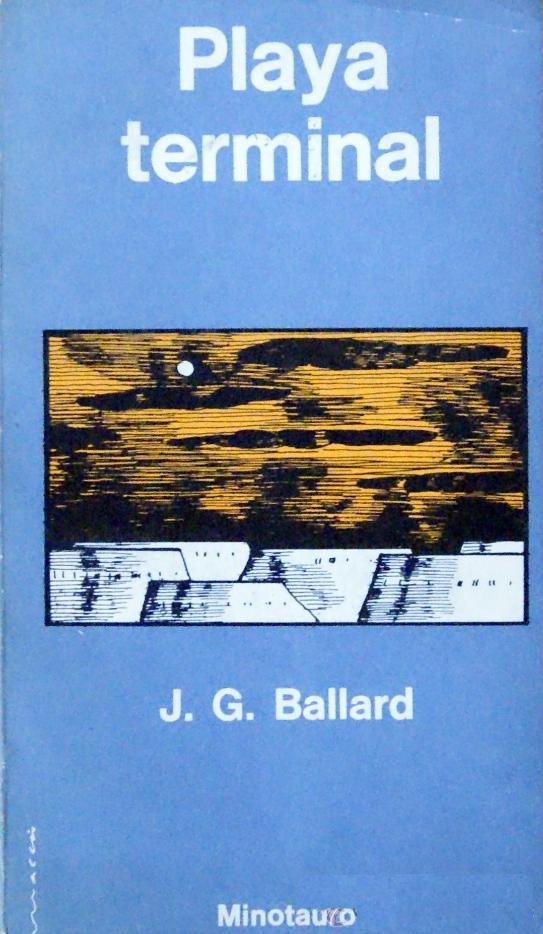
To begin with, this review is of the British edition of
The Terminal Beach
; the American edition published at about the same time had an almost-completely different selection of stories in it.
Ballard was the master of science fiction where the "science" is abnormal psychology. Some of the stories here are more traditional science fiction, but his interests in surrealism and inner space are very much on display in many of them.
There are twelve stories here. Two of them ("The Drowned Giant" and "Billenium") are much-anthologized and need no comment. As for the others -- I'm not going to worry about spoiling a 60-year-old book.
In "A Question of Re-entry," Lieutenant Conolly, a UN official, travels up the Orinoco River into the interior of the Amazonas, piloted by a rough-and-ready Captain Pereira, searching for the landing point of the manned space probe Goliath 7. He is seeking the aid of Ryker, a European who has come to live among the Nambikwara people. (Yes: the setup is more than a little bit remniscent of
Heart of Darkness
.) Ryker has something of an obsession with clocks, and seems to have some strange power over the Nambikwaras. The situation gradually grows darker until Ryker's secrets are revealed.
"End-Game" is the story of Constantin, a resident of some Eastern European country (remember, this was written at the height of the Cold War) , sentenced to death for unnamed political crimes and living in a villa with Malek, his executioner, and a sort of cook-houseboy. Over a series of chess games with Malek, Constantin tries to learn the planned date and time for his execution. Things get stranger.
"The Illuminated Man" tells the story of an English journalist, who seems pretty clearly to be Ballard (though he is referred to only as "James"), who comes to visit a spot in Florida where a peculiar phenomenon has begun: the vegetation, the wildlife, even the ground and buildings, have begun to be coated with crystalline protrusions. This is one of three sites on Earth where this phenomenon is taking place; in addition, weird celestial phenomena have been sighted. James goes into the zone and meets certain inhabitants who try to enlist him in their various aims; one explains to him his belief that the crystals are actually crystallized time. In the end, he escapes the zone, but intends to return. (Incidentally, this story feels like a trial run for
The Crystal World
, one of a series of "cozy" end-of-the-world novels Ballard published between 1962 and 1966.)
In "The Reptile Enclosure," a couple sitting on a veranda above a crowded beach talk. He, a scientist, ponders a colleague's theory of IRMs, "Innate Releasing Mechanisms," instinctive reactions buried deep in the brains of animals, including humans; he also considers the new satellite which has just been launched. As it passes overhead, everyone on the beach stands up and walks into the water.
"The Delta at Sunset" is about Charles Gifford, an archaeologist, at a Toltec ruin, who has been wounded in the foot; the wound appears to be growing gangrenous. As he sits in his stretcher-chair day after day, he observes many snakes coming up out of the water in the early evening. His wife and colleague (who, it appears, are having an affair) want to leave, to bring him somewhere where he can get medical aid; he refuses to go.
And so, roughly at the book's midpoint, we come to the titular piece, surely one of the strangest Ballard had written to date. Traven, a man whose wife and son were killed in an automobile accident, comes to the Eniwetok (now known as Enewetak), where the US held dozens of nuclear weapons tests in the late 40s and early 50s. Traven brings almost no food, no water, and seems to accept that he will die here, among the ruins of American technology brought here to monitor the tests. The story -- if it can even be called that -- tells, in no clear chronological order, of his arrival, his gradual deterioration, his encounters with (he beleives) the spectres of his wife and son, and the brief intrusion of a researcher and his pilot. But he seems to be not happy, exactly, but fulfilled and satisfied by the way he has chosen to end his life.
"Deep End" is a more traditional science fiction piece. Humanity has mostly left Earth for "the new worlds," and taken much of Earth's water with them. One of the remaining people, Holliday, lives in the salt flats near the Atlantic Lake, a ten-mile body of highly saline water that appears to be the last remaining bit of the world's oceans. Holliday, a young man, refuses to leave Earth, remaining in a small community of older people. On a visit to the lake, he discovers to his surprise a living dogfish, which has great significance to him, saying, Earth is not yet dead. Bad stuff happens.
"The Volcano Dances," the shortest story in the book, is also the weakest. A man and a woman are living in a house on the mountain Tlaxihuatl, which seems likely to blow. One of them wants to leave. One of them wants to stay.
In "The Gioconda of the Twilight Noon," a man who has been temporarily blinded by an operation is staying with his wife in his mother's house (the mother is taking a cruise). He sees mysterious scenes in the darkness behind his bandages. They become realer to him than his wife or the house. He does something about it.
The final story, "The Lost Leonardo" is, to my mind, one of the strongest. A (fictional) da Vinci Crucifixion is stolen from the Louvre. This appears impossible, given the size and weight of the painting, and its essential unsellability. The narrator, an art specialist for "Northeby's" auction house, and a French colleague set out to find the painting and the thief. They discover along the way that a certain person, recognizable from painting to painting, appears in Crucifixion paintings across nations and centuries -- and that all of these paintings have, over decades, been stolen and returned with that figure's visage changed. The identification of the figure suggests the identity of the thief.
J.G. Ballard once remarked that "Earth is the only alien planet." In many of these stories, it is easy to see what he meant by that.