Alan Bennett's award-winning series of solo pieces is a classic of contemporary drama, universally hailed for its combination of razor-sharp wit and deeply felt humanity. In Bed Among the Lentils, a vicar's wife discovers a semblance of happiness with an Indian shop owner. In A Chip in the Sugar, a man's life begins to unravel when he discovers his aging mother has rekindled an old flame. In A Lady of Letters, a busybody pays a price for interfering in her neighbor's life.
First produced for BBC television in 1988 to great critical acclaim, the Talking Heads monologues also appeared on the West End Stage in London in 1992 and 1998. In 2002, seven of the pieces were performed at the Tiffany Theater in Los Angeles for a highly praised brief engagement, and in 2003 a selection of the monologues premiered in New York at the Minetta Lane Theatre. These extraordinary portraits of ordinary people confirm Alan Bennett's place as one of the most gifted, versatile, and important writers in the English Language.
Librarian Note: There is more than one author in the GoodReads database with this name.
Alan Bennett is an English author and Tony Award-winning playwright. Bennett's first stage play, Forty Years On, was produced in 1968. Many television, stage and radio plays followed, along with screenplays, short stories, novellas, a large body of non-fictional prose and broadcasting, and many appearances as an actor. Bennett's lugubrious yet expressive voice (which still bears a slight Leeds accent) and the sharp humour and evident humanity of his writing have made his readings of his own work (especially his autobiographical writing) very popular. His readings of the Winnie the Pooh stories are also widely enjoyed.
Intimate isolation, amid loss: pandemic reading and viewing
This book contains thirteen sharp, intimate, but unsentimental monologues: eleven by middle-aged or elderly women, plus a couple of men. Their bittersweet lives, mostly in and around a version of Leeds in Yorkshire, are carefully revealed by Alan Bennett, an archetypal “national treasure” (a term of endearment he resists).
They were written for performance, mostly with specific actors in mind (Bennett himself played Graham in "A Chip in the Sugar"). The first batch was in 1988 and the second in 1998. In 2020, ten of them, plus a couple of new ones, were cast with different actors, filmed, and broadcast during Coronavirus lockdown, then staged when lockdown eased. They’re brilliant in all three mediums, though I find it most powerful when I can see and hear the body language and intonation of the specific actor, as I read.
Slow, partial exposition
Each narrator describes their apparently simple, straightforward, and conventional life, but gradually hints at sadness, secrets, and sinister undercurrents. In some, it’s just a breach of etiquette or societal expectations; in a couple, the taboo is far greater.
As a reader or viewer, you fill in the gaps before the narrator does. The clues are in what is unsaid. They all hold something back, even from themselves. It’s the opposite of confessional “reality” TV.
On first encounter, the stories are darker than you initially expect. On subsequent occasions, you relish spotting the clues, and yet each retains the power to surprise and move - and sometimes to shock. Quiet catastrophes, not cosy ones.
They’ve been part of the literary and TV fabric throughout my adult life. I regularly return to them with the fond familiarity of visiting great aunts who I’m concerned about.
Doubly powerful in a pandemic
Loneliness, loss, and isolation are horribly real for many of us right now, as well as being common themes in the monologues. Watching the new versions on TV, when I’ve hardly met, let alone touched anyone from another household, is especially poignant. Losing faith, wanting escape, drinking too much, and keeping or uncovering secrets take on new resonance. Guilt is another recurring theme, especially guilt about things not done or not acknowledged. Something about lockdown triggers guilt, I find. Another touchpoint.
Intimate pieces, intimately done
Theatres in London’s West End have not reopened yet (September 2020). Even at drastically reduced capacity, the pinch-points of entrances, exits, aisles, and loos in old theatres would not meet current guidelines. But the Bridge Theatre, less than three years old, and with links to The National Theatre, Nicholas Hytner, and Alan Bennett, is more spacious and adaptable, so they have started staging pairs of Talking Heads. They’ve ripped out 75% of the seats, there’s no interval, and everyone is masked throughout, except the two actors (who perform separately). It’s not financially viable; it’s about morale more than money.
After months where the only public indoor space I’ve been is the supermarket and, recently, hairdresser, my excitement was tinged with anxiety.
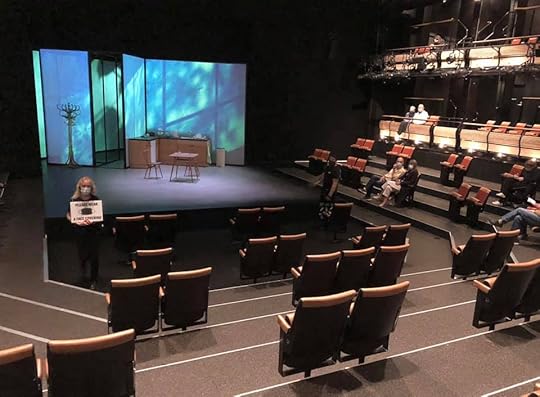
As we walked into the auditorium, this is what we saw:
Image: Bridge Theatre, as the audience took their seats for a Covid-safe performance of two Talking Heads monologues, 7 September 2020
We sat in intimate isolation, amid loss: a missing row in front, a missing row behind, and seats to our left and right were absent. Tragically apt.
When the lights went down, it felt as if the two of us were alone with the actor. So much so that at times, I wanted to reach out and touch her hand consolingly - except I’ve been conditioned out of such gestures in recent months.
The Shrine, performed by Monica Dolan. This is a new one for 2020. It’s not one of my favourites, but that may be because it’s not yet as familiar (I saw it on TV before the stage, and haven’t read it), but also because the ending was something of an anticlimax.
When Lorna’s birdwatching biker husband dies, she visits the site of the fatal collision. Rather than reaching closure, she cultivates it as a shrine, with flowers, a seat, and a schedule of rituals. It was no surprise when, one day, she finds flowers left by someone else...
Bed Among the Lentils, performed by Lesley Manville. It was originally performed by Maggie Smith (known to many as Professor McGonagall, Dowager Countess of Grantham, and/or Bennett’s The Lady in the Van). Manville made it her own, though.
“The Sermon was about sex. I didn’t actually nod off, though I have heard it before. Marriage gives the OK to sex is the gist of it, but while it is far from being the be all and end all (you can say that again) sex is nevertheless the supreme joy of the married state and a symbol of the relationship between us and God. So, Geoffrey concludes, when we put our money in the plate it is a symbol of everything in our lives we are offering to God and that includes our sex. I could only find 10p.”
Susan is married to a vicar, but is unsuited to the role: she’s not a fan of God or attending church (as she says, if her husband were a barrister she wouldn’t have to attend court), submits to occasional “dessicated couplings” with him, and has no skill or interest in flower-arranging, which her husband’s “fan club” treat as a competitive sport (Mrs Shrubsole’s “Forest Murmurs” especially). She’s lonely, bored, and unfulfilled: there’s no mention of a previous career nor children. She seeks solace in predictable and then less predictable ways. One secret is revealed and another remains hidden. Salvation is prompted by one, worked at by another, and credit for both is claimed by another. Ultimately, the most “Christian” characters are not those who would claim the label.
“The only preference I have is to shove my chrysanthemums up her nose but instead I practise a bit of Christian forbearance and go stick them in a vase by the lectern.”
Image: Monica Dolan (left) and Lesley Manville (right) in 2020 TV productions. (Source.)
Read and watch
Background to and history of the series: HERE, including a list of titles, with a plot situation summary of each.
Depending what country you live in, you can find video or audio of individual monologues broadcast by BBC or PBS. See the Wiki link, above, for a list of the titles, and Google them individually.
It’s best to read or watch no more than two at a time.
Loved these monologues and found them to be quintessentially British! I happen to finish reading them just in time to then watch the BBC’s new recordings of them.
I'd seen a couple of these on TV, and wondered whether they would work on the page. But I was not disappointed. Alan Bennett writes with such wit and perception that I could often visualise a set piece without having seen it. So true to life, but such poignancy.
I have mixed feelings about confessing to being tucked in a corner reading these while the rest of the family was glued to the Olympics.
Unfortunately, you cannot read this. Because it is written by An Old White Dude and everyone knows that Old White Dudes cannot write women well. And everyone knows that. Everyone.
Everyone knows that men, especially Old White Dudes are out of touch with modern society. This shit was written in the 80s for goodness sake. They also hate all women. Even when they write sparkling monologues for older women and have them having conversations that aren't just about men, you can just feel the hatred seeping in. It's the way they were brought up.
Oh yeah, and massive trigger warning as well. So don't bother. Stay in your comfort zone. It's nice there. Beanbags and terrariums. Mmm, avocado and quinoa.
I'm being facetious but I'm in that mood right now. I'll write a proper review later.
Alan Bennett is the patron saint of busybodies and of nobodies and of nobodies who think they're somebodies. Of small people living small lives, the details of which, in anybody else's hands, might come across as dull rather than droll. These monologues are funny in the way that Cranford is funny, and much of the humor lies in the details with which the characters concern themselves, combined with the colloquial language in which they express their thoughts. Some of the monologues have a darker side, exposing the more sinister side of suburbia, and Playing Sandwiches is pitch black. The pieces are performed by top-notch actresses, with the standouts being Patricia Routledge (Hyacinth Bucket) and Julie Walters. Missed Maggie Smith, who does not reprise her role from the BBC television series in the audio version.
A Woman of No Importance - 4 A Chip in the Sugar - 5 A Lady of Letters - 5 Bed Among the Lentils - 5 Soldiering On - 4 Her Big Chance - 5 A Cream Cracker Under the Settee - 4 Miss Fozzard Finds Her Feet - 5 The Hand of God - 5 Playing Sandwiches - 4 The Outside Dog - 5 Nights in the Garden of Spain - 5 Waiting for the Telegram - 4
Thirteen sad monologues, all with a twist. More happens in what is unsaid than what is said. Not a good idea to read too many in one sitting - moreish as they are - otherwise they meld a little too much.
'Talking Heads' (this edition 2020) is Alan Bennett's collection of both series (all 12) of his wonderful and groundbreaking monologues, all filmed so brilliantly for the BBC. Also included here is the stand alone monologue and precursor to Talking Heads - "A Woman of no Importance".
Being familiar with both BBC series of Talking Heads, it is difficult to read the written monologues without unconsciously visualising the filmed versions - the two are inseparable and in some respects that's no bad thing. The standard of direction and acting that the BBC versions delivered was nye on, largely perfect.
As such, it is therefore difficult to review bennetts collection of TH monologues without indirectly reviewing the filmed versions, nevertheless...
Bennets writing here is so well observed, the language, the minutiae, the observation of the human character, the pathos, the wit, the dark humour, the humanity and the skill with which it is delivered, are just wonderful and in this area, this field, Bennett is absolutely unsurpassed - utterly brilliant.
Regarding Bennett's Dramatic monologues, each one more than it initially seems or appears to be - all are brilliant, favourites and the strongest in an exceptionally strong collection - chip in the sugar, bed amongst the lentils, a cream cracker under the settee, hand of god, waiting for the telegram, all flawless and all pitch perfect.
In addition to the 12 Talking Heads monologues included here and their precursor A Woman of no Importance, is Bennett's entertaining, insiteful and really interesting introductions to both TH1 and TH2 - not too much unpacking of the suitcase here though.
Bennett demonstrates here that he absolutely is undeniably one of the greatest living writers in the English language.
Great fun reading these theatre monologues with characters ranging from the hilarious to the sad. The first one is maybe the best one: never imagined that such a little sentence as "We laughed" could become so significant, and sad! The most hilarious one is The finger of God. The only weak one would be Playing Sandwiches. There are many funny wisecracks to be found in these texts: "If you think squash is a competitive activity try flower arrangement."
Alan Bennett is something of an institution in Britain, known for the way in which he can encapsulate a world of voices within a single monologue. The monologues that make up this collection were written for BBC TV in 1987 and 1988, and feature a number of well known actors including Patricia Routledge, Thora Hird, Julie Walters, Anna Massey and Bennett himself. While it might have been possible to distance oneself while reading these on the page, listening to them is quite another experience. There’s an insular intensity that draws the reader in. You feel just a little bit dirty, implicated, and complicit as you listen to a range of confessions; stories of suppression, pretentions unhinged, and above all, a kind of pervasive loneliness that is almost too much to bear at times.
Most of the monologues contain just one character, and yet, by reference, there seem to be many more. For example, in the opening monologue “A Chip in the Sugar”, there is Graham Whittaker, a middle aged man who lives with his mother. His mother, and her ‘beau’ Frank Turnbull, have no voice in the piece – it’s all Graham’s recount, but they are as present and real to the action as if they were there. We’re in Graham’s point of view the entire time, but Graham’s mother is as tragic a character as Graham, and her excitement and loss moves the drama forward. Similarly, in "Bed Among the Lentils," Anna Massey's Susan has a transition which involves her husband, the parish ladies, and an Indian Grocer Ramesh. Each of these characters has life and depth, even as they exist only in the confessions of Susan.
Nearly all of the stories have a twist of some sort, usually in terms of character development. Susan discovers passion and begins to breath a little bit deeper in her transition. Irene Ruddock, in “A Lady of Letters”, changes entirely, as does Routledge’s other character Miss Fozzard in “Miss Fozzard Finds Her Feet”. Most of the transitions occur slowly, and are handled with tremendous subtlety. Bennett uses the characters’ perceptions to show what they lose and find in the course of each monologue. Many of the monologues are funny, showing up the pretensions and imaginings of ordinary people in unusual circumstances, such as Celia in “The Hand of God”. Celia is both pompous and devious in the way she covets, helps, and befriends an elderly neighbour in an attempt to get hold of her antiques cheaply and then resell them. She is put back in her place when the odd picture of a finger she sells cheaply turns out to be a Michelangelo original sketch for the Sistine Chapel. Her realisation is both humorous and satisfying. Not all of the monologues are pleasant though. A few are chilling. Three in particular manage to combine both pathos and horror as they move away from the ordinary world of aging and loneliness into mass murder, child molestation, and torture. From the perspective of a single witness, you almost come to understand Wilfred’s compulsions in “Playing Sandwiches”, and feel Rosemary’s humiliation and anger in “Nights in the Garden of Spain”. The most intense of all, “The Outside Dog” takes the reader on a journey through denial and discovery, and although it’s an eye opener, it’s not at all easy to listen to. Nevertheless, this is heady listening. Alan Bennett is the master of the monologue, pondering a range of social issues with a deftness that few other playwrights could match. This powerful collection features some of Bennett’s most famous monologues, performed superbly by actors that clearly have a deep understanding of the work. The combination of character development, a great eye for the minutiae of everyday life, and a theatrical sense of the absurd and tragic inherent in that life makes this an excellent piece of work.
I picked up this book last time I was in London solely based on having read and thoroughly enjoyed Bennett’s The Uncommon Reader, which I chuckled my way through. My expectations, therefore, were probably not quite realistic, not because Talking Heads isn’t funny. It is, in parts, but more than that, it is heartbreaking, sometimes even tragic, and although I suspect it is quite truthful about the kinds of lives some people lead, it was ultimately also somewhat depressing, with one or two exceptions.
The book consists of a number of monologues, most of which are by middle-aged women, most of whom are more or less miserable. What I enjoyed the most was when things were left unsaid and when the speaker was clearly clueless as to certain important parts of their own lives (e.g. when one woman’s husband is probably a murderer). However, as Bennett for some reason had included lengthy introductions to three rounds of monologues, way too much (in my view) had been explained even before I read the stories, which was a shame.
Quite enjoyable, but perhaps too much of the same. One or two more uplifting twists or different kinds of characters would have added more colour, more hope. I suspect I also would have gotten a lot more out of the monologues if I had actually heard them performed, which is after all what they were meant for. There were quite a lot of colloquial British expressions which would no doubt have come alive quite wonderfully if spoken by e.g. Patricia Routledge, who was apparently cast for a few of the monologues. I may have to try and find them despite the fact that they’re hardly part of the TV curriculum here in Denmark.
The best. Bennett is a master of his craft and this is perhaps his finest work.
I think this is the benchmark when it comes to British observational writing. Every single one of these monologues is written with such guile and skill. Not a word is wasted and it’s so deliberately written. Just supreme talent.
You find yourself involuntarily doing the Pity Smile at every 2nd sentence.
If I’ve said it once, I’ve said it a million times: Anything that makes you laugh and cry in equal measure is a great art.
I could wax lyrical about Bennett all day long but that won’t do any of us any good so I’ll end the review with a brilliant little excerpt from Her Big Chance:
I was playing Woman in a Musquash Coat, a guest at a wedding reception, and I was scheduled just to be in that one episode. However in my performance I tried to suggest I’d taken a fancy to the hotel in the hope I might catch the director’s eye and he’d have me stay on after the fork lunch for the following episode which involved a full-blown weekend. So I acted an interest in the soft furnishings, running my fingers over the Formica and admiring the carpet on the walls. Only Rex came over to say that they’d put me in a musquash coat to suggest I was a sophisticated woman, could I try to look as if I was more at home in a three star motel. I wasn’t at home in that sort of motel I can tell you. I said to the man I’d been put next to, who I took to be my husband, I said, ‘Curtains in orange nylon and no place mats, there’s not even the veneer of civilisation.’ He said, ‘Don’t talk to me about orange nylon. I was on a jury once that sentenced Richard Attenborough to death.’ We’d been told to indulge in simulated cocktail chit-chat so we weren’t being unprofessional, talking. That is something I pride myself on, actually: I am professional to my fingertips.
Whatever it is I’m doing, even if it’s just a walk-on, I must must must get involved, right up to the hilt. I can’t help it. People who know me tell me I’m a very serious person, only it’s funny, I never get to do serious parts. The parts I get offered tend to be fun-loving girls who take life as it comes and aren’t afraid of a good time should the opportunity arise-type thing. I’d call them vivacious if that didn’t carry overtones of the outdoor life.
From BBC radio 4: Alan Bennett's much-loved collection of monologues, giving us a glimpse in to the lives of six ordinary British people.
1 - Talking about Talking Heads
2 - A Chip in the Sugar read by Alan Bennett Life for Graham and his elderly mother has settled into a comfortable pattern when a face from the past appears to threaten his peace of mind.
3 - A Lady of Letters read by Patricia Routledge Irene thinks 'corresponding' is every citizen's right in a free society, but she gets her first taste of real freedom in the most unlikely place.
4 - Bed Among the Lentils read by Anna Massey Susan doesn't feel she has any of the talents needed to be a vicar's wife and finds herself seeking comfort elsewhere.
5 - Her Big Chance read by Julie Walters Lesley is an actress who works hard at her craft but needs a career leg-up. Will a chance encounter at a party provide just that?
6 - Soldiering On read by Stephanie Cole Muriel is determined not to let her recent widowhood get her down, but the fallout is far more serious than she could ever have expected.
7 - A Cream Cracker Under the Settee read by Thora Hird Doris has fallen off the buffet and, while sitting in the dark waiting for help, she looks back on a life dedicated to fighting dirt.
یکی از بهترین کتابهایی که تازگی خوندم، و مطمئنم به خاطر ترجمه ی محشرش بود. بعید میدونم انگلیسیش ازین بهتر بوده باشه. ترجمه ش به قدری عالی بود که من دلم نیومد کتاب رو زود تموم کنم و همین طوری مزه مزه کردمشتا تموم شد، و باید بگم تک تک زن های این کتاب با من موندن. از خانم آنتیک فروش گرفته تا دختری که توی فروشگاه کار میکرد تا اونی که یه پاپزشک گولش زده بود. این کتاب به عمق جونم نفوذ کرد،
After a fairly underwhelming year in regards my own reading, this book was such a breath of fresh air. A collection of short stories, all told via monologue, Bennett introduces us to 13 ordinary characters with rather simple lives, until a flash of the extraordinary rears its head. The beauty in these tales is often what's left unsaid. We "skirt around the issue" (little easter egg there!) and the reader starts to build a vague picture of the actual story so far hidden in the mundane. Sometimes they are funny (Her Big chance), sometimes heart-breaking (A Woman of No Importance), while others are really chilling. Both the Outside Dog and Playing Sandwiches will stay with me for some time.
After my last book I complained of characters not developed. Well, here is a textbook example of developed characters. I unwittingly arrived at the perfect antidote to the Feel Good book.
Talking Heads is a collection of monologues which were originally written for BBC television, the first group in 1988 and a second group in 1998. Since that time they have found life as radio broadcasts, in live theater, and as a published collection. I listened to the audio book. It’s hard for me to imagine a better way to encounter these devastating portraits because the impact is all in the words and the voices. Not so incidentally, those voices are from some of Britain’s finest actors. [I accidentally checked "paperback" when I entered the book and can't figure out how to change that.:]
I thought several times of Thoreau’s phrase “leading lives of quiet desperation.” These twelve flawed souls lay bare the circumstances of their inner and outer lives. There’s the nubile actress absorbed in her career, which she fails to notice has become soft porn. And the woman whose son mismanages the considerable assets she inherited from her deceased husband, forcing her to live with her stiff upper lip in a boarding house.
The six monologues from the second group are equally poignant but they are much darker. I was fascinated to realize after the fact that the second group was written ten years later. There’s a pedophile trying and failing to reform; the wife of a serial killer obsessed with the cleanliness of her house; a podiatrist with a foot fetish serviced by a middle-aged unmarried woman. I find myself liking some of these flawed people, grieving with them.
In April I went to a reading by David Sedaris, who always recommends another writer or book to his audiences. That is when I heard about these twelve devastating, and occasionally comic, stories.
Die Texte sind eigentlich als TV-Sketche (Monologe) geschrieben. Verschiedene Persönlichkeiten treten auf (Junggeselle, der noch bei der Mutter lebt, Pfarrersfrau mit Alkoholproblem, trauernde Witwe usw.). Sie sind voller Hemmungen und doch zu erstaunlichen Taten fähig. Manche von ihnen ahnen die eigene Verstrickung und ihre Unzulänglichkeiten, sie verlieren aber niemals ihren Stolz und ihre Selbstachtung. Very british, tragisch und manchmal haarsträubend komisch. Unbedingt lesen, Satire vom Feinsten.
Been listening to this on and off for a couple of years and am going to see it off. Now that makes it sound like a chore, doesn't it, well it is not. These are fab vignettes.
The only Bennett that I haven't liked is that which all else love, namely The Uncommon Reader.
This entire review has been hidden because of spoilers.
i have never found an author who captures a character as well as alan bennett, and this is the clear evidence for it. the final monologue in the collection, waiting for the telegram, was heartbreaking, but all were brilliant. particularly liked a chip in the sugar. fantastic.
alan bennett is a character master. his skill of observation has already influenced how I observe. he is hilarious but deeply feeling and each of these “talking heads” is so deeply crafted and complex. I can’t wait to study this at uni and continue reading/watching/listening to bennett’s work.
A bit depressing at times but also very funny, in an incredibly dark kind of way. So very darkly humorous. These short stories were originally written as monologues for the BBC. I had them as an audiobook where they were adapted for radio. With some fabulous actors, the likes of Julie Walters, Thora Herd and Bennett himself bringing life to the words. Overall I found them a little depressing especially when you listen to more than one at a sitting.
Listened to this as an audiobook, some of these stories are priceless, Patricia Routledge is incredible. The Vicars wife outstanding. Bennett gives a voice to the quiet Briton, universal man or woman with incredible pathos, satire, insight and wit, utterly compelling monologues spoken by people who totally wore the role, poignant and beautiful.
Originally read for school but i thought these were really effective. I highly enjoyed the journey and subtlety of his writing of the monologues. The characters were ordinary but at the same time interesting to read about. I would highly recommend!
"To watch a monologue on the screen is closer to reading a short story than watching a play", says Alan Bennett. What's it like to read on the page something that's been written for viewing? Originally dramatised on TV, "The Complete Talking Heads" contains 13 monologues. As the title suggests, these are the voices of people talking about their lives, speaking directly to the reader, mostly from their own home, occasionally from an institutional room.
In "A Woman of No Importance" Miss Schofield elevates her uneventful, everyday life into one of comedy and tragedy. She is the voice of women I grew up with, which is not surprising as Bennett is about my parents' age and was raised not too far from my own home town. The northern English voice is soothing in its rhythms and phrases, and the character is able to talk about nothing yet sound interesting. Her constant refrain, "we laughed", shows how she deals with life's difficulties, a shorthand for the platitude "if you didn't laugh, you'd cry".
This pilot episode and the first series are narrated mostly by people who must deal with everyday problems of life, my favourite being "Bed Among the Lentils". The vicar's wife, whose own identity has been suffocated by her position, questions why she must attend church and grumbles that no-one asks her opinion about God. "Not that it matters", she says, "So long as you can run a tight jumble sale you can believe in what you like."
There are more external forces at play in the lives of characters in the later, second series of monologues. As a reader you have to put the pieces of these darker stories together, and I did not enjoy being inside some of these heads.
At the end of the book I thought I had done a pretty good job of making the characters speak in my mind, listening to their fortitude and picking up on all the things that were not being said. Then I watched Patricia Routledge bring Miss Schofield to life as the "woman of no importance" and realised how much I had missed.
I studied the first set of Talking Heads as an A level text, 11 years ago now, and decided to re-read them recently. If anything, I enjoyed them more the second time through.
The first set of six monologues comprises Susan, the vicar's wife, in Bed Among the Lentils; Graham in A Chip in the Sugar; Lesley in Her Big Chance; Muriel in Soldiering On; Miss Ruddock in A Lady of Letters; and Doris in A Cream Cracker Under the Settee. Each of the narrators is ignorant as to what they are revealing to the audience. Each of the narrators ignorant as to the truth of their situation. There is most definitely a melancholy feel to the monologues, a sadness that pervades. The narrators strike the reader as lonely, some of them because they are genuinely alone, others because they feel alone despite being surrounded by family.
I have never before read the second set of monologues. It comprises Rosemary in Nights in the Gardens of Spain; Miss Fozzard in Miss Fozzard Finds Her Feet; Marjory in The Outside Dog; Wilfred in Playing Sandwiches; Celia in The Hand of God; and Violet in Waiting for the Telegram. If anything, I found these darker than the first, they deal with amongst other things child molestation and murder. Again, there is a naivety to the majority of the monologues, the narrators failing to recognise their own predicament.
All these monologues are beautifully written, Alan Bennett is a genuine master of the written word. I would love to have seen these performed on stage.
One of my absolute favourites, life-changingly good. A collection of six monologues, which I first came across when my English teacher wrangled them into the Year 9 curriculum, if they hadn't already been there. I loved reading aloud, and I loved language, and she gave me a ton of Alan Bennett stories and collections and said, go, read these, they will make you a much better reader, a much better writer, and a much better person. I think she was completely correct about all these things.
Since then, I've come back to them at least once a year. It's strange, too, because they change so much from my memories of them with each reading. Each time, they're sadder, darker, and, occasionally, funnier than I thought. Each tiome the 1980s seem further away (surprise: they are!) and there is a nostalgia for the horrid things that disturbs and engrosses me equally.
There are, as my edition's introduction notes, plenty of repetitious themese and characters: vicars, social workers, attitudes to immigration, fear of just about anyone and everything, and the self-importance of quiet people; there are things in every one of these stories that resonate with all kinds of memories and experiences. I wonder how these stories read if you spent the 1980s in Mumbai, or California, or Paris? There's something so completely at home about them for me, which makes them feel very...intense. And as pieces to read out loud go, I can't think of many better. Highly recommended, and, for me, very important reading.
I had been really looking forward to reading this book, having watched the Talking Heads series on TV many years ago and remembering it fondly. I wasn't disappointed. Alan Bennett's writing is beautiful, his character drawing is so good you feel that you know these people. Although the stories are often sad, they are written with a gentle humour so you are not left feeling depressed, but rather with a little smile playing about the lips. I'm glad I found this book, and may go back and watch the plays again too.
I absolutely adore Talking Heads. A collection of monologues, each with compellin characters, poignant moments and laced with humour. Read these back in school, and I think they made me a better performer and a better reader for it.
The accompanying TV episodes were equally stunning, featuring the wonderful Maggie Smith, Patricia Routledge, Julie Walters and Alan Bennett himself.
I utterly urge anyone who enjoys plays/monologues to check these out.






![Profile Image for [ J o ].](https://i.gr-assets.com/images/S/compressed.photo.goodreads.com/users/1673171874i/4639825._UY200_CR4,0,200,200_.jpg)