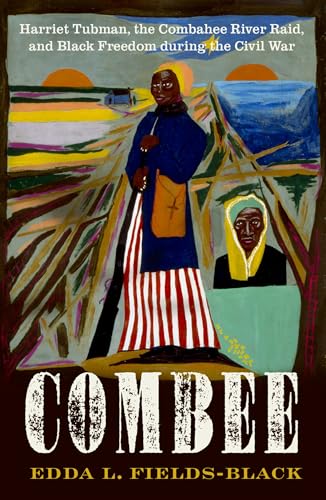
I listened to the audio edition of this book, so I'm going to fully separate my comments about the content of the book itself from some quibbles about the audio experience to not detract from the brilliant achievement of research and analysis the author has provided us.
The book - *****+
I'm not sure that anyone who hasn't spent a lot of time with 19th century (or earlier) primary sources can fully appreciate what an enormous contribution this book represents to our collective understanding of not only the events of the Combahee River Raid itself, but of Black social structures and culture in the low country and beyond before, during, and after the Civil War. The author rather modestly describes her process in her note at the end of the book, but consider that she had to:
1. Recognize that Harriet Tubman working with the US Army was not the only significant story to tell about the raid (although the book adds new insights to that angle as well).
2. Decide to focus her research on primary sources rather than oral tradition, despite the fact that the sources in question were unindexed, handwritten pension files and loose papers (also handwritten - typewriters were not a thing in 1863) from the estates of long-departed enslaver families.
3. Physically locate, read, transcribe, and index these records, mostly during a worldwide pandemic.
4. Figure out who was who in the records, despite the use of multiple names by almost everyone and the fact that the pension files reflect what the government needed to hear to deem the applicant eligible, even if it included some "partial truths" and the enslavers' papers reflect an attempt to procure the largest possible compensation for their losses.
5. Map out all of the relationships involved despite the previously mentioned challenges.
6. Weave all of this into the existing historical record to provide context and put those involved into the story where they belong.
And then, after all that, she wrote a book that is accessible to a broad audience. This isn't a textbook or reference material. It's like the raid itself is the eye of the hurricane and the book encompasses the arms that spiral out from it. From the ships themselves to the land the enslaved laborers were forced to work; from the transatlantic slave trade to the importance of rice to the South Carolina and US economies; from languages to marriages to basket names to military politics: this is truly an epic. And it's all told with full documentation, no attribution of unknowable feelings or dialogue, and a dedication to honoring the memory of these forgotten events and people.
I will admit to some level of frustration in the early chapters with what I considered to be unnecessary background - but then I remembered that we live in a world where it's considered controversial or dangerous to speak (or write) basic truths about our country's origins and history. Authors can no longer assume that their audience has even the most basic information about slavery, the antebellum south, or even the chronology of the Civil War itself. To have produced this work in this environment only adds to its magnitude.
Now, as for the audio version.....
***
The fundamental problem is that this is not a book that is well-suited to the audio format. The plethora of names of both people and places, the (necessary) skipping around the chronology, and the author's accurate and useful but somewhat-wordy-in-verbal-form language are made to be read, annotated, flipped back and forth through, and quoted. These are not things that are easily accomplished in most audiobook interfaces. There is no good way that I have seen to include footnotes or references in an audiobook (aside from providing them in written form, which rather defeats the purpose of listening), so while I support the decision to not try, it is a loss compared to the written edition.
The narrator generally does a good job with the somewhat repetitive and wordy language (not a criticism - it's just not a style that rolls naturally in speech). However, I'm not sure if there was an error in her script or what, but I have never in my life heard a person substitute Calvary for cavalry so many times in a row. Perhaps she usually narrates religious texts or travel guides to the holy lands. But there is a chapter about the Charleston Light Dragoons that (unsurprisingly) includes the world cavalry dozens of times that I was shocked was not re-recorded. I understand that it's time consuming and expensive to make corrections, but this rose to the point of distracting from the text.
So go get yourself a written copy and a set of sticky notes, and prepare to learn something.
Thank you to NetGalley for the ARC.