

What do you think?
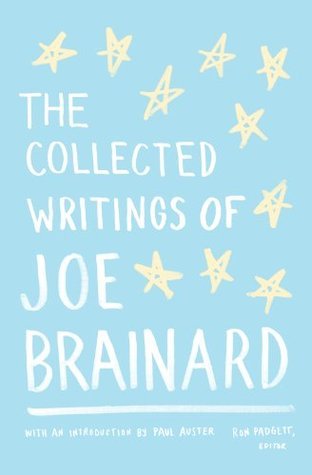
The Collected Writings of Joe Brainard
An artist associated with the New York School of poets, Joe Brainard (1942-1994) was a wonderful writer whose one-of-a-kind autobiographical work I Remember ("a completely original book" -Edmund White) has had a wide and growing influence. It is joined in this major new retrospective with many other pieces that for the first time present the full range of Brainard's writing in all its deadpan wit, madcap inventiveness, self-revealing frankness, and generosity of spirit. The Collected Writings of Joe Brainard gathers intimate journals, jottings, stories, one-liners, comic strips, mini-essays, and short plays, many of them available until now only as expensive rarities, if at all. "Brainard disarms us with the seemingly tossed- off, spontaneous nature of his writing and his stubborn refusal to accede to the pieties of self-importance," writes Paul Auster in the introduction to this collection. "These little works . . . are not really about anything so much as what it means to be young, that hopeful, anarchic time when all horizons are open to us and the future appears to be without limits." Assembled by the author's longtime friend and biographer Ron Padgett and including fourteen previously unpublished works, here is a fresh and affordable way to rediscover a unique American artist.
576 pages, Kindle Edition
First published January 1, 2012
Ratings & Reviews
Friends & Following
Create a free account to discover what your friends think of this book!
Community Reviews
Displaying 1 - 30 of 42 reviews

April 6, 2012
I remember reading this book.

October 27, 2020
Rabbit holes. The Internet has them, but Goodreads does too. Meaning: Sometimes I pick up a book I saw mentioned on GR, yet haven't a clue where it was or who it was or how it was.
But I do know I got this book via interlibrary loan, and that I'd never heard of Joe Brainard. Well, now I have. Heard of him, I mean. Linked with the New York School of Artists and Writers, if that means anything.
As for the Collected Works, the first section, called "I Remember," is worth the price of admission alone. It's only 134 pp. of a book that's over 500 pp., but if you read only that, I think you'd be happy with it. That is, if you are of a certain age, because it makes sense that a lot of things that a guy born in 1942 writes would be dated. Though some of his remembrances are timeless. And some are particular to him (he was gay, so a lot of his remembrances concern the struggles he experienced both coming out and out). A sampling:
I remember canasta.
I remember butter and sugar sandwiches.
I remember when I lived in Boston reading all of Dostoevsky's novels one right after the other.
I remember learning to play bridge so I could get to know Frank O'Hara better.
I remember many first days of school. And that empty feeling.
I remember the clock from three to three-thirty.
I remember when girls wore cardigan sweaters backwards.
I remember the outhouse and a Sears and Roebuck catalog to wipe off with.
I remember very old people when I was very young. Their houses smelled funny.
I remember a boy. He worked in a store. I spent a fortune buying things from him I didn't want. Then one day we wasn't there anymore.
I remember drive-in onion rings.
I remember pearlized plastic toilet seats.
I remember having marbles more than I remember playing marbles.
I remember wondering if girls fart too.
I remember big puzzles on card tables that never got finished.
I remember borrowed punch bowls.
I remember candy cigarettes like chalk.
I remember the fear of not getting a present for someone who might give me one.
I remember after Christmas shopping coming home and gloating over everything I bought.
I remember how sad and happy at the same time Christmas carols always made me feel: all warm inside.
I remember not being able to fall asleep Christmas Eve.
I remember opening my first packages very fast and my last few very slowly.
I remember after opening packages what an empty day Christmas day is.
You get the idea. They go down easy and quickly, some of them striking a chord with your own remembrances and some just striking a chord because they are interestingly particular to Brainard. But you keep reading because there's so much space between them and some are funny and some are sad and some are like YOUR childhood and some are not at all.
After this? A lot of journal-like entries. But after the "I Remember" bit, you feel like you kind of know Joe and feel sorry for Joe and want to cheer Joe on, as he is so honest and polite and painfully blunt and self-conscious with little self-confidence at times. Especially about his body, which he is obsessed with (too skinny).
But whether you go on or not is up to you. The sampling above gives you a hint over whether you'd like it or not. Just don't expect the whole thing to be engaging. And though there's some artwork and cartoons, which Joe was most known for (vs. writing), don't expect a lot of that, either.
Do expect some news about Ted Berrigan and Ron Padgett and a bit (only) about Frank O'Hara. Brainard knew a lot of poets and did illustrations / covers for their books. So if you're into some of the New York School people, maybe this is a yes. Still, as "rabbit hole" discoveries go, this was some light-reading fun.
But I do know I got this book via interlibrary loan, and that I'd never heard of Joe Brainard. Well, now I have. Heard of him, I mean. Linked with the New York School of Artists and Writers, if that means anything.
As for the Collected Works, the first section, called "I Remember," is worth the price of admission alone. It's only 134 pp. of a book that's over 500 pp., but if you read only that, I think you'd be happy with it. That is, if you are of a certain age, because it makes sense that a lot of things that a guy born in 1942 writes would be dated. Though some of his remembrances are timeless. And some are particular to him (he was gay, so a lot of his remembrances concern the struggles he experienced both coming out and out). A sampling:
I remember canasta.
I remember butter and sugar sandwiches.
I remember when I lived in Boston reading all of Dostoevsky's novels one right after the other.
I remember learning to play bridge so I could get to know Frank O'Hara better.
I remember many first days of school. And that empty feeling.
I remember the clock from three to three-thirty.
I remember when girls wore cardigan sweaters backwards.
I remember the outhouse and a Sears and Roebuck catalog to wipe off with.
I remember very old people when I was very young. Their houses smelled funny.
I remember a boy. He worked in a store. I spent a fortune buying things from him I didn't want. Then one day we wasn't there anymore.
I remember drive-in onion rings.
I remember pearlized plastic toilet seats.
I remember having marbles more than I remember playing marbles.
I remember wondering if girls fart too.
I remember big puzzles on card tables that never got finished.
I remember borrowed punch bowls.
I remember candy cigarettes like chalk.
I remember the fear of not getting a present for someone who might give me one.
I remember after Christmas shopping coming home and gloating over everything I bought.
I remember how sad and happy at the same time Christmas carols always made me feel: all warm inside.
I remember not being able to fall asleep Christmas Eve.
I remember opening my first packages very fast and my last few very slowly.
I remember after opening packages what an empty day Christmas day is.
You get the idea. They go down easy and quickly, some of them striking a chord with your own remembrances and some just striking a chord because they are interestingly particular to Brainard. But you keep reading because there's so much space between them and some are funny and some are sad and some are like YOUR childhood and some are not at all.
After this? A lot of journal-like entries. But after the "I Remember" bit, you feel like you kind of know Joe and feel sorry for Joe and want to cheer Joe on, as he is so honest and polite and painfully blunt and self-conscious with little self-confidence at times. Especially about his body, which he is obsessed with (too skinny).
But whether you go on or not is up to you. The sampling above gives you a hint over whether you'd like it or not. Just don't expect the whole thing to be engaging. And though there's some artwork and cartoons, which Joe was most known for (vs. writing), don't expect a lot of that, either.
Do expect some news about Ted Berrigan and Ron Padgett and a bit (only) about Frank O'Hara. Brainard knew a lot of poets and did illustrations / covers for their books. So if you're into some of the New York School people, maybe this is a yes. Still, as "rabbit hole" discoveries go, this was some light-reading fun.

August 25, 2013
Joe Brainard may be my favorite writer. As I was reading "The Collected Writings of Joe Brainard" I didn't want the book to end, and its over 500 pages. What strikes me the most brilliant aspect of Brainard is that he's not overly writer-like, but just naturally breathes as a writer. He is mostly famous for his "I Remember" which is an unique form of memoir writing, that to this day is taught by writing teachers. It is an effective way to open up the writing process, but in the hands (and mind) of Brainard, it's a work of genius.
The beauty of his work, including his artwork, which he's equally known for as well, is how simple he describes a piece of literature, art, or just commenting on day-to-day journals. But that 'simple' is quite complex and there is something very organic in the way he processes his subject matters to the readers or viewers. He is sometimes beyond zen, for instance "Short Story"
"Ten years ago I left home to go to the city and strike it big. But the only thing that was striking was the clock as it quickly ticked away my life."
Or his little prose piece "Ron Padgett"
"Ron Padgett is a poet. He always has been a poet and he always will be a poet. I don't know how a poet becomes a poet. And I don't think anyone else does either. It is something deep and mysterious inside of a person that cannot be explained. It is something that no one understands. it is something that no one will ever understand. I asked Ron Padgett once how it came about that he was a poet, and he said, "I don't know. It is something deep and mysterious inside of me that cannot be explained.""
Brainard is one of the great critics as well as a prose stylist. He writes like a visual artist who is extremely talented in giving the reader a picture. It's interesting that he never wrote a novel, because it seems that was one of his favorite literary formats. But again, the narration is not the key, but the way he observes his world, and it is a fascinating world. He was close the New York School Poets and the painters around that scene. His observations are fresh and non-cliché, it is almost like looking at the world for the first time. But looking at it with intelligence, great wit, and telling the tale in a very uncomplicated manner.
The Library of America should get a nice pat on the back for publishing this book, and also extra stars to Paul Auster for writing an interesting introduction, and most of all to the skills of fellow poet Ron Padgett for editing Joe's writings. This book is a must for those who write, and for those interested in 1960's/1970's Manhattan art culture. In other words, the book is a keeper, and I'll never loan it out.
The beauty of his work, including his artwork, which he's equally known for as well, is how simple he describes a piece of literature, art, or just commenting on day-to-day journals. But that 'simple' is quite complex and there is something very organic in the way he processes his subject matters to the readers or viewers. He is sometimes beyond zen, for instance "Short Story"
"Ten years ago I left home to go to the city and strike it big. But the only thing that was striking was the clock as it quickly ticked away my life."
Or his little prose piece "Ron Padgett"
"Ron Padgett is a poet. He always has been a poet and he always will be a poet. I don't know how a poet becomes a poet. And I don't think anyone else does either. It is something deep and mysterious inside of a person that cannot be explained. It is something that no one understands. it is something that no one will ever understand. I asked Ron Padgett once how it came about that he was a poet, and he said, "I don't know. It is something deep and mysterious inside of me that cannot be explained.""
Brainard is one of the great critics as well as a prose stylist. He writes like a visual artist who is extremely talented in giving the reader a picture. It's interesting that he never wrote a novel, because it seems that was one of his favorite literary formats. But again, the narration is not the key, but the way he observes his world, and it is a fascinating world. He was close the New York School Poets and the painters around that scene. His observations are fresh and non-cliché, it is almost like looking at the world for the first time. But looking at it with intelligence, great wit, and telling the tale in a very uncomplicated manner.
The Library of America should get a nice pat on the back for publishing this book, and also extra stars to Paul Auster for writing an interesting introduction, and most of all to the skills of fellow poet Ron Padgett for editing Joe's writings. This book is a must for those who write, and for those interested in 1960's/1970's Manhattan art culture. In other words, the book is a keeper, and I'll never loan it out.

September 26, 2019
Joe Brainard remains one of the most enigmatic figures of the New York School of poets, regardless of what generation or "wave" one is considering. He seemed to cleave to an existential sense of transparency in some of his works: drawings or paintings that were often straightforward graphic miniatures, his often-imitated-but-never-equaled masterpiece I Remember, his short confessional poems that often ingrain themselves in one's memory upon a single hearing. He had a stiletto honesty about things.
Brainard often made things look simple and he demonstrated a love of simple things. Yet he was never a simple man. That illusion was the product of his art. One might get the impression that he was not as bright as his poetic confreres and consoeurs. One has only to read the interviews contained in this volume, particularly the one he did with Tim Dlugos in 1977, to see how wrongheaded that notion is, how complex this artist was and with what subtlety and nuance he considered art and his place within it. That stiletto honesty is everywhere in that interview.
Something clearly "happened" to Brainard right around the period of his greatest success. He seems to have soured on the very idea of success as an empty category. He comes across in that interview as almost monastic. He would stop exhibiting his work just a few years after that interview, with rare exceptions, this despite having had hugely successful shows in New York, Paris and elsewhere. In the interview, he drops hints that a few years of obsessive collage-making somehow altered his mind. He also talks generously, candidly, about the shipwreck of his longterm relationship with poet and librettist Kenward Elmslie. He rues the distancing that occurred in that relationship in that period, which he describes as his closest, yet he shies from calling it love (in the 1977 interview). When this relationship underwent a major rupture, Brainard worked in a panic to salvage it. Brainard's iconic paintings of Elmslie's ghost-pale greyhound Whippoorwill usually show the dog slumbering, often in near-ouroboros form, sunk in domestic bliss. I wonder how much those paintings are confessions of the comfort Brainard felt in his domestic life with Elmslie.
Brainard's ashes lie scattered in Calais, Vermont, where he spent so many years with Elmslie. Brainard, like his interviewer, the wonderful poet Tim Dlugos, died in the days when AIDS was still largely unstoppable, before the advent of antiretroviral therapies (just two years after his death). But that last part of his life and its struggle remains hidden from view, and the poems, prose works and various hybrids (including drawings) gathered here embody the spirit of the seventies and its newfound freedoms (to speak and love as one chose) as much as any artist's work ever did in that period.
One could make the argument that Brainard was the quintessential collagist. Even I Remember is ultimately a work of collage. And we were lucky enough to have the closet door swing open on his long-hidden work earlier this year when Tibor de Nagy shared 100 Works with us to remind us how fantastic Joe actually was at collage: http://www.tibordenagy.com/exhibition... Branard at his best is arguably every bit as good as Cornell in this medium.
I have quite a few of the books contained in here in their original editions, but there's so much you simply can't collect on your own and this is a great compendium. Padgett and Auster are two long-devoted friends of Brainard's work and they were the right choices to assist this book in reaching the public. Auster's seemingly hyperbolic statements about Brainard's centrality might prove to be eerily prescient. If Joe can finally get over his strange, stoic reticence about the world posthumously, he's got it made. Because this book displays an astonishing capacity for friendship. Brainard's words are all about what is needed to process the world. What at first seems dippy existentialism (Brainard's forte) proves to be cannier than we realize. Because most writers in any age will hide the important things they really should have said, or said more directly, to their culture and their fellow human beings. They will satisfy themselves with received forms and received artistic etiquette. Brainard was hiding nothing and he took on no airs. He wanted to find out who he really was, and what it really meant to be no, not someone, but anyone, and that was the defining struggle in his life that produced these strange, ordinary, sui generis writings.
(One p.s. qualification: I don't have the Kindle edition. I have the physical book. For some reason, I didn't find that in the listings, although I'm guessing it's there.)
Brainard often made things look simple and he demonstrated a love of simple things. Yet he was never a simple man. That illusion was the product of his art. One might get the impression that he was not as bright as his poetic confreres and consoeurs. One has only to read the interviews contained in this volume, particularly the one he did with Tim Dlugos in 1977, to see how wrongheaded that notion is, how complex this artist was and with what subtlety and nuance he considered art and his place within it. That stiletto honesty is everywhere in that interview.
Something clearly "happened" to Brainard right around the period of his greatest success. He seems to have soured on the very idea of success as an empty category. He comes across in that interview as almost monastic. He would stop exhibiting his work just a few years after that interview, with rare exceptions, this despite having had hugely successful shows in New York, Paris and elsewhere. In the interview, he drops hints that a few years of obsessive collage-making somehow altered his mind. He also talks generously, candidly, about the shipwreck of his longterm relationship with poet and librettist Kenward Elmslie. He rues the distancing that occurred in that relationship in that period, which he describes as his closest, yet he shies from calling it love (in the 1977 interview). When this relationship underwent a major rupture, Brainard worked in a panic to salvage it. Brainard's iconic paintings of Elmslie's ghost-pale greyhound Whippoorwill usually show the dog slumbering, often in near-ouroboros form, sunk in domestic bliss. I wonder how much those paintings are confessions of the comfort Brainard felt in his domestic life with Elmslie.
Brainard's ashes lie scattered in Calais, Vermont, where he spent so many years with Elmslie. Brainard, like his interviewer, the wonderful poet Tim Dlugos, died in the days when AIDS was still largely unstoppable, before the advent of antiretroviral therapies (just two years after his death). But that last part of his life and its struggle remains hidden from view, and the poems, prose works and various hybrids (including drawings) gathered here embody the spirit of the seventies and its newfound freedoms (to speak and love as one chose) as much as any artist's work ever did in that period.
One could make the argument that Brainard was the quintessential collagist. Even I Remember is ultimately a work of collage. And we were lucky enough to have the closet door swing open on his long-hidden work earlier this year when Tibor de Nagy shared 100 Works with us to remind us how fantastic Joe actually was at collage: http://www.tibordenagy.com/exhibition... Branard at his best is arguably every bit as good as Cornell in this medium.
I have quite a few of the books contained in here in their original editions, but there's so much you simply can't collect on your own and this is a great compendium. Padgett and Auster are two long-devoted friends of Brainard's work and they were the right choices to assist this book in reaching the public. Auster's seemingly hyperbolic statements about Brainard's centrality might prove to be eerily prescient. If Joe can finally get over his strange, stoic reticence about the world posthumously, he's got it made. Because this book displays an astonishing capacity for friendship. Brainard's words are all about what is needed to process the world. What at first seems dippy existentialism (Brainard's forte) proves to be cannier than we realize. Because most writers in any age will hide the important things they really should have said, or said more directly, to their culture and their fellow human beings. They will satisfy themselves with received forms and received artistic etiquette. Brainard was hiding nothing and he took on no airs. He wanted to find out who he really was, and what it really meant to be no, not someone, but anyone, and that was the defining struggle in his life that produced these strange, ordinary, sui generis writings.
(One p.s. qualification: I don't have the Kindle edition. I have the physical book. For some reason, I didn't find that in the listings, although I'm guessing it's there.)

September 26, 2022
All the points are for I Remember, which is included in this collection and is by far one of the best "memoirs" ever written. The rest of the writing has a rambling sort of quality, by no means poorly done, but difficult to plow through after the beauty of I Remember and the marvelous foreword contributed by Paul Auster. I had read the one piece (reminiscences) quite some time ago and was reminded of it by the on target review from George Ilsley here so went back to refresh my memory. I wonder how I ever could have put it behind me. Perhaps because I was in my twenties back then and needed the clarity of age to recall how much insight Brainard had that coincided with my own memories and perhaps those of so many of us. This book is worth picking up for the joy of rereading I Remember alone but also for learning some new things about the marvel that was Joe Brainard.
August 28, 2013
If my list of favorite authors says anything, it's that I love longueur and extreme brevity. 19th century novels, for the first category; and Lydia Davis's short-short-stories, for the second. What she does in two paragraphs sings a lifetime of experience. Only today did I meet Joe Brainard's work from the 60s and 70s, and I see the bridge that connects Oulipo (experimental "potential literature") to Lydia Davis. This volume is special because it compiles writings that he did through the years, such as hilarious mini-plays and poignant anti-poems. It also contains Brainard's masterpiece, "I Remember," a memoir, one thousand or so entries beginning "I remember."
His memories are sensory, emotional, minor, cultural, autobiographical; they are of childhood, and of adolescent sexuality; they are pieces of growing up in a happy middle-class white American nuclear family. I share that background, so I keenly related to many of his memories. However, his language is so simple and clear that I believe that a reader from a different background might be just as likely to read each sentence and just linger, for a while, on the evocations of each one. The tone is never sentimental, sometimes lewd, all real.
You have to see it to believe it: it is a memoir of tiny thoughts that add up to one full person.
---
I remember thinking that "S.O.S." meant something dirty.
I remember fantasies of finding notes in old bottles washed ashore.
I remember magic carpets and giant "genies" and trying to figure out what my three wishes would be.
I remember not understanding why Cinderella didn't just pack up and leave, if things were really all that bad.
I remember getting a car door slammed on my finger once, and how long it took for the pain to come.
I remember the fear of "horror" coming out of my mouth as "whore," as indeed it quite often did.
I remember rocks you pick up outside that, once inside, you wonder why.
His memories are sensory, emotional, minor, cultural, autobiographical; they are of childhood, and of adolescent sexuality; they are pieces of growing up in a happy middle-class white American nuclear family. I share that background, so I keenly related to many of his memories. However, his language is so simple and clear that I believe that a reader from a different background might be just as likely to read each sentence and just linger, for a while, on the evocations of each one. The tone is never sentimental, sometimes lewd, all real.
You have to see it to believe it: it is a memoir of tiny thoughts that add up to one full person.
---
I remember thinking that "S.O.S." meant something dirty.
I remember fantasies of finding notes in old bottles washed ashore.
I remember magic carpets and giant "genies" and trying to figure out what my three wishes would be.
I remember not understanding why Cinderella didn't just pack up and leave, if things were really all that bad.
I remember getting a car door slammed on my finger once, and how long it took for the pain to come.
I remember the fear of "horror" coming out of my mouth as "whore," as indeed it quite often did.
I remember rocks you pick up outside that, once inside, you wonder why.

February 12, 2012
from What I Did This Summer
It seems to me that we just keep learning the same fucking things over and over again.
I must say tho, that for a hopeless situation, we do pretty good at taking advantage of it.

Read
August 17, 2024No clear stance here – I Remember is a goddamn masterpiece (although it’s not as stunning as it was when I first read it, when it was totally unique), but what makes it brilliant is the matchup of the conceit and the imageistic flash. The other works though? The same imageistic flash, but without the conceit. Sometimes this is enough, and sometimes Brainard is like a literary Mitch Hedberg. Sometimes it is not. As with all collections, this is uneven, and one generally expects an unevenness, especially with this sort of writing.
March 1, 2022
This man is super interesting and crazy. And also incredibly dull.

March 16, 2018
I read this for “I Remember” and skimmed the rest. I discovered this poem during a writing exercise in school and found it so useful that I wanted to read it in its entirety.
I won’t spoil the book but this is from the intro penned by Paul Auster.
“I remember … It seems so obvious now, so self-evident, so fundamental and even ancient—as if the magic formula had been known ever since the invention of written language. Write the words I remember, pause for a moment or two, give your mind a chance to open up, and inevitably you will remember, and remember with a clarity and a specificity that will astonish you. This exercise is now used wherever writing courses are taught, whether for children, college students, or the very old, and the results never fail to summon up long-forgotten particulars of lived experience. As Siri Hustvedt wrote in her recent book, The Shaking Woman or a History of My Nerves: “Joe Brainard discovered a memory machine.” But once you discover the machine, how do you use it? How do you harness the memories that come flooding through you into a work of art, into a book that can speak to someone other than yourself? Many people have written their own versions of I Remember since 1975, but no one has come close to duplicating the spark of Brainard’s original, of transcending the purely private and personal into a work that is about everybody—in the same way that all great novels are about everybody.” – p. xviii-xix
I won’t spoil the book but this is from the intro penned by Paul Auster.
“I remember … It seems so obvious now, so self-evident, so fundamental and even ancient—as if the magic formula had been known ever since the invention of written language. Write the words I remember, pause for a moment or two, give your mind a chance to open up, and inevitably you will remember, and remember with a clarity and a specificity that will astonish you. This exercise is now used wherever writing courses are taught, whether for children, college students, or the very old, and the results never fail to summon up long-forgotten particulars of lived experience. As Siri Hustvedt wrote in her recent book, The Shaking Woman or a History of My Nerves: “Joe Brainard discovered a memory machine.” But once you discover the machine, how do you use it? How do you harness the memories that come flooding through you into a work of art, into a book that can speak to someone other than yourself? Many people have written their own versions of I Remember since 1975, but no one has come close to duplicating the spark of Brainard’s original, of transcending the purely private and personal into a work that is about everybody—in the same way that all great novels are about everybody.” – p. xviii-xix
May 11, 2015
Brainard is a quirky, offbeat genius, who never got the kudos he deserved. This collection is also quirky. If you start with "I Remember," and love it, as I do, then you'll want to see more of his work. the lightness of touch, the self-insight, the unique phrasing, the person unhidden by language, all make his writing something special. Not for everyone, but then why should it be? This is a wonderful collection of what language can do right up to the edges of human beings. Lovely stuff.

June 9, 2012
This book has the most intense cock sucking description I have ever read outside of queer erotica... maybe even just ever. Pretty badass.

September 13, 2016
"I Remember" - which is contained within gets a solid 5 Stars.
June 21, 2025
Recommended in the Writers and Books class by the instructor, Tyler Barton.

April 13, 2022
OH, YES, I REMEMBER, TOO, JOE
The Collected Writings of Joe Brainard contains an embarrassment of riches. Brainard has a childish, mischievous sense of humor and the absurd that makes him a joy to read. In a short piece on Van Gogh, he writes: “Van Gogh’s portrait of a mailman with a red beard is probably one of the most sensitive paintings of a mailman ever painted.”
Brainard’s descriptive powers are magnificent. “A State of the Flowers Report (Vermont 1979)” is an absolutely gorgeous depiction of the flowers in Brainard’s garden. The following two observations are absolutely superb: “I remember the way a baby’s hand has of folding itself around your finger, as though forever” and “I remember that little jerk you give just before you fall asleep. Like falling.”
Brainard’s famous I Remember is included in its entirety. I have to mention that Joe Brainard and I were both born in 1942. We both grew up in Tulsa, Oklahoma. We went to different high schools and never crossed paths. I Remember brought back many memories of my childhood and teenage years in Tulsa during the 1940s and 1950s.
“I remember being Santa Claus in a school play”: I remember playing Santa Claus in the second grade Christmas play.
“I remember jacks”: I remember being the only boy that played jacks with the neighborhood girls.
“I remember yellow rubber raincoats with matching hoods” and “I remember big black galoshes with lots of metal foldover clamps”: I remember wearing a yellow rubber raincoat. I also had a pair of big black galoshes and always had to ask my last period teacher in the second grade to help me fasten the clamps on them before I left school. I hated those galoshes.
“I remember every year in school having to write an essay on thrift for some annual thrift essay contest, and never winning”: I remember writing essays for this thrift essay contest. One year I won a $25 savings account.
“I remember an ice cream parlor in Tulsa that had a thing called a pig’s dinner”: I remember going to this ice cream parlor many times. It was called Hawk’s Dairy. The pig’s dinner was a gigantic banana split.
“I remember ‘the Ritz’ movie theater. It was full of statues and the ceiling was like a sky at night with twinkling stars”: I remember seeing several movies during their road show engagements at the Ritz, for example, The Ten Commandments, South Pacific, and West Side Story.
“I remember blowing paper bags to pop”: All my life, I have loved to pop paper bags. I remember popping a paper bag during one of my last days at work before I retired. I always enjoyed the screams of my coworkers.
“I remember learning very early in life the art of putting back everything exactly the way it was”: Oh, yes, I remember perfecting this art, too.
“I remember when Negroes had to sit at the back of the bus”: Tulsa was an extremely segregated city during the period in which Brainard and I grew up. I don’t remember ever talking to a black person until 1964, when I went to graduate school at Rutgers University in New Jersey. Brainard probably had the same lack of experience and the same degree of ignorance as I did.
“I remember the day Marilyn Monroe died”: I was doing schoolwork at my desk at home when the news came over the radio.
Joe Brainard died of AIDS in 1994 at the age of 52.
The Collected Writings of Joe Brainard contains an embarrassment of riches. Brainard has a childish, mischievous sense of humor and the absurd that makes him a joy to read. In a short piece on Van Gogh, he writes: “Van Gogh’s portrait of a mailman with a red beard is probably one of the most sensitive paintings of a mailman ever painted.”
Brainard’s descriptive powers are magnificent. “A State of the Flowers Report (Vermont 1979)” is an absolutely gorgeous depiction of the flowers in Brainard’s garden. The following two observations are absolutely superb: “I remember the way a baby’s hand has of folding itself around your finger, as though forever” and “I remember that little jerk you give just before you fall asleep. Like falling.”
Brainard’s famous I Remember is included in its entirety. I have to mention that Joe Brainard and I were both born in 1942. We both grew up in Tulsa, Oklahoma. We went to different high schools and never crossed paths. I Remember brought back many memories of my childhood and teenage years in Tulsa during the 1940s and 1950s.
“I remember being Santa Claus in a school play”: I remember playing Santa Claus in the second grade Christmas play.
“I remember jacks”: I remember being the only boy that played jacks with the neighborhood girls.
“I remember yellow rubber raincoats with matching hoods” and “I remember big black galoshes with lots of metal foldover clamps”: I remember wearing a yellow rubber raincoat. I also had a pair of big black galoshes and always had to ask my last period teacher in the second grade to help me fasten the clamps on them before I left school. I hated those galoshes.
“I remember every year in school having to write an essay on thrift for some annual thrift essay contest, and never winning”: I remember writing essays for this thrift essay contest. One year I won a $25 savings account.
“I remember an ice cream parlor in Tulsa that had a thing called a pig’s dinner”: I remember going to this ice cream parlor many times. It was called Hawk’s Dairy. The pig’s dinner was a gigantic banana split.
“I remember ‘the Ritz’ movie theater. It was full of statues and the ceiling was like a sky at night with twinkling stars”: I remember seeing several movies during their road show engagements at the Ritz, for example, The Ten Commandments, South Pacific, and West Side Story.
“I remember blowing paper bags to pop”: All my life, I have loved to pop paper bags. I remember popping a paper bag during one of my last days at work before I retired. I always enjoyed the screams of my coworkers.
“I remember learning very early in life the art of putting back everything exactly the way it was”: Oh, yes, I remember perfecting this art, too.
“I remember when Negroes had to sit at the back of the bus”: Tulsa was an extremely segregated city during the period in which Brainard and I grew up. I don’t remember ever talking to a black person until 1964, when I went to graduate school at Rutgers University in New Jersey. Brainard probably had the same lack of experience and the same degree of ignorance as I did.
“I remember the day Marilyn Monroe died”: I was doing schoolwork at my desk at home when the news came over the radio.
Joe Brainard died of AIDS in 1994 at the age of 52.

February 15, 2023
I was recommended these works by a friend, a fan of poet Ron Padgett. Joe Brainard was Padgett's friend and contemporary. This volume is worth purchasing for Brainard's long, list poem, I Remember, which warrants multiple re-readings. The poem evokes vivid memories of my own. I wasn't as much a fan of Brainard's fiction, though this was more my subjective taste and perhaps, my own personal failing, as his stories are imaginative and funny. I love all the drawings in this book and I loved Joe's diaries, which made me want to write, and left me wishing, wistfully, that I could have been a part of that world, the world of all these brilliant and seemingly wonderful people, i.e. Kenward Elmslie, Ted Berrigan, Alice Notley, Ron and Pat Padgett, Robert Creeley and others. A perfect companion piece for Ron Padgett fans and fans of artists in general.

December 10, 2025
as a queer individual, the first 150 pages were liberation. i got this from the library and didn’t have time to surpass his autobiography in that first chunk, but this book has brought me the closest to a meditative state out of anything i’ve read- he’s fearless in his recollection. i’d be lying if i said i don’t have my own jumbled mess of ‘i remember’ statements in a note on my phone. in the strangest way i wish i could give him a hug and thank him- for being so incredibly vulnerable with those pages.

July 14, 2026
Like many, I bought this for "I Remember." As for the rest, there were some highlights. I don't know that everything really needed to be included here. How many diary entries of Joe saying he doesn't have anything to write about does one really need? But I like the bus journals and the Hamptons stuff, the experimental essays, and the handful of poems. Five stars for "I remember," 2.5 for the rest.

September 21, 2026
un libro muy especial, aunque claro, la primera parte es la que brilla más. Yo lo leí de corrido, casi sin leer otra cosa porque las 500 páginas y mi poca energía no me permitían más, aunque no recomendaría leerlo así sino acompañarlo de más cosas: al final la voz de Joe Brainard se ha alojado en mí como la de un amigo más (y hasta de los amigos descansa una cada varios días)

May 17, 2018
The first part of this book "I Remember" rates 3 stars.
The rest of the writings are disjointed memories and vignettes from Brainard's life.
It's interesting to read about his thoughts, feelings and ideas but 500 pages of this was too long.
The rest of the writings are disjointed memories and vignettes from Brainard's life.
It's interesting to read about his thoughts, feelings and ideas but 500 pages of this was too long.

October 5, 2023
diários, entrevistas, textos avulsos e "I remember" remembered

October 29, 2023
"I Remember" was great, and there are some interesting aperçus throughout the rest of the collection.

June 2, 2024
Charming, funny, I'll come back to this fat tome
Read
February 13, 2025After 10 months in his consistent company, I'm prepared to call Joe Brainard my best friend.

September 4, 2024
I've moved on to my next read but I am so missing Joe Brainard's voice. I loved this book.

March 12, 2013
Driving around the silly world with Joe Brainard
Joe Brainard (1942-1994) was born in Salem, Arkansas and raised in Tulsa, Oklahoma. An artist, poet, and theater set designer he moved to New York City at age 19. There, he joined the community of New York School poets and painters who would later become his artistic collaborators, including Frank O'Hara, Ted Berrigan, John Ashbery, and Ron Padgett. One of Brainard's most frequent collaborators was his longtime partner, the writer Kenward Elmslie.
Brainard s honored here by the esteemed writer Paul Auster and his works form his life are arranged by his fellow poet Ron Padgett. This huge volume has nearly everything Brainard created - except for that ineffable joie de vivre that surrounded him. This book is important in that it does give us so much more than the two works for which he is most remembered - `I Remember' from 1975 and The Nancy Book 2008. Much of what fills the pages of this tome will not register with everyone - it takes a certain state of mind to be able to appreciate just how silly and simple he saw the world and share in some of those tongue in cheek moments never meant to be great art. But it is fun to pick and choose some of his `remembrances' such as the following:
I remember my first erections. I thought I had some terrible disease or something.
I remember the only time I ever saw my mother cry. I was eating apricot pie.
I remember when my father would say "Keep your hands out from under the covers" as he said goodnight. But he said it in a nice way.
I remember when I thought that if you did anything bad, policemen would put you in jail.
I remember when polio was the worst thing in the world.
I remember the first time I met Frank O'Hara. He was walking down Second Avenue. It was a cool early Spring evening but he was wearing only a white shirt with the sleeves rolled up to his elbows. And blue jeans. And moccasins. I remember that he seemed very sissy to me. Very theatrical. Decadent. I remember that I liked him instantly.
Or some of his more brief poems:
WHY I AM A PAINTER
One reason I'm a painter is because I'm not a movie star.
CONCEIT
To tell you the truth, I don't think I'm as conceited as I have the right to be.
MY BIGGEST FEAR
My biggest fear is that some morning I'm going to wake up to find that I don't like myself anymore.
WHY I LEAVE MY SHIRT OPEN
Many years ago Joe LeSueur made the mistake of telling me I have a terrific stomach.
Or for those who prefer longer ones:
LIFE
When I stop and think about what it's all about I do come up with some answers, but they don't help very much.
I think it is safe to say that life is pretty mysterious. And hard.
Life is short. I know that much. That life is short. And that it's important to keep reminding oneself of it. That life is short. Just because it is. I suspect that each of us is going to wake up some morning to suddenly find ourselves old men (or women) without knowing how we got that way. Wondering where it all went. Regretting all the things we didn't do. So I think that the sooner we realize that life is short the better off we are.
Now, to get down to the basics. There are 24 hours a day. There is you and there are other people. The idea is to fill these 24 hours as best one can. With love and fun. Or things that are interesting. Or what have you. Other people are most important. Art is rewarding. Books and movies are good fillers, and the most reliable.
Now you know that life is not so simple as I am making it sound. We are all a bit fucked up, and here lies the problem. To try and get rid of the fucked up parts, so we can just relax and be ourselves. For what time we have left.
And Brainard didn't live long but he offered one of the best of the many epitaphs written about him: 'What's important is that I'm a painter and a writer. Queer. Insecure about my looks. And I need to please people too much. I work very hard. I'd give my right arm to be madly in love. (Well, my left.) And I'm optimistic about tomorrow. (Optimistic about myself, not about the world.) I'm crazy about people. Not very intelligent. But smart. I want too much. What I want most is to open up. I keep trying.'
Joe Brainard was an original and he is irreplaceable. Enjoy! He did.
Grady Harp
Joe Brainard (1942-1994) was born in Salem, Arkansas and raised in Tulsa, Oklahoma. An artist, poet, and theater set designer he moved to New York City at age 19. There, he joined the community of New York School poets and painters who would later become his artistic collaborators, including Frank O'Hara, Ted Berrigan, John Ashbery, and Ron Padgett. One of Brainard's most frequent collaborators was his longtime partner, the writer Kenward Elmslie.
Brainard s honored here by the esteemed writer Paul Auster and his works form his life are arranged by his fellow poet Ron Padgett. This huge volume has nearly everything Brainard created - except for that ineffable joie de vivre that surrounded him. This book is important in that it does give us so much more than the two works for which he is most remembered - `I Remember' from 1975 and The Nancy Book 2008. Much of what fills the pages of this tome will not register with everyone - it takes a certain state of mind to be able to appreciate just how silly and simple he saw the world and share in some of those tongue in cheek moments never meant to be great art. But it is fun to pick and choose some of his `remembrances' such as the following:
I remember my first erections. I thought I had some terrible disease or something.
I remember the only time I ever saw my mother cry. I was eating apricot pie.
I remember when my father would say "Keep your hands out from under the covers" as he said goodnight. But he said it in a nice way.
I remember when I thought that if you did anything bad, policemen would put you in jail.
I remember when polio was the worst thing in the world.
I remember the first time I met Frank O'Hara. He was walking down Second Avenue. It was a cool early Spring evening but he was wearing only a white shirt with the sleeves rolled up to his elbows. And blue jeans. And moccasins. I remember that he seemed very sissy to me. Very theatrical. Decadent. I remember that I liked him instantly.
Or some of his more brief poems:
WHY I AM A PAINTER
One reason I'm a painter is because I'm not a movie star.
CONCEIT
To tell you the truth, I don't think I'm as conceited as I have the right to be.
MY BIGGEST FEAR
My biggest fear is that some morning I'm going to wake up to find that I don't like myself anymore.
WHY I LEAVE MY SHIRT OPEN
Many years ago Joe LeSueur made the mistake of telling me I have a terrific stomach.
Or for those who prefer longer ones:
LIFE
When I stop and think about what it's all about I do come up with some answers, but they don't help very much.
I think it is safe to say that life is pretty mysterious. And hard.
Life is short. I know that much. That life is short. And that it's important to keep reminding oneself of it. That life is short. Just because it is. I suspect that each of us is going to wake up some morning to suddenly find ourselves old men (or women) without knowing how we got that way. Wondering where it all went. Regretting all the things we didn't do. So I think that the sooner we realize that life is short the better off we are.
Now, to get down to the basics. There are 24 hours a day. There is you and there are other people. The idea is to fill these 24 hours as best one can. With love and fun. Or things that are interesting. Or what have you. Other people are most important. Art is rewarding. Books and movies are good fillers, and the most reliable.
Now you know that life is not so simple as I am making it sound. We are all a bit fucked up, and here lies the problem. To try and get rid of the fucked up parts, so we can just relax and be ourselves. For what time we have left.
And Brainard didn't live long but he offered one of the best of the many epitaphs written about him: 'What's important is that I'm a painter and a writer. Queer. Insecure about my looks. And I need to please people too much. I work very hard. I'd give my right arm to be madly in love. (Well, my left.) And I'm optimistic about tomorrow. (Optimistic about myself, not about the world.) I'm crazy about people. Not very intelligent. But smart. I want too much. What I want most is to open up. I keep trying.'
Joe Brainard was an original and he is irreplaceable. Enjoy! He did.
Grady Harp

December 28, 2012
In reviewing Joe Brainard's book, I don't want to criticize him, pro or con. I want to quote him.
I remember laundromats at night all lit up with nobody in them.
I remember when I decided to be a minister. I don't remember when I decided not to be.
I remember how very black and white early "art" movies were.
My work never turns out like I think it is going to. I start something. It turns into a big mess. And then, I clear up the mess.
I remember angel food cake and wondering why the hole in the middle HAD to be there.
I remember finding things in glove compartments I had looked for before but not found.
HOW TO BE ALONE AGAIN: Read. Drink. Don't think too much. Or else think a lot. Write.
TODAY: For once in my life, today, I dropped an open-faced peanut butter sandwich that landed right side up.
I remember not understanding why people on the other side of the world didn't fall off
I remember wondering if girls fart too.
Joe Brainard was the ultimate minimalist. He never tried to get fancy with his prose. He just wrote things down as they came to him, whenever he decided to write something. Occasionally he worries about boring the reader, and boring himself. But then he doesn't care, because this is his time to write, and he'll write. His writing has a hypnotic quality. At some point as you're reading him, you feel he's writing about you, or maybe that you're writing the book. He knows more about you than you do. He only ever wrote about the present moment. Even his masterpiece I Remember is not about the past. It's about Joe remembering, right now. Read as a whole, the memories feel universal. They're mine, they're yours, only we don't remember them until we read Joe. Then they seem obvious.
During his brief lifetime, Joe Brainard was known as a prolific graphic artist who occasionally wrote. From reading this book, though, one gets the impression that his writing gradually became more important to him, and he doubted the worth of his art the more success he attained. Joe quit doing much of anything in his late thirties. The self doubts that feel like anyone's doubts in his writing appear to have overtaken him, and he refused most requests to do works of art.
Reading Ron Padgett's collection of Joe's writing has the effect of making the reader think about the present, the moment, and to start living in it instead of worrying about the past (depression) or the future (anxiety). The Collected Writings is like a tonic, or the newest miracle psychiatric wonder drug: take it along with you, you feel transported into a world of NOW where somehow your own doubts, worries, anxieties disappear.
My favorite piece in the Collected Writings, other than I Remember, is Joe's account of a bus trip he took from New York City to Montpelier, Vermont. It's every bus trip you ever took, and at the same time it could only be Joe's. That's his magic. The Collected Writings is a gift from the Library of America to anyone who cares to receive it. Read it, and you'll never be quite the same again. The best summary comes, of course, from Joe himself: "Outside my window snow is falling down, against a translucent sky of deep lavender, with a touch of orange, zig-zagged along the bottom into a silhouette of black buildings. (The icebox clicks off, and shudders.) And it's as simple as this, what I want to tell you about: if perhaps not much, everything. Painting the moment for you tonight."
I remember laundromats at night all lit up with nobody in them.
I remember when I decided to be a minister. I don't remember when I decided not to be.
I remember how very black and white early "art" movies were.
My work never turns out like I think it is going to. I start something. It turns into a big mess. And then, I clear up the mess.
I remember angel food cake and wondering why the hole in the middle HAD to be there.
I remember finding things in glove compartments I had looked for before but not found.
HOW TO BE ALONE AGAIN: Read. Drink. Don't think too much. Or else think a lot. Write.
TODAY: For once in my life, today, I dropped an open-faced peanut butter sandwich that landed right side up.
I remember not understanding why people on the other side of the world didn't fall off
I remember wondering if girls fart too.
Joe Brainard was the ultimate minimalist. He never tried to get fancy with his prose. He just wrote things down as they came to him, whenever he decided to write something. Occasionally he worries about boring the reader, and boring himself. But then he doesn't care, because this is his time to write, and he'll write. His writing has a hypnotic quality. At some point as you're reading him, you feel he's writing about you, or maybe that you're writing the book. He knows more about you than you do. He only ever wrote about the present moment. Even his masterpiece I Remember is not about the past. It's about Joe remembering, right now. Read as a whole, the memories feel universal. They're mine, they're yours, only we don't remember them until we read Joe. Then they seem obvious.
During his brief lifetime, Joe Brainard was known as a prolific graphic artist who occasionally wrote. From reading this book, though, one gets the impression that his writing gradually became more important to him, and he doubted the worth of his art the more success he attained. Joe quit doing much of anything in his late thirties. The self doubts that feel like anyone's doubts in his writing appear to have overtaken him, and he refused most requests to do works of art.
Reading Ron Padgett's collection of Joe's writing has the effect of making the reader think about the present, the moment, and to start living in it instead of worrying about the past (depression) or the future (anxiety). The Collected Writings is like a tonic, or the newest miracle psychiatric wonder drug: take it along with you, you feel transported into a world of NOW where somehow your own doubts, worries, anxieties disappear.
My favorite piece in the Collected Writings, other than I Remember, is Joe's account of a bus trip he took from New York City to Montpelier, Vermont. It's every bus trip you ever took, and at the same time it could only be Joe's. That's his magic. The Collected Writings is a gift from the Library of America to anyone who cares to receive it. Read it, and you'll never be quite the same again. The best summary comes, of course, from Joe himself: "Outside my window snow is falling down, against a translucent sky of deep lavender, with a touch of orange, zig-zagged along the bottom into a silhouette of black buildings. (The icebox clicks off, and shudders.) And it's as simple as this, what I want to tell you about: if perhaps not much, everything. Painting the moment for you tonight."

March 6, 2015
feel as though I had a small important love affair with this book. For weeks I carried it with me everywhere, clutching it, telling everyone about it, reading aloud from it as if from a scripture. I imitated it, I copied down its moves, I argued with it. More than once I got annoyed. Sometimes, particularly toward the end, I wish it tried a little harder. I admit I feel a little like I had an affair with Joe Brainard himself -- a liberty for which I hope he would forgive me. I think he would. I loved this book. I wanted it to go on forever.
The first portion of the book, “I Remember”, has long been renowned. Brainard discovered that the phrase “I remember” was a magic key and since then memoirs (and creative writing classes) have never been the same. The other sections, gathered from Brainard’s notebooks, literary magazines and small press books are presented in such a way that it feels you are flipping through his notebooks -- a choice which seems to me correctly intimate, casual and inviting. (Really, it’s no wonder that I felt like I was having an affair. It’s designed that way, I swear.)
More often than not, Brainard writes from the present moment and he seeks to do so in as simple and open a way as possible. Reading this book, I asked myself repeatedly if such writing could ever be done now, if it could ever be recognized and embraced -- or if we are too stuck in the pride of fancying ourselves incomprehensible, complicated, difficult. Could writing like this ever find readers now? Would the self-proclamed avant-garde stick ever up for it? (If so, I admit I have a stack of pages I wish to show them. . .)
I felt more than a little envious of how Brainard seems to have been surrounded by warm-hearted geniuses: Ron Padgett, Bobbie Louise Hawkins, Anne Waldman, Joanne Kyger -- people I have idolized for a long time. If you are a fan of any of these writers, this time in history, or The New York School of Poetry -- this is a book you must acquire at once. If you are as yet unitiated, you are still very likely to be smitten.
The first portion of the book, “I Remember”, has long been renowned. Brainard discovered that the phrase “I remember” was a magic key and since then memoirs (and creative writing classes) have never been the same. The other sections, gathered from Brainard’s notebooks, literary magazines and small press books are presented in such a way that it feels you are flipping through his notebooks -- a choice which seems to me correctly intimate, casual and inviting. (Really, it’s no wonder that I felt like I was having an affair. It’s designed that way, I swear.)
More often than not, Brainard writes from the present moment and he seeks to do so in as simple and open a way as possible. Reading this book, I asked myself repeatedly if such writing could ever be done now, if it could ever be recognized and embraced -- or if we are too stuck in the pride of fancying ourselves incomprehensible, complicated, difficult. Could writing like this ever find readers now? Would the self-proclamed avant-garde stick ever up for it? (If so, I admit I have a stack of pages I wish to show them. . .)
I felt more than a little envious of how Brainard seems to have been surrounded by warm-hearted geniuses: Ron Padgett, Bobbie Louise Hawkins, Anne Waldman, Joanne Kyger -- people I have idolized for a long time. If you are a fan of any of these writers, this time in history, or The New York School of Poetry -- this is a book you must acquire at once. If you are as yet unitiated, you are still very likely to be smitten.

September 8, 2013
Joe Brainard is an inspiration. This book includes "I Remember" in its entirety and this reading makes the third time I've read it. It never fails to inspire me, Brainard's memories touching off my own. "The Collected Writings" also includes a wealth of material: diaries, comics, poems, and stories that exhibit Brainard's unique style: witty and personal, sometimes surreal, sometimes playful in the way that Gertrude Stein is playful, but always wonderfully honest. Brainard's writing is often very simple, but through that simplicity he is able to channel great emotion: joy, melancholy, desire, so much comes through on these pages. In a way Brainard's writing is like the little collages he made, perfect little works of art composed of everyday elements that end up saying far more than you would expect.
Displaying 1 - 30 of 42 reviews