I've lived in Georgia for 3/4 of my life now, but we moved around quite a bit when I was younger, including three pretty formative years (8-10) in what was, at least at the time, a pretty rural part of Colorado. We had a barn. The roads around our house weren't paved. Every part of the natural world seemed unconquerably enormous, and every piece of civilization we patronized seemed almost laughably small. It was a beautiful, magical place to grow up. Our house was on what people call horse property - flat, treeless, littered with cactus and yucca and fire ant hills - and there was virtually nothing but that for the vast, vistal miles between our front deck and the rocky mountains. Except at night. When the coyotes came out.
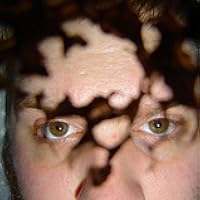
You could only ever see their eyes, glowing yellow in the dark, but you could pretty much always see them, as they were usually just staring, unnervingly, right at the large front windows of our living room. They knew we were in there, I'm sure, and my younger brother and I loved to stare back out at them; see how many we could count until we got scared and turned away. It was probably maddening for them - how close we were. How little actually separated us. How little we'd be able to do, if they ever figured out how to breach that last flimsy, transparent barrier and get all the way inside.
You could interpret the title of Max Restaino's chilling debut novella Coyote any number of ways, but it definitely brought back strong memories for me of the genuine article. The book's protagonist, Jim, is an insidiously relatable headcase - narrating his own formative journey from troubled child to inchoate creep to self-actualized menace - and the intrusive thoughts of extreme violence that plague him throughout his life feel increasingly like predators, hungrily eyeing the doors and windows of his fragile mind, scratching up the wood and glass until sooner or later, something cracks.
The delicacy with which Restaino handles this progression is perhaps Coyote's greatest strength. Where so many tales of mental instability airdrop us straight into a killer's dank torture pit, or else reduce his very existence to some singular, lightning strike trauma or outsizedly heinous, almost supernatural capacity for evil, Restaino brings us along slowly - meticulously - showing how a chance, latenight viewing of a gruesome slasher film (the titular Coyote) ushered a way-too-young Jim into an early obsession with the grim verboten. How that obsession in turn led him to the likeminded friendships and outre proclivities of his spongily absorbent adolescence, dabbling in altered states and making his own disturbing films (calling to mind modern alienation nightmares like Michael Haneke's Benny's Video and Antonio Campos's Afterschool), both of which serve to further blur the lines between his increasingly invasive fantasies and his stillborn reality. And finally, how that wayward youth subtly evolved into a detached, desensitized adulthood defined by the search for access to yet darker realms. Whether he's perusing the hard-R section of the video store, gazing intently at a piece of fresh roadkill, or exploring the abandoned home of a child murderer, Jim never feels like a born monster. He's more like a sleeper agent - activated by that first obsessional image that tapped into his own dangerous hardwiring. And ever since, those intrusive thoughts have just kept clawing outside the door.
From there, the pull of the void is strong; gravitational; exponential. Indeed, this strange inertia is heavily underscored by Restaino's deft, often repulsively poetic use of nature imagery throughout - the cyclical intertwining of damp earth and vegetal growth, carnivores, scavengers, and saprophytes, blood and meat. Killers aren't born, he seems to say softly, almost plaintively. Rather they grow, naturally, perhaps even inevitably, along the way. But even in its rawest, and most savage moments, this is a book of profound, and brave empathy. Restaino neither defends his subject, nor condemns him. Like all the best spelunkers of the abyss, he just wants to shine a little light; to better understand those mean, yellow eyes staring out at us from the dark, sniffing around for a way inside. Because in the end, there's nothing supernatural, or even all that unnatural about Jim's descent into his terrifying final form. You get the sense he did the best he could, for as long as he could, to keep the coyotes at bay. But he saw something he wasn't supposed to see, and it made him feel something he didn't expect to feel, and like the wild animals that populate his environment, his videos, and his deteriorating mind, he's ultimately just following his instincts. For him to chase that feeling to the bitter end - it's the most natural thing in the world.