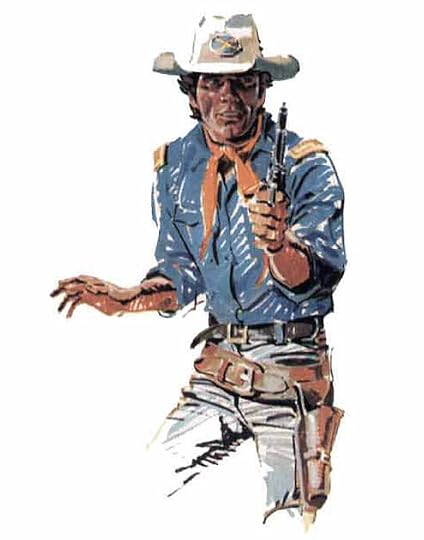
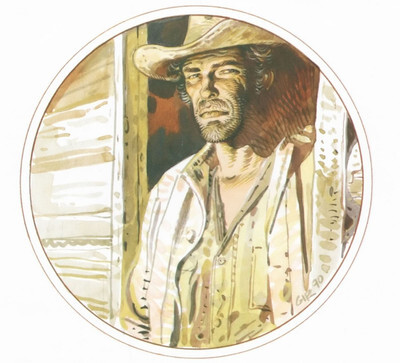
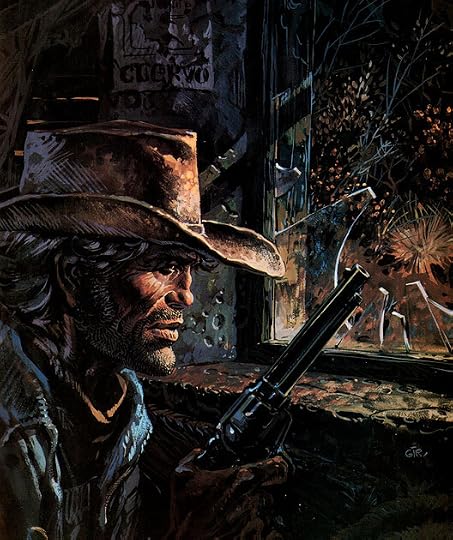
Une gueule. Un personnage. Une légende de l'Ouest américain, pas moins. Il s'appelle Blueberry. Mike Blueberry. Drôle de nom : en anglais, il signifie "myrtille"... Mais attention : avec son nez cabossé, sa barbe de trois jours et son caractère de cochon, Blueberry est un dur. Un coriace. Un éternel rebelle, indiscipliné, râleur et batailleur. C'est aussi l'une des figures légendaires de la bande dessinée, née dans les pages de l'hebdomadaire Pilote. Les bonnes fées de la BD se sont penchées sur son destin : ses créateurs, le scénariste Charlier et le dessinateur Giraud, sont deux signatures majeures du neuvième art. Jean-Michel Charlier, grand raconteur d'histoires et maître du récit réaliste, était l'auteur de classiques comme Buck Danny, Barbe-rouge ou Tanguy et Laverdure. Quant à Jean Giraud - qui ne signait pas encore de son pseudonyme Moebius -, il rêvait de mettre en images les paysages de l'Ouest. Quelques années plus tôt, lors d'un voyage initiatique au Mexique, il avait "passé un contrat avec le western, le désert infini et sa magie". En octobre 1963, Blueberry monte en selle dans Fort Navajo. Il va entraîner dans ses chevauchées plusieurs générations de lecteurs. La série ne manque pas d'atouts : les scénarios impeccablement ficelés de Charlier sont magistralement servis par le trait réaliste de Giraud, dont la puissance s'affirme au fil des albums. Le personnage de Blueberry, lui, va gagner en épaisseur et en humanité. Jusqu'à devenir un homme traqué, brisé, accusé de meurtre et trouvant refuge au sein des tribus indiennes, bien loin de l'imagerie traditionnelle de l'histoire du western. En 1989, Charlier disparaît. Giraud décide alors de poursuivre seul la série. Il met en scène un Blueberry pour le moins inattendu, qui délaisse l'action pour s'interroger sur le sens de son existence... Mais sa carrière est loin d'être achevée : Charlier avait écrit le récit complet de sa vie. Blueberry est programmé pour quitter la scène en 1933, le soir où le président Roosevelt signa l'Acte d'abolition de la Prohibition... --Gilbert Jacques
Jean-Michel Charlier was a Belgian script writer best known as a writer of realistic European comics. He was a co-founder of the famed European comics magazine Pilote.
Legendary! First album of the most popular ‘cowboys and indians’ western series in Europe from Belgian writer Jean-Michel Charlier and graphic artist Jean Giraud at the start of his phenomenal career, before he branched out into science-fiction and environmental issues as Moebius . My comments are for the Integrale edition, published over more than four decades from 1963 to 2007, from serialized strips in the magazine Pilote to 28 hardcover albums, almost 1500 pages of gunslinging and horse riding adventures in the second half of the XIXth century, mostly in Arizona, New Mexico, Texas and south of the Border.
We meet Michael Steven Donovan, later better known as Mike Blueberry, as a young lieutenant in the US Cavalry. After the end of the Civil War, when he enlisted as a bugler for his company, Mike is ‘exiled’ to the middle of nowhere for repeated misadventures : heavy drinking, brawling, insubordination, gambling and skirt chasing. From the start, Charlier and Giraud were decided on their lead character being an anti-hero, the antithesis of the classic western justiciary with the white hat and rigid moral compass.
... avec son nez cabossé, sa barbe de trois jours et son caractère de cochon, Blueberry est un dur. Un coriace. Un éternel rebelle, indiscipliné, râleur et batailleur.
This decision is one of the reasons for the early popularity of the series in the context of the late 1960s social unrest and youth rebellion. From interviews with the creators we learn how they workshopped the look and the actions of their anti-establishment hero.
"[The idea of giving Blueberry Belmondo's face] originated from the both of us. That came about this way: To have Blueberry come across as a non-conformist, I described him right from the start as uncombed, disheveled, unshaven, broken nosed, etc. After he had read that, Jean exclaimed to me, "That's Belmondo!""
I saw some mentions of Charles Bronson also in the design of Blueberry, and the idea is not so far fetched, both for the looks and for the sort of adventures included in the albums. My own reason for picking the series is what I read about the portrait of the Native American history, at odds with the prevalent American image of the bloodthirsty savage looting and raping and ravaging the ‘peaceful’ colonists. While the early albums were only partially successful in this presentation of Apaches, Comanches, Sioux and other mistreated tribes in the West, later albums paint a much clearer and critical picture of their plight.
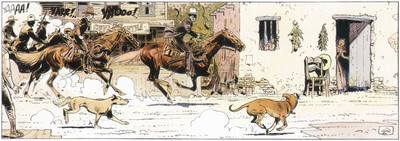
I wish I could give some plot synopsis for each album, but I was too busy reading them to take notes, and the events started to mix and melt together over the six months or so that it took me to finish the Integrale . As a general comment, Charlier is very good at mixing real historical events with dramatic character arcs. The first five albums were a bit too wordy, similar to a lot of other Belgian series from the period, and Giraud was still developing his personal touch of detailed, realistic panels with grotesque, humorous caricatures in support characters. His action panels, his landscapes and his horses in movement will soon become poster material. Both Charlier and Giraud have visited the SouthWest prior to the start of the series, and both were fascinated with the landscape, the colours, the history of the region.
I have arranged to 28 albums by story-arc in order to make it easier for a future re-read and more detailed resumes (eventually):
# 1 to 5 : the Fort Navajo cycle (3 stars). Lieutenant Blueberry tries to prevent an all out war between the US Army and the Apache tribes led by Cochise. Includes: Fort Navajo Thunder in the West Lone Eagle Mission to Mexico Trail of the Navajo
# 6 : single issue (4 stars). Blueberry is on leave from the Army and acts as sheriff for a small town. The Man With the Silver Star
# 7 to 10 : The Iron Horse cycle (4 stars). Blueberry prevents sabotage of the linking of the transcontinental railway lines. He fights against paid mercenaries and outlaws led by a certain ‘Steel Fingers’
The Iron Horse Steel Fingers The Trail of the Sioux General Golden Mane
# 11 and 12 : Lost Mine cycle (5 stars). Blueberry and his friends Jimmy McClure and Red Wooley search for treasure in the Superstition Mountains of Arizona
The Lost Dutchman’s Mine The Ghost with the Golden Bullets
# 13 to 15 : the Confederate Gold Cycle (5 stars). Blueberry is sent on a secret mission to Mexico to recover the missing gold treasury of the Confederate army.
Chihuahua Pearl The Half-a-Million Dollar Man Ballad for a Coffin
# 16 and 17 : Conspiracy cycle (4 stars). Accused of theft, Blueberry is on the run from the law and gets caught in a conspiracy to assassinate President Grant.
The Outlaw Angel Face
# 18 to 20 : the Fugitive cycle (4 stars). Blueberry is hiding with his Apache friends, who are hunted to extinction by the Army.
Broken Nose The Long March The Phantom Tribe
# 21 and 22 : the Rehabilitation cycle (5 stars). Blueberry returns to Mexico in search of proof of his innocence in the theft of the Confederate treasure.
The Last Card The End of the Trail
# 23 : single issue (5 stars) . Blueberry kidnaps a lady on her wedding day, but the Chihuahua Pearl is not thrilled by his domestic plans for the future.
Arizona Love
# 24 to 28 : the Tombstone Cycle (5 stars). Blueberry is drinking and gambling in Tombstone around the time of the duel at the OK Corral. He almost dies in a shotout and tells stories of his youth and of the Apache Chief Geronimo to a couple of journalists from Boston. Written by Giraud alone, after the death of Charlier.
Mister Blueberry Shadows over Tombstone Geronimo the Apache OK Corral Dust
Highly recommended, both for the story and for the art of Giraud / Moebius.
It's so odd to see Charlier and Gir in such a rough state. In the earliest incarnations of Blueberry, there is little to differentiate him from any of the other pulp western comics. Charlier uses real historic terms and events to connect his reader to the story, but then makes little anachronistic errors that rarely show up in the later books.
Likewise, Gir's work is solid, but unremarkable. The transitions are sometimes awkward and there are a surprising number of anatomical errors and inconsistencies in characterization. There is a suggestion of his remarkable eye for backgrounds (especially in the few more heavily-inked panels) but if I hadn't known it was Gir, I doubt I would have guessed.
I read a fairly literal fan translation, which, based on my knowledge of Charlier's style, indicates a certain inelegance in the storytelling. There are extra panels and redundant exposition, though it is possible that there was something more subtle at work which the translator didn't grasp. It wouldn't be the first time.
At least it heartens the artist (and writer) in me: if they started here, then I, too, may be forgiven a certain amount of inelegance in my foundling steps; that is, if I ever make any.
Grazie a Fabietto che mi detto che sarebbe uscita questa collana.
Non male, ecco. Pensavo peggio vista l'età e l'argomento. C'è lui che è un militare un po' sui generis che viene spedito in un forte fuori dal mondo in cui c'è un tipo che vuol far carriera a spese degli Indiani. Quindi la tregua messa in piedi con tanta diplomazia è in pericolo...
Anche i disegni sono meglio di quanto mi aspettassi. Mio papà ha subito riconosciuto Jean Paul Belmondo dietro Blueberry ma io non credo di averlo mai visto da giovane e non sono riuscita a far il collegamento.
Von Rothäuten und Blaujacken Wer vor diesem Band eines der Standardwerke zu den Beziehungen zwischen den US und den Indianern, Bury My Heart at Wounded Knee, gelesen hat, weiß direkt, worum es in diesem und einigen Folgebänden gehen wird: Die Bascom-Affäre, die einen jahrzehntelangen, verlustreichen Krieg zwischen den Vereinigten Staaten und den Apachen lostrat.
Manche Klischees entstehen aus wahren Begebenheiten, und der leicht durchgeknallte Bascom war wohl wirklich, wie hier gezeigt, ein paranoider Xenophobiker, der gerne am liebsten alleine den Genozid geleitet hätte. Aber auch wenn es wirklich solche Personen gab, so eignen sie sich nicht wirklich für interessante Literatur - spannend sind diese Leute nicht, weil sie nur schwarzweiß kennen. Und so wirkt dann auch dieser Auftaktband der Blueberry-Reihe: Voller Klischees, alles schon hundertmal gesehen und gehört. Neben dem Universalbösewicht Bascom gibt es den edlen, aber leicht selbstverliebten und unerfahrenen Kavallerieleutnant Graig (Generalssohn, gerade frisch aus West Point), den aufrechten Obristen, der leider in entscheidenden Situationen vom Faktischen überholt wird, die eigentlich gutmütigen Indianer, denen Unrecht angetan wird, die arme Familie, die zwischen diesen Fronten als Sündenbock zermahlen wird, Schießereien in Saloons und eine Kutschfahrt, in der der edle Kavalier die (selbstverständlich ausgesprochen hübsche) Tochter des Obristen kennenlernt. Hach ja. Spannend und neuartig sieht anders aus. Blueberry selbst hat eigentlich mehr eine Beobachterrolle inne, die er mit erstaunlich inbrünstiger Gleichgültigkeit ausfüllt.
Wahrscheinlich ist das Szenario aber eh nebensächlich, die meisten Leser wollen Jean Girauds Zeichnungen bewundern. Leider hat dieser Band aber noch nichts von dem, was den Zeichner, der unter dem Namen Moebius später Weltruhm erlangen sollte, so einzigartig macht. Sehr generische Cowboyzeichnungnen, nette Landschaften, mehr aber nicht.
Jede große Reihe fängt klein an. Bei Blueberry überrascht mich aber, wie klein das sein kann.
Westerns and European/BeNeLux-comics from the golden age are currently remembered by the collective conscious for their racey caricatures. It is the identity generation after all. To move the goalpost a little bit: the golden age is considered twenty years AFTER most of the harshest stereotype depictions peri- and post-war; Hergé drew his infamous comics during still-colonial Belgium in the 1940s. War hast stark contrasts of black and white, after all.
Maybe things got a little better through the decades? In 1963, at the time of the famous speech by Martin Luther King Jr. , René Goscinny and Jean-Michel Charlier were leading the french magazine 'Pilote'. Both of these artists were pioneers of the "Ninth Artform" known as comics, and a revered duo with already a name in their profession. This, however, did not stop their magazine from falling into financial trouble in their days, which forced them to go into self-publishing in the form of Édipresse. This eventually lead to the form of Blueberry as we see it today, with the fresh rookie Jean Giraud not disappointimg despite his big boots to fill. I also learned about the drawing technique used by him: gouache for those interested, from which the then young man had experience from drawing historical objects and depictions during his industrial art studies.
Blueberry is a solid take on the Western comic genre. It tries to dissect some of the sordidly tragic relations between Native Americans and the Yankees. Its realism is a good balance for Lucky Luke, though faces and situations are occasionally animated in toony ways. On another note: I wonder what Goscinny thought of the way we see caricatures today, even though a lot of our consumed media has distanced from reality
Facts are borrowed from the translated foreword of José-Louis Bacquet in a Finnish omnibus (first three Blueberry alba, ISBN 978-952-01-1988-1). It has a lot more detail, which is why I recommend to read it in total if you find it elsewhere.
This first album of Jean-Michel Charlier and Jean Giraud's brilliant Western series introduces the character of Mike S. Blueberry, seasoned veteran and a card cheat, here in competition with the fresh-out-of-the-academy lieutenant Craig (whose father is one of the reasons for Blueberry being stationed at Fort Navajo). It also opens the first five-part arc of the series, which deals with the wars against the native Americans (in particular the Apache, or more specifically, the Navajo).
All in all, it is a strong start for this series and highly recommended.
Retour dans le passé et retrouvailles chaleureuses avec le cow-boy favori de mon adolescence: de l’aventure au galop, un héros tête brûlée plutôt sympathique, le cadre de l’ouest américain superbement rendu, tous les ingrédients sont réunis pour passer une excellente après midi détente en compagnie du lieutenant Mike Blueberry.
Klasican vestern. Cijela garnitura standardnih likova je tu. 48 stranica proleti u galopu i sad jurisam po novi nastavak. Crtez je ono sto mi se ne sviđa, ali znam da ce se to vremenom promjenit pa se ne sekiram
Uno de los cómics más emblemáticos del salvaje Oeste es, por méritos propios, el creado por Charlier y Giraud en 1963 (unos cien años después de la Guerra de Secesión): Blueberry. Habiéndolo devorado desde niño, tenía muchas ganas de abordar la serie completa en orden cronológico. Así, me hice con el primer tomo, Fort Navajo, y he aquí mis impresiones. Aunque lo primero que me ha llamado la atención ha sido el estilo, que no se ve todavía asentado (suele resultar extraño abordar un primer número cuando se conoce a lo que ha llegado la serie), hay que señalar que la colección empezó ya con mucha fuerza, sobre todo en el plano narrativo. Llama la atención, de entrada, cómo el guión de Jean-Michel Charlier va hilando los grandes tópicos del género con mucho acierto. Así, arrancamos con un oficial atildado, todo un caballero que sale de West Point (la célebre academia militar) destinado a Fort Navajo y empieza su andadura con un encuentro en un saloon: partida de cartas, pelea a puñetazos y la presentación de su inesperado compañero de andanzas, otro oficial (nadie lo habría dicho por su aspecto desaseado) que no es otro que, evidentemente, Mike Blueberry. La rivalidad entre estos dos jóvenes oficiales va a servir de hilo conductor, un poco como en Zulú (la película de Cy Endfield, 1964), y va a articular una trama en torno a un alzamiento de indios apaches contra los colonos blancos, con aparición estelar de Cochise, su carismático y casi legendario líder. El conjunto es muy interesante, con tiroteos, persecuciones, escolta a una diligencia en la que irá, cómo no, una bella joven, cargas de caballería, etc. Falta ese punto redondo de cómics posteriores y en ocasiones da la impresión de que se concatenan demasiados elementos, como si hubiera demasiados homenajes a poner en marcha en tan pocas páginas, pero globalmente funciona muy bien. Es posible que también el haber sido concebido como formato serial pesara en el empaque del guión. Lo más interesante es ya, sin duda, el poso de crítica a las injusticias sufridas por los pueblos originarios americanos, no solo puesto de manifiesto en la actitud del propio Blueberry, sino también a través de interesantes personajes secundarios. Sobre el protagonista hay que añadir que su perfil está ya muy bien definido, tanto desde un punto de vista psicológico (ese héroe con su punto de ironía, lejos de los excesos del caballero de blanca armadura propio de la época, que le valdría ser tildado incluso de antihéroe) como en cuanto a la apariencia física: el dibujo de Jean Giraud nos muestra ya un aspecto carismático y único, inspirado, al parecer, en los actores Jean-Paul Belmondo y Charles Bronson. Así, Fort Navajo es un cómic muy dinámico y entretenido, con un fondo mucho más rico, tanto por el contexto histórico como por la crítica social, que el de los clásicos cómics de aventuras de la época y que sienta las bases, con acierto, de lo que será posteriormente la serie. Un muy buen arranque.
This is a comic in a classic western style. The main characters are two men; one named Blueberry and one named Craig; who meet by chance on their way to Fort Navajo. Along the way their stagecoach comes across the scene of a massacre at the ranch of a local family. The assumption is made that the family fell victim to the Navajo and as a result many mistakes are made.
I feel this book sets a good foundation for the following comics. Craig and Blueberry have personalities that counter and support each other well.
Content Consideration: racism, slavery, one use of the word bastard in politically correct way, scalping, death of women and children
I felt these topics were addressed in the proper way. Blueberry says he does not like slavery and was disowned by his family as a result. He also shows sympathy for the Native Americans amidst a superiors racism. The deaths of women and children are more stated than shown. Nothing is too graphic.
Lu en publication hebdomadaire dans une collection de Pilote de 1964. Je trouve ce début de la série Blueberry parfait en son genre. Tout y est, les massacres de pionniers par des Indiens mexicains qui se font passer pour des Navajos. Le fort isolé en territoire apache. Cochise, le vieux chef sage. Et tous ces portraits d'officiers, le commandant du fort, juste et bon, le bel officier frais émoulu de West Point, qui ne connait rien à l'Ouest, le méchant pour qui un bon Indien est un Indien mort, et bien entendu Blueberry, qui n'est plus à présenter. Parmi les commentaires, un des lecteurs italiens écrit que tout ça c'était déjà, vingt ans plus tôt, dans Tex, leur gloire nationale en matière de fumetti. Peut-être. En matière de western, les thèmes ne sont pas légion. Il y a la manière de les traiter. Ici c'est magistral. Amha.
He querido darle una oportunidad al Teniente Blueberry que nunca me atrajo lo más mínimo en las aventuras serializadas que aperecían en los cómics de mi niñez. El Oeste sucio y desalmado cercano al spaghetti Western de Leone no era plato de mi devoción. Me he encontrado con una historia de indios y vaqueros ramplona y llena de tópicos que no me ha dicho nada en ningún momento. Tampoco me ha gustado el dibujo de estos primeros álbumes, genérico y poco refinado. Quizá le de una oportunidad a sagas posteriores.
C’est le contexte historique de ce premier volume de blueberry avec cette intégrale #1 qui rends cette histoire si bien réussi. L’histoire de Charlier et Giraud autour de l’établissement des bandes dessinées et Goscinny, Uderzo avec l’hebdomadaire Pilote où Tanguay et Laverdure, et blueberry feront leurs débuts en 1963. C’est fascinant.
Le fort Navajo démontre la haine de certains contres les premières nations. Un événement en apporte d’autres et le tout se multiplie hors de contrôle.
A decent start but definitely a long way to go for Charlier and Gir. Feels pretty pulpy, but it sounds like it took them a bit to find their own. My first experience with Blueberry and I can't wait for the later books! Moeb's art is stunning even if it's not as polished here as in later volumes. The translation is nothing special.
Blueberryt jäivät joten nuoruudessani lukematta ja nyt kun ovat ilmestyneet komeina integraaleina päätin tutustua tarkemmin juttuun. Ja kyllähän tässä rajaseutujen kliseet kolisevat, vaan kovin sympaattisella tavalla. Jatketaan lukemista, jotta saadaan ainakin ensimmäinen tarinan kaari valmiiksi.
Pretty much just a cavalry Western but in comics form. Art is cool—love the poses and silhouettes Gir finds for the Western action—but story and characters are very standard.
Primera de las aventuras del Teniente Mike S. Biueberry, recopilada en este álbum que lleva el título de «Fort Navajo».
El inicio de un clásico del tebeo europeo en el que descubrimos una visión del salvaje oeste, más bien alejada de la mitificación artística que se había dado, hasta los años sesenta, en los Estados Unidos.
Aquí se presenta al joven oficial del ejército de la Unión. Un hombre pendenciero, indisciplinado y astuto pero, al mismo tiempo, enormemente leal. Como obra inicial, está lejos de lo que los autores llegarán a dar, contando las aventuras de este Blueberry que, recién salido de las batallas de la Guerra de Secesión, será testigó del auge, ocaso y desaparición del mundo del oeste.
Premier tome de la série, on y découvre un héros non-conformiste (pour l'époque, il a fait des émules entre-temps) : Blueberry boit beaucoup, fume (beaucoup aussi) et il ne respecte pas les règles alors même qu'il est dans l'armée !
Une tête brûlée donc qui, non content d' être fort en gueule et indiscipliné, pense que l' on peut discuter avec les indiens au lieu de les massacrer sans autre forme de procès !
Un héros tout de suite attachant, servi par un scénario haletant, les bases du mythe Blueberry sont posées !!!