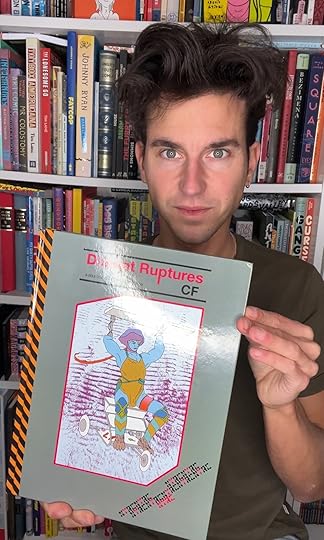
C.F. is an American visual artist, cartoonist and musician. Born Christopher Forgues in Eastern Massachusetts in 1979, C.F. graduated from the Massachusetts College of Art and is currently based in Brooklyn.
C.F.'s comics have characteristically defied storytelling and formalistic norms, and instead have been distinguished for their fluid or even nebulous narratives. Rob Goyanes interviews C.F. for this collection, asking a little about C.F.'s process, to which the artist cites Cormac McCarthy's approach to storytelling where stories can't be plotted out and instead one must "trust where it comes from". That isn't to say that C.F.'s stories are anything like McCarthy's, but understanding that the stream-of-consciousness stories aren't fully coming from nowhere is relevant towards reading the work.
Distant Ruptures is a fairly comprehensive collection of many of C.F.'s short works/zines/anthology contributions between 2000-2010. Having made many limited print zines or additions to out-of-print anthologies like Kramers Ergot, Mould Map and Paper Rodeo, this collection is great to have for those wishing to sample earlier C.F. works that have been much less accessible for years now. Though I have enjoyed some of C.F.'s longer form works like Powr Mastrs (PictureBox), Pierrot Alterations and William Softkey and the Purple Spider (both published by Anthology Editions), his brand of storytelling works best in short bursts. Though C.F.'s style has seen some evolution in recent years (as he continues to publish a few zines each year), the work chronicled here in Distant Ruptures will still paint a thorough picture on a very singular artist working in the modern comics landscape.
Varying in genre and tone, the short comics in Distant Ruptures convey C.F.'s continued disregard for conventional storytelling tropes. Often starting with a familiar premise, the stories devolve quickly into whimsical and often nonsensical directions. Roughly half of the comics here will make little to no sense, though they will still mostly find a way to be funny and imaginative. Some favorites here include "Bat-Man", "Semen", "Prey/Castor and Pollux/Creepy Crawl/Aerosol Burns/Del-X/Do-So" and "Core of Caligula", which are also unsurprisingly, the longer entries in the book. What I really enjoyed about the way this book came together is how it feels like a museum exhibit, where the reader is free to peruse the collection in any order. The size of the book also helps provide additional dimension to the artwork, since most of C.F.'s comics have typically been in pamphlet sized zines. The scribbly, thin and crude linework looks fantastic at larger scale, and the subdued watercolors (when used) look grand. Not an artist many would enjoy, but for C.F. fans this really is a collection worth picking up.
It feels way too incomplete for me. I guess it's my fault that i didn't knew what i was getting into and felt the need for more story development. I also didn't appreciate some (hopefully) ironic, random, questionable groups/minorities naming (easter eggs for anyone sensitive to things like that, like i am). If i put it all that aside i could enjoy the braveness in making comics like it's jazz or something like that, improvised, with some jolts of creative sandwiches of cool art buns and interesting wordplay mayonnaise. So, a medium read for me, a snack of sorts.
If you asked me right now I’d say C.F. is my favorite cartoonist. So inspiring how he casually disassembles the constraints of the medium and pushes the (literal) boundaries of comic-making. There is an impermanence in his work that ironically sticks with me. I can’t stop thinking about it. It’s like changing the channels, seeing snippets of worlds without concrete beginnings or endings or tidy resolutions, small glimpses into something.
Distant Ruptures collects punkish, rough-and-ready short comics that look a little unfinished, and often must be deciphered through smudgy Xerox murk, yet they’re punctuated by dazzling—if disorienting—crescendos that sometimes feel like epiphanies. Reading these fragmentary, enigmatic stories—studded with magicians, giant spiders, and bandits joyriding in stolen tanks—can feel a bit like listening in on a couple of kids playing with action figures. Digressions and tonal shifts abound—to say nothing of outright transmogrifications—and narratives routinely drop off unresolved. Passive reading won’t do here. Maybe it’s the talking owls, but at times reading these comics feels like a brush with some arcane knowledge. There’s a faint whiff of a Situationist (as in Debord) reconfiguration of pulp tropes, but even thinking the word “appropriation” feels like a wrong turn; these are wholly free of any bad-faith irony.