Jump to ratings and reviews
Rate this book

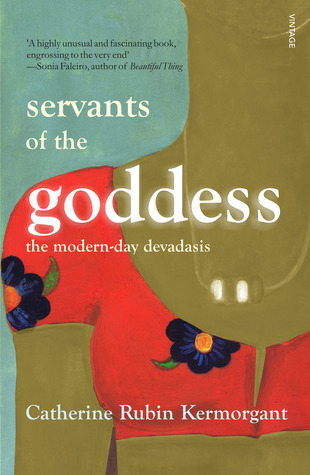
Servants of the Goddess: The Modern-Day Devadasis

Rate this book
Servants of the Goddess weaves together the heartbreaking, yet paradoxically life affirming stories of five devadasis - Women, in the clutches of an ancient fertility cult, forced to serve the gods. Catherine Rubin Kermorgant sets out attempting to make a documentary film about the lives of present-day devadasis. Through her, we meet and get to know the devadasi women of Kalyana, a remote village in Karnataka. As they grow to trust Kermorgant and welcome her as an honorary sister, we hear their stories in their own words, stories of oppression and violence, but more importantly, of resistance and resilience. Kermorgant becomes a part of these stories and finds herself unwittingly enmeshed in a world of gender and caste bias which extends far beyond Kalyana, all the way to Paris, where the documentary is to be edited and produced. Servants of the Goddess is a testament to women's strength and spirit and a remarkably astute analysis of gender and caste relations in today's rural India.

408 pages, Paperback

First published February 24, 2014

15 people are currently reading
1692 people want to read

About the author

Catherine Rubin Kermorgant

1 book15 followers

Ratings & Reviews

What do you think?
Rate this book

Friends & Following

Create a free account to discover what your friends think of this book!

Community Reviews

5 stars
34 (43%)
4 stars
27 (34%)
3 stars
15 (18%)
2 stars
3 (3%)
1 star
0 (0%)
Displaying 1 - 23 of 23 reviews
Profile Image for Paras.
182 reviews36 followers
August 7, 2014
Imagine being dedicated to a temple at the age of 6 years and wearing a beaded necklace for the rest of your life. Imagine being paraded in a procession of singing men and women on a high slab with nothing on your body except Neem leaves as soon as you hit puberty and being ‘deflowered’ when you don’t even know the reality of what just happened to you. Imagine being a mother of two at the age of fifteen (or even less). Imagine never being able to marry because ‘you’re attached to the temple for the holy duty you have been assigned’. Imagine a life of forced a sex worker, of poverty, of never being able to provide for your kids. And imagine all this while being (called) an ‘untouchable’.

Catherine Rubin Kermorgant in her book ‘Servants of the goddess’ after researching at Paris about the life of Devadasis, sets out for a small village Kalyana in India in order to learn more about truths and myths regarding the Devadasi system in India after which she is planning to make a film (documentary) sponsored by BBC. Soon (along with her interpreter Vani) Catherine learns about the heart wrenching tales of Devadasis, their stories of being dedicated by their families against their will or simply when they did not even have any knowledge of why they were being ‘beaded’ at a certain age.

Etymologically, deva-dasis are courtesans or dancing girls attached to temples, however the public more or less calls them prostitutes as they are bound by this profession to grand such favors to the visitors to the temple (or anyone else for that matter) in return for money. And hence it becomes a thread of survival for them. These Devadasis are mostly untouchables dedicated to the temple at very young age (mostly before puberty) by their family and live their whole life providing sexual services in the name of religion.

The more Catherine comes closer to Devadasis of Kalyana, the more she realizes the misery of these women: poverty, kids at a very young age, never being able to marry—they can take a ‘Jhoolva husband’ who may or may not decide to leave them after actually getting married—rather, earning money to support their whole family—even bearing the responsibility of marrying off their brothers. Hence, it hardly comes as a surprise to Catherine when she learns that Devadasis mostly die young—in their fifties at maximum—by either committing suicide or living their latter part of lives as alcoholics or falling in severe depression.

The book is divided into three parts: the first part discloses Catherine’s field research where she develops life long bonds of friendship and love with the devadasis of Kalyana, reassuring them that she would tell share story to the world of their oppression and destitution. The second part of the book portrays her journey back to Kalyana along with her film team and the Co-director Dillip—a pretentious high caste Brahman Hindu who is of opinion that Devadasi system is more of an old Indian cultural tradition than exploitation of poor women and is thus adamant on emphasizing upon the pros of the system such as financial stability etc.—all set to document the lives of young Devadasis in the hope that it might bring a positive change in their lives by being noticed internationally.

The second part of the book pours light on the caste and class differences where Catherine experiences firsthand the treatment of low caste—untouchables—by the high caste film crew. It is almost astonishing for the author to witness such cruel treatment of one human being by another just because one was born in a less fortunate household than the other.

The last part of the book I think is basically why Catherine decided to write a book in the first place. Although the devadasis had been filmed for weeks in their village and made to tell their woeful stories in front of strangers for all they knew, Catherine’s Co-director Dillip was resolute on showing Devadasis in the light of nothing but a glamorous culture of Hindu religion.

Whether Catherine wins her battle of truthfully depicting the lives of Devadasis or Dillip succeeds in manipulating the Producer in changing the whole story of the film, one has to read the book to know the full story. The author has nevertheless kept the reader fascinated and captivated throughout the book—one laughs when the girls of goddess laugh, and cries at the injustices that engulf their daily lives.

Profile Image for Ravi Jain.
159 reviews21 followers
March 13, 2014
Full Review: http://www.bookgeeks.in/entries/forei...

Wendy Doniger’s book ‘The Hindus: An Alternative History’ was recently recalled and pulped by Penguin India because it “hurt the feelings of the Hindus.” More specifically, the connections between sex and religion were the main concerns the opponents had about “The Hindus”. I am in the middle of reading it, and it sure is derogatory, but the fact is that Hinduism has had its share of strange and barbaric traditions, practices and customs; Jauhar, Sati, Human Sacrifices, Dhama, Fire Walking, Self-flagellation, were practiced for centuries, and some of them are still practiced in many rural areas.

Another such brutal and centuries’ old tradition is the Devadasi system. Under this system, young girls are dedicated to temples, and are bound to provide sexual services to male visitors of the temple. Catherine Rubin’s book, ‘Servants of the Goddess: The Modern-day Devadasis’, attempts to throw light on the Devadasi system and its presence in modern-day India. It comes as an answer to the banning of Doniger’s ‘The Hindus’ and, in an indirect way, shows that sex and religion have co-existed in Hinduism from a long time.
Profile Image for Manas Barpande.
99 reviews29 followers
August 18, 2020
From Sangli in Maharashtra to Kalyana village in Karnataka, devadasi system is a blot on the face of humanity, that we conveniently cover & ignore with shreds of 'ancient culture'.⁣

Imagine being 'dedicated' to a temple at the age of ~6 years & having to wear a beaded necklace for the rest of your life. Imagine being part of a procession that 'celebrates' your ‘deflowering’ by a high caste man as soon as you reach puberty. Imagine never being able to marry because you're 'property of the temple' & if anyone dares to marry you, he would face the wrath of the goddess Yellamma. Imagine a forced life of a sex worker, of poverty, of never being able to provide for your kids.⁣
Everything you just imagined is everyday reality for thousands of devadasis across India who are still being exploited under the garb of Hindu traditions.⁣

As the author Catherine Kermorgant finishes her research and spends months with these devadasis (aka servants of the goddess) in their village, for a BBC documentary, she gets the firsthand experience of the horrors of caste system - rampant prejudices & the exploitation of the low-caste.⁣

Poverty ridden untouchables have no other option than to succumb to the devadasi system. They don't just have to fight for their day-to-day survival but also have to take care of their family and send their younger brothers to school, who in turn, despise them for their 'work' & split after growing up. It's no surprise that Devadasis die young—before their fifties mostly—by either committing suicide or living their latter part of lives as alcoholics or severely depressed beings.⁣

A must read book for everyone. Not many people have the heart to understand the pain of others, let alone the courage to even try to alleviate it. The empathetic narrative of Catherine & Vani (her translator) amidst everything else is something to look up to. It's not just about the sad things but also shows how, sometimes, people find their hope & happines amongst smallest of things; how the folklores could also be stories of hope for someone going through hell.⁣
Profile Image for Masood Rezvi.
Author 7 books9 followers
December 15, 2021
Exploitation - poverty - exploitation, the vicious cycle is as old as the civilization itself and is universal.
Regal power, priests and those who happen to be wealthy through luck or machination have been the major drivers of this wheel.
The Devadasi institution of India in which low caste females have been and perhaps are still being sexually exploited is one example. At the root of it is economics, as the author has explicitly admitted. It is however not the only such institution in the world. If not in the name of a religious cult, in so many other ways girls including children are being exploited the world over. Such exploitation, if we believe the reports are rampant in the most developed places and that includes New York and Paris. The institution of pornography in these places is an example. Do you think that the girls playing roles in such films and images give their free consent to be photographed that way? How many of them would sign s contract to work in such movies if not compelled by penury?
The Gorean cult is another instance of sexual enslavement of women in the West.
India is no exception, here too exploitation of poor females -trash pickers, street beggars, domestic workers, and others is prevalent in every locality. In my book "Tightening Noose of Poverty" I mentioned with images a slum locality in Lucknow and invited serious researchers to research their lives. The poor inhabitants of this locality - mostly trash pickers - do not even enjoy the air of sanctity of a cult, the devadasis of Kalyana enjoy. And I have mentioned there that this is not specific to Lucknow or even India. Such slums have been reported even in papers published by the Global Poverty Project workers at Harvard University.
After going through this book by Catherine Rubin Kermorgant, however, one gets an impression that the sexual exploitation of the sort, she found the devadasis suffering from, is specific to that cult only. She has painstakingly depicted a pandemic as an endemic. Why? Because of her bitter differences on 'who was the boss' issue with her colleague Dilip in the film project? She has also made some scathing generalizations about Indian society. For example, the remark 'Every girl in rural India loses her virginity this way (in a rape)' is simply not acceptable to any discerning mind. Of course, she has put these words in the mouth of her adversary - Dilip.
She could have done much better had she also mentioned that now in free India a large number of Dalits has risen to the top-notch executive posts, and they are fully integrated into the system of a resilient Indian society, though at many places the insult to them especially the poor ones persists.
The book is still quite informative and can help as a practical guide to those who wish to undertake similar social or anthropological studies.
I strongly recommend this book for reading but before you go for it, kindly read 'Orientalism' by Edward W. Said.
Profile Image for Krishnan.
5 reviews
February 28, 2017
A must-read book. Sensitively written and filled with compassion. Kudos to the author. I have no qualms in recommending this work to everyone.

A must-read book. Sensitively written and filled with compassion. Kudos to the author. I have no qualms in recommending this work to everyone.
Profile Image for Neha Garg (thereadingowl_).
275 reviews53 followers
June 8, 2015
Devadasi in an ancient tradition practiced in some parts of India where girls are dedicated at an early age to temples and forced into a life of prostitution. They are made to forego any hope of a respectful life or of a healthy family. Some are sold to brothels in Mumbai and South India and contract fatal diseases.
The only time they are acknowledged as human beings is during religious festivals and pujas. Else, their lives are nothing short of living hell.

Being an Indian, i witness the harsh realities of caste system that still permeates Indian society, still, i was not prepared for the shock, pain and guilt, the book invoked in me. This is a non-fiction but the characters in the story stand out vividly. It is never boring and i felt one with the emotions of its characters. The names had associated images that came to my mind every time they were mentioned. I was moved by the sorrows of Devadasis, anguished by their helplessness and angered by the people
who cheated the simple minded villagers for teir own economic and sadistic ends.

The book is not only about sad things. It taught me how people try to be happy in worst of the situations and find happiness in simplest of the things. That superstitions and folk tales are not just stories but a source of inspiration if one looks closely. That history is good or bad depending on how you interpret it.

Not many people have the heart to understand the pain of others, neither they have the courage to even try to alleviate it. I found these both in the writer of this book Catherine and her friend Vani, who go among the so called "untouchables" in a remote village of northern Karnataka in India and become a part of their lives, sharing with them whatever shred of hope and happiness they could find. I know i'll ever have the courage to do even a fraction for others, what Catherine and Vani did for these devadasis, but I wish that the writer's good work brings awareness among social, political and religious leaders of our country and they'll look beyond their personal gains to better the society and help people out of systems like the Devadasis.

Profile Image for Shrilaxmi.
293 reviews69 followers
July 19, 2024
July 2024:
I understand this book better and could connect it to a lot of things I've seen and hadn't thought about, especially as a person who has spent a significant amount of time in north Karnataka. It was sad and scary and exasperating but as I noted the first time I read it - so full of hope.

November 2016:
This book is one I think everyone should read. It talks about the lives of people who are victims of the Devadasi system. The majority are ignorant and of those who have caught a glimpse of this world behind rich temples, many pretend it doesn't exist. One thing that struck me hard is the prejudice that the commoner harbours while dismissing Devadasis as untouchables till nightfall when it suddenly becomes acceptable and even "holy" to associate with them. But what I thought was the best thing about this book is that although there is so much suffering and sadness, another thing that abounds in this book is hope that one day, young girls won't have to go through what the Devadasis go through today. That nobody would be subjected to the horrors of this system for want of a bit of food.

I received a free copy of this book from the author
Profile Image for Marissa MC.
8 reviews
January 2, 2019
If you want to journey from Paris, France to Kalyana, India, and to fall in love with a group of women you’ve never encountered, this is the book for you. A heart-warming tale of struggle and the versatility of endurance this group of women possess while being thrust into a life of servitude in the most unimaginable conditions. The cause and effect of their lives, cyclical and devastating as they strive to serve their goddess, Yellamma. Catherine Rubin Kermorgant is filming a documentary when she becomes intertwined in the lives of the women. And soon her enemies become theirs in a twisted plot that reads rapidly like fiction.

Put this on your life reading list. I believe that every woman should read this book at some point in her life and men should read it to understand the fate of many women, not just in India. Kermorgant’s vivid and precise writing allows the reader to be a silent traveler on her journey where there’s hope, despair, suspense, and drama from the vilains who pop up in her chronicles.

Grab your copy and share it with your closest friend.
1 review
October 3, 2014
Incredible story. In the end, I couldn't put it down. I found myself drawn in because the writer made it feel like we were there with her in India, among the Devadasis. We feel what they feel, and though they may seem strange at first, we come to understand their perspective. The material about prostitutes and prostitution in general is fascinating. No clichés here -- The women are not sad, passive victims of male exploitation, but heroines, each in her own way, overcoming unimaginably difficult situations with amazing strength. They are so inspiring! No trauma is too great to overcome. The women in the book may be illiterate, but we have a lot to learn from them.
1 review
March 16, 2014
Fascinating. Great story, vividly told. Poignant, yet funny. The author takes us beyond the exotic images of India we know by heart and deep into Indian culture. Though non-fiction, it is never boring. The characters are vividly described. The women come from a very different world, and yet we can easily relate to them. Getting the point-of-view of these "sacred" prostitutes and the tricks they use to ensnare men is a real eye-opener. It's worth visiting the books website to look at the photos of the characters. A must read.
Profile Image for Vinay Leo.
1,006 reviews82 followers
May 7, 2014
Review at A Bookworm’s Musing: http://wp.me/p2J8yh-2CG

Read this book for a non-fiction that sometimes feels like an incredulous fiction, but one that brings out the troubles Devadasis face in their lives. The book, originally meant to be a documentary, is well researched and though its presentation feels boring at times, it reveals that a tradition or custom we thought was mostly abolished still continues to be practiced silently in some parts of the country.
Profile Image for Michelle Nicolaou.
10 reviews12 followers
Read
May 16, 2016
My first non-fiction of the year. A very human introduction to the complexity of the devadasi system. A book that pulls heart strings unapologetically through the landscape that is rural India and the vibrancy of the spectrum that these women feel so rawly. Insightful and methodical in its reflection, Kermogrant does a good anthropological job of approaching subjects of caste and gender, but her importance lies, above all, in her solidarity and human compassion.
Profile Image for Consuelo Murgia.
Author 12 books57 followers
October 25, 2014
I'm attracted by books with exotic settings and dealing with the lives of oppressed women and this one, about gender and caste relations in India, is surely one of them.
Profile Image for David Skivington.
Author 2 books6 followers
November 23, 2014
A very powerful and important book which really delves below the surface into the lives of the Devadasi women of India. Extremely well written raising awareness on a very important issue.
Profile Image for Joseph.
21 reviews
September 11, 2025
Kermorgant entered the devadasi world initially to make a documentary but ended up producing this powerful book recounting the stories of five women dedicated to the goddess from childhood—a dedication often forced upon them by poverty and familial pressures. The women live lives marked by early motherhood, sexual exploitation, exclusion from marriage, and economic hardship, all framed by their sacred but stigmatized roles. The author’s close relationships with the women give the narrative intimacy and authenticity, showing their voices and perspectives without sensationalization.

The book highlights the interplay of caste discrimination, gender violence, and cultural traditions that trap these women in cycles of poverty and sexual servitude under the guise of religious duty. Kermorgant also reveals internal tensions, such as caste-based discrimination within the production team and the challenges of representing the devadasis’ narratives without diluting the harsh realities they face. The juxtaposition of the village realities and international filmmaking contexts further underscores global inequalities of power and representation.

While Kermorgant is respectful and empathetic, some critiques note the occasional Western outsider gaze—as a foreign researcher and filmmaker, her presence sometimes highlights the challenge of fully transcending Western preconceptions about gender, caste, and religion in India. However, the book largely resists exoticizing or simplistically condemning the tradition, instead giving space to complex lived experiences and systemic forces.

Servants of the Goddess is an astute and heartbreaking account that broadens the understanding of the devadasi system today, moving beyond historical romanticism or mere victim narratives. It serves as both a tribute to the women’s courageous spirit and a call for justice, exposing how deeply embedded social inequalities perpetuate their exploitation. The book is essential for readers interested in gender studies, caste dynamics, and the intersection of religion and poverty in contemporary India. Kermorgant’s work offers a clear-eyed yet compassionate view of modern devadasis, while carefully negotiating the complexities of insider-outsider scholarship and revealing both the strengths and limitations of Western engagement with deeply local realities.
Profile Image for Nex_imo.
3 reviews
June 24, 2025
Of all the books I have read in 2025, this one is the best so far.
Profile Image for Rich.
16 reviews1 follower
April 2, 2016
Insightful, eye opening, disturbing, complex and many other adjectives. A swift takedown of Hindu traditionalism and caste, yet questions some knee jerk Western liberal assumptions too. The author wears her feminism a little too much as she seeks to excuse all women, even those who seek to sabotage her project for personal gain, yet fails to give most of the male characters the benefit of the doubt. But I can forgive her this because the system is uncontrovertibly stacked in favour of the male players, and it makes you so angry to hear many of them excuse it. Perhaps I'm just sensitive of my own privilege.

Picked this up at Liverpool's Slavery Museum where I was distressed to see a video of a young devadasi dedication ceremony. It was heartbreaking to see the fear in the girl's eyes yet the forceful enthusiasm of the devotees pushing her into it. Like watching a video of someone being abused. Horrible. Indian religion really has a lot to answer for, but gets a soft pass by many Westerners who clearly turn a blind eye to its dark aspects.

Highly recommend this book.
1 review
April 10, 2014
Incredibly moving work of nonfiction about sacred prostitutes in India. I could hardly put it down. If the writer didn't do such a great job fleshing out the characters and how the system works, I would have had a hard time believing it were true. The character development and the descriptions -- from the sacred prostitutes to the filmmakers to the local politicians are excellent. The plot thickens when the film team arrives and as we move along we go deeper and deeper into the psychology of the characters as well as the complexity of modern and ancient india. I loved the intriguing bits and pieces of history that the writer throws at us. I wish there were more. The chapter on how prostitutes get their revenge of men is amazing. Reminds me of what Studs Turkell writes in his book "Working." Fascinating. All in all great read.
Profile Image for Zach Leatherman.
1 review1 follower
September 11, 2016
This highly readable work embarks on an enchanting adventure to the Indian countryside to shed light on the problems faced by women who are forced to take part in one of the most ancient religious traditions known to man. The journalistic/anthropological point of view combines with fantastic poetic imagery to create a stunning portrait of this distant society and the unique ways it oppresses and gives life. Kermorgant masterfully illustrates the delicate balance that surrounds these (in)auspicious women in their struggle between sexual slavery and liberation. I would highly recommend this book to any fellow Women/Gender Studies students, as well as anyone else looking for a fresh, thought-provoking journey.
1 review
December 3, 2014

Catherine Kermorgant's Servants of the Goddess is lush and powerful. It weaves threads of rich history, contemporary commentary, and heartbreaking true stories into a touching and engaging tapestry. The book serves as a document of the author's journey to and within rural India, as well as a testimony of the women who find themselves trapped in an ancient tradition that is as pervasive and complicated as it is devastating. I had never heard of these "servants of the Goddess" (called Devadasis) before, and I found Kermorgant's book incredibly informative. The adept combination of deep human sentiment and contextual research make it both readable and enlightening.


Unique, bold, heartfelt, and important.

Profile Image for Katie Martin.
2 reviews
November 24, 2016
An eye opening account of the modern day devadasis system (temple dedication of children and women to the goddess for religious prostitution purposes)in southern India. Outlawed since the 40s, and still a thriving on the exploitation of women within the constraints of the caste system.
This entire review has been hidden because of spoilers.
Displaying 1 - 23 of 23 reviews

Can't find what you're looking for?

Get help and learn more about the design.