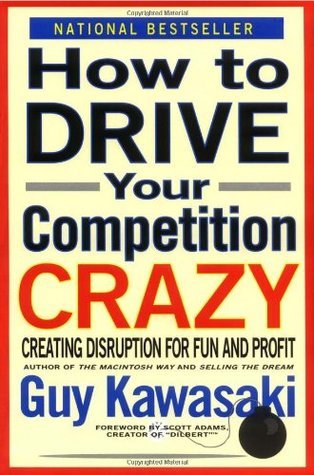
Continually doing what is best for your customers. That will always keep your competition guessing. If you keep your eyes on the prize, and you always do what is best for your company, things that you do will always be changing, but your strategy will be the same.
The best way to drive your competition crazy is to do the right things. If you do the right things, you will relegate all comers to the slippery slope toward lunacy.
Focusing on beating the competition instead of focusing on the customer inevitably leads to tit-for-tat combat. Tit-for-tat combat inevitably leads to doing the wrong things for the seemingly right reasons.
The first task is to choose a worthy opponent
Mighty Opposites- Choose a worthy MIGHTY Opponent. Know Thyself - Who you are Know Thy Customer- who are your customers. Know Thy Enemy - Who are your competitors.
Part Two: Do the Right Things
Focus on Your Customers- . Take such damn good care of customers that they have no choice but to do business with you.
Concentrate on a Decisive Point- Toss out vanity, superficiality, and irrelevance and do what really matters •
Turn Customers into Evangelists- View your customers not as pain-in-the-ass patrons but as potential (unpaid!) salespeople.
Very Good Book from Guy Kawasaki, very insightful, practical and thought provoking.
Another interesting, informative book from Mr. Kawasaki. Great perspective, from the "little guy's" POV. Provides simple and/or brief exercises designed to shake the reader out of his/her rut. The short interviews included at the end of most chapters were engaging, particularly those from outside the business world. Again, great examples from the real world on creative ways to survive and thrive in an age of cutthroat competition. I also appreciate his emphasis on integrity and ethics.
(The English review is placed beneath the Russian one)
Название к этой книге было подобранно мастерские в том смысле, что оно отлично цепляет внимание потенциального покупателя, особенно если такой читатель является целевой аудиторией, ведь какой предприниматель или маркетолог не хотел бы свести с ума своих конкурентов? Однако если выбранное название книги оценивать объективно, то оно не очень подходит к тому, о чём рассказывает книга, ведь по факту, всё содержание укладывается в три тезиса: знайте своих покупателей, продукт что вы продаёте и ваших конкурентов. Просто, не так ли? Эти тезисы являются основой основ классического маркетинга. Да, книга рассказывает о совершенно типичном маркетинге, т.е. о том, как он в идеале должен функционировать.
Книга имеет две составляющие – теорию и интервью с людьми из мира бизнеса. Интервью я пропускал, т.к. теория мне понятна, а интервью всегда предлагает идеалистический образ, ведь кто будет говорить о своих неудачах? Что касается теории или большей части книги. Как я отметил выше, главный упор делается на том, чтобы стать маркетингоориентированно компанией, т.е. максимально эффективно удовлетворять потребности покупателей, благодаря чему покупатели станут лояльными. Идея проста, но вот только на практике реализуют эту идею не так много компаний, впрочем, большинство всё же старается это делать (особенно если конкуренция между компании сильная). Однако нельзя не отметить, что слепо следовать за желаниями клиентов тоже ошибочно. Компании нужно найти баланс, когда улучшение качества обслуживания не вело бы к непропорциональному увеличению издержек, по сравнению с возросшей прибылью. Автор о таких мелочах не пишет, но это и понятно, ибо очень тонка тут грань. Тем не менее, я согласен с тем, что автор описывает, как маркетинг должен выглядеть без всех этим примесей новомодного Agile и излишней финансовой аналитики (которую так любят так называемые маркетологи-аналитики).
В заключительной части автор описывает различные тактические подходы, какие использовали компании в США, чтобы «свести конкурентов с ума». Эта информация скорее забавная, чем полезная, поэтому вся стоящая информация располагается лишь в первой половине книги. Но даже в этом случаи большинству маркетологов эта информация и эта книга не скажет ничего нового, что означает, что книгу можно спокойно пропустить.
The title of this book was chosen masterfully in the sense that it perfectly captures the attention of a potential buyer, especially if such a reader is the target audience, because what entrepreneur or marketer would not want to drive their competitors crazy? However, if the chosen title of the book is to be evaluated objectively, it doesn't really fit what the book is about, because in fact, the whole content is summarized in three theses: know your customers, the product you are selling, and your competitors. Simple, isn't it? These theses are the basis of the fundamentals of classic marketing. Yes, the book is about typical marketing, i.e., how it should ideally function.
The book has two components: theory and interviews with people from the business world. I skipped the interviews, as the theory is clear to me, and the interviews always offer an idealistic image, because who would talk about their failures? As for the theory, or most of the book. As I noted above, the main emphasis is on becoming a marketing-oriented company, i.e., meeting the needs of customers as efficiently as possible so that customers become loyal. The idea is simple, but not many companies implement this idea in practice; however, most of them still try to do it (especially if the competition between companies is strong). However, it is also wrong to blindly follow the wishes of customers. The company needs to find a balance where improving the quality of service does not lead to a disproportionate increase in costs compared to increased profits. The author does not write about such details, but it is understandable, because the line is very thin. Nevertheless, I agree that the author describes what marketing should look like without all these new-fangled Agile and excessive financial analytics (which so-called marketing analysts love so much).
In the final section, the author describes the various tactics that companies in the US have used to “drive competitors crazy”. This information is more fun than useful, so all the worthwhile information is only in the first half of the book. Even so, to most marketers, this information and this book won't tell anything new, which means you can safely skip the book.
I had high expectations about this book given that Mohnish Pabrai called it out as one of his Top 10. On that metric, it disappointed. Nevertheless, a useful book to think about effectively competing and always satisfying your customer. Kawasaki is successful is stating the obvious, but often overlooked, aspects, there there wasn't truly anything revolutionary about this book. I also could have done without the interviews at the end of chapters - though the one with Steve Wynn was enjoyable.
Written more than ten years ago, this Guy Kawasaki book offers creative ideas to excel in the competitive arena. Guy reiterates the maxim "the best defense is a good offense". A lot of creative ideas here...