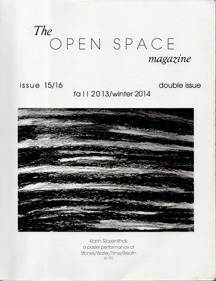
review of OPEN SPACE 15/16 by tENTATIVELY, a cONVENIENCE, Practicing Promotextal - January 19-27, 2014
Once upon a time there was a reviewer who had too much to say. His reviews were inelegant (ie: LONG). This one's no exception, you shd really read the whole thing, really:
In Elaine Barkin's OPEN SPACE 15/16 article "Telling it SLANT or In Search of the Early Years or 'A Sitting on a Gate'", a remembering of her involvement w/ the magazine Perspectives of New Music (reprinted from the same as it appeared in Volume 20, Nos. 1 & 2 (2012)), she describes PNM in a way that cd just as easily be a description of OPEN SPACE:
"In 1980, the Big Fat White issue included complex theoretical-philosophical discourse by Robert Morris, John Clough, David Lewin, and John Rahn, sitting in the same pew with Arthur Margolin's evocative "Mozart's D major String Quartet / k 593 / mm. 53-56" (four measures to die for: ERB), preceded by Wallace Berry's "Symmetrical Interval Sets and Derivative Pitch Materials in Bartók's String Quartet No. 3", my own "A Dedication / Five ADmusementS, & A Digression", all coming after a 250 page riot of texts celebrating Kenneth Gaburo" - pp 350-351
"Ben's stunning "TALK. If I am a Musical Thinker." melding with Naomi's arresting Rohrschachian ink-blobs, its layout created with the assistance of Bruce Huber, beckoning reader-viewer-listener. But many had been crying "foul", hiss-filled air reeked again; several Yale graduate music theory students hassled me in 1981 with: "it's just poetry"—as if "poetry" was a dirty word, as if expressive verbal language was an irrelevance; did "IT" belong in The Academy, in Music-Talk? Did they—or whoever they were speaking for—think that they "owned" Perspectives?" - p 351
"For many of us, Perspectives had become a utopian vision, communitas. Why not dream of better ways of doing things?; being inclusive, responsible but not narrowly responsive to any one way" - p 351
"It was more like a Crazy Quilt, each unique patch from a different expressive-investigative corner of the emerging, diversely un-unified multicultural music-analytic-theoreticspeculative-soundscape." - p 351
Now I, alas, don't have any issues of Perspectives of New Music in my otherwise very substantial personal archive/library - probably b/c it was mainly aimed at academia where high prices cd be pd for its sustenance & where the majority, if not the entirety, of its readership & contributors lived anyway. The same observation cd be aimed at OPEN SPACE as well: after all, single issues are priced at $45, double issues (like the one being reviewed here) at $80, & even the student rates price per issue is $38! The "utopian vision, [the] communitas" definitely doesn't include people outside that financially luxurious environ as far as purchase access goes.
Nonetheless, many OPEN SPACE recordings, tapes & CDs, had cheaply wended their way into my collection before I ever made contact w/ OPEN SPACE's editors & I've since found these folks to be generous & exceptionally open-minded. If they weren't, I wd've never been included in 2 issues so far - occupying, as I do, a place in what many wd consider to be a 'lunatic fringe'.
In many ways that are important to me, I IDENTIFY w/ Barkin's statement: consider this seemingly trivial instance: she places commas after quotation marks - something that some people to this day find almost insufferably heretical even tho I, personally, do the same thing & find it quite logical. & there are many things in Barkin's descriptions above that resonate w/ my own experiences in different environments. Take, eg, "several Yale graduate music theory students hassled me in 1981 with: "it's just poetry"—as if "poetry" was a dirty word, as if expressive verbal language was an irrelevance": in the mid 1990s I was a participant in a list-serv for improvisors called PhiBa, for Philadelphia-Baltimore, where I had similar experiences to those that Barkin had w/ the Yale students.
In one thread I participated by cutting & pasting other people's comments & reorganizing them into a more experimental text wch I then posted as a continuation of the thread. My logic was that I was playing w/ the list-serv as a way to improvise, using, of course, the musician's common imitation & recontextualization technique, thinking that I was moving the discourse onto a level on a par w/ everyone's purported interest. There was an uproar, a strong voicing of disapproval to the effect that 'I didn't join this list-serv for poetry!!' I didn't get the impression that anyone even noticed that I was quoting from previous postings. Ironically, 2 of the people who protested the most were 2 Pittsburgh-based musicians that I'd encouraged to join the list.
Since I'd been a prime mover in the improvisation community in BalTimOre before moving to Pittsburgh where I once again became involved w/ improvising, it seemed fit to me that the participation of PGH peops justified renaming the list-serv PhiBaPit or some such. I even went so far as to propose that the Washington DC participants be acknowledged in the name as well. My proposal was met w/ stony silence. This was clearly a snobbish closed circle.
I repeatedly submitted info about an upcoming event I was organizing to the PhiBa improvising calendar: the Anonymous Family Reunion to take place at Ringing Rocks State Park & at the Sonambient Theater where Harry Bertoia's sound sculptures are housed. Both locations are in eastern Pennsylvania w/in fairly easy driving distance of Philly & B-More. These locales were chosen for their extraordinary potential as places for site-specific improvising. But, apparently since they weren't 'conventional' improvising events at a club or gallery, my promotion was ignored by the administrator of PhiBa & not posted in the calendar. When I finally complained about this, the moderator acted frostily as if I were just being an asshole. When the Anonymous Family Reunion finally happened in the late summer of 1997, only one participant came from PhiBa. He & I are still friends 16+ yrs later. It probably wasn't much after this that I dropped off the list-serv. W/ the exception of the very few friends & collaborators that I met thru it, it was mostly a waste of time.
OPEN SPACE 15/16 begins w/ a memorial from Benjamin Boretz, the founder of PNM & coeditor (& presumed cofounder) of OPEN SPACE , for composer/teacher Harold Shapero (1920-2013). As Barkin writes about the 1st issue of PNM from the Fall of 1962 it had a "memoriam to Irving Fine who died way too young and also with whom Ben and I had studied at Brandeis" (p 346) &, Lo & Behold!, here's another tribute to a Brandeis music prof that Boretz studied w/ who managed to hang in there until 51 yrs later after the 1st issue of PNM! Long live longevity!
Boretz describes Shapero as a "local young-turk jazzpianist all-music wunderkind, [who] was not yet 35, inconceivably young for an actual official professor." (p 1) To quote Wikipedia: "The Young Turks [..] was a Turkish nationalist reform party in the early 20th century, favoring reformation of the absolute monarchy of the Ottoman Empire." "The term "Young Turks" has since come to signify any groups or individuals inside an organization who aggressively pursue liberal or progressive policies, or advocate for reform." ( http://en.wikipedia.org/wiki/Young_Turks )
I 1st recall encountering the term as, perhaps, the tile of a publication from the late 1970s or early 1980s by artist Stephen Seemayer about artists that he appreciated in LA & its rough urbanity, including himself. More recently, however, in a 2005 record called Totalitarian Sodomy by punk band "World Burns to Death" I encountered a song called "All the Young Turks" about wch they write "This song is inspired by a poem called "The Bride", written by poet Siamanto (real name Atom Yarjanian) who was born in 1878 and died in 1915, one of the first of the 1.5-million people murdered by the Young Turks movement during the Armenian genocide." That puts quite a different spin on things, eh?!
Back to Boretz: "Harold himself wrote about "the musical mind" as a manifestation of subconscious processes". (p 1) while this article is brief, it's still highly welcome to me b/c I only have 2 records w/ Shapero's music on it & don't really know his work at all. One of these is on the Columbia Masterworks series - one of the highest recommendations - & is a playing of his "String Quartet No. 1" (I'm listening to it now). The other is on The Louisville Orchestra's First Edition Records & is his "Credo for Orchestra" (I'll listen to it next). Boretz praises Shapero's "Symphony for Classical Orchestra". Perhaps I'll get to hear that someday.
Perhaps the person whose articles herein excited me the most is James Hullick, or ")-(Ull!c]<" as he (almost) writes it here. In his "Never Mind the Bollocks" he says: "Meditating on sonic art as an act of social conscience can lead to philosophy; and specifically the interabilities agenda. "Interabilities" is a term that denotes the interaction of people of all abilities. As an agenda for sonic practice, it describes people of varying abilities working together toward some sonic outcome. In and of itself, the term "interabilities" does not have anything to do with the quality of a sonic outcome. People of all abilities could be working together to make absolute rubbish and the term "interabilities" would be met. But the ethics behind interabilities activities elevates the activities beyond this broader blanket term. In the case of sound, for example, if people of all abilities work together to produce a truly dreadful concert, then the positive ethic and social benefit of the interabilities agenda can be lost. The audience may have suffered. It lies at the heart of the interabilities agenda that interabilities activities will eventually strive to inspire participants and audiences alike to our greatest vision of humanity — where all people stand equal in society, and where all abilities are considered of equal worth to the wider human mission." (p 6)
Now, I very much like this statement & laud the term "interabilities" wch I've never encountered before & wch )-(Ull!c]< may very well have coined. HOWEVER, I question some of its implications: )-(Ull!c]< being the guider of these interabled activities is in some sense the composer. He's also, presumably, being pd to be an interabilities facilitator. In his ideal interabilities scenario do ALL PARTICIPANTS have equal access to being the guide/facilitator & to equal pay? Also, are ALL PARTICIPANTS going to be in agreement on what a "truly dreadful concert" is & will someone's opinion be more privileged in relation to this? ()-(Ull!c]<'5, eg?) & will they all be in agreement that "if people of all abilities work together to produce a truly dreadful concert, then the positive ethic and social benefit of the interabilities agenda can be lost"? & that "The audience may have suffered"? &/or even that this 'suffering' is a bad thing? I've been told by 'friends' of mine who know close to nothing about what I do that my 'obvious' intention is 'just to irritate people' - this b/c I produce dense & challenging work that people find difficult to process - hence, it 'must' be 'sadistic'. NOT.
Cf this excerpt from my own article in this issue, "30 4 5 + 97.9": "my 1st reel-to-reel recorded audio piece from 1976: dadadadadadadadadadadadadadadadadadadadadadadadadadadadadadadadadadada A part of the significance of this latter was that it is a piece designed to be easily performable by almost anyone & that what wd distinguish one performance from another cd just as validly be the performers' incompetence or other foibles as well as their skills & strengths. This was an important 1st step for me in stepping outside of the disciplines of classical music into what I usually now refer to as "Low Classical Usic"." (pp 200-201)
The idea being here is that this, too, is an example of an interabilities situation but there is no such thing as a "truly dreadful concert" & whether "The audience [considers itself to] have suffered" or not is irrelevant - unless actual nonconsensual physical pain (psychological pain can be a bit harder to assess) is being induced. &, of course, I am the d composer here &, despite the extreme d liberate simplicity of the score/title, my function as such places me in a unique unequal position in relation to the performers.
)-(Ull!c]< does address possibilities that other more people living in a more insulated world wdn't even think of in their delusional utopian imaginings. That's one of the things that leads to my respecting his article(s) so much. "So while I think an interabilities agenda should be open to the experience of darkness that many people feel, I also think that we can find ways of embracing both the darkness and the light, that don't end in murder." (p 10) "The project responded to the story of Milarepa, a Buddhist saint from the 11th century (c. 1052-1135) who had started life out as a mass-murderer." (p 10) I'm reminded of an interview w/ John Waters from several decades ago. He'd made Pink Flamingos in wch his drag queen star, Divine (named after a Jean Genet character), actually ate dog shit. Waters remarked about changing the direction of his filmmaking b/c 'To be more shocking I would've had to kill somebody and I wasn't going to do that.'
In a promotional email sent out announcing this issue, the OPEN SPACE editors proclaimed:
"As a longtime supporter, you already know something of our guiding aspiration to extend the boundaries and horizons of the community of creative thinkers and artmakers. After fifteen years of publication, we believe our new issue has broken through to a significantly new level toward that goal; we have produced a 364-page panoramic, kaleidoscopic book which is composed in a meaningful way to lead you through a huge diversity of subjects treated with consummate seriousness, personal investment, and creative originality.
"The current issue of The Open Space Magazine includes an introduction to magical practice"
& it's this latter sentence (chopped off in my excerpting of it here) that leads to my next comments. Robert Podgurski provides a "Graphic: First Enochian Call to Spirit" that I find interesting to look at in a similar way to the way I enjoy Visual Poetry or a score. Peteris Cedrins also contributes things occult-relevant. I particularly like his imagistic writing:
"'Twas the night before feminism, & all through the hows ... ... ... the stirrings of rats, & at night there are bats in your hair. The colibri of hope are finally kaput, to be eaten like ortolan. Laima's lord tells of the south wind, wch years ago brought blistering heat to the village. Between two to four hundred prostitutes were deported to northern Kazakhstan as anti-Societ elements. Kiss the doorknob, kids would say, & you'll see Riga. It was an iron doorknob, of course, In the dead of winter. Lick it. Eat the bunting." - p 33
Other Podgurski sigils & a poem close the issue. The PNM logo in White's article quoted above looks very much like a sigil too. I'm reminded of my own fanciful theory that sigils are actually circuit diagrams for controlling energy flow (both metaphorically & directly). Maybe someday I'll actually build circuits somehow based on them & see what happens when electricity is introduced.
As w/ White's recalling that "several Yale graduate music theory students hassled me in 1981 with: "it's just poetry"—as if "poetry" was a dirty word, as if expressive verbal language was an irrelevance" & can easily imagine that happening here in reference to "an introduction to magical practice". But, to me, it's the mindset that I'm interested in. One ex-girlfriend who was a poet was interested in experimental writing but her tastes in relation to music were pop all the way. I've never understood that. Why differentiate so between disciplines? It's the experimentation that does it for me.