

What do you think?

Teaching Cross-Culturally: An Incarnational Model for Learning and Teaching
Teaching Cross-Culturally is a challenging consideration of what it means to be a Christian educator in a culture other than your own. Chapters include discussions about how to uncover cultural biases, how to address intelligence and learning styles, and teaching for biblical transformation.
Teaching Cross-Culturally is ideal for the western-trained educator or missionary who plans to work in a non-western setting, as well as for those who teach in an increasingly multicultural North America.
Teaching Cross-Culturally is ideal for the western-trained educator or missionary who plans to work in a non-western setting, as well as for those who teach in an increasingly multicultural North America.
146 pages, Kindle Edition
First published May 1, 2003
Ratings & Reviews
Friends & Following
Create a free account to discover what your friends think of this book!
Community Reviews
Displaying 1 - 28 of 28 reviews

February 15, 2019
Really helpful introduction to teaching in a cross-cultural setting
January 4, 2025
I first read this book for my undergrad degree in Theology and Global Studies as part of a cultural anthropology class. At the time, I applied it exclusively to overseas missions.
I revisited it this year as a teacher/administrator in a diverse classical school in America. I found several principles helpful for my context:
- Identify the hidden curriculum in your school. These are the unspoken rules of the school. You can have a fantastic written curriculum, but if your students can't engage with it, it doesn't do much good. I think the Lingenfelters were using the term "hidden curriculum" to refer to their students' expectations, behaviors, and beliefs.
- Study the people in the context in which you work. Learn from them. Know their language and how they relate to people of different ages and social statuses. How do they parent? How do their children learn things? What is the purpose of school? What do they value?
- Give up some of your culture. Although I find the 150-percent metaphor a little confusing, the idea of retaining, giving up, and accepting elements of different cultures is helpful.
This seems like a good beginning read, but I wish it was more complete. I would have liked to see more descriptions of different types of cultures and more examples of teaching strategies that correspond to different cultures. I have more research to do!
I revisited it this year as a teacher/administrator in a diverse classical school in America. I found several principles helpful for my context:
- Identify the hidden curriculum in your school. These are the unspoken rules of the school. You can have a fantastic written curriculum, but if your students can't engage with it, it doesn't do much good. I think the Lingenfelters were using the term "hidden curriculum" to refer to their students' expectations, behaviors, and beliefs.
- Study the people in the context in which you work. Learn from them. Know their language and how they relate to people of different ages and social statuses. How do they parent? How do their children learn things? What is the purpose of school? What do they value?
- Give up some of your culture. Although I find the 150-percent metaphor a little confusing, the idea of retaining, giving up, and accepting elements of different cultures is helpful.
This seems like a good beginning read, but I wish it was more complete. I would have liked to see more descriptions of different types of cultures and more examples of teaching strategies that correspond to different cultures. I have more research to do!

July 1, 2021
Very challenging book. Cultural studies is so fascinating to me and I appreciated the approach taken by the authors to help teachers understand the importance of incarnations teaching.
“The teacher’s role is to create the most appropriate context within which students can learn.”
“The teacher’s role is to create the most appropriate context within which students can learn.”

March 6, 2021
The contents of this book are drawn on decades of research and experience from teachers and learners. In earlier chapters, it draws upon the teaching of Jesus Christ and what made him effective and successful. A great read for teachers who are working towards teaching students across cultures.

August 23, 2012
I've been teaching cross-culturally for a bit more than 30 years. I've also done quite a bit of graduate work in anthropology but this is the first thing I've read specifically focused on teaching in a cross-cultural context. This is a brief, helpful book that avoids a lot of educational and anthropological jargon. Issues covered include hidden curriculum, traditional and formal learning strategies, learning styles, the role of teacher and learner, teaching for change, etc. Really, anyone engaged or about to be engaged in teaching cross-culturally would do well to take a look at this book. Reading it is the easy part. Willingness to change one's approach is much more challenging and all to often does not happen or is not permitted to happen by those who control the learning program/situation. That the authors did a lot of their fieldwork on the Micronesian island of Yap was something of a bonus for me as I spent a few years in Micronesia and a brief time on Yap. The examples cited from their fieldwork in the islands and elsewhere and those drawn from the experience of others were very helpful.
April 13, 2008
This book didn't add anything new to the conversation about how to teach cross-culturally. Though it had interesting and important points, I think the book could've been more helpful as an extended journal article.

November 13, 2024
a fine primer
A short and somewhat shallow treatment, good for an introduction and probably sufficient for those who do not plan to make a living cross culturally. For those with a vested interest, something like Craig Ott, Teaching and Learning Across Cultures is more comprehensive and full of useful suggestions for further research.
A short and somewhat shallow treatment, good for an introduction and probably sufficient for those who do not plan to make a living cross culturally. For those with a vested interest, something like Craig Ott, Teaching and Learning Across Cultures is more comprehensive and full of useful suggestions for further research.

February 6, 2020
This book is full of practical advice about teaching within a different culture. It exposed a lot of assumptions that I had about education that may be true in the West, but not across the globe, and presented a lot of strategies and attitudes that I develop in my future context!
February 9, 2024
This is a short book on cross-cultural teaching with a Christian touch. Repetitive.
A newer and extensive discussion of incarnation and cross-cultural teaching is in Ott, Craig. Teaching and Learning across Cultures: A Guide to Theory and Practice. Grand Rapids: Baker Academic, 2021.
A newer and extensive discussion of incarnation and cross-cultural teaching is in Ott, Craig. Teaching and Learning across Cultures: A Guide to Theory and Practice. Grand Rapids: Baker Academic, 2021.

July 14, 2017
Good reminder of important principles to keep in mind for those teaching cross-culturally. I found the descriptive matrices of teacher mindset vs learner mindset very helpful and want to have discussions about this with national leaders who plan workshops.

November 18, 2017
helpful, yet repetitive

August 29, 2018
Excellent book for anyone who is teaching or preaching cross-culturally.

March 21, 2022
Helpful introduction.

May 14, 2022
This was one of the better books I read for my major. I appreciated the practical insights the authors had from their own time teaching.

December 7, 2025
Helpful and insightful. Read for class. Would recommend to anyone looking to deepen their understanding of cross-cultural education.

November 3, 2020
Teachers are learners. This is the firm belief of Judith and Sherwood Lingenfelter in this slim but dense book. Teachers must learn their own cultural context as well as the context of their students.
There are many challenges that face cross-cultural teachers, including the hidden curriculum (ch. 2), differences between formal and traditional education (chs. 3-4), different learning styles (ch. 5), false expectations (ch. 8), and culture shock (ch. 9). Teachers must be flexible, and the Lingenfelters provide many practical teaching techniques for teaching in different contexts.
There are many challenges that face cross-cultural teachers, including the hidden curriculum (ch. 2), differences between formal and traditional education (chs. 3-4), different learning styles (ch. 5), false expectations (ch. 8), and culture shock (ch. 9). Teachers must be flexible, and the Lingenfelters provide many practical teaching techniques for teaching in different contexts.

August 28, 2011
Summary: As a Western teacher teaching non-Western people, you need to become a 150% person: you'll never make it to 200%, but at least you can make an effort to understand and work within another culture's very subtle customs.
Quick review: Very worthwhile. The author (Judith wrote most of the book) has a keen eye for stories and real insight in revealing their lessons. Here's a sample:
Here is Judith Lingenfelter's own summary of the book:
Quick review: Very worthwhile. The author (Judith wrote most of the book) has a keen eye for stories and real insight in revealing their lessons. Here's a sample:
Yet I was not always successful in this endeavor; sometimes I relied on old alternatives rather than continuing to learn from the context. An example of my failure on Yap to decipher the hidden curriculum occurred when teaching the color wheel during a Head Start class. The first day I confidently held it up and had the students repeat the colors in English after me. They did fine until they came to the colors blue and green. I patiently went over these colors again and again until they could repeat verbatim what I had said. Only ten years later in graduate school, when reading about differences in cultural perceptions of color, did I realize what I had done. In my frustration, I had failed to ask why my young students knew all the colors except blue and green. I now understand that on this tiny island surrounded by the Pacific Ocean, they use many words to capture the distinctions of blue and green necessary to function effectively in their environment. I had solved the color wheel ambiguity by forcing a level-1 solution on a level-2 problem. To be an effective cross-cultural teacher, one must learn the other-culture perspective and derive from it new alternatives for the challenges faced in a classroom. Relying on past experience will often lead to misunderstanding and failure. Only by understanding the other-culture context can we identify appropriate alternatives for teaching that will have maximum effectiveness for student learning.
Here is Judith Lingenfelter's own summary of the book:
The basic argument in this book is that our culture serves us well when it is the only culture in focus. In fact, it is a palace when there are no other contesting voices around us, when we can live fairly comfortable, ordered lives in the context of our own cultural system. However, when we are pushed into relationships that are outside the boundaries of our culture, that culture becomes a prison to us. We are blind to other ways of seeing and doing things, and we assume that our way is the only way that is appropriate. We become frustrated and angry with those who insist on breaking our rules, and we attempt to enforce our rules on them.

July 18, 2012
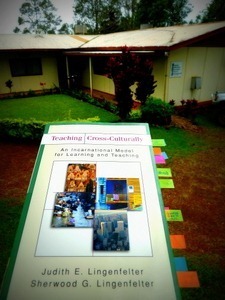
In a couple of weeks’ time I’ll be running a Cultural Self-Discovery workshop. Although I’ve attended the workshop and helped facilitate and teach parts of it before, this will be the first time that I’ve been responsible for the entire thing. With over 20 participants from 8 different nations, I thought I should prioritise this book when I saw it on a shelf in an abandoned office at work. Glad I did.
The Lingenfelters write from decades of experience overseas. They write with humility and plenty of insight from their own lives into how you can do it the wrong way. But they learned how to do it the right way and this combination of failing and succeeding was helpful I think. I’ve read a lot of cross-cultural stuff where the author has plenty of stories of others’ failures but seems curiously silent about their own.
As you can see from my context photo above, there was lots in this that I found worthwhile to inform my training in this short 120 page book. I’m no stranger to living and working cross-culturally (this is my 5th decade overseas in some form or other) but although I’m streets ahead of the field in terms of practical experience, I’m woefully behind when it comes to the theory side of things.
I appreciated their analogy of the prison v palace dichotomy of culture. When we’re in our own environment, our culture is like a palace where everything is neat and tidy and we rule over those around and nothing is beyond our control. But when we’re out of it, our culture is a prison in which we’re confined, miserable at the mercy of those who control our environment for us.
This is so true and reinforces the need for us to abandon our palace mentality while living in a foreign culture or interacting with those from different cultures. If we don’t we are either dictatorial tyrants who imprison others or we’re cowering wrecks wallowing in the misery of our own culture shock. I’m sad to say that I’ve been both of these. I think anyone who’s honest would admit that too if they’ve had any real cross-cultural exposure. In fact, I’d go so far as to say that if someone doesn’t admit they’ve experienced both extremes… well… don’t invite them to form a multicultural team anytime soon!
So, I’m very much looking forward to what these 23 participants are going to teach me over the coming 8 weeks of the course. If this book was anything to go by, I’ve got a great deal yet to learn and a hunger for it too!

Read
August 2, 2011I really recommend the last half of the book. It is recommended for those teaching in a non-western school setting or in a multi-cultural school or university in a major city in North America. I thought it gave some great insight into adapting to the non-western setting, handling culture shock, and dealing with the unmet expectations westerners can have when working in a cross-cultural setting. It also emphasized the need to really study the new culture--for the teacher to become a learner in the new setting. There are some things that as westerners we become uncomfortable with, but to really succeed in the new environment we need to become 150% people. When I reached the end, I felt that it ended abruptly. It's a short read at only 125 pages, but there are some powerful nuggets in there.

April 3, 2008
In my earlier review which I wrote while slowly progressing through the book, I stated that I was simply unimpressed. Now that I finally finished the book, I can tell you that honestly, it was not helpful nor was it insightful. It was difficult for me to read the book since their main premise and entire thesis was based on being 150% human, which is of course impossible. Unfortunately, I have read another book they previously wrote which preached the same message of being superhuman, like Jesus. That book was called "Ministering Cross-Culturally: An Incarnational Model for Relationships", and as you can guess by it's twinish name, it's much like this book.

August 3, 2011
I really enjoyed this book. I recommend it. It is short and easy to read. Only about 125 pages. Kind of expensive, but lots of good illustrations about teaching in cross cultural setting. It is really a good read as an introduction to teaching cross-culturally both in the US or overseas. You cannot underestimate or work separated from your students cultures. We should do all that we humanly can to bridge that gap. This book will help.

February 17, 2023
As a missionary i would read any book by this author
Read
December 21, 2015A must read for anyone desiring to teach in a cross cultural setting. Some of it may not make a lot of sense without experience but read it and take it with you to read again while serving, it will save you a lot of headaches and help you to be more effective!

July 29, 2011
Some very helpful guidelines on teaching in a cross-cultural setting. The authors even propose some thoughts on teaching in multi-cultural settings.

April 9, 2012
Simply a must-read for any who want to minster to those of another culture.

June 2, 2015
Very good and very practical. I wished I had read it years ago, before teaching in several different cross-cultural settings.
June 16, 2015
I found this book to be a very helpful basic guide for teaching cross-culturally,and would recommend this book for anyone who is thinking about getting involved in cross-cultural teaching.

April 14, 2017
Helpful insight for people planning on teach (or working) in diverse areas of the US as well as abroad.
Displaying 1 - 28 of 28 reviews