Ok, I'm not going to lie...I started reading this book because I am disgustingly obsessed with the Netflix show Midnight at the Pera Palace (a fictionalized Turkish series very loosely based off the historical information presented in this book). I love and watch it so often that any day now I'm going to get an email from Netflix asking me if I'm okay, like that one girl who watched that Princess movie a million times and they had to check in on her. It owns my whole ass.
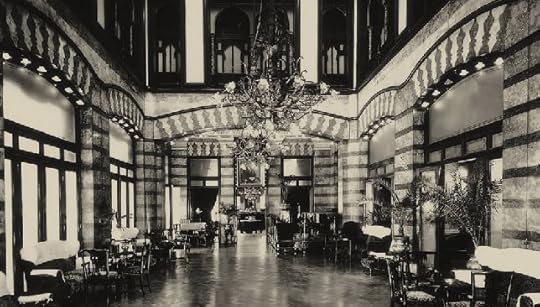
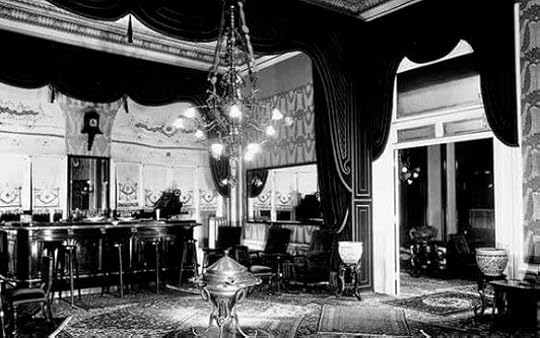
Midnight at the Pera Palace: The Birth of Modern Istanbul has a very interesting core idea: tracing the history of Turkey by focusing on a hotel in Istanbul called the Pera Palace in Taksim (which I've been to!) In theory, King uses the Pera Palace as a touchstone to discuss the innate diversity and dynamism that has always been definitional of the Ottoman Empire, later the Turkish Republic. He argues the Pera Palace evolved along with Turkey in the 20th century, and the hotel is a microcosm of its larger social context. This idea itself is fascinating and unique for a historical study. However, the execution left a lot to be desired. While the target audience seems to be the general layman reader, King often used confusing or mixed terminology when discussing critical events in Turkish history. For example, he briefly and superficially delves into the Young Turks, yet sometimes calls them the Unionists without ever explicitly relating the two. For someone who has a solid understanding of Turkish history, this would be more understandable, but the target reader of this book would not know enough to comfortably use those terms interchangeably.
In addition to brushing over critical movements and groups, the study awkwardly sidesteps questions of the Armenian Genocide (1915-23) and other pogroms (against Bulgarians, Greeks etc), to the point that it became painfully obvious, uncomfortable, and frustrating. In his vague and hurried style, he half-addresses the genocide only when it can literally not be avoided. Mention is made of how there are no longer a large number of Armenians in Anatolia after they were 'pushed out', and how many Armenians were 'cast from their homes.' By whom were they pushed out? How? How did a historical study on the Ottoman Empire/Turkey talk about the 20th century without discussing the Armenian Genocide? How can a historian discuss Trotsky going fishing at length, but throws out mention of the genocide in a couple sentences, and only as an afterthought? My personal theory is that, due to modern Turkey's denial of the genocide and its current assertion that Armenians were killed by roaming bands of Kurds, King did not want to get on the wrong side of Turkish favor. As a result, he fails as a historian to look at the evidence and assess accordingly.
I found the structure of King's study to be very odd and discontinuous to its ultimate detriment. The historian often drifts away not only from the Pera Palace, but from Turkey in general (which is not very promising for a book about Turkey). Instead, he keeps referring back to Eastern Europe and Russia, in particular. It became so obvious that at one point I googled Charles King to see what his specialization was as a historian, only to discover that he does in fact have a Masters in Russian and Eastern European Studies, and still writes intensely on those areas today. Whereas a chapter called "Beyond the Veil", predominantly focused on Turkish (Muslim and non-Muslim) women's position in the new Republic, was only 18 pages (most of which unfortunately focused on biographies of different women instead of a more generalized social and legal assessment), the chapter on Leon Trotsky was 20 pages, and often had nothing to do with Turkey at all. When he does focus on Turkey, the book is riveting, but it's brought down by the fact that King almost always glosses over fascinating social and legal changes by briefly mentioning them and then quickly moving on in a directionless and roundabout manner. For example, in the aforementioned chapter about women, he brings up the fact that window screens, which were used to keep Muslim women away from view in houses during the Ottoman period, were discouraged (banned? regulated? I don't know - King never clarifies because it was literally only one sentence!) in the republic as a result of a national hygiene law to bring in light and fresh air into stuffy housing. This would have been a very insightful place to bring up Mustafa Kemal's progressive views towards women in society and how he used various channels (often using roundabout indirect legislation - like sanitation laws) to increase their presence in public life, but King races forward to only give biographies of a few select women (albeit they were badasses, like Halide Edip). Giving rambling biographies of random people, instead of giving social and legal overviews was a staple of King's approach, to the extent that it became annoyingly predictable. The pattern is this: a couple paragraph overview of a topic in Istanbul, and then extremely long biographical information about specific people. Often the people he focused on were Europeans/Americans, which only affirmed my belief that his speciality was not Euroasia/the Middle East at all.
I feel like Charles King really wanted to write a book on Russia and its international relations in the 20th century, but was forced by his editor to return to Turkey. I often wondered if he had to background to really give any in-depth thoughts on Turkey at all, due to the fact that he has few Turkish language sources in his bibliography and his viewpoint is extremely European-focused. The study even sometimes forgets about the Pera Palace itself, and throws mention of it here and there as a kind of afterthought in the editing process. I wish this study had been written by someone who had more savvy in both the time period and the country. This review is a little harsher than I foresaw when I began to write it, but I didn't realize how much the aforementioned points were grating me until I finished. I don't regret reading Midnight at the Pera Palace, but I wish it was more organized, less Euro-focused/sourced, and a little more historically situated.
The show, however, is bomb, and has my eternal loyalty and devotion. Season 2 on February 29th :D !