"Smart, knowing, and deeply reported, the definitive history of one of modern American humor’s wellsprings." ―Kurt Andersen, author of Fantasyland , host of NPR’s Studio 360 Labor Day, 1969. Two recent college graduates move to New York to edit a new magazine called The National Lampoon . Over the next decade, Henry Beard and Doug Kenney, along with a loose amalgamation of fellow satirists including Michael O’Donoghue and P. J. O’Rourke, popularized a smart, caustic, ironic brand of humor that has become the dominant voice of American comedy. Ranging from sophisticated political satire to broad raunchy jokes, the National Lampoon introduced iconoclasm to the mainstream, selling millions of copies to an audience both large and devoted. Its excursions into live shows, records, and radio helped shape the anarchic earthiness of John Belushi, the suave slapstick of Chevy Chase, and the deadpan wit of Bill Murray, and brought them together with other talents such as Harold Ramis, Christopher Guest, and Gilda Radner. A new generation of humorists emerged from the crucible of the Lampoon to help create Saturday Night Live and the influential film Animal House , among many other notable comedy landmarks. Journalist Ellin Stein, an observer of the scene since the early 1970s, draws on a wealth of revealing, firsthand interviews with the architects and impresarios of this comedy explosion to offer crucial insight into a cultural transformation that still echoes today. Brimming with insider stories and set against the roiling political and cultural landscape of the 1970s, That’s Not Funny, That’s Sick goes behind the jokes to witness the fights, the parties, the collaborations―and the competition―among this fraternity of the self-consciously disenchanted. Decades later, their brand of subversive humor that provokes, offends, and often illuminates is as relevant and necessary as ever.
Ellin Stein has contributed arts features and criticism to publications including the New York Times, The Times (of London), the Guardian, the London Telegraph, and Variety and is a former reporter for People and InStyle magazines. She currently lives in London, where she teaches screenwriting at Goldsmiths College, University of London.
The book's title is pretty self-explanatory. The National Lampoon was one of the linchpins of 70's humor, and its influence stretched far beyond that decade.
Ellin Stein has a formidable command of her subject, and traces all the relevant players from the early Harvard days to Saturday Night Live to Hollywood … In a section at the back of the book, she provides brief summaries of the post-Lampoon careers of scores of people.
If the book lacks anything, it is illustrations. Too often, Stein is reduced to describing a particular cartoon or photograph, when it would have been so much easier to just show the damn thing. Would it really have bumped the cost of the book up by that much?
Still, I found this to be a thoroughly enjoyable book. Recommended if you're interested in the history of the Lampoon, or even humor in general.
I read this on a friends recommendation. He liked it. I really didn't. It's a smug self-satisfied book about a bunch of smug self-satisfied people. I found it torturous to read. I made it partway through the fifth chapter until it became too painful to continue. After a break of a few days, I flipped ahead to around chapter 20, where Animal House comes into play. It had become a better read by that point, humorously in direct correlation to how much it became about Saturday Night Live actors over National Lampoon writers.
Favorite chapter: "Tie A Yellow Ribbon Round the Dildo Please!"
Great history of National Lampoon from the early days of inspired lunacy, leftist politics and anti-war satire to the shameful Reagan years and the proto-Trumpian pandering of creeps like P.J. O'Rourke. The decline and fall of a whole generation is chronicled through laughter and tears.
I was interested to read this book as I love satire and reading a bunch of National Lampoons I got through a friend were a pretty big influence on me when I was 16.These lead me to get involved in the school newspaper and attempting - I realise in retrospect - to emulate the Lampoon. This was in early 1980's Christchurch New Zealand but the Lampoon spoke very srongly to me. I was really impressed with P J O'Rourke and followed his career through his books - until sadly he has become a right wing ostentatiously libertarian Washington bore.
It was fascinating to read of the glory days of the Lampoon starting in the early seventies and to learn just how much they influenced, and defined, the era. It seems criminal that the often brilliant Saturday Night Live, which many of the writers migrated to, has only recently started screening in NZ on the satellite Comedy Channel - what an enormous amount of fun and talent we have missed out on. SNL, Spinal Tap, The Simpsons...it is an interesting story and made me hunt out old NL issues online. I recall never reading Mad magazine after the NL satire of it I read as a teenager.
An interesting story and interesting characters but it is over long. I wasn't surprised to see that the author is an academic, which might explain its slightly dry tone.
In this book, journalist Ellin Stein provides a history of the iconoclastic 'National Lampoon' magazine, and the movies, television shows, publications, etc. it spawned or inspired. Stein did extensive research and conducted myriad interviews, and her coverage of the topic - and all the people involved - is very thorough.
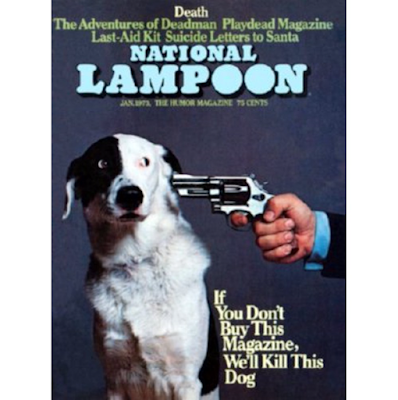
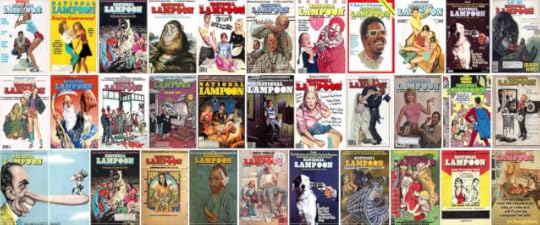
An iconic National Lampoon cover
*****
At the end of the 1960s, Harvard graduates Henry Beard and Doug Kenney moved to New York to be the chief editors of a magazine called the 'National Lampoon' (NL), an outgrowth of the iconoclastic 'Harvard Lampoon' (HL).
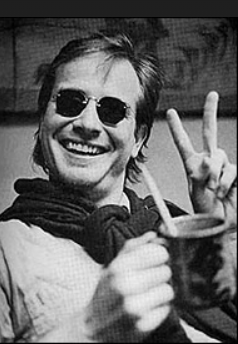
Henry Beard
Doug Kenney
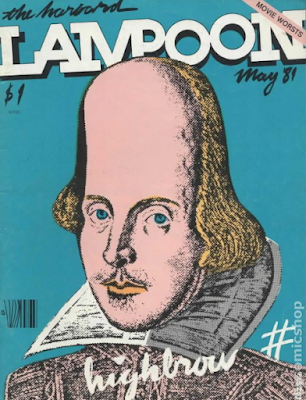
A Harvard Lampoon cover
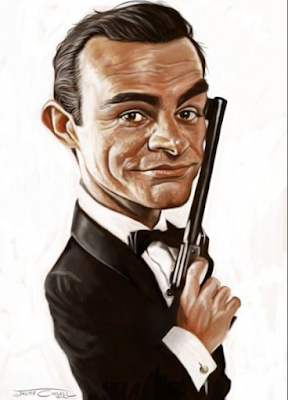
The HL prided itself on fun parodies, like a story called 'Alligator' that riffed on the suave James Bond (007) character, who orders his martinis 'shaken not stirred'. Alligator's James Bond is meticulous about his food, and in his BLT sandwich, "the bacon must be crisp, not however over-cooked; lettuce from the inside please, but not the heart."
Cartoon of James Bond (007)
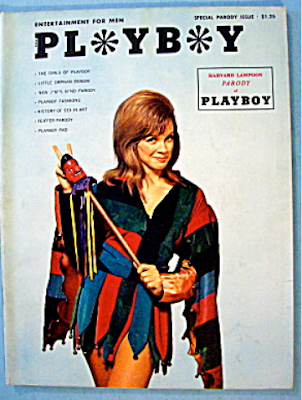
One of HL's big successes was a parody of 'Playboy' magazine, which was endorsed by Playboy founder Hugh Hefner himself. The Poonies (HL writers) came up with the ideal playmate, a sort of female Tarzan from a Carolina coastal island whose English is restricted to 'My name is Oona. Mama and Papa dive into sea. Berries and herbs, herbs and berries'.
The Harvard Lampoon's parody of Playboy Magazine
Stein writes, "The Poonies had stumbled onto the trick that would be the financial cornerstone of their subsequent parodies and later the National Lampoon: because the naked ladies were presented in a joke context, the reader could feel superior to his sweaty-palmed brethren who genuinely sought out this kind of fantasy stimulant without having to deny himself any of their voyeuristic gratification."
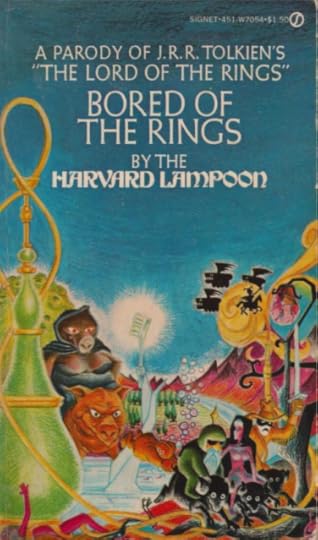
Another HL project was a parody of J.R.R Tolkien's heroic epic 'Lord of the Rings', called 'Bored of the Rings', in which "cowardice, confusion, and passing the buck are the order of the day."
The Harvard Lampoon's parody of Lord of the Rings
With several popular publications under their belt, HL writers Beard and Kenney "just knew they wanted to create a humor magazine and it would be big and glossy and wonderful and they would have a great time doing it and would be a great success." This new magazine would be called the National Lampoon.
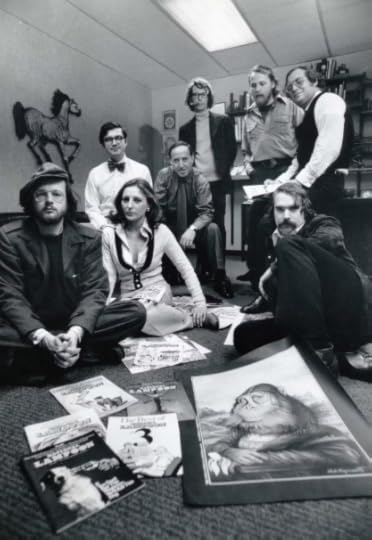
To get the NL going, Beard and Kenney hired Harvard Poonies to be writers, HL alumni to be advisors, and outside artists and caricaturists to supply pictures to go with the words. This resulted in a kind of 'boys club', where meetings were held in restaurants, and irreverence ruled the roost.
Some staff members at the Natonal Lampoon
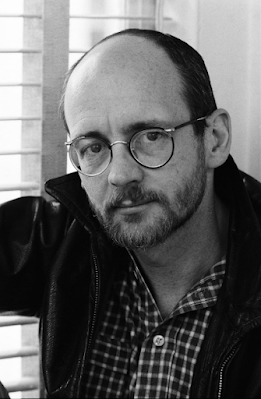
When outsider Michael O'Donoghue came on board, he wanted to do some damage, search and destroy....that's the kind of comedy he liked. O'Donoghue observed, "The Harvard people fought with the épée. They made little digs in the wrist you know - 'Ha ha! Have at you!' I taught them to fight with the truncheon. It was just a more brutal form of humor - less sport, more murder."
Michael O'Donoghue
The NL also segued into politics. For instance, when the Vietnam war expanded into Cambodia amidst increasing antiwar protests, Kenney wrote a satirical editorial that suggested Cambodia would soon enjoy he same benefits as South Vietnam, "Once an underdeveloped Asian sump full of mosquitoes, overcooked rice and foreigners, [South Vietnam] has blossomed under our tutelage into a veritable Eden of rusted tanks, Coca-Cola bottles and highly decorative half-breeds."
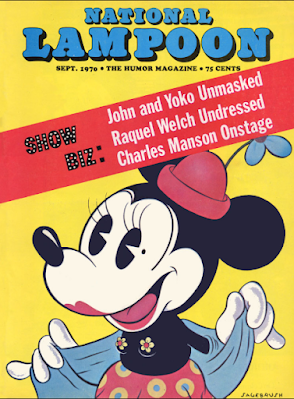
The National Lampoon's first big success featured a cover of Minnie Mouse in pasties, which spurred the Disney organization to sue for $11 million.
National Lampoon's cover of Minnie Mouse with pasties
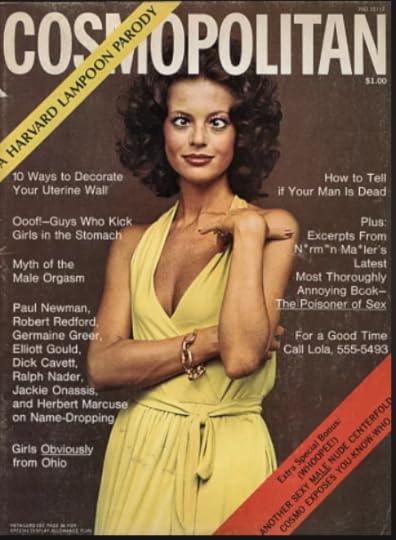
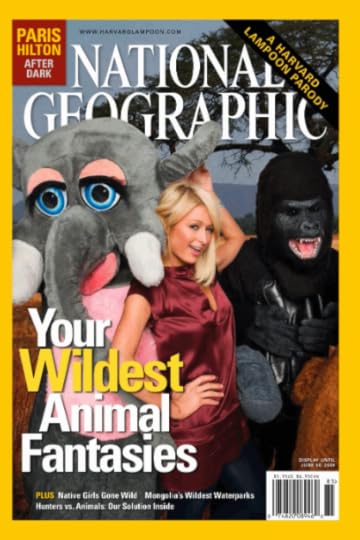
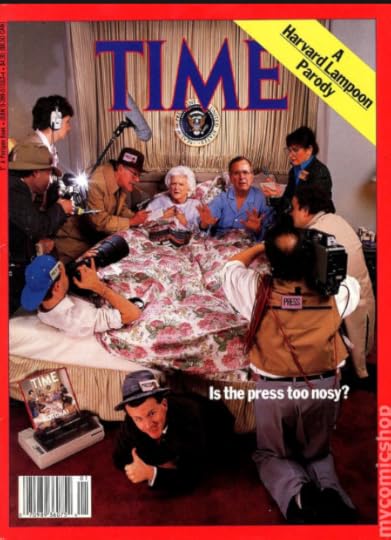
Among the magazines most popular features were parodies of other types of publications, for instance, 'Pethouse' - which featured photos of furry animals in provocative poses; 'Stupid News and World Report'; Gun Lust magazine; Third Base - the Dating Newspaper; and more.
Examples of Harvard Lampoon parodies
The NL writers and artists collaborated to formulate content, and tried to think of every possible joke on a subject. For example, the writers' room came up with a story about a convicted Watergate burglar doing time at a light security prison: there's a moment when the prisoners, "pushed beyond endurance by a selection of inferior vintages, bang their tin cups and call for 'Montrachet'."
There weren't many women working for the the NL, and women weren't especially welcome. For example, NL comedy writer Anne Beatts got the distinct impression that neither Henry Beard or Doug Kenney wanted her to be there. Stein writes, "However, because the editors had been brought up to be polite, they weren't about to run to Michel Chobette [a Lampoon contributor and Beatts' boyfriend at the time] and say, 'Can't you just leave her at home?' "
Anne Beatts
In time, the NL staff expanded to include refugees from advertising and Canadians, and Stein describes their differing personalities and styles of comedy. Some of the magazine's Canadiana included bumper stickers like 'My Country, Correct or Misinformed'; and translations into Canadian: 'Up against the wall you motherf***ingpig turns into 'Now wait a minute officer, let's be reasonable'.
Regardless of their provenance, once writers/editors were admitted to the club, it became the most important thing in their lives. A Lampoon editor was a Lampoon editor twenty-four hours a day, and the Lampooners appreciated having kindred spirits to bounce their ideas off. Stein notes, "The Lampoon writers had found more than drinking buddies: they had joined a sort of gym for the intellect, where their creativity could be stimulated and stretched."
Relations among the NL personnel wasn't all sweetness and light, however, and Stein documents the numerous jealousies and rivalries as well as the collaborations and alliances.
In addition to contributing to the NL, many comedy writers went on to work in radio, movies, records, live theater, television, publishing, etc. Stein gives examples of celebrities like Gilda Radnor, Bill Murray, Chevy Chase, Dan Akroyd, Harold Ramis and others, who went from the NL to Saturday Night Live.....and on to big success, often in movies.
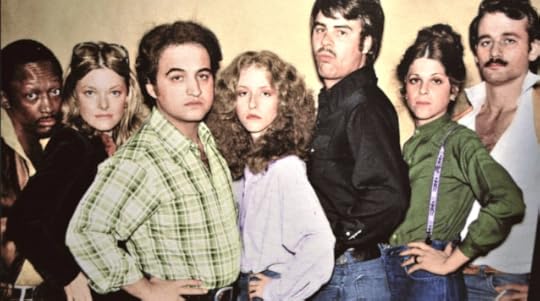
1975 cast of Saturday Night Live. From left, Garrett Morris, Jane Curtin, John Belushi, Laraine Newman, Dan Akroyd, Gilda Radnor, Bill Murray
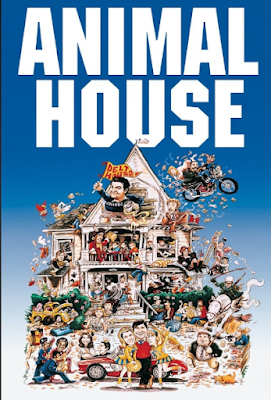
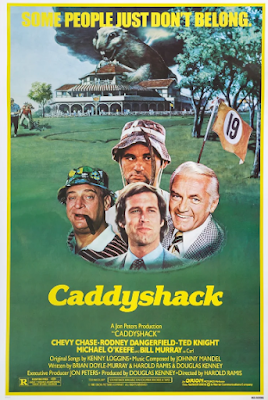
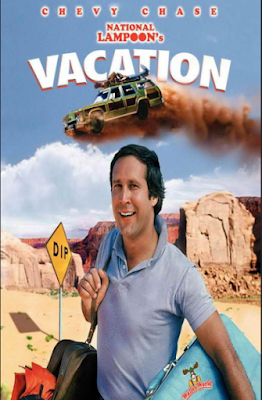
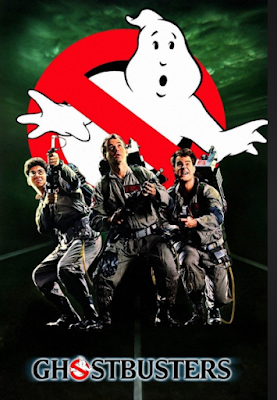
NL writers penned the script for the film 'National Lampoon's Animal House' (1978), which started out as a raunchy juvenile story set in high school. The movie took many rewrites, many writers, and many years to come to fruition. NL also spawned successul movies like 'Caddyshack' (1980), 'National Lampoon's Vacation' (1983), and 'Ghostbusters' (1984). Moreover, the NL changed the face of popular culture by inspiring The Simpsons, The Onion, This is Spinal Tap, South Park, SCTV, The Blues Brothers, and more.
In a way, the NL was responsible for its own demise, because its audience moved on to other comical fare inspired by the magazine.
Unfortunately, one of the NL's founders, Doug Kenney, came to a sad end. Kenney grew insecure about his talent, succumbed to cocaine addiction, and in 1980 - at the age of 33 - Doug was found dead at the bottom of a cliff in Hawaii.
At over 400 pages, author Ellin Stein relates everything you'd ever want to know about the National Lampoon; its editors, writers, and artists; the movies it sponsored inspired; and its HUGE influence on popular culture.
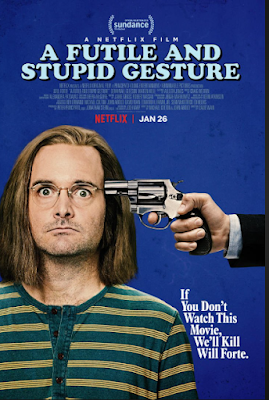
FYI: The 2018 movie 'A Futile and Stupid Gesture' tells the story of the founding of the National Lampoon, and relates the troubled life and sad end of Doug Kenney.
I have read a half-dozen or so books regarding the genesis of National Lampoon, and Ellin Stein's is the best (Denis Perrin's MR. MIKE, by far, the worst).
TNFTS provides a terrific overview, great interview material, tremendously valuable focus on the more below-the-radar players (Bluestone, McCall, TVTV, etc), and it is extremely well told.
One gripe: given our modern age, it's irritating how every author tackling this and related subjects must run down the road wailing (to varying degrees) "BUT THEY DIDN'T ALLOW WOMEN, BLACKS, OR GAYS!"
Yeah. And?
Maybe that would have made NatLamp a better magazine. Maybe not. There is only what is. And what is is the greatest moment in American humor of the twentieth century.
Despite such detours, I devoured and will regularly revisit Ms. Stein's achievement here. And I thank her for it.
A detailed history of the funny boys (and a very few girls) that brought you the National Lampoon. From it's roots in the Harvard Lampoon, to the print magazine better known as "The Lampoon" that skewered EVERYTHING sacred to somebody or other to the spin-off movies in the 80's and 90's and most recently to the actors from Second City and the Lampoon that became the headliners of SNL, it's all detailed here. If you were a fan of the magazine this is a great history of the flamboyant personalities that crafted some of the finest satire of century.
The story of two Harvard graduates who moved to New York to work on a magazine titled National Lampoon, Henry Beard and Doug Kenney. Six years later, they were millionaires, Beard keeping a low profile, and Kenney tumbling to his death of a cliff in Hawaii. In the interim, they would change comedy, inspiring The Simpsons, The Onion, This Is Spinal Tap, South Park, The Daily Show, SNL (“the post-Watergate victory party for the Woodstock generation”), Second-City (the name from a condescending reference to Chicago in The New Yorker), SCTV, Caddyshack, Animal House (which Belushi almost turned down, and was only paid $35,000), The Blues Brothers, and more. It began has Harvard Lampoon, which did a Playboy parody in 1966, which sold 450,000 copies in less than a week. The first issue of NL appeared in April 1970. The author writes: In 1970, there was no shortage of publications ready to attack the Establishment. What distinguished the Lampoon was its lack of faith in a viable alternative.” The magazine was sued by Disney for putting pasties on Minnie Mouse on its cover, and by Volkswagen for a parody ad it ran showing a VW bug floating in water, with the caption: “If Ted Kennedy drove a Volkswagen he’d be President today.” Starting in 1978, P.J. O’Rourke took over as managing editor in 1976, and did the 1964 High School Yearbook Parody, selling over 1.5 million copies. It classified students in one of the following cultural archetypes: bully, clown, intelligent introvert, politician, proto-homosexual. “It was Nazi social engineering,” Kenney said. NL’s humor was a weapon (offensive), not a shield (defensive). You’ll learn all sorts of things about John Belushi, Chevy Chase, Dan Akroyd, Bill Murray, Ivan Reitman, Loren Michaels, Gilda Radner, Harold Ramis, who said this: “It was hard for me to reconcile being commercially successful. People who had strong leftist values had a lot to overcome. A lot of us espoused egalitarian political beliefs that would seem to work against the star system, and I think I was perceived as one. You can be successful and not good, but because it was successful, you can allow yourself to think it was good. It’s a comfortable illusion.” That’s an excellent insight into the guilt-ridden left. The book is a bit too long, and I wish it had contained more of NL’s parodies and stories, rather than branching off into so many different directions. There’s a lot of detail in here, but if you enjoyed NL growing up, you’ll probably enjoy the ride.
(Audiobook) This book attempts to document the rise and fall of one of the key mediums for humor in the post-1960s/Vietnam era. Started by a number of Harvard Alumni, the National Lampoon grew to capture the humor and zeitgeist of the early 1970s. It would be the springboard for many of the key actors/performers/writers that came to dominate the world of humor and entertainment from the 1970s to today. Yet, for its focus on humor, the behind-the-scenes accounts are far from funny. While most came from a place of privilege, ego, greed, drugs and the pressures of trying to stay ahead of the humor game created a stressful environment, and while there could be some great humor produced, there was a lot of pain involved. The style of humor could be controversial and while it tried to slam everyone equally, the writing staff lacked diversity with women or POC, which could lead to some very awkward and difficult jokes. Still, the humor gave many individuals the chance to grow their skills, which could be used in different mediums.
Eventually, many came over to Saturday Night Live, and movies such as Animal House and Caddyshack could trace their starts to National Lampoon. However, as the times evolved, and the original creators took their profits and moved on to other things, the magazine could never recapture its place. After Caddyshack, National Lampoon eventually faded in quality, offering its name to various projects, but it was a shell of its former self and long superseded by Saturday Night Live.
This was an interesting back story of the organization and the people involved. It could be a little formulaic. Still, it shows that the production of humor in the entertainment world is far from a funny business. An okay read, but probably doesn't resonate unless you grew up reading the National Lampoon. The reader (a woman, ironically enough) is solid, but the material is neither improved nor lessened with the audiobook narration. Worth a checkout, but not much more than that.
How the Lampooners went from Harvard grads to ruling the newsstands, then to household names on Saturday Night Live, followed by kings and queens of Hollywood via a steady conquering of print, radio, stand-up comedy, improv theatre, TV and movies – wielding an influence far beyond the things they actually created themselves – is a heck of a tale. Crafted by Ellin Stein and including one-on-one interviews conducted over many years, it is fair to say it crackles off the page, with all the intrigue and derring-do, deal-making and double-crossing you would expect from such a talented gang.
While it seems safe to say that The National Lampoon’s reputation for counter-culture activity was perhaps over-stated – mostly by themselves – Thats Not Funny, That’s Sick doesn’t shy away from calling them out on it, quoting one contributing editor’s view that,
It was a commercial venture from the start, and subversion was the product being sold.
In the UK, writers tend to work alone and the teams that are locked in a room until the hilarity is honed are largely unknown to us. Perhaps this adds to the Lampoon mythology and brings it closer to the legendary sporting teams we love to laud. It is clear that what Stein calls the Lampoon’s ‘gym of the intellect’ fostered a competitiveness that spurred some individuals into levels of fame that can be difficult for such sensitive types to contend with. The push and pull between the mercurial types and the ones who have to manage their ‘output’ is painfully and truthfully detailed.
A history of National Lampoon and the influence its creatives across its several media incarnations (print, radio, theater, film) cast on underground and mainstream comedy in the 70s and 80s. I "graduated" from MAD to National Lampoon in the early 80s, and was sad to see the magazine's ultimate demise in the 90s. I thought I was getting access to a forbidden world of naughty adult humor back then, particularly since a few of the news stores I frequented back then (Community News, Chaloner's) kept it on the same rack with Playboy. Little did I know the writers were well aware that their primary readership was teenagers, and they deliberately pandered to adolescent (and male) prurience. I was reminded of this when I picked up a vintage collection of National Lampoon Foto-Funnies at a Comicon a year or so ago and was disappointed to recognize both how unfunny it is today and why I would have coveted it so at 12. This book provides a greatest hits of National Lampoon jokes and concepts and a deeper-than-necessary dive into the production history of SNL and other properties featuring National Lampoon alumni.
I have a number of significant issues with this book. The author can be incredibly preachy at times which can be infuriating and if any book needed some photographs and/or illustrations this one is it (thank God for the internet and search engines). Having said that there is so much significant and illuminating history here for anyone who came of age reading the National Lampoon and watching the original cast of Saturday Night Live. While I knew some of the writers and actors that are mentioned, I did not come close to knowing them all or understanding all of the connections. This book helped to shed some light on that as well as introducing me to others that I did not know that I had read before. This is the kind of book that I will not probably go back and read in its entirety but I will refer back to it many times in order to choose works to read in the future.
A comprehensive historical accounting of the rise of parody and irreverence born during the early 1970s, focusing on the National Lampoon, Saturday Night Live and all of the creative talent that resulted. For a shorter pithy introduction, the Netflix movie "A Stupid and Futile Gesture" does a nice, tidy overview of what this tome covers. I picked this up because I wanted more detail, but then found myself wishing it had been edited down quite a bit. A lot of extraneous flights of narrative that lost me, reminding me of being at a party and finding myself unpleasantly in the presence of an overtalker who gave me intimate details of his last physical exam. But overall, an interesting and worthy examination of the birth and rise of satirical writing and comedy that provides a backdrop to our modern age.
Really tried with this book, could not hang in there. Considering it was a book about National Lampoon, I thought it would be hilarious, although dumbed down humor. However, I could find one part of this book that would bring a laugh or smile. Just absolutely boring. It should be renamed “The History of National Lampoon, that is way too long AND will BORE to near death”. Is that too long of a title, perhaps a sub-title? Can I get those hours back?
I was a fan of most of the National Lampoon movies, MAD magazine, etc... So I thought I would love this book. There was some interesting "trivia" regarding the origins of some of these publications/media. But it just didn't hold my interest. I abandoned about a third through.
An interesting look at the creation of my all-time favorite publication. My only complaint is that it lacks pictures, as well as a timeline. Otherwise, a well-researched and mostly entertaining read.
Most of this book was terribly boring to me, but maybe it's because I never read the Harvard or National Lampoon. I appreciated the chapters that included SNL history and the films that came from Poonists, but the majority of the 400+ pages bored me.
I had only heard of National Lampoon from its movie ventures. It was interesting to learn about the start with Harvard Lampoon and the link between the NL and SNL.
I realize I am the prime demographic for this book -- the whole Mad/National Lampoon/early-Saturday Night Live/SCTV trajectory provided the humor "soundtrack" to my adolescence -- so I might be more inclined to find it compelling than others, but I'll be darned if this thing isn't a page-turner. Even "students" of the subject might be surprised by the full extent to which the mainstream comedy landscape came to be dominated by people with a common point of origin in a grungy nearly-underground subversive little rag. Occasionally Stein deploys some awkward phrasing but for the most part she really keeps this narrative barreling along nicely.
Just finished barreling through That’s Not Funny, That’s Sick, a history of The National Lampoon. All told, it’s a fascinating read. The National Lampoon sprung out of the college humor magazine, The Harvard Lampoon. College humor mags had been kicking around since the 20s, but as the 60s rolled along they were primed to take advantage of the 60s cultural zeitgesit. The college humor magazine was a great format to poke fun at changing societal values. Magazines like The Lampoon were in a great position to take the piss out of both sides of the cultural divide. Juvenile, puerile, but intellectual, The Harvard Lampoon and its ilk spoke to a younger, increasingly cynical, anti-authoritarian generation. Recognizing that their generation’s worldview was not being expressed by other magazines, a group of Lampoon graduates decided to take The Harvard Lampoon national.
Anyone interested in comedy and satire in print, TV, and movies will find many points of entry here. As The Lampoon gained its footing as a satire and parody mag, it also began producing stage productions and comedy albums. People getting their start in various Lampoon endeavors include SNL stalwarts, Chevy Chase, John Belushi and Dan Akyroyd, SCTV lynchpins Joe Flaherty and Harold Ramis, directors Ivan Reitman, John Landis, and Christopher Guest, to name but a few.
For me, the book was most interesting when discussing how The Lampoon fit into the broader comedy movements of the 60s and 70s. The Lampoon isn’t seen in a vacuum. That’s Not Funny, That’s Sick looks at how The Lampoon related to other magazines like Mad and The Realist, and to comedy troupes like Second City, The Committee, The Credibility Gap, The Firesign Theater, and Monty Python. Likewise, as The Lampoon embarks on video projects, we see how they fit in with more political video pioneers like TVTV. If anything, I would have loved to see an even broader view of the comedy landscape.
The book also takes a long look at the early years of SNL and the careers of Chase and Belushi, in particular. These were great sections of the book, but part of me felt like it was a little bit of a cheat. Granted, Chase, Belushi, and SNL writers Michael O’Donoghue and Anne Beatts came through The Lampoon, and Donoghue and Beatts were absolutely central in both the development of The Lampoon and early SNL, but the book seems to veer away from The Lampoon and capitalize on the notoriety of its more popular, younger rival in SNL for long periods of a time.
That’s Not Funny, That’s Sick does have its rough patches. It often wanders away into contributors’ non-Lampoon projects for stretches, and it could also be tighter. It doesn’t always find the right balance of Lampoon history and in-depth descriptions of particular articles and issues. Regardless, it charts a progression of art, politics, and culture from the early 60s through the early 80s, and does so through the lens of comedy movements and satire, shining a unique perspective on those eras.
That's Not Funny, That's Sick: The National Lampoon and the Comedy Insurgents Who Captured the Mainstream by Ellin Stein (W.W. Norton & Co. 2013) (051). I picked this up because I loved the magazine “National Lampoon” as a teenager. What a pleasant surprise the book turned out to be! It was about (in order) the Harvard Lampoon, the National Lampoon, Saturday Night Live, and SCTV (Second City Television). It was full of stories about the early days of Saturday Night Live about Belushi, Chevy Chase, and Dan Ackroyd, and there were good tales about the making of the movie “Animal House.” There was plenty of insight about the making of SCTV with John Candy, Joe Flaherty, Eugene Levy, and the rest of the crew. Here is one particularly astonishing story about Bill Murray's early days as a TV personality: Bill was busted in Chicago's O'Hare airport on his twenty-first birthday when denied a discount for being a minor because he told an airline ticket agent that he had “two bombs in my briefcase.” When the briefcase was opened for inspection, it was revealed that Murray did not have bombs. What he had instead was eight and a half pounds of pot. Busted! He was jailed briefly then did a stretch on probation. (p. 197). My rating: 7.5/10, finished 9/18/14.
a biographical catalog of the rise and fall of the humor magazine national lampoon. this book focuses on the three founders: beard, kenney, and hoffman, but it also goes great lengths to prove the point that national lampoon found the state of comedy in one place, picked it up, and moved it to another place entirely. the fingerprints of this magazine and its comedy can be found all over modern humor, but especially in the dna of SNL and the simpsons. it's not entirely complimentary though. the book also points out that often the target of the lampoon's satire was unclear, the humor juvenile, the motives vengeful. still, the rerouting of american comedy is a story worth telling, and this is a worthy attempt at that narrative.
I liked this book and learned something from it. Still, being a huge Lampoon fan (I still have my collection of the classic mags through the mid 70's) I thought I'd love it, but found it somewhat workmanlike. Stein takes too many detours (SNL, other TV and movie projects) that, while certainly part of the story, don't require the space she gives them. And some pictures of the colorful cast of characters here would have been a helpful, welcome addition. If you're old enough to remember Tarzan of the Cows, Jessica Christ and Foto Funnies, you're probably going to want to read this (and Mr. Mike, a book I remember enjoying more).
Probably the best book about the National Lampoon and the various offshoots and parallel universes--Saturday Night Live, Kentucky Fried Theater, Channel One, the video collective TVTV, etc.--that defined a decade in fringe comedy that was on its way to taking over the mainstream. Stein doesn't have the insider's perspective that define the best parts of Tony Hendra's memoir/critical study Going Too Far, but in a way, that's a blessing: she has no feuds to settle and has a clear, objective take on the golden-age Lampoon's sometimes unfocused attempts to grapple with racial and gender stereotypes that was beyond the author of "Dragula" and "Jessica Christ."