Jump to ratings and reviews
Rate this book

The Bayeux Tapestry: The Life Story of a Masterpiece

Rate this book
One of Europe’s greatest artistic treasures, the Bayeux Tapestry depicts the events leading up to the Battle of Hastings in 1066. For all its fame, its origins and story are complex and somewhat cloudy. Though many assume it was commissioned by Bishop Odo—William’s ruthless half-brother—it may also have been financed by Harold’s dynamic sister Edith, who was juggling for a place in the new court. In this intriguing study, medieval art historian Carola Hicks investigates the miracle of the tapestry’s making—including the unique stitches, dyes, and strange details in the margins—as well as its complicated past. For centuries it lay ignored in Bayeux cathedral until its discovery in the 18th century. It quickly became a symbol of power: townsfolk saved it during the French Revolution, Napoleon displayed it to promote his own conquest, and the Nazis strove to make it their own. Packed with thrilling stories, this history shows how every great work of art has a life of its own.

368 pages, Hardcover

First published March 2, 2006

35 people are currently reading
342 people want to read

About the author

Carola Hicks

12 books7 followers
Carola Hicks studied archaeology at Edinburgh University, and was an actress, journalist and House of Commons Researcher, before taking up an academic career. For several years she was curator of the Stained Glass Museum at Ely Cathedral, and then became a Fellow and Director of Studies in art history at Newnham College, Cambridge. Her books include Animals in Early Medieval Art, Improper Pursuits: The Scandalous Life of Lady Di Beauclerk, and two fine 'biographies' of works of art: The Bayeux Tapestry: The Life Story of a Masterpiece and Girl in a Green Gown: The History and Mystery of the Arnolfini Portrait.

Ratings & Reviews

What do you think?
Rate this book

Friends & Following

Create a free account to discover what your friends think of this book!

Community Reviews

5 stars
34 (19%)
4 stars
83 (48%)
3 stars
48 (28%)
2 stars
6 (3%)
1 star
0 (0%)
Displaying 1 - 30 of 30 reviews
Profile Image for zed .
602 reviews158 followers
November 3, 2011
A biography of an embroidery! Could this be interesting? Yes. I could not put this detective story down and though there are a few suppositions this did not detract from the story. From the beginning to the times of Napoleon and the Nazis Carola Hicks has told a good tale of this wonderful piece of embroidered propaganda.
Profile Image for Emily.
172 reviews268 followers
Read
June 19, 2011
Those of you who read my comments on the first few chapters of Carola Hicks's awkwardly-titled The Bayeux Tapestry: The Life Story of a Masterpiece, are probably wondering whether I was ever able to get over my yearning for a close reading of the Tapestry, and enjoy this book for what it is: a "biographical" account following the artifact through the thousand years since its composition, and all of the social and ideological battles that have been fought over and around it during that time. And the answer would be, more or less, yes. I'm still interested in reading something geared more toward artistic analysis of the Tapestry—something that "fondles its details," as Nabokov might say—but Hicks's approach proved quite juicy as well, and brought up some interesting points of consideration.

She has plenty of material to work with. The Bayeux Tapestry has simply been around longer than most non-classical works of art in the Western canon, and when you combine that with the fact that by its very nature it exists on the boundary between two nations—depicting as it does the invasion of England by the Normans, a people from what is now the northwest corner of France—it's not surprising that the work has become the site of a number of nationalistic and ideological struggles throughout the years. As "antiquarianism" (the 17th and 18th-century precursor to anthropology) gained ground, for example, the Tapestry was the subject of a hilarious series of sniping pamphlets between Frenchmen and Englishmen, who argued bitterly about whether the thing was a "French" or an "English" artifact. The fact that the modern "English" have long incorporated Norman heritage into their identities; that "Normans" were not exactly French to begin with; and that the Tapestry's own narrative is remarkably sympathetic to those on both sides of the Conquest; did not stop pamphleteering gentlemen of leisure from interpreting the embroidery in the most jingoistic terms, such as in this nuanced reading from 1742:


We see the faithless, inconstant and perfidious disposition of the French and their behavior towards us. We see, then as now, the genius of the English, brave, generous, honest and true. We may learn hence never to trust the bonne foy of that nation, but expect they will still be the same, as from the beginning.

The question addressed in my previous posts, about who did the actual embroidering on the Tapestry, was actually a topic of hot debate during this time. The French contingent attempted to emphasize the work's Frenchness by claiming that it was embroidered by the French queen Mathilde (wife of William the Conqueror), whereas the English contingent tried to emphasize the opposite by claiming that it was embroidered by English monks or nuns, on English soil. As far as I can tell, this debate is still very much alive, with no one definitive interpretation emerging—although the theory that it was commissioned by Odo, designed by a monk and executed in England seems to be the most popular.

For their side, the French used the Tapestry when convenient to serve as a model for current events. Napoleon, for example, had his arts-and-culture man Denon arrange an exhibition of the Tapestry in the newly-converted Louvre, in order to drum up popular support for the idea of a Napoleon-led invasion of England. He even went so far as to plant pieces of information in the press (which he controlled) to the effect that a comet had recently been seen in the skies—just like the one in the Tapestry that heralds the downfall of Harold and the arrival of William the Conqueror. Clearly, whatever Napoleon wanted to do must be sanctioned by divine right.

In a similar but slightly stranger vein, Heinrich Himmler and the Nazi party were extremely interested in the Tapestry during the Second World War. As far as the Nazis were concerned, the Anglo-Saxon heritage of the pre-Conquest English made them more or less Vikings, which meant that they were more or less German. (I'm betting they did not ask a Norwegian's opinion on this.) Which, in turn, meant that the Bayeux Tapestry could be "reclaimed" as an example of "pure Aryan" art, and removed back to Germany to serve the cause of Nazi propaganda. It was only through the resistance of a few individuals (both German and French), and a series of lucky breaks, that the artwork survived the War and remained in France. This Nazi angle is one of the stories that Hicks is very interested in telling: she opens the book with an anecdote about Himmler ordering the Tapestry removed to Berlin in the last days of the War, and her chapters on WWII are longer and more detailed than most others. Personally, I found that they dragged a bit, but I must admit to being a little "Nazi-ed out" in my reading, so others may feel differently. Not, of course, that Nazis and the Holocaust should not be written and talked about, but I've read a LOT about them and at this point am more interested in other historical periods.

One of the aspects of the book I did find reliably fascinating was Hicks's examination of the social debates taking place around the tapestry: in particular, its relationship to feminism and art theory. In the early Victorian era, when the first rumblings of an organized feminism were afoot, attitudes to embroidery within that nascent movement were very conflicted. For some early feminists, like Mary Wollstonecraft and Mary Lamb, embroidery was pointless, infantilizing busy-work, taught to upper- and middle-class women in order to signify that they had nothing important to do and so could afford to waste their time on trifles. These women agitated for a female education closer to that received by boys, emphasizing physical and mental activity over sedentary domestic arts. A different contingent of early feminists, however, looked to the Bayeux Tapestry and other works of needle art as a uniquely female sphere of artistic endeavor—one often unfairly dismissed, yet in truth equal to the male-dominated mediums of painting and sculpture, and in need of rehabilitation in the public eye. Both of these arguments are fascinating, and remarkably similar to debates still raging among feminists in the fiber arts world today. Neither side presents a case I can wholeheartedly agree with, but both provide food for thought, particularly as they intersect with issues of class. (And just to add spice to the mix, still other Victorian critics claimed that the naked figures in the margins of the Tapestry proved it COULDN'T have been embroidered by women, as their native delicacy would never have permitted such lewd subject matter.)

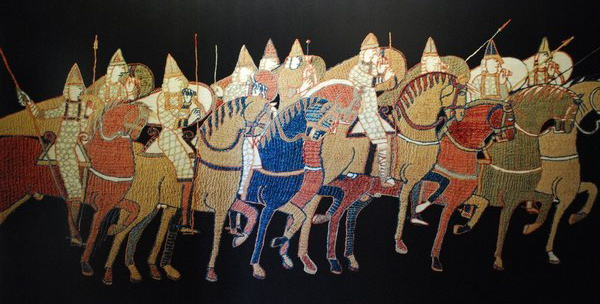
The other unexpectedly thought-provoking thread in Hicks's book was her tracing of aesthetic reactions to the Tapestry through time. In the 18th and 19th centuries, for example, most people were extremely put off by details that I would not even think to criticize: for example, that the colors in the Tapestry are not "true to life," or that a single horse is often portrayed using different colors. See below, for example; the inner side of a horse's back leg is often embroidered in a different color, giving a sense of depth without Renaissance-style perspective.


Similarly, 18th and 19th-century viewers were alienated by the lack of classicism in the style of the Tapestry. They equated "good art" with the ideals of Greek and Roman statuary and the painting that imitated it—illusionistic perspective, clothes that drape "realistically" over a muscled body, and so on—and there simply was no other yardstick by which to measure a piece of art. Accordingly, when people started attempting to revive the reputation of the Bayeux Tapestry, they made obsessive parallels to classical art; the only way they could think to elevate public opinion of the Tapestry was to uncover previously-unnoticed similarities to the Greek and Roman style. Only the most sensitive art critics of these times, among them John Ruskin, were able to evaluate the Tapestry on its own merits rather than attempting to imagine it into being as the Roman frieze it so plainly is not. It's fascinating to think that modern viewers, long accustomed to the playful abandonment of perspective pioneered by Van Gogh and others, and the anti-realistic use of color in everything from Picasso paintings to TV commercials, can more easily appreciate the artwork of the Tapestry than people for several centuries before us.


So, despite the occasional slow section, Hicks's Bayeux Tapestry was more than worth my time. I have another, lavishly illustrated book of academic papers on the Tapestry, so hopefully I'll get my fill of both its biographical and textual details.
Profile Image for Robert Tostevin.
37 reviews
June 9, 2017
The Bayeux Tapestry is an historical artefact that has fascinated me for many years now and which I have visited at least half a dozen times and it never fails to impress, depicting as it does such a pivotal moment in British history.

So if like me you want to dig deeper into the life of the tapestry then this book is for you as it lists the many near disasters during its 1,000 year life that might have robbed us of this wonderful artefact - from the French Revolutionaries to the Nazi's in WWII.

The book also goes into how it was constructed, hypothesises as to who ordered & actually made it and what its purpose might have been.

It also opens up the story told in the tapestry by revealing some of the hidden meanings and gestures that would have been obvious to the people of the 11th & 12th century but have been lost to our modern minds as you can see here ..... Secrets of The Bayeux Tapestry : Hidden Meanings & Gestures


All in all a very good read.
352 reviews7 followers
March 23, 2021
The book tells the story of this tapestry, a fabulous historical artefact with an adventorous background.
Carola Hicks did meticulous research to give us a new perspective on the work.
Profile Image for Kate Forsyth.
Author 86 books2,564 followers
October 23, 2016
I have always been interested in the Bayeux tapestry and made the trip to see it in its little French stone village this year. It really is a fascinating artefact, the world’s longest piece of embroidery and quite possibly the first real comic strip. It tells the story of William the Conqueror’s invasion of England in 1066, in a series of small scenes sewn with extraordinary vigour and humour. I bought Carola Hicks’s book in Bayeux, and read it over the next few nights. It begins with the story of how the embroidery came about, and then the extraordinary story of its survival over the next three thousand years. It survived the French revolution, the Napoleonic Wars, years of being kept in a damp church cellar, and the Nazis who tried to steal it. A really lively and beguiling story about an utterly unique piece of art.
Profile Image for Sally O'wheel.
186 reviews3 followers
November 23, 2019
I loved this book. Such interesting story about women's work of art. Unfortunately I left the book on the plane in Singapore and had to finish it on Kindle. Originally I had bought the actual book so that I could see the pictures properly. Now I still feel bereft about that book on the plane and I think I will have to buy the book again.

I especially was interested in her theory about who designed it and organised its creation and it made a lot of sense.
Profile Image for Michelle.
533 reviews11 followers
June 12, 2023
My library had two man books about the Bayeux Tapestry (Bridgeford and Bloch), but I sought out this one because I have really been enjoying history from a female perspective. (Also because I'm tired of "hidden histories" and Bloch sounded boring.) Considering that the tapestry was likely commissioned and sewn by women, a female perspective makes a lot of sense, and I was not disappointed. In fact, I was enthralled. The first few chapters hooked me with their reading of the scenes of the tapestry, with photos sprinkled in. I was not sure whether I wanted to go see the Tapestry when we're in Normandy next month, but now there is no way anyone will stop me. I LOVE THE TAPESTRY. How can something so silly looking be so engaging? The borders! The chainmail! The wading men without their hose!

The rest of the book is not quite as exciting as the first chapters, but it was interesting to learn about how it miraculously survived being bandied about. Only the last chapter dragged, essentially a compilation of references to and takes on the Tapestry. Fun knowledge but may have been better as a list.
Reproduction done with historically accurate dyes by Leek Embroidery Society (now in Reading Museum)
Ivanhoe set in "a post-Conquest England trodden under the cruel Norman yoke" (p. 252).
Anthony Powell cited the Tapestry in A Question of Upbringing (1951): Le Bas 'holding up both his hands, one a little above the other, like an Egyptian god or figure from the Bayeux tapestry.' (p. 257)
Benchley's "Bayeux Christmas Presents Early" (p. 258)
Bedknobs and Broomsticks opening
John Hassall's Ye Berlyn Tapestrie (p. 270) at Brown University in Anne S.K. Brown Military Collection
Profile Image for Teresa.
103 reviews14 followers
October 27, 2022
Este é o tipo de livro que eu gostava de um dia ser capaz de escrever. Um livro que nos conta a vida de uma obra de arte, de um documento histórico, e das pessoas envolvidas no seu percurso, da criação ao presente, e que nos mostra para que serve a arte e como ela transcende o tempo e o espaço, sendo reinventanda constantemente aos olhos da sociedade, sem nunca perder o valor. A batalha de Hastings fará um milénio este século e, com ela, muito provavelmente esta tapeçaria. É um verdadeiro privilégio ter já cruzado o meu percurso com o dela, esperando que quando eu cá já não estiver ela continuará aqui, a suscitar admiração e espanto, a conduzir mais gerações ao amor pela Idade Média.

Só não leva cinco estrelas porque a parte sobre a ocupação nazi me aborreceu bastante. E porque a tradução contém erros de palmatória...
Profile Image for Leah.
356 reviews45 followers
December 8, 2021
A fun, fascinating and fast-paced look at the life of the Bayeux tapestry. The first chapter sucks you in with a description of the tapestry itself, and from there the book follows its long life from it's murky creation to the way it is used culturally today. Chapters are short and make for very light reading.

Those who like this should also try A Needle in the Right Hand of God: The Norman Conquest of 1066 and the Making and Meaning of the Bayeux Tapestry.
Profile Image for Michelle Long.
57 reviews6 followers
March 26, 2018
Waited 'til I'd seen the tapestry itself, so I got a huge amount out of this book as I could picture the town and the buildings etc. Great book. So many little known events this amazing piece of embroidery was involved in throughout its long history. Just a miracle that it has survived after all its adventures! Extremely well researched and laid out book.
104 reviews1 follower
December 26, 2023
Nicely structured and written in an accessible style .... so important for history that's aimed at a public audience.
The final chapters were less attentively read, as they rattled through the work's more recent history, listing how it had fared the hands of such as novelists, cartoonists, and media. Just 3-star, this bit of an otherwise 4-book.
Profile Image for Sindre.
52 reviews
September 10, 2024
Fin oppsummering av historien til Bayeux-teppet. Tar for seg kunsthistorien, hvordan folk har tenkt om det, og hva "nytten" til teppet har vært gjennom historien.
Kjøpte den på Bayeux-museet, så den gjorde vel det den skulle.
Profile Image for Ivo Nicolay.
50 reviews1 follower
October 24, 2017
How the Bayeux Tapestry is a symbol for national identity and a battle between the French and the English.
Profile Image for Beth A.
573 reviews
October 10, 2021
Great explanation of the history, significance, and meaning of the "tapestry." Which is really embroidery.
Profile Image for Marks54.
1,572 reviews1,228 followers
October 24, 2011
This is another background book on the Bayeux Tapestry and the Battle of Hastings - a follow-up to the Bloch book I just finished. It is well written and informative. The books spends relatively less time on the actual making of the embroidery/tapestry and more time on the history of the tapestry as an important artifact -- this is especially the case following the intervention of Napoleon in trying to use the tapestry for propaganda value in the battle against England. This book goes over this episode and more recent history is good detail and provides detail where it needs to -- for example in the entire WWII history of escaping capture by the Nazis. Some of the episodes are less compelling - for example the various attempts to make popular copies of the tapestry -- but that is redeemed by an effective use of illustrations throughout the book, including numerous spin-offs and commercials based on the tapestry. Apart from a book of replicas of the actual tapestry frames, I think I am up to speed on my background reading.
Profile Image for Ellen.
Author 4 books26 followers
April 22, 2016
This is as the title says. I knew little about the Bayeaux Tapestry before reading the book, other than thinking it was an amazing piece of work. I still think that. What this book highlights is that there are times when much is known about the Bayeaux Tapestry, for example it was tracked in detail during World War II, but there is much which is not known about its actual origins. There are theories but none are certain. It went through stages of appalling storage so it is remarkable that is has survived so well. It is a highly political object with French and English using it for political ends, at different times. It was documented in different ways, some of them damaging to it (wax being poured onto some of the panels and harsh lights for flash photography). The stories of the different replicas of it are very interesting as they are impressive works in their own rights. It has inspired much fiction and much speculation, I enjoyed reading this very narrow history of one object surrounded, at times, by much uncertainty.
Profile Image for Kristin.
183 reviews13 followers
January 4, 2015
The Bayeux Tapestry is rapidly becoming one of my favorite works of art, even moreso after visiting it this past summer. Hicks' study deviates from traditional scholarship on this work, focusing on the biography of the work rather than questions of patronage and the circumstances of its creation. These are dealt with briefly, but the bulk of her book discusses its later preservation under what were very often tumultuous circumstances. The only thing that would make the read more enjoyable would be a reproduction of the entire tapestry, rather than just a few plates (understanding, of course, the considerable expense involved in providing such images). I felt I needed to reference more images than were presented. I am fortunate enough to have my own full facsimile of the work to reference, but others may find themselves wanting more visual reference points as they read.
Profile Image for Sandra The Old Woman in a Van.
1,442 reviews73 followers
Read
January 2, 2018
I started this book in the summer when I visited the tapistry and I wanted to finish it before the year ended. I can not give it a star rating. It is an excellent book if you are interested in the tapestry; if you are visiting Normandy and Bayeux. It was a fairly long, detailed slog though, even for me and I love history. I think I now know all I want to know about the tapistry. I am glad the book exists.

This book did make me ponder how I grew up doing embroidery. My grandmother and mother taught me and my maternal grandmother taught my grandmother. I know she came from Maine/Canada and I think is British so who knows.....maybe I have some ancestors who learned their needlework skills way way back. Unfortunately they are dying out with this generation. There is still a lot of creativity, but not so much with needles.
340 reviews1 follower
March 17, 2016
This book was okay. It started off very interestingly with the story of the tapestry and many of the theories behind who may or may not have commissioned or worked on the actual tapestry. Then the detail begins. It was like reading a textbook only one did not have to take notes. It was a fast read. The chapters on the tapestrys' fate during World War Two were excellent. So fast paced and very interesting. But then your back to entire chapters in which extreme detail is given on the Bayeux Tapestry in film, book and media. This was simply too much. I wanted to finish this book to say that I had. Like some other readers, I would suggest skimming some of the chapters and focusing on the chapters that appeal to you.
672 reviews
June 30, 2015
What an amazing book! Whatever I have read about the Norman Invasion, there was always a reference to the Bayeux Tapestry. I finally decided to pay some attention to this masterpiece and I am so glad I did. A truly interesting and exciting read (better than some fictional thrillers). This book is a must-read for all Medieval enthusiasts. I can't recommend it highly enough.
Profile Image for Julia.
174 reviews2 followers
December 23, 2013
An very enjoyable read. I was lucky enough to visit the tapestry this summer, and I picked up the book in the gift shop.

Some chapters were more interesting than others. I found I skimmed through some of the very detailed chapters, although I'm sure a more scholarly reader would appreciate the amount of information included.

Profile Image for Patricia Gulley.
Author 4 books53 followers
January 21, 2014
A fabulous read, the history and the controversies. I enjoyed this book very much and read it slowly over a long period of time. I liked the explanation of it display, cleaning and moving to a new home in the end. Now to get myself over there to see it.
Profile Image for Helaine.
342 reviews3 followers
September 30, 2016
This is the first book I have read about the Bayeux Tapestry after viewing the tapestry this summer & it has just given me an awareness of how little I know about 1066 history. However, once the author ventured into the references to the tapestry in literature, plays, etc, my interest waned.
Profile Image for Dr. Sharada.
49 reviews
June 22, 2012
As an academic book, it is excellent--well-documented and totally engaging. If, however, you're not accustomed to academic reading, this book may not prove as entertaining as the cover claims.
178 reviews3 followers
May 21, 2016
It was more than I wanted to know, but I am prepared to see this tapestry.
303 reviews2 followers
May 18, 2016
This is a very detailed historical book...not for the faint of heart.
Displaying 1 - 30 of 30 reviews

Can't find what you're looking for?

Get help and learn more about the design.