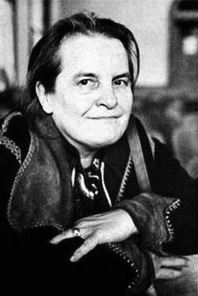
Gertrude Elizabeth Margaret Anscombe, better known as Elizabeth Anscombe, was a British analytic philosopher. A student of Ludwig Wittgenstein, she became an authority on his work, and edited and translated many books drawn from his writings, above all his Philosophical Investigations. She wrote on the philosophy of mind, philosophy of action, philosophical logic, philosophy of language, and ethics. Her 1958 article "Modern Moral Philosophy" introduced the term "consequentialism" into the language of analytic philosophy; this and subsequent articles had a seminal influence on contemporary virtue ethics. Her monograph Intention is generally recognized as her greatest and most influential work, and the continuing philosophical interest in the concepts of intention, action and practical reasoning can be said to have taken its main impetus from this work.
AN EXCELLENT STUDY IN THE “ANALYTIC” TRADITION BY A PROMINENT STUDENT OF WITTGENSTEIN
Gertrude Elizabeth Margaret Anscombe (1919-2001) was a British analytic philosopher, who was also a prominent student of Ludwig Wittgenstein (who called her “Miss Anscombe” in his lectures and writings),and edited and translated a number of his books. [She was married to philosopher Peter Geach; they are both converts to Catholicism.]
She wrote in the Introduction to this 1957 book, “The greater part of what appears here was delivered as a course of lectures at Oxford in … 1957… this book assembles the results, so far as concerns this particular topic, of research begun during my tenure of the Mary Somerville Research Fellowship at Somerville College.”
She said in the first chapter, “Intention appears to be something that we can express, but which brutes (which, e.g., do not give orders) can HAVE, though lacking any distinct expression of intention. For a cat’s movements in stalking a bird are hardly to be called an expression of intention. One might as well call a car’s stalling the EXPRESSION of its being about to stop. Intention is unlike emotion in this respect, that the expression of it is purely conventional; we might say ‘linguistic,’ if we will allow certain bodily movements with a conventional meaning to be included in language. Wittgenstein seems to me to have gone wrong in speaking of the ‘natural expression of an intention.’” (§2)
She explains, “What distinguishes actions which are intentional from those which are not? The answer that I shall suggest is that they are the actions to which a certain sense of the question, ‘Why?’ is given application; the sense is of course that in which the answer, if positive, gives a reason for acting.” (§5)
She notes, “We have now distinguished between a backward-looking motive and mental cause, and found that, here at any rate, what the agent reports in answer to the question, ‘Why?’ is a reason for acting if in treating it as a reason he conceives it as something good or bad, and his own action as doing good or harm… Whether in general good and harm play an essential part in the concept of intention is still remains to find out… When the question ‘Why?’ about a present action is answered by a description of a future state of affairs, this is already distinguished from a mental cause just by being future. Hence there does not so far seem to be any need to say that intention as such as intention of good or harm.” (§14)
She summarizes, “Intentional actions are a sub-class of the events in a man’s history which are known to him NOT just because he observes them. In this wider class is included one type of involuntary actions, which is marked off by the fact that mental causality is excluded from it; and mental causality is itself characterized by being known without observation… Intentional actions, then, are the ones to which the question ‘Why?’ is given application, in a special sense… the question has not that sense if the answer is evidence or states a cause, including a mental cause… in [one type of] case it is an answer to that question if the ideas of good or harm are involved in its meaning as an answer; or again if further enquiry elicits that it is connected with ‘interpretative’ motive, or intention ‘with which.’” (§16)
She states, “while we can find cases where ‘only the man himself can say whether he had a certain intention or not, they are further limited by it: he cannot profess not to have had the intention of doing the thing that was a means to an end of his.” (§25)
She argues, “you cannot take any performance (even an interior performance) as itself an act of intention; for if you describe a performance, the fact that it has taken place is not a proof of intention; words for example may occur in somebody’s mind without his meaning them. So intention is never a performance in the mind, though in some matters a performance in the mind which is seriously MEANT may make a difference to the correct account of the man’s action---e.g., in embracing someone. But the matters in question are necessarily ones in which outward acts are ‘significant’ in some way.” (§27)
She asks, “Can it be that there is something that modern philosophy has blankly misunderstood: namely want ancient and medieval philosophers meant by ‘practical knowledge’? Certainly in modern philosophy we have a incorrigibly contemplative conception of knowledge. Knowledge must be something that is judged as such by being in accordance with the facts. The facts, reality, are prior, and dictate what is to be said, if it is knowledge. And this is the explanation of the utter darkness in which we found ourselves. For if there are two knowledges---one by observation, the other in intention---then it looks as if there must be two objects of knowledge; but if one says the objects are the same, one looks hopelessly for the different ‘mode of contemplative knowledge’ in acting, as if there were a very queer and special sort of seeing eye in the middle of the acting.” (§32)
She states, “In fact the term ‘intentional; has reference to a FORM of description of events. What is essential to this form is displayed by the results of our enquiries into the question ‘Why?’ Events are typically described in this form when ‘in order to’ or ‘because’ (in one sense) is attached to their descriptions: ‘I slid on the ice because I felt cheerful.’ ‘Sliding on ice’ is not itself a type of description, like ‘offending someone,’ which is directly dependent on our possessing the form of description of intentional actions. Thus we can speak of the form of description ‘intentional actions,’ and of the descriptions which can occur IN this form, and note that of these some are and some are not dependent on the existence of this form for their own sense.” (§47)
She concludes, “It is for this reason that in some cases one can be as certain as possible that one will do something, and yet intend not to do it. So a man hanging by his fingers from a precipice may be as certain as possible that he must not let go and fall, and yet determined not to let go. Hence, however, we might say: “In the end his finger let go, not he.’ But a man could be as certain as possible that he will break down under torture, and yet determined not to break down. And St. Peters might perhaps have calculated ‘Since HE says it, it is true’; and yet said ‘I will not do it.’ The possibility in THIS case arises from ignorance as to the way in which the prophecy would be fulfilled; this St. Peter could to what he intended not to, without changing his mind, and yet do it intentionally.” (§52)
This book will be of great interest to anyone studying modern analytic philosophy.