Jump to ratings and reviews
Rate this book

Picturing the Bomb: Photographs from the Secret World of the Manhattan Project

Rate this book
Presents images that reflect the US Government's effort to build the world's first atomic device. The book contains photographs of farmland and desert scrub hastily transformed into cities to manufacture the bomb's fuel, as well as portraits, snapshots and ID badges.

232 pages, Hardcover

First published September 1, 1995

2 people are currently reading
34 people want to read

About the author

Rachel Fermi

2 books2 followers

Ratings & Reviews

What do you think?
Rate this book

Friends & Following

Create a free account to discover what your friends think of this book!

Community Reviews

5 stars
17 (39%)
4 stars
16 (37%)
3 stars
9 (20%)
2 stars
1 (2%)
1 star
0 (0%)
Displaying 1 - 7 of 7 reviews
Profile Image for Nick Black.
Author 2 books910 followers
Want to read
December 23, 2008
I must say, it was pretty cool to get an email today:

"Mr. Black. This is Glen at Acapella Books. We've come into possession of a copy of Rachel Fermi's 'Picturing the Bomb: Photographs from the Secret World of the Manhatten Project'. I assumed you'd want first crack at it; it's a nice edition, we're listing Very Good on Amazon, $70."

well yes Glen, I would appreciate first crack at it -- I hiked the ~50 minutes to L5P immediately. Looks great; we'll see!
Profile Image for Glenn Zorpette.
30 reviews
July 23, 2012
A remarkable collection of photographs from the single most significant project in human history. The photographs span the gamut from industrial/technical to personal and poignant. The more you know about the Manhattan project the more this amazing book will resonate with you. But you don't have to be knowledgeable about it to appreciate these images and the brief, utterly unique, and long-gone world they come from.
Profile Image for Mark Reynolds.
310 reviews4 followers
June 14, 2025
A very profound and important book. It should be read by everyone. The photos are compelling, as is the text. Here are some - what I found to be - interesting quotes.


"In Los Alamos, we were working on something which is perhaps the most questionable, the most problematic thing a scientist can be faced with. At that time physics, our beloved science, was pushed into the most cruel part of reality and we had to live it through. But suddenly, in the midst of it, [Niels] Bohr appeared in Los Alamos. It was the first time we became aware of the sense in all these terrible things, because Bohr right away participated not only in the work, but in our discussions. Every great and deep difficulty bears in itself its own solution. This we learned from him." Victor Weisskopf

Bohr and Wheeler believed, correctly, that only a particularly rare variety of uranium [U-235] could be used effectively in the creation of an atomic explosion. Bohr said this rare variety could not be separated from common uranium except by turning the country into a gigantic factory. ... Years later, when Bohr came to Los Alamos, I was prepared to say, "You see ...," but before I could open my mouth, he said, "You see, I told you it couldn't be done without turning the whole country into a factory. You have done just that."
- Edward Teller

"Almost every industrialized country in the world had sufficient information to initiate some sort of atomic bomb project before the second world war broke out, but only the United States had both the industrial resources and the manpower to launch the mammoth effort involved during the war itself. This, combined with the collective brilliance of native and émigré scientists, gave the Americans a critical advantage in constructing the bomb. Despite this advantage, no efficient means existed to produce useful amounts of either uranium-235 or plutonium when General Groves took command of the Manhattan Project in 1942. At this time, all experimental production methods were based upon laboratory-scale techniques, which could produce only minute quantities of the necessary materials. It was clear to Groves that a huge engineering effort would be necessary if sufficient quantities of fuel were to be generated. Therefore, the general persuaded almost every major American industrial or chemical firm to help in designing and building the massive production factories for the Manhattan District. The scientists did the basic research in physics and chemistry, but it was the engineers who made the production of the bombs active corre possible."

The first atomic bombs were made by extremely young people, and the technical and moral territory they explored was new. For some of the scientists, the initial reasons for working on the bomb were compelling, but its effects left them deeply disturbed. After the war, Oppenheimer bade farewell to his former colleagues, some of whom had vowed to abandoned weapons work after Hiroshima, saying, "But when you come right down to it the reason that we did this job is because it was an organic necessity. If you are a scientist, you cannot stop such a thing. If you are scientist, you believe that it is good to find out how the world works; that it is good to find out what the realities are; and that is good to turn over to mankind at large the greatest possible power to control the world to deal with it, according to its lights in this values."

Eugene Wigner refused to let General Groves fingerprint him for security purposes: "A fingerprint record might someday fall into the hands of the Nazis. I had no doubt that if the Germans won the war, they would begin swiftly rounding up everyone in the Manhattan Project for execution. And the round up would go easier with fingerprints.

At 4 AM, the arming party opened the circuits, checked connections, and began the final countdown. The project staff gathered outside control bunkers at 10,000 yards north and west. All were told to lieflat and face down, feet toward zero. Edward Teller remembered: "No one complied. We were determined to look the beast in the eye."

Profile Image for Keith.
945 reviews13 followers
January 26, 2025
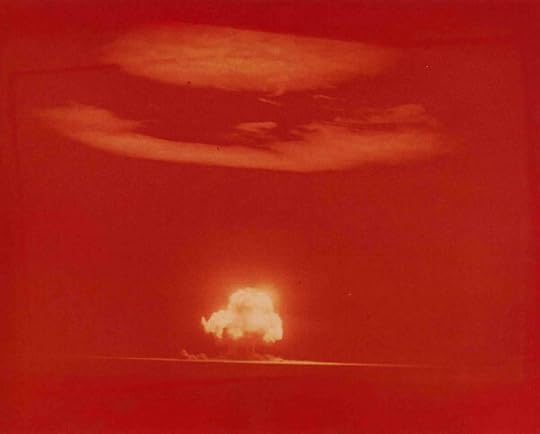
This is an essential companion to The Making of the Atomic Bomb (1986) by Richard Rhodes. Rachel Fermi and Esther Samra provide many photographs related to the Manhattan Project, giving a much more personal look into this world-changing event. It truly was necessary to turn the United States "into a gigantic factory" (p. 66). Rachel Fermi herself is the granddaughter of physicist Enrico Fermi (1901-1954), who was integral in the development of nuclear weapons. One of the inspirations for the writing of Picturing the Bomb was when she found the only color photograph of the first atomic explosion – the Trinity test on July 16, 1945 – in “a box of family photographs” (p. 197).


Esther Samra writes in the afterword:
“We became interested in seeing how these personal images coexist with the official record. The snapshots seen in this book extend the existing official documentation and enable us to view the Manhattan Project as a complex historical event. The photographs don’t explain why the first atomic bombs were made, or provide a comprehensive history. Rather, they point to the complexity of this event by virtue of the many means photography has at its disposal to document human activity.” (p. 197).
***************************************************************************

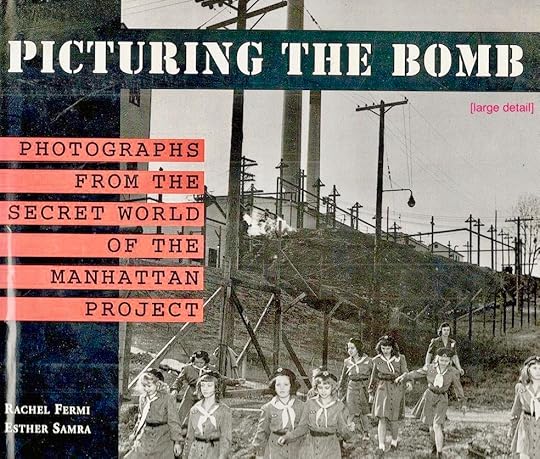
[Image: Book Cover]

Citation:
Fermi, R., & Samra, E. (1995). Picturing the bomb: Photographs from the secret world of the Manhattan Project. Harry N. Abrams, Inc. Publishers.

Title: Picturing the Bomb: Photographs from the Secret World of the Manhattan Project
Author(s): Rachel Fermi & Esther Samra with an introduction by Richard Rhodes
Year: 1995
Genre: Nonfiction - History, science, & photography
Page count: 232 pages
Date(s) read: 1/25/25 - 1/26/25
Book 15 in 2025
***************************************************************************
Profile Image for Samantha Larson.
211 reviews
June 19, 2025
Picturing the Bomb: Photographs from the Secret World of the Manhattan Project by Rachel Fermi is a fascinating and visually rich book that offers a unique window into one of the most secretive undertakings of the 20th century. The collection of photographs—some intimate, some technical, others haunting—gives readers a sense of the scale and secrecy of the Manhattan Project, while also humanizing the scientists, workers, and military personnel who were part of it. What makes the book especially compelling is how it captures the contrast between ordinary daily life and the extraordinary historical significance of what was unfolding behind the scenes. Seeing these images brings to life a time and place that has always seemed shrouded in mystery and secrecy.

One of the things that struck me most while reading was the simple fact that these photographs even exist. Given the intense secrecy surrounding the project, it's hard to wrap my head around how it was possible—or even legal—for anyone to be taking pictures of such highly classified work. That mystery adds another layer of intrigue to the book. Were these photos taken unofficially, or were they part of some internal documentation effort that only became public decades later? The book doesn't always answer these questions directly, but it invites the reader to ponder them while flipping through its pages.

Overall, I would rate this book 4 out of 5 stars. It’s incredibly cool to see these historical moments captured in black and white, and it adds a visual dimension that many history books lack. While it doesn’t dive deeply into the technical or political aspects of the Manhattan Project, it succeeds beautifully at making history feel tangible, real, and deeply human. It’s a book that will likely appeal to history buffs, photography enthusiasts, and anyone curious about how such a massive secret was kept—and occasionally documented—during a pivotal time in world history.
Profile Image for Jennie Kerns.
152 reviews1 follower
June 10, 2024
An ABSOLUTE must read. There are so many details that are not (and cannot) be fit into what you learn in school, and paired with that kind and amount of footage is just overwhelming. I have watched numerous documentaries and read books on WWII, but this was the first extensive media of the science and history of the bomb that I have happened upon. Even if science is not your cup of tea, this is STILL a must read.
Displaying 1 - 7 of 7 reviews

Can't find what you're looking for?

Get help and learn more about the design.