Perili Ev Charles Dickens’ın yönettiği All the Year Round dergisinin 1859 Noel Özel sayısında bulunan sekiz öyküden oluşur. Dickens’ın bu dergide yayımlanmış öykü derlemeleri arasında en popüleridir. Her öykü “perili ev”in bir odasına musallat olan bir hayaleti konu alır. Üçü Dickens tarafından yazılan öykülerin geri kalanı Hesba Stretton, George Augustus Sala, Adelaide Anne Procter, Wilkie Collins ve Elizabeth Gaskell imzasını taşıyor.
Charles John Huffam Dickens (1812-1870) was a writer and social critic who created some of the world's best-known fictional characters and is regarded as the greatest novelist of the Victorian era. His works enjoyed unprecedented popularity during his lifetime, and by the twentieth century critics and scholars had recognised him as a literary genius. His novels and short stories enjoy lasting popularity.
Dickens left school to work in a factory when his father was incarcerated in a debtors' prison. Despite his lack of formal education, he edited a weekly journal for 20 years, wrote 15 novels, five novellas, hundreds of short stories and non-fiction articles, lectured and performed extensively, was an indefatigable letter writer, and campaigned vigorously for children's rights, education, and other social reforms.
Dickens was regarded as the literary colossus of his age. His 1843 novella, A Christmas Carol, remains popular and continues to inspire adaptations in every artistic genre. Oliver Twist and Great Expectations are also frequently adapted, and, like many of his novels, evoke images of early Victorian London. His 1859 novel, A Tale of Two Cities, set in London and Paris, is his best-known work of historical fiction. Dickens's creative genius has been praised by fellow writers—from Leo Tolstoy to George Orwell and G. K. Chesterton—for its realism, comedy, prose style, unique characterisations, and social criticism. On the other hand, Oscar Wilde, Henry James, and Virginia Woolf complained of a lack of psychological depth, loose writing, and a vein of saccharine sentimentalism. The term Dickensian is used to describe something that is reminiscent of Dickens and his writings, such as poor social conditions or comically repulsive characters.
On 8 June 1870, Dickens suffered another stroke at his home after a full day's work on Edwin Drood. He never regained consciousness, and the next day he died at Gad's Hill Place. Contrary to his wish to be buried at Rochester Cathedral "in an inexpensive, unostentatious, and strictly private manner," he was laid to rest in the Poets' Corner of Westminster Abbey. A printed epitaph circulated at the time of the funeral reads: "To the Memory of Charles Dickens (England's most popular author) who died at his residence, Higham, near Rochester, Kent, 9 June 1870, aged 58 years. He was a sympathiser with the poor, the suffering, and the oppressed; and by his death, one of England's greatest writers is lost to the world." His last words were: "On the ground", in response to his sister-in-law Georgina's request that he lie down.
Sad to say, this was my first experience with reading Dickens. Might have been better to have read one of his more famous tales as he has, to this day, quite the reputation of being a great writer of the Victorian Era. This novella, compiled by him and edited by him, includes stories from other authors as well as himself. Some being short , some being a bit longer, some ghostly, and others not ghostly at all. But I still found this book very interesting and reading it gave me a chance to obtain a feel for the writing style of Dickens. I will definitely experience this author again. I would recommend, if you are just getting started with Charles Dickens, that you do, as I did not, read one of his more proliferus writings that made him one of the 'literary geniuses' of his era.
vallahi beni çok şaşırtan bir kitap oldu çünkü edgar allen poe tarzı, ne bileyim a christmas carol tarzı öyküler okuyacağımı sanırken bayağı psikolojik öyküler okudum. charles dickens’ın yayın yönetmeni olduğu all the year round dergisinin 1859 noel özel sayısı için kaleme alınan bu öyküler bence çağının oldukça ilerisinde bir öykü toplamı. öyküler bir bütünlük taşıyor çünkü en başta anlatıcı john perili olduğu söylenen bir eve taşınmasının hikayesini anlatıyor. john’un kısımları hep charles dickens’ın kaleminden çıkma. kızkardeşiyle eve taşınan ve birkaç ayda yaşanan garip şeyler yüzünden hizmetçisiz, aşçısız kalan john eve arkadaşlarını misafir etmeyi, herkese kurayla çektiği ayrı bir oda vermeyi, üç ay sonunda yaşanan garip olayları da noel gecesi birbirlerine anlatmayı düşünür ve bu planı uygularlar. evdeki 7 odada kalan 7 kişi hikayelerini paylaşıyorlar ve en baştaki girişle beraber 8 hikaye oluyor. charles dickens john’un girişinden sonra kaldığı odada yaşadıklarını anlattığı ve sonda kapanışı yaptığı 3 öykü yazmış. geri kalan 5 öykü dönemin başka ünlü isimlerinden. öyküler en başta da dediğim gibi perili hayaletli filan öyküler değil. zaten en başta da son derece rasyonel john’la tanışıyoruz. pek çok öykü bence psikanalitik çözümlemeye bile uygun. başka bir yazıda sevdiklerimden daha uzun bahsetmeyi düşünüyorum. bu kitabın telif geliri edebiyatla ilgilenen herkesin bildiği canımız ciğerimiz çevbir’e gidecek. çevbir üyesi 8 ayrı çevirmen tarafından çevrilen öyküler tadından yenmiyor diyebiliriz. yazarın sesine uygun, mükemmel çeviriler. ama savaş kılıç’ın çevirdiği manzum hikaye “resimli odadaki hayalet” beni kendisine hayran bıraktı onu söyleyebilirim. dickens’ın dehası ve muzipliğinin öykülerinde hissedildiği, ustalıkla seçilmiş bu öykülerle tanışın bence. böyle çevirmenleri de bir arada bulmanız biraz zor.
One of Dickens Christmas collaborations featuring Dickens, Wilkie Collins, Elizabeth Gaskell, Adelaide Anne Proctor and two I am not familiar with Hesba Stretton a.k.a. Sarah Smith and George Sala. I have only read one other of these types of work which was A House to Let and that work seemed a bit more coordinated, that is to say 4 authors each wrote one chapter in the same story. This was more like do your own thing and it does in parts recognize ghosts but we also have a section by Proctor which is in poem form and Elizabeth Gaskell actually has a full story albeit a short one. It is what it is and I can't fault it for that. Not one of my favorites but not horrible either. This is available in a few ways. I have the Kindle Delphi Complete Works of Dickens, Collins and Gaskell and I chose to read the print from the Dickens version. It is also available on audio from Audible.
Necesitaba algo corto para leer y terminar el reto así que encontré estos dos cuentos de dos grandes autores para ayudarme.
El primero es "La casa encantada" (también se puede hallar como "La casa hechizada"), de Charles Dickens. Increíblemente, es el que menos me gustó. La historia empezaba bien y creí que iba a convertirse indefectiblemente en una de mis favoritas sobre fantasmas pero no ocurrió. Se trata de un hombre que se va a vivir con su hermana a una casa encantada (previo aviso de los vecinos) y empieza a tener problemas con la servidumbre, ya que nadie soporta quedarse allí. Este hombre convive normalmente con lo sobrenatural y luego los hechos dan un giro que no me gustó para nada.
El segundo cuento es "Esa cosa al final de la escalera", de Ray Bradbury, y es un poco más interesante. Un hombre regresa a su casa de la infancia para enfrentarse con "la cosa al final de la escalera" que lo acechaba cuando era niño. Muy bueno y muy original, ya que pocas veces se ve a un protagonista que quiere cerrar la historia y no huir de ella.
En síntesis, son dos cuentos que me hicieron pasar el rato. Lástima que el de Dickens me haya decepcionado un poco.
I am sure that I will not spoil anything when I tell you, right at the start, that you must not expect a haunted house in this collection of short stories. Rather, each of the stories included in this collection tell you something about the fears, worries and preoccupations of the minds of their respective narrators. This could be the breeding ground for some truly spine-chilling yarns, but alas! the title The Haunted House is misleading in that the house is not haunted at all. I am telling you this beforehand lest you should approach this collection with wrong expectations, as I most certainly did.
The Haunted House is a collaboration of Dickens’s with a handful of other writers and it appeared in the 1859 Christmas number of Dickens’s periodical All the Year Round. Probably Dickens wanted to live up to the public’s expectation of his delivering his annual Christmas story without putting too much time into it. His collaborators were well-known writers to the Victorian reader, although only two of them – Wilkie Collins and Elizabeth Gaskell – have stood the test of time. And if you look at the two stories these two contributed you might get an idea why this is the case, because these two contributions are the best tales in the whole collection. Collins gives us the tale of a sailor who goes through two hours of mortal anguish when he is manacled and put into the hold of a ship containing explosives – with a burning candle and a slow match wick ready to light. It is not a ghost story but a tale of terror redolent of Edgar Allan Poe’s The Pit and the Pendulum. Gaskell’s story is about a couple of honest-to-God farmers whose son is an ingrate and underhanded good-for-nothing. How far will this villain go in his attempts at obtaining his parents’ modest fortune? Not only is there a very dramatic ending, but Gaskell also manages to give us a vivid impression of her characters and the atmosphere.
Dickens’s introduction is also amusing to read as he makes fun of people’s sensationalist gullibility when it comes to haunted houses, but the tale he contributes is downright silly. A similar experience in silliness, and in an annoyingly contrived attempt at original prose, can be seen in George Augustus Sala’s story. The first story in the collection was written by Hesba Stretton, and it has a certain touch of Brontëan sentimentality and pathos, which made it the most unpalatable story of the bunch for me. Last, not least, there is a long narrative poem by Adelaide Anne Procter, which is superior to Sala and Stretton’s efforts, though still not as convincing as the tales given by Collins and Gaskell.
All in all, I did not particularly enjoy this short story collection, but nevertheless I would recommend the two outstanding tales by Gaskell and Collins.
Charles Dickens is often credited with having “invented” Christmas as we know it. This claim might be exaggerated (as is argued here), but one can hardly contest the fact that his “Christmas novels” are a major contribution not only to the literature of this feast, but also to what might be termed its “social iconography”. Works such as “A Christmas Carol” or “The Chimes” both fed and met the expectations of the periodical-reading public whilst tapping into the tradition of telling ghost stories during long December nights.
“The Haunted House” dates from 1859 and was published in Dickens’s weekly periodical 'All the Year Round'. It is a collective effort featuring contributions from several of Dickens’s friends and regular collaborators. Dickens himself acts as master of ceremonies and provides the frame-story, about a group of acquaintances who spend Christmas at an allegedly haunted house, with an agreement that they recount their experiences on Twelfth Night. Given the title and premise, one would be forgiven for expecting a supernatural work or even a prototype “Haunting of Hill House”. Alas, this is nothing of the sort. Many of the contributors either interpret “haunting” in a metaphorical sense or else merely use the ghost as a “prop” for a totally different sort of tale. Just to give an example, Hesba Stretton writes a moralistic love story whilst George Augustus Sala’s narrator claims to have been visited by “the Ghost of the Ague”, prompting a rather tiresome slapstick piece about a wretch with an uncontrollable tremor.
This Hesperus Press edition includes a foreword by novelist and Dickens biographer Peter Ackroyd. He is decidedly lukewarm in his praise for this work, singling out only Dickens’s contributions for their quality. Even about these, he has some serious reservations which are, frankly, justified. Indeed, apart from the background narrative, Dickens contributes a strange and rather uncomfortable story about a group of infants at a school who decide to set up a harem. It is likely that Dickens meant to satirise a contemporary fad for “Orientalism”, but to a modern reader, his tale raises disturbing spectres of both paedophilia and (although Ackroyd does not specifically mention this) racism.
Ackroyd still considers the remaining chapters as inferior, and here I beg to differ. I must confess that, except when I’m in the mood for him, I tend to find Dickens’s prose heavy and his humour smug. In The Haunted House, for instance, I much preferred his friend Wilkie Collins’s rollicking seafaring tale or, despite its streak of melodrama, Elizabeth Gaskell’s domestic tragedy about a son who disappoints his simple parents’ expectations. And yes, Adelaide Ann Procter’s “sacred legend in verse” (featuring a nun visited by the Virgin Mary) is over-written at times, but its Medieval setting and deliberate archaisms give it pleasant Pre-Raphaelite and Gothic overtones, not unlike Flaubert’s The Legend of Saint-Julian the Hospitaller.
Still, a few ghostly scares would not have been amiss...
“Sento di poter dire con una certa tranquillità che a infettare ogni uomo sulla faccia della terra siano nient’altro che le sue paure.”
Un'antica villa immersa nella campagna inglese, uno stuolo di (presunti) fantasmi che terrorizzano abitanti e servitù, ed un'impavida comitiva pronta ad affrontare gli spettrali inquilini della casa; il tutto nella classica cornice delle feste di fine anno: tradizionale momento di riflessione e, secondo l'uso anglosassone, d'inquietanti ed affascinanti storie gotiche.
Gli ingredienti per un avvincente racconto natalizio ci sono tutti; se poi a concepirlo è la penna geniale e imprevedibile di Charles Dickens, il successo è garantito!
Pubblicato originariamente nel 1859, sul periodico All the Year Round, Le stanze dei fantasmi (titolo originale: The Haunted House) ha la particolarità di essere un’opera a più voci, in cui Dickens, negli inconsueti panni di regista, si avvale della collaborazione di uno speciale team di autori che vede schierati alcuni tra i suoi più stimati e fidati collaboratori.
Troviamo così Wilkie Collins, celebre precursore del genere poliziesco; Elizabeth Gaskell, affermata autrice di romanzi a sfondo sociale e non solo; Adelaide Anne Procter, poetessa raffinata e amatissima dalla regina Vittoria, ed altre due personalità a noi meno note, ma non per questo meno rilevanti: Hesba Stretton – al secolo Sarah Smith – apprezzata autrice di libri per bambini, e George Augustus Sala, versatile giornalista e scrittore, assurto agli onori della cronaca, nel 1882, per aver pubblicato, con uno pseudonimo, un romanzo dal contenuto decisamente “audace” dal titolo The Mysteries of Verbena House.
Una squadra tanto eterogenea quanto ben assortita, che sotto la sapiente direzione del miglior Dickens, rivisita con un pizzico di sano umorismo gli archetipi del gotico, regalandoci un’opera originale in cui il gusto classico della narrativa vittoriana si declina secondo i generi allora più popolari: dal bucolico al picaresco, dal sentimentale al poliziesco, passando per il romanzo di formazione così caro al padre dell’opera.
Scenario della vicenda è una misteriosa dimora poco distante da Londra, dove, secondo la gente del luogo, si aggirerebbero da tempo sinistre presenze. Quando l’ultimo di una lunga serie di oscuri fenomeni mette per l’ennesima volta in fuga i domestici, John e la sorella Patty, freschi proprietari della villa, decidono di fare a meno della servitù, e d’invitare invece un nutrito gruppo di parenti e amici, a tener loro compagnia fino alla conclusione delle festività natalizie.
Ciascuno dei presenti, a cui verrà assegnata una stanza, dovrà confrontarsi durante l’intera permanenza col presunto fantasma che infesta la sua camera, senza però svelare niente ai coinquilini, fino alla notte dell’Epifania, quando i membri della comitiva si riuniranno finalmente per narrarsi l’un l’altro le proprie esperienze.
Attenzione però: come i suoi affezionati lettori ben sanno, quando si tratta del buon Charles niente è mai ciò che sembra! E così, quello che dalle premesse si direbbe un tipico romanzo gotico, si rivela piuttosto un brillante esperimento letterario di ben maggior spessore, in cui a farla da padrone non sono gli spiriti e le entità soprannaturali, bensì quei demoni molto più reali, e per questo tanto più temibili, che albergano silenziosamente nell’animo umano, tormentando senza requie chi, suo malgrado, ne è vittima.
Saranno infatti il peccato, la paura della morte, la perdita dell’innocenza, la malattia, e i sensi di colpa, i veri fantasmi che gli ospiti della villa dovranno affrontare nel corso di quel soggiorno che, a sorpresa, diventerà l’occasione per guardare dentro di sé, ed esorcizzare una volta per tutte i propri incubi, condividendoli nell’ultima notte delle Feste: quando – con chiara valenza simbolica – il dolore cederà il passo alla pace, e l’animo rinnovato verrà finalmente liberato dal male.
Il romanzo, che sfrutta con abilità il noto espediente della storia nella storia, si articola – ad eccezione della parte introduttiva dal titolo I mortali della casa – in sette diversi racconti – tanti quante sono le stanze – affidati ciascuno ad un diverso autore (ad eccezione di Dickens che, come padrone di casa, ne redige due), e presentati dalla voce narrante dei singoli personaggi, che nella loro eterogeneità richiamano le tante differenze tra gli stessi scrittori.
Le stanze dei fantasmi, dunque, non è una raccolta di racconti, come potrebbe sembrare a prima vista, ma un’opera unitaria di cui i vari racconti costituiscono i vari tasselli rispecchiando ciascuno la personalità, lo stile, e la sensibilità del proprio creatore.
Se il primo racconto (La Stanza dell’Orologio), una classica storia d’amore uscita dalla penna della Stretton, si distingue per la prosa limpida e fluente, il successivo (La Stanza Doppia) di stampo romantico-avventuroso, incarna invece le peculiarità del più diretto Sala, spiccando per la scrittura asciutta ed il ritmo incalzante.
Troviamo poi i versi delicati di Adelaide A. Procter (La Stanza del Quadro)– all’epoca fresca di conversione al cattolicesimo – che nel loro misticismo, risultano efficacissimi nell’evocare la grandezza della fede, in una sofferta storia di seduzione, peccato e redenzione, in linea con la più classica tradizione vittoriana.
Perfettamente riusciti anche i lavori di Collins (La Stanza della Madia), impegnato in un trepidante noir dall’ambientazione marittima sullo sfondo delle colonie spagnole, e di Dickens, che attingendo al suo più fortunato repertorio, si dedica ad un sentito racconto (La Stanza del Signorino B) incentrato sulla figura di un bambino, in cui riecheggiano nitidamente memorie del celebre David Copperfield.
L’ultimo componimento (La Stanza del Giardino) è invece quello affidato ad Elizabeth Gaskell: una toccante storia bucolica imperniata sul dramma di una modesta famiglia alle prese con un figlio ingrato, in cui, in perfetto stile social novel, non viene risparmiata una stoccata alla crudele indifferenza della Giustizia inglese verso l’essere umano. Il racconto, basato su un’idea interessante e dagli intenti lodevoli, ha confermato la mia opinione che la Gaskell dia il meglio nella narrazione breve; peccato solo per il sentimentalismo (a mio avviso un tantino eccessivo) che permea la narrazione, e per l’occasionale tendenza dell’autrice a dilungarsi oltre il necessario.
La conclusione dell’opera (La Stanza ad Angolo), così come l’introduzione, vede finalmente il ritorno di Charles Dickens, e chiude il romanzo con un gioioso finale in cui egli si congeda dai lettori rivolgendo loro un messaggio di speranza e un bell’augurio natalizio sempre attuale e condivisibile:
“Facciamo uso della virtù più grande, la Fede, ma non abusiamone; e utilizziamola nel migliore dei modi avendo fede nel grande libro di Natale che è il Nuovo Testamento, e credendo gli uni negli altri.”
Avevo letto in passato alcuni stralci di quest’opera, precisamente dei brani composti da Dickens, nell’ambito di una breve e confusionaria raccolta pubblicata da L’Unità, nella collana Illusioni & Fantasmi, dal titolo La casa dei fantasmi, in cui non si faceva alcuna menzione dell’origine degli scritti, né dell’esistenza di un’opera entro cui essi erano stati concepiti; inutile dire che, leggendoli, ne ero restata alquanto perplessa.
Leggere questo libro, al contrario, si è rivelata un’esperienza piacevolissima e soddisfacente, grazie a cui ho avuto modo di conoscere ottimi esponenti della scena letteraria vittoriana che, a dispetto dell’indiscutibile bravura, risultavano ai giorni nostri ingiustamente ignoti.
Il vero trionfatore, però, è superfluo dirlo, resta il grande Charles! In questo romanzo, come del resto in ogni sua fatica, Dickens dà prova di quella singolare genialità che gli consente di sperimentare, far riflettere, e divertire, appagando tanto il gusto degli addetti ai lavori, quanto quello dei pubblico: una capacità che pochi altri possono vantare. Il suo punto di forza – l’ironia innata e spassosa che ne contraddistingue le opere – emerge con forza anche ne Le stanze dei fantasmi, dando vita ad alcuni siparietti memorabili: come la scena iniziale sul treno, dove il protagonista s’imbatte in uno strambo passeggero che di punto in bianco comincia ad enumerare gli spiriti (ben centoventiquattro!) a suo dire intenti ad infestare lo scompartimento, snocciolando – ciliegina sulla torta – improbabili proverbi e perle di saggezza.
Un plauso speciale, infine, alla bravissima Stella Sacchini, a cui va il merito di aver riportato alla luce questa piccola perla dimenticata, di cui ha inoltre curato, con dedizione e scrupolosità, l’ottima traduzione, la prefazione e la postfazione, nonché il ricco ed interessantissimo apparato di note esplicative di cui è corredata questa splendida edizione proposta dalla Del Vecchio, curatissima sia a livello grafico che letterario. Un vero gioiellino.
I had about given up hope of finding a complete copy of THE HAUNTED HOUSE. It was included in two Dickens collections that I own. However, when I started the book in each one, I found that only the portions written by Dickens had been included. (The book is a collection of stories contributed by six writers on one theme.) My library had an eBook copy ... and it, too, only had the Dickens portions! Finally, I ordered the Modern Library paperback edition published in 2004. It had the complete text.
According to the Introduction by Wesley Stace, one of Dickens’ literary journals was called “All the Year Round.” He came up with the idea for THE HAUNTED HOUSE as a holiday edition for Christmas. The British have a long-standing tradition of ghost stories during this holiday time. (In fact, I have some DVD copies of shows produced by the BBC over a number of Christmas years.) The emphasis here was not to be on scares, but on a theme.
A man and his sister lease a dilapidated house that is believed to be haunted. Servants take their leave after a short time, giving the occupants an idea. They will invite their friends to stay for the Christmas holiday in a “roughing it” atmosphere of managing the household duties on their own. Then, on Twelfth Night, they will have a special party at which they will detail any ghostly experiences that they encountered in their rooms.
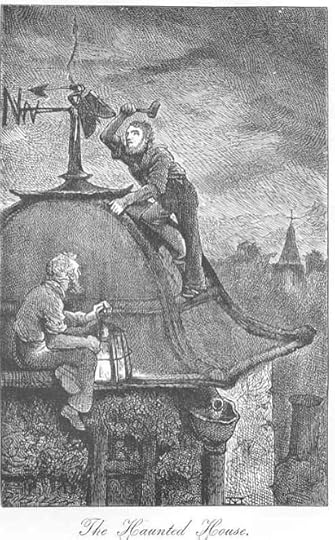
In the first chapter, Dickens sets the stage Not to expect any supernatural visitations. Screams and moans in the house are tracked to their source and are either repaired or made quiet (such as a rusted weathercock on the rooftop). One young townsperson in particular, taking pleasure in giving people a fright, is discovered and warned away from the property. So, there is no need to look here for something akin to “The Headless Horseman of Sleepy Hollow.”
But, what will they find?
The short book reminded me of one of those Writers’ Seminar assignments when attendees were given the start of a story and were then sent away to finish it (their final result being shared with the group). Dickens had a definite idea of what he wanted for the form of the stories, but he was the only one to actually follow that form in his offering, “The Ghost In Master B’s Room.” Everyone else went in a different direction ... Adelaide Anne Procter took the most extreme approach for “The Ghost In The Picture Room” by producing a long poem! Each was given one of the house’s rooms as the setting and the occupants of that room as the central character.
Modern Readers, those who find a complete edition, tend to be confounded by what they discover in THE HAUNTED HOUSE. None of the stories is particularly scary. (The “Master B” story by Dickens comes the closest to that.) Yet, I did enjoy most of what I read. “The Ghost In The Double Room” by George Augustus Sala was the wildest ride with the most humor. Wilke Collins uses “The Ghost In The Cupboard Room” to tell an adventure tale reminiscent of Poe’s THE PIT AND THE PENDULUM. Hesba Stretton unfolds a proper love story in “The Ghost In The Clock Room.” And Elizabeth Gaskell relates a story that would be worthy of one told by Dickens in “The Ghost In The Garden Room.”
Dickens is there at the beginning and the end, too, providing a framework in which the stories can reside. His hope for a thematic “Lesson Learned” is discarded, though, and the book ends abruptly.
As a sampling of creative British writers of the time (1859), THE HAUNTED HOUSE is an enjoyable “place” to visit. If you are looking for ghostly tales to be told around the campfire ... with some eerie voice chanting, “Whose got my golden arm?” ... you’d best keep looking. That level of creepiness will not be found here at all.
Yazarın kendi hayatından etkilenerek yazdığı öykü tarzında bir oturuşta okunabilecek hoş bir kitap. Klasik perili ev hikayelerinden ayrılan pek bir yönü yok ama yazarın kalemi kitabı okumak için iyi bir etken. Yine de kitap ne güzel ne kötü denebilecek orta kıvamda bir eser. :)
An interesting concept for an anthology of short stories, very unique! The introduction and setting of the Haunted House was creepy and funny, and created a vivid atmosphere for the stories, so that though they were extremely varied, they always hand an air of mystery, as well as a bridge between their widely differing genres and styles. The ending of the book fell a bit flat for me though, since the ghostly activity from the beginning of the book was never sufficiently resolved, and just seemed to vanish in the end without reason; instead, two couples got married and the author talked about the Bible. Maybe this made sense as a convention of literature at the time it was written, maybe to make it a happy ending or something, but at present, it threw an anticlimax at the end of a book that was really good and engaging in all other aspects. Aside from that, this book was highly entertaining and extremely memorable. The stories themselves are haunting and will stick with me for sometime to come! This is most definitely a book worth reading!
This book was my first attempt at reading a full-length Dickens novel. Unfortunately, I didn't realize until I'd got home from the library that it was a collection of short stories, a collective round robin of Victorian literary minds. This didn't detract me though, and I'm very glad. Though Dickens only contributed a few short chapters to the "novel," he orchestrated the whole scheme, and his humor and affinity for the supernatural was present throughout the work. This was a very enjoyable read, very amusing at times, especially the story of the Ague ghost.
Che cosa c’è di meglio, quando nell’aria s’inizia a percepire l’atmosfera natalizia, che immergersi pienamente in questo clima magari leggendo un buon libro ambientato in questo particolare periodo dell’anno? Le mie ultime festività natalizie sono state allietate dalla lettura de Le stanze dei fantasmi; come se avessi, incoscientemente, voluto rispettare la tipica tradizione inglese vittoriana di leggere dei racconti popolati da fantasmi e spettri proprio in questo periodo dell’anno. Le stanze dei fantasmi non è una semplice raccolta di racconti, ma un progetto letterario collettivo ideato da Dickens in occasione del Natale. L’autore inglese decise, infatti, di mettere insieme alcuni fra gli autori più famosi e rappresentativi del periodo vittoriano; parteciparono al progetto: lo stesso Charles Dickens, Wilkie Collins, Elizabeth Gaskell, la poetessa Adelaine Anne Procter, l’autrice di libri per l’infanzia Hesba Stretton, lo scrittore e giornalista George Augustus Sala. Questo progetto fu pubblicato a puntate nella rivista “Alla the Year Round” diretta da Dickens, come strenna natalizia nel 1859. Il libro inizia con il trasferimento di Joe e Patty, fratello e sorella, in una dimora di campagna in un piccolo paese fuori Londra con l’idea di rilassarsi un po’. La casa però è oggetto di strane storie da parte degli abitanti del villaggio. Si narra, infatti, che sia infestata dai fantasmi, popolata da strane creature e che la notte si sentano campanelli suonare, porte sbattere e voci inquietanti. Per sfatare la leggenda Joe e Patty si trasferiscono in questa tenuta un po’ fatiscente e decidono di invitare per le feste natalizie alcuni amici, che accettano di trasferirsi nell’inquietante dimora per tre mesi, con l’intento di scoprire se le storie che si raccontano siano veritiere o solo un frutto della fantasia delle persone. Solo durante la Dodicesima notte (dopo Natale) dovranno raccontare cosa hanno scoperto e quale fantasma occupi le loro stanze. Fino allora nessuno dovrà menzionare cosa avviene durante la notte nella stanza che è stata assegnata ad ognuno di loro…
The Haunted House (questo il titolo originale) è certamente un progetto ambizioso e inconsueto; non è la solita raccolta di racconti di fantasmi slegati tra loro ma una sorta di racconti nel racconto. Un progetto ben riuscito, che riesce a calibrare soprannaturale, satira, mistero e bella prosa, in cui si passa dal genere sociale a quello avventuroso, dal sentimentale al giallo, da quello di formazione al grottesco. Nel libro non si respira un’atmosfera gotica, misteriosa, soprannaturale o horror come la intendiamo noi oggi; i racconti, tutti collegati tra loro, sono un pretesto per introdurre e far venire allo scoperto le nevrosi, le paure, le inquietudini, le psicosi degli esseri umani. Charles Dickens pianificò una traccia della storia che doveva tenere conto delle paure più assurde ma anche più comuni dell’umanità, scrivendo il “contorno” del libro (il prologo, un racconto centrale e il finale) e lasciando ad ogni scrittore la cura di un capitolo diverso; otto racconti, quante sono le stanze della casa, in cui si possono distinguere benissimo, grazie anche allo stile e alla tipologia più congeniale ad ognuno di loro, le particolarità, lo stile, le tematiche e la prosa dei singoli autori. Il risultato è un insieme di racconti ben amalgamati, diretti dalla regia unica e inimitabile di Dickens. Le stanze dei fantasmi è un’opera in cui i vari racconti sono come i tasselli che compongono un mosaico completo. Il primo racconto, quello della scrittrice dell’infanzia Hesba Stretton (di cui ignoravo perfino l’esistenza) scritto con stile fluido e scorrevole, è il racconto di una storia d’amore sofferta, fatta d’inganni, rivelazioni, redenzioni e ostacoli; il successivo è un racconto avventuroso e allo stesso tempo romantico scritto da George Augustus Sala; vergato con uno stile asciutto e stringato, con tipico tratto giornalistico, racconta le avventure di un rampollo inglese, orfano sin dalla più tenera età, in procinto di sposarsi con una fanciulla appartenente ad una delle famiglie più facoltose della società londinese. Durante un viaggio in treno è colto dalla febbre malarica; le convulsioni e i tremori conseguenti lo fanno passare per un ubriacone distruggendo così la sua credibilità agli occhi della ragazza e della famiglia; il terzo racconto si distingue per la sua originalità perché è un romanzo scritto in versi, infatti, è stato vergato da Adelaine Anne Proctetor, la poetessa preferita della regina Vittoria; narra l’infelice storia di suor Angela, accolta in tenera età in convento; l’autrice è capace di evocare la grandezza della fede contrapponendo gli effimeri piaceri materiali e della carne alle gioie durature e reali dello spirito; in pratica è una storia di seduzione, caduta e redenzione, un argomento tipico della letteratura vittoriana. Il quarto racconto è scritto dal precursore del romanzo poliziesco, Wilkie Collins; dalla trama enigmatica e noir in cui la suspense si mantiene alta per tutta la sua lunghezza, il racconto, a sfondo marittimo e ambientato nelle colonie spagnole, narra la storia di un marinaio inglese la cui vita è appesa alla fiamma di una candela; quinto racconto è quello scritto da Charles Dickens che, con il suo tipico stile arguto e ironico, ha al centro la figura di un bambino che appare allo specchio mentre Joe si rade; tema, quello del bambino, che in qualche modo ricorda al lettore i suoi libri più celebri. Il sesto racconto (il più lungo) è stato scritto dalla scrittrice del romanzo sociale Elizabeth Gaskell. Ambientato nella campagna del Nord dell’Inghilterra, è la storia di una modesta famiglia di contadini con un unico figlio. L’autrice ci racconta (come solo lei sa fare) le vicissitudini di una famiglia di poveri e semplici contadini, di un amore genitoriale troppo grande e troppo soffocante, ma soprattutto, troppo cieco nei riguardi di questo figlio ingrato che non riconosce i sacrifici che i genitori compiono per lui. L’ultimo racconto, così come il prologo, è scritto da Charles Dickens, e chiude il romanzo lasciando ai lettori un messaggio festante e pieno di speranza per il futuro. Tra i vari racconti presenti nel libro quelli che mi sono piaciuti di più sono quelli della Stretton, perché la protagonista dalla forte volontà mi ha ricordato qualcosa delle eroine brontiane; poi quello della Gaskell, che narra una vicenda dalle tinte fosche, toccante e amara allo stesso tempo; anche quello di Collins non mi è dispiaciuto perché è riuscito ad appassionarmi e a farmi restare con il fiato sospeso per tutta la durata del racconto. Quello che però mi ha divertito di più è sicuramente il prologo scritto dal grande Charles Dickens. Il racconto è scritto con piacevole ironia tipica dell’autore inglese; sono presenti dei siparietti divertenti, ad esempio quello sul treno, dove il protagonista s’imbatte in un passeggero che, all’improvviso, si mette a parlare con i fantasmi che infestano il treno mediante celebri proverbi un po’ rimescolati.
Il libro ci dimostra ancora una volta la genialità di Dickens nel progettare e realizzare esperimenti letterari, nel far riflettere e divertire i lettori allo stesso tempo. All’interno dell’opera non ci sono veri e propri fantasmi, nel senso letterale del termine, che fanno paura e si manifestano con urla e apparizioni nelle notti più buie; quelli presenti nel libro sono “entità” molto più reali e temibili che vivono silenziosamente dentro di noi; sono cose, persone, pensieri e ricordi che ognuno porta dentro di sé, che tornano ad “infestare” e tormentare l’esistenza del personaggio che narra il racconto. La paura della morte, il peccato, la malattia, i sensi di colpa e la perdita dell'innocenza, sono i veri fantasmi che gli ospiti della villa devono affrontare nel corso del loro soggiorno e avranno, in questo modo, l'occasione per guardare dentro di sé ed esorcizzare finalmente i propri incubi. Le stanze dei fantasmi si è rivelata una bella lettura, scorrevole e piacevole; un testo ben riuscito, formato da storie che strappano un sorriso e fanno scendere un brivido lungo la schiena; tutte ben scritte, originali e intriganti, che mi hanno fatto conoscere esponenti della lettura vittoriana a me ancora sconosciuti e apprezzare quelli a me già noti.
Per concludere vorrei complimentarmi con la casa editrice Del Vecchio per aver portato alla luce questa bell’opera, per la pregevole e curata edizione del volume, corredata da una buona ed interessante introduzione ed una traduzione moderna e fluida.
3,5*
[…] e le nostre stanze non furono mai infestate, neppure per un momento, da qualcosa di più spiacevole delle nostre fantasie e dei nostri ricordi.
Nel mese di dicembre un gruppo di amici si riunisce in una casa che viene ritenuta infestata dai fantasmi per passare le vacanze di Natale. Dopo due settimane si riuniscono per raccontare le storie che hanno ricevuto dal fantasma che abitava la loro camera da letto. La cornice della storia (la casa, la descrizione degli amici, il patto, ecc.) è raccontata da Dickens, mentre i vari racconti dei fantasmi delle camere sono stati scritti da suoi amici scrittori, molto noti all'epoca (e alcuni ancora oggi: tra cui Wilkie Collins e Elizabeth Gaskell). L'idea è originale e la scrittura di Dickens brillante e piena di ironia. Tuttavia la qualità dei racconti non è omogenea e non tutti sono entusiasmanti (il mio preferito è stato quello di Elizabeth Gaskell). Un aspetto che ho molto apprezzato è che le storie dei fantasmi in realtà non hanno niente di soprannaturale: ogni volta lo spirito in questione è una personale ossessione di chi racconta la storia. Maggiori dettagli qui: https://youtu.be/naBjkbijOeI
"The Haunted House" is a story series published in 1859 for the weekly periodical All the Year Round. It was "Conducted by Charles Dickens", with Charles Dickens writing the opening and closing stories, framing stories by Dickens himself and five other authors. The story appeared in the Extra Christmas Number on December 13, 1859. Dickens began a tradition of Christmas publications with A Christmas Carol in 1843. The Haunted House was his 1859 offering although I don't see what is so Christmasy about a haunted house.
We start the book with Dickens story titled The Mortals in the House. In this story John - I can't remember who John is - and his sister rent a house because John's health required a temporary residence in the country. Knowing this, a friend drove by the house which was situated close to a railroad stop. I guess that's why he saw it in the first place. He suggested that John come down and look at the house, which he does. It is a large house, a manor house on two acres with a sadly neglected garden, much too closely and heavily shadowed by trees. The poor house itself is described as "ill-placed, ill-built, ill-planned, and ill-fitted. I feel sorry for this house. Oh, it also had the "flavour of rats". I am going no where near the place. Neither are the servants, any of them. The narrator and his sister plan to rent the place for six months, but they cannot retain any servants because of the house noises. Probably the rats. Finally, his sister says they should take care of the house themselves without servants and invite a group of friends to come down and form a society for three months and see what happens.
And there you have it. The beginning of it anyway. These friends arrive and draw lots to see which bedrooms they get. These rooms are named things like the Double room, the Clock room, the Picture room, the Corner room, and the Cupboard room. And there they sleep and there they live, and there they say not one word about any haunted experiences until they gather on Twelfth Night. Then come the "stories", three by Dickens, the others by Elizabeth Gaskell, Hesba Stretton, George Augustus Sala, Adelaide Anne Procter, and Wilkie Collins. I never heard of some of those people, but apparently Dickens did. And now you get to go find the book and read each story for yourselves. Are there ghosts in each and every room? I'm not telling.
Creo que es la primer reseña que hago de una decepción xD
Este libro no es lo que parece. Parece un compendio de historias de fantasmas en una mansión escrita por diferentes autores, donde un grupo de amigos pasan 3 meses para contar sus versiones en navidad sobre lo que vivieron en cada una de sus habitaciones, habitaciones nombradas como "la del reloj", "la del cuadro", "la del armario" para diferenciarlas y aparentemente tener alguna importancia. Pero en cambio es una antología donde no importan los amigos de la mansión, no hay fantasmas enrealidad, ni alguna conexión con su habitación, o porque están en esa mansión, no hay terror, solo alguna angustia o misterio en alguno de esos cuentos. Me parece que empezaba cada capítulo con "me tocaba contar mi historia a mi jack y me encontré: *introduce un cuento aleatorio que poco tiene que ver*". En ocasiones la misma historia era del pasado de uno de los amigos que no tiene nada que ver con la mansión xD en otras directamente hablaba ese "fantasma" que solo era una persona que no tiene nada que ver con el lugar que se le apareció a alguno de los amigos y contó su historia.
En total son una introducción llamada "los mortales de la casa" escrita por Dickens y 7 historias más, dividas en cada una de las habitaciones; el cuento más decente es el de Elizabeth Gaskell, aunque pareciera que se le acabó el número máximo de palabras que le permitieron escribir porque le faltó un final; y en sí los cuentos no son malos, están bien, no son la gran cosa, pero están bien, el problema a sido toda la premisa.
Este libro es la clara representación de "cada quien hace su parte de la presentación y allá en la escuela las juntamos" xD lo bueno es que es corto y como dije no están tan mal independientemente así que no fue un sufrir.
Published in 1862 in the periodical, 'All the Year Round', 'The Haunted House' is a portmanteau of seven 'ghost' stories including a narrative poem, by different authors that Dickens invited to contribute to an annual Christmas collection. These authors included Elizabeth Gaskell and Wilkie Collins, both personal friends of Dickens. However, if the reader is expecting full-blown supernatural Gothic effects, he/she may be disappointed. However, it is a collection that repays reading to appreciate its subtlety.
Each narrator is assigned a haunted room in the abandoned house where the story telling takes place. Undoubtedly, the story that stands out in this collection, 'The Ghost in the Cupboard Room', manages to evoke a real sense of psychological terror that is worthy of Edgar Allen Poe, is by Wilkie Collins. The narrator, a mariner called Jack Beaver, cannot take a candle upstairs to his haunted room. As the reader discovers in his account of how he is taken prisoner on his ship travelling to Bolivia, the sight of a candle burning down its wick will mean a gruesome death from which it is seemingly impossible to escape.
Not everything by Charles Dickens is worthy of being called a masterpiece. The Haunted House is a selection of short stories on the theme of a haunted house. Dickens dashed off the joining story and two smaller contributions, and edited the other stories. The contributors included Wilkie Collins (who wrote the only good story in the collection) and Elizabeth Gaskell, along with three other writers whose names were not familiar to me.
At first I thought the stories would all be about ghosts in the particular haunted house which Dickens's hero and his friends were staying, but it seems that most of the stories were about incidents in the others' pasts that haunted them.
John decide di affittare una casa, rinomata per essere infestata dai fantasmi, ma contrariamente a quanto si possa immaginare, va a visionarla in pieno giorno. Si tratta di una casa isolata, con un giardino trascurato, disabitata e rifiutata da tutti. Decide poi di compiere un esperimento chiamando a condividere la permanenza nella casa con lui la sorella Patty ed un gruppo di amici. Ad ogni inquilino verrà assegnata una stanza, in caso di rumori potrà bussare alla porta di John ma solo la dodicesima notte ognuno potrà raccontare le proprie ed eventuali visioni sovrannaturali.
È un libro sicuramente particolare, dal momento che è scritto a ben 6 mani. Si tratta di un esperimento di scrittura collettiva ideato e diretto da Charles Dickens e fu pubblicato a puntate sulla sua rivista vittoriana nel 1859. Dickens coinvolge autori di spicco come Collins, Gaskell, Procter, Sala e Stretton, dando vita ad una raccolta di storie spettrali autoconclusive, ma legate tra loro dalla medesima ambientazione in una casa infestata. Ogni autore mantiene e sfoggia i propri tratti peculiari, soprattutto la poetessa Adelaide Anne Procter che scrive la sua storia in rima baciata. Dickens fa da collante creando la cornice e curando l'epilogo. Il libro è in prima persona, anche nel momento in cui prendono parola i vari inquilini, o per raccontare una vicenda personale o un qualcosa che li tormenta. Ed infatti il vero scopo del libro è quello di mostrare che i fantasmi che infestano le varie stanze della casa, sono in realtà le paure, le ansie, le fobie ed i traumi personali di cui i narratori stessi non riescono a liberarsi. Si delinea così una velata critica alla rigida società vittoriana, rivelando ipocrisie, desideri repressi e le ingiustizie di una società improntata all'apparenza e ad una dubbia moralità, a discapito della felicità del singolo. Si creano tra l'altro delle storie nella storia, a cui le varie mani di scrittura aggiungono coralità. Gli autori amano giocare anche con il confine tra sogno e realtà, avvalendosi spesso di una dimensione onirica che rimette in discussione il tutto. Personalmente ho faticato nella contestualizzazione della storia scritta da Dickens per la sua stanza, ma in generale è stata una lettura piacevole.
I’m glad I read the introduction to this before beginning, as it reformed my expectations into something realistic and thus helped me enjoy the book more than I would have, had I continued to expect stories of actual hauntings. There are no ghosts or macabre happenings in this haunted house; rather, folks are haunted by memories.
I don’t fully understand how the tales told apply to the actual tellers, as they don’t really seem to be autobiographical in most cases, but I enjoyed the stories nonetheless. I’m not very familiar with Dickens’ work, but the “flashes of Dickensian humor” promised by the blurb on the back did in fact deliver—I had several chuckles over clever wording and characterizations, and generally enjoyed the prose quite a lot, across all the writers included here not just Dickens.
One quibble is that it supposedly takes place on Christmas Eve (thus my choice of time to read it) but other than that being mentioned once there was not the slightest hint of a Christmassy atmosphere. Oh well!
This is not what I expected, but I did enjoy it! A hodgepodge of little ghost stories that are not about the house but rather the ghosts/hauntings we bring with us wherever we go. A couple of the stories I didn't really understand, but they ranged from cute and funny to crazy and sad.
The second to last story gets all the stars. I had to make a sincere effort to re-read passages throughout the rest of the tales. 3 out of 5 broken peasant hearts.
Divertente, come il primo esperimento che ho letto l'anno scorso, La casa sfitta.
Continuo a provare una forte invidia al pensiero di tutti questi autori incredibili insieme, riuniti a scrivere un'unica opera... Perché non posso avere una macchina del tempo e partecipare? Porto anche solo il caffè, mi occupo del camino, faccio tutto... Ma fatemi partecipare!
Il circolo si allarga, da quattro a sei, e acquisisce sfaccettature in questa storia di fantasmi atipica: un gruppo di amici decide di passare il periodo delle feste insieme per "esorcizzare" la casa comprata dal narratore, creduta infestata da tutti, al punto che la servitù fugge, suggestionata, con l'accordo di parlare dei fantasmi con cui ognuno è entrato in contatto solo l'ultima notte, la dodicesima (Shakespeariani riferimenti...). Non è una storia dell'orrore, sia ben chiaro: i fantasmi qui non fanno paura, e quasi non compaiono, perché sono gli spettri che ogni personaggio si porta dietro, e che fanno loro compagnia nel soggiorno nella casa come nel resto del tempo. Le storie sui fantasmi in alcuni casi fanno capire elementi più dei narratori che degli spettri, in realtà... Ma è molto interessante. Il mio cuore al solito si è concentrato sulla Gaskell, che racconta forse l'episodio più lungo, nero e cupo, ma tutti gli autori spiccano per le rispettive caratteristiche. Le due new entries, Hesba Stratton e George Augustus Sala, vanno ad allungare il lungo elenco di scrittori ottocenteschi che non conoscevo e che vorrei approfondire (aiuto, aggiungerei).
Complimenti poi all'editore italiano per la splendida copertina. È davvero di spicco, richiama chiaramente sia l'epoca in cui gli autori sono vissuti che l'elemento "gotico", riuscendo però a essere originale e di spicco. Davvero bella.
Once more my foray into the library fiction shelves was rushed. I quickly grabbed this thinking I was going to read a spooky tale by Charles Dickens. 'The Haunted House' it turns out, is a collection of short stories. 'The Mortals in the House' by Dickens. 'The Ghost in the Clock Room' by Hesba Stretton. 'The Ghost in the Double Room' by George Augustus Sala. 'The Ghost in the Picture Room' (a poem) by Adelaide Anne Procter. 'The Ghost in the Cupboard Room' by Wilkie Collins. 'The Ghost in Master B's Room' by Dickens. 'The Ghost in the Garden Room' by Elizabeth Gaskell, and 'The Ghost in the Corner Room' by Dickens. I initially struggled with this. Not what I would call supernatural, and the short stories were just that, too short. A dozen pages each. The jewel was 'The Ghost in the Garden Room' by Elizabeth Gaskell, over forty pages and I wished it had lasted longer. The book itself is done in just over 120 pages. It was o.k. I'm really a die hard non-fiction reader and this was no spine chiller.