Jump to ratings and reviews
Rate this book

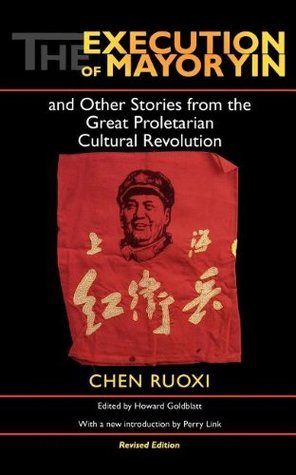
The Execution of Mayor Yin and Other Stories from the Great Proletarian Cultural Revolution, Revised Edition

Rate this book

Praise for the first edition:

"... in the great tradition of Orwell and Solzhenitsyn; its true subject is the survival�and sometimes the defeat�of the human spirit in its lonely quest for integrity." �Time

"The almost childlike directness of Chen's tales... is captured in the very lightly revised translations of this new edition... Highly recommended." �Choice

A classic of modern world literature, this collection of stories provides a vivid and poignant eyewitness view of everyday life in China during the Cultural Revolution. For this edition, Howard Goldblatt has thoroughly revised the text and updated it to Pinyin romanization. In a new introduction, Perry Link reflects on the book's significance in the post-Tiananmen era. Twenty-five years after its first publication, The Execution of Mayor Yin has lost none of its power to move the reader, and remains unmatched as a document of the period.

202 pages, Paperback

First published May 1, 1978

4 people are currently reading
188 people want to read

About the author

Ruoxi Chen

21 books8 followers
Chen Ruoxi (陳若曦), born 1938, is a Taiwanese author. A graduate of National Taiwan University, she among others helped found the literary journal Xiandai wenxue (Modern Literature).

(from Wikipedia)

Ratings & Reviews

What do you think?
Rate this book

Friends & Following

Create a free account to discover what your friends think of this book!

Community Reviews

5 stars
22 (22%)
4 stars
42 (43%)
3 stars
28 (29%)
2 stars
3 (3%)
1 star
1 (1%)
Displaying 1 - 14 of 14 reviews
Profile Image for Jee Koh.
Author 24 books185 followers
August 25, 2009
The Execution of Mayor Yin and Other Stories from the Great Proletarian Cultural Revolution is a collection of eight stories. They tell, in a powerful and subtle manner, how Mao's disastrous experiment affected--destroyed--the lives of ordinary people. Their dominant tone is not denunciatory or self-righteous, but empathetic and observant when narrated in the third person, and self-protectively detached or complicit when narrated in the first. Many of the narrators share Chen's background: a former overseas scholar who returned from the USA to support the motherland. Despite their idealistic patriotism, they are doubly suspicious in Maoist ideology, first, for being an intellectual, second, for being an ex-American imperialist. These stories trace, in part, the disillusionment of these repatriates, who are sent to farms to be "re-educated" by labor.

The loss of idealism forms a painful backdrop to the strongest story of the collection "Geng Er in Beijing." The story stands out for its length and complexity, and also for the fact that it is not driven by a crisis, the way short stories usually achieve their direct impact. Instead, the crises in Geng Er's life are already over before the story begins. He loved and lost a woman to the Workers' Propaganda Corps. He loved a second woman but was prevented from marrying her by the outbreak of the Cultural Revolution. The life he leads now is a much diminished thing, brightened only by the lucky chance of securing one of 20 bowls of hot mutton soup in a popular restaurant.

Chen does not comment on her characters, but lets their situations speak for themselves. It is an art of selection and organization, and often succeeds brilliantly. Both "The Execution of Mayor Yin" and "Ren Xiulan" end with a scene that is also an indelible image. "Residency Check" appears to be inconclusive--why does Leng not divorce his apparently adulterous wife?--until one realizes that its very inconclusiveness is a part of the writer's tact. In this story about the destructive effects of prying curiosity, to keep private affairs private is a public statement.
263 reviews9 followers
July 30, 2018
The glimpse into life in China in the era of the cultural revolution was not too different from what I had expected. There was throughout the short stories a paranoia of being on the wrong side of an ever-adjusting history. It reminds me a bit of our current culture as the celebrities and politicians continue to redefine their beliefs in keeping with the latest pronouncements of the social justice warriors. The words used and the stances taken yesterday will make us worthy of re-education today.

Some of the tales were a bit boring, but the next to last story called "Keng Ehr in Peking" was quite touching.
Profile Image for Levi.
140 reviews25 followers
October 13, 2015
A collection of short stories situated during China's Great Proletarian Cultural Revolution. The very title of this book made me expect a Solzhenitsyn/Orwell type of political battering.

The Execution of Mayor Yin, 3 stars- This being the title story, I expected a lot from it. Truth to say, it was fine. A mayor who served whole-heartedly during the revolution became the object of doubt when he disobeyed the Party's order to collective the farms. The mayor, seeing that the call for collectivization will induce starvation among the citizens, made proposals for minimum retention of private property. He was eventually branded as a rightist, and was executed. We know that he will be executed (hence the title). The drama revolves around the reasons, the circumstances, of his death.

Chairman Mao Is a Rotten Egg, 2 stars- About two Chinese parents whose sole child uttered a blasphemous phrase, "Chairman Mao is a rotten egg." What would the communist officials do to the child? Punish him? Punish the parents? Punish the teacher? Or must it be punished it the first place? These are the baffling questions the story raised.

Night Duty, 2 stars- Some sort of a whoddunit story, but has undertones of how a socialist state deals with crime, specifically theft, and hunger amidst the difficulties of the revolution.

Residency Check, 2 stars- A promiscuous, but nonetheless care-free and naive woman became the subject to random late-night residency checks, meant to catch the woman in the 'act' of adultery. A story of how some people judge others who do not comply to their respective moral tastes.

Jen Hsui-Lan, 3 stars- A story about Jen Hsui-lan, an active member of the Party who eventually became a political enemy because of her extremist political tendencies. The plot revolves around how the townspeople, from the oldest to the youngest, search for fugitive Jen Hsui-lan around the city, even without knowing what she particularly did. There is a plot twist towards the end. All I can say is this is a sad, sad one.

The Big Fish, 2 stars- A very short comical story about an old man who wanted a buy a big fish for his family's dinner, but was not given the right to buy the fish, because foreign visitors are going to visit the market, with the officials wishing to present their best products for the said visitors.

Keng Erh in Peking, 5 stars- My favorite story. It seems as if the other stories are child's play compared to this one. It is about Keng Erh, an intellectual bachelor who studied in the US, looking back at his 49 years of existence. It is about his heartbreaks and his vertiginous solitude. The thing I particularly liked in the story is how Chen Jo-hsi managed to focus the story on the character itself and not on the political environment, while at the same time giving subtle criticisms. Unlike the other stories, it was heartbreaking and not annoying, and political ranting was shown and not told.

Nixon's Press Corps- Nixon is visiting China, and everyone in China are making preparations. A woman was told to demolish her clothes rack because it is an eye-sore. She displays her little rebellion by refusing to do so.

All in all the collection is tolerable. Nonetheless there still remains a certain amount of bitterness and sarcastic edge to the stories, making them somewhat less believable. I also understand that these stories come from the perspective of a privileged middle-class writer, and its aim is to highlight the struggle of the individual amidst the repressive force of the State. But let me just stress: why do middle-class writers often write about what we expect them to write? I mean, there is nothing new in this collection. Solzhenitsyn, Orwell, Zamyatin, Kundera, among others, are already in the bitter fray. It is becoming stale.
Profile Image for Sarah.
131 reviews4 followers
May 29, 2007
First and only required reading for Chinese Literature that I actually enjoyed. The nuances of the language were conveyed semi-accurately which is much more than I can say for a lot of other works.
Profile Image for KYH.
121 reviews2 followers
December 13, 2018
(Fast) alle Geschichten sind aus der Sicht einer Lehrerin oder eines Lehrers bzw. eines Mitarbeiters einer Hochschule geschrieben. Die Umstände sind also ähnlich und vermutlich entsprechen sie der Erfahrung der Autorin. Und obwohl die Geschichten sich eigentlich recht gut und flüssig lesen lassen, hinterlassen alle einen beklemmenden Eindruck, die Einmischung des Staates/ der Politik ist einfach immens und geht bis in den kleinsten Bereich.
Deshalb: Sehr interessant, aber einmal lesen reicht mir.
Profile Image for Eric Hinkle.
867 reviews41 followers
October 12, 2013
Chen Jo-Hsi (also perplexingly Romanized as Chen Ruoxi) is a Taiwanese writer. These stories are inspired by her stay in China during Mao Tse-Tung's dark and terrible "Cultural Revolution and Re-Education" of the 60s and 70s. As such, these stories are incredibly sad. There's a lot of politics involved, naturally, but the stories are more literary than political. She's a great writer: writing simply and effectively, she tends to let the stories tell themselves.

They're all about the awful ways in which everybody's lives were affected by Mao's ridiculous policies and egocentrism. Nobody in these stories is close to Mao personally, but that distance makes no difference - his teachings and theories were far-reaching and gravely consequential. The eight stories are split almost evenly between male and female protagonists, all first-person, and she writes from either perspective with equally knowing brilliance. She knows how to get inside the head of a man, and those stories are just as effective.

My two favorites were "Chairman Mao is a Rotten Egg" and "Keng Erh in Peking". The former is about a pregnant mother in a community of friends and sneaks, and living in constant terror of being interrogated and publicly reprimanded (or executed) for being a "counterrevolutionary", a label that can be stamped on someone for the merest trifle (true or otherwise). When her son's friend tells on him for saying "Chairman Mao is a rotten egg!" the mother freaks out, fearing for the family's lives. It is a terrifying evocation of a world in which nobody can be trusted, one where you have to be on your guard at all times, keeping up a facade you have no faith in. It's terrible, and it's a world that some people have always had the misfortune of living in, around the globe.

"Keng Erh in Peking" is an absolutely heartbreaking account of how one man fell in love with, and nearly married, two women at different points in his life. Each time, Mao and his idiotic "Revolution" got in the way and ruined every opportunity, due to "unmatching family backgrounds" and even lamer reasons. The end result is an almost unbearably sad story, but one that rings so true and clear. The last page or two are just...amazing.

The last story, "Nixon's Press Corps", does offer one glimmer of a triumph (ultimately effective in just how SMALL that triumph seems). But aside from that, these stories do not have happy endings. As such, the book will not be everybody's cup of tea, but the stories are real, and they offer a numbing look into an awful world. The stories are also portraits of several very poignant main characters, who should be praised for their strength, humanity, and reality. So should Chen, who lived to tell so well about it.
Profile Image for Tariq Mahmood.
Author 2 books1,063 followers
February 16, 2015
What was life like under Mao's cultural revolution? The stories in this book paint a very vivid picture of the people who were suddenly from being followers of Mao's revolution became the main stakeholders. Each and everyone of the public could now act as a judge, jury and executioner of the revolution. Age, rank and status did not matter in this new purification drive. The stories of the victim and their kin, of their fears, anxieties and insecurities. Calumny became a sinister and malicious weapon, with which anyone no matter how illustrious his past maybe could be accused and branded for life.

The ultra radical were always those who had a checkered past.
Individuals chosen to attend party meetings etc were the most enthusiastic proponents of the Revolution, probably because they didn't have to work themselves.
Everyone was on guard against everyone else apart from family members.


Its almost impossible to fight off propaganda especially if every one is working for a single employer like in Mao China. It seems that the effectiveness of communist propaganda was to harangue incessantly with the singular objective of convincing each target person to agree with the communist propaganda hype on his/her own accord. This was a shrewd move as the authorities never actually carried out any punitive actions but rather let the party workers 'volunteer' to do their dirty work for them, after everyone was thoroughly convinced obviously. The stories also highlight how most ordinary Chinese simply caved into the Party pressure instead of rebelling against the unnecessary excesses.

Very interesting stories and real page turner.
Profile Image for Jenny.
501 reviews10 followers
March 16, 2012
Read it on a whim because my roommate had it. I think the writing style of all translated Chinese books are the same. The stories though--I'm always weirded out that these stories could pertain to my parents and my grandparents because they lived through this time. Every time I think about the Cultural Revolution I'm just filled with endless rage. This book had a collection of interesting stories from different perspectives--but in all honesty I've read better anthologies.
Profile Image for Jessica.
121 reviews7 followers
March 12, 2008
A very matter of fact set of stories about life in Cultural Revolution China. Each story demonstrates an insanity of the CR, but does so almost without apology. It's almost as if the author is saying "Here it is, take what you will from it." I enjoyed it very much, but also overall found the stories to be desperately sad.
393 reviews
October 8, 2011
This is a curious little book that tells straightforward stories about the Cultural Revolution. As the intro says, it's no a book about the conscience of the revolution, but it does get at the interesting minutiae that would drive any Westerner up the wall (and some not so minutiae)
Profile Image for Devin.
11 reviews
May 28, 2008
Actually not too boring. i enjoyed the stories and am amazed by how the country is.
Displaying 1 - 14 of 14 reviews

Can't find what you're looking for?

Get help and learn more about the design.