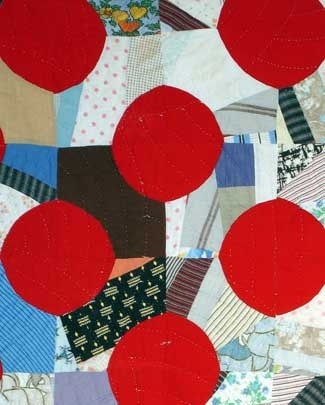
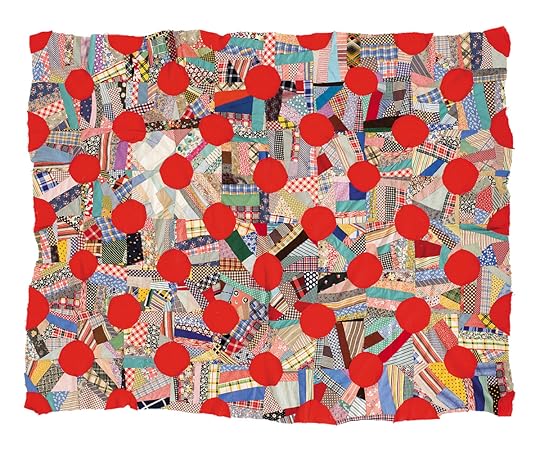
Unconventional & American Quilts Below the Radar 1950–2000 is a stunning collection of approximately 150 eccentric and extraordinary quilts made predominantly by anonymous quilters in the US during the second half of the 20th century. Collected by renowned quilt authority and collector Roderick Kiracofe, they represent a 20th-century quilt movement that remains mostly undocumented. Unlike the familiar quilts that replicate traditional patterns of earlier centuries, these surprising textiles represent a freer, more casual, utilitarian style that departs from (and returns to) a multitude of norms and standards. Peppered with essays by renowned experts that help to contextualize the quilts’ surprisingly modern aesthetic, Unconventional & Unexpected is a groundbreaking celebration of 20th-century quilting that picks up where most other quilt histories leave off.
Lots of stars for all the eye candy in this charming and heart-filling art collection. The essays skim the surface, open up some issues for further discussion, perpetuate some fallacies,...etc. It's an okay book. Buy it for the photos and go read other books on culture, quilts, and textiles.
A wonderful addition to my "textiles" shelf. The book as such is already a beautiful object: lovingly designed and set in an unusal mix of typefaces, printed on high-quality paper, with a bright cover, patterned endpapers and an embossed jacket that give the impression of being a collage itself. And the book's contents are nothing less than spectacular – absolutely stunning, highly original quilts that made me gasp while turning the pages. They're all here: Spectacularly reduced, abstract quilts that remind of Rothko, Warhol or Hockney. Fantastically unexpected colour schemes, downright funny combinations or disgressions from the rule, idiosyncratic methods of quilting, fronts and backs that cunningly mirror or openly contradict each other, palimpsests that had been quilted on over decades by two or three generations of one family or by friends living hundreds of miles apart. Add to this a range of authors that couldn't be any more prestigious and knowledgable in the field, ranging from Ulysses Grant Dietz or Allison Smith to Kaffe Fassett or Denyse Schmidt. Roderick Kirakofe's incredible collection adds a priceless layer to the fabric of quilting; I bow to his eye.
A thoroughly wonderful book! As a quilt lover, user, maker and collector, I devoured each and every page. It’s tempting to leaf through quickly. Eye candy galore calls you. Go ahead. Do it. But if that’s all you do you will be missing a lot. Interspersed among the beautiful photos are ten essays by notables in the quilt and art world. Varying comments about the collection (specifically and generally) provide a range of viewpoints. Each photo description points out details you must study. Keep a magnifying glass and notebook handy. Be prepared to flip pages back and forth, to be guided to close observation of the details on a quilt some pages away from the text. Study the construction in wonder. Note the use of color. Look at the borders. If you are a quiltmaker this will rock your world if you are itching to break out from under acrylic rulers, coordinating fabric collections and matching points. I can tell you it’s HARD. . . but oh so exciting. If you are not, perhaps you’ll find new appreciation of family quilts of grandma or auntie. *A note on the essays. I was disappointed in Janneken Smucker’s comments regarding the Underground Railroad and quilts as signs. Though it was in the context of an artist who does work influenced by this story, there is no trace of any primary source to back it up. It should not be perpetuated in any manner. My favorite essay was by Ulysses Grant Dietz concluding this way: “I am inclined to see these connections with modern art and African American quilts as false cognates—accidental intersections with no cultural weight beyond delightful coincidence. For me the most valid way to discuss quilts is through their own virtues. Are they beautiful? Does looking at them give pleasure? Why is that so? The real art in these anonymous quilts is the remarkable God-given gift for design and color, for layout and form that the unknown makers have brought to them. They need no further validation, and surely not the validation of the modern art world. These quilts would exist and would mesmerize and inspire, even if modern art had never existed.”
I have such mixed (and personal) feelings about books on quilts like these. Worthless, unless the “right” someone finds them and gives them value, usually thousands or tens of thousands of dollars. Then only to be sold to the privileged, so they can comment on the craft and creativity of the working class quilters who made them. So utterly pretentious. Then the countless number of quilts that never get found by the “right” people, or made by people with the known names (Chanin, Gees Bend, etc), only to remain worthless in the eyes of most. Quilts that quilters like myself make, seen only as a hobby or craft by most to “keep us busy”. Never recognized for the time, money, skill, love, we put into quilts. Dismissed. Patronized. Patted on the head. Oh how cute? You know you could get a blanket cheaper at Walmart? Fill in the blank here with the many attempts at clever remarks (but actually back handed compliments most of the time) people toss our way. Never truly valued as real art, unlike other mediums.
I bought this book for my school library as we are opening up a somewhat extensive quilting maker space. I am not a quilter, but I am looking forward to supporting staff and students who are less fumble-fingered than myself.
Visually, the book is stunning. I learned a lot about how patterns, precision, improvisation, and thrift are all important elements in the creation of a quilt.
I learned about the artistic debate over whether the modernist effect that many of the quilts possess occurred as a result of broader cultural influences or not. Similarly, there is the question of whether the similarities between the quilts of the Siddi people, members of the African diaspora in India, and quilts made by African-Americans are part of a heritage carried over many distances or simply a manifestation of thrift with similar results.
In the end, I did what I too often do when I purchase a book for my school library and fall in love with it: I bought a copy for myself.
I love this book, and I have many ideas for future quilts thanks to the gorgeous photos. I learned a lot about quilting history and it's fascinating how little we know. Making do with what I have is where I am as a quilter, and the Ragfinery fire helped me see how much fabric I had already collected. Lots to think about with this book about how I'll obtain fabric in the future. Grateful.
"Smudgy fingerprints on the edges of well-loved pictures or the imperfect stitches in any number of these beautiful quilts are small reminders of the animate life of objects, a secret, visceral account of our time here (216).
This is an OUTSTANDING book of unusual quilts made by creative ordinary women (one of the best parts!) over the late decades of the 20th century....this book will be inspiration for me FOREVER! (at least that's the way I feel right now!) The colors and wild abandon of design are exciting and make me want to run to my fabrics.....for the most part, they are homey, bright, cheerful scrap quilts made to be used and abused. They are full of innovation and 'make do'. I've already made two quilts inspired by this book. So there!
This book felt intimate – from the incredible, sometimes colorful, sometimes not so colorful, quilts to the accompanying essays, some rich with biographical information about quilters, some delineating the history of quilts and textiles and art and manufacturing, and… Amazing quilts that were work horses - despite being works of art - made to serve a utilitarian existence. I am so glad I stumbled upon this book at my library.
Fantastic book! The quilts included are amazing, not the examples of "high quilting" I've seen in other books about American quilts, these are surprisingly beautiful examples of creative resourcefulness.
Some of the essays were thoughtfully written and brought up further questions, some not so much.
The pictures and breadth of the quilt styles alone was worth the purchase of this book. They're very lovely, and very clear.
I also thought the collection of essays was nice. I liked some more than others, but a few were so good I perhaps highlighted a bit too much. I'm very glad I got this book.
This is a beautiful photographic collection of everyday vintage quilts from earlier mid last century. none of them follow a pattern although many are graphic and bold.
This is not for someone who defers to only perfectionist traits. The commenatray by several well known quilt makers provides perspcetive on what you see.
Been looking for inspiration for scrappy quilts, and this certainly fit the bill! Unpretentious quilts that were meant to be used and wonkiness is celebrated. Recommend for any quilt nerd.
Unlike many Goodreads commenters, I found the text fascinating. The mix of specialties of the essayists--artists, historians, quilters, and museum curators--creates a conversation from a variety of perspectives. And they don’t always agree. One could wish for a panel discussion where they have a chance to comment on each others’ comments.
Some tell the old story and some revise it. Janneken Smucker, a historian specializing in American Material Culture, does both as she traces early quilting historians’ romanticization of colonial scrap quilting to the revision by later historians who question that reading. She places herself among those later historians, then tells of her further revision prompted by the Kiracofe collection.
Essayists also provide a range of opinion on the question of quilts as modern art. Elissa Author, an associate professor of contemporary art, provides an overview of rebellious fine artists who were influenced by quilts. Amelia Peck, a curator of American Art at the Museum of Modern Art, tells the criteria she uses to select art quilts and illustrates from the collection. Smucker and Ulysses Grant Dietz, another curator, tell the features of several quilts in the collection that appeal to them artistically; Dietz goes on with cultural critique, placing his taste in the era of the “Gees Bend syndrome,” noting the marketing of that collection and trendiness of curation. Alison Smith, an activist artist, probes with this question: “What is at stake in considering paintings and quilts as parallel endeavors? Do we reinforce their differences when we marvel at their similarities?” (158). She proceeds to analyze the differences.
“A Texas Quiltmaker’s Life: An Interview with Sherry Ann Byrd” provides an organizational scheme for my thinking (not for the structure of the book) about the quilts pictured: “precision quilt, M-provisational quilt, and throw together quilt” (52). Her term, “M-provisational” points beyond “improv” to an emphasis on syncopation that she sees in some designs. And Byrd says many in the collection represent the “throw together” category, made extremely quickly for extreme need.
I will confess that though all the quilts were historically interesting, I did not find them all equally appealing visually. However, artistic commentary in the essays and in a few captions led me to revaluate some of those judgments.
These 2 quotes express feelings I had no words for, that shed light on the magic of working with fabric.
"... the repeated moments of blindness involved when two pieces are sewn facing each other, the nature of their connection only to be revealed by opening conjoined elements and pressing them flat." Allison Smith
"The beautiful truth of making do is that the act of sewing two random and perhaps clashing pieces of fabric together means they now "go" together, simply by virtue of being stitched together into one object." Denyse Schmidt
This is one of those big and interesting books that REQUIRE that I sit on the sofa with my feet up and a pillow and cat on my lap. It's been my evening coffee break book. Tonight when I turned the last page, I said- Oh, it's over already- I wanted some more! One of my favorite quilts in this collection is the Grandma's Flower Garden that starts out normal and then goes to hell in a hand basket! The rattle snake quilts fascinated me, and the "House" quilt on page 185 kept my attention for a long time.
Beyond the pure inspiration of color, pattern, and stitching from the visual imagery of these quilts, the many photos of front-and-back gave me insight into construction that no quilt book, including those with detailed diagrams and directions, has ever done. I have always been a "show me" kind of learner, and Kiracofe clearly values process as much as product in the quilts he collects.
These are not award-winning quilts meticulously made for show. Because they are for personal use, often sorely needed by the people who used them for warmth, improvisation and expression blur the rules for traditional patterns and materials. There is beauty in the serendipity and willingness to work with what exists instead of insisting on perfection and an inflexible ideal, both in these lives and the quilts that they produced.
I like the results of randomness and the creativity that is born of necessity.
I didn't find the essays to be all that enlightening or useful, but no matter--a feast for the eyes plus inspiration that overflows.
This is a large coffee table book filled with excellent color photography of the most amazing and individual quilts. I also enjoyed reading the many well-written essays. This is not an instructional book with designs and patterns to follow. Of course not. The designs reside dormant within your brain. Like these anonymous fiber artists, it is up to you to observe, be inspired by your own thoughts and your own life and start creating. I am very thankful for Mr. Kiracofe's extensive effort in collecting these unsung works of American art and for his research and creating a book to share this information with the world.
This large-sized pictorial history of American quilts from 1950-2000 is beautiful! The photography is excellent, and I enjoyed the interesting essays from quilt designers Kaffe Fassett and Denyse Schmidt and a variety of other quilt historians and curators.
I recommend this book for anyone who loves textile history, quilts, and American folk art. I found this book on the new book shelf at our local library.
A stunning, visual book of amazing quilts. It really opens your eyes to the possibility of quilts beyond 'the rules', liberating quilters of all abilities and resources to simply get going with what you have. The essays work to complement the quilts. The whole book makes me question the intersection of craft/folk art/art. Sumptuous and beautifully designed. I borrowed this from the library but I'm going to buy my own copy.
High quality printing and paper, this is more of an examination of the history of quilts in America than a pattern book. Included are several essays from Big Quilting People. The photography is great, would have liked to see more close-ups, maybe. Good range of styles and regional representation. Inspirational stuff!
Quilt history has always been a passion and there are not too many people who write about it better than Roderick Kiracofe.
This book is a visual feast of unique quilts through the years. This book is filled with colorful and unique quilts. Beautiful images and revealing narrative make for another book that will remain in my personal library of quilt history books. Yep. It's a keeper!
Interesting book on quilts made without regard to the matchy-matchy concept of quilting instead rogue designs and fabrics and make do, I loved the designs and I liked the comment section about how and why these quilts were chosen. I was inspired! Good book for quilters and collectors.