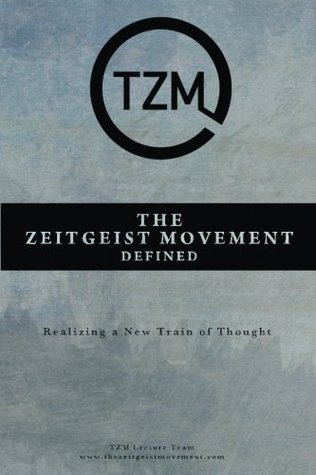
The Zeitgeist Movement Defined is the official representative text of the global, non-profit sustainability advocacy organization known as The Zeitgeist Movement (TZM).
This tediously sourced and highly detailed work argues for a large-scale change in human culture, specifically in the context of economic practice. The dominant theme is that the current socioeconomic system governing the world at this time has severe structural flaws, born out of primitive economic and sociological assumptions originating in our early history, where the inherent severity of these flaws went largely unnoticed.
However, in the early 21st century, these problems have risen prominently, taking the consequential form of increasing social destabilization and ongoing environmental collapse. Yet, this text is not simply about explaining such problems and their root causality - It is also about posing concrete solutions, coupled with a new perspective on social/environmental sustainability and efficiency which, in concert with the tremendous possibility of modern technology and a phenomenon known as ephemeralization, reveals humanity's current capacity to create an abundant, post-scarcity reality.
While largely misunderstood as being "utopian" or fantasy, this text walks through, step by step, the train of thought and technical industrial reordering needed to update our global society (and its values) to enable these profound new possibilities. While this text can be read strictly from a passive perspective, it was created also to be used as an awareness or activist tool. The Zeitgeist Movement, which has hundreds of chapters across dozens of countries and is perhaps the largest activist organization of its kind, hopes those interested in this direction will join the movement in global solidarity and assist in the culmination of this new social model, for the benefit of the whole of humanity.
This book will one day be read in schools. It is a comprehensive analysis of the problems facing humanity and the solutions which when we really think about it are so simple as to make you wonder why they are not being implemented. Of course we know why, capitalism and the belief that money has value, it doesn't. This book will show you why and provide credible sources to back up all claims. Read and enjoy.
If you are stunned by all that is happening right now around the world; wars, inequality, protests, poverty, climate change - then you need to read this book. The arguments presented are intriguing and make a lot of sense. Modern society needs to realise this new train of thought, or else we are headed to disaster.
"A real economy is always wanting to limit consumption/manufacturing as much as possible by assuring the strategically "best" and "adaptable" productions at all times, while keeping balance with human needs and public health." (P. Joseph)
Really interesting book about a movement to make sustainability of our resources a reality. Some very interesting ideas and many make sense. However their idea of this new world appears challenging to create. At the very least this book is a good resource to start on a path of utilization and rejecting waste and materialism. At the most it's a good idea of a world without poverty, greed, and want. Reads a little better than a text book, very comprehensive and hard to absorb it all in one reading.
I can safely call this "the manual for humankind's survival through and past the 21st century". TZM stands out among most movements for peace, progress, and sustainability because it is an open train-of-thought that relies on the scientific method to offer solutions to our current global and local problems. TZM targets the root causes of social and environmental issues and aspires for a non-elitist collaborative governance. TZM is not linked to any established organizations of any kind or systems of belief either. As an artist and a free critical thinker, TZM is what I've been waiting for--for a long time. If the solutions seem difficult for some readers to grasp, remember: great changes come slowly but are relentless, and the ideas presented here are just the tip of the iceberg--if you believe you can improve them, or that you have better ones join TZM, and your ideas will be scientifically analyzed. The Zeitgeist movement is a sustainable train of thought that promotes a Natural Law Resource-Based economy, an economy that will promote intelligent use of our current outstanding technological potential while respecting both the planet and its entire human population.
The vast majority of the book is relatively easy to read while also not using overly simplistic language. Near the end there are some parts with lots of formulas and algorithms which at first glance made me wince, but the explanations were quite clear as to their purpose and meaning; anyone with above average math knowledge will figure out the patterns immediately.
The entire book is a collection of essays with lots of sources to back the claims (over 800 for about 300 pages). The essays themselves work off one another in a very natural way, but rereading the book after about two month hiatus would be beneficial to really solidify the ideas. As the essays progress, they start from what could be called point zero (which for would be where the average person is in their knowledge) and works its way through the fundamental flaws of our current system, then it introduces the ideas for the new system, and it finally all ends with ways to approach the transition and how to advocate for it. This last section could have more done for it by listing organizations also advocating for a NL/RBE; for instance, open source ecology is aiming for a post-scarcity or RBE system so working with them could be highly beneficial for everyone.
As for the problems with the book, I only found one and it was quite minor. There's a part that talks about switching to a vegetarian diet because raising cattle for meat increases CO2 levels dramatically. This is true. However, there's a good TEDx talk given by Allan Savory about how we could use cattle to counteract desertification and climate change. So it's just some new information we need to apply to the book, as is the way of science; I hope others will come forward with their information so we can refine the book even more.
Overall, this book gave me a lot of information, refined some ideas rattling in my head, and actually sparked off a couple of ideas: one for a thesis and another for a book. Truly revolutionary book that once read becomes a self-realizing truth. However, the trouble is convincing a person to read it when they are already convinced against it.
Reads like a text book, but cited appropriately. There is so much data and relevant information in here that it should be mandatory reading. Extrapolating and applying this information is where the magic should happen. How are you compelled to get involved? Also, have to recommend the Zeitgeist Film Series since you are here. You can find them on Netflix and YouTube.
I began reading the book zeitgeist movement as a upgraded version of Technocracy. The book is something similar like technocracy study guide. The books heavily emphasized on NLRBE (Natural Law Resource Based Economy). The 70% of the book was about criticism of the present day world problems. The 30% was about their utopian ideas and zeitgeist movement.
I haven't read all the chapters other than reading crucial chapters. Zeitgeist isn't still a well established theory like socialism and communism — it’s still in an utopian phase. Before karl marx, socialism was also used to considered as utopia. Now it's a well established theory — people take seriously in academics and intellectual discussion. The ideas in zeitgeist movement lacked bridge from reality and imagination.
They haven't mentioned anything about present day government failures, role of judiciary, courts, police, and military. They haven't deeply explained how would we establish such systems in the world. They have gave an example of setting up their system in a small country. However, doing this would faced resistance from other countries. They have ignored real world scenario. Anyway, I loved reading about NLRBE.
To start this review, I would like to encourage everyone to read this. You can download it for free from: www.thezeitgeistmovement.com
I think this is one of the most important texts written in the history of humankind, really. It is basically a manual on how to arrive at a “Natural Law, resource based economy” via a train of thought which focuses on system thinking i.e.; acknowledging that planet earth and all nature, humans and animals are “one” integrated symbiotic system. The key to bring about societal change is to acknowledge that many of today’s problems like war, starvation, global warming etc. Are a direct result of our society which is based on kapitalist system which can only exist through competition and maintaining artificial “scarcity” to keep demand and price levels high, which is effectively needed to fuel our “labor for income”- system. The alternative is a world based on responsible resource management, shared acces systems and sustainability. This is based on technology and NOT on some outdated “ism” like socialism, communism etc. Everything you know is wrong. I cannot express in words how interesting this is. Go and read this book today!
Just like all of Peter Joseph’s work, this book should be mandatory reading in high schools and universities. It discusses issues that are now relevant more than ever. Our current capitalistic socioeconomic system needs an overhaul. Just as slavery and feudalism have risen and died (for the most part anyway), so will capitalism. We need to intelligently design our way out of the current system. Everything else on this planet is always changing. Our socioeconomic system is no exception. Peter’s work is of utmost importance.
This book is full of excellent ideas to change the world and create a better, more sustainable one. However, I doubt that these ideas be adopted by any of the leaders around the free market economy today. Thus, it is safe to say that it is highly unlikely that these ideas will be implemented in the real world in the next 20 years or so.
It's a very thought provoking book about ambiguities about the way we look at ourselves and the planet as a whole. You have to open-minded and realistic about the possibilities this book try to explain the current technologies of today and the future. The main premise of this book is to use technology and science for social betterment for the planet and humanity as a whole.
It's an excellent book , I read somewhere that this could be a future book to teach at schools and I agree, certainly the future if we carry on with this outdated socioeconomic system is gona bring down the demise of all the humanity, so we nned to change and this is a gerat start, its good to know there are thousands of people now believing this.