

What do you think?

Inspector Lefebvre #1
The Devil in Montmartre: A Mystery in Fin de Siècle Paris
Amid the hustle and bustle of the Paris 1889 Universal Exposition, workers discover the mutilated corpse of a popular model and Moulin Rouge Can-Can dancer in a Montmartre sewer. Hysterical rumors swirl that Jack the Ripper has crossed the Channel, and Inspector Achille Lefebvre enters the Parisian underworld to track down the brutal killer. His suspects are the artist Toulouse-Lautrec; Jojo, an acrobat at the Circus Fernando, and Sir Henry Collingwood, a mysterious English gynecologist and amateur artist.
Pioneering the as-yet-untried system of fingerprint detection and using cutting edge forensics, including crime scene photography, anthropometry, pathology, and laboratory analysis, Achille attempts to separate the innocent from the guilty. But he must work quickly before the “Paris Ripper” strikes again.
Pioneering the as-yet-untried system of fingerprint detection and using cutting edge forensics, including crime scene photography, anthropometry, pathology, and laboratory analysis, Achille attempts to separate the innocent from the guilty. But he must work quickly before the “Paris Ripper” strikes again.
257 pages, Hardcover
First published December 8, 2014
About the author
Gary Inbinder
13 books192 followersGary Inbinder is a retired attorney who left the practice of law to write full-time. His fiction, articles and essays have appeared in Bewildering Stories, Halfway Down the Stairs, The Absent Willow Review, Morpheus Tales, Touchstone Magazine and other publications. Gary is a member of The Historical Novel Society and Mystery Writers of America. He is also a member of the Bewildering Stories Editorial Review Board. His Inspector Lefebvre series is published by Pegasus Books.
Ratings & Reviews
Friends & Following
Create a free account to discover what your friends think of this book!
Community Reviews
Displaying 1 - 30 of 86 reviews

March 14, 2022
Fine mystery with hints of Jack the Ripper set in fin de siciele Paris. Features locations and some of the "characters" of the time. Toulouse-Lautrec is a main supporting character in the novel. Well done, convoluted mystery with plenty of red herrings.

June 29, 2018

Since I’m a big fan of French fin-de-siecle literature, I was keen to take a trip to 1889 Paris by way of Gary Inbinder’s The Devil in Montmartre. Wow! This novel exceeded my expectation. Watching the Can-Can dancers at the Moulin Rouge, walking the Parisian streets, following such characters from the tale as Inspector Achille Lefebvre and renowned artist Toulouse-Lautrec, I had the sense I was right there in the city along with some of my favorite authors: Jean Lorrain, Remy de Gourmont, Joris–Karl Huysmans, Guy de Maupassant. The world Gary Inbinder creates is that vivid.
At the heart of the tale is the grisly murder of one of the leading Can-Can dancers of the Moulin Rouge. Has the infamous Jack the Ripper traveled from London to Paris? The solving of this mystery will keep readers in suspense, turning the pages as one clue after the other comes to the surface. However, as much as I was intent on keeping abreast of events revolving around the crime, since my personal interests are literature, art and culture, I was particularly drawn to the following colorful highlights sprinkled throughout the novel's pages:
TO BE AN ARTIST: In conversation at the Moulin Rouge, American artist Marcia Brownlow tells Toulouse-Lautrec one of his portraits, a portrait featuring a beautiful young blonde woman with blue eyes stands out from his other works since the portrait has a distinctive charm and prettiness. Toulouse-Lautrec stiffens at this remark, sensing this American woman artist insulted him. In a subsequent conversation, Toulouse-Lautrec refers back to Macia Brownlow’s comment, noting how Marcia is admired for her vivid landscapes and portraits of beautiful woman, how she is the type of aesthetic painter who derives inspiration from the beauty of nature. The French artist goes on: “I’m not such an artist. To call one of my paintings ‘pretty’ is damning it with faint praise.”
This difference in an artist’s approach to painting was one of the hot topics back in those fin-de-siecle years. Here’s a description of Toulouse-Lautrec at the Moulin Rouge: “To Lautrec’s unerring eye and calculating brain the dancers were a problem in geometry and physics; fluid energy, flashing color, transforming forms and shapes in motion. He worked like a fiend to render them on paper the way the very latest in fast photographic lenses and shutters were capture the moment for posterity.” And such discussions of art continue, including when Lautrec is with his friend and fellow artist Émile Bernard and the work of Vincent Van Gogh and Paul Gauguin are topic of debate.
THE DARK SIDE: “Achille’s eyes narrowed; his mind focused on his primary suspect. “Do you believe the individual who was ‘helping’ Mile Ménard could have been a doctor specializing in the treatment of female hysteria?”" Back in the late nineteenth century, the dark side of the human mind fascinated artists and scientists and also those involved in medicine and the new science of psychology. Sigmund Freud published his Studies on Hysteria in 1895. Marcia Brownlow speaks of one of her friends who suffered from a painful childhood and was haunted by cruel visions that propelled her to create a revenge fantasy. The use of chloroform in surgery and as part of a patient’s therapy was practiced at the time and chloroform comes into play in The Devil in Montmartre.
LITERATURE’S IMPACT: Inspector Achille has read Émile Zola, Victor Hugo and Guy de Maupassant and has been deeply moved by the honesty and decency of Edmond Dantès from The Count of Monte Cristo, inspiring him to be a champion of justice in defending the innocent and pursue the guilty. The Devil in Montmartre also includes famous American expatriate novelist Arthur Wolcott who brings a writer’s sensibility to the happenings in Paris.
HISTORY’S SCAPEGOAT: Two Parisian publishers, Edouard Drumont and Pierre Cauchon, concoct a story that will have the newspaper reading public believe the murdered dancer was fleeing the clutches of the Illuminati. Ah, the Jews and their diabolical plans! And these two will add spice to their story by writing how the Jewish influence has now spread even further: the Jews have infiltrated the police and are steering the investigation away from the true culprits within their insidious culture-destroying organization. Edouard Drumont, founder of the Anti-Semitic League of France, chortles, “I hope Baron de Rothschild gets hold of a copy. I’d like to see the look on his face when he reads it. I’ll be it makes him choke on his motzoth.” Such anti-Jewish sentiments festered at the turn of the century and continued throughout Europe for years, leading to deadly and tragic consequences, most notably in Germany under Adolph Hitler.
DEVELOPMENTS IN CRIMINOLOGY: Again, The Devil in Montmartre is a murder mystery. Gary Inbinder has his Inspector Achille Lefebvre employ all the latest scientific methods to crack the case. There’s Paul-Jean Coulier’s discovery within the world of chemistry to lift fingerprints. Also, at one point, Giles the photographer proudly informs the Inspector: “It’s the new Kodak No. 1 box camera. It has the latest modifications, including an advanced shutter and celluloid roll film, an improvement over the paper stripper film. It’s light, hand-held, and simple to operate in detective work.” Fans of whodunits will find much pleasure in following Achille in his solving the mystery before the murderer claims yet another victim. And, oh, yes, there’s a twist at the end that will surprise even the most seasoned reader. Highly recommended.

American novelist and essayist Gary Inbinder currently resides in Southern California where he continues his literary adventures
"Does filth breed crime?" Achille pondered this question as he anxiously awaited a discovery that might shed light on his case. He had read Zola and was familiar with the author's literary theory of naturalism, according to which character was formed by a combination of social conditions, heredity, and environment. That might hold true for the common criminal, but would it apply to a monster that could murder and horribly mutilate a woman?" - Gary Inbinder, The Devil in Montmartre

October 12, 2017
It could have been just another conventional thriller about a “Jack the Ripper” type slaying transported to fin de siècle Paris. Instead this novel provides us with many touches from the development of scientific criminal investigation on the part of our detective, Achille Lefebvre, to the smokey bars in Montmartre frequented by the artist, Toulouse-Lautrec.
I was initially tempted to devour this book to see if I had correctly determined the perpetrator, but I quickly reversed myself and decided to savor the world that Gary Inbinder has created. I am glad that I did.
Inbinder has his details in good order as he takes us through the Paris of many contrasts: the “new” boulevards and buildings of Haussmann; the lagging sanitation of the city; the world of the struggling artists; the life of the bourgeoisie; the state of medical practice; the thrills of the latest continental exposition; and, the fresh food markets that are ready for customers by dawn.
What sets this book apart from similar works is the strength of Inbinder’s storytelling. He isn’t serving up the same fare in every scene. We are treated to a constantly interchanging mix of history, fashion, entertainments, science, puzzlement, politics, manners, politics, art, food, and domestic scenes. His skill in providing all that, while keeping the story moving, is impressive. The plot is solid; the subplots don’t distract; and, the venue is particularly well described.
I was initially tempted to devour this book to see if I had correctly determined the perpetrator, but I quickly reversed myself and decided to savor the world that Gary Inbinder has created. I am glad that I did.
Inbinder has his details in good order as he takes us through the Paris of many contrasts: the “new” boulevards and buildings of Haussmann; the lagging sanitation of the city; the world of the struggling artists; the life of the bourgeoisie; the state of medical practice; the thrills of the latest continental exposition; and, the fresh food markets that are ready for customers by dawn.
What sets this book apart from similar works is the strength of Inbinder’s storytelling. He isn’t serving up the same fare in every scene. We are treated to a constantly interchanging mix of history, fashion, entertainments, science, puzzlement, politics, manners, politics, art, food, and domestic scenes. His skill in providing all that, while keeping the story moving, is impressive. The plot is solid; the subplots don’t distract; and, the venue is particularly well described.

February 12, 2022
Trompe-l'œil
Here is a captivating detective story set in picturesque 1889 Paris, when the mutilated corpse of a dancer recently found cast doubts on nearly everyone :) Who is the culprit? Is it the rowdy painter Toulouse-Lautrec? perhaps the shady English gynecologist Sir Henry Collingwood? Is it a jealous model? unless... :)
I'm no crack polar/whodunit reader, still, this one managed to engage me to the end with its colourful characters, lifelike popular Paris, well-paced twists and inventive plot! Well done!
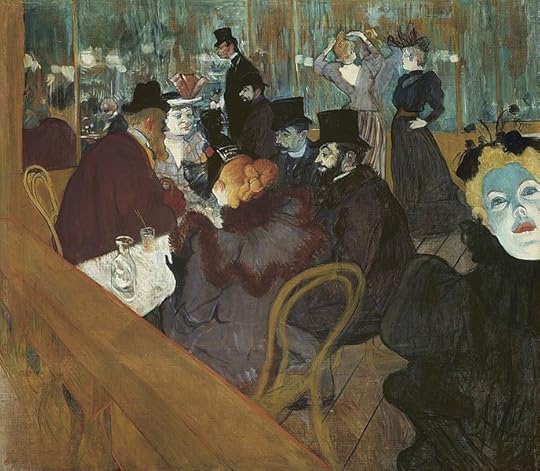
Au Moulin Rouge (1895) - Henri de Toulouse-Lautrec
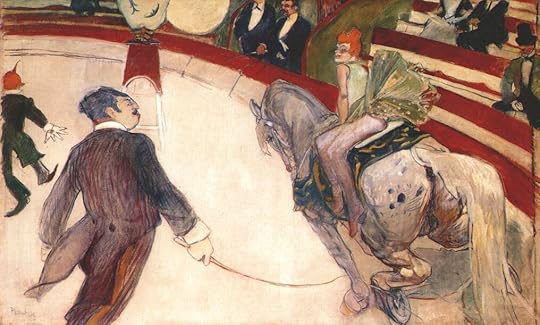
Au cirque Fernando, l'écuyère (1888)- Henri de Toulouse-Lautrec
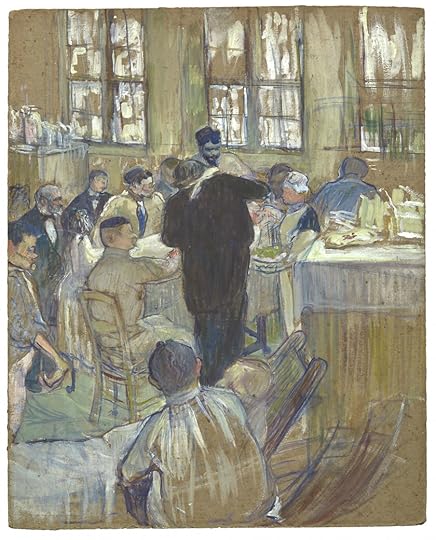
Une opération par le Docteur Péan à l’Hôpital International (1891) - Henri de Toulouse-Lautrec
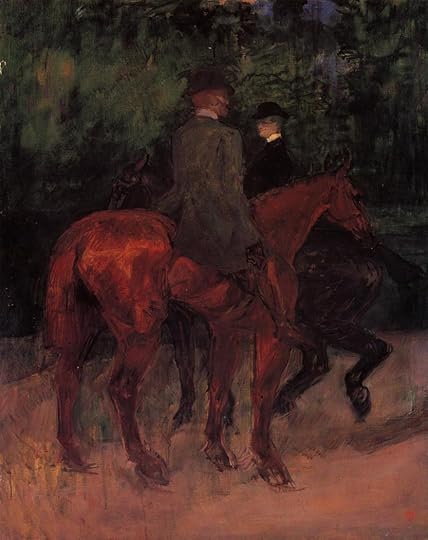
Man and Woman Riding through the Woods (1901) - Henri de Toulouse-Lautrec
Kindred spirits:
Context:
La France du XIXe siècle. 1814-1914
La Révolution Française (in particular 'The Revolution : 1770-1880')
Histoire de la peinture
Stories set more or less in the same era:
Contes cruels
L'Œuvre
La Maison Tellier - Les Tombales - Sur l'eau - Histoire d'une fille de ferme - En famille - Le Papa de Simon - Une partie de campagne ... - La Femme de Paul
The King in Yellow
À rebours
Là-bas
Essays published in the same era:
Exégèse Des Lieux Communs
Psychologie Des Foules
Kiosque à musique :
French Cancan (tirée du Galop infernal d'Orphée aux Enfers)- Jacques Offenbach
Here is a captivating detective story set in picturesque 1889 Paris, when the mutilated corpse of a dancer recently found cast doubts on nearly everyone :) Who is the culprit? Is it the rowdy painter Toulouse-Lautrec? perhaps the shady English gynecologist Sir Henry Collingwood? Is it a jealous model? unless... :)
I'm no crack polar/whodunit reader, still, this one managed to engage me to the end with its colourful characters, lifelike popular Paris, well-paced twists and inventive plot! Well done!
Au Moulin Rouge (1895) - Henri de Toulouse-Lautrec
Au cirque Fernando, l'écuyère (1888)- Henri de Toulouse-Lautrec
Une opération par le Docteur Péan à l’Hôpital International (1891) - Henri de Toulouse-Lautrec
Man and Woman Riding through the Woods (1901) - Henri de Toulouse-Lautrec
Kindred spirits:
Context:
La France du XIXe siècle. 1814-1914
La Révolution Française (in particular 'The Revolution : 1770-1880')
Histoire de la peinture
Stories set more or less in the same era:
Contes cruels
L'Œuvre
La Maison Tellier - Les Tombales - Sur l'eau - Histoire d'une fille de ferme - En famille - Le Papa de Simon - Une partie de campagne ... - La Femme de Paul
The King in Yellow
À rebours
Là-bas
Essays published in the same era:
Exégèse Des Lieux Communs
Psychologie Des Foules
Kiosque à musique :
French Cancan (tirée du Galop infernal d'Orphée aux Enfers)- Jacques Offenbach

September 26, 2015
The Setting; Paris, end of the 19th century, two weeks before closing ceremonies of 1889 Expedition Universelle, Jack The Ripper is still fresh news.
When the torso of Virginie Ménard, a dancer at the Moulin Rouge is discovered, the police fears a polemic (Jack The Ripper) and tries to close the case as soon as possible.
Inspector "Achille Lefebvre", head of the invistigation, is a believer in modern investigative technics, he always tries to include new ways to solve the crimes. A fact that will earn him the sobriquet of "The professor". Bearly thirty, this man is very effective and can not be corrupted, wich means trouble for some guys.
Even if it's easy to guess who did it pretty early, the particular thing about this mystery that the other books lack is the journey, the way Mr Gary Inbinder describes "Fin de Siècle Paris", the can-can dancers, the flourishing art and artists, the everyday life of the different characters and the introduction to technics considerd new then is simply amazing!
I liked that book very much, I tried to make the reading last as long as I could, but, good things always come to an end!
Getting to the next on soon!
When the torso of Virginie Ménard, a dancer at the Moulin Rouge is discovered, the police fears a polemic (Jack The Ripper) and tries to close the case as soon as possible.
Inspector "Achille Lefebvre", head of the invistigation, is a believer in modern investigative technics, he always tries to include new ways to solve the crimes. A fact that will earn him the sobriquet of "The professor". Bearly thirty, this man is very effective and can not be corrupted, wich means trouble for some guys.
Even if it's easy to guess who did it pretty early, the particular thing about this mystery that the other books lack is the journey, the way Mr Gary Inbinder describes "Fin de Siècle Paris", the can-can dancers, the flourishing art and artists, the everyday life of the different characters and the introduction to technics considerd new then is simply amazing!
I liked that book very much, I tried to make the reading last as long as I could, but, good things always come to an end!
Getting to the next on soon!

November 22, 2019
A mediocre "mystery" with a preposterous and spurious ending wrapped in the setting of late 1880's Paris.


December 12, 2014
3.8, rounded up.
Despite the title of this book, there is definitely nothing supernatural going on here. But I knew that already when I decided to read it (and my thanks to both the author and to Pegasus for my copy!!) -- and it turned out to be a good novel of historical crime fiction that should appeal to anyone who enjoys this genre. Personally, I used to read this genre all of the time, outgrew it, and moved on. But this book sounded like it might be good and it was.
The year is 1889, and it's only two weeks before the closing ceremonies of that year's Expedition Universelle. A year earlier, London had been in the grip of fear because of the horrific acts perpetrated by Jack the Ripper, so when a female torso is discovered in a city sewer, the police want to catch the murderer as quickly as possible to stifle any rumors that the Ripper has crossed the channel and set up shop in Paris. The chief inspector of the Sûreté, Paul Feraud, knows that he needs his best man for the job -- and that just happens to be Inspector Achille Lefebvre. Only thirty, Lefebvre is "a new breed of detective," one who believes in applying modern investigative techniques in his work. But he gets lucky: the autopsy report reveals a clue that points Lefebvre in a particular direction even though someone is doing his level best to put the frame on someone else, and the report of a missing woman gives him a potential lead on who the victim might be. But while he's working hard to make sure he gets everything right, his rival in the police department has his own ideas about how to bring a quick end to the case, one that could definitely incite mob violence in a city where the divisions caused by the Dreyfus affair are still fresh and are still on everyone's mind.
The Devil in Montmartre is set in the Paris of Henri Toulouse-Lautrec, where the whirling skirts of can-can dancers mesmerize the customers of the Moulin Rouge, where the small boîtes serve as meeting places for professionals and street people alike, a place where art and artists flourish. The author easily captures this atmosphere and the beautiful parks with their gardens visited by tourists from America and England; in contrast to the beauty and excitement of the city, he also takes his readers into dirty back streets and alleys and out into areas controlled by the city's criminals, places that most visitors never see. It's also very obvious that the author put in a LOT of time on research, especially in the area of police work and contemporary investigative methods. Putting that together with his character construction, it's impossible to believe that this is his first mystery novel. Trust me -- I've read enough first novels to feel qualified to judge. On the other hand, and this is probably more on my end rather than his since it isn't all that obvious, I figured out the who quite early into the story. I wasn't overly keen on the romantic parts either, but that's a personal thing and an area where I tend to find myself in the minority. However, I will say that the book made for fun reading. So have a good time with it.
Hopefully there will be a sequel some day, but in the meantime, The Devil in Montmartre should especially appeal to fans of historical crime fiction or historical fiction in general. It's lighter than my normal crime preferences, but there is definitely a good central mystery to be solved, and even though a headless torso may make some people maybe want to think twice about picking up the book, the violence is not anywhere near graphic nor is it overused or used gratuitously in any way. That in itself is commendable these days. I think Mr. Inbinder has done a fine job here with his first mystery novel. I hope it's only the first of many.
Despite the title of this book, there is definitely nothing supernatural going on here. But I knew that already when I decided to read it (and my thanks to both the author and to Pegasus for my copy!!) -- and it turned out to be a good novel of historical crime fiction that should appeal to anyone who enjoys this genre. Personally, I used to read this genre all of the time, outgrew it, and moved on. But this book sounded like it might be good and it was.
The year is 1889, and it's only two weeks before the closing ceremonies of that year's Expedition Universelle. A year earlier, London had been in the grip of fear because of the horrific acts perpetrated by Jack the Ripper, so when a female torso is discovered in a city sewer, the police want to catch the murderer as quickly as possible to stifle any rumors that the Ripper has crossed the channel and set up shop in Paris. The chief inspector of the Sûreté, Paul Feraud, knows that he needs his best man for the job -- and that just happens to be Inspector Achille Lefebvre. Only thirty, Lefebvre is "a new breed of detective," one who believes in applying modern investigative techniques in his work. But he gets lucky: the autopsy report reveals a clue that points Lefebvre in a particular direction even though someone is doing his level best to put the frame on someone else, and the report of a missing woman gives him a potential lead on who the victim might be. But while he's working hard to make sure he gets everything right, his rival in the police department has his own ideas about how to bring a quick end to the case, one that could definitely incite mob violence in a city where the divisions caused by the Dreyfus affair are still fresh and are still on everyone's mind.
The Devil in Montmartre is set in the Paris of Henri Toulouse-Lautrec, where the whirling skirts of can-can dancers mesmerize the customers of the Moulin Rouge, where the small boîtes serve as meeting places for professionals and street people alike, a place where art and artists flourish. The author easily captures this atmosphere and the beautiful parks with their gardens visited by tourists from America and England; in contrast to the beauty and excitement of the city, he also takes his readers into dirty back streets and alleys and out into areas controlled by the city's criminals, places that most visitors never see. It's also very obvious that the author put in a LOT of time on research, especially in the area of police work and contemporary investigative methods. Putting that together with his character construction, it's impossible to believe that this is his first mystery novel. Trust me -- I've read enough first novels to feel qualified to judge. On the other hand, and this is probably more on my end rather than his since it isn't all that obvious, I figured out the who quite early into the story. I wasn't overly keen on the romantic parts either, but that's a personal thing and an area where I tend to find myself in the minority. However, I will say that the book made for fun reading. So have a good time with it.
Hopefully there will be a sequel some day, but in the meantime, The Devil in Montmartre should especially appeal to fans of historical crime fiction or historical fiction in general. It's lighter than my normal crime preferences, but there is definitely a good central mystery to be solved, and even though a headless torso may make some people maybe want to think twice about picking up the book, the violence is not anywhere near graphic nor is it overused or used gratuitously in any way. That in itself is commendable these days. I think Mr. Inbinder has done a fine job here with his first mystery novel. I hope it's only the first of many.

August 6, 2014
This historical fiction takes place in fin-de-siecle Paris. the backdrop is the 1899 Universal Exposition and characters include the painter Toulouse-Lautrec.
The dismembered, decapitated body of a woman is found in a sewer a popular Can-Can dancer from the Moulin Rouge is missing. This is right after the jack the Ripper murders in London and the police are wondering if he has crossed the Channel. Inspector Achille Lefebvre of the Surite must find the killer.
The action takes place in Montmartre and Pigalle and other locations on the Left Bank. The clues point to Toulouse-Lautrec but the inspector discovers that the painter has been set up and is not the killer. Lefebvre is an educated man and uses new methods like fingerprint detection to help pinpoint the killer.
This is an action packed mystery and will appeal to readers who have visited Paris and those who hope to visit someday.
The dismembered, decapitated body of a woman is found in a sewer a popular Can-Can dancer from the Moulin Rouge is missing. This is right after the jack the Ripper murders in London and the police are wondering if he has crossed the Channel. Inspector Achille Lefebvre of the Surite must find the killer.
The action takes place in Montmartre and Pigalle and other locations on the Left Bank. The clues point to Toulouse-Lautrec but the inspector discovers that the painter has been set up and is not the killer. Lefebvre is an educated man and uses new methods like fingerprint detection to help pinpoint the killer.
This is an action packed mystery and will appeal to readers who have visited Paris and those who hope to visit someday.
October 3, 2014
The Devil in Montmartre succeeds on all levels. Paris is a wonderful setting for this intriguing mystery with interesting characters and unusual history. I couldn't put it down.
I received this books compliments of Goodreads for my honest review.
I received this books compliments of Goodreads for my honest review.

July 25, 2018
Review for book: The Devil in Montmartre: A Mystery In fin-de-siecle Paris
Author: Gary Inbinder
This delightful detective/crime thriller story, set in France in the early 1890s, came to me via a GoodReads giveaway. In this fictional narrative, we follow Inspector Achille Lefebvre as he and the other policemen try to solve the mystery of who killed a young and somewhat famous can-can dancer from the Moulin Rouge. During the story, you also meet a couple of independent American women, as well as the infamous painter, Toulouse-Lautrec. As the setting is in and around Paris, this colorful piece of fiction is occasionally peppered with French words and phrases. The author does a marvelous job using vivid and picturesque descriptions, giving the reader the wonderful opportunity to transport themselves to France in the late 19th century.
I found the book quite enjoyable, and would recommend it to those who like detective crime stories that are reminiscent of Sherlock Holmes.
In closing, I'd like to say that I received this book as part of a GoodReads giveaway and while a review is requested, it is not required. I wish to thank both the publisher and the author for the chance to read a wonderful, enjoyable book!
Author: Gary Inbinder
This delightful detective/crime thriller story, set in France in the early 1890s, came to me via a GoodReads giveaway. In this fictional narrative, we follow Inspector Achille Lefebvre as he and the other policemen try to solve the mystery of who killed a young and somewhat famous can-can dancer from the Moulin Rouge. During the story, you also meet a couple of independent American women, as well as the infamous painter, Toulouse-Lautrec. As the setting is in and around Paris, this colorful piece of fiction is occasionally peppered with French words and phrases. The author does a marvelous job using vivid and picturesque descriptions, giving the reader the wonderful opportunity to transport themselves to France in the late 19th century.
I found the book quite enjoyable, and would recommend it to those who like detective crime stories that are reminiscent of Sherlock Holmes.
In closing, I'd like to say that I received this book as part of a GoodReads giveaway and while a review is requested, it is not required. I wish to thank both the publisher and the author for the chance to read a wonderful, enjoyable book!

November 23, 2014
4 1/2 to 5. Up till about five chapters from the end, I was going to give it a 4, but then a plot twist occurred which left me amazed, and I read A LOT of mysteries, so it does not happen often.
This was an Advanced Reader's Copy, so, if they have not been found:
on page 123 there is a run together word - "won'tact," instead of won't act
on on page 133, there is a tense problem - "just you and me," when, in context, it should be "just you and I."
On page 200, there is a typo, "Iwe'd."
on 217, there is a run together word - "all history."
And, for a lot of Americans, on the "little cabbage" reference will mean nothing.
This was an Advanced Reader's Copy, so, if they have not been found:
on page 123 there is a run together word - "won'tact," instead of won't act
on on page 133, there is a tense problem - "just you and me," when, in context, it should be "just you and I."
On page 200, there is a typo, "Iwe'd."
on 217, there is a run together word - "all history."
And, for a lot of Americans, on the "little cabbage" reference will mean nothing.

April 4, 2017
A great historical mystery centering around the artists of the period like Toul0use-Lautrec, the Paris art scene, and the society of the day. When a beautiful woman's torso is found in a cess pit, and a well known model goes missing, Police Inspector Achille Lefebvre is given the case. As he methodically studies clues and uses new techniques like fingerprints he is finding several suitable suspects. He is able to rule most of them out but finds himself looking at an unlikely pair of people.

July 14, 2015
I was drawn in from the beginning—the setting and genre are a perfect fit for my interests, and Inbinder has such a way of conjuring a place. I also particularly enjoyed the cast of supporting characters, who really rounded out a story that felt, to me, to call back to the mysteries of the Golden Age, full of twists and red herrings. Achille is off to the start of a great career.

September 7, 2020
Interesting plot and reading.

January 17, 2020
This was a great story, with historical characters brought to life, a likeable main character and well written prose. I loved the descriptions on the French country side and the Moulin-Rouge as they were poetic and thoughtful. The horror of what childhood abuse does to a person lends itself well to a the world Gary Inbinder describes, with counterpoints of what good upbringings can lead to. A satisfying thriller, with a real mystery, set in the infancy of forensic science, that will stick with my for a while. Recommended.

March 15, 2020
In the waning days of the Paris 1889 World Exposition, a beautiful model disappears. Several artists, including Toulouse Latrec, have painted her or want to. Inspector Achille Lefebvre is nicknamed the Professor. He will be the detective who must find out what happened to Virginie Menard before anyone decides that Jack the Ripper has crossed the channel.
This book is both historical novel, bringing Paris to life, and police procedural. Achille uses the most scientific methods he can to solve this crime, including fingerprints. Fingerprints aren't yet accepted by the courts, but Achille finds them a useful tool in eliminating suspect.
I found this book informative as well as entertaining. It was occasionally too wordy, but otherwise a very good read.
This book is both historical novel, bringing Paris to life, and police procedural. Achille uses the most scientific methods he can to solve this crime, including fingerprints. Fingerprints aren't yet accepted by the courts, but Achille finds them a useful tool in eliminating suspect.
I found this book informative as well as entertaining. It was occasionally too wordy, but otherwise a very good read.

July 27, 2016
Discovery of the mutilated body of a popular model and Can-Can dancer spawns fears Jack the Ripper has moved to Paris.
Inspector Achille Lefebvre, a young, married man, but also a pioneer in the use of forensics to solve crimes, is assigned to the case. His advocacy for use of scientific methods of detection as well as his acceptance of the unorthodox technique of fingerprinting estranges him from his former second, Rousseau, an old-style cop who believes things should be done his way.
Achille perseveres, despite Rousseau's efforts to belittle his achievements while bragging about his findings. They develop suspects, including the artist Toulouse-Lautrec; Jojo, a circus acrobat, and the respectable British gynecologist, Sir Henry Collingwood.
Which is the killer? Only Achille and his science can sort of the guilty.
Set in Paris during the 1889 Universal Exposition, Inbinder offers just the right amount of history and some names of upcoming artists to put us firmly in the scene with Achille.
Achille is a likable character, especially in those precious moments he gets to spend time with his beloved wife and little girl. All the characters are well-drawn, the plot is intriguing and the setting is perfect for a good read.
There's a sub-plot involving Betsy Endicott, heiress to a railroad fortune, and her friend and former lover, Marcia Brownlow, a prize-winning artist. Tying it into the main plot, Betsy is being courted by Dr. Collingwood.
We know early on who the killer is, though that doesn't prevent us from reading more. Inbinder still has some surprises in store for us.
Inspector Achille Lefebvre, a young, married man, but also a pioneer in the use of forensics to solve crimes, is assigned to the case. His advocacy for use of scientific methods of detection as well as his acceptance of the unorthodox technique of fingerprinting estranges him from his former second, Rousseau, an old-style cop who believes things should be done his way.
Achille perseveres, despite Rousseau's efforts to belittle his achievements while bragging about his findings. They develop suspects, including the artist Toulouse-Lautrec; Jojo, a circus acrobat, and the respectable British gynecologist, Sir Henry Collingwood.
Which is the killer? Only Achille and his science can sort of the guilty.
Set in Paris during the 1889 Universal Exposition, Inbinder offers just the right amount of history and some names of upcoming artists to put us firmly in the scene with Achille.
Achille is a likable character, especially in those precious moments he gets to spend time with his beloved wife and little girl. All the characters are well-drawn, the plot is intriguing and the setting is perfect for a good read.
There's a sub-plot involving Betsy Endicott, heiress to a railroad fortune, and her friend and former lover, Marcia Brownlow, a prize-winning artist. Tying it into the main plot, Betsy is being courted by Dr. Collingwood.
We know early on who the killer is, though that doesn't prevent us from reading more. Inbinder still has some surprises in store for us.
July 22, 2014
There has been a murder in Montmartre and Jack the Ripper is suspected. Ever since the murders in London, the French Police and the Surete have worried that he would cross the Channel to Paris. When the body (torso) of a young woman is found in a cesspool in Paris, their biggest fears seem to have come true.
Inspector Lefevre is an up and coming young officer who is on top of all the newest technologies to catch criminals. He is familiar with the biometrics of Chief Inspector Bertillon and the experimental use of fingerprinting to identify suspects. Though the use of fingerprints in a criminal case has never been presented as prima facie evidence, in this case it may exculpate one person and prove another.
Inspector Lefevre found a footprint at the cesspool cover and mad a cast of it. It proved to be from a person of short stature. Toulouse-Lautrec had used the dead woman as a model and a mistress, so he was suspected. But the body shows signs of a vaginal hysterectomy and the limbs and head were severed by precise cuts. Therefore a medical professional is also suspected as an accomplice.
Through following the trail of those who committed the murder Lefevre is able to put together the information he needs to apprehend the murderer. But there is one thing he didn’t plan for and that was who the murderer was. Well Done.
Zeb Kantrowitz zworstblog.blogspot.com
Inspector Lefevre is an up and coming young officer who is on top of all the newest technologies to catch criminals. He is familiar with the biometrics of Chief Inspector Bertillon and the experimental use of fingerprinting to identify suspects. Though the use of fingerprints in a criminal case has never been presented as prima facie evidence, in this case it may exculpate one person and prove another.
Inspector Lefevre found a footprint at the cesspool cover and mad a cast of it. It proved to be from a person of short stature. Toulouse-Lautrec had used the dead woman as a model and a mistress, so he was suspected. But the body shows signs of a vaginal hysterectomy and the limbs and head were severed by precise cuts. Therefore a medical professional is also suspected as an accomplice.
Through following the trail of those who committed the murder Lefevre is able to put together the information he needs to apprehend the murderer. But there is one thing he didn’t plan for and that was who the murderer was. Well Done.
Zeb Kantrowitz zworstblog.blogspot.com

August 20, 2016
What an absolutely Fabulous read!! Which takes place during the Universal Exposition in Paris, events occur between October 10 - 22, 1889. Some events occur at the Moulin Rouge involving Toulouse Lautrec. From beginning to end the author keeps your interest, plus the characters are well-rounded. You are aware of their personal lives as well professional. This, of course, is especially true with Inspector Lefevbre the main & thoroughly interesting character. He is called the "Professor" by his peers due to his being a graduate of Ecole Polytechnique & is a fervent advocate for scientific methods of detection. This time one of his new interests is fingerprints, which is an unknown science as yet & gives him some new clues. As he was mentally wrestling with how to enhance the prints in order to classify them, he went up for the evening, his wife was sitting at her dresser, while they were talking her hairbrush hit her face powder spilling some on a silver box, she blew it away & it immediately gave him inspiration! I hope I have peaked your interest to read this book & I am grateful to Pegasus Books for this Review Book.

August 29, 2021
A beautiful young model and popular can-can dancer disappears. Her friends and adoring fans are soon frantic and when a dismembered body is found in the sewers of Paris, rumors' abound.
The clues around the grisly body parts points firmly to the popular painter Toulouse-Lautrec, down to he's monogramed cigarette case being on the scene, this convince Detective Lefebvre that there is more to the scene than meets the eye.
Achille Lefebvre is a new type of detective, interested in the new science of finger prints and using cutting edge new photography methods, Lefebvre follows the evidence to where it leads, not where it's so obviously pointing.
I did enjoy the detail around the development of finger print technology and overall enjoyed the story, it is pretty clear who the killer is early on, it does not feel like the author is trying to mislead you, but rather focus on how the crime is solved.
Although I enjoyed the story, and particularly the narration on audible, most of the dialogue is a bit to dramatic and overly romantic for my liking, so I'm not sure I will look for the 2nd one in the series.
The clues around the grisly body parts points firmly to the popular painter Toulouse-Lautrec, down to he's monogramed cigarette case being on the scene, this convince Detective Lefebvre that there is more to the scene than meets the eye.
Achille Lefebvre is a new type of detective, interested in the new science of finger prints and using cutting edge new photography methods, Lefebvre follows the evidence to where it leads, not where it's so obviously pointing.
I did enjoy the detail around the development of finger print technology and overall enjoyed the story, it is pretty clear who the killer is early on, it does not feel like the author is trying to mislead you, but rather focus on how the crime is solved.
Although I enjoyed the story, and particularly the narration on audible, most of the dialogue is a bit to dramatic and overly romantic for my liking, so I'm not sure I will look for the 2nd one in the series.
July 8, 2015
A very well-written and compelling historical mystery filled with colorful characters and period atmosphere, The Devil in Montmartre was a great read from beginning to end. It will especially appeal to those interested in the late 19th century Paris art scene. What's more, it introduces Inspector Lefebvre, a clever detective who uses cutting edge forensics to solve the gruesome murder of a popular Montmartre CanCan dancer.

April 17, 2018
Loved this book !
Detecting crime the old school way !
It all starts with a headless body is found in a cesspit. It was not really difficult to guess the Murderer, but , the way the crime was solved was simply superb.
I loved two things the most, The accidental spill of talcum powder that led to Fingerprinting and then the introduction of Kodak camera to capture those fingerprints.
It gets a bit slow with Inspector's interaction with his family. But overall it was gripping.
Detecting crime the old school way !
It all starts with a headless body is found in a cesspit. It was not really difficult to guess the Murderer, but , the way the crime was solved was simply superb.
I loved two things the most, The accidental spill of talcum powder that led to Fingerprinting and then the introduction of Kodak camera to capture those fingerprints.
It gets a bit slow with Inspector's interaction with his family. But overall it was gripping.

December 6, 2014
I received this book in a Goodreads Giveaway.
I really enjoyed this book. I was not expecting the twist at the end. It was definitely hard to put this down when it was time to stop reading. I love historical fiction, and it's fun when there are actual historical figures in the story. I'm really looking forward to reading the next book in the series.
I really enjoyed this book. I was not expecting the twist at the end. It was definitely hard to put this down when it was time to stop reading. I love historical fiction, and it's fun when there are actual historical figures in the story. I'm really looking forward to reading the next book in the series.

October 21, 2014
I don't know why Goodreads doesn't show this as one of my books, because I read it and reviewed it at that time! Excellent beginning to a new series. Victorian mystery with great French detective. I liked the book very much. Can't wait for next in series!

June 12, 2015
When you already know whodunit by page 10 it's time for the book to go back to the library, which it did.
November 2, 2018
The historical immersion is a bit overdone, the characters numerous but each one distinctive. The story is unusual...and macabre.

March 28, 2016
The Devil in Montmartre by Gary Inbinder
My thanks to Iris Blasi and my other supporters at Pegasus Books for my hardcover review copy! Always glad to hear from Pegasus Books!
Paris Universal Exposition, 1889. It is a time of festivity and celebration. Many artists have come to Paris. Among them are Toulouse-Lautrec, Émile Bernard, and a young American artist named Marcia Brownlow, with her companion and lover Betty Endicott, heiress to a railroad baron.
Marcia is dying of consumption, and the women are trying to make her last days comfortable. Marcia is enjoying sketching and painting a new model, Moulin Rouge Can-Can dancer Virginie Ménard. Lautrec has been sketching at a hysterectomy operation performed by Doctor Péan, who is an artist himself in a small way.
A British Doctor, Sir Henry Collingwood, a specialist in “female hysteria” meets and falls for Betty Endicott. Marcia Brownlow has an attack, and Dr, Collingwood arranges for her to go to a sanatorium in Colorado. Marcia reconnects with an old friend author Arthur Wolcott, who arranges for Marcia to return to England with him, instead.
A woman’s torso is discovered in a Montmartre cesspool by Papa LeBœuf and his helper Jacques, night soil gathers. Sûreté Captain Paul Féraud puts Inspector Achill Lefebvre on the case. Inspector Lefebvre is considered a new type of Inspector. He is a graduate of the prestigious École Polytechnique, and a stickler for modern scientific methods. His colleagues refer to Achill as “The Professor.”
Inspector Lefebvre consults with Alphonse Bertillon, whose system of identifying criminals based on a series of anatomical measurements predated fingerprints. Bertillon was leery of fingerprints, but Inspector Lefebvre is counting on them as evidence.
The evidence is a tangled web. Somehow, Inspector Lefebvre must cut through all of the darkness until light shines upon a likely suspect. I do not believe the average reader will fail to be very surprised by the results! This is an excellent read! I couldn’t put the book down until I finished it!
I give Gary Inbinder five glowing stars for a tale well told and a mystery well plotted!
Quoth the Raven…
My thanks to Iris Blasi and my other supporters at Pegasus Books for my hardcover review copy! Always glad to hear from Pegasus Books!
Paris Universal Exposition, 1889. It is a time of festivity and celebration. Many artists have come to Paris. Among them are Toulouse-Lautrec, Émile Bernard, and a young American artist named Marcia Brownlow, with her companion and lover Betty Endicott, heiress to a railroad baron.
Marcia is dying of consumption, and the women are trying to make her last days comfortable. Marcia is enjoying sketching and painting a new model, Moulin Rouge Can-Can dancer Virginie Ménard. Lautrec has been sketching at a hysterectomy operation performed by Doctor Péan, who is an artist himself in a small way.
A British Doctor, Sir Henry Collingwood, a specialist in “female hysteria” meets and falls for Betty Endicott. Marcia Brownlow has an attack, and Dr, Collingwood arranges for her to go to a sanatorium in Colorado. Marcia reconnects with an old friend author Arthur Wolcott, who arranges for Marcia to return to England with him, instead.
A woman’s torso is discovered in a Montmartre cesspool by Papa LeBœuf and his helper Jacques, night soil gathers. Sûreté Captain Paul Féraud puts Inspector Achill Lefebvre on the case. Inspector Lefebvre is considered a new type of Inspector. He is a graduate of the prestigious École Polytechnique, and a stickler for modern scientific methods. His colleagues refer to Achill as “The Professor.”
Inspector Lefebvre consults with Alphonse Bertillon, whose system of identifying criminals based on a series of anatomical measurements predated fingerprints. Bertillon was leery of fingerprints, but Inspector Lefebvre is counting on them as evidence.
The evidence is a tangled web. Somehow, Inspector Lefebvre must cut through all of the darkness until light shines upon a likely suspect. I do not believe the average reader will fail to be very surprised by the results! This is an excellent read! I couldn’t put the book down until I finished it!
I give Gary Inbinder five glowing stars for a tale well told and a mystery well plotted!
Quoth the Raven…

February 18, 2015
This is a wonderful mystery that has a splendid sense of time and place that is combined with a great cast of characters both fictional and historical. The author has captured the time period perfectly. Paris and Montmartre are lustily painted with bold strokes that also focus on the gritty details of crime and detection just as forensics were being discovered. A fascinating read that I could not put down.
September 28, 2015
I received this book as a first read. It's a great historical fiction read. The descriptions transport you to turn of the century Paris. The characters are well developed. The mood is dark and brooding. There are lots of art and historical references. The story sucks you in and the mystery floods your mind with thoughts. Fans of art, historical fiction, or mysteries will find this an engrossing read and a good gift for like minded friends.
Displaying 1 - 30 of 86 reviews