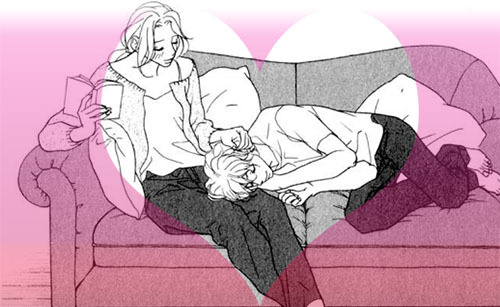
Tramps Like Us (きみはペット Kimi wa Petto "You're My Pet/You're a Pet") is an early 2000s manga targeted at women (josei) that follows Sumire, a successful but lonely and frustrated career woman, who one day takes in a younger man, (who gets renamed "Momo" but is actually named Takeshi), because his curly bleached hair and upbeat attitude remind her of her beloved childhood dog. The story focuses on how this unconventional situation between two people of very different walks of life blossoms into a journey of personal growth--and an unexpected romance.
Like a lot of manga, my first experience with this series was actually through its first Japanese drama adaptation (the one with Matsumoto Jun) and I didn't read the manga until I found it sometime later on MangaTraders (rest in peace, old friend) because by this point the Tokyopop editions were out of print and somewhat rare.
I found it to be a unique story; you don't often see stories with older women framed like this. Sumire, despite being older than Takeshi/Momo, isn't portrayed in the way a "cougar" usually is (which is is a more sexualized, predatory light--someone who deliberately seeks out and seduces younger men) because she doesn't bring him into her home for sex or to keep him like a secret lover or even to make him do her housework.
Her interest in Takeshi/Momo is companionship--in fact, she wants him to be more like a pet dog than a friend. Someone with whom she can be open and vulnerable with, who provides uncomplicated companionship and affection in return for being taken care of.
Sumire is a very lonely person and struggles to socialize; she knows there are expectations of her socially and she wants to try adhering to them, but is often at odds and must suppress herself and her feelings, so connecting to people in meaningful, fulfilling ways is difficult.
By placing Takeshi in a "pet" role, she can be honest and vulnerable with him in a way she can't with others--much like how she was with childhood dog--which is a sort of catharsis for her as she finds validation and comfort and release when she arrives home from a stressful day at work battling men and women who all hate her for different reasons.
It was interesting to see how Sumire grew as a person through her interactions with Takeshi. She starts off very reserved and even a little callous; Takeshi, at first, is just a "pet" she doesn't have to worry about, not like someone like Hasumi, who she constantly tries to maintain a certain visage for, but over time, she becomes much more open and begins to realize that Takeshi understands and accepts her in a way no romantic partner ever has and that she, in turn, is more at peace and happy with Takeshi than with anyone else.
Another interesting facet was how the manga chooses to approach what is an unconventional relationship against a society that is always demonstrated to be more conservative and traditional.
Sumire is, from the start, walking a razor's edge socially. She's tall, beautiful, smart, educated, successful, and quite independent, plus she's unmarried at 28 and creeping up into what's considered sort of the modern spinster age in Japan in the early 2000s. All her qualities are at odds with what's expected of her.
Men are intimidated by her background--she's highly educated, makes good money, has a powerful position at work, and all around is considerated quite elite--and they constantly allow their insecurities to make them feel emasculated by Sumire's education, salary, career... even her height, all of which generally outrank their own education background, career, and height. Women, on the other hand, regard her with spite and suspicion and jealousy, often presuming that Sumire is acting arrogantly or going overboard because, as a woman, she shouldn't need a successful career or degree or to be so independent and strong, she just has to focus on being a good wife and finding a good husband.
At the start of the series, we discover that Sumire's boyfriend, a blue-collar worker from the printing department, cheated on her with a less successful girl, impregnated her, and then broke up with Sumire to be with her, saying that he felt more comfortable with his mistress and that Sumire's glamour and success made him feel inferior, which really affects Sumire, who genuinely hadn't cared that he wasn't as rich or successful as she was and had thought they'd been happy.
Because of this, Sumire decides she's done trying to please people because she can't win no matter what does and throws herself into being exactly what people think of her: a strong-willed, powerful bitch who excels at work, demands perfection, and has the highest of standards for her men, swearing she'll only date men who rank higher than her in height, education, and salary, so that her partner can never claim that she makes him feel inferior as a justification for the relationship not working.
This, of course, creates a hiccup when it comes to her relationship with Takeshi. He's not only younger (I believe the gap is like 6 years), but he's shorter than her, is basically homeless and makes little money, is often a dependent on someone else, and his time is occupied with the job/dream of being a modern dancer.
In other words, there's socially no one less suitable for someone like Sumire, who is expected to marry someone more like Hasumi: a tall, older, successful, wealthy, highly educated man with a fancy, important job at a company that ranks above Sumire's position.
The author does a great job of having Sumire struggle between social expectations, her own internalized expectations, and the reality of what it is that would actually make her feel happy.
There's a clear sexual/romantic tension between Sumire and Takeshi from early on, but Sumire resists it and Takeshi is often left waiting for Sumire to sort out her feelings and get over crushing herself down to try to appease what she thinks she wants because society told her she should. The fights and conflicts they experience aren't overblown or unrealistic; it makes sense that Sumire would be hesitant about dating Takeshi, that he would get frustrated with her not being open about her feelings and disregarding social expectations, that her trying to force a relationship with Hasumi to work for her when it clearly doesn't would be straining on them both. We also have the worked in elements of how, once Sumire and Takeshi are finally together, they have to contend with their families and all the various other things of life, like their careers, their dreams for the future, etc.
Overall, I feel like it has a good emotional structure and reads with enough seriousness and comedy to remain engaging, realistic, and feel-good.
As for the art, I do like the artist's style and it does get a lot more polished and beautiful as time goes on, which I feel is especially evident in how Takeshi is drawn and how the lines become less sketchy and more refined/polished. By the final volume I think the style is very lovely. I like that the characters have enough dimension to their faces to be distinct; Sumire's profile and face shape differ from say, Rumiko's or Akane's, which is nice.
I will mention that with this being from the early 2000s the job-related sexism is a bit heavy and there are a few instances of strange homophobia presented, but that overall the content wasn't really problematic or worth commenting about.
As a manga targeted at women, this series does feature some more mature themes, but nothing is really explicit.
A quality josei for sure! It's aged pretty nicely and remains a worthwhile read.




![Profile Image for Mona :].](/_next/image?url=https%3A%2F%2Fi.gr-assets.com%2Fimages%2FS%2Fcompressed.photo.goodreads.com%2Fusers%2F1706966729i%2F138421633._UX200_CR0%2C0%2C200%2C200_.jpg&w=128&q=75)


