

What do you think?
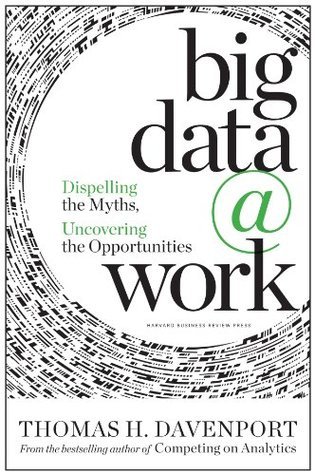
Big Data at Work: Dispelling the Myths, Uncovering the Opportunities
Go ahead, be skeptical about big data. The author was—at first.
When the term “big data” first came on the scene, bestselling author Tom Davenport ( Competing on Analytics , Analytics at Work ) thought it was just another example of technology hype. But his research in the years that followed changed his mind.
Now, in clear, conversational language, Davenport explains what big data means—and why everyone in business needs to know about it. Big Data at Work covers all the what big data means from a technical, consumer, and management perspective; what its opportunities and costs are; where it can have real business impact; and which aspects of this hot topic have been oversold.
This book will help you
• Why big data is important to you and your organization
• What technology you need to manage it
• How big data could change your job, your company, and your industry
• How to hire, rent, or develop the kinds of people who make big data work
• The key success factors in implementing any big data project
• How big data is leading to a new approach to managing analytics
With dozens of company examples, including UPS, GE, Amazon, United Healthcare, Citigroup, and many others, this book will help you seize all opportunities—from improving decisions, products, and services to strengthening customer relationships. It will show you how to put big data to work in your own organization so that you too can harness the power of this ever-evolving new resource.
When the term “big data” first came on the scene, bestselling author Tom Davenport ( Competing on Analytics , Analytics at Work ) thought it was just another example of technology hype. But his research in the years that followed changed his mind.
Now, in clear, conversational language, Davenport explains what big data means—and why everyone in business needs to know about it. Big Data at Work covers all the what big data means from a technical, consumer, and management perspective; what its opportunities and costs are; where it can have real business impact; and which aspects of this hot topic have been oversold.
This book will help you
• Why big data is important to you and your organization
• What technology you need to manage it
• How big data could change your job, your company, and your industry
• How to hire, rent, or develop the kinds of people who make big data work
• The key success factors in implementing any big data project
• How big data is leading to a new approach to managing analytics
With dozens of company examples, including UPS, GE, Amazon, United Healthcare, Citigroup, and many others, this book will help you seize all opportunities—from improving decisions, products, and services to strengthening customer relationships. It will show you how to put big data to work in your own organization so that you too can harness the power of this ever-evolving new resource.
209 pages, Kindle Edition
First published January 1, 2014
About the author
Thomas H. Davenport
75 books138 followersTom Davenport holds the President's Chair in Information Technology and Management at Babson College. His books and articles on business process reengineering, knowledge management, attention management, knowledge worker productivity, and analytical competition helped to establish each of those business ideas. Over many years he's authored or co-authored nine books for Harvard Business Press, most recently Competing on Analytics: The New Science of Winning (2007) and Analytics at Work: Smarter Decisions, Better Results (2010). His byline has also appeared for publications such as Sloan Management Review, California Management Review, Financial Times, Information Week, CIO, and many others.
Davenport has an extensive background in research and has led research centers at Ernst & Young, McKinsey & Company, CSC Index, and the Accenture Institute of Strategic Change. Davenport holds a B.A. in sociology from Trinity University and M.A. and Ph.D. in sociology from Harvard University. For more from Tom Davenport, visit his website and follow his regular HBR blog.
Davenport has an extensive background in research and has led research centers at Ernst & Young, McKinsey & Company, CSC Index, and the Accenture Institute of Strategic Change. Davenport holds a B.A. in sociology from Trinity University and M.A. and Ph.D. in sociology from Harvard University. For more from Tom Davenport, visit his website and follow his regular HBR blog.
Ratings & Reviews
Friends & Following
Create a free account to discover what your friends think of this book!
Community Reviews
Displaying 1 - 30 of 56 reviews

December 20, 2013
ARC provided by NetGalley
Big data. What is it and why the heck do we keep hearing people talk about it? Hasn't it been around for years and years? Haven't we always looked at data? Yes..and no. In Big Data at Work author Tom Davenport, expert in analytics, shares with us that at one time he too thought big data was just a retread of old information. But then he started looking into it and he discovered...big data is new. In this book Davenport tells us in a concise, nonsense, and nontechnical way of what big data is and why it should matter to us.
Davenport starts us at the very beginning of explaining in simple, easy to understand terms and illustrations as to what big data is and why it's different from regular analytics. Big data, as Davenport explains, consists of unstructured data--such as comments on a feedback form; is made up of 100 terabytes or more of information; and that it is a continuous flow of data, it doesn't stop just because a survey ends. Davenport clearly explains to us that not everyone will need big data or people to analyze it, but walks us through the different aspects that might be of interest to us, why it matters, and how we can go about implementing it in our own businesses. He shares with us how companies the size of Netflix and Google are using big data to help change their approach at how they interact with their users, but even more importantly he shares with us how startups are utilizing big data to get ahead of their peers.
Even more importantly for me, Davenport explains to readers about how to get people on board with wanting to examine big data and how to build a strategy and framework into implementing it. I say it's the most important for me, because so many authors put out pie in the sky dreams or hopes, or suggest things that are only practical for businesses the size of Google. Davenport instead talks about how to do this on a practical small scale and gives us examples of how it has worked for different groups already in existence.
For anyone that is interested in the study of data, whether big or small, and how you can utilize it in your place of work, this is a must have book. Davenport's clear and concise terminology will help you understand it and explain it to others that you work with, even if they think that data crunching is looking at 2 spreadsheets at a time. I give this book 4 out of 5 stars and it will definitely have a place on my book shelf.
Big data. What is it and why the heck do we keep hearing people talk about it? Hasn't it been around for years and years? Haven't we always looked at data? Yes..and no. In Big Data at Work author Tom Davenport, expert in analytics, shares with us that at one time he too thought big data was just a retread of old information. But then he started looking into it and he discovered...big data is new. In this book Davenport tells us in a concise, nonsense, and nontechnical way of what big data is and why it should matter to us.
Davenport starts us at the very beginning of explaining in simple, easy to understand terms and illustrations as to what big data is and why it's different from regular analytics. Big data, as Davenport explains, consists of unstructured data--such as comments on a feedback form; is made up of 100 terabytes or more of information; and that it is a continuous flow of data, it doesn't stop just because a survey ends. Davenport clearly explains to us that not everyone will need big data or people to analyze it, but walks us through the different aspects that might be of interest to us, why it matters, and how we can go about implementing it in our own businesses. He shares with us how companies the size of Netflix and Google are using big data to help change their approach at how they interact with their users, but even more importantly he shares with us how startups are utilizing big data to get ahead of their peers.
Even more importantly for me, Davenport explains to readers about how to get people on board with wanting to examine big data and how to build a strategy and framework into implementing it. I say it's the most important for me, because so many authors put out pie in the sky dreams or hopes, or suggest things that are only practical for businesses the size of Google. Davenport instead talks about how to do this on a practical small scale and gives us examples of how it has worked for different groups already in existence.
For anyone that is interested in the study of data, whether big or small, and how you can utilize it in your place of work, this is a must have book. Davenport's clear and concise terminology will help you understand it and explain it to others that you work with, even if they think that data crunching is looking at 2 spreadsheets at a time. I give this book 4 out of 5 stars and it will definitely have a place on my book shelf.
July 5, 2017
This is a very dry book and feels slightly outdated since it was released. It feels like this book could be condensed into an article without loss of content.

July 18, 2020
This is rated completely upon what I imagine is the right audience for this book - senior executives in companies that have or will soon be forced to move into being more data driven. Sure, for those people it could prove useful. But if you are in such a position and you find this rather rudimentary and quite dated guide useful, I would argue it’s probably too little to late for those poor souls. Anyone who does not identify with my above example audience is probably better of with something else.

January 10, 2020
Önemli olan verinin hacmiyle büyülenmek değil onu analiz edebilmek onu içgörü, inovasyon ve işletme değerine çevirebilmektir. Dünya ve onu açıklayan veri sürekli bir değişim ve gelişim halinde; bunu hızla idrak edip akıllıca tepki veren kuruluşlar ayakta kakacak.
Bigdata at work her kademeki yönetici ve veri bilimcisinin okuması gereken ufuk açıcı bir kitap.
Bigdata at work her kademeki yönetici ve veri bilimcisinin okuması gereken ufuk açıcı bir kitap.
March 4, 2017
This book is a simple accessible guide to help business owners and executives make sense of big data technologies, including their numerous opportunities, potential benefits, required talents, business strategies, implementation processes, etc. Don't expect any nitty-gritty stuff, but reading the book should provide a good starting point for evaluating and probing into how exactly to apply big data technologies in a way that aligns with and supports your company's key objectives.

March 11, 2014
Absolutely interesting! All the articles are written with such clarity that it is a pleasure to enjoy the reading. I loved the way the authors describe how the new trends are re-shaping diverse industries and how the data scientists are never going to be out of work... which makes me sigh in relief...

December 11, 2018
Davenport's " Big Data at Work " is a short and sweet guide to the big trends in everything big data. From data analytics, data management, machine learning and implementation, the book covers a little bit of everything without ever going too much into the minutiae -- which is exactly what you should expect from this kind of book.
This book is aimed at managers involved in the data management and analysis process or casual onlookers who want to get the big-picture version of what's going on in the field. This book won't help you write better ML algorithms, but it'll help you put the algorithmic part of the job into perspective. At the end of the day, ML needs to generate insights that could not be derived from traditional analytics in a practical way.
This book is aimed at managers involved in the data management and analysis process or casual onlookers who want to get the big-picture version of what's going on in the field. This book won't help you write better ML algorithms, but it'll help you put the algorithmic part of the job into perspective. At the end of the day, ML needs to generate insights that could not be derived from traditional analytics in a practical way.
May 22, 2017
A good managerial overview on what you "should" do with data. Technology is advancing so fast in this space, any in-depth analysis (or high level for that matter) will be out of date before publication. The business aspects are good and always the bigger challenge. IT should drive governance - great if a business agrees but a battle royale if they don't. Still worth the time to get an idea on concepts.

July 31, 2021
Sicuramente più utile (e innovativo) al momento della sua pubblicazione, il volume comunque ha un valore documentario sul perché e come i big data sono e saranno sempre più cruciali. Adesso è "palese" (e comunque non ancora usati da tutte le aziende che potrebbero), ma nel 2014 questa consapevolezza non era di molti. Curiosamente, le aziende che sono state le prime a capirne il valore sono quelle che continuano a crescere ;)

May 7, 2018
What I liked most about this overview of Big Data is that it shows the potential without participating in the hyperbole. Davenport is an established expert in this field. This book covers what a modern practitioner or business leader needs to know, including the evolution, technology stacks, skill sets and, most importantly, the application.

June 21, 2017
If you are in the data mining/analysis field, this is probably a fascinating read. I found certain parts of it interesting but for the most part it was really dry and I thought it would never end. And I really got tired of hearing the term "early days". As in, "It's still early days, but...".

August 18, 2018
Livro simples não entra em detalhes técnicos, passa uma visão simples do analytics tradional e o avançado e tenta mostrar com exemplos de outras empresas como se tornar uma empresa voltada para os dados, com uma cultura data driven.

November 4, 2019
Big data çok meşhur ama önemli olan datanın büyüklüğü değil olan datanın analizi.
Fırstları keşfetmek için datanın kullanılabilir olması gerek. Kütüphanedeki kitaplar büyük bir veridir, fakat o veriden istifade eden ne kadarsa hayat o kadar verimli hale gelir.
Fırstları keşfetmek için datanın kullanılabilir olması gerek. Kütüphanedeki kitaplar büyük bir veridir, fakat o veriden istifade eden ne kadarsa hayat o kadar verimli hale gelir.

December 25, 2020
Small book that is good as a quick introduction of big data concepts, use cases, and differences from standard analytics. An entry point to executives, managers and any newbie to big data.
Do not expect any deep discussions or any technical details.
Do not expect any deep discussions or any technical details.
July 6, 2017
The author stole my money on this book. This one contains exactly what his other books, but with a new cover...

February 28, 2018
DNF. If after 40 pages the value proposition of the book doesn't come through I can't continue.
August 30, 2020
A decent high level overview of what big data is and the tech to support it; however, this was written in 2012 so is quite dated by 2020.
January 12, 2022
Je n'ai pas appris grand chose, mais peut-être que je n'étais pas le public cible. Il y a les deux modèles , DELTA et FORCE, que je regarderai plus en détail

August 1, 2023
Listened to this book: interesting; good history of data analytics, he likes LinkedIn

January 17, 2017
Surprisingly readable book on the explosion of big data and its emergence within modern businesses. I expected a dry overview of data analytics. Instead, I was given a clear introduction to the nature of big data, the reason for its growing focus within so many organizations, and the change (if not havoc) it will bring on future commerce, traffic, security, innovation, etc.
Data is growing exponentially. Nowadays it encompasses not just the facts (i.e. name, rank, serial number) but shopping patterns, video clips, social media, podcasts, music. They are a gold mine for all kinds of information, which can help a physician determine the best treatment for a patient, or a travel agent can curate an entire hotel package for an executive at a convention.
The author discusses crucial software programs like Hadoop, which probably by now (3 years later) is obsolete, and the necessary communication and relationship skills to interpret data and find effective solutions. He cites examples such as Netflix, Google, and -- the greatest of all -- Amazon, which has retained every single byte of data because of possible use later.
This book is a great complement to the two I read last year -- BIG DATA, which also describes its uses, and SMALL DATA, which goes into the overlooked details, which are gleaned only through human contact and community. This is, in fact, my one criticism of the overreliance on data. Interpretation depends a lot on religious, cultural, institutional, and personal context. Hate to see robots replacing us totally, because there are nuances robots will never get. Nevertheless, big data has already helped large-scale operations, like airports and factories.
Although the main audience is presumably CEOs and managers -- and at the end of each chapter are questions and guidelines for integration of data analytics into an organization -- this book will appeal to the curiosity of anyone interested in data science.
Data is growing exponentially. Nowadays it encompasses not just the facts (i.e. name, rank, serial number) but shopping patterns, video clips, social media, podcasts, music. They are a gold mine for all kinds of information, which can help a physician determine the best treatment for a patient, or a travel agent can curate an entire hotel package for an executive at a convention.
The author discusses crucial software programs like Hadoop, which probably by now (3 years later) is obsolete, and the necessary communication and relationship skills to interpret data and find effective solutions. He cites examples such as Netflix, Google, and -- the greatest of all -- Amazon, which has retained every single byte of data because of possible use later.
This book is a great complement to the two I read last year -- BIG DATA, which also describes its uses, and SMALL DATA, which goes into the overlooked details, which are gleaned only through human contact and community. This is, in fact, my one criticism of the overreliance on data. Interpretation depends a lot on religious, cultural, institutional, and personal context. Hate to see robots replacing us totally, because there are nuances robots will never get. Nevertheless, big data has already helped large-scale operations, like airports and factories.
Although the main audience is presumably CEOs and managers -- and at the end of each chapter are questions and guidelines for integration of data analytics into an organization -- this book will appeal to the curiosity of anyone interested in data science.

December 3, 2014
Comment dire en 218 pages ce qui tient en 20 ou 30 pages au format "Que sais-je ?". Rarement lecture n'a été aussi insipide : de redites en périphrases, de traductions bancales en assertions pontifiantes, il vous sera à la fois aisé et laborieux d'arriver au bout de cet ouvrage qui se résume en ces quelques "idées" : le Big Data est une excroissance de l'analytique classique, il s'agit davantage de gérer une diversité des données et son flux continu plutôt que sa quantité, l'idéal du scientifique de données est si difficile à atteindre qu'il vaut mieux embaucher plusieurs profils similaires avec une spécialité différente et mettre tout ce beau monde dans une pièce d'où les idées jailliront inévitablement, "le modèle Delta que j'ai inventé est génial pour enfoncer les portes ouvertes", LinkedIn s'est développé grâce à son algorithme PYMK (répété 4 fois dans l'ouvrage), "avez-vous vraiment réfléchi à l'impact que pourrait avoir le Big Data dans votre entreprise, non mais vraiment, je le répète mais il faut bien y réfléchir, et dans le prochain chapitre je vous donnerai les clés, tiens d'ailleurs je suis à la fin du livre et j'ai passé 200 pages à vous faire des promesses"... L'Amérique dans toute sa splendeur. Pas celle de Twain, Faulkner et Miller, non. Celle de Bush, du story telling et des livres vides de sens sur le Management ou le Marketing. Tout ce que l'on peut y apprendre techniquement, c'est que l'architecture Big Data s'appuie sur une technologie créée par Google et nommée Hadoop et sur un langage de script, Hive, développé par Facebook. Informaticiens rigoureux et curieux amateurs de vulgarisation scientifique, passez votre chemin, ceci est une imposture. Comme ne l'indique pas son prix prohibitif. Quelques liens en fin d'ouvrage permettent heureusement de sortir de la posture et de rentrer davantage dans le sujet...

March 31, 2014
I read this book to gain a better understanding of how Big Data can benefit companies who develop intentional efforts to harness all that big data has to offer. Given that I don't have a large technical background in data analysis or programming, I appreciated the easy to follow language that was used throughout the book.
With that being said, I don't feel like I gained a deeper understanding of how to harness this resource that is taking the business world by storm. The examples given were very interesting and definitely got my thoughts going but I felt that Thomas was a little vague and really only said that big data is complex and you need to go into it with a plan and make sure management is on board, without any further elaboration.
In the first half of the book Thomas skips around and mentions that he'll go into further detail on certain subjects in later chapters or chapter x. Then in the second half of the book he regurgitates information he already touched on saying, I previously mentioned this in chapter x so I won't go over it again. Or he would reference his other book and briefly mention a topic before adding, you can read more in my other book. I don't mean to tear him apart but the style of his writing was beginning to drive me crazy. He would open into his next example and say "see X case study" literally 4 lines above where the case study begins. It wasn't a reference to a footnote. It's like, dude, I'm reading your book, you don't need to queue me to read more (in parenthesis) of something that's about to come my way in 5 lines.
Still a worthwhile read but I don't know if it warranted an entire book.
With that being said, I don't feel like I gained a deeper understanding of how to harness this resource that is taking the business world by storm. The examples given were very interesting and definitely got my thoughts going but I felt that Thomas was a little vague and really only said that big data is complex and you need to go into it with a plan and make sure management is on board, without any further elaboration.
In the first half of the book Thomas skips around and mentions that he'll go into further detail on certain subjects in later chapters or chapter x. Then in the second half of the book he regurgitates information he already touched on saying, I previously mentioned this in chapter x so I won't go over it again. Or he would reference his other book and briefly mention a topic before adding, you can read more in my other book. I don't mean to tear him apart but the style of his writing was beginning to drive me crazy. He would open into his next example and say "see X case study" literally 4 lines above where the case study begins. It wasn't a reference to a footnote. It's like, dude, I'm reading your book, you don't need to queue me to read more (in parenthesis) of something that's about to come my way in 5 lines.
Still a worthwhile read but I don't know if it warranted an entire book.

May 4, 2016
Big data at work is an hype-free introduction to the highly popularized topic of big data. The books' content, depth and structure are targeted to novices in the field of big data. I would especially recommend the book to managers who having heard about big data are looking for a guide on what it is, where to start, what is needed and some success stories.
Davenport introduces the concept of big data in an excellent manner. The introduction is jargon free and filled with excellent examples. He follows this up by explaining in a concise manner how it will affect different business functions and industries. The book is then filled with pointers on how to come up with a big data strategy, the human face of big data and the technology behind big data.
Even though I was impressed with the great summation of a complex topic into simple and quickly understandable forms, I was greatly annoyed by the authors repetition of examples and statement. E.g. He used a particular example on linkedin and kept referring back to it so many times that it became exasperating.
I would recommend the book to any one new to the topic big data. The book is not at all technical and any technical person will find it boring and uninformative. Welcome to the world of big data.
Davenport introduces the concept of big data in an excellent manner. The introduction is jargon free and filled with excellent examples. He follows this up by explaining in a concise manner how it will affect different business functions and industries. The book is then filled with pointers on how to come up with a big data strategy, the human face of big data and the technology behind big data.
Even though I was impressed with the great summation of a complex topic into simple and quickly understandable forms, I was greatly annoyed by the authors repetition of examples and statement. E.g. He used a particular example on linkedin and kept referring back to it so many times that it became exasperating.
I would recommend the book to any one new to the topic big data. The book is not at all technical and any technical person will find it boring and uninformative. Welcome to the world of big data.

February 9, 2014
Big Data at work seeks to provide a high level overview of what Big Data is and how it can integrate into the business world. Thomas Davenport seeks to show that the next evolution in data management (from traditional reporting, to business intelligence to analytics) is now focused on Big Data and how to organize large unstructured amounts of data and correlate it with trends in your industry. Davenport looks at two paths that have used big data. The start-ups who had a clean slate and were able to organize their data from the start. The second is the existing companies that have to integrate a legacy ERP/CRM system with the massive amounts of big data. The traditional data warehouse model is explored and although not getting to technical it gives a sense as tot the partnership between IT and the “Data Scientists” who conduct the big data work. The book is meant to stay at a high level and does so with a focus on why big data should be used without getting into the nitty gritty how or lost in the technology of Hadoop clusters and analytical tools. A worthwhile read and one for those who want to understand more about big data.

March 11, 2014
Most organizations should be moving toward big data, especially retail, travel,telecommunications, media, entertainment, and financial services. And funny enough a 2013 survey showed that although familiar with the concept, only 28% were making use big data.
What is this thing called "Big Data?" Big Data is broad and affects organizations and businesses in a myriad of ways. Basically it's a way of taking in huge amounts of data, even data that you might not think is relevant and making use of it by deciphering exactly what you need from it. And it will take a lot of data collection, IT development, system integration, and analysis capability.
Using big data will require 1. understanding the opportunities from a data perspective so that the highest potential in a business, an individual, or an organization can be achieved and 2. Obtaining the big data applications that is needed, rather than simply what is available. What strategy, goals, objectives, and initiatives could be advanced with big data?
Big data will allow savings, faster and better decisions, and innovation. It is something to know about. Thomas Davenport does a good job with this book.
What is this thing called "Big Data?" Big Data is broad and affects organizations and businesses in a myriad of ways. Basically it's a way of taking in huge amounts of data, even data that you might not think is relevant and making use of it by deciphering exactly what you need from it. And it will take a lot of data collection, IT development, system integration, and analysis capability.
Using big data will require 1. understanding the opportunities from a data perspective so that the highest potential in a business, an individual, or an organization can be achieved and 2. Obtaining the big data applications that is needed, rather than simply what is available. What strategy, goals, objectives, and initiatives could be advanced with big data?
Big data will allow savings, faster and better decisions, and innovation. It is something to know about. Thomas Davenport does a good job with this book.

October 6, 2014
Since I know next to nothing about Big Data, this book was a welcomed oasis in the rapidly changing world of information technology. Davenport is a business consultant, as such his focus is on the conceptual and business end of the idea. I was looking for something that was closer to the technical end. To be fair, he does make a more than valiant stab at listing what big data can do for actual physical products rather than just virtual products.
I think he did a great job of introducing me to the idea of big data, what it is, what it would take to implement, the million and one considerations that one needs to take into account prior to jumping in with both feet.
I think the key thing that he kept hammering on was that Big Data is more than just analytics on steroids. He made that point abundantly clear. I appreciate the way Davenport presents the information concisely and in detail without losing the reader and without condescending to the reader's lack of knowledge.
Obviously this is not a be all end all book on big data, but it is a great introduction to the topic.
I think he did a great job of introducing me to the idea of big data, what it is, what it would take to implement, the million and one considerations that one needs to take into account prior to jumping in with both feet.
I think the key thing that he kept hammering on was that Big Data is more than just analytics on steroids. He made that point abundantly clear. I appreciate the way Davenport presents the information concisely and in detail without losing the reader and without condescending to the reader's lack of knowledge.
Obviously this is not a be all end all book on big data, but it is a great introduction to the topic.

April 8, 2014
Big Data at Work
Thomas H. Davenport
Harvard Business Review Press
What is Big Data? This book explains what Big data is and how it is different from conventional data, and why it is important for business.
In understandable terms, Davenport describes Big Data as unstructured data that flows continuously. Technology and the internet provide this type of data, for businesses to process and analyse, often on the run.
The book goes on to explain how to start and develop a strategy to get on board, and integrate it into the business. This needs to be more practical than it is.
A worthwhile read and one for those who want to understand more about big data, but not for those wanting a book that will allow them to develop an action plan.
Thanks to Netgalley & Harvard Business Review Press for my copy. This review can also be found on my blog, Books-Reviewed.
Thomas H. Davenport
Harvard Business Review Press
What is Big Data? This book explains what Big data is and how it is different from conventional data, and why it is important for business.
In understandable terms, Davenport describes Big Data as unstructured data that flows continuously. Technology and the internet provide this type of data, for businesses to process and analyse, often on the run.
The book goes on to explain how to start and develop a strategy to get on board, and integrate it into the business. This needs to be more practical than it is.
A worthwhile read and one for those who want to understand more about big data, but not for those wanting a book that will allow them to develop an action plan.
Thanks to Netgalley & Harvard Business Review Press for my copy. This review can also be found on my blog, Books-Reviewed.
April 23, 2014
This book's intended audience is a rather narrow band. Directed at upper level managers who are playing catch up on (or new to) the 'big data' game, Babson Professor - Thomas Davenport, has crafted a very readable and approachable high level executive summary on the importance of big data utilization, how to set up said infrastructure, how to staff and some light usage case scenarios. Those already well versed on these practices and looking for something more technical won't learn anything that they aren't already familiar with but for those that the book is intended for a nice crash course on the essential concepts and process is thoughtfully presented.

September 25, 2015
Pragmatic Advice
This is a good book for anyone looking for strategic advice in the realm of enterprise big data. Davenport covers a variety of concerns including data sourcing, the role of the data scientist, and glimpses into approaches that some companies have already adopted. He provides summaries at the end of each topic that include a number of questions that will help you drive towards the right approach for your organization.
One important note is that this is not a technology roadmap per se. Technologists looking for tactical guidance in the realms of Hadoop, map reduce, etc. should look elsewhere for coverage of those topics.
This is a good book for anyone looking for strategic advice in the realm of enterprise big data. Davenport covers a variety of concerns including data sourcing, the role of the data scientist, and glimpses into approaches that some companies have already adopted. He provides summaries at the end of each topic that include a number of questions that will help you drive towards the right approach for your organization.
One important note is that this is not a technology roadmap per se. Technologists looking for tactical guidance in the realms of Hadoop, map reduce, etc. should look elsewhere for coverage of those topics.

September 17, 2016
this is an interesting book on that teaches you what big data is, how it is used now and how it may be used in future. the book makes a strong case on how important big data will be to businss in future so it's a big recommendation for people in business.
it's a little slow to start but very good once it gets going it's very good. there's lots of interesting side points that go along with the main point.
reading this book alongside 'Rise of the Robots' works very well. they cover many similar points and they support each other by approaching the points from two different angles.
it's a little slow to start but very good once it gets going it's very good. there's lots of interesting side points that go along with the main point.
reading this book alongside 'Rise of the Robots' works very well. they cover many similar points and they support each other by approaching the points from two different angles.
Displaying 1 - 30 of 56 reviews