

What do you think?

The Ultimate Book of Blues Guitar Legends: The Players and Guitars That Shaped the Music
Sure to strike a chord with guitarists and blues fans, this authoritative and photo-filled volume includes well over 100 of the genre’s greatest players and performers from the prewar era to present. From blues pioneers like Robert Johnson, Son House, Blind Lemon Jefferson, and Memphis Minnie to today’s hottest guitar slingers such as Derek Trucks, Joe Bonamassa, Gary Clark Jr., and Samantha Fish, The Ultimate Book of Blues Guitars is your guide to the instruments and musicians that made blues a cornerstone of American culture and the very foundation of rock and roll. Author and guitar journalist Pete Prown presents his subjects by blues-defining eras and subgenres, early acoustic and country blues, Chicago blues, the British Invasion, blues rock, and more. Prown’s knowledgeable discussions examine specific noteworthy guitars each player made famous, as well as effects pedals, amplifiers, and career overviews that include the players’ first-person revelations and insights. Illustrated with photos of the guitarists in action, the book also features sidebars on influencers who were pioneers of various styles and subgenres, techniques like slide guitar, blues jargon, and influential women who helped shape the blues.Guitarists profiled Robert Johnson Son House T-Bone Walker Clarence “Gatemouth” Brown Lightnin’ Hopkins B. B. King Freddie King Albert King Albert Collins Otis Rush Buddy Guy John Lee Hooker Mississippi John Hurt Muddy Waters Howlin’ Wolf Brian Jones Keith Richards Michael Bloomfield Eric Clapton Jimi Hendrix Peter Green Jeff Beck Jimmy Page Mick Taylor Alvin Lee Duane Allman Dickey Betts Johnny Winter Roy Buchanan Carlos Santana Billy F Gibbons Rory Gallagher Lowell George Robin Trower Stevie Ray Vaughan Jimmie Vaughan Robert Cray Bonnie Raitt Gary Moore Kenny Wayne Shepherd Jonny Lang Sonny Landreth Warren Haynes Derek Trucks Joe Bonamassa Gary Clark Jr. Christone Ingram
200 pages, Hardcover
Published October 29, 2024
Ratings & Reviews
Friends & Following
Create a free account to discover what your friends think of this book!
Community Reviews
Displaying 1 - 7 of 7 reviews

October 16, 2024
5★
“Music ‘moves’. It can travel from place to place, just like any human.”
Music moves people as it moves itself from continent to continent and culture to culture. Rural folk and blues get electrified and become a kind of international urban blues-rock. Prown opens the book with the statement above, followed by this (which was news to me).
“Case in point, think about Mexican mariachi music, with its jaunty rhythms and festive horns. Now compare that to the strangely similar sounds of European polka music. A coincidence? Not at all. In the nineteenth century, millions of German immigrants arrived in Texas and Mexico, bringing their polkas and waltzes with them. As these songs mingled with northern Mexican music, it evolved into what we loosely call mariachi. This underscores the essential premise: when people move, their music moves with them.”
I am still going through this massive book – it will take me some time – but I’m going to “review” it now so those who need to know about it will find it in plenty of time for the gift-giving season. I have only a digital PDF copy for review, but I can imagine the real thing.
The author begins by referring to the port cities in the US south, especially New Orleans.
“ It’s where seagoing vessels from the Americas, the Caribbean, Africa, and Europe arrived with slaves, sailors, and passengers, inadvertently bringing together shards of song, rhythms and reels, hollers and calls, and lyrics of many languages. As they mixed and spread inland, tuneful new hybrids emerged, among them ragtime, jazz, Dixieland, and the blues. The latter further developed in Black farming communities and brutal cotton plantations throughout the South and, within decades, began spreading by boat, train, horse, and foot.”
Prown talks not only about how the music styles blend and morph, but also how the sound and instruments changed. Basic acoustic became electrified so that Jimi Hendrix playing The Star Spangled Banner is a far cry from that of a classic acoustic rendition.
Acoustic anthem by Adrian Holovaty, from Amsterdam. [He says the last chord was intentional because it was recorded when George W. Bush was president 😁. ]
Adrian Holovaty playing The Star Spangled Banner on acoustic guitar
Here is Jimi Hendrix at Woodstock, August 1969. Brace yourself!
Jimi Hendrix playing The Star Spangled Banner at Woodstock, August 1969
The photo below is not from Woodstock.
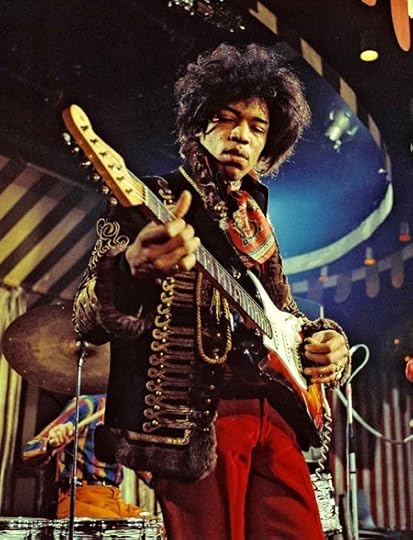
“Over the decades, Jimi’s blues creds have been largely restored and, today, his seismic strat runs connect with fans the world over.”
There are countless photographs and illustrations, and I was particularly taken with the way the Contents were depicted as a poster for what looks like an amazing two-week festival, if all of those people had lived at the same time and appeared together.
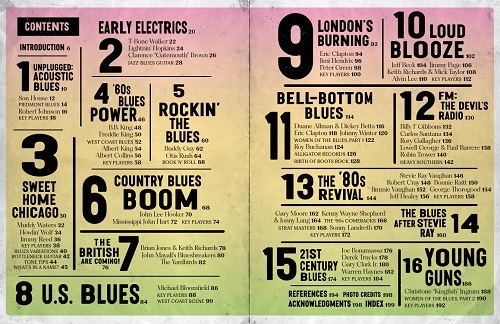
Each section is then introduced with its own part of the poster.
There are many references to, and quotations from, previously published material, such as this one from Lightnin’ Hopkins (1912-1982).
“Hopkins recalled in the documentary “Where Lightnin’ Strikes”, ‘My family is . . . from Centerville, Texas, [and we] raised cotton and corn, peas and peanuts and things. So I got me a guitar when I was eight years old. I got me a cigar box and cut me a round hole in the middle of it. Got me a little piece of plank and nailed it on to that cigar box. And I got me some screen wire—and I got me a tune out of it.’”
Although there is a section about women, I’m sure there are more men featured than women. There is only a hazy photo and short paragraph about Memphis Minnie, but she is mentioned by other singers as one of their inspirations, including Bonnie Raitt, who called her one of her heroes.
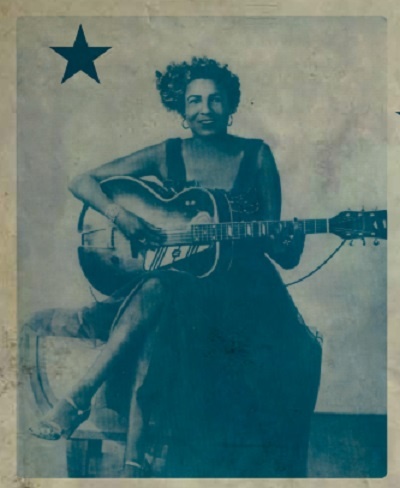
“Though not from the Carolinas or the East Coast, Memphis Minnie (1897–1973) was a deep-voiced singer and superb guitarist who also worked in the ragtime/blues vein. A prolific songwriter and performer from the 1920s to the 1950s, Minnie wrote “Me and My Chauffeur Blues” and 1936’s “Hoodoo Lady Blues,” the latter of which has a double-stop-laden guitar solo. Her most famous work is 1929’s “When the Levee Breaks,” recorded with husband Kansas Joe, featuring a dexterous guitar figure over rhythm accompaniment. Its lyrics were adapted into Led Zeppelin’s sledgehammer FM anthem of 1971.”
It is an entertaining and informative history of a music genre that has not only told straight-forward stories of slaves and the down-and-out but has also stirred listeners with the unique sounds and styles that have developed and infiltrated other genres over the years.
“In the waning years of the Eisenhower presidency and into the JFK and LBJ eras, college-educated white listeners began craving authentic American music, something they couldn’t glean from pop and rock ’n’ roll. It was a generation that desired traditional acoustic music over Elvis and the Beatles. This was the American folk revival.”
Ah, the folk music era. And then acoustic went electric and fans complained. But the electric guitar moved into surf music, the Beatles, folk-rock, Bob Dylan – all of whom would have taken the blues influence to much wider audiences. We may not know we’re hearing the echoes of these old-timers and many more.
Lead Belly (1888-1949)
Mississippi John Hurt (1893-1966)
Muddy Waters (c.1913-1988)
John Lee Hooker (c.1917-2001)
“With his reputation as a gifted picker and lovable songster, Mississippi John Hurt attracted younger artists like Bob Dylan who tried to decipher the cotton farmer’s intricate style.”
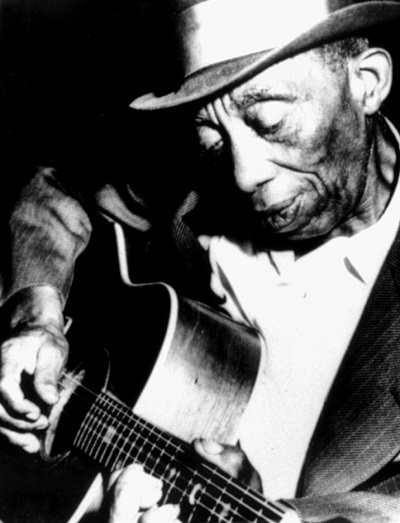
“Hurt enjoyed a breakthrough performance at the 1963 Newport Folk Festival, making the seventy-year-old an instant star of the burgeoning folk-blues scene.”
I liked the inclusion of many little photos of album covers. Here are a couple with Eric Clapton. The first is from John Mayall’s Blues Breakers in 1966, and the next with Cream. the world’s first so-called supergroup, founded by Clapton and two others in what has been referred to as the second British invasion.
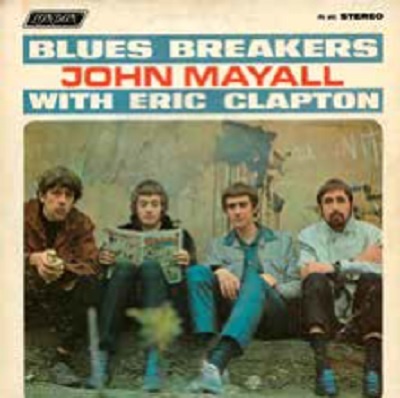
John Mayall’s Blues Breakers album cover
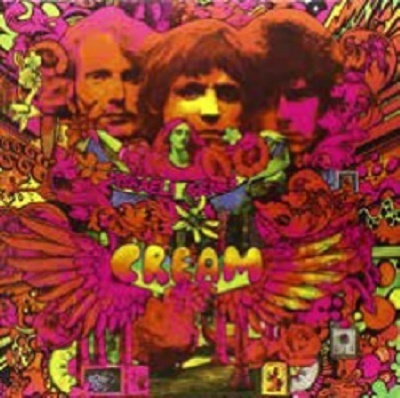
The iconic Cream album cover
I remember when I first heard Eric Clapton on his grammy-winning ‘Unplugged’ album (1992) following the MTV series of the same name. It felt to me as if the guitar had come full circle, back to magic fingers and smooth tones. I admit to being more of a Clapton fan than a Hendrix fan, but by golly there has been a lot of diverse talent in this field.
I’d call this a reference anthology, I think. I believe it’s mostly (all? - happy to be corrected) collated from available published material and seems comprehensive and well-referenced. I imagine this will appeal to enthusiasts of folk, pop, rock, and jazz as well as hard-core blues fans. I’m not even sure what constitutes hard-core blues anymore anyway.
Thanks to #NetGalley for the preview copy of #TheUltimateBookofBluesGuitarLegends.
Publication is 29 October 2024, and it’s available for NetGalley reviewers until 8 November.
“Music ‘moves’. It can travel from place to place, just like any human.”
Music moves people as it moves itself from continent to continent and culture to culture. Rural folk and blues get electrified and become a kind of international urban blues-rock. Prown opens the book with the statement above, followed by this (which was news to me).
“Case in point, think about Mexican mariachi music, with its jaunty rhythms and festive horns. Now compare that to the strangely similar sounds of European polka music. A coincidence? Not at all. In the nineteenth century, millions of German immigrants arrived in Texas and Mexico, bringing their polkas and waltzes with them. As these songs mingled with northern Mexican music, it evolved into what we loosely call mariachi. This underscores the essential premise: when people move, their music moves with them.”
I am still going through this massive book – it will take me some time – but I’m going to “review” it now so those who need to know about it will find it in plenty of time for the gift-giving season. I have only a digital PDF copy for review, but I can imagine the real thing.
The author begins by referring to the port cities in the US south, especially New Orleans.
“ It’s where seagoing vessels from the Americas, the Caribbean, Africa, and Europe arrived with slaves, sailors, and passengers, inadvertently bringing together shards of song, rhythms and reels, hollers and calls, and lyrics of many languages. As they mixed and spread inland, tuneful new hybrids emerged, among them ragtime, jazz, Dixieland, and the blues. The latter further developed in Black farming communities and brutal cotton plantations throughout the South and, within decades, began spreading by boat, train, horse, and foot.”
Prown talks not only about how the music styles blend and morph, but also how the sound and instruments changed. Basic acoustic became electrified so that Jimi Hendrix playing The Star Spangled Banner is a far cry from that of a classic acoustic rendition.
Acoustic anthem by Adrian Holovaty, from Amsterdam. [He says the last chord was intentional because it was recorded when George W. Bush was president 😁. ]
Adrian Holovaty playing The Star Spangled Banner on acoustic guitar
Here is Jimi Hendrix at Woodstock, August 1969. Brace yourself!
Jimi Hendrix playing The Star Spangled Banner at Woodstock, August 1969
The photo below is not from Woodstock.
“Over the decades, Jimi’s blues creds have been largely restored and, today, his seismic strat runs connect with fans the world over.”
There are countless photographs and illustrations, and I was particularly taken with the way the Contents were depicted as a poster for what looks like an amazing two-week festival, if all of those people had lived at the same time and appeared together.
Each section is then introduced with its own part of the poster.
There are many references to, and quotations from, previously published material, such as this one from Lightnin’ Hopkins (1912-1982).
“Hopkins recalled in the documentary “Where Lightnin’ Strikes”, ‘My family is . . . from Centerville, Texas, [and we] raised cotton and corn, peas and peanuts and things. So I got me a guitar when I was eight years old. I got me a cigar box and cut me a round hole in the middle of it. Got me a little piece of plank and nailed it on to that cigar box. And I got me some screen wire—and I got me a tune out of it.’”
Although there is a section about women, I’m sure there are more men featured than women. There is only a hazy photo and short paragraph about Memphis Minnie, but she is mentioned by other singers as one of their inspirations, including Bonnie Raitt, who called her one of her heroes.
“Though not from the Carolinas or the East Coast, Memphis Minnie (1897–1973) was a deep-voiced singer and superb guitarist who also worked in the ragtime/blues vein. A prolific songwriter and performer from the 1920s to the 1950s, Minnie wrote “Me and My Chauffeur Blues” and 1936’s “Hoodoo Lady Blues,” the latter of which has a double-stop-laden guitar solo. Her most famous work is 1929’s “When the Levee Breaks,” recorded with husband Kansas Joe, featuring a dexterous guitar figure over rhythm accompaniment. Its lyrics were adapted into Led Zeppelin’s sledgehammer FM anthem of 1971.”
It is an entertaining and informative history of a music genre that has not only told straight-forward stories of slaves and the down-and-out but has also stirred listeners with the unique sounds and styles that have developed and infiltrated other genres over the years.
“In the waning years of the Eisenhower presidency and into the JFK and LBJ eras, college-educated white listeners began craving authentic American music, something they couldn’t glean from pop and rock ’n’ roll. It was a generation that desired traditional acoustic music over Elvis and the Beatles. This was the American folk revival.”
Ah, the folk music era. And then acoustic went electric and fans complained. But the electric guitar moved into surf music, the Beatles, folk-rock, Bob Dylan – all of whom would have taken the blues influence to much wider audiences. We may not know we’re hearing the echoes of these old-timers and many more.
Lead Belly (1888-1949)
Mississippi John Hurt (1893-1966)
Muddy Waters (c.1913-1988)
John Lee Hooker (c.1917-2001)
“With his reputation as a gifted picker and lovable songster, Mississippi John Hurt attracted younger artists like Bob Dylan who tried to decipher the cotton farmer’s intricate style.”
“Hurt enjoyed a breakthrough performance at the 1963 Newport Folk Festival, making the seventy-year-old an instant star of the burgeoning folk-blues scene.”
I liked the inclusion of many little photos of album covers. Here are a couple with Eric Clapton. The first is from John Mayall’s Blues Breakers in 1966, and the next with Cream. the world’s first so-called supergroup, founded by Clapton and two others in what has been referred to as the second British invasion.
John Mayall’s Blues Breakers album cover
The iconic Cream album cover
I remember when I first heard Eric Clapton on his grammy-winning ‘Unplugged’ album (1992) following the MTV series of the same name. It felt to me as if the guitar had come full circle, back to magic fingers and smooth tones. I admit to being more of a Clapton fan than a Hendrix fan, but by golly there has been a lot of diverse talent in this field.
I’d call this a reference anthology, I think. I believe it’s mostly (all? - happy to be corrected) collated from available published material and seems comprehensive and well-referenced. I imagine this will appeal to enthusiasts of folk, pop, rock, and jazz as well as hard-core blues fans. I’m not even sure what constitutes hard-core blues anymore anyway.
Thanks to #NetGalley for the preview copy of #TheUltimateBookofBluesGuitarLegends.
Publication is 29 October 2024, and it’s available for NetGalley reviewers until 8 November.

September 27, 2024
Thanks to the publisher and Netgalley for this eARC.
Ultimate Book of Blues Guitar Legends: The Players and Guitars That Shaped the Music by Pete Prown is a treasure trove for any blues enthusiast or guitar aficionado. This comprehensive volume delves into the rich history of blues music, spotlighting over 150 of the genre’s most influential guitarists and their iconic instruments.
Prown’s expertise shines through as he meticulously categorizes the musicians by era and subgenre, from the early acoustic and country blues to the electric Chicago blues, the British Invasion, and blues rock. Each section is thoughtfully curated, providing readers with a deep understanding of how these artists and their guitars shaped the evolution of blues music.
One of the standout features of this book is its detailed exploration of the specific guitars that became synonymous with these legendary players. Prown doesn’t just list the instruments; he provides insightful commentary on how each guitar contributed to the unique sound and style of its player. This approach not only highlights the technical aspects of the instruments but also brings to life the personal stories and musical journeys of the guitarists.
The book is richly illustrated with photographs of the musicians in action, adding a visual dimension that enhances the reader’s experience. These images, combined with Prown’s engaging narrative, create a vivid portrait of the blues scene across different periods.
Additionally, the book includes fascinating sidebars on influential women in blues, the development of slide guitar techniques, and the jargon unique to the blues community. These elements add depth and context, making the book not just a collection of biographies but a holistic guide to understanding the cultural and musical significance of the blues.
For anyone passionate about blues music or guitar history, The Ultimate Book of Blues Guitar Legends is an essential addition to their library. It offers a well-rounded and immersive journey through the world of blues, celebrating the artists and instruments that have left an indelible mark on music history. Whether you’re a seasoned blues fan or a newcomer to the genre, this book is sure to inspire and educate.
Ultimate Book of Blues Guitar Legends: The Players and Guitars That Shaped the Music by Pete Prown is a treasure trove for any blues enthusiast or guitar aficionado. This comprehensive volume delves into the rich history of blues music, spotlighting over 150 of the genre’s most influential guitarists and their iconic instruments.
Prown’s expertise shines through as he meticulously categorizes the musicians by era and subgenre, from the early acoustic and country blues to the electric Chicago blues, the British Invasion, and blues rock. Each section is thoughtfully curated, providing readers with a deep understanding of how these artists and their guitars shaped the evolution of blues music.
One of the standout features of this book is its detailed exploration of the specific guitars that became synonymous with these legendary players. Prown doesn’t just list the instruments; he provides insightful commentary on how each guitar contributed to the unique sound and style of its player. This approach not only highlights the technical aspects of the instruments but also brings to life the personal stories and musical journeys of the guitarists.
The book is richly illustrated with photographs of the musicians in action, adding a visual dimension that enhances the reader’s experience. These images, combined with Prown’s engaging narrative, create a vivid portrait of the blues scene across different periods.
Additionally, the book includes fascinating sidebars on influential women in blues, the development of slide guitar techniques, and the jargon unique to the blues community. These elements add depth and context, making the book not just a collection of biographies but a holistic guide to understanding the cultural and musical significance of the blues.
For anyone passionate about blues music or guitar history, The Ultimate Book of Blues Guitar Legends is an essential addition to their library. It offers a well-rounded and immersive journey through the world of blues, celebrating the artists and instruments that have left an indelible mark on music history. Whether you’re a seasoned blues fan or a newcomer to the genre, this book is sure to inspire and educate.

March 21, 2025
The Ultimate Book of Blues Guitar Legends by Pete Prown is a wonderful book, both an introduction for those who might be new to the genre or haven't followed it a long time (in other words, not old like me) as well as a trip down memory lane with some new and interesting facts thrown in.
When I was very young (based on where we were living at the time it was a year or two before I started school) a neighbor introduced me to Howlin' Wolf's music. Apparently I had been humming or making some other type of attempt at a tune and he recognized it as blues. I am guessing it was from one of my father's albums. This kind old man played some of his records for me and talked to me about the origins and history of blues, helping to plant the seed of curiosity about both the sound and the history/meaning of music. This book can do the same thing for any who are new to the blues.
No matter your familiarity with the artists, their guitars, or even the blues in general, I would highly recommend you listen to as many songs as you can while working your way through this volume. Go down a few rabbit holes, explore beyond just what is in this book. You will soon be hearing the blues in far more songs than you realized, no matter what genre those songs are.
While not a lot of depth on the equipment used there is enough here to help a guitarist appreciate how specific equipment can play such a big role in the sound. From signature sounds to simply changing guitars on certain songs.
Reviewed from a copy made available by the publisher via Edelweiss.
When I was very young (based on where we were living at the time it was a year or two before I started school) a neighbor introduced me to Howlin' Wolf's music. Apparently I had been humming or making some other type of attempt at a tune and he recognized it as blues. I am guessing it was from one of my father's albums. This kind old man played some of his records for me and talked to me about the origins and history of blues, helping to plant the seed of curiosity about both the sound and the history/meaning of music. This book can do the same thing for any who are new to the blues.
No matter your familiarity with the artists, their guitars, or even the blues in general, I would highly recommend you listen to as many songs as you can while working your way through this volume. Go down a few rabbit holes, explore beyond just what is in this book. You will soon be hearing the blues in far more songs than you realized, no matter what genre those songs are.
While not a lot of depth on the equipment used there is enough here to help a guitarist appreciate how specific equipment can play such a big role in the sound. From signature sounds to simply changing guitars on certain songs.
Reviewed from a copy made available by the publisher via Edelweiss.

October 16, 2024
For those who have a deep appreciation for blues music or an interest in the history of guitar, this book is a must-have for any collection. It provides a thorough and engaging exploration of the blues world, honoring the artists and instruments that have profoundly influenced the course of music history. Whether you are a lifelong blues enthusiast or just beginning to discover the genre, this book promises to both inspire and educate, making it a delightful addition to your reading list.
Thank you NetGallery and Quarto Publishing Group – Motorbooks for the opportunity to review this book.
Thank you NetGallery and Quarto Publishing Group – Motorbooks for the opportunity to review this book.

October 3, 2025
I found this to be a very good book about different guitar players from different time periods. You also have acoustic, and then you move into electric guitar. You have Chicago Blues, Blues Rock, and the British invasion, all have guitarists from each of those times, and pictures to go along with them also. Everything about this book is excellent, which makes for a wonderful read.
December 3, 2025
Right up my alley, another collection of notable blues players. Mr. Prown's heros are pictured with guitar in hand, and he informs briefly on their playing style, gear and some key work. I love dashing about in my music collection to listen again to the wonderful blues guitar work he describes.

March 1, 2026
This book brought back a lot of memories as I grew up listening to many of these Texas blues musicians and Bonnie Raitt was one of my favorite performers. I was glad to see Jesse Ed Davis (Come and Get Your Love) and Jack White mentioned, who I saw Austin City Limits last summer.
Displaying 1 - 7 of 7 reviews