Based on his own childhood, beloved and award-winning artist Raúl Colón's wordless book is about the limitless nature of creativity and imagination.
A boy alone in his room. Pencils. Sketchbook in hand. What would it be like to on safari? Imagine. Draw!
A boy named Leonardo begins to imagine and then draw a world afar — first a rhinoceros, and then he meets some monkeys, and he always has a friendly elephant at his side. Soon he finds himself in the jungle and carried away by the sheer power of his imagination, seeing the world throuhg his own eyes and making friends along the way.
New York City has been Raul's loyal patron, from illustrated New Yorker covers to an MTA mural at the 191st. St. subway station to work in the New York Times.
Along with all this 'grown up' work, Raul Colón is a most prolific and popular children's book illustrator, happy that his time is always committed to publishers for years hence. In recent years he is pleased that his work has been recognized with The David Usher Greenwich Workshop Award from The Society of Illustrators as well as SI Gold and Silver Medals; honors from Communication Arts and 3x3; two Pura Belpre Awards; twice included in the NY Public Library's 100 titles for Reading and Sharing; and twice recipient of The Tomas Rivera Mexican American Children's Award. Raul lives north of New York City with his beautiful wife, Edith, who can often be spotted as the model for his characters.
I love the way Colón uses different artistic styles to differentiate reality from imagination. This book is a celebration of imagination and art. Colón's characteristic textured, color-rich illustrations are beautiful and will surely inspire readers to try creating their own. That being said, there's not enough story here to satisfy me. The African safari sequence doesn't have enough tension or forward movement. The main character shown before and after doesn't appear to have changed in any way, other than his impressive drawings. For me, the book falls a bit flat and doesn't invite multiple readings. It's too bad, though, because there really is some wonderful artwork in it.
A boy alone in his room with books, pencils, a sketchbook, and a wild, limitless imagination. A stunning wordless picture book celebrating creativity and imagination.
The prize-winning author and illustrator recalls his childhood in this wordless tour of his early imagination. As a child, he had chronic asthma, and sometimes had to spend weeks at a time confined to his bed. But in spite of his indisposition, he managed to travel all over the world in his mind.
Children can easily see how his drawings took him from his tame and relatively safe bedroom to the middle of an African safari. Carrying his sketchbook, sometimes he draws the animals, and sometimes they even draw him!
In the end, he is back in his bedroom, surrounded by his books and sketches that he made while “on” his safari.
Colón used colored pencils, grainy paper, and an etching instrument to achieve an effect somewhere between intaglio and pointillism, with the muted palette of the bedroom changing into the rich tones of Africa on the boy’s adventures. The illustrations are gorgeous.
Evaluation: Wordless books offer many opportunities to encourage creativity in readers. Children will also learn about many of the majestic animals of Africa, and perhaps be inspired to find out more about the wildlife and ecosystem.
Picture-book illustrator Raúl Colón draws upon his own experiences as a young would-be artist in creating this lovely wordless tale, which follows a boy who, inspired by the massive volume on Africa that he is reading, uses his drawing skills to take an imaginative safari. Drawing all of the wonderful animals that live in the African Serengeti ecosystem, the boy has imaginary adventures with each, finding himself being chased by the rhinoceros, and drawn himself by the monkeys.
The artwork here, done in pen and ink, watercolors, pencil, and lithograph, is absolutely beautiful, capturing both the wonder of the boy's rich imaginative experience, and the majesty of the creatures he is depicting. Draw! works very well as a wordless book, not just because the visuals are so strong, but also because it taps into the common childhood experience of using visual stimuli - pictures, movies, etc. - to launch a world of make-believe. Recommended to anyone looking for good wordless picture-books, as well as to anyone searching for children's stories about the imagination and the artistic process.
Reading is not the only thing that can take you to different worlds - so can drawing! There are no limits to the imagination. After reading a book about Africa, a young boy in his room starts drawing a journey to Africa and what he sees there. The beautiful, savannah-hued illustrations capture the mightiness of elephants, the curiosity of zebras, the loping of giraffes, the majesty of lions, companionship of gorillas, and the stampeding of rhinos. Make sure to look at the title page and the knapsack of sandwiches - they show up in the hands of the gorillas and monkeys. I noticed that the boy's bedside table suggests he may even be sickly - there's an inhaler and a bottle of medicine there. It's even more important that he be able to escape the confines of his room and travels to other worlds. The Author's Note at the end explains how Raul Colon, the illustrator, would spend long hours drawing in his room in New York City, inspired by books, comics, and other artists.
This book is wordless, creative, and a meta window into a young artist's life. As a boy sits on his bed he starts to draw out his imaginary expedition to Africa. While traveling with the elephant and bird he befriended, he captured some great shots of these creatures in their habitat. This is a portrait of an ideal safari trip, in which the illustrations invoke thoughts of old photographs thanks to the grainy effect of the Arches paper.
Draw! is a wordless picturebook that celebrates the power of art and imagination.
Raúl Colón employs two different art styles to differentiate between the real and imaginary worlds, and although I am not too crazy about the illustrations of the reality, the boy's imaginary world is vibrant with color:
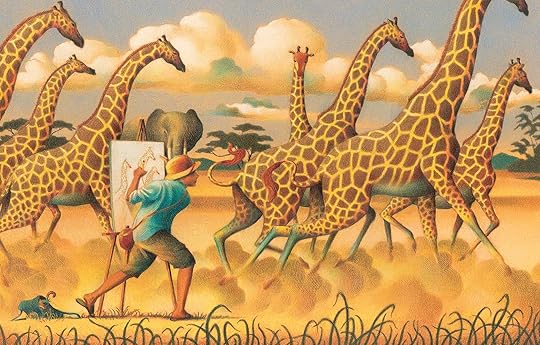
Colón charts his own path in a medium well known in the 80s and 90s from the likes of Chris Vanallsburg and William Joyce. Not to mention, it reminds me of Nancy Erekson's beautiful prismacolor on paper work! Nancy reminds me how long this kind of layering takes, so I appreciate how much work the book represents. Colón's flawless drawing! I could sit and look at the giraffe page for hours! I loved watching how he used the palette for all the shadows and nuances. Look at those reds in the chin stripes on the zebra, and the blue green shadows on the backs of the giraffes' legs! And the way drawing paper insists on its own texture despite the colors makes each page so look-at-able.
The peritext says Raúl Colón used lithograph pencils, and Nancy and I discussed whether he did the scratches in the paper beforehand so the drawing wouldn't go into those grooves or whether he scratched afterward to create those interesting contour lines. I think Nancy is probably right: he likely grooved his pencil drawing before digging in with the prismacolors.
The little jokes in the narrative were a lot of fun: Making the front and back of the story in the 'real' world less realistic, drawn with black outline; moving out of imagination was a visual loss, more spare; keeping the animal from the previous page and showing it in the background on the next page--the rhino was pretty funny; the way the little heron gets on its tiptoes to try to see the elephant drawing; boy on back of elephant, birds on back of buffalo. Not laugh-out-loud jokes, just fun.
It's a simple narrative: draw pictures of folks and share sandwiches with them. As with other memorable books about making pictures (Harold and the Purple Crayon, Journey) Colón's work makes magic out of visual imagining.
A wonderful main character with brown skin, strong multiculturalism without making the story follow that topic. There was no trace of tokenism, just good representation in a strong wordless picturebook.
I was halfway through the book before I realized I was reading a wordless picture book. Very engrossed in the pictures and all that was going on therein. I very much enjoyed that. Especially the little back or side stories of the sandwiches, or the animals after he left them. Must try in storytime.
1/27/16 Used in my D is for... theme, and as the literacy moment. Each child took a turn coming up and identifying the animal on the page. Then they told me what letter that started with. Then they took the little car and drove (d word!) it through the tunnel with the correct starting letter. Had enough kids take turns through the rhino, then we read through the rest together, still calling out the starting letters for the animals and his sandwich. So even though the flow of the book was disrupted doing Literacy Moment, they still got the end with his pictures on display. Really good.
2/1/17 Used the same way as last time--in the D theme for the literacy moment and driving through the tunnel. We ended around Lion. I also had them picking a color and finding the starting letter for that, since I had more than 9 kids and wasn't sure if they would all want a turn. Went well. They really enjoyed the activity and pictures.
1/31/18 Did the same as previous two times and also ended around Lion. Only had my 3 regulars and then a couple newbies who didn't come up. So we just did animals and didn't worry about colors. Then we did them all together for the rest of the book. Worked well.
2/9/18 SD went through this with Daddy on Father Night. So I got to see her with it for bedtime tonight. She wanted to do all the reading--since it had no words. (She's not enjoying words as much--too much work right now. Understandable and even typical. At least she is still loving books and being read to. Words will come around.) She read this to me and she did an excellent job in catching various clues, seeing what might come next. Great way to practice her vocabulary and storytelling skills. Will need to bring more wordless ones home for her to enjoy on her own and telling aloud.
In this wordless picture book, Colón recreates his love of drawing as a child and the way that it could take him to new places. Here a boy is sitting on his bed looking at a book about Africa. He sets the book aside and picks up his drawing pad and a pencil. Soon readers can see the images in his head as he puts them on paper. The boy is transported directly to Africa, setting up his drawing easel in front of each of the different animals of Africa. The elephant is first and after seeing his picture gives the boy a ride to met the zebras. The book moves from one animal to the next, the boy changing how he approaches them according to what animal it is. Until finally a group of monkeys make a picture of the boy. Readers and the boy return to his bedroom, now littered with all of the drawings of the animals.
This book nicely captures without using any words at all the transformative power of art and creativity. It beautifully shows how art can transport you to a different place and time, moving you into the flow of creating a work. It also demonstrates how inspiration can strike and the flow of creativity can overtake you in the best possible way.
Colón’s illustrations are done in pen, ink, watercolors and pencil. They move from line drawings with pastel tones of real life to a more lush and rich color and style when we are inside the boy’s imagination. Colón uses lines on these more colorful pages to give texture and movement to the image. They are illustrations that invite you to walk right into them.
Imagination, creativity and art come together in this book to transport readers right into Africa. Now it’s time to get out your own pencils and see where they will take you. Appropriate for ages 4-6.
This is a great book about losing yourself in your imagination. A friend mentioned to me that this is a great companion or read-alike for WHERE THE WILD THINGS ARE. Both stories start in the bedroom and end in the bedroom. In between, the reader gets lost in an amazing adventure. DRAW! is set in Africa and follows a young artist as he draws his way across the country while he draws the beautiful animals that live there. The Colon's illustrations are gorgeous - the use of texture, superb. This is definitely a book to add to your collection.
This is a wordless picture book targeted for the 4-8 year old crowd, and while the art is wonderful, there is not enough of a story here. A little boy is stuck in his room with art supplies and a book on African animals. I love how his creative imagination took him on a safari, but there just wasn't enough to think about. My fave part was how he packed his backpack - art supplies, an umbrella, and half a dozen sandwiches. Kinda how I pack my bag too. Granted, this might be perfect for 4 year olds, and that I am not.
I am not crazy about wordless picture books, but "Draw" is definitely worth a look. It shows how a childhood imagination can be expressed through a creative outlet: in this case, drawing. There are even a few nods to comical amusement with monkeys eating sandwiches and drawing a picture of the boy. All-in-all, the author (illustrator?) does a great job with making the story come to life by showing instead of telling.
I would recommend this to imaginative children, and children who love drawing and silliness.
This is a fun wordless picture book that celebrates art, wildlife and the power of imagination. The pictures are very nicely detailed, with subtle humor and majestic scenes.
We love the boy's ability to project himself into the scenes and our girls love his artwork.
We really enjoyed reading this book together and we appreciated how the author's note at the end of the book explains his personal connection with the story.
A book entirely without words, encouraging your child to create their own explanations for the artistic safari that takes place. I Love all the different animals, and enjoyed the artwork. There's nice bits of humor throughout. I wish I could go on a drawing excursion like this!
“Draw!” is a wordless picture book about a boy who is confined in his room and decides to draw himself on a safari with lions, elephants and other exotic creatures of an African safari. The author and illustrator Raul Colon, beautifully illustrates each page with rich colors and a unique artistic style. It is interesting to note that the first pages and the last pages are in a slightly different style than other pages. The distinct art styles are used to differentiate between the real events and the events that take place in his imagination. The more robust and colorful style is for the main character’s art and for his imagination, demonstrating how his art takes him to places that he may not be able to go to in the “real world”. The first two of the final three pages are back in the real world with the picture he drew saying farewell to his elephant friend he met on his imaginary safari getting smaller as he transitions back to the real world. This mirrors the pages at the beginning of the book, where he drew himself setting out on the safari and the drawing increases in size as the boy transitions into his imaginary safari. The pages in between cover his safari in this beautiful art style, capturing his adventure in a style that is a unique mix of realism and folk art. The illustrator's use of lines and pattern to capture movement draws the reader in, investing them in the story even with no words. The front book cover is taken directly from a dramatic scene from the book where a rhinoceros charges the main character, this is effective in drawing the potential reader to the book. There is a hidden illustration inside the book jacket, another scene from the book where the main character is watching and drawing a herd of giraffes. I feel children of any age would enjoy this book. The large well drawn illustrations will appeal to young children, and can be read to them or since there are no words they can engage with the book on their own. Older children can also enjoy the beautiful art and can easily be used in an art class, or just any time that a book filled with beautiful illustrations would be fun. Many children like animals and a book such as this will speak to this interest and reinforce the value of imagination.
Draw! is a wordless picture book about the endless possibilities and adventure that can be achieved through imagination. The book starts with a young boy reading about Africa for school. As he is reading, he begins to imagine himself there and draws his adventure. He depicts himself exploring Africa and meeting elephants, zebras, giraffes, lions, and more incredible animals. At the end of the story, the young boy presents to his class his drawings of all the beautiful animals in Africa.
The overall theme of Draw! is the power of imagination, and the endless possibilities one has in their life through using his or her creativity.
When I read Draw! I found myself very captivated by the amazing artwork depicting the beauty of the nature and animals in Africa. In the past I had been weary of wordless picture books because there are no words to tell the story. However, this book has changed my perspective and demonstrated how a story of adventure can be told exceptionally well simply through pictures. Personally, I loved drawing when I was younger because there were no limits on what I could do with it. I think that this book really captured that spirit of drawing that I experienced when I was younger, and is teaching it to a new generation of children.
I would recommend this book because it shows young children the power of creativity, specifically drawing. Encouraging creativity is becoming increasingly more important because of the rise of technology, which is resulting in children spending more time on screens than out exploring the potential of what’s around them. I think this book does a great job at showing how incredible drawing and using your imagination can be, which I hope will encourage young children to get away from the screens and explore what they can do through drawing or other platforms for creativity.
Draw!, by Raúl Colón, is an amazing wordless book about a little boy sketching different animals while in Africa. I enjoyed this book, and thought it was clever. I have never read a wordless book, but this ended up being great! This book starts off with the a little boys sitting on the bed in his room reading about Africa, with a sketchbook and pencils by his side. After he finishes reading, he starts to draw animals, as if he were on a safari in Africa. The transition from his bedroom to the safari in Africa is truly remarkable, as the kids drawings are becoming real on the pages of the book. The boys starts off by sketching an elephant, who seems to enjoy the sketch of himself. The elephant then takes the boy to sketch zebras, then giraffes, then lions, then gorillas, then a ram, then a hippo, and as he tries to draw a rhinoceros, the rhino charges at him. After that, he gets some baboons to draw him. Sadly, the boy has to say goodbye to the elephant, and he is done drawing. The next day, the little boy brings in the drawing to show his class. I loved the two different ways Raúl drew the story, to signify real life, and the boys drawings. Also, what was cool about this book was how the hardcover was different then the dust jacket. The dust jacket shows the rhino coming up to the little boy on the front, and him just taking a break on the back. But, underneath the dust jacket is a picture of the little bow drawing the giraffes. This would be a great book for parents to show to young children, but would also be great for children a little older who can actually understand the book. So it would be good for toddlers and elementary aged students.
"Draw" is a wordless picture book for young children ages preschool through first grade.
Text to Self: The little boy is using his drawing and creativity to help him imagine animals in Africa. He is using his drawings to take him to another world. He is using his drawings as a way to record his thoughts. I can relate to this because while I don’t draw, I use music as my creative outlet. When I am playing music, it takes me to another world. It takes me to a place of ultimate happiness and it lets me escape from reality. He uses drawing the same way that I use music in my life.
Text-to-Text: Reading this book reminded me of the character Ally in "Fish in a Tree". Ally is constantly making “mind movies” in her head which gives her inspiration for her drawings in her Sketchbook of Impossible Things. Ally is struggling with reading, so she uses drawing as her way to see the world in her own way. She becomes inspired to draw in different situations that she is faced with. She would rather have her face in her sketchbook all day than to have to deal with school and reading.
Text to World: This book could relate to the world in the fact that it shows us that using your imagination can make you happy. I think it could also teach children that anything is possible with a little imagination.
Draw! Is a wordless picture book for children. The story of this book is simple. A boy on a bed is reading a book regarding animals in Africa. He draws something on his sketchbook, which guide a reader into this boy’s imagination. In Africa, he becomes a friend with an elephant and a bird by drawing, and they take a journey to see other Africa’s animals, including rhinoceroses, lions, and giraffes. After bidding farewell to the elephant and the bird, the reader comes back to the illustration of the boy on his bed with several pages of drawings of African animals. On the last page, the boy is holding one of the drawing in his hands, displaying the rest of them on the wall in class. The artwork of this book is impressive. The drawings of illustrations are simple and clear when the boy is in the real world, while in the surrealistic African world, the illustrations have lots of lines and blurry patterns. The distinctively different art styles draws me into the illustrations as well as imaginative world.
A Fantasy Fiction of a boy who makes believe he goes to Africa and draws safari animals. This book had great drawings with very vivid colors. This book is targeted for children from Pre-K through Second grade. Each page is very specific in its drawings leaving little room to expand the story, great for younger kids! Text-to-Self- Children can relate to this book, because many kids like to draw animals. Maybe just like the character in this book kids make believe and travel in their drawings. Text-to-Text- This book is similar to other children's books because the characters are animals. Also it has great illustrations of real life outdoor environments. Students might have read Non-Fiction books about these safari animals and in this book they can relate to the background of where the animals are at. Text-to-World- This book does an amazing job in its illustrations, kids can turn the page and see the environment that each animal lives in. For example, the giraffes running in a heard. Students can relate this book to the real scenarios these animals live in.
Copyright- 2014 Number of Pages-31 Book format-hardcover, paper Reading Level-PreK-K, 1-2, GR Level- N/A Genre- Fiction, Fantasy Lit. Requirement- Wordless Book-2
This was a wordless book illustrated by Raul Colon. It was about a young boy who draws and is transported to another world with his imagination. The boy goes to Africa and interacts with wild animals. Right away the illustrator foreshadows what the story is about by showing the boy reading an Africa book with a sketch pad by him. He goes to Africa to draw all of the animals. The first animal is an elephant who is friendly and he befriends him. We see the elephant in multiple pictures either watching the boy almost as protecting him, and giving him rides. The illustrator portrays the animal's personalities such as a rhino trying to charge him. The story used lots of colors but mostly nature colors and oranges to resemble the plains in Africa.
I would recommend this book I liked it. It was a cute book about a boy who loves to draw. He uses his imagination and I think kids will love this book and the animals.
After reading a book about Africa, a boy sitting in his room begins to travel through Arica by sketching the animals while on a safari with an elephant. Despite being a wordless picture book, excitement and adventure is illustrated through facial expressions and actions, such as when the boy is being chased by a rhino! He shares his adventures with his classmates as he proudly showcases all of his drawings on the wall and all the animals he met while on his adventure through Africa.
The illustrations appear to be hand drawn with colored pencil, which is the same medium the boy uses in his own drawings. The shading and details provide a beautiful depiction of all the animals and the scenery. The pictures serve as a reminder that sometimes, the best trips take place in our own imaginations, where we have the opportunity to meet our own elephant companion to show us around Africa.
Colón achieves a commanding multi-layered book within a book, taking the reader into the sequential and wordless narrative, mostly without using but hinting at the frames we are used to in comics and graphic novels. As the sole artist-character befriends a few animals, observes others, and just avoids another, we enter the imaginary world with him. This is a tender and tense telling that doesn’t lose its impact or enjoyment after the first reading. The book’s little details are the most whimsical: the multiplying sandwiches, interesting perspectives (like above a hippopotamus), the rhinoceros looking at the drawing of itself, and baboons sketching the artist. The entry and exit points for the story actually seem less real than the created ones, reinforcing the real feeling of the imagined one. Bravo! The author’s note at the end adds interesting background to understand the book.
This wordless book takes us on an African journey as a young boy’s imagination takes flight. The nameless child explores Africa while drawing it many animal denizens, showing an adroit style of artistic expression. Like Cinderella singing “In My Own Little Corner”, the child never actually leaves his room, safely mingling with lions, elephants and a charging rhino. But his interior landscape is vast and lively and we share the boy’s wistful sorrow when he finally leaves it.
The illustrations are softly colored but vivid and realistic. Giraffes charge by, their elongated necks outlined against fluffy clouds, while their hooves churn up dust. A pride of lions lounge in regal splendor, much like their domesticated cousins. A curious gorilla partakes of a meal. It’s a splendid book and children who like the idea of exploring will enjoy it.
Draw! is a colorful and fun wordless picture book that dives right into the creative and imaginative world of a young boy who is quite the artiste. Each page is full of such big and unique pictures that feel like they come to life before your own eyes, in fact the cover and back of the book is the same picture as one of the illustrations at the beginning of the book that can really pull you in as a reader. Colon uses what looks like texture in his illustrations that make pages and animals look more real. I like how this book can show a young reader where their imagination can take them and that there is so much beauty around us and within our own minds.
Books with no words always astound me. And Raul Colon is a heckin’ master at writing books with no words. There is a level of creativity and imagination that is necessary to tell a story with so many levels of nuance and then get it published, and dang, Colon is well above and beyond that. The illustrations are detailed, engaging, and hold a great balance between action-packed, serious, and humorous. Colon’s work is truly one of a kind, and I can’t wait to read more.
I liked this book because it left everything up to the child’s imagination. There are no words just illustrations so you have to explore every page. It is about a child who draws pictures of his imaginary safari in Africa. It would be great to use in class as a starter to story writing. If the whole class breaks into groups and writes about one page it would be a great exploration leading into writing their own or group imaginary stories. This could lead to book studies about character, setting, main idea and so on. I would recommend this book for all ages for that reason.