

What do you think?
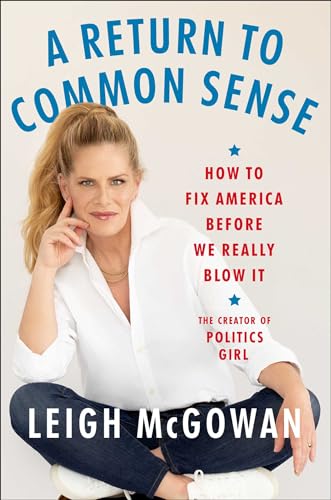
A Return to Common Sense: How to Fix America Before We Really Blow It
A political book for non-political people from viral TikTok sensation PoliticsGirl.
Something’s gone wrong in the Land of the Free and the Home of the Brave. We can all feel it, but if we’re being honest, most of us don’t understand it. At the end of the day, we don’t have all the facts, and if you don’t know how something works, how do you fix it?
A Return to Common Sense is a concise, no-nonsense, dare we say fun, guide to how America works and a roadmap to reclaiming a government of, by, and for the people.
If we truly want to be a land of freedom and opportunity where everyone has a shot at a good life, we must acknowledge the ideals of America are in danger, but worth saving. We fought a revolutionary war for the idea of self-governance and pursuit of happiness—we can’t just give up on it now.
To address the crisis, Leigh McGowan offers Six American Principles. Six ideals, rooted in history, that we can all agree make America, America.
1. America is a land of freedom.
2. Everyone should have the opportunity to rise.
3. Every citizen should have a vote, and that vote should count.
4. Representatives should represent the people who elected them.
5. The law applies to all of us.
6. Government should be a force for good.
Using the Six Principles as guideposts, this book will lay out suggestions for America, to not only find its way out of the mess it’s currently in, but to set a course for a future of which we can all be truly proud.
It’s time to find the courage to step out of our comfort zones and off our team benches to reboot America. If we start here, we start strong.
We can fix this, but the way forward starts with understanding.
Something’s gone wrong in the Land of the Free and the Home of the Brave. We can all feel it, but if we’re being honest, most of us don’t understand it. At the end of the day, we don’t have all the facts, and if you don’t know how something works, how do you fix it?
A Return to Common Sense is a concise, no-nonsense, dare we say fun, guide to how America works and a roadmap to reclaiming a government of, by, and for the people.
If we truly want to be a land of freedom and opportunity where everyone has a shot at a good life, we must acknowledge the ideals of America are in danger, but worth saving. We fought a revolutionary war for the idea of self-governance and pursuit of happiness—we can’t just give up on it now.
To address the crisis, Leigh McGowan offers Six American Principles. Six ideals, rooted in history, that we can all agree make America, America.
1. America is a land of freedom.
2. Everyone should have the opportunity to rise.
3. Every citizen should have a vote, and that vote should count.
4. Representatives should represent the people who elected them.
5. The law applies to all of us.
6. Government should be a force for good.
Using the Six Principles as guideposts, this book will lay out suggestions for America, to not only find its way out of the mess it’s currently in, but to set a course for a future of which we can all be truly proud.
It’s time to find the courage to step out of our comfort zones and off our team benches to reboot America. If we start here, we start strong.
We can fix this, but the way forward starts with understanding.
300 pages, Kindle Edition
Published September 17, 2024
Ratings & Reviews
Friends & Following
Create a free account to discover what your friends think of this book!
Community Reviews
Displaying 1 - 30 of 161 reviews

October 9, 2024
I follow McGowan on social media (Politics Girl) and have always been impressed with her knowledge and her amazing ability to articulate complex issues in a way most can understand. With that in mind, I wanted to check out her book, thinking I'd probably just hear things I've already heard her speak on.
But, wow. This is an amazing compilation of civics 101 and should be read by every high school student and most adults. It was a fabulous review of how our government is structured, how it's evolved over the years and how it's running off the rails in a variety of ways. This could not be a more timely treatise on our current situation, especially as many of our fellow citizens don't appear to understand how the branches of government work (or don't) and who's responsible for what and why that all matters when we vote.
McGowan covers a lot of ground in this relatively short and engaging book. Among those topics are the electoral college, income disparity, gerrymandering, systemic racism, the filibuster, the intersection of religion with government, the loss of freedoms, the evolution of SCOTUS and how it's removing rights rather than adding them, and how our country compares with other developed nations in taking care of its citizens. She discusses how social programs that benefit people are not "socialism", how the loss of freedom for one group puts other groups at risk of the same thing down the road, how voter suppression efforts are causing people to lose their voice in government, how capping the number of congressional seats resulted in a representative being the voice of far too many people to really be the voice of anyone, and how SCOTUS might be due for a change that removes the potential for partisanship and money to influence decisions (her suggestions sound very good to me).
McGowan's reasoning is sound and is based on historical context and the intent of the original framers, while recognizing our culture has changed tremendously in the meantime. While most of those who identify as "democrats" will find much to appreciate in this book, and most who identify as "republican" may not, she ends her book speaking directly to those doubters. She asks that they consider, "What if you're wrong? What if those you trust are lying to you?", and asks them to research some of what she offers for followup. At one point she offers that it is our adopted "identities" that keep us locked into particular ways of thinking, behaving and voting, and suggests that if we adopted the identity of "American" instead, people with more in common than differences, we might be able to pull together in a way that protects that which we most value and fight against the forces trying to tear us apart to serve their own desires and intentions. I have seen us do just that at times (September 11th?) and know this is possible.
Fabulous book, just like her Politics Girl segments. Well worth the time to spend with it.
But, wow. This is an amazing compilation of civics 101 and should be read by every high school student and most adults. It was a fabulous review of how our government is structured, how it's evolved over the years and how it's running off the rails in a variety of ways. This could not be a more timely treatise on our current situation, especially as many of our fellow citizens don't appear to understand how the branches of government work (or don't) and who's responsible for what and why that all matters when we vote.
McGowan covers a lot of ground in this relatively short and engaging book. Among those topics are the electoral college, income disparity, gerrymandering, systemic racism, the filibuster, the intersection of religion with government, the loss of freedoms, the evolution of SCOTUS and how it's removing rights rather than adding them, and how our country compares with other developed nations in taking care of its citizens. She discusses how social programs that benefit people are not "socialism", how the loss of freedom for one group puts other groups at risk of the same thing down the road, how voter suppression efforts are causing people to lose their voice in government, how capping the number of congressional seats resulted in a representative being the voice of far too many people to really be the voice of anyone, and how SCOTUS might be due for a change that removes the potential for partisanship and money to influence decisions (her suggestions sound very good to me).
McGowan's reasoning is sound and is based on historical context and the intent of the original framers, while recognizing our culture has changed tremendously in the meantime. While most of those who identify as "democrats" will find much to appreciate in this book, and most who identify as "republican" may not, she ends her book speaking directly to those doubters. She asks that they consider, "What if you're wrong? What if those you trust are lying to you?", and asks them to research some of what she offers for followup. At one point she offers that it is our adopted "identities" that keep us locked into particular ways of thinking, behaving and voting, and suggests that if we adopted the identity of "American" instead, people with more in common than differences, we might be able to pull together in a way that protects that which we most value and fight against the forces trying to tear us apart to serve their own desires and intentions. I have seen us do just that at times (September 11th?) and know this is possible.
Fabulous book, just like her Politics Girl segments. Well worth the time to spend with it.

September 10, 2024
4.5-5⭐️ To be honest, even the super voters among us could use a refresher or two. Leigh McGowan, also known as @politicsgirl does a phenomenal job of laying out the 6 core American principals: freedom, opportunity, representation and the importance of your vote, the law, government for good. And through each of these lenses she walks us through both the founding of the government, and how each branch works, where we went horribly wrong and how to course correct before it’s too late.
🎧 This book is terrific on audio narrated by McGowan herself. She is a master at laying out facts and arguments in a way that’s easy to grasp and her audiobook is no different. The structure and organization of her book makes the audio very easy to follow even if you don’t have a physical or ebook copy nearby.
Thank you Atria Books for the gifted physical ARC and an e-ARC through Edelweiss.
🎧 This book is terrific on audio narrated by McGowan herself. She is a master at laying out facts and arguments in a way that’s easy to grasp and her audiobook is no different. The structure and organization of her book makes the audio very easy to follow even if you don’t have a physical or ebook copy nearby.
Thank you Atria Books for the gifted physical ARC and an e-ARC through Edelweiss.

September 9, 2024
This book couldn't be more timely. Ms. McGowan lays out a strong case why "We don’t need to make America great again. We need to make America great, and that starts with living up to its promise that everyone should have the opportunity to rise." She observes, "The truth is, we built this nation on noble goals but a shaky foundation, and it’s coming back to haunt us." There are many problems and she comes bearing suggestions (solutions) with sound supporting arguments.
Her six principles we need to adopt:
Principle 1: America is a Land of Freedom
Principle 2: Everyone Should Have the Opportunity to Rise
Principle 3: Every Citizen Should Have a Vote, and That Vote Should Count
Principle 4: Representatives Should Represent the People Who Voted for Them
Principle 5: The Law Applies to All of Us
Principle 6: Government Should Be a Force for Good
Simple, right? Obvious? Dare we say, Common Sense? Well, she did, so we can, too. Simple, obvious, and yet so hard. And principles one wing is working hard to subvert.
The background of the Constitution, the government and (basic) operation came off to me as written for a younger audience. Far too many adult citizens/voters seem to need the basics, so unsmarting it down isn’t a bad thing - though I would be surprised if they actually read this (those are the ones who sorely need to, more’s the pity.) And if they do, she preempts the keyboard anti-reason crowd: "It’s not hard to check what I’m saying. I check what I’m saying."
But, she starts hitting hard right after and as the book progresses. Her chapter on Principle 3 is a master class on what the Republicans have done to suppress fair voting - there are details (and references, though in my review copy they had yet to be finalized*.) "Republicans have realized they can no longer win purely on ideas or candidates, so instead of adjusting their unpopular policies, or picking better candidates, they’ve turned their attention to voting itself and are engaging in a multipronged attack on our democracy. If you can’t win based on the rules, change the rules so your opponent can’t win. They have chosen to lead, or more specifically rule, without input from the people, and are doing everything they can to erode our democratic norms and civil liberties to keep power in their own hands."
And I thought her solutions presented to bring representation up to the 21st century brilliant. And her takedown of SCOTUS, "You can see it by asking, Is this court expanding or limiting who and what is protected? Is it giving rights or taking them away? Is it liberty and justice for all, or liberty and justice for some?", slides off their Teflon robes. Her solution to turn SCOTUS into an actual judicial body not in the pockets of billionaires or an easy strategic mark for unconstitutional cases and decisions is also quite brilliant.
Many notes to sift. Lots to ponder. I need to get a final copy of this to keep and loan. (My review copy came courtesy of the publisher through Edelweiss. ) Recommended.
* The reference notes are of the form that are not cited in the body text, a form I do not like because the reader doesn't know to look for the references until the end and then has to go back and find/reread the section to get the context. It's an inconvenience and to me an annoyance (And I have yet to find the term for the form. Anybody?)
Curated notes and observations:
[Lagging infrastructure] How is it that we call ourselves a first world country, but our trains and airports look like we still live in the 1960s, our roads are a mess, and a fair amount of people in “the richest country in the world” can’t afford a place to live?
{The truth hurts.}
[No kings for us] America was built in opposition to hereditary rule. In contradiction to a monarchy, which is why anyone who says “I alone can fix it” should feel deeply un-American to you
{Can't get more un-American than the 78yo 45.}
[Freedom is not what we say it is] America is not unique. There are lots of countries in the world with "freedom." In fact on the 2023 Human Freedom Index, America doesn’t even crack the top 10, so we need to ask ourselves, when we say “freedom,” what are we actually talking about?
{Don't know? She tells you. Read the book.}
[Ah, the "A" word] Americans are offered freedom from tyranny, not freedom from accountability.
{And yet... some (one in particular) are so not held accountable for their actions, what they say, slander, lies, criminal acts...}
[The separation is gone, and that is bad] So, you might ask, if our government was created to represent all the people of the United States, no matter their faith, or lack thereof, why then is “God” on our money? Good question—and I think a pretty striking error that should be addressed.
{It sure would be nice to have freedom from religion, but that's not their business model. Belive what you want, practice how you want, but do not impose your religion on everyone else.}
[The Agenda is Real] So, if we don’t want to see a reimagining of the federal government using religious doctrine, antithetical to the founding principles of our nation, it shouldn’t matter our voting preference, religious affiliation, or personal beliefs. It’s essential we recognize Project 2025 for the threat it is. America was predicated on a constitution, a secular body of laws that derives its power from the will of the people. If we pivot to reestablish our government based on religious doctrine, from a specific sect of Christianity, then we can kiss American freedoms goodbye. [...] Project 2025 is not just a list of stated ideals, but a detailed strategic playbook on how to dismantle the government so the far right can effectively enact its extremist agenda without interference. This isn’t hyperbolic, it’s what all the Republican presidential candidates signed on for.
{I've read some of it. They are quite thorough in their scorched earth Plan.}
[ (NOT) all people are created equal, according to some] So, America never passed a universal healthcare bill or acknowledged, as our peer nations did, that health care was a basic human right, because there were people in our government who simply couldn’t get their heads around giving health care to everyone because that “everyone” would include Black people. In fact, when you look at it, it’s amazing how many things we don’t have in this country because some white lawmaker, or donor, didn’t want Black people to have it.
{More hurting truths. }
[quotable] I often think of the author John Green’s statement about government-funded education where he said, Public education does not exist for the benefit of students or the benefit of their parents. It exists for the benefit of the social order. We have discovered as a species that it’s useful to have an educated population. Which is why I like to pay taxes for schools, even though I don’t personally have a kid in school: It’s because I don’t like living in a country with a bunch of stupid people.
{My note to self was, "Quote this"}
[Saint Ronnie's legacy, part of it, anyway] Reagan’s whole concept of “trickle-down economics,” this idea that money given to the wealthy through tax cuts and market deregulation would eventually make its way down to the worker, has been completely debunked as of 2023. We were told that the economy would be like a tower of champagne glasses, where you pour champagne into the top glass and all the glasses underneath end up getting filled, when in reality, trickle-down economics was more like the top glass just kept getting bigger in order to take in more champagne, while the glasses underneath were left practically empty and cracking under the weight.
[Another quotable] As Jon Stewart said, “We’re not going bankrupt in this country because of our taxes. We’re going bankrupt because of all the things we pay for out of pocket that other countries pay for with taxes.”
[Nefarious] Now, gerrymandering is something both parties do, but the Republican Party uses it far more readily than the Democrats. Republican legislators are responsible for drawing the maps in nineteen states whose 117 districts make up 41 percent of seats in the US House of Representatives, while Democratic state legislatures are only responsible for drawing 49 districts in seven states whose representatives make up about 11 percent of the House.
[It gets worse...] You could go down a rabbit hole with everything the Republicans have been doing to democracy in North Carolina, and you’d find it heartbreaking and morally and ethically wrong, but it’s also currently completely legal, and just one of the Republican-controlled states that participates in this behavior.
[See?] As of 2024, we’ve had 446 restrictive bills passed by a legislative committee, and 119 voter-suppression laws enacted since 2021. Many of the states enacting these laws tend to be states where voting was already restrictive, and prior to the Supreme Court gutting the Voting Rights Act, previously would have required “preclearance” to change their voting laws. To be clear, the Republican response to record voter turnout in 2020 was to make sure it never happened again. To unleash a tsunami of bogus “election integrity laws” at the state level that will restrict access to voters they don’t want voting, and to throw out or overturn votes they don’t want counted. In fact, for a powerful network of conservatives, voting restrictions are now viewed as the political life-or-death debate.
[Spoiler alert, we have a broken system] The Electoral College is simply no longer democratically fair. In a country with more than 330 million people and only 538 electoral votes, the small and medium states are overrepresented at the expense of the large ones. There’s also an economic imbalance. The fifteen most prosperous states in the nation generally have the largest populations whose House members represent hundreds of thousands more people than smaller-state House members, and they have a total of thirty senators, which equates to thirty electoral votes. While the thirty-five states with smaller economic activity and populations, have seventy senators, which equates to seventy electoral votes. So the smaller, less prosperous states have disproportionate power to not only dictate national policy, but to choose the president.
[Are you sitting down?] From 1790 to 1910, the House of Representatives added seats to Congress after every census. [...] So, after the 1920 Census the House stopped growing, and by 1929 Congress made it permanent by passing a law to cap the size of the House of Representatives at 435 seats. [...] We had fewer than 100 million people living in the United States in 1910. In the 2020 Census, America had over 330 million people, but we still have the exact same number of representatives. That means a single congressmember who used to represent around 200,000 people now represents approximately 700,000 people, with some congressmembers representing close to a million people.
[A solution they will fight to kill] House Resolution 622 (H.R. 622), a bill that would grow the House to 585 seats for the 2030 redistricting. [...] big states like California, Texas, Florida, New York, and Pennsylvania would greatly increase their House representation and allow them to be more in line with the number of people who live and work in those states.
[Marginalization without Representation] There was a time when New York had forty-three representatives in the House. Today it has twenty-six. California lost a House member after the 2020 Census, despite having a population of almost forty million people. For reference, it would take twenty-two states with the smallest populations to even get to forty million people, which means California is hopelessly underrepresented in the federal government. But this isn’t just a big-state problem. Take Delaware, for example. In 2020 it had a population of 989,948, while Montana had a population of 1,084,225. However, because of how representatives are allotted, Delaware stayed at one House seat, while Montana was given a second. So, despite the fact that the two states have almost the exact same population, Montana has double the House representation
[A Senate flaw...] Without the filibuster, we could conceivably put bills on the Senate floor that Republicans and Democrats could vote on together because they didn’t need to vote as a bloc to represent their party; they needed to vote as individuals to represent their state.
[Another Inconvenient Truth]
I think it’s fair to say the Citizens United decision was the tipping point event that shifted American political influence away from the people and toward wealthy donors and corporations.
{This might be the worse decision of all because it paid ... uh, paved... the way for future judicial rape and pillage.}
[Stinging rebuke] The people who paid for this court, who spent forty years working diligently to reshape the judiciary in their own image, have been rewarded mightily. The goal was to turn back the clock. To reverse the progress the country had made on everything from voting rights to workers’ rights, and they’re succeeding. This isn’t a partisan statement, simply a factual observation.
{Bought. Factual observation.}
[The Oppressors] People blame identity politics on Democrats, on women, on the LGBTQIA and BIPOC communities, but real identity politics doesn’t come from those who have been forced into their identity through marginalization, but from those who put them in that box in the first place. Real identity politics comes from those whose identities have always run politics. Those who feel the ground shift under their superiority don’t like the feeling.
Her six principles we need to adopt:
Principle 1: America is a Land of Freedom
Principle 2: Everyone Should Have the Opportunity to Rise
Principle 3: Every Citizen Should Have a Vote, and That Vote Should Count
Principle 4: Representatives Should Represent the People Who Voted for Them
Principle 5: The Law Applies to All of Us
Principle 6: Government Should Be a Force for Good
Simple, right? Obvious? Dare we say, Common Sense? Well, she did, so we can, too. Simple, obvious, and yet so hard. And principles one wing is working hard to subvert.
The background of the Constitution, the government and (basic) operation came off to me as written for a younger audience. Far too many adult citizens/voters seem to need the basics, so unsmarting it down isn’t a bad thing - though I would be surprised if they actually read this (those are the ones who sorely need to, more’s the pity.) And if they do, she preempts the keyboard anti-reason crowd: "It’s not hard to check what I’m saying. I check what I’m saying."
But, she starts hitting hard right after and as the book progresses. Her chapter on Principle 3 is a master class on what the Republicans have done to suppress fair voting - there are details (and references, though in my review copy they had yet to be finalized*.) "Republicans have realized they can no longer win purely on ideas or candidates, so instead of adjusting their unpopular policies, or picking better candidates, they’ve turned their attention to voting itself and are engaging in a multipronged attack on our democracy. If you can’t win based on the rules, change the rules so your opponent can’t win. They have chosen to lead, or more specifically rule, without input from the people, and are doing everything they can to erode our democratic norms and civil liberties to keep power in their own hands."
And I thought her solutions presented to bring representation up to the 21st century brilliant. And her takedown of SCOTUS, "You can see it by asking, Is this court expanding or limiting who and what is protected? Is it giving rights or taking them away? Is it liberty and justice for all, or liberty and justice for some?", slides off their Teflon robes. Her solution to turn SCOTUS into an actual judicial body not in the pockets of billionaires or an easy strategic mark for unconstitutional cases and decisions is also quite brilliant.
Many notes to sift. Lots to ponder. I need to get a final copy of this to keep and loan. (My review copy came courtesy of the publisher through Edelweiss. ) Recommended.
* The reference notes are of the form that are not cited in the body text, a form I do not like because the reader doesn't know to look for the references until the end and then has to go back and find/reread the section to get the context. It's an inconvenience and to me an annoyance (And I have yet to find the term for the form. Anybody?)
Curated notes and observations:
[Lagging infrastructure] How is it that we call ourselves a first world country, but our trains and airports look like we still live in the 1960s, our roads are a mess, and a fair amount of people in “the richest country in the world” can’t afford a place to live?
{The truth hurts.}
[No kings for us] America was built in opposition to hereditary rule. In contradiction to a monarchy, which is why anyone who says “I alone can fix it” should feel deeply un-American to you
{Can't get more un-American than the 78yo 45.}
[Freedom is not what we say it is] America is not unique. There are lots of countries in the world with "freedom." In fact on the 2023 Human Freedom Index, America doesn’t even crack the top 10, so we need to ask ourselves, when we say “freedom,” what are we actually talking about?
{Don't know? She tells you. Read the book.}
[Ah, the "A" word] Americans are offered freedom from tyranny, not freedom from accountability.
{And yet... some (one in particular) are so not held accountable for their actions, what they say, slander, lies, criminal acts...}
[The separation is gone, and that is bad] So, you might ask, if our government was created to represent all the people of the United States, no matter their faith, or lack thereof, why then is “God” on our money? Good question—and I think a pretty striking error that should be addressed.
{It sure would be nice to have freedom from religion, but that's not their business model. Belive what you want, practice how you want, but do not impose your religion on everyone else.}
[The Agenda is Real] So, if we don’t want to see a reimagining of the federal government using religious doctrine, antithetical to the founding principles of our nation, it shouldn’t matter our voting preference, religious affiliation, or personal beliefs. It’s essential we recognize Project 2025 for the threat it is. America was predicated on a constitution, a secular body of laws that derives its power from the will of the people. If we pivot to reestablish our government based on religious doctrine, from a specific sect of Christianity, then we can kiss American freedoms goodbye. [...] Project 2025 is not just a list of stated ideals, but a detailed strategic playbook on how to dismantle the government so the far right can effectively enact its extremist agenda without interference. This isn’t hyperbolic, it’s what all the Republican presidential candidates signed on for.
{I've read some of it. They are quite thorough in their scorched earth Plan.}
[ (NOT) all people are created equal, according to some] So, America never passed a universal healthcare bill or acknowledged, as our peer nations did, that health care was a basic human right, because there were people in our government who simply couldn’t get their heads around giving health care to everyone because that “everyone” would include Black people. In fact, when you look at it, it’s amazing how many things we don’t have in this country because some white lawmaker, or donor, didn’t want Black people to have it.
{More hurting truths. }
[quotable] I often think of the author John Green’s statement about government-funded education where he said, Public education does not exist for the benefit of students or the benefit of their parents. It exists for the benefit of the social order. We have discovered as a species that it’s useful to have an educated population. Which is why I like to pay taxes for schools, even though I don’t personally have a kid in school: It’s because I don’t like living in a country with a bunch of stupid people.
{My note to self was, "Quote this"}
[Saint Ronnie's legacy, part of it, anyway] Reagan’s whole concept of “trickle-down economics,” this idea that money given to the wealthy through tax cuts and market deregulation would eventually make its way down to the worker, has been completely debunked as of 2023. We were told that the economy would be like a tower of champagne glasses, where you pour champagne into the top glass and all the glasses underneath end up getting filled, when in reality, trickle-down economics was more like the top glass just kept getting bigger in order to take in more champagne, while the glasses underneath were left practically empty and cracking under the weight.
[Another quotable] As Jon Stewart said, “We’re not going bankrupt in this country because of our taxes. We’re going bankrupt because of all the things we pay for out of pocket that other countries pay for with taxes.”
[Nefarious] Now, gerrymandering is something both parties do, but the Republican Party uses it far more readily than the Democrats. Republican legislators are responsible for drawing the maps in nineteen states whose 117 districts make up 41 percent of seats in the US House of Representatives, while Democratic state legislatures are only responsible for drawing 49 districts in seven states whose representatives make up about 11 percent of the House.
[It gets worse...] You could go down a rabbit hole with everything the Republicans have been doing to democracy in North Carolina, and you’d find it heartbreaking and morally and ethically wrong, but it’s also currently completely legal, and just one of the Republican-controlled states that participates in this behavior.
[See?] As of 2024, we’ve had 446 restrictive bills passed by a legislative committee, and 119 voter-suppression laws enacted since 2021. Many of the states enacting these laws tend to be states where voting was already restrictive, and prior to the Supreme Court gutting the Voting Rights Act, previously would have required “preclearance” to change their voting laws. To be clear, the Republican response to record voter turnout in 2020 was to make sure it never happened again. To unleash a tsunami of bogus “election integrity laws” at the state level that will restrict access to voters they don’t want voting, and to throw out or overturn votes they don’t want counted. In fact, for a powerful network of conservatives, voting restrictions are now viewed as the political life-or-death debate.
[Spoiler alert, we have a broken system] The Electoral College is simply no longer democratically fair. In a country with more than 330 million people and only 538 electoral votes, the small and medium states are overrepresented at the expense of the large ones. There’s also an economic imbalance. The fifteen most prosperous states in the nation generally have the largest populations whose House members represent hundreds of thousands more people than smaller-state House members, and they have a total of thirty senators, which equates to thirty electoral votes. While the thirty-five states with smaller economic activity and populations, have seventy senators, which equates to seventy electoral votes. So the smaller, less prosperous states have disproportionate power to not only dictate national policy, but to choose the president.
[Are you sitting down?] From 1790 to 1910, the House of Representatives added seats to Congress after every census. [...] So, after the 1920 Census the House stopped growing, and by 1929 Congress made it permanent by passing a law to cap the size of the House of Representatives at 435 seats. [...] We had fewer than 100 million people living in the United States in 1910. In the 2020 Census, America had over 330 million people, but we still have the exact same number of representatives. That means a single congressmember who used to represent around 200,000 people now represents approximately 700,000 people, with some congressmembers representing close to a million people.
[A solution they will fight to kill] House Resolution 622 (H.R. 622), a bill that would grow the House to 585 seats for the 2030 redistricting. [...] big states like California, Texas, Florida, New York, and Pennsylvania would greatly increase their House representation and allow them to be more in line with the number of people who live and work in those states.
[Marginalization without Representation] There was a time when New York had forty-three representatives in the House. Today it has twenty-six. California lost a House member after the 2020 Census, despite having a population of almost forty million people. For reference, it would take twenty-two states with the smallest populations to even get to forty million people, which means California is hopelessly underrepresented in the federal government. But this isn’t just a big-state problem. Take Delaware, for example. In 2020 it had a population of 989,948, while Montana had a population of 1,084,225. However, because of how representatives are allotted, Delaware stayed at one House seat, while Montana was given a second. So, despite the fact that the two states have almost the exact same population, Montana has double the House representation
[A Senate flaw...] Without the filibuster, we could conceivably put bills on the Senate floor that Republicans and Democrats could vote on together because they didn’t need to vote as a bloc to represent their party; they needed to vote as individuals to represent their state.
[Another Inconvenient Truth]
I think it’s fair to say the Citizens United decision was the tipping point event that shifted American political influence away from the people and toward wealthy donors and corporations.
{This might be the worse decision of all because it paid ... uh, paved... the way for future judicial rape and pillage.}
[Stinging rebuke] The people who paid for this court, who spent forty years working diligently to reshape the judiciary in their own image, have been rewarded mightily. The goal was to turn back the clock. To reverse the progress the country had made on everything from voting rights to workers’ rights, and they’re succeeding. This isn’t a partisan statement, simply a factual observation.
{Bought. Factual observation.}
[The Oppressors] People blame identity politics on Democrats, on women, on the LGBTQIA and BIPOC communities, but real identity politics doesn’t come from those who have been forced into their identity through marginalization, but from those who put them in that box in the first place. Real identity politics comes from those whose identities have always run politics. Those who feel the ground shift under their superiority don’t like the feeling.

September 28, 2024
I am giving this book 3 stars because it is pretty much what I expected it to be. It is well written and worth reading and the author is clearly passionate and well intentioned in her goals. However, if you are reasonably to well informed and politically engaged then you probably won't get much out of this book. I consider myself relatively well informed and follow politics closely and while I didn't get much from the book I still did learn some things I didn't know so thank you Leigh. The people that should be reading this book are the woefully ignorant and the uniformed but they will also be the people that will never read this book because their apathy is a point of pride for them. Those most likely to read the book are those that are well informed and curious (me) and those that know they are not as well informed as they should be and have decided to correct that deficiency. Let's hope that the content of this book reaches as many people as possible because it is a wake up call about the peril this country presently faces.
The book is organized around 6 points that the author has concluded are the foundation of the American ideal and our democracy. These 6 points concern freedom, opportunity, voting, our representation, the rule of law, and purpose of government. Ms McGowan then proceeds to give us a bit of history regarding each of these points and how these points became so important and how they evolved through our history. While I was aware of much of this history some of the legislative and political influences were new to me and informative. She also provides some explanations of how some of the Congressional rules work and how these rules came into being and this was also new and interesting to me. With each point the author identifies the problems being experienced and what needs to be done to correct or solve the problems. For instance regarding the rule of law the author believes, correctly, that our Supreme Court is compromised by politics and needs to be expanded. On this point we agree though how it should be expanded is something to debate. She recommends other solutions for all of the 6 points of her discussion but the bottomline for the entire discussion is that change and solutions will require all of the voting public to stop playing identity politics and unite as one American people and demand the things that will make life in this country better for everybody.
McGowan, to me, represents a group of people that I have learned as a criminal trial lawyer are the closest to being ideal Americans. McGowan is an immigrant and a naturalized citizen. These are the people that truly appreciate what America has to offer because they have a basis of comparison. Native born citizens take our American advantages for granted because we were born into them and have never experienced a life where their goals were limited by the condition of their birth or where education wasn't readily available and free; where they could say or read or worship as they wished. We all understand that we have rights but very few of us understand that those rights aren't free and come with responsibilities. Today those rights that we take for granted are seriously threatened and it is our responsibility to defend them or we will lose them. If we lose them getting them back will be a monumental struggle. Read the book and maybe even give it to somebody you think really needs to read it.
The book is organized around 6 points that the author has concluded are the foundation of the American ideal and our democracy. These 6 points concern freedom, opportunity, voting, our representation, the rule of law, and purpose of government. Ms McGowan then proceeds to give us a bit of history regarding each of these points and how these points became so important and how they evolved through our history. While I was aware of much of this history some of the legislative and political influences were new to me and informative. She also provides some explanations of how some of the Congressional rules work and how these rules came into being and this was also new and interesting to me. With each point the author identifies the problems being experienced and what needs to be done to correct or solve the problems. For instance regarding the rule of law the author believes, correctly, that our Supreme Court is compromised by politics and needs to be expanded. On this point we agree though how it should be expanded is something to debate. She recommends other solutions for all of the 6 points of her discussion but the bottomline for the entire discussion is that change and solutions will require all of the voting public to stop playing identity politics and unite as one American people and demand the things that will make life in this country better for everybody.
McGowan, to me, represents a group of people that I have learned as a criminal trial lawyer are the closest to being ideal Americans. McGowan is an immigrant and a naturalized citizen. These are the people that truly appreciate what America has to offer because they have a basis of comparison. Native born citizens take our American advantages for granted because we were born into them and have never experienced a life where their goals were limited by the condition of their birth or where education wasn't readily available and free; where they could say or read or worship as they wished. We all understand that we have rights but very few of us understand that those rights aren't free and come with responsibilities. Today those rights that we take for granted are seriously threatened and it is our responsibility to defend them or we will lose them. If we lose them getting them back will be a monumental struggle. Read the book and maybe even give it to somebody you think really needs to read it.

September 19, 2024
Very timely perspective on the current state of US politics.
I like how matter-of-fact the author was in presenting the basic tenets of American democracy. The author's politics are clear from her examples and arguments, but the most of the changes that she's in favor of (like ethics reforms) should be things that go beyond political party.
If you've been following US politics at all over the last few years, none of the concepts in this are really new, but I liked the presentation, and I hope it gets everyone thinking about the reforms we can all fight for to make democracy better for everyone.
Thanks to NetGalley for this ARC!
I like how matter-of-fact the author was in presenting the basic tenets of American democracy. The author's politics are clear from her examples and arguments, but the most of the changes that she's in favor of (like ethics reforms) should be things that go beyond political party.
If you've been following US politics at all over the last few years, none of the concepts in this are really new, but I liked the presentation, and I hope it gets everyone thinking about the reforms we can all fight for to make democracy better for everyone.
Thanks to NetGalley for this ARC!

August 28, 2024
"A Return to Common Sense" by Leigh McGowan is a book that should be read by every American when it is available on September 17th.
Chocked full of common sense solutions that examine 6 American principles that most Americans will recognize and I suspect, agree with. Our country seems to become more divisive and splintered along party lines; and we need to realize that is up to each of us to become informed and involved if we want the grand experiment that is our nation to continue. Written in conversational tones with a refresher civic lesson for some of us...that may be new to others...Leigh has written a compulsively readable book that is so very important in this election year and into the future. Her section on Identity politics was especially noteworthy and thought provoking. I want to thank NetGalley and Atria for an advanced electronic copy in exchange for my honest opinion.
Chocked full of common sense solutions that examine 6 American principles that most Americans will recognize and I suspect, agree with. Our country seems to become more divisive and splintered along party lines; and we need to realize that is up to each of us to become informed and involved if we want the grand experiment that is our nation to continue. Written in conversational tones with a refresher civic lesson for some of us...that may be new to others...Leigh has written a compulsively readable book that is so very important in this election year and into the future. Her section on Identity politics was especially noteworthy and thought provoking. I want to thank NetGalley and Atria for an advanced electronic copy in exchange for my honest opinion.

August 14, 2024
This book is part a reminder of how the US’s government is set up (for those of us who need a reminder because it’s been a while since high school), mixed in with how we got to where we are in current politics and what we can do to get it back on track. It’s a relatively easy read, even with all the information she throws at you and is definitely worth picking up, especially now. Her writing style is conversational, which I liked and I also appreciated her list of other resources/works to check out at the end. I would definitely recommend this one for all Americans.
Thank you to Atria and NetGalley for the review copy.
Pub date: September 17, 2024
Thank you to Atria and NetGalley for the review copy.
Pub date: September 17, 2024

January 19, 2025
All the stars for this history book that ABSOLUTELY and DIRECTLY applies to current events.
I learned so much from you, Leigh McGowan. You packed so much insight into this rather small book. Looking now to follow on Bluesky, TikTok, wherever you post, so I can stay on top of my own common sense attitude and actions.
I wish we could make this mandatory reading for all Americans.
I learned so much from you, Leigh McGowan. You packed so much insight into this rather small book. Looking now to follow on Bluesky, TikTok, wherever you post, so I can stay on top of my own common sense attitude and actions.
I wish we could make this mandatory reading for all Americans.

November 7, 2024
This book is a must for anyone that needs a refresher or even an understanding in how our voting system works and our government in general. From what our Framers (not to be confused with Founding Fathers) put together to how it is being used today. Whether you agree with it or not isn’t the point. The point is our government is racing to a complete collapse. From the original purpose of our US Representatives (it use to fluctuate based on population until permanently set at 435 in 1913) To the purpose of the electoral college and its original purpose (wasn’t even part of the original layout of our country but used as a compromise when we had 13 states and prevented slaves from voting). In any event it is a history lesson and a refresher for those that may need it.

December 4, 2024
She explains government and politics in a clear way. Listened to the audiobook

May 13, 2026
Feeling a little less defeated about the state of our country after reading this.

November 20, 2025
If you've been following Leigh McGowan @iampoliticsgirl on social media, you already know how knowledgeable and smart she is. This audiobook was read by her and she was obviously excellent. She is such a fantastic speaker. This book is such a great book for anyone to pick up, that needs a refresher on how government and democracy works. She gives insightful information on how we can get back to a healthy and functional democracy, and government that works for all of us. This is well written, and easy to comprehend, and shows how passionate she is, not only about her own views, but for the rights of ALL PEOPLE to be able to live in a free country. This is a MUST READ, and so very important at this extremely critical time.
Thank you to the publisher for the gifted copy. All opinions are my own.
Thank you to the publisher for the gifted copy. All opinions are my own.
September 24, 2024
Purchased this book because I have followed Leigh McGowan, AKA PoliticsGirl, for a while and appreciate her no-nonsense approach. I somehow missed in her podcasts and such that she is Canadian and immigrated to America, and became a citizen. Thus, she learned a lot more about American history and requirements for the citizenship test than most of us learn (or used to learn....) in high school civics classes!! The book was very easy to read, extremely informative, breaking down the components of our government into understandable pieces. She offers insights on how we can fix our political climate, emphasizing that democracy is fragile and must be encouraged and nurtured, or we will watch it fail. It is much easier to prevent an authoritarian from taking over our country than it is to regain it once the takeover has happened....so we must all get out and vote if we hope to save it!

August 11, 2026
Loved listening to the author read her book. She explains things in a way for me to understand and for that, I’m grateful.

February 5, 2025
I wish I read this before the election. I think we may have blown it…

August 12, 2024
This book is part reminding us how the government was set up to work - which harkened back to high school civics/government class and part discussing where and how things have gone so wrong along the way. I've watched a lot of Leigh McGowan's videos online and that same common sense explanation is in full force in this book. Thank you to Atria Books and NetGalley for a chance to read an early copy of this book in exchange for an honest review.

September 22, 2024
This is a MUST READ for all Americans. Eye-opening, common sense book about our government.

March 14, 2026
Thank you to #partner Atria Books for the gifted copy of this book...this is my honest review.
🎧📱📖 A Return To Common Sense: How To Fix America Before We Really Blow It 📖📱🎧
Author: Leigh McGowan
Pub Date: September 17, 2024
Audiobook Pub: Simon & Schuster Audio
Narrator: Leigh McGowan
Length: 6 hours, 49 minutes
Publisher: One Signal Publishers | Atria Books
MY RATING: 4.5/5⭐
(Rounded Up To 5⭐)
I was really looking forward to reading A Return To Common Sense: How To Fix America Before We Really Blow It by Leigh McGowan, as I follow her channels on social media @iampoliticsgirl and I love her passion. She always explains politics and current political events in a relatable and impassioned way, and I expected the same fire in her book. She emigrated to the United States from Canada, in pursuit of the American dream, so I value her perspective as someone who has chosen to be here, rather than someone who is just here by default.
I actually downloaded the audiobook -- narrated by McGowan herself -- to go along with the physical book, and I found that to be a really good way to read this one.
From an educational standpoint, this book was phenomenal. It's a massively expanded version of everything we should have learned in civics class in school, but it includes history and information about modern times too. McGowan talks about the current state of government and the ways in which it either comports with or is contrary to the intentions of our founding fathers and democracy. It gave me a good refresher on this country's founding principles and an overview of the laws by which our country was intended to be governed.
While I enjoyed the read, especially the narration by the author, I will be honest and say this book wasn't what I was expecting. I figured it would reflect much of the same passion and outrage we see in so many of McGowan's viral videos, but this definitely wasn't that. Don't get me wrong -- this was a great book in its own right. However, I felt like most of it was educational, rather than reflective of the signature personality I've come to expect from McGowan.
With the divisiveness of politics right now and everything going on in the world, sometimes it's good to remind yourself of where it all started. McGowan presents the information in an easy-to-understand way and helps the reader to see how where we are now in this country compares to the principles of what this country was intended to be.
If you go into this book knowing what to expect, I think you'll find this a highly educational and genuinely thought-provoking read. McGowan is so good at helping to explain politics and knowledge in a relatable manner that readers can genuinely understand -- no matter which side of the aisle they prefer.
#AReturnToCommonSense #LeighMcGowan #IAmPoliticsGirl #OneSignalPublishers #AtriaBooks #partner #AtriaInfluencers #audiobook #SimonAudio #nonfictionreads #booklover #bookreviews #bookrecs #bookrecommendations
🎧📱📖 A Return To Common Sense: How To Fix America Before We Really Blow It 📖📱🎧
Author: Leigh McGowan
Pub Date: September 17, 2024
Audiobook Pub: Simon & Schuster Audio
Narrator: Leigh McGowan
Length: 6 hours, 49 minutes
Publisher: One Signal Publishers | Atria Books
MY RATING: 4.5/5⭐
(Rounded Up To 5⭐)
I was really looking forward to reading A Return To Common Sense: How To Fix America Before We Really Blow It by Leigh McGowan, as I follow her channels on social media @iampoliticsgirl and I love her passion. She always explains politics and current political events in a relatable and impassioned way, and I expected the same fire in her book. She emigrated to the United States from Canada, in pursuit of the American dream, so I value her perspective as someone who has chosen to be here, rather than someone who is just here by default.
I actually downloaded the audiobook -- narrated by McGowan herself -- to go along with the physical book, and I found that to be a really good way to read this one.
From an educational standpoint, this book was phenomenal. It's a massively expanded version of everything we should have learned in civics class in school, but it includes history and information about modern times too. McGowan talks about the current state of government and the ways in which it either comports with or is contrary to the intentions of our founding fathers and democracy. It gave me a good refresher on this country's founding principles and an overview of the laws by which our country was intended to be governed.
While I enjoyed the read, especially the narration by the author, I will be honest and say this book wasn't what I was expecting. I figured it would reflect much of the same passion and outrage we see in so many of McGowan's viral videos, but this definitely wasn't that. Don't get me wrong -- this was a great book in its own right. However, I felt like most of it was educational, rather than reflective of the signature personality I've come to expect from McGowan.
With the divisiveness of politics right now and everything going on in the world, sometimes it's good to remind yourself of where it all started. McGowan presents the information in an easy-to-understand way and helps the reader to see how where we are now in this country compares to the principles of what this country was intended to be.
If you go into this book knowing what to expect, I think you'll find this a highly educational and genuinely thought-provoking read. McGowan is so good at helping to explain politics and knowledge in a relatable manner that readers can genuinely understand -- no matter which side of the aisle they prefer.
#AReturnToCommonSense #LeighMcGowan #IAmPoliticsGirl #OneSignalPublishers #AtriaBooks #partner #AtriaInfluencers #audiobook #SimonAudio #nonfictionreads #booklover #bookreviews #bookrecs #bookrecommendations
July 17, 2025
This book is clickbait.
The introduction is always a summary of what you can expect or what the premises the content of a book will present and hopefully arguments that will present verifiable facts to justify the premises and positions.
It fails at hello. There was no reason to read further.
You may think that isn't fair. It is, these are what she believes are the issues and a summary of what needs to be done. If someone states in an introduction we need to become socialist (which of course almost always ends up communism) to save our nation, do you really have to read the whole book to have a valid opinion she isn't right? More text just potentially confuses the primary issue, which of course is exactly the intent. Make you believe that Socialism, 'executed properly' I would imagine, is the answer with obfuscation of real world facts. How else can it happen, really. It would have to present that the ideas of Marx, brought violently to life by Lenin, Mao, Hitler, (yes Hitler, he very specifically called Socialism what he was as the gize to rise up the poorly paid common man), Stalin killing millions, then Castro, Chavez in Venezuela, was a valid direction to try again. Of course, America, won't have the corruption found in all of these nations. We are way too smart for that. (Said the man behind the curtain at USAID and any number of other govt NGO fundings...)
Remind me, where are all the immigrants coming from again? SURPRISE! Appears you might as well go home.
I thought by reading the title it might be a more recent book presenting how this nation has gone off the deep end into liberal lunacy and how we can get 'America back'. The lunacy I speak of is the near ridiculous positions of the left that has driven this nation to where we are. Near division chaos with uncontrolled immigration, a large percentage criminal, rampant inflation caused by Democrat policies on energy production and endless, government 'program spending' (now rife with corruption to feed their own engines we are discovering) and DIRECT attacks on our freedoms outlined so strongly in our constitution the author seems to support, in theory she believes. Of course none of this has ever happened in a Socialist state has it?
Seems I was completely mistaken and it is just the opposite. Appears a Canadian National with strong beliefs in Socialism, not described that way cleverly but clearly in intent and opinion of the 'proper direction' American needs to take. I have news for you. America is not a Soccialist nation and becoming one is exactly how we are falling apart and will be our downfall. Just like her home country that is being ripped apart internally by division between the 'GDP creators' and 'GDP Takers'. You know, "thank you for keeping our nation solvent Western Provinces but we need to tell you how to spend it and how you need to live and behave." Hmmm, that kind of sounds familiar doesn't it. Like the early American Independence events she seems so proud of in her adopted nation.
But alas, America "has abandoned the common man". It is 'its fault' that not everyone enjoys the same successes as Mark Zuckerberg (specifically mentioned BTW) so something MUST be broken...It is in fact. Because suddenly in the land of the free who have complete control over whether they are or are not 'successful financially', that blame rest entirely 'on the government'. That entity that IS NOT SUPPOSE TO CONTROL YOU.
I think she actually says it best. 'Are we the nation of immigrants, or a 'white Christian nation' (my emphasis) where anyone who doesn't fit into a specific box is marginalized?' Would you like me to point out all the foreign people that have become successful? Isn't Mark Zuckerberg's wife Chinese? Oh wait, still 'white', nevermind.
I have an idea, let's truly open the border, let 250 million, hey let's shoot our sights higher let's go with 600 million, almost twice the number of current residents, people into our nation unencumbered. We will feel so proud we stand 'for the people'. That should be good right? No? Why not? You need to control it at some point? Umm, isn't that what immigration laws are for? Not working, well, who has owned the Law Making almost entirely for the last decade and a half? The ones screaming at Trump and attacking hime for actually enforcing the laws they created. (and directly broke I might add.)
Yeah, good bye at hello. I see enough of this nonsense all day in the headlines to understand I don't need to read more of it myself. The Author said it herself. "Will we be a nation that learns from mistakes?" Appears if we follow this advice we ignore every fact of Socialism History failures known to the civilized world. But "other people's money" as Margaret Thatcher so eloquently stated, is always so easy and appealing isn't it? Funny, no one seems to mention where it is going to come from as part of their arguments do they? But hey, 'free' bus rides in NY thanks to Mamdani! You go Zo. And government owned grocery stores...yep, that has always worked hasn't i? ....
Yet people don't seem to realize they are paying for it. Unless Mr. Mamdani is writing a personal check or the $27M donated by Soros to his campaign, maybe that will cover it?
She is right about one thing. There is a crisis in America. It is called 'informed intelligence' of where the real corruption and problem is. But thanks to the administration change, hopefully we are getting to that. It had to be an outsider. A significant amount of us 'smart ones' unfortunately will need to admit we have been so completely played like the Cubans, Venezuelans, Russians, and Chinese and Germans by past 'for the people' stories. Here we go again...
I wish I could hold out more hope for that.
There, that is my honest and I believe informed opinion. Guess how many times I have been banned elsewhere for offering it. I am guessing you socialists are saying...."as it should be". Yep, the new American vision. Free speech for those with the 'right speech'.
Come on everyone who believes that. If you have more than $40,000 in mean net worth at 35, write a check for the difference and send it in. If you have a grand parent or parent who did well especially, send it in. We will handle it properly for you. I wonder how much Mamdani has contributed to th cause?
The introduction is always a summary of what you can expect or what the premises the content of a book will present and hopefully arguments that will present verifiable facts to justify the premises and positions.
It fails at hello. There was no reason to read further.
You may think that isn't fair. It is, these are what she believes are the issues and a summary of what needs to be done. If someone states in an introduction we need to become socialist (which of course almost always ends up communism) to save our nation, do you really have to read the whole book to have a valid opinion she isn't right? More text just potentially confuses the primary issue, which of course is exactly the intent. Make you believe that Socialism, 'executed properly' I would imagine, is the answer with obfuscation of real world facts. How else can it happen, really. It would have to present that the ideas of Marx, brought violently to life by Lenin, Mao, Hitler, (yes Hitler, he very specifically called Socialism what he was as the gize to rise up the poorly paid common man), Stalin killing millions, then Castro, Chavez in Venezuela, was a valid direction to try again. Of course, America, won't have the corruption found in all of these nations. We are way too smart for that. (Said the man behind the curtain at USAID and any number of other govt NGO fundings...)
Remind me, where are all the immigrants coming from again? SURPRISE! Appears you might as well go home.
I thought by reading the title it might be a more recent book presenting how this nation has gone off the deep end into liberal lunacy and how we can get 'America back'. The lunacy I speak of is the near ridiculous positions of the left that has driven this nation to where we are. Near division chaos with uncontrolled immigration, a large percentage criminal, rampant inflation caused by Democrat policies on energy production and endless, government 'program spending' (now rife with corruption to feed their own engines we are discovering) and DIRECT attacks on our freedoms outlined so strongly in our constitution the author seems to support, in theory she believes. Of course none of this has ever happened in a Socialist state has it?
Seems I was completely mistaken and it is just the opposite. Appears a Canadian National with strong beliefs in Socialism, not described that way cleverly but clearly in intent and opinion of the 'proper direction' American needs to take. I have news for you. America is not a Soccialist nation and becoming one is exactly how we are falling apart and will be our downfall. Just like her home country that is being ripped apart internally by division between the 'GDP creators' and 'GDP Takers'. You know, "thank you for keeping our nation solvent Western Provinces but we need to tell you how to spend it and how you need to live and behave." Hmmm, that kind of sounds familiar doesn't it. Like the early American Independence events she seems so proud of in her adopted nation.
But alas, America "has abandoned the common man". It is 'its fault' that not everyone enjoys the same successes as Mark Zuckerberg (specifically mentioned BTW) so something MUST be broken...It is in fact. Because suddenly in the land of the free who have complete control over whether they are or are not 'successful financially', that blame rest entirely 'on the government'. That entity that IS NOT SUPPOSE TO CONTROL YOU.
I think she actually says it best. 'Are we the nation of immigrants, or a 'white Christian nation' (my emphasis) where anyone who doesn't fit into a specific box is marginalized?' Would you like me to point out all the foreign people that have become successful? Isn't Mark Zuckerberg's wife Chinese? Oh wait, still 'white', nevermind.
I have an idea, let's truly open the border, let 250 million, hey let's shoot our sights higher let's go with 600 million, almost twice the number of current residents, people into our nation unencumbered. We will feel so proud we stand 'for the people'. That should be good right? No? Why not? You need to control it at some point? Umm, isn't that what immigration laws are for? Not working, well, who has owned the Law Making almost entirely for the last decade and a half? The ones screaming at Trump and attacking hime for actually enforcing the laws they created. (and directly broke I might add.)
Yeah, good bye at hello. I see enough of this nonsense all day in the headlines to understand I don't need to read more of it myself. The Author said it herself. "Will we be a nation that learns from mistakes?" Appears if we follow this advice we ignore every fact of Socialism History failures known to the civilized world. But "other people's money" as Margaret Thatcher so eloquently stated, is always so easy and appealing isn't it? Funny, no one seems to mention where it is going to come from as part of their arguments do they? But hey, 'free' bus rides in NY thanks to Mamdani! You go Zo. And government owned grocery stores...yep, that has always worked hasn't i? ....
Yet people don't seem to realize they are paying for it. Unless Mr. Mamdani is writing a personal check or the $27M donated by Soros to his campaign, maybe that will cover it?
She is right about one thing. There is a crisis in America. It is called 'informed intelligence' of where the real corruption and problem is. But thanks to the administration change, hopefully we are getting to that. It had to be an outsider. A significant amount of us 'smart ones' unfortunately will need to admit we have been so completely played like the Cubans, Venezuelans, Russians, and Chinese and Germans by past 'for the people' stories. Here we go again...
I wish I could hold out more hope for that.
There, that is my honest and I believe informed opinion. Guess how many times I have been banned elsewhere for offering it. I am guessing you socialists are saying...."as it should be". Yep, the new American vision. Free speech for those with the 'right speech'.
Come on everyone who believes that. If you have more than $40,000 in mean net worth at 35, write a check for the difference and send it in. If you have a grand parent or parent who did well especially, send it in. We will handle it properly for you. I wonder how much Mamdani has contributed to th cause?

June 9, 2026
A great book to be reminded of the fundamentals of what makes/use to make our government, the reality of why some amendments were created and some ways we could progress forward.
This book was published 2 years ago so at times I felt welp, this is a little too late as we’re almost 2 years into this current administration. However, I still found it useful and a great reminder of what we should be fighting for. Don’t get me wrong. I feel absolutely helpless half the time and would rather throw in the gloves. Reading books like this though remind me there is something worth holding out hope for. No country is perfect, nor will it ever be. However, until we hold true empathy and give up always wanting to be right, I truly don’t know where all of this is headed.
The media plays a huge part on keeping us apart. The emphasis on culture wars and how the media is used to make government feel more like entertainment really needs to be more acknowledged. They want us to be separated. There’s a purpose to it all. Remember knowledge is power (or at moments like now, a lack of knowledge gives them power).
Thank you NetGalley, Atria and Leigh McGowan for the copy!
This book was published 2 years ago so at times I felt welp, this is a little too late as we’re almost 2 years into this current administration. However, I still found it useful and a great reminder of what we should be fighting for. Don’t get me wrong. I feel absolutely helpless half the time and would rather throw in the gloves. Reading books like this though remind me there is something worth holding out hope for. No country is perfect, nor will it ever be. However, until we hold true empathy and give up always wanting to be right, I truly don’t know where all of this is headed.
The media plays a huge part on keeping us apart. The emphasis on culture wars and how the media is used to make government feel more like entertainment really needs to be more acknowledged. They want us to be separated. There’s a purpose to it all. Remember knowledge is power (or at moments like now, a lack of knowledge gives them power).
Thank you NetGalley, Atria and Leigh McGowan for the copy!

December 15, 2025
I've been so confused about what's happening in our country these days. This book came to me at just the right time. Not only is Leigh (aka PoliticsGirl) a great writer, but she talks to me in a way that I understand. Things may seem like a mess now, but she has great hopes for our country. She has absorbed the ugliness and gives us mere humans six principles to help us heal her:
1. America is a Land of Freedom (what we stand for)
2. Everyone Should Have the Opportunity to Rise
3. Every Citizen Should Have a Vote, and That Vote Should Count
4. Representatives Should Represent the People Who Voted for Them (and not only the donors)
5. The Law Applies to ALL of Us
6. The Government Should Be a Force for Good
Not only does she explain these principals in detail, but she includes a 'Further Reading List' and a detailed index to refer back to when we're wondering about the Electoral College.
To soften the hit of all of this stuff that we're hearing and trying to decipher, she includes her favorite banana bread recipe at the back of the book :-)
1. America is a Land of Freedom (what we stand for)
2. Everyone Should Have the Opportunity to Rise
3. Every Citizen Should Have a Vote, and That Vote Should Count
4. Representatives Should Represent the People Who Voted for Them (and not only the donors)
5. The Law Applies to ALL of Us
6. The Government Should Be a Force for Good
Not only does she explain these principals in detail, but she includes a 'Further Reading List' and a detailed index to refer back to when we're wondering about the Electoral College.
To soften the hit of all of this stuff that we're hearing and trying to decipher, she includes her favorite banana bread recipe at the back of the book :-)

September 30, 2024
I give the book 4.25 stars. I received a free ebook from Netgalley in exchange for a fair and unbiased review. I really like politics and political books. I was excited to read this book.
This book is very informative. It explains how and why the constitution,, electoral college, and political system was set up. It explains why and how the system is today. It goes over a lot of details. It would actually be a good book to reread.
It's a book for democrats. It explains why systems work and don't work. I learned a lot from this book. It's a good book to read when an election is coming up.
It's a fairly easy read. It goes over a lot. The chapters aren't too long. It is very interesting. I feel most people need and really should read this book. It mainly a positive spin on politics. Makes you believe that the system can be better.
Thank you to Netgalley and the author for this book. I have more knowledge now. I look forward to reading more from the author.
This book is very informative. It explains how and why the constitution,, electoral college, and political system was set up. It explains why and how the system is today. It goes over a lot of details. It would actually be a good book to reread.
It's a book for democrats. It explains why systems work and don't work. I learned a lot from this book. It's a good book to read when an election is coming up.
It's a fairly easy read. It goes over a lot. The chapters aren't too long. It is very interesting. I feel most people need and really should read this book. It mainly a positive spin on politics. Makes you believe that the system can be better.
Thank you to Netgalley and the author for this book. I have more knowledge now. I look forward to reading more from the author.

October 3, 2024
Very informative. I like how Leigh went through the history of the constitution and those who wrote the bill of rights. Why some of these laws where written specifically to allow those in the south to keep their slaves. How those laws prevented people from voting hundreds of years later even after slavery was abolished. She also goes on to explain how today if project 2025 is enacted that they will remove our current constitution and its amendments returning us to a time where discrimination and women having no rights will once again prevail.

April 21, 2026
I feel like I have no choice but to rate this five stars. Leigh is so sharp and on point. This is a hardcore civics lesson that is easy to understand and digest. Something we could have and likely did learn in school but that most US Americans probably have forgotten along the way. Or maybe it’s just me.
I didn’t know who Leigh was prior to her viral video mocking a denier of the Epstein files. I love her and I think she’s a national treasure. I think this is an important book for any US American to read but I have a feeling it’s something members of the left will read. A real shame.
I didn’t know who Leigh was prior to her viral video mocking a denier of the Epstein files. I love her and I think she’s a national treasure. I think this is an important book for any US American to read but I have a feeling it’s something members of the left will read. A real shame.

January 15, 2026
I wish everyone would read this book, especially chapter one on US Government. I firmly believe we are in our current political situation because most of the US does not know our history or how our government was designed to work. Leigh explains it simply and very clearly.
This was written prior to Trump’s second term; Leigh nails it at the end of her book when she talks about what will happen if he is (was) reelected. It’s happening in spades.
This was written prior to Trump’s second term; Leigh nails it at the end of her book when she talks about what will happen if he is (was) reelected. It’s happening in spades.

January 23, 2026
Well-written. She’s definitely a Democrat/Liberal, but she’s up front about it which I really appreciated. I definitely didn’t agree with everything, and it felt preachy at times, but it was a good overview of the government and current events. A lot of her predictions about the future came true, which is crazy. 4 stars because I felt like she set me up with the appropriate expectations for this book and then delivered.

October 2, 2024
Informative. Leigh makes it easy to understand our complex government. Her viewpoint is always right on. Definitely recommend for anyone that wants a good Civics lesson without it being boring.
October 28, 2024
This should be required reading for citizens! I encourage everyone who cares about our country and our democracy to read this.

March 4, 2025
Very interesting and informative, but not as balanced as I would hoped.
October 1, 2024
A must read!
Such an easy read. Everyone should read it. Loved it, I hope you write another one soon. It was over too soon.
Such an easy read. Everyone should read it. Loved it, I hope you write another one soon. It was over too soon.
Displaying 1 - 30 of 161 reviews