What do you think?
Rate this book


957 pages, Kindle Edition
First published January 1, 2002
 2015 Reboot as I didn't bookmark where I was up to the last time this was picked up.
 The Bronze Horseman by Pushkin is here
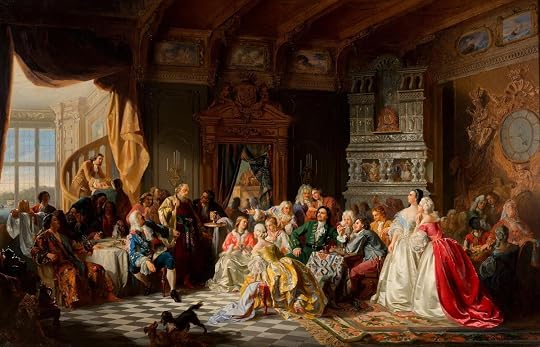
Assembly Under Peter the Great by Stanisław Chlebowski
“St Petersburg was more than a city. It was a vast, almost utopian, project of cultural engineering to reconstruct the Russian as a European man. In Notes from Underground (1864) Dostoevsky called it ‘the most abstract and intentional city in the whole round world’. Every aspect of its Petrine culture was intended as a negation of ‘medieval’ (seventeenth-century) Muscovy. As Peter conceived it, to become a citizen of Petersburg was to leave behind the ‘dark’ and ‘backward’ customs of the Russian past in Moscow and to enter, as a European Russian, the modern Western world of progress and enlightenment.” ~European Russia, page 10.
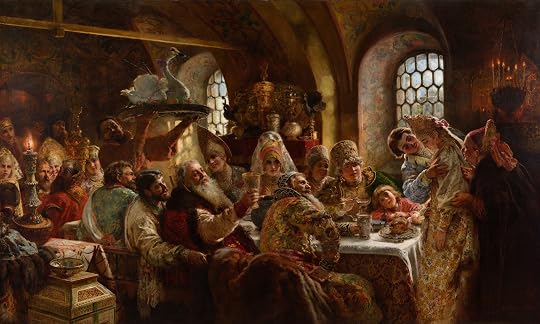
A Boyar Wedding Feast by Konstantin Yegorovich Makovsky
“Without a court, or much to occupy them in their offices, Muscovites had little else to do but visit all their friends and do the rounds of parties, feasts and balls. The doors of Moscow’s mansions were always open and the Petersburg custom of set times for visits was regarded as absurd. Guests were expected to show up at any time, and on certain days, such as namedays, birthdays or religious holidays, or when someone had arrived from the country or abroad, houses were all come and go.” ~Moscow! Moscow!, page 168-169.
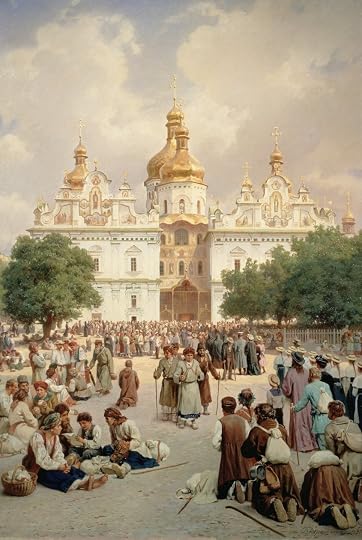
The Great Church of the Kyiv-Pechersk Lavra by Vasily Petrovich Vereshchagin
“He (Ivan Bunin) had never had any illusions about the spiritual or noble qualities of the peasants. His diaries are filled with horrific incidents he had seen or heard about in the villages: a woman who was beaten by her drunken husband so that she had to be ‘bandaged up like a mummy’; another woman raped so often by her husband that she bled to death.” ~The Peasant Marriage, page 262.
“Three years later, Gorky was beaten unconscious by a group of peasant men when he tried to intervene on behalf of a woman who had been stripped naked and horsewhipped by her husband and a howling mob after being found guilty of adultery. Experience left Gorky with a bitter mistrust of the ‘noble savage’. It led him to conclude that, however good they may be on their own, the peasants left all that was fine behind when they ‘gathered in one grey mass’. ~The Peasant Marriage, page 264.
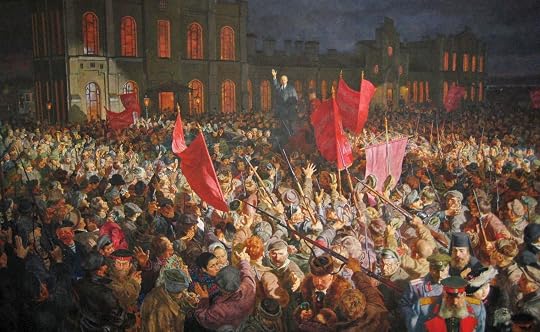
A Speech by Lenin at the outset of the Russian revolution
“Popularly seen as a war against all privilege, the practical ideology of the Russian Revolution owed less to Marx—whose works were hardly known by the semi-literate masses—than to the egalitarian customs and utopian yearnings of the peasantry. Long before it was written down by Marx, the Russian people had lived by the idea that surplus wealth was immoral, all property was theft, and that manual labour was the only true source of value. In the Russian peasant mind there was Christian virtue in being poor—a fact the Bolsheviks exploited brilliantly when they called their newspaper The Peasant Poor (Krestianskaia bednota). It was this striving for pravda, for truth and social justice, that gave the Revolution its quasi-religious status in the popular consciousness: the war on private wealth was a bloody purgatory on the way to a heaven on earth.” ~Russia Through the Soviet Lens, page 437.
Stravinsky emerged and, standing at the top of the landing stairs, bowed down low in the Russian tradition. It was a gesture from another age, just as Stravinsky's sunglasses, which now protected him from the television lights, symbolized another kind of life in Hollywood.
Such was the challenge that confronted Russia’s poets at the beginning of the nineteenth century: to create a literary language that was rooted in the spoken language of society. The essential problem was that there were no terms in Russian for the sort of thoughts and feelings that constitute the writer’s lexicon. Basic literary concepts, most of them to do with the private world of the individual, had never been developed in the Russian tongue: ‘gesture’, ‘sympathy’, ‘privacy’, ‘impulsion’ and ‘imagination’ - none could be expressed without the use of French. Moreover, since virtually the whole material culture of society had been imported from the West, there were, as Pushkin commented, no Russian words for basic things:
But pantaloons, gilet, and frock —
These words are hardly Russian stock.
‘Modern mass culture’, Tarkovsky wrote, ‘is crippling people's souls, it is erecting barriers between man and the crucial questions of his existence, his consciousness of himself as a spiritual being.’ This spiritual consciousness, he believed, was the contribution Russia might give to the West - an idea embodied in the last iconic image of his film Nostalgia (1983), in which a Russian peasant house is portrayed inside a ruined Italian cathedral.Modern mass culture in the Brezhnev era. Imagine what he would have made of the mobile phone era!
In the terrible years of the Yezhov terror, I spent seventeen months in the prison lines of Leningrad. Once, someone 'recognized' me. Then a woman with bluish lips standing behind me, who, of course, had never heard me called by name before, woke up from the stupor to which everyone had succumbed and whispered in my ear (everyone spoke in whispers there):
'Can you describe this?'
And I answered, 'Yes I can.'
Then, something that looked like a smile passed over what had once been her face.