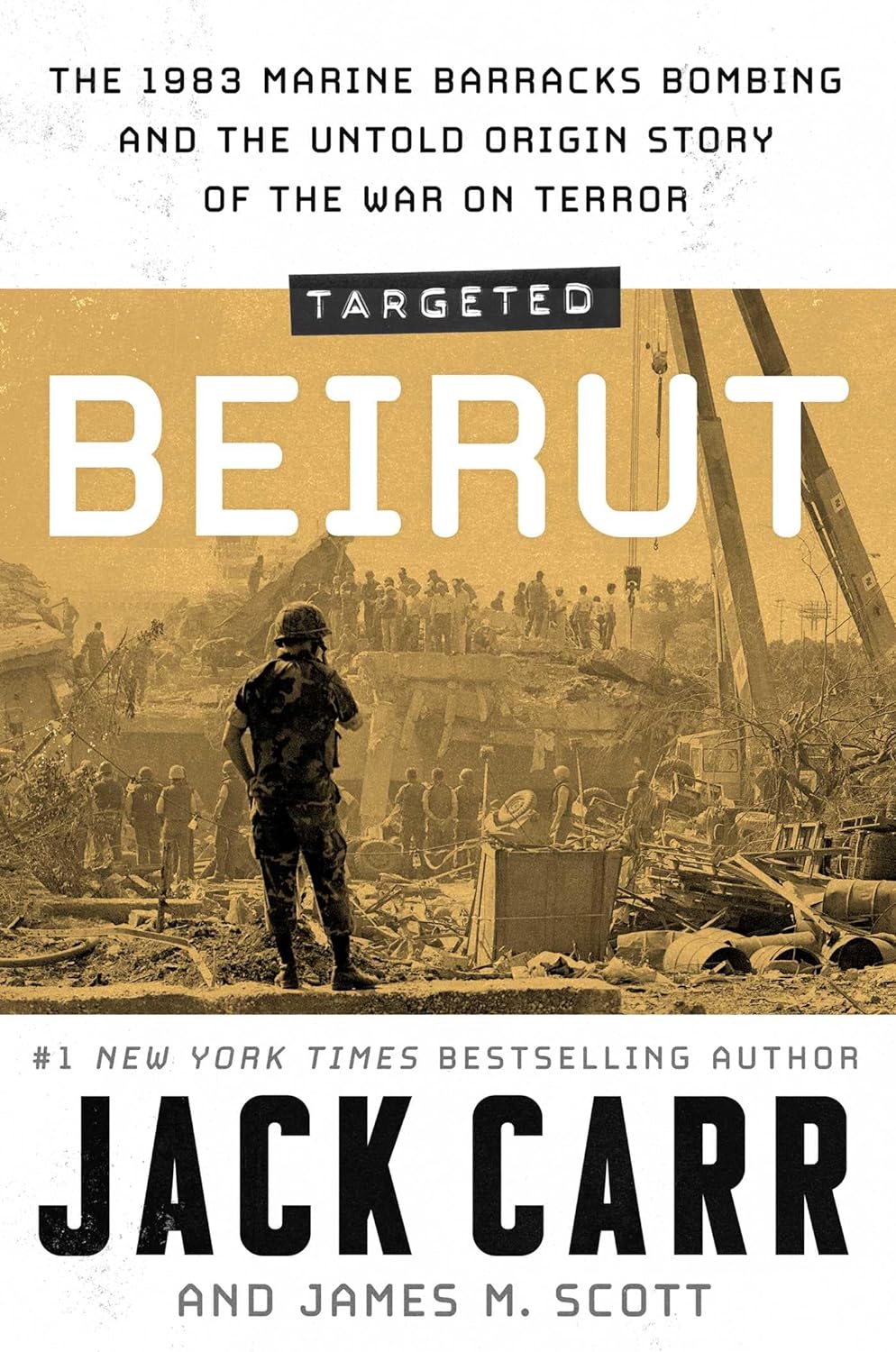
“The truck turned west, paralleling the concertina wire, as the driver…looped the lot. [Lance Corporal Eddie] DiFranco heard the rev of the Mercede’s engine as the operator shifted into a higher gear and increased speed. The driver then executed a sharp turn north and aimed his five-ton truck straight toward the wire barrier. Something felt wrong. DiFranco rammed a magazine into his rifle and chambered a round as the truck crashed through the barbed wire, producing a popping noise that survivors would later tell investigators resembled gunfire. The Mercedes accelerated, charging across the 450 feet that separated the concertina wire from the building. Before DiFranco could shoulder his M16, the truck blew past him, the operator gripping the wheel with both hands. ‘I caught only a glimpse of the driver as he passed by,’ DiFranco wrote in a handwritten memo for investigators. ‘He was wearing a blue shirt and had the smile of a crazy person on his face when he looked at me…’”
- Jack Carr and James M. Scott, Targeted: Beirut: The 1983 Marine Barracks Bombing and the Untold Origin Story of the War on Terror
At the risk of making broad assumptions, I’m guessing most Americans have heard of the 1983 suicide truck bombing of the Marine barracks in Beirut, without knowing much else about it. That’s the position I was in, before picking up Jack Carr and James M. Scott’s Targeted: Beirut. I knew of the attack, and the devastation it caused, without much of an idea about why the Marines were in Lebanon, or how they came to find themselves in the crosshairs.
Targeted: Beirut supplies those answers – and more – in a book that is well-researched, tautly written, and thoroughly compelling. It is also a representative portrait of all of America’s failed endeavors in the Middle East.
***
Before going any further, its worth saying something about the authors.
Jack Carr is a former Navy SEAL sniper, novelist, and podcaster. I haven’t read any of his fiction, but the algorithmic overlords that run YouTube has – on occasion – directed me to his show. I also watched The Terminal List, a television series based on one of Carr’s books, which is a well-produced actioner that operates within a questionable ethical world in which all wrongs must be righted by extrajudicial killings. Based on this resume, I probably wouldn’t have purchased Targeted: Beirut had Carr written it himself, simply because his background does not include the skills typically associated with nonfiction.
That’s where Scott comes in.
James Scott has produced some exceptionally readable, incredibly detailed, morally balanced books on the Second World War, including titles on the Dolittle Raid, the bombing of Tokyo, and the Battle for Manilla. Knowing that Scott was involved with Targeted: Beirut palliated any misgivings I might have had.
Ultimately, it’s impossible to know what each man brought to the table, especially since Scott’s storytelling skills are very good. Still, it feels like their book is the product of each author’s strengths, with Carr’s novelistic approach and military insights nicely balanced by Scott’s ability to describe the fraught contextual framework in which the Marine bombing occurred.
***
Targeted: Beirut gets off to a fast start, opening in April 1983 with a suicide driver headed towards the American Embassy in Lebanon’s capital city. The resulting explosion killed sixty-three, including famed Central Intelligence Agency operations officer Robert Ames.
By the time of this attack, the Lebanese Civil War had been raging for years, and American soldiers were already in-country. They were part of a multinational peacekeeping force meant to oversee the evacuation of the Palestine Liberation Organization (PLO) following Israel’s June 1982 invasion of Lebanon. Far from deterring President Ronald Reagan, the bombing seemed only to harden his resolve to maintain the presence of American forces.
Unfortunately, no one – not all the king’s horses, not all the king’s men, and not the U.S. Marines – could possibly be expected to put Lebanon back together again. Instead, the Marines became a conspicuous target for Iranian-backed militant groups, while being hampered by unclear rules of engagement. This set the board for a disaster that many saw coming.
***
The focus of Targeted: Beirut is on the men of the 1st Battalion of the Eighth Marines, who were part of the 2nd Marine Division assigned the thankless task of keeping the peace. On Sunday morning, October 23, 1983, 220 of these Marines – along with eighteen sailors and three soldiers – died in their barracks at the Beirut International Airport. Fifty-eight French military personnel were also killed in a separate attack that struck just minutes after the Marines were hit.
Books like this follow a specific template, one that straddles the line between meaningful remembrance and gross emotional manipulation. In short, we meet a bunch of guys, get to know them, and then wait tensely to see who will get out alive. Such emotional exploitation is to be expected in fiction, but becomes a lot trickier when dealing with actual human beings who walked the earth within living memory.
Targeted: Beirut succeeds in part because it treats these men very seriously. Instead of a few glib factoids, we really get to know them. Having interviewed survivors and family members, Carr and Scott have access to personal contemporary correspondence that brings the dead – briefly – back to fully realized life. The inevitable climax – which perfectly encapsulates Alfred Hitchcock’s dictum on the difference between “surprise” and “suspense” – is delivered with a real impact because Carr and Scott have done such a good job characterizing the victims.
***
It does nothing to reduce the tragedy of the barracks bombing – the effects of which still linger, forty-one years later, and will linger until the last person touched by it has gone – to note that America’s losses paled in comparison to the estimated 150,000 Lebanese civilians who died in an exceptionally messy collision of outside powers.
Given this reality, Targeted: Beirut could easily could have devolved into a lachrymose paean to fallen Americans that ignored the larger-scale tragedy all around them. Carr and Scott avoid this trap by providing a sharp primer on the conflict in Lebanon. While not meant to be comprehensive, they do a commendable job filling in the backstory, and identifying the many participants in this multipronged sectarian struggle: the PLO; Lebanese Christians; Sunni and Shiite Muslims; Israel; and Syria.
Carr and Scott’s purpose is obviously not to present the full story, which would require a lengthy volume of its own. But they do enough to widen the scope, thereby avoiding charges that Americans have to make everything – even another nation’s civil war – all about America. It also shows both why the Marines were in Beirut in the first place, and why they should never have been there at all. Importantly, Carr and Scott do not pick sides, but describe the brutality of all the contestants, such as the Israeli-backed massacre of Palestinians by Christian militias at the Sabra and Shatila refugee camps.
***
One of the themes that Carr and Scott try to develop is the idea that the Marine barracks bombing was the “origin” of the War on Terror, which dominated the first decade of the 21st century. I’m not entirely convinced of this assertion, mainly because the assault – undeniably horrifying – does not fit neatly into the definition of “terrorism,” at least to the extent it involved an attack on uniformed troops, rather than civilians.
Carr and Scott are more successful in their critiques of American military intervention in the Middle East. Throughout, they are skeptical of President Reagan’s decision to deploy troops with only the vaguest of missions. There was no plan as to how the Marines could improve the situation. Without such a plan, they made things worse, becoming a lightning rod for criticism and a relatively soft target for anti-American groups. It resulted in the senseless deaths of United States soldiers, while simultaneously angering the larger Muslim world, lessening American prestige, and heightening American vulnerability. Regrettably, this scenario would unfold again, and again, and again in the years to come, at ever higher costs in lives.