Charlie Brown hits a home run and Linus tries to get Snoopy a Supreme Court seat in the 22nd volume ('93-'94) of The Complete Peanuts.
Even the most devoted Peanuts fan will be surprised by revisiting Schulz's last decade of work. Schulz's cartooning has never been more expressive, and his sense of humor never more unencumbered by formula or tradition. In one sequence, the gang waits… and waits… for a school bus that never comes. Another shockingly showcases Charlie Brown hitting a game-winning home run — off Roy Hobbs' great-granddaughter? Then, Linus lobbies the White House to nominate Snoopy for a Supreme Court seat (it would go to Ruth Bader Ginsburg). Woodstock discovers his long-lost grandfather's diary, detailing a hard life in captivity (birdcage). Snoopy lands in the hospital with pneumonia, and all three of his brothers — Andy, Spike, and Olaf — come pay their respects. This is the 22nd volume (of 25) of the bestselling series collecting every single one of the 18,000-plus strips created by Schulz from 1950-2000.
Charles Monroe Schulz was an American cartoonist, whose comic strip Peanuts proved one of the most popular and influential in the history of the medium, and is still widely reprinted on a daily basis. Schulz's first regular cartoons, Li'l Folks, were published from 1947 to 1950 by the St. Paul Pioneer Press; he first used the name Charlie Brown for a character there, although he applied the name in four gags to three different boys and one buried in sand. The series also had a dog that looked much like Snoopy. In 1948, Schulz sold a cartoon to The Saturday Evening Post; the first of 17 single-panel cartoons by Schulz that would be published there. In 1948, Schulz tried to have Li'l Folks syndicated through the Newspaper Enterprise Association. Schulz would have been an independent contractor for the syndicate, unheard of in the 1940s, but the deal fell through. Li'l Folks was dropped from the Pioneer Press in January, 1950. Later that year, Schulz approached the United Feature Syndicate with his best strips from Li'l Folks, and Peanuts made its first appearance on October 2, 1950. The strip became one of the most popular comic strips of all time. He also had a short-lived sports-oriented comic strip called It's Only a Game (1957–1959), but he abandoned it due to the demands of the successful Peanuts. From 1956 to 1965 he contributed a single-panel strip ("Young Pillars") featuring teenagers to Youth, a publication associated with the Church of God. Peanuts ran for nearly 50 years, almost without interruption; during the life of the strip, Schulz took only one vacation, a five-week break in late 1997. At its peak, Peanuts appeared in more than 2,600 newspapers in 75 countries. Schulz stated that his routine every morning consisted of eating a jelly donut and sitting down to write the day's strip. After coming up with an idea (which he said could take anywhere from a few minutes to a few hours), he began drawing it, which took about an hour for dailies and three hours for Sunday strips. He stubbornly refused to hire an inker or letterer, saying that "it would be equivalent to a golfer hiring a man to make his putts for him." In November 1999 Schulz suffered a stroke, and later it was discovered that he had colon cancer that had metastasized. Because of the chemotherapy and the fact he could not read or see clearly, he announced his retirement on December 14, 1999. Schulz often touched on religious themes in his work, including the classic television cartoon, A Charlie Brown Christmas (1965), which features the character Linus van Pelt quoting the King James Version of the Bible Luke 2:8-14 to explain "what Christmas is all about." In personal interviews Schulz mentioned that Linus represented his spiritual side. Schulz, reared in the Lutheran faith, had been active in the Church of God as a young adult and then later taught Sunday school at a United Methodist Church. In the 1960s, Robert L. Short interpreted certain themes and conversations in Peanuts as being consistent with parts of Christian theology, and used them as illustrations during his lectures about the gospel, as he explained in his bestselling paperback book, The Gospel According to Peanuts, the first of several books he wrote on religion and Peanuts, and other popular culture items. From the late 1980s, however, Schulz described himself in interviews as a "secular humanist": “I do not go to church anymore... I guess you might say I've come around to secular humanism, an obligation I believe all humans have to others and the world we live in.”
Always makes you feel good to read some Peanuts. This one featured Snoopy more and Rerun showed up quite a bit. Charlie Brown finally hit a home run. Quite enjoyable.
Spurred perhaps by Rerun’s belated coming of age, Schulz bestows upon the Peanuts gang some nice little touches of character growth (Charlie Brown’s more active pursuit of the Little Red-Haired Girl, for instance). Unfortunately, his once-consummate penmanship is starting to look shaky.
Nie sądziłam, że te komiksy mają w sobie tyle refleksji. Myśli dotyczących dorastania, ale także takiej… filozofii życia. Z pewnością będę sięgać po kolejne komiksy (dwa mam już w domu).
First off, you have to love the cover illustration of Peppermint Patty. She looks ticked off. And the corresponding drawing in the upper left corner of the dust-jacket shows her walking into a fierce wind. Life ain’t easy and we are getting a little impatient with that fact. Marcie and Patty are having lunch at school. A boy sits next to them, “Move over little girls…Let a man sit down!” Marcie says, “Miriam was Moses’ older sister. In chapter twelve of the book of ‘Numbers’ she asks, ‘Has the Lord spoken only through Moses?’” The boy grumps, “What’s that supposed to mean?” Patty turns to Marcie, “I’ll explain it to him.” The next panel is filled with a big POW!
In a two panel strip, Charlie Brown stares into an empty mailbox. No Valentines again. “Nothing,” he says, “is more empty than an empty mailbox.” Marcie and Patty have a theological discussion. “I wonder if they have fractions in heaven.” Marcie reassures Patty who is staring helplessly at a school assignment. “No fractions, sir. No decimals either.” Patty pushes, “How about commas?” Marcie can’t help here. “There have to be commas, sir. We can’t avoid them.” Pencil to her mouth, Patty says, “Eternity’s going to be longer than I thought.”
There are great moments throughout the two year span of this volume but not as many as in previous volumes. Schulz’s hand is a little shaky but he is still not just working but experimenting. He draws a couple of series of football games in a rainstorm where only Peppermint Patty is having fun; everyone else is blinded with mud, soured by injury, and the stark, witty, very black panels are magnificent. Rerun emerges as more than just a passenger on his unseen mom’s bike and takes on aspects of both siblings, Lucy and Linus. Before Christmas, Rerun approaches Santa Claus (Snoopy) on the street to demand to know what happened to all the things he was supposed to get last year. Santa turns and growls fiercely at Rerun. In the last panel Lucy asks how it went. “We really didn’t talk that much. He seemed pretty busy.” A lot is familiar. Some is new. And, while it’s no longer peak Peanuts, there are only three more volumes to go. [Sigh.] Or is it, Rats?
Another highly satisfactory two years worth of Peanuts. Snoopy on the beaches on the 50th anniversary of D Day. Snoopy in hospital (not war related) visited by his brothers. Patty and Marcie still fancy Charlie Brown but he still has his eyes on the red haired girl. Rerun having a higher profile. Just some of the goings on in the wonderful world of Peanuts.
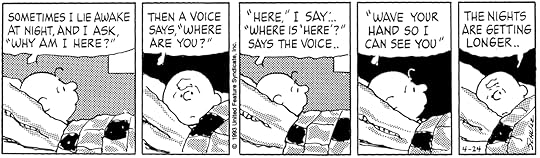
So usually when I do reviews of The Complete Peanuts I don't bother to talk about the greatness of Peanuts because for fifty years, Charles M. Schulz populated the daily newspaper comics section with his now ubiquitous characters. Instead, I post my favorite comic from the collection I have just finished reading, because as I say in almost every review "I don't need to tell you how great Peanuts is." And as a whole--The Complete Peanuts so to speak, I don't. But in this case, this is the first Complete Peanuts collection where I feel that you can feel the end is near. Up to this point, I had only given a Complete Peanuts review a four star rating thanks to a racist joke that Schulz put in the strip that he should have shut down before it ever hit the paper, but in this volume you can kind of feel Schulz starting to wind down. The artwork isn't as crisp and the jokes not as sharp. In addition, perhaps Schulz was even trying to come to peace with his own mortality. There are number of strips in this book where Charlie Brown sits in bed wide awake asking all sorts of questions that portend that he is experiencing an existential crisis. Since Peanuts ran literally until Schulz's death, this fairly new development in the strip in 1993 isn't that surprising.
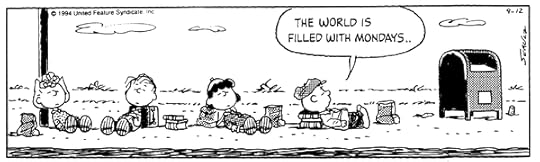
This is not to say the Schulz still couldn't belt out his wry observations of humanity through Charlie Brown and the gang. The strip I am sharing with you in this review has to do with the fact that Mondays and I do not get along at all. I always have a hard time getting myself together after a weekend and I once complained to my mentor, "I hate Mondays." His response was: "No, you hate capitalism." Unfortunately, even if Schulz had these sorts of radical views (which I doubt) this is not the fare of the daily funnies (unless you are Walt Kelly) of course), but it turns out that Charles Schulz felt me when it came to Mondays:
Check it out--the gang can't get their shit together either! Mondays suck!
Charlie Brown: "I thought she was writing only to me... Then she tells me she has thirty other pen pals!" Linus: "Well, life is like a helicopter, Charlie Brown." Charlie Brown: "Like a what?" Linus: "Or maybe a skateboard... No, life is like a t-shirt... No, life is like a gutter ball..." Charlie Brown: "I can't stand it!"
You can see a certain frailty in some of the line drawings start to come more pronounced. However there is some great artwork in Peppermint Patty's football match. Still the occasional laugh out loud moment, and a series of Rerun panels. Nice for him to get a turn.
I came to the attention of this book from this particular comic-strip posted on the internet a few years ago:
Like most people born before 1992, I grew-up with Charlie Brown and his associates. This book is a collection of every Peanuts comic-strip between 1993 and 1994 (but the Sunday editions are not in color). Charlie Brown was, for over half a century every American's first, or near first, exposure to pessimism and existential despair. These kids (and dog) go through life failing, but persevering. They get little victories, but mostly things don't go right, the cold status-quo of the universe always asserts itself no matter what folks believe or do. I was never a big Charlie Brown comic-strip fan, but I liked the movies (especially the WWII one, surprisingly dark even for Charlie Brown--not surprising given that the creator was a veteran of that war) and I watched the holiday specials like everybody else. The Boondocks will always be the newspaper comic-strip that will feel me with the nostalgia, but I do admire the comic-strip that reinvented the genre post-WWII; much of the existential philosophy of Europe came back with Schulz. Also, the characters are big Russian literature fans: their preference seems to be for Leo Tolstoy.
I have always remembered the February 7, 1994 strip as the exact moment when I realized that this wasn't a game for Charles Schulz. Comic strips about children lying in bed saying "Sometimes I lie awake at night, and I ask, 'Why am I here?'" are not kid fodder. They are acts of deep philosophical inquiry and, probably, of therapy.
I was very optimistic for this volume given the description on the back cover. Snoopy running for Supreme Court Justice? Charlie Brown hitting a home run and winning a baseball game? It all sounded very interesting for a usually episodic strip like Peanuts.
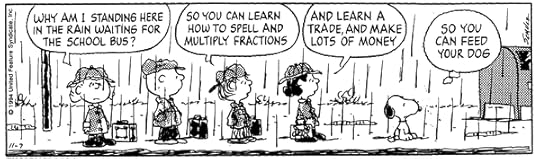
But, for the most part, the strips from 1993 and 1994 continue the well worn groove Schulz had carved out after 40 years. There's no bad strips to be found, and the few mediocre ones can be forgiven. On the flip side, there's not many outstanding strips either. The November 7, 1994 strip (featured at top) struck me. And the June 27, 1993 strip noted in the introduction is also a good summation of Peanuts ("I probably won't write War and Peace, either.").
One noteworthy series includes Roy Hobbs great-granddaughter. This girl must be delusional since Roy Hobbs is the protagonist from The Natural. It also turns out this girl likes Charlie Brown! Oddly, that continues the trend of delusional girls liking the boys in Peanuts, as also seen in the many-named girl who likes Linus but insists he is too old for her (thankfully that joke isn't repeated here). And as the introduction observes, every character in Peanuts is pursuing something they can never have, particularly romantic relationships.
Another solid entry in the classic comic strip series. It's just tough to innovate after so many years. But it's also easy to coast and repeat, which Schulz avoids with aplomb.
These years were sadly not for me. The first year I caught only a few times. During both I only ended up taking a picture of 4 that I really liked. A bunch of strips were incredibly sad like: (Charlie brown is laying in bed with snoopy on top if him) ""sometimes, I lie awake at night and wonder, "why and I am here? What's the purpose of it all? Does my life have any meaning?" Then a voice comes to me and says "forget it! I hate questions like that!"" (Pg. 205) That's it... that's the whole daily funny. Not super funny if you ask me.
But a ton of the art was adorable and I took lots of pictures of that. I also ended up falling in love with Patty and Marcie!
By this point, the strip is really starting to become more formulaic than it ever was in the past. Too many repeat jokes, too many one panel strips, and too many little storylines that don’t have much of a payoff. Even when Charlie Brown finally hits a home run it's dragged down by a Roy Hobb's grandaughter joke that get's driven into the ground. Every once in a while though the old charming Peanuts comes through.
This was the most enjoyable one I've read yet, a lot more of the jokes made me laugh, and to me felt like less repetition within the book (though having only read 3 volumes of the many, means I won't have picked up if is repeating jokes from other volumes). A nice comfy read that makes me want to read more :)
Magnifique collection qui rend hommage au travail remarquable de Schultz. C'est inimaginable de se dire qu'un auteur peut autant créer des strips autours des même thèmes sur plusieurs années. A picorer de temps en temps dans sa bibliothèque
This was my second time reading this, but really, aren't Peanuts books meant to be read multiple times? Nothing short of amazing, hilarious, and often touching. I can't wait to read it again!
It’s strange, isn’t it? Nearly forty-four years go by of Peanuts being comprised of black ink on white paper, until 1994 comes along and Schulz goes hog wild with zipatone.
Can you believe I had this book checked out at the library for nearly two months? These things take me about two days to read! But this one I started the day after I checked it out of the library, and then renewed because I hadn't picked it up again. Surely I'll read it by October 5th! I declared. And yet on October 4th, deadline looming, I sped through the other half of this volume.
Is there some deeper meaning behind this? Naw. Things have just been hectic this year and I've been reading this series since 2004 when the first volume came out and I vowed to keep reading through to the bitter end. The strips of the 60s and 70s amused me since I hadn't seen some of the quirkier content, but by the 90s I feel like Sparky Schulz may have just been coasting. Or maybe it's because I was alive and possibly more familiar with these strips since they'd be the ones I'd see when reading the newspaper myself? At any rate, while this volume was enjoyable as any other book would be that has Snoopy in it, I wouldn't say I got as much out of this one as I have gotten out of past volumes. And we're at T-minus six years, and that seemed to loom over my reading of parts of this book as well.
My favorite two strips in this volume: • Linus reads Alice in Wonderland and Snoopy transforms into the Cheshire cat, becoming just eyes and a smile. He asks Linus to read something else. • Charlie Brown, Linus, and Snoopy are under a tree. Linus ponders what type of dog he would want, perhaps a border collie. Snoopy retorts, "If you don't mind someone staring at you all the time." O_O As an Aussie owner, I empathized. Rain is staring at me right now. <-----
I've already got the next volume on hold at the library. Only three more volumes left and I'll have read every Peanuts strip printed in syndicate papers! Man, when I set my mind to something (as I did in 2004), I really stick to it! And THANK YOU to Fantagraphics in Seattle for taking this series on!
One of the things I have loved about this collection has been the introductions, comics, artists, writers have all added their stories, and recollections of their introductions to Peanuts, or Charles Schultz, or the TV shows. Most have been entertaining, some funny, and some emotional and profound. This volume, as we near the end of this historic comic strip, may have run out of steam, with the introductions. Jake Tapper is a correspondent with CNN, The Chief Washington Correspondent,in fact. His indroduction, is a memoir and he might have tried a bit too hard. Still I look forward to the next one, and hope for more. Volume 22 itself continues Schultz's experimentation with panel size and quantity. Making the most out of his space, in your newspaper, that he was so familiar with for such a long time. With only three volumes,covering six years, to go, Peanuts has never been more expressive or experimental in its entire run. Some of the fun has all of Snoopy's brothers,that we know of, show up at his sick bed. What happens when your school bus never shows? For three quarters of the year that school bus and that school are a childs whole world. Roy Hobbs relative, a female, pitches to Charlie Brown, and Snoopy gets nominated to the Supreme Court. I am always impressed with Schultz's ability to tell a long running story and still deliver a gag every day while taking you to his end game. At times weeks and months from the introduction of the idea. Its great stuff, a master running his last laps but never slowing down, and in fact just showing that there was so much more that can be done.
As we near the end of "Peanuts", it's nice to see that Charles M. Schulz was still at the top of his game with the strip. Yes, his art lines are occasionally jumping due to his hand occasionally shaking, but damn, the drawings on the June 6th, 1993 strip shows Schulz was a far greater talent the deceptively drawings of Charlie Brown, Linus, Lucy, Snoopy and the rest might make you think. Even more impressive was Schulz's desire to play with the comic strip format, often effectively telling his jokes in one or two panels rather than utilizing three or four. Even more impressive is that Sparky was still creating new characters for "Peanuts". 1993 saw the debut of Roy Hobbs' great-granddaughter, Royanne, a character who would even make some appearances the following year. (When you consider how rare it is for strips such as "Garfield", "Mother Goose & Grimm", "Blondie", "Hagar the Horrible", "The Wizard of Id", "B.C.", "Dilbert", etc. to add a new character, Schulz creating and adding Royanne showed he was not interested in merely repeating himself and satisfied merely using the same cast over and over. It showed Sparky was looking to expand his horizons.)
With this volume, there are only three more books, covering 5 years and almost 5 months worth of "Peanuts" to go. I'm looking to seeing what else the late, great Charles M. Schulz did with Charlie Brown and company.
Just the length of the run of the Peanuts strip is impressive, but it’s truly amazing that this deep in the run, the humor is as strong as ever – after a bit of a fall off during the eighties, Schulz gets back into top form for the nineties. And he’s still capable of exploring some of the nuances of the strip – there’s a period during which Charlie Brown’s life seems to center around just how much he loves Snoopy.
Snoopy also enters some uncharted territory himself, like being in the hospital. Which shouldn’t come as much of a surprise, really – at that point of the run (early ’94) he’s been at it for almost 44 years – that’s over three centuries in dog years!