

What do you think?
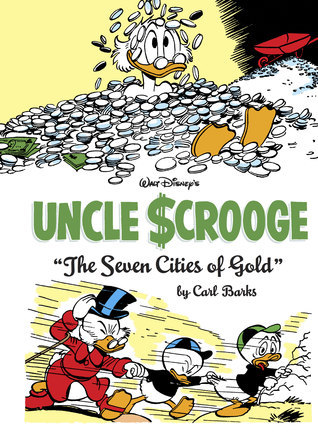
The Complete Carl Barks Disney Library #14
Walt Disney's Uncle Scrooge: The Seven Cities of Gold
Uncle Scrooge takes Donald and the nephews on a perilous trek in search of the fabled seven cities of gold! This is the Scrooge story famous for providing Steven Spielberg and George Lucas with inspiration for parts of Raiders of the Lost Ark. Speaking of gold and movies, James Bond fans might recognize in The Mysterious Stone Ray a gimmick that was later used in Goldfinger Uncle Scrooge s pores fill with gold dust from his money bin. It makes him ill so he goes on vacation, which turns into a rescue mission for a sailor stranded on an island with some very mysterious baddies. Also, Scrooge decides to run for Treasurer of Duckburg, but it seems the only way to get votes is to spend a lot of money. (Sound familiar?) And you know what Uncle Scrooge thinks of that! Carl Barks delivers another superb collection of clever plot twists, laughout- loud comedy, and all-around cartooning brilliance."
234 pages, Hardcover
First published October 8, 2014
About the author
Carl Barks
2,453 books262 followersCarl Barks was an American cartoonist, author, and painter. He is best known for his work in Disney comic books, as the writer and artist of the first Donald Duck stories and as the creator of Scrooge McDuck. He worked anonymously until late in his career; fans dubbed him "The Duck Man" and "The Good Duck Artist". In 1987, Barks was one of the three inaugural inductees of the Will Eisner Comic Book Hall of Fame.
Barks worked for the Disney Studio and Western Publishing where he created Duckburg and many of its inhabitants, such as Scrooge McDuck (1947), Gladstone Gander (1948), the Beagle Boys (1951), The Junior Woodchucks (1951), Gyro Gearloose (1952), Cornelius Coot (1952), Flintheart Glomgold (1956), John D. Rockerduck (1961) and Magica De Spell (1961).
He has been named by animation historian Leonard Maltin as "the most popular and widely read artist-writer in the world". Will Eisner called him "the Hans Christian Andersen of comic books." Beginning especially in the 1980s, Barks' artistic contributions would be a primary source for animated adaptations such as DuckTales and its 2017 remake.
Barks worked for the Disney Studio and Western Publishing where he created Duckburg and many of its inhabitants, such as Scrooge McDuck (1947), Gladstone Gander (1948), the Beagle Boys (1951), The Junior Woodchucks (1951), Gyro Gearloose (1952), Cornelius Coot (1952), Flintheart Glomgold (1956), John D. Rockerduck (1961) and Magica De Spell (1961).
He has been named by animation historian Leonard Maltin as "the most popular and widely read artist-writer in the world". Will Eisner called him "the Hans Christian Andersen of comic books." Beginning especially in the 1980s, Barks' artistic contributions would be a primary source for animated adaptations such as DuckTales and its 2017 remake.
Ratings & Reviews
Friends & Following
Create a free account to discover what your friends think of this book!
Community Reviews
Displaying 1 - 30 of 39 reviews

December 1, 2018
Uncle Scrooge: The Seven Cities of Gold is a collection of Uncle Scrooge comics written and drawn by Carl Barks, originally presented in Uncle Scrooge 7-12 and 14.
I've seen Carl Barks mentioned as being influential time and time again, from sources like Jeff Smith and Bill Watterson. Since I grew up on the Disney Afternoon and Ducktales was one of my favorite shows, I finally decided to take the plunge.
The tales within range from comic-length adventures or 1-4 pagers detailing with the world's richest/cheapest duck, Scrooge McDuck. The stories are meant for kids but clever enough for adults to enjoy.
I mentioned Ducktales earlier and that's what this book primarily reminds me of. Uncle Scrooge and Donald Duck, and nephews Huey, Dewey, and Louie, go on adventures around the world, looking for gold, lost cities, and the like. In fact, Barks created the nephews! And their damn Junior Woodchuck Guide Book! The money bin and Gyro Gearloose also make appearances, further making me wonder if Carl Barks was mentioned in the credits for Ducktales.
The shorter stories are mostly one page gags, usually revolving around Scrooge's cheapness. While treasure hunting and prospecting was his bread and butter at the beginning, Scrooge isn't above screwing the local diner owner out of a nickel every chance he gets.
The book itself is a gorgeous hardcover that's built to last. The colors aren't overly vibrant, which is how I imagine they looked on newsprint back in the 1950s. Between the Carl Barks Library and the EC Artist Edition Library, Fantagraphics isn't going to go broke on my account.
Superheroes are the first thing that comes to mind when people mention comic books but that needn't be the case. Uncle Scrooge: The Seven Cities of Gold is an enjoyable all-ages collection. Four out of five stars.
I've seen Carl Barks mentioned as being influential time and time again, from sources like Jeff Smith and Bill Watterson. Since I grew up on the Disney Afternoon and Ducktales was one of my favorite shows, I finally decided to take the plunge.
The tales within range from comic-length adventures or 1-4 pagers detailing with the world's richest/cheapest duck, Scrooge McDuck. The stories are meant for kids but clever enough for adults to enjoy.
I mentioned Ducktales earlier and that's what this book primarily reminds me of. Uncle Scrooge and Donald Duck, and nephews Huey, Dewey, and Louie, go on adventures around the world, looking for gold, lost cities, and the like. In fact, Barks created the nephews! And their damn Junior Woodchuck Guide Book! The money bin and Gyro Gearloose also make appearances, further making me wonder if Carl Barks was mentioned in the credits for Ducktales.
The shorter stories are mostly one page gags, usually revolving around Scrooge's cheapness. While treasure hunting and prospecting was his bread and butter at the beginning, Scrooge isn't above screwing the local diner owner out of a nickel every chance he gets.
The book itself is a gorgeous hardcover that's built to last. The colors aren't overly vibrant, which is how I imagine they looked on newsprint back in the 1950s. Between the Carl Barks Library and the EC Artist Edition Library, Fantagraphics isn't going to go broke on my account.
Superheroes are the first thing that comes to mind when people mention comic books but that needn't be the case. Uncle Scrooge: The Seven Cities of Gold is an enjoyable all-ages collection. Four out of five stars.

November 6, 2014
I loved this volume, partially because it contains one of my favorite Uncle Scrooge stories from when I was a kid, The Mysterious Stone Ray. This story has a more science fiction element than a lot of the other adventure stories by Barks, and it held up to my expectations, with the ridiculous ray that instead of removing the fumes from cooking cabbage, turns living things to stone. I loved the whole story-line with Scrooge's habit of swimming and rolling in money first causing him to go on the trip, and second, protecting him from the ray. This is one of Bark's best stories, with excellent gags, and moments that bring depth to his characters. In this volume the nephews have become the resourceful Junior Woodchucks, instead of foils to irritate Donald. This period of Bark's work has a great selection of his adventure stories, which tend to be my favorites. The weakest story is the Golden Fleecing, but as the story notes explain, Barks was censored fairly severely by his publisher at the time, and it sapped his energy, and clearly affected his story-telling. I'm so happy that Fantagraphics is continuing to issue these great collections.

February 21, 2016
I have been a Disney fan my entire life...but, other than when I was very little, I preferred their live-action productions, ranging from George of the Jungle and Flubber to pretty much every Disney Channel sitcom since Even Stevens. Whether it's Mickey and Goofy or Cinderella and Prince Charming, I just rarely got excited about their non-Pixar animation. Still, I do love comics, especially old-school ones, and, when I saw this book at the library, I picked it up on a whim. It turned out to be really fun; there was plenty of humor and suspense, alongside great artwork. I should find more comic compilations from the House of Mouse.
April 7, 2026
A number of real classics in this one, particularly the title story.

October 25, 2014
I sometimes forget just how good Barks was. Then I read (or re-read) something of his, and I am reminded what a master of the form he was.

January 28, 2024
Lots of decent Scrooge in here. Stories that had great potential but didn’t quite reach the heights of others (mainly due to publishers shortening or interfering). Seven Cities of Cibola is good (and inspired raiders of the lost ark) and there are a bunch of fun ideas (Stone Ray, Lemming with the Locket, Philosopher’s Stone, Steamboat Race, Golden Fleecing) but chronologically following some A++ classics these B+ stories leave me wanting. But some more a++ adventures are coming up in the next volume.

March 1, 2021
Duckburg must be a surburb of Los Angeles, because in the first story, the Beagle Boys get kicked out of the Riverside County Welfare office, and Uncle Scrooge, Donald and the boys are exploring the deserts east of the city near Palm Springs.
Uncle Scrooge comics are a balm for boredom: great, great fun.
My dream as a child was to have a giant bin full of money, in which I dove in and out like a porpoise. Still waiting...
Uncle Scrooge comics are a balm for boredom: great, great fun.
My dream as a child was to have a giant bin full of money, in which I dove in and out like a porpoise. Still waiting...
March 9, 2015
The library also had this volume, reprinting Scrooge stories originally published between 1954 and 1956. The featured story, "The Seven Cities of Cibola," was the first portrayal of Scrooge as a world-traveling adventurer, and apparently a heavy influence on Indiana Jones. One particular sequence that's echoed in Raiders of the Lost Ark occurs when the Beagle Boys grab a booby-trapped idol, causing the cities to become completely buried in rubble. The tale combines two myths regarding the Spanish conquest in America, the Seven Cities of Gold and the Lost Ship of the Desert. In other stories, Scrooge and Donald Duck encounter a ray that turns people to stone, seek the Philosopher's Stone, complete a race that Scrooge's uncle had started many years previously, and find the Golden Fleece in Colchis. A weird note about the Golden Fleece story is that Barks's editors originally rejected it because "Harpies" was an obscure word for prostitutes, so he called them "Larkies" instead. There was a DuckTales episode with a lot of the same plot elements, but many of the details changed. It's interesting that several of the stories here show Scrooge either outright failing or not being happy with his success. The Cities of Gold are buried and the ducks forget about their existence, the mansion Scrooge wins in the steamboat race is too dilapidated to live in (and his allergies don't help matters either), prolonged contact with the Philosopher's Stone proves to be too dangerous, and the coat he has made from the fleece is too cold. "Riches, Riches, Everywhere!", on the other hand, shows Scrooge as TOO successful at treasure hunting, in that he keeps digging up mineral wealth when all he really wants is water. I also have to wonder what happened to the kangaroos that were exposed to so much uranium.

November 17, 2024
It’s still quite amazing to me how modern Barks’ comics feel. Read basically any other comic from the era and these are miles ahead in terms of storytelling and dialogue. No extended narration boxes redundantly telling you exactly what’s happening in a panel, just fun and funny dialogue that moves the story along. Crisp, clear storytelling. And of course his art looks wonderful to this day.
Like the first Scrooge collection (Only a Poor Old Man), this book is mostly made up of long adventures. By this time, it seems that Barks largely reserved the Scrooge series for long adventures, while 10-pagers were set aside for Donald Duck. The last story, “The Golden Fleecing,” is my favorite of the bunch; it’s a sprawling, even surprising take on the Greek myth. “The Seven Cities of Cibola” notably has a scene that (probably) inspired Raiders of the Lost Ark. In many of Barks’ long adventures, he starts off in one direction that almost makes you think it’s going to be a 10-pager. Then he shifts the plot and sets up the quest/adventure that takes up the rest of the story. It keeps you on your toes, and they’re sometimes hard to predict (even though he certainly has his formulas).
Of the shorter stories, I like the one where Scrooge runs for town council (the campaigning commentary is depressingly on point). Also fun are the recurring one-pagers with Scrooge swindling the cafe owner. And there’s a one-pager on page 158 that is entirely silent and a perfect encapsulation of Scrooge’s cheapness. I hope to see more like that in later collections, because Barks is a lovely visual storyteller.
Like the first Scrooge collection (Only a Poor Old Man), this book is mostly made up of long adventures. By this time, it seems that Barks largely reserved the Scrooge series for long adventures, while 10-pagers were set aside for Donald Duck. The last story, “The Golden Fleecing,” is my favorite of the bunch; it’s a sprawling, even surprising take on the Greek myth. “The Seven Cities of Cibola” notably has a scene that (probably) inspired Raiders of the Lost Ark. In many of Barks’ long adventures, he starts off in one direction that almost makes you think it’s going to be a 10-pager. Then he shifts the plot and sets up the quest/adventure that takes up the rest of the story. It keeps you on your toes, and they’re sometimes hard to predict (even though he certainly has his formulas).
Of the shorter stories, I like the one where Scrooge runs for town council (the campaigning commentary is depressingly on point). Also fun are the recurring one-pagers with Scrooge swindling the cafe owner. And there’s a one-pager on page 158 that is entirely silent and a perfect encapsulation of Scrooge’s cheapness. I hope to see more like that in later collections, because Barks is a lovely visual storyteller.
June 4, 2024
According to the expert commentary at the end of this book, the time period covered here was a very difficult time creatively for creator Carl Barks. For those of you wondering, we're talking 1955-1960. Apparently, Barks and the editors at Western Publishing butted heads over the contents of several stories. All of a sudden, the editorial staff began nitpicking over every little thing and especially took issue with anything that they deemed to be too violent.
The commentators don't seem to know why the sudden change. How good a comic book historian can these experts be if they can't make the connection that Western Publishing was freaking out over concerns brought about by the Comics Scare of the 1950s and the newly established Comics Code?!
True, I purchase and read the volumes of the Carl Barks collection out of order because I shop for the books based on current affordability and not sequence. Maybe in a previous or later volume, the commentaries will dive into the Comics Code. I just think if you're going to question why about something, you really either need to figure out the reasoning or don't call yourself the authority on something. It just makes for poor research. But that's probably just the history major in me coming out.
Within this difficult time, it's said that Barks' productivity waned and his creativity stagnated. I just don't see evidence of that in this book. In fact, for someone who grew up on DuckTales, this volume seems to align with that classic 80s toon the most out of the several volumes in this set I now own!
Several amazing adventures starring Uncle Scrooge and his nephews Donald, Huey, Dewey and Louie take the ducks across the globe including an epic trek all over planet Earth in search of the fabled Philosopher's Stone. Then there's the sci-fi adventure The Mysterious Stone Ray starring those dastardly Beagle Boys. My favorite was The Golden Fleecing which I believe was adapted for the Disney cartoon series! Plus the origins of Scrooge's steamboat days are explored in action packed story titled The Great Steamboat Race.
When I reviewed Don Rosa's The Complete Life and Times of Scrooge McDuck, I commented how much I disliked the talent making Scrooge so ornery. Yet, this volume here confirms that Carl Barks was behind the anger because in reality, he was a very disgruntled man. I'd really like to read a biography about Barks. Though I'm not all that sure if such a thing exists. And if it does, I surely hope it's not written by the 'expert' who neglected to connect the damage Dr. Wertham did to the comic book industry in the 1950s to all the in-fighting between Carl Barks and his editors. For if it is, I might have to take a pass.
The commentators don't seem to know why the sudden change. How good a comic book historian can these experts be if they can't make the connection that Western Publishing was freaking out over concerns brought about by the Comics Scare of the 1950s and the newly established Comics Code?!
True, I purchase and read the volumes of the Carl Barks collection out of order because I shop for the books based on current affordability and not sequence. Maybe in a previous or later volume, the commentaries will dive into the Comics Code. I just think if you're going to question why about something, you really either need to figure out the reasoning or don't call yourself the authority on something. It just makes for poor research. But that's probably just the history major in me coming out.
Within this difficult time, it's said that Barks' productivity waned and his creativity stagnated. I just don't see evidence of that in this book. In fact, for someone who grew up on DuckTales, this volume seems to align with that classic 80s toon the most out of the several volumes in this set I now own!
Several amazing adventures starring Uncle Scrooge and his nephews Donald, Huey, Dewey and Louie take the ducks across the globe including an epic trek all over planet Earth in search of the fabled Philosopher's Stone. Then there's the sci-fi adventure The Mysterious Stone Ray starring those dastardly Beagle Boys. My favorite was The Golden Fleecing which I believe was adapted for the Disney cartoon series! Plus the origins of Scrooge's steamboat days are explored in action packed story titled The Great Steamboat Race.
When I reviewed Don Rosa's The Complete Life and Times of Scrooge McDuck, I commented how much I disliked the talent making Scrooge so ornery. Yet, this volume here confirms that Carl Barks was behind the anger because in reality, he was a very disgruntled man. I'd really like to read a biography about Barks. Though I'm not all that sure if such a thing exists. And if it does, I surely hope it's not written by the 'expert' who neglected to connect the damage Dr. Wertham did to the comic book industry in the 1950s to all the in-fighting between Carl Barks and his editors. For if it is, I might have to take a pass.

August 12, 2019
A few of these stories didn't work as well for me compared to the last volume I read, but I still enjoyed it quite a bit. The story with the machine that turns people to stone is one of my personal favorites in Barks' library, and even the more mediocre stories have great art and some great moments.
Interesting trivia in this volume, too. I hadn't realized that one of Carl Barks' stories helped to inspire Raiders of the Lost Ark! In "The Seven Cities of Gold," when an idol is moved in the titular cities, a giant rolling ball comes down and smashes the city to bits. This sequence apparently inspired the iconic sequence in Raiders.
Also, there is a story included here in which harpies appear. Apparently after Barks drew this story, it was nearly scrapped because "harpy" apparently can refer to hookers! So Barks only managed to save the story by calling the harpies "larkies" instead! Geez!
Complaints:
This basically can be applied to almost any of these releases in the series, but the coloring is not very good. Buttons are basically always the same color as the clothes themselves. In this book, a character starts to become gold and Donald comments on the character's eyes changing yellow... but it wasn't reflected in the coloring job at all. I remember reading the story published back in the 80s or 90s where they DID color his eyes yellow. Also, there is a part of the story where parsnips get thrown at some characters, but they are colored orange and look like carrots. Just sloppy! And these are not cheap books!
Also the commentary on the one-pagers is still incredibly boring for the most part, with the author just describing each gag. "Scrooge did this in the first panel, then he did that in the second panel..." Wow it's boring! I can just read the comic! Admittedly in this volume some interesting trivia (such as money worth back when the comics were first published) was occasionally included, but more often it was just description which was just dull.
Interesting trivia in this volume, too. I hadn't realized that one of Carl Barks' stories helped to inspire Raiders of the Lost Ark! In "The Seven Cities of Gold," when an idol is moved in the titular cities, a giant rolling ball comes down and smashes the city to bits. This sequence apparently inspired the iconic sequence in Raiders.
Also, there is a story included here in which harpies appear. Apparently after Barks drew this story, it was nearly scrapped because "harpy" apparently can refer to hookers! So Barks only managed to save the story by calling the harpies "larkies" instead! Geez!
Complaints:
This basically can be applied to almost any of these releases in the series, but the coloring is not very good. Buttons are basically always the same color as the clothes themselves. In this book, a character starts to become gold and Donald comments on the character's eyes changing yellow... but it wasn't reflected in the coloring job at all. I remember reading the story published back in the 80s or 90s where they DID color his eyes yellow. Also, there is a part of the story where parsnips get thrown at some characters, but they are colored orange and look like carrots. Just sloppy! And these are not cheap books!
Also the commentary on the one-pagers is still incredibly boring for the most part, with the author just describing each gag. "Scrooge did this in the first panel, then he did that in the second panel..." Wow it's boring! I can just read the comic! Admittedly in this volume some interesting trivia (such as money worth back when the comics were first published) was occasionally included, but more often it was just description which was just dull.
April 24, 2025
I was introduced to Duck comics via Don Rosa’s The Life and Times of Scrooge McDuck, which is a masterpiece. So of course I decided to delve into the Carl Barks classic with Donald Duck. The Donald Duck volumes are full of the types of adventure stories I adore, but those are mixed in with more cartoony shorts that, while enjoyable, didn’t quite scratch the itch I was looking for. This volume, however, does the trick.
Most of the stories here are long, epic tales that develop out of Scrooge’s greed or his need to impress his nephews with tales of adventuring, taking Donald and the nephews across the world in search of various treasures or to solve some mystery. Some of them take a while to get going, but by the end I was surely enchanted by the creativity. The interplay between characters is always fun: the experienced but grumpy old traveler, Scrooge, the scrappy nephews who can somehow pull every answer out of their Junior Woodchuck Guidebook, and in the middle Donald, who doesn’t get a huge role in most of these stories but stands in the middle supporting it all. The times where Scrooge gets excited and you can see his youthful vigor light up, or when the nephews pull some wild solution to a puzzle out of their pocket like they’re playing a 90s point-and-click adventure game, make even the more plodding stories worthwhile.
In between are fun palette cleansers, one page gag shorts that play with Scrooge’s greed and insane thrift. They’re not why you buy the book, but they are fun to break up the sometimes very long adventure stories and show off Barks’ brilliant sense of humor.
Most of the stories here are long, epic tales that develop out of Scrooge’s greed or his need to impress his nephews with tales of adventuring, taking Donald and the nephews across the world in search of various treasures or to solve some mystery. Some of them take a while to get going, but by the end I was surely enchanted by the creativity. The interplay between characters is always fun: the experienced but grumpy old traveler, Scrooge, the scrappy nephews who can somehow pull every answer out of their Junior Woodchuck Guidebook, and in the middle Donald, who doesn’t get a huge role in most of these stories but stands in the middle supporting it all. The times where Scrooge gets excited and you can see his youthful vigor light up, or when the nephews pull some wild solution to a puzzle out of their pocket like they’re playing a 90s point-and-click adventure game, make even the more plodding stories worthwhile.
In between are fun palette cleansers, one page gag shorts that play with Scrooge’s greed and insane thrift. They’re not why you buy the book, but they are fun to break up the sometimes very long adventure stories and show off Barks’ brilliant sense of humor.

June 6, 2019
Another volume in this amazing collection from Fantagraphics giving us the collected works of Carl Barks' ducks. Like many people, I prefer the Uncle Scrooge stories to the Donald Duck ones (although Donald and his nephews are in almost every Uncle Scrooge story) and this collection shows him hitting his stride. We have Donald being a good foil for the adventures that Scrooge McDuck decides to go on, and we have the three nephews being the voice of reason with their Woodchuck guide book. The art is - as always, amazing. 60 years later and it has still not been surpassed.
The stories in this volume may not be my favourite Scrooge stories but they are still full of creativity and humour. The ones that stood out were the Great Steamboat Race, Riches, Riches Everywhere and the Fabulous Philosopher Stone. I do admit I prefer the tales where Scrooge comes out on top in the end but most of his adventures here have him failing in some way. Even when he finds the Golden Fleece in the Golden Fleecing he ends up disappointed with his new coat. And the Lemming with a Locket is just an odd chase for an odd reason - a lemming steals the locket with Scrooge's safe combination (the Uncle Scrooge I know would be able to memorize the combination to his safe - not store it in a locket).
All in all - a lot of fun and a fantastic collection.
The stories in this volume may not be my favourite Scrooge stories but they are still full of creativity and humour. The ones that stood out were the Great Steamboat Race, Riches, Riches Everywhere and the Fabulous Philosopher Stone. I do admit I prefer the tales where Scrooge comes out on top in the end but most of his adventures here have him failing in some way. Even when he finds the Golden Fleece in the Golden Fleecing he ends up disappointed with his new coat. And the Lemming with a Locket is just an odd chase for an odd reason - a lemming steals the locket with Scrooge's safe combination (the Uncle Scrooge I know would be able to memorize the combination to his safe - not store it in a locket).
All in all - a lot of fun and a fantastic collection.

November 28, 2025
Oltre ad essere, a parere mio, una delle storie più divertenti di Barks (con delle gag che sembrano essere prese in prestito dai film di animazione per i quali Barks stesso lavorava), "Zio Paperone e l'oro di Pizzarro" è anche elaborato sul piano narrativo: come fa notare il rimpianto Luca Boschi nell'introduzione " si dipana descrivendo due diversi piani geografici del territorio, corrispondenti a due diversi livelli di conoscenza (...) Zio Paperone ei nipoti, intenti a schivare trappole che credono li dai tempi di Pizarro, non si accorgono dei guardiani (...) Più in alto è il livello di conoscenza dei nativi, che possono osservare i movimenti dei Paperi, sulla cui testa grava però, un grave equivoco di fondo".
Come sempre, nella semplicità delle sue storie Barks da sfoggio della sua arte migliore.
Come sempre, nella semplicità delle sue storie Barks da sfoggio della sua arte migliore.

January 12, 2021
These stories from early issues of Uncle Scrooge's own title in 1954 and 1955 featuring Scrooge as a protagonist show that Barks was still trying to finish figuring out how to treat him, although the foundation was clear. Scrooge as simply a miser wouldn't work, but that aspect of his personality couldn't be ignored, either. What Barks settled on was an adventurer looking for ways to increase his already vast fortune (or to protect it from the Beagle Boys). It's a formula that worked and worked very well. With equal doses of action and humor, Scrooge becomes a great character, a role model of intelligence and hard work for all the Huey, Dewey, and Louies of the world.

October 3, 2021
This volume introduces the concept of Scrooge as an adventurer and treasure hunter, which later became the basis for both DuckTales series. Duckworth (nameless) also appears in the first story, and Scrooge meets Gyro Gearloose for the first time. But beyond that, this isn't Barks's best work. Aficionados agree that the mid to late 50s was not his most creative period, and it shows here. When censors go after you for using the mythologically correct term "harpies" because it was slang for prostitutes in some backwater places, you know the story is bound to suffer.

August 21, 2025
A collection of comics anywhere from one to thirty pages long each. Shorter stories may only have Scrooge but the longer ones also have Donald, Huey, Dewey, and Louie. Scrooge usually sets off on an adventure to find treasure and the boys use their Junior Woodchuck Guidebook to get them all out of a jam. Funny but repetitive.
Getting toward the end of the book, I realized there weren't any women. There's mention of Daisy Duck, but no appearance on the page. But then in the final story we get Larkies, which are like harpies but not.
Getting toward the end of the book, I realized there weren't any women. There's mention of Daisy Duck, but no appearance on the page. But then in the final story we get Larkies, which are like harpies but not.

December 1, 2021
Another dead solid entry in the series. This one is more an adventure comic than a gag one, with a sequence in the title story being lifted by George Lucas for Raiders of the Lost Ark. The art is gorgeous, the stories all fun, I loved this. I have one more volume in this series since I figured I had enough but I might end up getting them all.
July 1, 2025
A very good collection of 11 stories and several one-pagers, featuring three excellent long stories I remember fondly from comic books in the 60s, "Reprinted by Popular Demand:" The Seven Cities of Cibola, The Fabulous Philosopher's Stone, and The Great Steamboat Race. My sibs and I didn't know Carl Barks by name at the time, but we recognized the 'good art' when we saw it!

August 20, 2025
This was fine. Certainly better than I expected. Even Donald were worth reading. And Uncle Scrooge was quite a bit better than a caricature. But the stories just weren't all that interesting. Art was fine, writing was fine. And sure I can see how the lead off story was an inspiration for Indiana Jones. This also could have shown its age even more.

April 6, 2019
Elegant, clean art with fun, globe-trotting adventure stories suitable for all ages. Classic stuff that inspired Ducktales and holds up today. You can hear all the cartoon voices in your head as you read. Great collection!
March 18, 2020
It's great to see where the dragon in Bone originates! I remember buying one of these comics as a very young kid. I remember that it was a sunny day and the store had big glass doors and display windows.

September 27, 2020
Perhaps not all the stories in this collection are Carl Barks' best, but even Barks' near-best are wonderful tales, and a few are among his best. Well worth reading these amazing adventures that influenced the Indiana Jones films and much more.

September 14, 2022
Some great adventures and gags in this one, but the Larkie story creeps me out!
![Profile Image for [Name Redacted].](https://i.gr-assets.com/images/S/compressed.photo.goodreads.com/users/1347082397i/287915._UY200_CR0,0,200,200_.jpg)
February 2, 2023
The old inventor is right.
This world does have too many masters and not enough friends.
This world does have too many masters and not enough friends.

February 25, 2025
Some great adventure stories in this volume, my favorite kind of Duck tales. Overall, it’s a very strong batch of Barks.
January 26, 2015
I'm really torn between giving this four or five stars; in the end, there were a few comics that weren't as well constructed as the rest, and I'm terribly picky about what I categorize as "perfect." Let's call this 4.5 stars and leave it there.
Carl Barks is certainly at the height of his powers in his Uncle Scrooge stories. All of the characters are fleshed out and have complex motivations and appropriate reactions to a number of mundane settings (the miserly Scrooge getting his money's worth at the local coffee shop) and off-the-wall scenarios(an island with a ray that turns living creatures to stone). The adventure stories are outstanding and, quite frankly, make me want to pull out my DuckTales DVDs and relive the joy of watching the ducks caper around the globe.
These comics are some of Barks's most brilliant; in fact, their exceptional creativity inspired other works years later, including the opening scene of Raiders of the Lost Ark. The part that truly makes these stories stand out, though, is the heart underlying the clever plotlines and quirky humor. Even the villains in these tales aren't necessarily fully evil, and it's enjoyable to watch Barks explore the nuances of human (or animal?) emotions.
Carl Barks is certainly at the height of his powers in his Uncle Scrooge stories. All of the characters are fleshed out and have complex motivations and appropriate reactions to a number of mundane settings (the miserly Scrooge getting his money's worth at the local coffee shop) and off-the-wall scenarios(an island with a ray that turns living creatures to stone). The adventure stories are outstanding and, quite frankly, make me want to pull out my DuckTales DVDs and relive the joy of watching the ducks caper around the globe.
These comics are some of Barks's most brilliant; in fact, their exceptional creativity inspired other works years later, including the opening scene of Raiders of the Lost Ark. The part that truly makes these stories stand out, though, is the heart underlying the clever plotlines and quirky humor. Even the villains in these tales aren't necessarily fully evil, and it's enjoyable to watch Barks explore the nuances of human (or animal?) emotions.

August 6, 2015
"Travelers afoot in hot deserts should set their course toward shade!" Ah, the infinite practical wisdom of the Junior Woodchucks' Guidebook! All these years since I first read "The Seven Cities of Gold," that moment has stayed stuck in my brain. It's one of the wonderful things about these great Carl Barks stories that they pivot so often on real facts and the precious value of real knowledge. If only there were a Junior Woodchucks' Guide now to advise what "Inhabitants of planets where the icecaps are melting and the oceans are dying should ______."
Meanwhile, until we complete the self-destruction of humanity, it's some consolation to delight in these classic flights of fancy again and again.
Meanwhile, until we complete the self-destruction of humanity, it's some consolation to delight in these classic flights of fancy again and again.

August 18, 2015
This volume of Uncle Scrooge Comics collect Uncle Scrooge stories from the 1950s by Carl Barks combining epic style adventures that would become the basic for the TV show Duck Tales (one story "The Lemming with the Locket" would be directly adapted.) My favorite story in here is, "The Mysterious Stone Ray," a great story that mixes Science Fiction, mystery, and philosophy.
The shorts are amusing. As they do say in the rather extensive commentary, the latter half of the book comes during a weaker period in Bark's career so, "The Great Steamboat Race" and "The Golden Fleecing" aren't up to high standards. Still, Scrooge remains a fascinating and very fun character, and if you grew up reading these comics or grew up watching Duck Tales 30 years later, this is definitely a worthwhile read.
The shorts are amusing. As they do say in the rather extensive commentary, the latter half of the book comes during a weaker period in Bark's career so, "The Great Steamboat Race" and "The Golden Fleecing" aren't up to high standards. Still, Scrooge remains a fascinating and very fun character, and if you grew up reading these comics or grew up watching Duck Tales 30 years later, this is definitely a worthwhile read.

May 10, 2017
I thought that this was a pretty weak volume in this Carl Barks collection. It was entertaining, but nothing memorable.
I will say that the commentary in this volume is pretty awful: a bunch of essays that bend over backwards to find deep meaning in Barks' work, but fail miserably. The most egregious is Ken Parille's reflection on "The Tuckered Tiger", where he tries to make an argument that Barks was writing a story about "competition and gender." Sometimes, folks, these are just good stories about ducks who happen to like money.
I will say that the commentary in this volume is pretty awful: a bunch of essays that bend over backwards to find deep meaning in Barks' work, but fail miserably. The most egregious is Ken Parille's reflection on "The Tuckered Tiger", where he tries to make an argument that Barks was writing a story about "competition and gender." Sometimes, folks, these are just good stories about ducks who happen to like money.
Displaying 1 - 30 of 39 reviews