

What do you think?
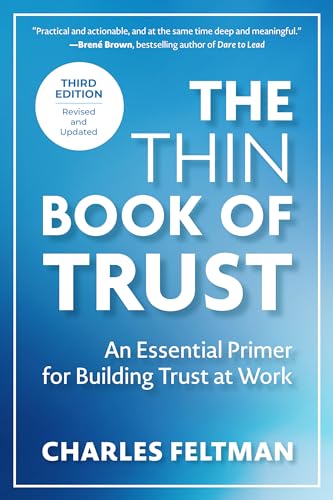
The Thin Book of Trust, Third Edition: An Essential Primer for Building Trust at Work
Bestselling author Charles Feltman updates his business classic, The Thin Book of Trust, with new resources and tools to build trust in the post-pandemic world.
Feltman’s phenomenal bestseller with almost 100,000 copies sold across two editions outlines in a very simple and quick way the art of building trust between people in organizations as a core essential workplace competency.
The updated Thin Book of Trust offers a framework that supports trust building as a workplace competency. It is based on the idea that building trust is a competency, a set of skills that can be learned, improved, and practiced. It will help you continuously improve your ability to build and maintain trust with others. It can also help you create and contribute to a high-trust culture at work.
The third edition includes a new study guide and a new resource download page.
Charles Feltman says: "Whether you lead others, contribute individually, or serve as a coach, consultant, facilitator, HR or OD professional, your ability to generate and sustain strong trust is critical to the success and well-being of your enterprise. It is my hope this new edition serves you well in becoming an exceptional trust-builder."
Feltman’s phenomenal bestseller with almost 100,000 copies sold across two editions outlines in a very simple and quick way the art of building trust between people in organizations as a core essential workplace competency.
The updated Thin Book of Trust offers a framework that supports trust building as a workplace competency. It is based on the idea that building trust is a competency, a set of skills that can be learned, improved, and practiced. It will help you continuously improve your ability to build and maintain trust with others. It can also help you create and contribute to a high-trust culture at work.
The third edition includes a new study guide and a new resource download page.
Charles Feltman says: "Whether you lead others, contribute individually, or serve as a coach, consultant, facilitator, HR or OD professional, your ability to generate and sustain strong trust is critical to the success and well-being of your enterprise. It is my hope this new edition serves you well in becoming an exceptional trust-builder."
112 pages, Paperback
First published January 1, 2008
Ratings & Reviews
Friends & Following
Create a free account to discover what your friends think of this book!
Community Reviews
Displaying 1 - 30 of 113 reviews

January 29, 2016
I really liked this fast little read that Brené Brown mentioned in Rising Strong. Feltman is an executive coach and consultant. He looks at four distinctions of trust - Sincerity (Am I sincere and congruent with my thoughts/words/actions), Reliability (do I keep my commitments), Competence (do I know what I'm doing, and able to recognize the areas that I need to work on), Care (Do I consider how my actions impact others, my staff, the organization and customer, or am I in it for myself).
There are many of great applicable ideas, and questions to ask yourself and others. This will be a go-to book when I need to have a conversation with others when I need to build trust, or have a discussion in a way that is about a loss of trust in a manner that will reduce defensiveness.
There are many of great applicable ideas, and questions to ask yourself and others. This will be a go-to book when I need to have a conversation with others when I need to build trust, or have a discussion in a way that is about a loss of trust in a manner that will reduce defensiveness.

January 25, 2014
OK, I keep getting handed these self-help books on management in an office work environment. On one hand, I hate them, mainly because I am an anarchist and corporate management is about strategies to control other human beings for the purpose of bringing profit to your workplace above all else, even (especially?) worker well-being, which is anathema to me. On the other hand, I kind of love them, because I am an anarchist so I am secretly obsessed with org theory, and these books invariably pull from, steal, and appropriate really amazing consensus-based decision-making skill sets when they talk about "buy in" or whatever and then present them in clear & no-brainer easy to read formats, so I usually find useful ideas within, and it is fun to debate the authors inside my head and to tease out what is a misapplied tactic of actually respecting people and what is an evil tool of manipulation and coercion to get people to do what you want. It's like watching Mad Men. Except it's actually reading a corporate management self help book, so there's a lot less sex.
All that to say that I found some really useful stuff inside this book! The definition of trust is great: "Trust is the choice to risk making something you value vulnerable to another person's actions." There it is, yes.
Feltman breaks trust down into four components, which I also found really useful:
1) Sincerity - do you act out your stated values?
2) Reliability - do you follow through on your commitments?
3) Competence - are you capable of doing the things you say you'll do, and do you do them well?
4) Care - do you have others' self-interest in mind alongside your own when you make decisions? [this book presents this as about having the corporation in mind first and foremost, but obvi fuck that; activists may be tempted to put the cause above the people but honestly, fuck that too. that conflict is another genre of book I really, really enjoy reading though. i.e. [book:Les Mains sales|103796] ]
The whole point of the book is that when you want to talk to someone about trust, you should do some reflection and figure out what specific components of (mis)trust you need to talk about, and then from there bring up specific actions and examples of how that person betrayed that part of trust. Keep your conversation focused on behavior, not that person's overall character, because then you can actually find specific, actionable steps to rebuild trust in a relationship. Because this book is for the workplace, it pushes the ideas of confronting betrayal and rebuilding trust, since you often cannot choose who you work with and must be able to work with that person anyway. This can apply to communities and families that aren't fluid, where freedom of association isn't so easily applied.
My working definition of accountability is "Accountability = Reparations + Behavior Change." This book posits "acknowledge [the responsibility] and apologize [for the harm caused]." It's a little funny that the above framework was so useful in teasing out action steps for approaching someone who has betrayed your trust, but the part directed at an abuser is so lacking in action. In here we have evidence of the book's audience: management needs to be able to call other folks to task, and even to look inside themselves. They do not, however, need to be responsive to the harm they caused others.
Now everyone please read The Revolution Will Not Be Funded: Beyond the Non-Profit Industrial Complex and Direct Action: An Ethnography for some real anarchist org theory.
All that to say that I found some really useful stuff inside this book! The definition of trust is great: "Trust is the choice to risk making something you value vulnerable to another person's actions." There it is, yes.
Feltman breaks trust down into four components, which I also found really useful:
1) Sincerity - do you act out your stated values?
2) Reliability - do you follow through on your commitments?
3) Competence - are you capable of doing the things you say you'll do, and do you do them well?
4) Care - do you have others' self-interest in mind alongside your own when you make decisions? [this book presents this as about having the corporation in mind first and foremost, but obvi fuck that; activists may be tempted to put the cause above the people but honestly, fuck that too. that conflict is another genre of book I really, really enjoy reading though. i.e. [book:Les Mains sales|103796] ]
The whole point of the book is that when you want to talk to someone about trust, you should do some reflection and figure out what specific components of (mis)trust you need to talk about, and then from there bring up specific actions and examples of how that person betrayed that part of trust. Keep your conversation focused on behavior, not that person's overall character, because then you can actually find specific, actionable steps to rebuild trust in a relationship. Because this book is for the workplace, it pushes the ideas of confronting betrayal and rebuilding trust, since you often cannot choose who you work with and must be able to work with that person anyway. This can apply to communities and families that aren't fluid, where freedom of association isn't so easily applied.
My working definition of accountability is "Accountability = Reparations + Behavior Change." This book posits "acknowledge [the responsibility] and apologize [for the harm caused]." It's a little funny that the above framework was so useful in teasing out action steps for approaching someone who has betrayed your trust, but the part directed at an abuser is so lacking in action. In here we have evidence of the book's audience: management needs to be able to call other folks to task, and even to look inside themselves. They do not, however, need to be responsive to the harm they caused others.
Now everyone please read The Revolution Will Not Be Funded: Beyond the Non-Profit Industrial Complex and Direct Action: An Ethnography for some real anarchist org theory.
November 3, 2021
Inspired to read this because of Brené Brown's Dare to Lead Podcast interview with Charles Feltman. 84 pages of actionable insights, examples, questions to reflect upon, and self/team diagnosis. I'm glad I caught this in its second edition. It's a fast read but provides enough detail for implementation.
Highly recommend it to anyone working in teams as a contributor or leader and especially for someone entering a new role or resetting a team charter. I read Patrick M. Lencioni's The Five Dysfunctions of a Team which is also great. However, this very thin booklet can be read on a flight, digested, and implemented at the destination! (as they alluded to in the interview).
Highly recommend it to anyone working in teams as a contributor or leader and especially for someone entering a new role or resetting a team charter. I read Patrick M. Lencioni's The Five Dysfunctions of a Team which is also great. However, this very thin booklet can be read on a flight, digested, and implemented at the destination! (as they alluded to in the interview).

October 8, 2023
Has some good information but is not an easy read. The examples are long winded and not very helpful. I recommend reading the informative sections and skipping over most if the "stories".

August 17, 2026
Had to read for work. Not even bad or wrong or anything. Maybe even helpful for the workplace to have shared vocabulary. But not a lot of new or interesting ideas.

July 28, 2024
Excellent quick read and so very relevant for my current work situation. Really appreciated the outline of the four frameworks for trust, care, sincerity, reliability and competence. Lots of marked pages, stars and highlights and some first ideas about how to put this into practice. Reflecting on my own perceptions and why I’m so distrustful in the current work environment, owning that some of my behaviors have contributed to a lack of trust in me (perhaps as it relates to care?—think that my D style in the disc contributes to this while at the same time my social work skills and values make it confusing for some people; knowing their experience with me working with other families/colleagues….(total run on sentence😊) but can do more later on a computer and in person to more focused on communicating in a clear, thoughtful manner, and starting to engage in those difficult conversations to make the next 18 months on a better upward trajectory. Hopeful and comes with two reflective practice coaches, so I’m thinking th is was the gift or reason for this opportunity for growth, let it not be wasted.

January 19, 2025
Don't let the size of this book fool you. This is full of gems and includes discussion questions to work through. It's a very helpful book. The author talks of 4 areas of trust that are essential to a healthy workplace: care, sincerity, reliability, and competence. He also gives tips on how to confront distrust in the workplace and how to rebuild trust. Lots of helpful information.

June 4, 2025
Easy to read and straight to the subject :)
Nice examples to make it more useful in the day to day life.
Nice examples to make it more useful in the day to day life.

June 1, 2026
An essential (and quick) read for anyone looking to advance their career or who simply works on a team. A book I will be revisiting often.
July 11, 2025
Meh. Nothing groundbreaking in here.
I think a few folks at work recommended it so I gave it a go. At least it’s short.
I think a few folks at work recommended it so I gave it a go. At least it’s short.

March 8, 2022
The Thin Book of Trust: An Essential Primer for Building Trust at Work by Charles Feltman is a very handy (I don’t know if I would go so far as to say “essential”) primer on trust in the workplace. He proposes a practical framework for building, maintaining, and restoring trust. The framework consists of four constructs (also referred to as assessments or distinctions): Care, Sincerity, Reliability, and Competence.
The book is filled with authoritative, real-life examples from Mr. Feltman’s vast experience as executive and leadership coach, which illustrate each of these constructs in detail showing what they look like when they are working and when they are not. In addition, there are numerous “Trust Check” opportunities with lists of questions to further illustrate a particular construct and how you, the reader, may self-assess your own trustworthiness.
Early in Chapter 1, Mr. Feltman defines trust as “choosing to risk making something you value vulnerable to another person’s actions,” and later, in a chapter on distrust, he says, “distrust is a choice not to make yourself vulnerable to another person’s actions.” However, he elaborates on the latter by suggesting that “when we distrust, we engage in strategies to protect ourselves.” I disagree with that elaboration, for it is possible (I speak from personal experience) to distrust another person’s competence and reliability enough to stop them taking an action which will negatively affect them—and them alone—in terms of how they are perceived by other colleagues.
When discussing betrayal of trust, the author presents steps for restoring broken trust, but there is a hint of the formulaic in his discussion. In other words, in a situation of betrayal, if one does X and Y, then that sets one on the road to repairing damage and restoring trust. That may not always be the case, especially if there accompanying harm to the betrayed. I subscribe to the following expression (sadly, I have no attribution): “Forgiveness is the realization that you are no longer harmed.” The time for such realization to materialize can vary wildly form one person to another; in some cases, it may never materialize.
It would have been useful to know Mr. Feltman’s thoughts on whether restored trust can ever reach whatever heights it enjoyed before betrayal. At the point of betrayal, trust tends to acquire a binary quality: it drops instantly to zero from whatever level it is positioned. Restoration steps may return it to a positive trend, but will it ever reach as high as it was before the betrayal?
Finally, the author spends a brief but useful couple of pages on the neuroscience of trust and distrust, but within the confines of a “very thin book,” it naturally only scratches the surface. Nevertheless, it is helpful to understand the high-level neurobiology of what is going on in moments of practicing trust and distrust. The reference notes at the end of the book will whet the appetite of those wanting to know more on the subject.
All-in-all, The Thin Book of Trust is a practical and helpful book well worth the one-sitting reading!
The book is filled with authoritative, real-life examples from Mr. Feltman’s vast experience as executive and leadership coach, which illustrate each of these constructs in detail showing what they look like when they are working and when they are not. In addition, there are numerous “Trust Check” opportunities with lists of questions to further illustrate a particular construct and how you, the reader, may self-assess your own trustworthiness.
Early in Chapter 1, Mr. Feltman defines trust as “choosing to risk making something you value vulnerable to another person’s actions,” and later, in a chapter on distrust, he says, “distrust is a choice not to make yourself vulnerable to another person’s actions.” However, he elaborates on the latter by suggesting that “when we distrust, we engage in strategies to protect ourselves.” I disagree with that elaboration, for it is possible (I speak from personal experience) to distrust another person’s competence and reliability enough to stop them taking an action which will negatively affect them—and them alone—in terms of how they are perceived by other colleagues.
When discussing betrayal of trust, the author presents steps for restoring broken trust, but there is a hint of the formulaic in his discussion. In other words, in a situation of betrayal, if one does X and Y, then that sets one on the road to repairing damage and restoring trust. That may not always be the case, especially if there accompanying harm to the betrayed. I subscribe to the following expression (sadly, I have no attribution): “Forgiveness is the realization that you are no longer harmed.” The time for such realization to materialize can vary wildly form one person to another; in some cases, it may never materialize.
It would have been useful to know Mr. Feltman’s thoughts on whether restored trust can ever reach whatever heights it enjoyed before betrayal. At the point of betrayal, trust tends to acquire a binary quality: it drops instantly to zero from whatever level it is positioned. Restoration steps may return it to a positive trend, but will it ever reach as high as it was before the betrayal?
Finally, the author spends a brief but useful couple of pages on the neuroscience of trust and distrust, but within the confines of a “very thin book,” it naturally only scratches the surface. Nevertheless, it is helpful to understand the high-level neurobiology of what is going on in moments of practicing trust and distrust. The reference notes at the end of the book will whet the appetite of those wanting to know more on the subject.
All-in-all, The Thin Book of Trust is a practical and helpful book well worth the one-sitting reading!

January 5, 2022
A staple for organisations, The Thin Book of Trust provides a framework to make those sometimes vulnerable conversations about trust accessible and a little less daunting
…
No matter where the conversations lie, amongst colleagues, upper management or leadership, the issue of trust and collegiality can impact process, progress and outcomes
…
Breaking down trust into four distinct attributes of care, sincerity, reliability and competence, Feltman applies anecdotes and research to foster positive and proactive work around the culture of trust
…
Through zooming in on the attributes Feltman also provides scripts to support conversations where trust has been jeopardised by an employee or even yourself that aims to maintain psychological safety in the workplace…or at least begin to foster it
…
A really great read of only 84 pages, I certainly recommend this to everyone as it’s applicable across all facets of life
…
Have you #read this #book? What did you think?
…
No matter where the conversations lie, amongst colleagues, upper management or leadership, the issue of trust and collegiality can impact process, progress and outcomes
…
Breaking down trust into four distinct attributes of care, sincerity, reliability and competence, Feltman applies anecdotes and research to foster positive and proactive work around the culture of trust
…
Through zooming in on the attributes Feltman also provides scripts to support conversations where trust has been jeopardised by an employee or even yourself that aims to maintain psychological safety in the workplace…or at least begin to foster it
…
A really great read of only 84 pages, I certainly recommend this to everyone as it’s applicable across all facets of life
…
Have you #read this #book? What did you think?

February 2, 2022
Bought this book after reading “Atlas of the Heart” by Brene Brown, and she references it. The overall theme is quick and easy to follow and repeated in appropriate ways. Great examples for each section. Definitely actionable - and shareable advice. Came with a tear out card to share theme. Length was appropriate so it didn’t go on and on. Expected business tone.

September 28, 2023
This is a great book!!
Super practical, simple and thoughtful. A humble and insightful approach to trust at work in only 74 pages! You can understand and apply right away.
Trust at work: “Choosing to risk making something you value vulnerable to another person’s actions.” - C. Feltman
Dimensions of trust: Care, Sincerity, Reliability, Competency.
So helpful.
Super practical, simple and thoughtful. A humble and insightful approach to trust at work in only 74 pages! You can understand and apply right away.
Trust at work: “Choosing to risk making something you value vulnerable to another person’s actions.” - C. Feltman
Dimensions of trust: Care, Sincerity, Reliability, Competency.
So helpful.
January 11, 2020
I didn't disagree with any of it, but didn't strongly connect to any of it. Dry and boring. Message is good though- live trustworthy in all ways, inspire others to do the same.

April 16, 2024
I learned more and was challenged more in the 85 pages of this book than I have been in a LONG time.
January 18, 2026
This book is for beginners in team building, addressing problems and building trust. This book could have been easily summarized in an article that takes 5 mins to read rather than a book. Here's a cliff notes of the book:
The Four Dimensions of Trust
1. CARE
“Do you have my interests in mind?”
Demonstrated through empathy, listening, and shared success
Grows when people feel valued and considered
Weakens when actions appear self-serving
Reflect
Do my actions show concern for others’ needs?
Do people feel safe bringing concerns to me?
2. SINCERITY
“Are you honest and genuine?”
Words, intentions, and actions align
Clear, respectful truth builds trust
Mixed messages erode confidence quickly
Reflect
Am I saying what I really mean?
Do my actions match my words?
3. RELIABILITY
“Can I count on you?”
Commitments are kept
Expectations are clear
Communication happens early when plans change
Reflect
Do I consistently follow through?
Do I clarify expectations or assume alignment?
4. COMPETENCE
“Can you do what you say you can do?”
Competence is task-specific
Trust increases when limits are named honestly
Learning and asking for help build credibility
Reflect
Am I honest about my strengths and limits?
Do I seek support when needed?
Confronting Distrust
Distrust is protective, not personal
It usually stems from a gap in one trust dimension
Naming behaviors (not intentions) opens dialogue
Ask
Which trust dimension feels broken?
What specific behavior caused concern?
Repairing Broken Trust
-Acknowledge the impact
-Take responsibility without excuses
-Change behavior consistently over time
Ask
Have I fully owned my part?
What will I do differently going forward?
Trust in Teams
-High trust enables openness, learning, and innovation
-Psychological safety is essential
-Leaders model trust through daily behavior
Ask
Do people feel safe speaking up?
How do we respond to mistakes?
Daily Trust Check
How did I show care today?
Was I sincere and clear?
Did I keep my commitments?
Was I honest about my competence?
The Four Dimensions of Trust
1. CARE
“Do you have my interests in mind?”
Demonstrated through empathy, listening, and shared success
Grows when people feel valued and considered
Weakens when actions appear self-serving
Reflect
Do my actions show concern for others’ needs?
Do people feel safe bringing concerns to me?
2. SINCERITY
“Are you honest and genuine?”
Words, intentions, and actions align
Clear, respectful truth builds trust
Mixed messages erode confidence quickly
Reflect
Am I saying what I really mean?
Do my actions match my words?
3. RELIABILITY
“Can I count on you?”
Commitments are kept
Expectations are clear
Communication happens early when plans change
Reflect
Do I consistently follow through?
Do I clarify expectations or assume alignment?
4. COMPETENCE
“Can you do what you say you can do?”
Competence is task-specific
Trust increases when limits are named honestly
Learning and asking for help build credibility
Reflect
Am I honest about my strengths and limits?
Do I seek support when needed?
Confronting Distrust
Distrust is protective, not personal
It usually stems from a gap in one trust dimension
Naming behaviors (not intentions) opens dialogue
Ask
Which trust dimension feels broken?
What specific behavior caused concern?
Repairing Broken Trust
-Acknowledge the impact
-Take responsibility without excuses
-Change behavior consistently over time
Ask
Have I fully owned my part?
What will I do differently going forward?
Trust in Teams
-High trust enables openness, learning, and innovation
-Psychological safety is essential
-Leaders model trust through daily behavior
Ask
Do people feel safe speaking up?
How do we respond to mistakes?
Daily Trust Check
How did I show care today?
Was I sincere and clear?
Did I keep my commitments?
Was I honest about my competence?

March 20, 2025
Charles Feltman effectively clarifies the often vague concept of trust, offering a straightforward yet impactful framework for establishing, upholding, and restoring trust.
This book taught me to reflect more on the importance of trust in others, particularly in the workplace. When I am confident in my actions, I don't need to worry about the potential consequences of a colleague's envy or distrust. Feltman emphasizes the need to repair relationships, which involves understanding the other person's perspective. This can sometimes lead to the challenge of recognizing how irresponsible the other person may be towards us. It's my daily challenge!
Feltman argues that trust is the foundation of all successful interactions; collaboration and connection suffer without it.
You define trust as "choosing to make something important to you vulnerable to the actions of another person." This definition forms the basis of the book, which emphasizes that trust is not a one-time act but something that must be earned and maintained over time through consistent behaviour.
The book provides accurate and relevant examples and thought-provoking questions that help readers apply the concepts to their professional and personal lives.
By taking the time to understand and build trust, readers can form stronger connections and foster environments where individuals feel valued and respected.
While primarily focused on the workplace, these principles truly resonate in all relationships.
It's a fantastic read!
I believe many of my colleagues would greatly benefit from this insightful book!
August 3, 2022
Having served as a human resources professional for nearly 18 years, I know the significance of fostering trust among employees and coworkers alike.
This entire book by Charles Feltman is devoted to trust and other related topics. An excellent quick read, it is straightforward, explaining a vague subject with great real-life examples. Trust is an overstated, underrated quality, and Charles examines its four distinctions – Sincerity, Reliability, Competence, and Care.
He defines sincerity as the perception that a person is truthful, that they speak what they mean and mean what they say. Reliability is the degree to which you fulfill your obligations and uphold your promises. Competence refers to the evaluation that you are able to do what you are doing or intend to do. Lastly, Care is the evaluation that, when making judgments and taking actions, you consider the other person's interests in addition to your own.
As HR professionals, we consciously or subconsciously consider all of these variables. And not simply as an HR professional. If you deal with people, this book is worth your attention. It may be The Thin Book of Trust, but it explores "Thick Trust." The book will make you more aware of the big little lies we rely on on a daily basis, assist you in creating stronger bonds built on trust, and increase your empathy.
This entire book by Charles Feltman is devoted to trust and other related topics. An excellent quick read, it is straightforward, explaining a vague subject with great real-life examples. Trust is an overstated, underrated quality, and Charles examines its four distinctions – Sincerity, Reliability, Competence, and Care.
He defines sincerity as the perception that a person is truthful, that they speak what they mean and mean what they say. Reliability is the degree to which you fulfill your obligations and uphold your promises. Competence refers to the evaluation that you are able to do what you are doing or intend to do. Lastly, Care is the evaluation that, when making judgments and taking actions, you consider the other person's interests in addition to your own.
As HR professionals, we consciously or subconsciously consider all of these variables. And not simply as an HR professional. If you deal with people, this book is worth your attention. It may be The Thin Book of Trust, but it explores "Thick Trust." The book will make you more aware of the big little lies we rely on on a daily basis, assist you in creating stronger bonds built on trust, and increase your empathy.

February 15, 2025
A Simple Yet Powerful Framework for Building Trust
The Thin Book of Trust by Charles Feltman is a concise yet impactful read that delivers exactly what it promises—a practical framework for understanding and building trust. Feltman distills a complex topic into clear, actionable principles that can be applied in both personal and professional relationships.
One of the book’s greatest strengths is its simplicity. In just an afternoon, you can absorb Feltman’s wisdom and immediately start implementing it in your life. Whether you're leading a team, strengthening a partnership, or improving personal connections, this book offers invaluable insights without unnecessary fluff.
If you’re looking for a quick but powerful read on trust, I highly recommend this book. It's a must-read for anyone who values strong, authentic relationships.
The Thin Book of Trust by Charles Feltman is a concise yet impactful read that delivers exactly what it promises—a practical framework for understanding and building trust. Feltman distills a complex topic into clear, actionable principles that can be applied in both personal and professional relationships.
One of the book’s greatest strengths is its simplicity. In just an afternoon, you can absorb Feltman’s wisdom and immediately start implementing it in your life. Whether you're leading a team, strengthening a partnership, or improving personal connections, this book offers invaluable insights without unnecessary fluff.
If you’re looking for a quick but powerful read on trust, I highly recommend this book. It's a must-read for anyone who values strong, authentic relationships.

March 14, 2018
Zo, dat was een potje nuttig. Feltman geeft een eenvoudig model waarmee je vertrouwensrelaties kunt vormgeven en onderhouden. Het boekje richt zich daarbij vooral op zakelijke relaties, maar het is wat mij betreft toe te passen op alle andere relaties, inclusief die met jezelf. Feltman zegt eigenlijk niet veel meer dan: wees duidelijk over wat je verwacht en over wat je kunt bieden aan oprechtheid, betrouwbaarheid, competentie en zorg.
Begin daar zo vroeg mogelijk in een relatie mee en kom er op terug als je dat nodig acht. Het klinkt heel simpel, maar het heeft voor mij een lastig onderwerp enorm verhelderd.
Oh: en het is zowaar écht een dun boekje, maar iets van 60 pagina's.
Begin daar zo vroeg mogelijk in een relatie mee en kom er op terug als je dat nodig acht. Het klinkt heel simpel, maar het heeft voor mij een lastig onderwerp enorm verhelderd.
Oh: en het is zowaar écht een dun boekje, maar iets van 60 pagina's.

December 19, 2021
A friend was telling me about a quote from this book that she heard on Brene Brown’s podcast. Before she could even finish her sentence, I was ordering it on Amazon. It truly is a thin book (only 76 pages) and borrows mostly themes from other people’s work. But, I truly could see this being required reading for any team who is newly forming or a team that is struggling. It will be the first thing for me to slide this across the desk of some of my colleagues because the information in this is so useful with quick suggestions on how to build/repair trust.
Glad I read it, but I am mostly seeking a way to share it now…
Glad I read it, but I am mostly seeking a way to share it now…

August 2, 2026
This is one of the most valuable books that I read this year. I had an incomplete impression of the trust factor, and how it could be impactful in our relationships.
Trust is an essential primer in working or doing business with others. It is not always what you think. It is a two-way street. What we may think about others might be the same the way they think about us.
Four major pillars of trust are - care, sincerity, competence and reliability. When we say we trust someone it usually means that they bolsters their attitude through one or more of these 4pillars when they interact with the other people.
A must read book!
Trust is an essential primer in working or doing business with others. It is not always what you think. It is a two-way street. What we may think about others might be the same the way they think about us.
Four major pillars of trust are - care, sincerity, competence and reliability. When we say we trust someone it usually means that they bolsters their attitude through one or more of these 4pillars when they interact with the other people.
A must read book!

October 16, 2020
As an executive and team coach I have long worked with individuals and teams on building trust. This book deconstructs trust into 4 components: sincerity, reliability, competence and care. The book includes examples on how to assess trust in a relationship using these criterion to get more specific on what is causing the breakdown of trust. I appreciated the author's brevity (the entire book is 68 pages) and yet he provides enough explanation, examples and exercises in the book for it to be a very worthwhile read. I have already successfully used these ideas with a coaching client!

January 16, 2022
It's not a thrilling read but a great book on something we can be a little more intentional about: Trust. I was introduced to Charles Feltman on Brene Brown's Dare to Lead Podcast and loved what he said so much about trust I found other podcast's he's spoken on and decided to pick up the book. As he said in his acknowledgments, I don't think the information is Earth shattering, it's just the way it's situated and talked about. I appreciate hi perspective lots and he just you very actionable ways to create better trust in your teams.
February 6, 2025
This was a useful book. The term "trust" has been coming up a lot at work, and I wanted a framework to start thinking about the topic so that I can understand the issue when it comes up and have a vocabulary for talking about it and hopefully building it. The book breaks down trust into four different categories, gives examples of people building or tearing down those facets of trusts, and poses questions to the reader to help them assess trust in their own lives. I'm lucky to have seen this book at the library; I didn't even know it existed.

July 15, 2020
No groundbreaking information in this book (the author says as much himself), but it was nice to see the four pillars of trust organized tidily. I had some vague notion of the concepts in my head, but it wasn't quite as organized.
The book is also quite short (as indicated by the title) so if you don't find it helpful you've at worst lost a few bucks and a couple hours (if you're as slow a reader as me).
The book is also quite short (as indicated by the title) so if you don't find it helpful you've at worst lost a few bucks and a couple hours (if you're as slow a reader as me).
August 14, 2021
This should be must reading for anybody that has ever, or will ever have a job. While it’s focused for work, the principles are applicable to all areas of life.
It’s a quick, but meaty read. Like having a large Mucho Burrito. Stuffed with so much goodness.
Self checks at the end of each chapter and all the things I wanted to highlight they have already put the text in a different colour.
It also has really, really great examples, illustrating the principle or technique.
It’s a quick, but meaty read. Like having a large Mucho Burrito. Stuffed with so much goodness.
Self checks at the end of each chapter and all the things I wanted to highlight they have already put the text in a different colour.
It also has really, really great examples, illustrating the principle or technique.

October 29, 2024
I read the 3rd edition of this book. This is a short trade book, written in simple and accessible language, but it packs a wallop if you’re dealing with a work environment filled with disillusionment and mistrust. I found it hugely helpful in unpacking the issues that led to a months-long labor dispute in my workplace this past summer. I have recommended this book to my union and to management leaders. These concepts, presented in this way, could be fundamental to our organizational healing. A+

March 14, 2025
An excellent read that touches on simple, specific steps to building, maintaining, and repairing trust within a team. With self-reflection, application, and samples, this book provides helpful tips that can reset how you consider your trustworthiness and others. A great read for anyone since these steps are applicable in family, yet mostly professional situations. There are challenging points and Feltman makes them approachable.
Displaying 1 - 30 of 113 reviews