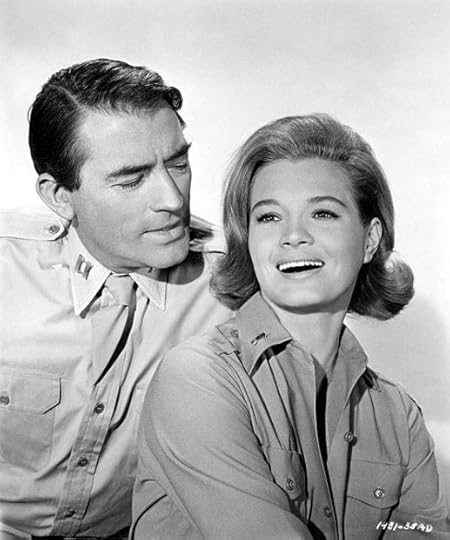
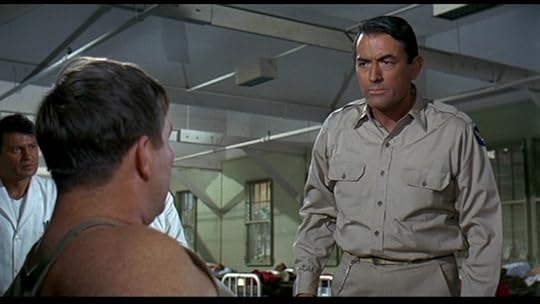
Captain Newman, M.D. invites you to make rounds on the ward of an Army psychiatric hospital where wounded veterans have lost touch with reality and erased memories of civilian life with verdicts of guilt from the battlefield. What is the prognosis for these physically unscared victims of war? This is a realistic rendering of the consequences of the War's stimuli, a bombardment of visual horrors where men in charge shoulder overwhelming responsibility for the carnage around them. Courage and valor are replaced by internal feelings of guilt and cowardice.
Leo Calvin Rosten was born in Lodz, Russian Empire (now Poland) and died in New York City. He was a teacher and academic, but is best known as a humorist in the fields of scriptwriting, storywriting, journalism and Yiddish lexicography.
I thought this book was hilariously funny! I read parts of it to my son, and he was laughing as well. The book is based on Leo Rosten's experiences in the mental health field at Camp Colfax during WWII. I swear, one of the characters, Coby Clay, had to have been the inspiration for Gomer Pyle-- someone either knew him or read the book.
Well, actually I first read this book sometime around 1965--my copy was printed in 1964. A WWII novel, set in an N.P. (neuro-psychiatric) ward on air base in the American southwest. No shots are fired in this slim war novel. I admire Mr. Rosten's ability to bring characters to life through dialog. Captain Newman and his patients, backed up by his ward man, the incredible Laibowitz, all assume a three-dimensional nature that draws me back again and again. Though Newman uses the tools of psychoanalysis, he cheerfully throws away the book as he takes a unique approach to the many forms of human wreckage that the tide of world war washes into his ward. Some very funny incidents are elegantly narrated; some terrible experiences are narrated with care and sensitivity.
Newman's insights into human behavior are worth one's time to read this book; Leo Rosten's careful craftsmanship is superb as he tells his story.
Here, Captain Newman interrogates Corporal Laibowitz regarding the Christmas tree he stole for the ward by sawing the top off the General's tree in the Rec Hall:
"How did you do it?" "With a saw." "A SAW? what kind of saw?" "How many types of saw ARE there?" cried Laibowitz. "A saw. For sawing." "Where did you get it?" "From surgery." "From SURGERY?" Newman exploded. "You sound like an echo." "You stole a surgical saw--" "Such an accusation is not fair! The saw was borrowed." "You BORROWED a delicate, expensive instrument--" ... "It's already returned!" "Dull as a board, no doubt--" "No!" protested Laibowitz. "Just bent." "'Bent.' That's nice. Nothing could be better for a surgeon, of course, than a bent saw. For crooked patients. It will cut around corners." "Doc, I can see you are getting upset." "Upset? I?" Newman laughed hollowly. "Simply because my orderly broke into surgery--" "I didn't. Don't be hard on Pepi, Doc! He was doing it for the ward. I tell him to get a saw, thinking he'll go to the tool shed, but the poor four-eyed slob sneaks upstairs--"
Captain Newman rose. "Let's quit all this stalling. Tell me the whole story."
IMDB description: In 1944, Capt. Josiah J. Newman is the doctor in charge of Ward 7, the neuropsychiatric ward, at an Army Air Corps hospital in Arizona. The hospital is under-resourced and Newman scrounges what he needs with the help of his inventive staff, especially Cpl. Jake Leibowitz. The military in general is only just coming to accept psychiatric disorders as legitimate and Newman generally has 6 weeks to cure them or send them on to another facility. There are many patients in the ward and his latest include Colonel Norville Bliss who has dissociated from his past; Capt. Paul Winston who is nearly catatonic after spending 13 months hiding in a cellar behind enemy lines; and 20 year-old Cpl. Jim Tompkins who is severely traumatized after his aircraft was shot down. Others come and go, including Italian prisoners of war, but Newman and team all realize that their success means the men will return to their units and combat. - Written by garykmcd
I found an ancient copy of this book complete with old book smell and had a powerful urge to re read it. I first read this book under the bed at my house when I was young; it was one of the few books that I remember being forbidden to me... not really sure why except maybe the mental health aspects...I remembered it as being one of the funniest books I had ever read and it lived up to my memory. Leo Rosten was a humorist, but this book is not comical, but rather dark humor amidst human tragedy. A young lieutenant is stationed at a base in Arizona that trains fighters and pilots for World War II. He is assistant to a psychiatrist who sees the survivors of the traumas war inflicts on the human psyche as well as the human body. There are many tragic figures and stories here, but we are kept reading through the antics of the Three Horsemen, three orderlies that include one of the greatest comic figures I can remember. This book was basically a more witty, less bullying MASH. Made into a quite good movie with Gregory Peck in the lead role. Definitely worth the trip down memory lange.
A favorite of mine, it's about a Army Air Force (they were the same at the time) psychiatrist and the wing of the hospital run in the hot Arizona desert during WWII. Told by a lieutenant who is sent to be an aide to Captain Newman (who is not "regular Army" and thus tends to rub the Top Brass a bit the wrong way), one learns of the various persons at Camp Colfax, both personnel serving in the Army Air Force hospital wing and patients. It's part humorous and part sad - the traditional comedy/tragedy. This is psychiatry as what was known in the early 1940s, but compassion then was just as pertinent as it is now - and stupidity in Top Brass the same. I recommend it.
Read this book when I was in HS, after seeing the movie with Gregory Peck & Tony Curtis. It opened my eyes to a whole new aspect of war, those walking wounded who would carry the war in their heads and hearts forever afterwards. I remember well-drawn characters, and writing that made me smile, laugh, and cry. Seek it out, it is well worth your time.
This classic is a wonderfully funny, moving read. Has stuck in my head since I read it in the early 1980s and have re-read several times. Nice picture of the writing style of this era, as well. Like watching a Doris Day flick.
I read this when I was a young adult, mainly because I had been told it was funny (it is.) But this is a book that has always stayed with me because of the main character's humanity - particularly, the story he tells at the end about how various types of people prepare for a disastrous flood.
One of the funniest books written -- loved it, AND the movie. I can just still see Gregory Peck and Tony Curtis in those roles. Despite its underlying theme of mental illness, it was still laugh out loud funny.
I saw the movie twice and really enjoyed it. The more that I read the book, the more that I was reminded of the film, and I did not see the point of continuing. The movie was better!
A Roman a clef based on the experiences of a WWII Army Air Corps psychiatrist, as told to the author, Leo Rosten. It brought to mind other novels: MASH, Catch-22 and One Flew Over the Cuckoo’s Nest; which came out much after Captain Newman. Many of the patients in the book are clearly suffering from some form of what we now refer to as PTSD. I found the stories and character descriptions of the medical staff, the brass and patients to be intriguing, entertaining and at times sorrowful. The epilogue was especially thought provoking and emotional for me. I plan to go back to reread that section again, from time to time.
Episodic novel about a military hospital mental ward during World War Two and the Psychiatrist who ran it. Somewhat old fashioned in writing, it actually tackles issues taken on by more recent and well-known novels like Pat Barker's trilogy of World War One and even MASH. Captain Newman's job is to take men sickened by war and get them healthy again so they can return to the fighting. The tonal shift from comedy to drama which seemed jarring in the movie seems more seamless in the novel. Although forgotten over the years, the book is worthwhile and a good read.
First read this back in 1963- 1964. I loved it then and enjoyed it again just as much this time around. Unforgettable characters and situations. Seem to remember a movie but not as good as the book, which is usual. Highly recommended.


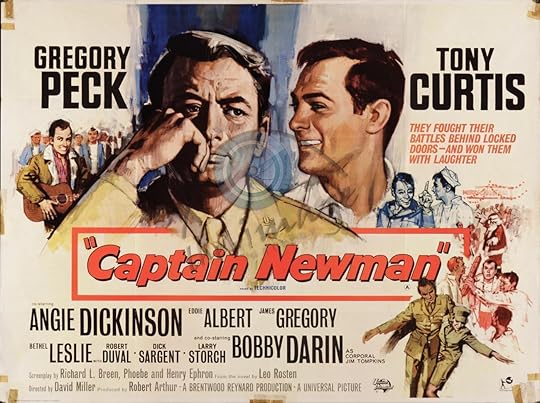
 https://www.youtube.com/watch?v=VHGnf...