

What do you think?
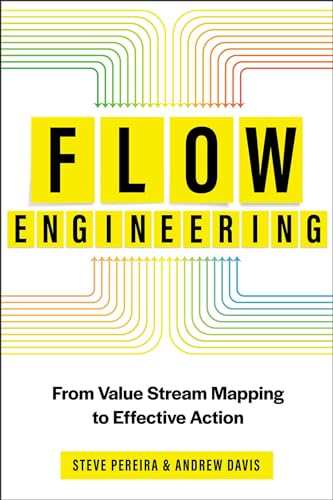
Flow Engineering: From Value Stream Mapping to Effective Action
2026 Axiom Book Awards Gold Medal Winner
Tired of misalignment, friction, and stalled workflow? Flow Engineering is a practical guide to using value stream mapping techniques to align teams, unlock innovation, and optimize performance.
Based on foundations from Value Stream Mapping, cybernetics, and the Toyota Production System, Flow Engineering's lightweight and iterative practices build the value, clarity, and flow required for effective collaboration and collective action. Written by Value Stream Mapping experts Steve Pereira and Andrew Davis, Flow Engineering provides a step-by-step guide for running fast-paced mapping workshops that rapidly build shared understanding.
Using five key maps to facilitate collaborative “flow conversations,” Pereira and Davis show how teams can surface tangled process dependencies, conflicting priorities, and unspoken assumptions that grind progress to a halt. The result? A clear roadmap owned by the people doing the work to accelerate innovation cycles, optimize workflows, and achieve more effective coordination.
Applicable across any industry, Flow Engineering's techniques have helped leading organizations improve critical workflows like customer onboarding, product development, and hiring.
It's time to stop trying one-size-fits-all frameworks to find value, clarity, and flow to improve culture and performance. Flow Engineering meets your organization where it's at and shows you how to move it where it needs to go.
Tired of misalignment, friction, and stalled workflow? Flow Engineering is a practical guide to using value stream mapping techniques to align teams, unlock innovation, and optimize performance.
Based on foundations from Value Stream Mapping, cybernetics, and the Toyota Production System, Flow Engineering's lightweight and iterative practices build the value, clarity, and flow required for effective collaboration and collective action. Written by Value Stream Mapping experts Steve Pereira and Andrew Davis, Flow Engineering provides a step-by-step guide for running fast-paced mapping workshops that rapidly build shared understanding.
Using five key maps to facilitate collaborative “flow conversations,” Pereira and Davis show how teams can surface tangled process dependencies, conflicting priorities, and unspoken assumptions that grind progress to a halt. The result? A clear roadmap owned by the people doing the work to accelerate innovation cycles, optimize workflows, and achieve more effective coordination.
Applicable across any industry, Flow Engineering's techniques have helped leading organizations improve critical workflows like customer onboarding, product development, and hiring.
It's time to stop trying one-size-fits-all frameworks to find value, clarity, and flow to improve culture and performance. Flow Engineering meets your organization where it's at and shows you how to move it where it needs to go.
290 pages, Kindle Edition
Published May 14, 2024
Ratings & Reviews
Friends & Following
Create a free account to discover what your friends think of this book!
Community Reviews
Displaying 1 - 24 of 24 reviews

June 3, 2024
(if you're going to listen to the audiobook, subtract 1 star; if you're looking for one single book that synthesizes concepts related to the flow of work in modern IT, add 1 star)
I didn't fall in love with this book. It feels very "dry" & mechanical (but I think this flaw is less painful in the Kindle/paperback versions because of all the diagrams and sketches), the wording is very enterprise-y, and all the concepts have already been presented many times. What is more, sometimes the authors are (apparently on purpose) mixing concepts that probably should not be mixed - e.g., when they look for the correspondence between the individual state of "flow" and the flow, as defined by Goldratt/Reinertsen.
Another very specific thing about this book is that it does not try to prove anything—it simply states opinions as they don't need any confirmation/proof. This is a manner typical for many consultants, and it works quite nicely for the vast majority of the time until, e.g., they start advocating for SAFe.
The main topic of the book is, in fact, not the "flow" (btw. if you really want to upskill in this area, I strongly advise you to read Reinertsen's "Flow"), but Value Stream Mapping. There's nothing particularly wrong about that, but as in the case of many other concepts mentioned in this book, they are presented mostly as "terms" with some explicitly named advantages - one can't resist the impression that actual implementation is beyond the scope of this book, so it's main role is to attract new customers for the consulting services (provided by the authors and their associates).
3 stars. It's not the best book by IT Revolution Press, but it is not the worst either.
I didn't fall in love with this book. It feels very "dry" & mechanical (but I think this flaw is less painful in the Kindle/paperback versions because of all the diagrams and sketches), the wording is very enterprise-y, and all the concepts have already been presented many times. What is more, sometimes the authors are (apparently on purpose) mixing concepts that probably should not be mixed - e.g., when they look for the correspondence between the individual state of "flow" and the flow, as defined by Goldratt/Reinertsen.
Another very specific thing about this book is that it does not try to prove anything—it simply states opinions as they don't need any confirmation/proof. This is a manner typical for many consultants, and it works quite nicely for the vast majority of the time until, e.g., they start advocating for SAFe.
The main topic of the book is, in fact, not the "flow" (btw. if you really want to upskill in this area, I strongly advise you to read Reinertsen's "Flow"), but Value Stream Mapping. There's nothing particularly wrong about that, but as in the case of many other concepts mentioned in this book, they are presented mostly as "terms" with some explicitly named advantages - one can't resist the impression that actual implementation is beyond the scope of this book, so it's main role is to attract new customers for the consulting services (provided by the authors and their associates).
3 stars. It's not the best book by IT Revolution Press, but it is not the worst either.
June 25, 2024
The book tackles the issues businesses face when scaling up, emphasizing the productivity and collaboration challenges that arise. It argues that individual efforts can't match the collective output of well-coordinated teams, even if individual efforts are more significant.
The authors rely on past studies to support their points, focusing on the elements of a productive team: purpose, shared views, and value/clarity and flow. They identify three main challenges when scaling: alignment, visibility, and on-ramp gaps. Addressing these requires solutions that meet budget, schedule, and scope constraints. The book suggests integrating feedback loops and control systems, drawing inspiration from Lean implementation and Kotter's eight steps for driving change.
Cybernetics is discussed as a means of enhancing collaboration between humans and IT through feedback loops. The book's concepts of value, clarity, and flow echo Marcus Aurelius' ideas of right judgment, action, and willingness. As organizations grow, individuals and teams may drift apart, losing focus on their original goals.
The book promotes value stream mapping (VSM) as a tool to help businesses maintain focus and alignment. VSM, part of Lean manufacturing, is vital for understanding and improving business processes. It visually represents systems, facilitating better communication and collaboration.
Key takeaways at the end of each chapter offer valuable insights without rereading the entire text. Readers can jump to Part 2 for practical guidance on implementing these ideas. The book conveys a "Seven Habits" vibe and highlights the existence of an ISO standard for value stream mapping (ISO 22468:2020).
Overall, the book offers a straightforward approach to process mapping that simplifies traditional methods. While it doesn’t introduce groundbreaking ideas, it provides a practical method for improving mapping processes. Part 3 focuses on leadership and management, offering useful suggestions, though it leans toward promoting their method.
The authors rely on past studies to support their points, focusing on the elements of a productive team: purpose, shared views, and value/clarity and flow. They identify three main challenges when scaling: alignment, visibility, and on-ramp gaps. Addressing these requires solutions that meet budget, schedule, and scope constraints. The book suggests integrating feedback loops and control systems, drawing inspiration from Lean implementation and Kotter's eight steps for driving change.
Cybernetics is discussed as a means of enhancing collaboration between humans and IT through feedback loops. The book's concepts of value, clarity, and flow echo Marcus Aurelius' ideas of right judgment, action, and willingness. As organizations grow, individuals and teams may drift apart, losing focus on their original goals.
The book promotes value stream mapping (VSM) as a tool to help businesses maintain focus and alignment. VSM, part of Lean manufacturing, is vital for understanding and improving business processes. It visually represents systems, facilitating better communication and collaboration.
Key takeaways at the end of each chapter offer valuable insights without rereading the entire text. Readers can jump to Part 2 for practical guidance on implementing these ideas. The book conveys a "Seven Habits" vibe and highlights the existence of an ISO standard for value stream mapping (ISO 22468:2020).
Overall, the book offers a straightforward approach to process mapping that simplifies traditional methods. While it doesn’t introduce groundbreaking ideas, it provides a practical method for improving mapping processes. Part 3 focuses on leadership and management, offering useful suggestions, though it leans toward promoting their method.

December 28, 2025
This book felt like Ben Wyatt explaining the rules and strategy of Cones of Dunshire. This book however was not as fully developed as Cones rules or strategy. While it had nuggets of valuable information, it was at times contradictory (don't focus on one area but focus on one area; it's not a one size fits all but you could use this with any company and department) and at others seemed to not know its own system well (outcome mapping was 5 stages on page 55 then later on page 64 only 4 stages). The authors seem to believe if they only say "simple," "lightweight," or "fast" enough we'll look beyond the 9+ hours, 5 maps, and cumulative ~22 steps/stages required to get started. The book name drops other books in the field like a background actor trying to get into an A-list party (e.g. Team Topologies, Thinking in Systems, Scale).
I think this book would benefit from considerable scale back and more real stories about how this has been used. There is truth and value to some of what's in here. Teams shouldn't work at 100%+ capacity. There needs to be time to refill the gas tank. I like their facilitation tips. Too often facilitation is considered something that anyone in a group can take on which ignores that facilitation is a full time job by itself. It's often overlooked labor. Citing Paula Thrasher's Recent, Real, Reach, Road Tested, Representative was the moment where the whole system felt most tangible to me. Overall, I think the authors jump to the abstract too quickly and lingers too long in the theoretical. More messy, real examples would give this process more credibility. You forgot about the essence of the game. It's about the cones!
I think this book would benefit from considerable scale back and more real stories about how this has been used. There is truth and value to some of what's in here. Teams shouldn't work at 100%+ capacity. There needs to be time to refill the gas tank. I like their facilitation tips. Too often facilitation is considered something that anyone in a group can take on which ignores that facilitation is a full time job by itself. It's often overlooked labor. Citing Paula Thrasher's Recent, Real, Reach, Road Tested, Representative was the moment where the whole system felt most tangible to me. Overall, I think the authors jump to the abstract too quickly and lingers too long in the theoretical. More messy, real examples would give this process more credibility. You forgot about the essence of the game. It's about the cones!

August 8, 2024
My review is for the audiobook version. I am quite familiar with the topic as a management consultant doing business transformation, but I would recommend reading the paper copy, not the audiobook. There are too many references to visuals that I think I missed some of the points because of it.
July 27, 2024
A modern refresher to value stream mapping and project execution
Steve and Andrew have done a great job of condensing a complex topic into a book (with a good flow!).
I love the generalizations in the book such as prescriptive to generative solutions to scale or cybernetics before jumping into Flow Engineering.
The authors have done a great job of providing a prescriptive model, a blue print to implement Flow Engineering in any organization.
This book has a wealth of references from Steven Covey, Peter Senge to Simon Wardley. Be prepared to hit your library and pull out the references. I really enjoyed learning the “Liberating Structures” structures. Thanks to the authors for introducing me to the subject.
As a change practitioner, I did not appreciate repeated statements like “three months is long enough for change/transformation”. I wish the authors touched on people side of change and introduced/referenced change management discipline so support the amazing process oriented flow engineering discipline.
Steve and Andrew have done a great job of condensing a complex topic into a book (with a good flow!).
I love the generalizations in the book such as prescriptive to generative solutions to scale or cybernetics before jumping into Flow Engineering.
The authors have done a great job of providing a prescriptive model, a blue print to implement Flow Engineering in any organization.
This book has a wealth of references from Steven Covey, Peter Senge to Simon Wardley. Be prepared to hit your library and pull out the references. I really enjoyed learning the “Liberating Structures” structures. Thanks to the authors for introducing me to the subject.
As a change practitioner, I did not appreciate repeated statements like “three months is long enough for change/transformation”. I wish the authors touched on people side of change and introduced/referenced change management discipline so support the amazing process oriented flow engineering discipline.

September 6, 2024
Flow Engineering offers an accessible and practical introduction to Value Stream Mapping (VSM) and its application in modern software engineering. The book effectively bridges Lean Management principles with the unique challenges of the software industry, making it a valuable resource for engineers, managers, and team leaders alike.
One of the standout aspects of the book is its focus on Outcome Discovery and Outcome Maps—two powerful tools that helped me personally identify strategies to scale a software organization. By leveraging these tools, the book shows how to break down complex workflows, visualize dependencies, and pinpoint bottlenecks that can hinder scalability.
Rather than sticking to theory, the author provides actionable insights with real-world examples that make it easy to see how these concepts can be applied directly to scaling software teams. For anyone looking to optimize their processes, improve cross-functional collaboration, and support sustainable growth in a software organization, this book offers indispensable advice.
One of the standout aspects of the book is its focus on Outcome Discovery and Outcome Maps—two powerful tools that helped me personally identify strategies to scale a software organization. By leveraging these tools, the book shows how to break down complex workflows, visualize dependencies, and pinpoint bottlenecks that can hinder scalability.
Rather than sticking to theory, the author provides actionable insights with real-world examples that make it easy to see how these concepts can be applied directly to scaling software teams. For anyone looking to optimize their processes, improve cross-functional collaboration, and support sustainable growth in a software organization, this book offers indispensable advice.

November 2, 2025
If you’re considering the audiobook, skip it; the accompanying 100+ page PDF makes it impractical. You’d be better off with the print or ebook version. The content itself feels dry and would benefit from more real-world examples to show how the concepts can be applied.

December 28, 2025
Principles implementing flow-efficiency across organization to improve performance of organizations. It's a quite well structured framework but as a whole the description gets a bit too lengthy and as it has been common with such books then the case studies and real life examples remain generic and weak. Having read all the individual books on this subject (This is Lean; There's Got to be a Better Way; The Goal, Phoenix Project, Unicorn project, DevOps Handbook, Accelerate, Making work visible, The 5th discipline) then it does summarize the different concepts and terms, but the dryiness makes it more difficult to follow.
"Disengagement comes from lack of purpose or being too far removed from it"
"Information flow could lead to the greatest improvement... Sometimes the best improvement you can hope for today is awareness."
For any team to succeed, three elements must be present:
1)Value: A shared understanding of what matters and why.
2)Clarity: An accurate, shared picture of the current situation and the path forward.
3) Flow: The unobstructed movement of work toward the target outcome.
Three human costs of scale:
*Distraction
*Disorientation
*Disengagement
Misalignment in teams: different perspectives, goals, scopes.
Iron triangle of constraints: budget, scope, schedule.
5 maps of FLOW engineering:
*Outcome Map: Aligns the team on a specific goal. It helps surface unspoken assumptions and identifies the "North Star" for the project, ensuring everyone understands why they are doing the work.
*Current State Value Stream Map: Visualizes the existing workflow. The goal isn't perfect precision but identifying the single most significant constraint or bottleneck where work is stalling.
*Dependency Map: "Zooms in" on the identified constraint to see what external teams, tools, or processes are holding it back. It reveals the invisible network of relationships that impact performance.
*Future State Map: A collaborative vision of how the workflow should look once the primary constraints are addressed. It defines what "improved flow" looks like in practice.
*Flow Roadmap: The final step that turns insights into action. It sequences the smallest possible steps (minimum viable improvements) needed to reach the future state.
Outcome mapping:
1) Discovery - Get all on the same page.
2) Target outcome - What is the clarified target?
3) Benefits - What makes this valuable?
4) Obstacles - What's in the way?
5) Next steps - What can we test and start on?
Dependency mapping targets only dependencies that impact the constraints.
5 stages of dependency mapping:
1) Start with constraints (from value stream map)
2) Create sub-value stream map (reveal contributions to the constraint)
3) Identify hot spots (highlight the problem areas)
4) Identify direct causes for hot spots (look and internal and external contributors)
5) Dig deeper into constraint (add data to drive insithgs)
The trade-off between resource efficiency and flow efficiency leads to an Efficient Frontier: a range of possible utilization options. The greater the variation in the work, the more that Efficient Frontier is pushed down.
The biggest misconception of lead time is that it’s just the total time that you spend doing the work, which is incorrect. Lead time, by standard definition, actually includes the time that the work waited plus the cycle time for each stage that you worked on that item. So, if you had a user story that was waiting for eight months, and you only spent two months actually developing it, your total lead time ends up being ten months, because we are taking the wait time and the cycle time of each stage together to give you the actual lead time because we are thinking in terms of customer outcomes.
"Disengagement comes from lack of purpose or being too far removed from it"
"Information flow could lead to the greatest improvement... Sometimes the best improvement you can hope for today is awareness."
For any team to succeed, three elements must be present:
1)Value: A shared understanding of what matters and why.
2)Clarity: An accurate, shared picture of the current situation and the path forward.
3) Flow: The unobstructed movement of work toward the target outcome.
Three human costs of scale:
*Distraction
*Disorientation
*Disengagement
Misalignment in teams: different perspectives, goals, scopes.
Iron triangle of constraints: budget, scope, schedule.
5 maps of FLOW engineering:
*Outcome Map: Aligns the team on a specific goal. It helps surface unspoken assumptions and identifies the "North Star" for the project, ensuring everyone understands why they are doing the work.
*Current State Value Stream Map: Visualizes the existing workflow. The goal isn't perfect precision but identifying the single most significant constraint or bottleneck where work is stalling.
*Dependency Map: "Zooms in" on the identified constraint to see what external teams, tools, or processes are holding it back. It reveals the invisible network of relationships that impact performance.
*Future State Map: A collaborative vision of how the workflow should look once the primary constraints are addressed. It defines what "improved flow" looks like in practice.
*Flow Roadmap: The final step that turns insights into action. It sequences the smallest possible steps (minimum viable improvements) needed to reach the future state.
Outcome mapping:
1) Discovery - Get all on the same page.
2) Target outcome - What is the clarified target?
3) Benefits - What makes this valuable?
4) Obstacles - What's in the way?
5) Next steps - What can we test and start on?
Dependency mapping targets only dependencies that impact the constraints.
5 stages of dependency mapping:
1) Start with constraints (from value stream map)
2) Create sub-value stream map (reveal contributions to the constraint)
3) Identify hot spots (highlight the problem areas)
4) Identify direct causes for hot spots (look and internal and external contributors)
5) Dig deeper into constraint (add data to drive insithgs)
The trade-off between resource efficiency and flow efficiency leads to an Efficient Frontier: a range of possible utilization options. The greater the variation in the work, the more that Efficient Frontier is pushed down.
The biggest misconception of lead time is that it’s just the total time that you spend doing the work, which is incorrect. Lead time, by standard definition, actually includes the time that the work waited plus the cycle time for each stage that you worked on that item. So, if you had a user story that was waiting for eight months, and you only spent two months actually developing it, your total lead time ends up being ten months, because we are taking the wait time and the cycle time of each stage together to give you the actual lead time because we are thinking in terms of customer outcomes.

September 28, 2026
A Pragmatic, Collaborative Guide to Seeing Constraints and Unlocking Flow (5/5 ⭐)
Flow Engineering: From Value Stream Mapping to Effective Action by Steve Pereira and Andrew Davis tackles one of the most frustrating realities in growing software organizations: why teams work harder and faster, yet deliver less meaningful customer value.
The authors diagnose the root cause with precision: scale introduces the "Three Ds"—distraction, disorientation, and disengagement. Inward-looking org charts hide customer value, causing teams to retreat into localized optimization and cargo-cult process theater.
The book introduces five interconnected, lightweight mapping practices (Outcome, Value Stream, Dependency, Future State, and Flow Roadmap) designed to fit into collaborative 2–3 hour workshops.
Key insights that resonated strongly:
- The Mapping is More Important than the Map: The primary value of mapping is not producing a polished diagram; it is the visual conversation that externalizes individual mental models and builds genuine shared clarity.
- Enabling vs. Governing Constraints: Differentiating between guardrails that make the right path effortless (such as automated CI pipelines) and restrictive bureaucratic gates that masquerade as safety (such as Change Advisory Boards).
- Cybernetic Systems: Treating every value stream as a closed-loop control system founded on measuring and reacting.
- Continuous Improvement as a Habit: Anchoring improvement in the Improvement Kata (Plan-Do-Study-Act) rather than treating process fixes as finite projects.
- Focus on the Constraint: Before investing in more talent, tools, or training, identify the primary bottleneck holding the entire system back.
A concise, accessible, and actionable manual for engineering leaders, product managers, and team facilitators looking to move from task-level velocity to true customer flow.
---
I wrote an in-depth review reflecting on these concepts, consulting realities, and cybernetic feedback loops on my blog: https://hussainweb.me/blog/flow-engin...
Flow Engineering: From Value Stream Mapping to Effective Action by Steve Pereira and Andrew Davis tackles one of the most frustrating realities in growing software organizations: why teams work harder and faster, yet deliver less meaningful customer value.
The authors diagnose the root cause with precision: scale introduces the "Three Ds"—distraction, disorientation, and disengagement. Inward-looking org charts hide customer value, causing teams to retreat into localized optimization and cargo-cult process theater.
The book introduces five interconnected, lightweight mapping practices (Outcome, Value Stream, Dependency, Future State, and Flow Roadmap) designed to fit into collaborative 2–3 hour workshops.
Key insights that resonated strongly:
- The Mapping is More Important than the Map: The primary value of mapping is not producing a polished diagram; it is the visual conversation that externalizes individual mental models and builds genuine shared clarity.
- Enabling vs. Governing Constraints: Differentiating between guardrails that make the right path effortless (such as automated CI pipelines) and restrictive bureaucratic gates that masquerade as safety (such as Change Advisory Boards).
- Cybernetic Systems: Treating every value stream as a closed-loop control system founded on measuring and reacting.
- Continuous Improvement as a Habit: Anchoring improvement in the Improvement Kata (Plan-Do-Study-Act) rather than treating process fixes as finite projects.
- Focus on the Constraint: Before investing in more talent, tools, or training, identify the primary bottleneck holding the entire system back.
A concise, accessible, and actionable manual for engineering leaders, product managers, and team facilitators looking to move from task-level velocity to true customer flow.
---
I wrote an in-depth review reflecting on these concepts, consulting realities, and cybernetic feedback loops on my blog: https://hussainweb.me/blog/flow-engin...

May 20, 2024
I can imagine this book loafing on the performative bookshelf harboured by every modern CEO. Something to flip through, and perhaps studied deeply/memorized by a very few.
I must admit my pleasure was hampered by the galley copy. At least 1/3 of the text is figures. But the galley copy doesn't render them. Half the time, the reader can't understand the text for this reason alone.
The rest ... there's a lot here. There's a structure for each section. There's lists and takeaways. And the (dreaded) figures, in all their absence. But like many such texts of its ilk, this would be better off as a course or workshop series. I'm not going to remember anything, let alone apply it.
Also, there were a few contradictions. For example, "making the map" is more important than the map itself ... but in the next section, we're advised to "share the map" as resources.
The authors know what they're talking about, nonetheless. Take this apt quote: "The role of leadership is to assume the risk and responsibility of guiding others safely in a beneficial direction, in spite of great uncertainty." And this one: "There are two types of challenges: situations where you don't know what to do, and situations where you know what to do but don't want to do it." (I'd really love to know how to tackle the second one ...) The form their insights took here didn't work for me, but it may for others.
Thank you to Edelweiss+ and IT Revolution Press for the advance copy.
I must admit my pleasure was hampered by the galley copy. At least 1/3 of the text is figures. But the galley copy doesn't render them. Half the time, the reader can't understand the text for this reason alone.
The rest ... there's a lot here. There's a structure for each section. There's lists and takeaways. And the (dreaded) figures, in all their absence. But like many such texts of its ilk, this would be better off as a course or workshop series. I'm not going to remember anything, let alone apply it.
Also, there were a few contradictions. For example, "making the map" is more important than the map itself ... but in the next section, we're advised to "share the map" as resources.
The authors know what they're talking about, nonetheless. Take this apt quote: "The role of leadership is to assume the risk and responsibility of guiding others safely in a beneficial direction, in spite of great uncertainty." And this one: "There are two types of challenges: situations where you don't know what to do, and situations where you know what to do but don't want to do it." (I'd really love to know how to tackle the second one ...) The form their insights took here didn't work for me, but it may for others.
Thank you to Edelweiss+ and IT Revolution Press for the advance copy.

February 23, 2025
I started reading this as I'm in gauging in a pretty extensive project that will require various mapping to both understand the problem and understand if we've attained a solution.
I got about halfway through this book and I realized a couple things. First it felt over complicated. Perhaps it's written for engineers who want a more technical view of a tool or have little or no concept of mapping not for someone who's been doing it for a number of years.
Second I felt that it was very sterile. Perhaps it was more the way the narrator read it, but there was very little excitement about using these tools. Perhaps it was written more as a textbook with a case study, but I just found my attention being focused on other things.
On the plus side, there is a ton of very good resources that go with the audiobook. Quotes, references, tables, and other things are almost a book within the audiobook.
There may be a time I choose to listen to the entire book again, but right now is not that time.
I got about halfway through this book and I realized a couple things. First it felt over complicated. Perhaps it's written for engineers who want a more technical view of a tool or have little or no concept of mapping not for someone who's been doing it for a number of years.
Second I felt that it was very sterile. Perhaps it was more the way the narrator read it, but there was very little excitement about using these tools. Perhaps it was written more as a textbook with a case study, but I just found my attention being focused on other things.
On the plus side, there is a ton of very good resources that go with the audiobook. Quotes, references, tables, and other things are almost a book within the audiobook.
There may be a time I choose to listen to the entire book again, but right now is not that time.
July 29, 2025
If you’ve ever been part of a team that’s “trying to improve” but keeps spinning in circles, this book is for you. Flow Engineering gives you five really simple and visual tools to actually figure out where things are stuck and how to fix them without overcomplicating it.
The authors walk you through each map step by step. You start by getting clear on your goals, then map your current state, dependencies, and what a better future might look like. Finally, you lay out a plan that your team can act on. It’s smart, practical, and doesn’t waste time.
What I liked most is that it’s not just for software teams. I can see this working in marketing, operations, customer support pretty much any group that needs better flow and less chaos.
A couple things to keep in mind: it’s packed with info, so if you’re brand new to this kind of thinking, maybe start slow. I wouldn’t mind a super lightweight version just for small teams. But again, overall, its usable by all teams regardless of size and should be a go-to reference on every leader's bookshelf.
The authors walk you through each map step by step. You start by getting clear on your goals, then map your current state, dependencies, and what a better future might look like. Finally, you lay out a plan that your team can act on. It’s smart, practical, and doesn’t waste time.
What I liked most is that it’s not just for software teams. I can see this working in marketing, operations, customer support pretty much any group that needs better flow and less chaos.
A couple things to keep in mind: it’s packed with info, so if you’re brand new to this kind of thinking, maybe start slow. I wouldn’t mind a super lightweight version just for small teams. But again, overall, its usable by all teams regardless of size and should be a go-to reference on every leader's bookshelf.

September 23, 2024
A Fantastic book! "Flow Engineering" makes sense of the chaos within organizations. It's a practical, guide to aligning teams on outcomes, delivering continuous value, and improving iteratively. Combining insights from both physical and digital engineering, it consolidates years of learning into an accessible volume. The book focuses on creating a flow-centric culture of collaboration and innovation, using value stream mapping and emphasizing the human aspects of development. Whether you're a startup founder or a seasoned coder, this book is a game-changer for software development. Highly recommend!
June 6, 2024
This book does a great job of outlining both the benefits of flow engineering and in providing a step-by-step guide to understand and implement into any organization, regardless of industry or size. It balances theory and practice in a way that’s digestible and actionable. It provides practical tools we could use to help eliminate waste and improve collaboration and output, without flowery exec jargon. Highly recommend!
August 21, 2024
As someone who has worked in software for over 40 years, I can safely say that I wish this book was available back then, or at any point in my early career. It is easy to read, insightful, and extremely practical. It addresses the complexities of cross-functional teams, scale, and provides a framework for improved collaboration, and output. A must read for anyone in the space.
Read
February 21, 2026Flow Engineering is a game-changer for R&D leaders because it moves the conversation away from "working harder" and toward "removing friction." As a Head of R&D, you likely deal with the constant tension between innovation and delivery; this book provides the literal map to navigate it.
Rereading it now in paper format.
Rereading it now in paper format.

November 20, 2024
This is one of those books that you read when you have the time. In my case, some of this was review and in others, it brought together concepts I had thought about but not integrated in my own thinking. Anyone involved in software development or product management should read this book
November 1, 2024
A good book to start to map your system.
December 31, 2024
Fantastic read
Loved the book and worth reading a few times. Brought together and clarified great insights to propel change in an organization.
Loved the book and worth reading a few times. Brought together and clarified great insights to propel change in an organization.
July 11, 2025
a lot of great ideas and relevant insights. wish there was more practical discussions about how to navigate common challenges in rollout but overall a good framework and introduction to the practice.

September 17, 2025
This is a must read for teams working together but not aligned, with wasted time, and messed up communication.

December 5, 2025
Great ideas and I especially have gotten benefits from outcome mapping and outcome discovery and have incorporated these techniques into several brainstorming sessions and workshops.
September 15, 2026
It was ok. A little dense for the topic, compared to other related books (e.g. Project-to-Product), but I still found takeaways.

March 31, 2024
A great collection of practices and theory around how the flow of value can be mapped and improved incrementally without any fluff. I'd been waiting for this book to come out for a while and was happy to receive an advanced copy through IT Revolution press.
This book gives some useful case studies of flow engineering in the real world and ties back to many of the places of origins from various practices and ideas so you are getting a qualified book to help you on your own personal explorations and learning journey.
I read this book after the Wiring the Winning Organisation and I find Flow Engineering to be much more approachable. It is a shame that there are references to SAFe in the book but that is more a personal choice. I would recommend this book to anyone in the ways of working and architecture space as a compliment to a set of sociotechnical practices that are emerging in the community.
This book gives some useful case studies of flow engineering in the real world and ties back to many of the places of origins from various practices and ideas so you are getting a qualified book to help you on your own personal explorations and learning journey.
I read this book after the Wiring the Winning Organisation and I find Flow Engineering to be much more approachable. It is a shame that there are references to SAFe in the book but that is more a personal choice. I would recommend this book to anyone in the ways of working and architecture space as a compliment to a set of sociotechnical practices that are emerging in the community.
Displaying 1 - 24 of 24 reviews