

What do you think?

Oasis: A Science Fiction Graphic Novel
JieJie and her little brother, DiDi, are living on their own in a barren desert while their mother works tirelessly to earn their admission into Oasis City. Their days are filled with weathering sandstorms and scavenging for water, but everything changes when they come across an AI-powered robot lying dormant in an abandoned junkyard.
Filled with equal parts hope and suspense, Oasis tells the story of a potentially not-so-distant future that you won’t ever forget.
Filled with equal parts hope and suspense, Oasis tells the story of a potentially not-so-distant future that you won’t ever forget.
160 pages, Hardcover
First published February 18, 2025
About the author
Guojing
12 books159 followersGuojing (Jing Guo) is an illustrator and concept artist. Previously she worked in the game and animation industry. She is now a professional illustrator. Her wordless picture book, ‘The Only Child’, a New York Times Best Illustrated Children’s Book of 2015, and a Publishers Weekly Book of 2015, is published by Schwartz and Wade (Random House, Dec, 2015). The story is based on her own experiences as a child. Guojing is also planning her next picture book. She also likes to paint in oils in her spare time. She loves to share her ideas and feelings through her art work.
Offical website: www.guojingart.com
(from http://www.creativeauthors.co.uk/illu...)
Offical website: www.guojingart.com
(from http://www.creativeauthors.co.uk/illu...)
Ratings & Reviews
Friends & Following
Create a free account to discover what your friends think of this book!
Community Reviews
Displaying 1 - 30 of 137 reviews
![Profile Image for s.penkevich [hiatus-will return-miss you all].](https://i.gr-assets.com/images/S/compressed.photo.goodreads.com/users/1735525095i/6431467._UX200_CR0,11,200,200_.jpg)
February 19, 2025
As our lives are increasingly swallowed up by the demands of labor, families find themselves spending more time with their technology than each other. Oasis, a bittersweet and gorgeously illustrated graphic novel from Guojing, finds siblings JieJie and DiDi spending their days in a barren wasteland of a desert braving sandstorms to find water and travel to a payphone booth for a daily chat with their mother. Their mother works in the nearby city and cannot yet afford admission to the city for her children, but when the siblings stumble upon a discarded AI robot they may have found a replacement mother to care for them. With breathtaking art that further crafts a heavy atmosphere of loneliness and frustration punctuated by tenderness, Guojing harnesses a whole slew of modern anxieties around labor, technology, family, financial stability and meeting basic needs into a succinctly haunting sci-fi fable. A beautifully heart wrenching tale that can be equally enjoyable and poignant for readers of any age, Oasis is a quiet little gem.
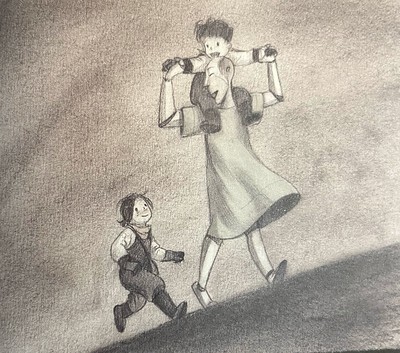
Oasis managed to really move me in a short space of time. The art is breathtaking and Guojing is able to instill so much life into the two siblings that you can immediately empathize with them. They are so cute and care for each other while having to survive alone in a desert.
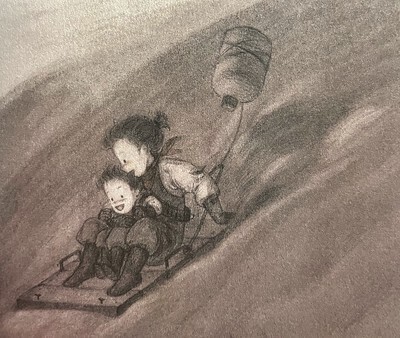
While the recent adaptation of The Wild Robot retaining it freshly in cultural memory may garner a few passing comparisons, Oasis feels rather original in its simplicity. The children find a destroyed AI, fix it, and program it to be their mother. While the older sibling is apprehensive, the AI Mom quickly wins them over and truly does take care of them.
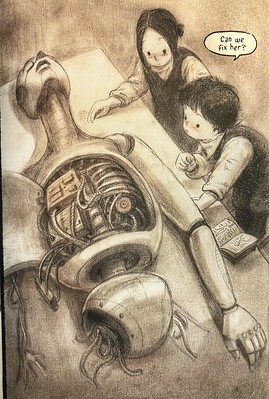
Yet when the mother returns, she is initially horrified to find herself replaced by an AI that isn’t actually a mother with real emotions. It nudges our increasing social reliance on technology and the aide of AI, with AIs being able to mimic human interactions and people even turning to AI for companionship (the internet is full of articles about people dating an AI), and how the absence of the mother has pushed the children closer to the AI. The AI Mom fills a need and instill hope in the children, real authentic hope and real feelings of closeness. The story, for how short it is, does a good job of addressing this nuance.
‘May we all be blessed with long life. Though we are far apart…
…we are still able to share the moonlight together.’
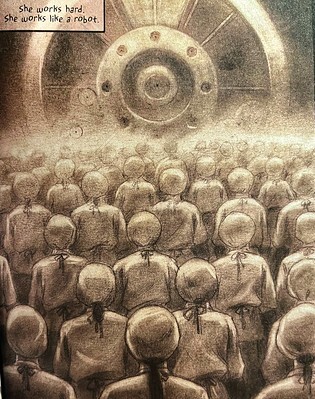
Something Oasis does best, however, is capture the plight of parenting and the struggles to find financial footing even with a full time job. The percentage of stay-at-home parents has declined significantly over the past two generations while the percentage of parents feeling financially secure despite having a full-time job has plummeted. And the cost of daycare almost negates having a part time job in order to pay for daycare. Oasis looks at the anxieties over how, despite greater technology to assist us, people are finding they are working more, longer, or struggling to find jobs they enjoy. In Oasis, the mother works around the clock ‘like a robot’ in a blue-collar job that looks like something out of the film Metropolis to uphold the city now mostly run by AI robots yet still cannot afford to bring her kids to come stay in the city with her.
There is a moment near the end where she crumbles under the duress of having to always miss her children in order to work while still never having enough money. ‘I wish we could survive without money’, she says. While Oasis is a beautiful yet heartbreaking slice of life story, it does end on a note of hope and optimism that really ties the whole thing together gorgeously. A lovely little story with great artwork, I really enjoyed Oasis.
4.5/5
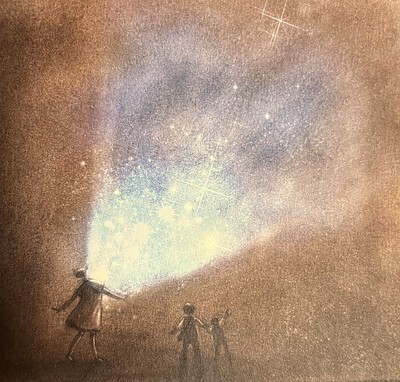
Oasis managed to really move me in a short space of time. The art is breathtaking and Guojing is able to instill so much life into the two siblings that you can immediately empathize with them. They are so cute and care for each other while having to survive alone in a desert.
While the recent adaptation of The Wild Robot retaining it freshly in cultural memory may garner a few passing comparisons, Oasis feels rather original in its simplicity. The children find a destroyed AI, fix it, and program it to be their mother. While the older sibling is apprehensive, the AI Mom quickly wins them over and truly does take care of them.
Yet when the mother returns, she is initially horrified to find herself replaced by an AI that isn’t actually a mother with real emotions. It nudges our increasing social reliance on technology and the aide of AI, with AIs being able to mimic human interactions and people even turning to AI for companionship (the internet is full of articles about people dating an AI), and how the absence of the mother has pushed the children closer to the AI. The AI Mom fills a need and instill hope in the children, real authentic hope and real feelings of closeness. The story, for how short it is, does a good job of addressing this nuance.
‘May we all be blessed with long life. Though we are far apart…
…we are still able to share the moonlight together.’
Something Oasis does best, however, is capture the plight of parenting and the struggles to find financial footing even with a full time job. The percentage of stay-at-home parents has declined significantly over the past two generations while the percentage of parents feeling financially secure despite having a full-time job has plummeted. And the cost of daycare almost negates having a part time job in order to pay for daycare. Oasis looks at the anxieties over how, despite greater technology to assist us, people are finding they are working more, longer, or struggling to find jobs they enjoy. In Oasis, the mother works around the clock ‘like a robot’ in a blue-collar job that looks like something out of the film Metropolis to uphold the city now mostly run by AI robots yet still cannot afford to bring her kids to come stay in the city with her.
There is a moment near the end where she crumbles under the duress of having to always miss her children in order to work while still never having enough money. ‘I wish we could survive without money’, she says. While Oasis is a beautiful yet heartbreaking slice of life story, it does end on a note of hope and optimism that really ties the whole thing together gorgeously. A lovely little story with great artwork, I really enjoyed Oasis.
4.5/5

September 25, 2025
I'm not sure I knew what to expect before diving into Oasis, but this was a delightful read.
What Did I Like: I've heard so much about Guojing's beautiful artwork, but nothing could compare to actually experiencing it. A key part of my enjoyment of graphic novels is the way that the art, without text, can evoke so many emotions and push the reader to make inferences about the story. Though it is filled with text, Oasis shines in its art and use of color to illustrate a post apocalyptic world that relies heavily on the extensive labor to keep it functioning. Though filled with dark moments and themes, hope is woven through the course of the entire story.
It's a quick read, but meaningful and impactful and definitely recommend checking it out.
What Did I Like: I've heard so much about Guojing's beautiful artwork, but nothing could compare to actually experiencing it. A key part of my enjoyment of graphic novels is the way that the art, without text, can evoke so many emotions and push the reader to make inferences about the story. Though it is filled with text, Oasis shines in its art and use of color to illustrate a post apocalyptic world that relies heavily on the extensive labor to keep it functioning. Though filled with dark moments and themes, hope is woven through the course of the entire story.
It's a quick read, but meaningful and impactful and definitely recommend checking it out.

January 8, 2026
JieJie and DiDi are two young children getting by on their own in a desert wasteland while their mother -- one of the working poor -- is away for days at a time pulling shifts in a factory in a city in which they cannot afford to live.
A chance discovery in a junk heap leads to a path of lessening misery.
I'm a little confused by the moral here. The author seems to say that AI and high tech are the only solutions to this ongoing problem, even as those same things currently seem on track to make the problems of the unemployed and working poor even greater.
Is this robot overlord propaganda?
(Best of 2025 Project: I'm reading all the graphic novels that made it onto one or more of these lists:
• Washington Post 10 Best Graphic Novels of 2025
• Publishers Weekly 2025 Graphic Novel Critics Poll
• NPR's Books We Love 2025: Favorite Comics and Graphic Novels
This book made the NPR list.)
A chance discovery in a junk heap leads to a path of lessening misery.
I'm a little confused by the moral here. The author seems to say that AI and high tech are the only solutions to this ongoing problem, even as those same things currently seem on track to make the problems of the unemployed and working poor even greater.
Is this robot overlord propaganda?
(Best of 2025 Project: I'm reading all the graphic novels that made it onto one or more of these lists:
• Washington Post 10 Best Graphic Novels of 2025
• Publishers Weekly 2025 Graphic Novel Critics Poll
• NPR's Books We Love 2025: Favorite Comics and Graphic Novels
This book made the NPR list.)

August 28, 2025
Guojing is really great at art. This story was pleasant, simple, heartfelt like her other work I've read. I don't know though, AI characters always give me the ick no matter how nice they are.

June 4, 2026
A very beautifully illustrated, often wordless post-apocalyptic comic for young readers. Two children, siblings, live alone in a shack in a sand-blown wasteland. They journey out to collect water from a shaky pump and try to call their mom on an ancient payphone but can rarely reach her. Then one day they find the broken body of an android in a trash heap and they carry the head and torso back to their home. They awaken the android, which starts a cascade of changes in their life. This is a simple story, but poignant, touching on tech and wealth inequality, climate change, and how poverty separates parents from their children.

June 7, 2026
Would only be a short story without the art. Which is monochrome, and so dark I have trouble making out the details. But a rich, concisely told story well worth reading. I'm rounding up my rating because A it made me sniffle and B I want to look for more by the creator and C I recommend it if you have any interest.

February 20, 2025
This is so flipping beautiful and since as an adult I’ve fallen in love with robots due to the work of Jasmine Warga, Jarrett Lerner, and Peter Brown, I had to pick it up. This STUNNING graphic novel is set in a hopefully very distant future and it follows siblings who live alone in a desert while their mother works in “the city” to keep them all alive. When the kids find a robot in pieces, they bring it to life and find themselves with hope and comfort they’d once thought was lost.

May 28, 2025
Set in a dystopian future, two young children are left alone in the wastelands while their mother works in a nearby ‘utopian’ city to make their lives better. Feeling abandoned and isolated, the children find an unexpected source of succor.
Like with her first book, THE ONLY ONE, Canadian author/illustrator, Guojing, references her Chinese roots. With this book she showcases the children that are left at home in rural places, while their parents work in cities to carve out a sustainable economic life. Even without the subtext this story soars in its kindness and hope.
Like with her first book, THE ONLY ONE, Canadian author/illustrator, Guojing, references her Chinese roots. With this book she showcases the children that are left at home in rural places, while their parents work in cities to carve out a sustainable economic life. Even without the subtext this story soars in its kindness and hope.
January 29, 2025
In a dystopian future ruled by robots, humans are the workforce required to keep society moving forward. Unfortunately for one family, two children are left behind in the desert while their mother desperately works to provide for them. One day, the children discover a discarded robot in a scrap heap and they manage to return the machine to functionality, activating a program that turns the AI into a surrogate mother. When the human mother returns to care for her children, two previously disparate paths must unite for their blended family to survive. This thought-provoking graphic novel incorporates limited text and few colors to illustrate the world of Oasis and the land and people the elevated community abandoned. Emotional imagery connects readers to the complexity of the children’s existence, especially as they manage each day without an adult caregiver. The existential conflict between the human and the AI mothers is palpable in the story, and while the ultimate connection between the mothers is predictable, it is also endearing. Accessible to an elementary school-aged audience, this book investigates substantial subject matter primarily through illustrations, which offers a wide range of readers the ability to connect with the narrative. Fans of sci-fi and dystopian fiction will appreciate the approach of this story, and the plot will inspire young people to consider a potential future wherein artificial intelligence has the upper hand. Thoughtful and visually stunning, this is an enjoyable addition to graphic novel collections for upper elementary school-aged readers.
October 23, 2024
JieJie and DiDi live in a harsh desert, navigating sandstorms and making due with limited resources. In order to pay for their passage to Oasis City, JieJie and Didi’s mother is constantly working, leaving the siblings to fend for themselves. When a fox steals some of the children’s water reserves, they end up chasing it into a junkyard of Oasis City trash. Lying among the garbage is a humanoid robot, powered by AI. After some tinkering, JieJie manages to restore the robot, and the added company brings a great change to the children’s lives.
Guojing’s illustrations are beautiful, stark in black and white but soft with texture and round-faced characters. JieJie is a sweet and thoughtful older sibling, shouldering the responsibilities of caring for DiDi and reassuring him of their mother’s return. As the AI replicates the role of a mother, the burden the young girl carries is made even more apparent once she is able to let go and be taken care of. By contrast, once we glimpse the life of the mother working in Oasis City, a new layer is added to the role of AI robots and the humans that create them. This story is sad and bleak at times, but the hopeful solution at the end was satisfying and took me by surprise. An interesting tale at a time when AI is becoming ever more present in our own lives, I appreciated the nuance of the relationships between this little family and the robot that became a part of it.
Many thanks to NetGalley and Macmillan Children's Publishing Group for the digital ARC!
Guojing’s illustrations are beautiful, stark in black and white but soft with texture and round-faced characters. JieJie is a sweet and thoughtful older sibling, shouldering the responsibilities of caring for DiDi and reassuring him of their mother’s return. As the AI replicates the role of a mother, the burden the young girl carries is made even more apparent once she is able to let go and be taken care of. By contrast, once we glimpse the life of the mother working in Oasis City, a new layer is added to the role of AI robots and the humans that create them. This story is sad and bleak at times, but the hopeful solution at the end was satisfying and took me by surprise. An interesting tale at a time when AI is becoming ever more present in our own lives, I appreciated the nuance of the relationships between this little family and the robot that became a part of it.
Many thanks to NetGalley and Macmillan Children's Publishing Group for the digital ARC!

September 6, 2026
A fast paced graphic novel about Jai Jai and her brother Didi who are left by their mother, while she works in a far away city. They must care for themselves, amidst dust storms, little food and water.
Until they find something that could change their lives. I thought the art was fantastic, and I know many of my students will enjoy this one.
Maine Student Book Award nominee 26|27.
Until they find something that could change their lives. I thought the art was fantastic, and I know many of my students will enjoy this one.
Maine Student Book Award nominee 26|27.

Read
May 8, 2026The art is STUNNING, but I agree with other reviews saying that the depiction of AI Mom is weird in this day and age. But part of me feels like that’s the point and why it’s dystopian, because AI is praised for coming up with a solution that AI causes. Certainly is a story that makes you think
This entire review has been hidden because of spoilers.

February 2, 2026
A story with an AI robot.

June 21, 2025
Read this while walking around my local library. The colors and story are bleak to begin, though small changes bring positivity to the children’s existence. I loved that the ending bucked typical expectations. I feel like there’s a message in here for blended families, as well.

November 13, 2025
“i wish we could survive without money”
the struggles of a low income single mother who ends up *checks notes* coparenting with an AI robot??
the struggles of a low income single mother who ends up *checks notes* coparenting with an AI robot??

May 29, 2026
Excellent dystopian graphic novel set in a future run by the AI robots the humans created and took over. Two children trying to survive and waiting for their mother to return until an AI robot does.

September 4, 2025
Cute, kinda weird, but the art is cool

January 6, 2025
In Oasis two kids live in the middle of the desert while their Mom works in the city of Oasis, hoping to earn enough to buy the kids passes into the city. They exist on packaged food, water they must trek through the sand dunes to find, and weekly phone calls from Mom. One day they find an AI robot in the junkyard and when they turn it on their lives change.
Wow, this was an emotional read. The imagery is dark, and sad, and beautiful. The author and artist do such a good job of pulling the feelings out of you and your heart just aches for the kids. The introduction of the AI robot, who becomes a surrogate mother for the kids, also starts the introduction of color and hope into the story. Just well done overall.
Thank you Net Galley for the ARC
Wow, this was an emotional read. The imagery is dark, and sad, and beautiful. The author and artist do such a good job of pulling the feelings out of you and your heart just aches for the kids. The introduction of the AI robot, who becomes a surrogate mother for the kids, also starts the introduction of color and hope into the story. Just well done overall.
Thank you Net Galley for the ARC

November 1, 2024
This story is super sweet and has beautiful artwork. Jiejie and DiDi created a good example of how it can be difficult when there is a single parent household and the parent must work frequently. I also love that their mother's hesitation to trusting the robot. It made for a sweet heartwarming read about family.

October 29, 2025
In an imagined desolate, sand-stormed post-apocalyptic future, two siblings try to survive in a barren wilderness while their mother works in the subterranean factory that serves the lucky (unseen) people who inhabit a dome-covered paradise of clean air and fresh water.
Their existence is lonely, bleak, and frustrating, but they have hope and they manage to occasionally speak by phone to their mother - when they make the trek to an old phone booth that still has "service" and the timing is right.
When a wild fox steals some of their meager supplies, they chase it through a prohibited area to a trash dump. Undiscovered, they make off with an abandoned partial-robot. The older sister repairs it, they find the robot's missing pieces, and it starts to care for them.
The assistance of a capable AI-enabled robot changes their lives completely, and they begin to thrive. When their mother is unable to phone them and makes a desperate escape to reach them in person, her initial jealousy and fear quickly turns to collaboration with the robot, and the small family creates their own tiny pod of clean air and safety.
It is a beautiful, haunting, ephemeral book, with images entirely in black, white, and grey tones, with hints of warmer tones (rose, sienna, pale blue) and the exception of the robot's eyes, which are green in a few images. Oddly, the robot's cheeks are just slightly more vivid pink than the people's cheeks.
The text is sparse and relies heavily on the images, so it's accessible to a wide age-range of readers; maybe 4th to 10th graders?
If this story was meant to demonstrate that a robot is nearly as good as a parent at showing affection, that a parent could only come to clarity about their own children's priorities after a robot prompts them, that the only hope for humankind after an apocalypse and a cruelly, inhumanely inequitable distribution of resources is the intervention of a personal robot, that human beings may be clever, but they can't think through their own problems to sustainable solutions, then I believe it succeeded.
But why would anyone want to spread that message? I find it hard to believe that an artist who draws people with such a range of emotions, and who is willing to grapple with difficult topics would actually believe that we are doomed without AI-assisted humanoid robots. Does Guojing believe this? If not, then why not introduce even a tiny bit of outside perspective to get readers to THINK about what the story is presenting?
I mean, most post-apocalypse children's stories are missing something - for example; how do they get power, building materials, food, water, human connection, etc.? But to be missing all of that AND to convey the idea that you just have to be lucky and find a helpful robot...this seems irresponsible at our present moment.
Maybe I am in such a desperate state of mind, I can't handle a light-hearted sci-fi exploration of an unlikely future...
What I really think is that our current wealth disparities, ecological precarity, and reliance on AI is just a few steps away from this story - and if I try to imagine the Way Out, it is certainly the exact OPPOSITE of what happens here. In other words, community, unity, and disruption of the status quo to achieve healing for everyone in the underground factory and for the surface of the planet.
Their existence is lonely, bleak, and frustrating, but they have hope and they manage to occasionally speak by phone to their mother - when they make the trek to an old phone booth that still has "service" and the timing is right.
When a wild fox steals some of their meager supplies, they chase it through a prohibited area to a trash dump. Undiscovered, they make off with an abandoned partial-robot. The older sister repairs it, they find the robot's missing pieces, and it starts to care for them.
The assistance of a capable AI-enabled robot changes their lives completely, and they begin to thrive. When their mother is unable to phone them and makes a desperate escape to reach them in person, her initial jealousy and fear quickly turns to collaboration with the robot, and the small family creates their own tiny pod of clean air and safety.
It is a beautiful, haunting, ephemeral book, with images entirely in black, white, and grey tones, with hints of warmer tones (rose, sienna, pale blue) and the exception of the robot's eyes, which are green in a few images. Oddly, the robot's cheeks are just slightly more vivid pink than the people's cheeks.
The text is sparse and relies heavily on the images, so it's accessible to a wide age-range of readers; maybe 4th to 10th graders?
If this story was meant to demonstrate that a robot is nearly as good as a parent at showing affection, that a parent could only come to clarity about their own children's priorities after a robot prompts them, that the only hope for humankind after an apocalypse and a cruelly, inhumanely inequitable distribution of resources is the intervention of a personal robot, that human beings may be clever, but they can't think through their own problems to sustainable solutions, then I believe it succeeded.
But why would anyone want to spread that message? I find it hard to believe that an artist who draws people with such a range of emotions, and who is willing to grapple with difficult topics would actually believe that we are doomed without AI-assisted humanoid robots. Does Guojing believe this? If not, then why not introduce even a tiny bit of outside perspective to get readers to THINK about what the story is presenting?
I mean, most post-apocalypse children's stories are missing something - for example; how do they get power, building materials, food, water, human connection, etc.? But to be missing all of that AND to convey the idea that you just have to be lucky and find a helpful robot...this seems irresponsible at our present moment.
Maybe I am in such a desperate state of mind, I can't handle a light-hearted sci-fi exploration of an unlikely future...
What I really think is that our current wealth disparities, ecological precarity, and reliance on AI is just a few steps away from this story - and if I try to imagine the Way Out, it is certainly the exact OPPOSITE of what happens here. In other words, community, unity, and disruption of the status quo to achieve healing for everyone in the underground factory and for the surface of the planet.
This entire review has been hidden because of spoilers.

December 3, 2025
In Guojing’s Oasis, two children wait for their mother in a desert wasteland.
Guojing is the author of several picture books and graphic novels. She was born in Shanxi and notes life under China’s One-Child Policy as inspiration for her first novel The Only Child, which was named one of The New York Times’ Best Illustrated Children’s Books of 2015. Guojing now resides in Vancouver.
Oasis is set in a grim future. JieJie and her little brother, DiDi, wait for their mother to return from work. Unlike many parents who may leave for a few hours a day, JieJie and DiDi’s mother has been away for weeks. JieJie and DiDi live in a menacing desert. They have no neighbours, the dunes seemingly barren of all other life.
Guojing’s art style makes the setting seem both claustrophobic—one can almost feel the sand rubbing uncomfortably against their skin—and infinite. In spite of this, the siblings venture daily into the dunes to find water and call their mother in Oasis City.
JieJie is a diligent older sister. She takes care of DiDi’s basic needs, maintains the household, and keeps her little brother’s panic at bay. Though she faces this role valiantly, JieJie is just a child herself, and the work weighs on her. DiDi is barely more than a toddler and feels his mother’s absence deeply, making JieJie’s role even more difficult.
When their mother misses their scheduled phone call on DiDi’s birthday, the little boy is distraught. Upset, DiDi flees from his sister’s side and stumbles across a decommissioned AI robot in the nearby landfill. Though JieJie is nervous (rightly so, as robots rule Oasis City, where their mother is forced to work underground night and day), she allows DiDi to bring the robot home as a means to mend his sour mood. Through wisdom beyond their years, JieJie and DiDi repair the robot. A charming, if atypical, ‘found family’ is born.
Oasis is inspired by “the left-behind children,” those who stay in rural communities while their parents go to urban centres in search of work. This, paired with the bleak, futuristic setting, has all the makings of a sad or disturbing story. Guojing leans into this presumption, using a largely monochromatic art style that plays with shadows and light to create a landscape that is both beautiful and unsettling.
Yet, Oasis is anything but dire. JieJie and DiDi demand to be adored. Though the landscape is harsh, the siblings are not. They love each other with a fierceness that cuts through the sandstorm blackouts. Though marketed as a middle-grade novel, Oasis will resonate with many adult audiences, too. Not only is the art style captivating, but the story has a level of simple sophistication that lingers like an affecting dream.
Unlike other dystopian novels, where children become violent and solemn due to unforgiving circumstances, JieJie and DiDi remain soft and kind. As our once-distant dystopian future seems to draw nearer every day, many books and films eagerly portray the inevitability of disaster. Oasis is set apart by the bravery to hope for the best. In Oasis, Guojing dares us to push back on the seeming certainty of that dark future, showing how love and kindness bring us together and propel us forward, even in the worst of times.
Guojing is the author of several picture books and graphic novels. She was born in Shanxi and notes life under China’s One-Child Policy as inspiration for her first novel The Only Child, which was named one of The New York Times’ Best Illustrated Children’s Books of 2015. Guojing now resides in Vancouver.
Oasis is set in a grim future. JieJie and her little brother, DiDi, wait for their mother to return from work. Unlike many parents who may leave for a few hours a day, JieJie and DiDi’s mother has been away for weeks. JieJie and DiDi live in a menacing desert. They have no neighbours, the dunes seemingly barren of all other life.
Guojing’s art style makes the setting seem both claustrophobic—one can almost feel the sand rubbing uncomfortably against their skin—and infinite. In spite of this, the siblings venture daily into the dunes to find water and call their mother in Oasis City.
JieJie is a diligent older sister. She takes care of DiDi’s basic needs, maintains the household, and keeps her little brother’s panic at bay. Though she faces this role valiantly, JieJie is just a child herself, and the work weighs on her. DiDi is barely more than a toddler and feels his mother’s absence deeply, making JieJie’s role even more difficult.
When their mother misses their scheduled phone call on DiDi’s birthday, the little boy is distraught. Upset, DiDi flees from his sister’s side and stumbles across a decommissioned AI robot in the nearby landfill. Though JieJie is nervous (rightly so, as robots rule Oasis City, where their mother is forced to work underground night and day), she allows DiDi to bring the robot home as a means to mend his sour mood. Through wisdom beyond their years, JieJie and DiDi repair the robot. A charming, if atypical, ‘found family’ is born.
Oasis is inspired by “the left-behind children,” those who stay in rural communities while their parents go to urban centres in search of work. This, paired with the bleak, futuristic setting, has all the makings of a sad or disturbing story. Guojing leans into this presumption, using a largely monochromatic art style that plays with shadows and light to create a landscape that is both beautiful and unsettling.
Yet, Oasis is anything but dire. JieJie and DiDi demand to be adored. Though the landscape is harsh, the siblings are not. They love each other with a fierceness that cuts through the sandstorm blackouts. Though marketed as a middle-grade novel, Oasis will resonate with many adult audiences, too. Not only is the art style captivating, but the story has a level of simple sophistication that lingers like an affecting dream.
Unlike other dystopian novels, where children become violent and solemn due to unforgiving circumstances, JieJie and DiDi remain soft and kind. As our once-distant dystopian future seems to draw nearer every day, many books and films eagerly portray the inevitability of disaster. Oasis is set apart by the bravery to hope for the best. In Oasis, Guojing dares us to push back on the seeming certainty of that dark future, showing how love and kindness bring us together and propel us forward, even in the worst of times.

April 28, 2026
Ok ok let's break this down
It's hard not to read this and feel confused, because there's a benevolent robot literally called "AI Mom" and generally speaking that goes against my religion.* I think ultimately that wasn't the point, but it's an interesting choice for the author to have made in This Day and Age; it's a little hard to look past in some ways.
AI Mom ultimately is a positive, supportive character for the kids AND human mom, which is interesting to me. Robots like AI Mom are essentially the reason they never get to see their human mom; technology has clearly become their society's idol, and the average working human is being subsumed by that. Maybe I'm projecting a bit, but their family has basically been torn apart by the technological advancements and climate disasters of society. The human mom perhaps rightfully completely freaks out when she finds her kids hanging out with AI Mom, because she's kind of representative of everything that's going wrong. Maybe there's kind of a message here about how technology doesn't have to be evil incarnate, but that we do have to be careful how we're using it? I don't know. Like I said, it's an interesting lens to use for the story, and gives me kind of complicated feelings.
Luckily, I'm a sucker for stories with home and family at their heart, and that is actually what the author is exploring - and yes, AI and the advancement of technology is a theme, but I don't think the book's stance is generally a positive one. The author bio mentions that she was inspired by the idea of "left-behind children," whose parents have to leave rural homes (and their children) to move to the big city to find work in order to survive. Telling this story in the context of a environmental dystopian setting is even more striking, because visually we can see the bleakness of the childrens' lives without their mother. There are a handful of moments that really got me - for example, when the AI Mom offers a hand to JieJie (there's this look on her face like "oh, maybe I don't have to do everything alone now" and ouch), or when the mom says "I wish we could survive without money" because yes.
In addition, it has to be said that the art is subtly beautiful throughout and very touching at times. Those kids are so darn cute too 😭 Sometimes I struggle with the graphic novel format, because the story can feel truncated or emotionally lacking, but Guojing did a fantastic job with the form. I think this was almost perfect. I'd have rated it 5 stars if I weren't so hung up on the AI Mom thing, but it felt more personally cognitively dissonant than it did actually objectionable I guess?
*I'm sure my actual religion has thoughts but I don't really know what they are, so I'm trusting what the kids call My Conscience on this one
It's hard not to read this and feel confused, because there's a benevolent robot literally called "AI Mom" and generally speaking that goes against my religion.* I think ultimately that wasn't the point, but it's an interesting choice for the author to have made in This Day and Age; it's a little hard to look past in some ways.
AI Mom ultimately is a positive, supportive character for the kids AND human mom, which is interesting to me. Robots like AI Mom are essentially the reason they never get to see their human mom; technology has clearly become their society's idol, and the average working human is being subsumed by that. Maybe I'm projecting a bit, but their family has basically been torn apart by the technological advancements and climate disasters of society. The human mom perhaps rightfully completely freaks out when she finds her kids hanging out with AI Mom, because she's kind of representative of everything that's going wrong. Maybe there's kind of a message here about how technology doesn't have to be evil incarnate, but that we do have to be careful how we're using it? I don't know. Like I said, it's an interesting lens to use for the story, and gives me kind of complicated feelings.
Luckily, I'm a sucker for stories with home and family at their heart, and that is actually what the author is exploring - and yes, AI and the advancement of technology is a theme, but I don't think the book's stance is generally a positive one. The author bio mentions that she was inspired by the idea of "left-behind children," whose parents have to leave rural homes (and their children) to move to the big city to find work in order to survive. Telling this story in the context of a environmental dystopian setting is even more striking, because visually we can see the bleakness of the childrens' lives without their mother. There are a handful of moments that really got me - for example, when the AI Mom offers a hand to JieJie (there's this look on her face like "oh, maybe I don't have to do everything alone now" and ouch), or when the mom says "I wish we could survive without money" because yes.
In addition, it has to be said that the art is subtly beautiful throughout and very touching at times. Those kids are so darn cute too 😭 Sometimes I struggle with the graphic novel format, because the story can feel truncated or emotionally lacking, but Guojing did a fantastic job with the form. I think this was almost perfect. I'd have rated it 5 stars if I weren't so hung up on the AI Mom thing, but it felt more personally cognitively dissonant than it did actually objectionable I guess?
*I'm sure my actual religion has thoughts but I don't really know what they are, so I'm trusting what the kids call My Conscience on this one

March 11, 2025
What did you like about the book? Stuck in the middle of an inhospitable desert outside Oasis City, JieJie and her little brother DiDi eke out a kind of life, communicating with their mom on daily treks to a old phone booth while dreaming of being reunited for the Moon Festival. Their ingenious adaptations to their harsh surroundings fill the first third of the novel as we watch them devote every ounce of their energy to retrieving water and preparing their meager meals. On Didi’s birthday, they can’t reach Mom, but then find a lithe, broken android in a slag pile of Oasis trash. Astonishingly, they manage to repair and activate the unit. Now in Mom mode, the droid tenderly assumes the children’s care, offering comfort, warmth, and bedtime stories. Frantic at being unable to reach her children, JieJie and Didi’s human mom returns, setting off a short-lived conflict before the little family can finally reach a new and loving equilibrium. It’s only in the second half of this astonishing novel that we see inside Oasis City (“a paradise with the purest air and water”), in which the human mom “works hard. She works like a robot.” The final pages offer a sliver of hope as the mom and her android counterpart create a modest but independent life, complete with emerging bits of greenery, which may eventually compete with the arid sand.
Throughout the story, the characters communicate economically through simple speech using talk bubbles. Much is left to conjecture (what’s happened to the Earth, why the children are separated from their mother, who controls the planet) but Giojing’s astonishing artwork will help even young readers make sense of her dystopian setting. The grey and black color palette (possibly created with charcoal and graphite) and smudgy monochromatic style beautifully conveys the encroaching sandstorms and barren landscapes of the children’s world. Occasional pale accents of color immediately demand our attention: the faint orange “on” light for Mother, the dark blue sky she is able to evoke, or the pale green shoots that she manages to coax from the ground. In a brief author’s note, Guojing lets us know that the book also pays tribute to “left-behind children” in our own world, whose parents must leave to find work in cities or even other countries. Link to complete review: https://ysbookreviews.wordpress.com/2...
Throughout the story, the characters communicate economically through simple speech using talk bubbles. Much is left to conjecture (what’s happened to the Earth, why the children are separated from their mother, who controls the planet) but Giojing’s astonishing artwork will help even young readers make sense of her dystopian setting. The grey and black color palette (possibly created with charcoal and graphite) and smudgy monochromatic style beautifully conveys the encroaching sandstorms and barren landscapes of the children’s world. Occasional pale accents of color immediately demand our attention: the faint orange “on” light for Mother, the dark blue sky she is able to evoke, or the pale green shoots that she manages to coax from the ground. In a brief author’s note, Guojing lets us know that the book also pays tribute to “left-behind children” in our own world, whose parents must leave to find work in cities or even other countries. Link to complete review: https://ysbookreviews.wordpress.com/2...
Read
January 19, 2026I find this book very hard to rate, so will stick to a review in words.
In terms of positives, the art is absolutely gorgeous, and is the reason i picked this book up from the library shelf when browsing. The art is evocative and makes the dystopian surroundings feel real. The book also lead me to learn about the left-behind children, which I hadn't heard about before. The book prompted me to look up a bit more about this online.
I struggled a bit with the story itself. I think I would have found the idea of the children adopting a robot as their AI-parent easier to digest if there were no human adults (family or otherwise) alive in this dystopian world that could conceivably care for the children. I think the way the author tries to 'solve' this with the ending of the book was not very satisfactory. For example, .
Surprisingly, this book was published very recently, in 2025. I thought maybe it was from a couple years ago, before the Generative AI hype that came with more general awareness of AI capabilities as well as the costs (of GenAI specifically) to the environment. Given that it was published in 2025, I'm somewhat surprised at the positive light the AI robot is painted in -- though, I don't work in publishing, and maybe it was written however many years ago. I think maybe the story could have benefited from a longer ending, so that we could see more nuances in the relationships in the family, rather than all of that being very quickly presented without depth.
In terms of positives, the art is absolutely gorgeous, and is the reason i picked this book up from the library shelf when browsing. The art is evocative and makes the dystopian surroundings feel real. The book also lead me to learn about the left-behind children, which I hadn't heard about before. The book prompted me to look up a bit more about this online.
I struggled a bit with the story itself. I think I would have found the idea of the children adopting a robot as their AI-parent easier to digest if there were no human adults (family or otherwise) alive in this dystopian world that could conceivably care for the children. I think the way the author tries to 'solve' this with the ending of the book was not very satisfactory. For example, .
Surprisingly, this book was published very recently, in 2025. I thought maybe it was from a couple years ago, before the Generative AI hype that came with more general awareness of AI capabilities as well as the costs (of GenAI specifically) to the environment. Given that it was published in 2025, I'm somewhat surprised at the positive light the AI robot is painted in -- though, I don't work in publishing, and maybe it was written however many years ago. I think maybe the story could have benefited from a longer ending, so that we could see more nuances in the relationships in the family, rather than all of that being very quickly presented without depth.

October 31, 2025
Two children live in the desert wasteland of a future Earth while their mother works at a factory in the domed city overseen by robots. The children miss their mother and have to work hard to survive on their own. When they find a robot in the rubbage heap, they get it working again and put it on the Mother setting. It would be nice to have someone care for them when their actual Mom can’t be there, right? But what will happen when their real mom returns? One who lives under the harsh rule of robot overseers?
The artwork is really the star of the show in this, as anyone who has read any of Guojing’s other books will no doubt expect. This dystopia setting could have been very heavy, but it was kept more muted for middle grade readers. The plot is kept pretty basic and simple, whereas a full length novel based on this premise could have been quite complex. It is an interesting premise and highlights the desire most people have to be cared for and have someone else shoulder the heavier burdens.
Notes on content:
Language: None
Sexual content: None
Violence: Only a robot is injured. It is hinted the robots took over by force.
Ethnic diversity: The characters appear to be of Asian heritage.
LGBTQ+ content: The kids end up with .
Other: The kids have to travel a long way for water and other basic supplies. Kids and parent separated for a job/survival. Less than ideal working conditions.
The artwork is really the star of the show in this, as anyone who has read any of Guojing’s other books will no doubt expect. This dystopia setting could have been very heavy, but it was kept more muted for middle grade readers. The plot is kept pretty basic and simple, whereas a full length novel based on this premise could have been quite complex. It is an interesting premise and highlights the desire most people have to be cared for and have someone else shoulder the heavier burdens.
Notes on content:
Language: None
Sexual content: None
Violence: Only a robot is injured. It is hinted the robots took over by force.
Ethnic diversity: The characters appear to be of Asian heritage.
LGBTQ+ content: The kids end up with .
Other: The kids have to travel a long way for water and other basic supplies. Kids and parent separated for a job/survival. Less than ideal working conditions.

May 27, 2025
Oasis is set in a dystopian world where a young Chinese brother and sister (they go by Jie Jie and Di Di) are largely living on their own in a desert setting where sandstorms are common, there is no water, and most adults live in the city, Oasis, where Jie Jie and Di Di's mother works in a factory producing robots and AI. Every day they trudge to a pay phone to attempt to call their mother, but she is unable to visit or speak for long (sometimes missing calls) because she has to work long shifts in the factory. One day, the siblings find an outdated AI robot in a landfill, which they fix and re-program to be their AI mom. In AI Mom, they find the affection and care that they so desperately needed, but when mom returns, they're faced with a new challenge.
I haven't read this type of dystopian fiction for middle grade in a while, and it made me really melancholy and reflect on technology, our planet/environment, and children/motherhood. It was a super quick read (maybe 20 minutes) and would be a great discussion tool for a middle grade book club.
Gr. 4-6 for content but since it has very little dialogue and a lot of wordless spreads, it could easily be read by a younger age group (my 1st grader picked it up and was engrossed, as she often does with her older sister's graphic novels)
I haven't read this type of dystopian fiction for middle grade in a while, and it made me really melancholy and reflect on technology, our planet/environment, and children/motherhood. It was a super quick read (maybe 20 minutes) and would be a great discussion tool for a middle grade book club.
Gr. 4-6 for content but since it has very little dialogue and a lot of wordless spreads, it could easily be read by a younger age group (my 1st grader picked it up and was engrossed, as she often does with her older sister's graphic novels)

June 21, 2026
The art is absolutely stunning. Breathtaking. I want to frame every single panel. More of this please.
The story? Confusing. The world has been destroyed, a dystopia where robots are designed to care for humanity, however in a cruel twist of fate, people are being enslaved by corporations to create robots. The supposed 'aid to humanity' turning into the enslavement thereof.
The children in the story discover an outdated model of this ai robot and this is where the story begins to fall apart. The human mother has been replaced by the robot. In the end when she has to return to 'work', I thought it would surely end with the robot volunteering to go in her stead, letting her raise her children. But it just... Ends?
What is the message here? Especially in today's battle with generative AI (badly) replacing the roles of humans. It left me with a sour, uncomfortable, feeling.
My last complaint. Oldest Daughter syndrome runs hard here. I'm more aware of it now after taking a course on children's lit, and how innocent and well meaning stories have the power to normalize unhealthy social expectations. I hurt when I see modern lit (even accidentally) reinforcing the idea that oldest daughters can and must be the mother figure and forsake their needs and childhoods to care for others. Of course it is nuanced and in circumstances like this plot, unavoidable, but it is also unintentionally romanticezd to the reader.
The story? Confusing. The world has been destroyed, a dystopia where robots are designed to care for humanity, however in a cruel twist of fate, people are being enslaved by corporations to create robots. The supposed 'aid to humanity' turning into the enslavement thereof.
The children in the story discover an outdated model of this ai robot and this is where the story begins to fall apart. The human mother has been replaced by the robot. In the end when she has to return to 'work', I thought it would surely end with the robot volunteering to go in her stead, letting her raise her children. But it just... Ends?
What is the message here? Especially in today's battle with generative AI (badly) replacing the roles of humans. It left me with a sour, uncomfortable, feeling.
My last complaint. Oldest Daughter syndrome runs hard here. I'm more aware of it now after taking a course on children's lit, and how innocent and well meaning stories have the power to normalize unhealthy social expectations. I hurt when I see modern lit (even accidentally) reinforcing the idea that oldest daughters can and must be the mother figure and forsake their needs and childhoods to care for others. Of course it is nuanced and in circumstances like this plot, unavoidable, but it is also unintentionally romanticezd to the reader.

February 24, 2025
The illustrations of this book are stunning- I love everything Guojing does.
But- I just couldn't love this book. Maybe it's because I don't understand what the brother and sister were going through. Maybe it's because I just watched Cassandra on Netflix and was spooked by it. Maybe it's because I see so many artists rallying against the dangers of AI.
Try as it might, AI will never ever replace or come close to the companionship and love of a real human being. As AI develops and grows smarter and more capable of predicting things and solving problems, it begins to leave relationships cold and limits human interactions.
I know that this brother and sister were craving a motherly love.
I know it was conveyed that they felt that sort of love from the robot.
The book seemed to imply that if your mother (or any loved one) is unavailable to care and love you, an AI replacement or substitute will get you by.
I have been in the thick of relationship bliss and shattered relationships- relationship shattered by disagreement or distance or even death. As much as I crave those relationships to be restored, there is no robot or machine that could ever replace the love I felt from these individuals.
I'm sorry, but the implication of AI being able to replicate or replace human love ruined the book for me. I hoped for a different ending.
But- I just couldn't love this book. Maybe it's because I don't understand what the brother and sister were going through. Maybe it's because I just watched Cassandra on Netflix and was spooked by it. Maybe it's because I see so many artists rallying against the dangers of AI.
Try as it might, AI will never ever replace or come close to the companionship and love of a real human being. As AI develops and grows smarter and more capable of predicting things and solving problems, it begins to leave relationships cold and limits human interactions.
I know that this brother and sister were craving a motherly love.
I know it was conveyed that they felt that sort of love from the robot.
The book seemed to imply that if your mother (or any loved one) is unavailable to care and love you, an AI replacement or substitute will get you by.
I have been in the thick of relationship bliss and shattered relationships- relationship shattered by disagreement or distance or even death. As much as I crave those relationships to be restored, there is no robot or machine that could ever replace the love I felt from these individuals.
I'm sorry, but the implication of AI being able to replicate or replace human love ruined the book for me. I hoped for a different ending.

August 15, 2025
🤖 𝙊𝙖𝙨𝙞𝙨 //𝘎𝘶𝘰𝘫𝘪𝘯𝘨
If this isn’t one of the sweetest books I’ve read in a long time. It was reminiscent of 𝘞𝘪𝘭𝘥 𝘙𝘰𝘣𝘰𝘵 for me…robots as sentient beings who have the capacity for care, love, and connection. This story has heart…metallic AI heart, but heart all the same.
As the story goes…⬇️
“JieJie and her little brother, DiDi, are living on their own in a barren desert while their mother works tirelessly to earn their admission into Oasis City. Their days are filled with weathering sandstorms and scavenging for water, but everything changes when they come across an AI-powered robot lying dormant in an abandoned junkyard.”
I was blown away by how such simple artwork and minimal, but meaningful, dialogue shaped such a powerful story exploring our inevitable addiction to working to survive and also maintain our family connections. There’s a certain underlying sadness to the story, but also so much hope and love. The topic of AI reliance is also touched upon…how much can (and should) AI do? Can AI take the place of a human being? And in what ways should AI integrate into our communities and family lives?
I really, really enjoyed this graphic novel (which is usually not my thing). The deeper messages and thought provoking aspects made it a win for me! If you’re looking for a short, powerful read, THIS is it!
🖤🖤🖤🖤🖤/5
If this isn’t one of the sweetest books I’ve read in a long time. It was reminiscent of 𝘞𝘪𝘭𝘥 𝘙𝘰𝘣𝘰𝘵 for me…robots as sentient beings who have the capacity for care, love, and connection. This story has heart…metallic AI heart, but heart all the same.
As the story goes…⬇️
“JieJie and her little brother, DiDi, are living on their own in a barren desert while their mother works tirelessly to earn their admission into Oasis City. Their days are filled with weathering sandstorms and scavenging for water, but everything changes when they come across an AI-powered robot lying dormant in an abandoned junkyard.”
I was blown away by how such simple artwork and minimal, but meaningful, dialogue shaped such a powerful story exploring our inevitable addiction to working to survive and also maintain our family connections. There’s a certain underlying sadness to the story, but also so much hope and love. The topic of AI reliance is also touched upon…how much can (and should) AI do? Can AI take the place of a human being? And in what ways should AI integrate into our communities and family lives?
I really, really enjoyed this graphic novel (which is usually not my thing). The deeper messages and thought provoking aspects made it a win for me! If you’re looking for a short, powerful read, THIS is it!
🖤🖤🖤🖤🖤/5
September 14, 2025
A sister and her younger brother are living on their own in a place destroyed by desertification while their mother works in Oasis, the dome city built and maintained by AI robots, but staffed by human labor in slave-like conditions. Jiejie and Didi live for the moments they can speak to their mother from the old-fashioned phone booth. On Didi's birthday, though, Mom doesn't call. When a fox steals their water, Jiejie and Didi discover an enormous dumping ground from Oasis. In it, they find a partial AI robot. To cheer Didi, they bring it home and fix it. The robot becomes their AI mom. The struggle of their human mom to accept AI mom, and the ways AI mom enhances life for the children and ultimately for the entire family and perhaps even the world shine a spotlight on the ways that AI can perhaps help improve lives for families and improve the rapidly-deteriorating environments of Earth, but only with human-AI cooperation. Guojing's wonderful art captures both the hopelessness and the joy of the children and mother and paints the positive aspects of AI in a rosy light, while tangentially showing the cost of human greed coupled with AI. This is an important book which presents young readers with a simplified choice of how to navigate the crossroad of AI vs. human-only existence.
Displaying 1 - 30 of 137 reviews