

What do you think?
The Moral Case for Fossil Fuels
A sure-to-be-controversial defense of the fossil fuel industry
Conventional wisdom says fossil fuels are an unsustainable form of energy that is destroying our planet. But Alex Epstein shows that if we look at the big picture, the much-hated fossil fuel industry is dramatically improving our planet by making it a far safer and richer place.
The key difference between a healthy and unhealthy environment, Epstein argues, is development—the transformation of nature to meet human needs. And the energy required for development is overwhelmingly made possible by the fossil fuel industry, the only way to produce cheap, plentiful, reliable energy on a global scale.
While acknowledging the challenges of fossil fuels (and every form of energy), Epstein argues that the overall benefits, including the largely ignored environmental benefits, are incomparably greater.
Conventional wisdom says fossil fuels are an unsustainable form of energy that is destroying our planet. But Alex Epstein shows that if we look at the big picture, the much-hated fossil fuel industry is dramatically improving our planet by making it a far safer and richer place.
The key difference between a healthy and unhealthy environment, Epstein argues, is development—the transformation of nature to meet human needs. And the energy required for development is overwhelmingly made possible by the fossil fuel industry, the only way to produce cheap, plentiful, reliable energy on a global scale.
While acknowledging the challenges of fossil fuels (and every form of energy), Epstein argues that the overall benefits, including the largely ignored environmental benefits, are incomparably greater.
248 pages, Hardcover
First published November 13, 2014
Ratings & Reviews
Friends & Following
Create a free account to discover what your friends think of this book!
Community Reviews
Displaying 1 - 30 of 397 reviews

December 27, 2014
I really like reading books that express viewpoints opposed to my own. My hope is that they will contain valuable insight that will cause me to revise my thoughts to form a better opinion.
Here's what I learned from this book:
Solar and wind are stupid and unreliable and are a waste of time.
Using fossil fuels is wonderful!
Environmentalists are bad.
Catastrophic climate change is a myth.
Using fossil fuels is FREEDOM and VERY AMERICAN.
Alex Epstein likes Brazilian jujitsu a lot and mentions it on two separate occasions (which wouldn't be a big deal, except this is a very trim little book at barely more than 200 pages).
Most importantly, we owe the fossil fuels companies an apology for making them feel bad.
Sigh.
Here's what I learned from this book:
Solar and wind are stupid and unreliable and are a waste of time.
Using fossil fuels is wonderful!
Environmentalists are bad.
Catastrophic climate change is a myth.
Using fossil fuels is FREEDOM and VERY AMERICAN.
Alex Epstein likes Brazilian jujitsu a lot and mentions it on two separate occasions (which wouldn't be a big deal, except this is a very trim little book at barely more than 200 pages).
Most importantly, we owe the fossil fuels companies an apology for making them feel bad.
Sigh.
March 25, 2016
I'm going to do this review a bit differently. I just started and am in chapter 2, but I'm going to write my impressions along the way because there is a lot of stuff happening. I'll update my star rating as well as I go on.
I need to start by saying that Epstein and I actually agree on a few things so far. I do, like he does, believe that the promise of solar and wind are being dramatically overstated and the downsides basically ignored, such as the frightening pollution going on in China in the processing of heavy metals for electronics including photovoltaic cells and wind turbines and battery systems. He also claims (I believe with justification) that they require a tremendous commitment of land and resources to make the materials to capture these dilute energy sources. Though there are certainly lots of rooftops that could perhaps be converted to solar plants with advantage, I would argue that it's not "green" to cover an empty lot with solar cells to make "emissionless" energy.
I also agree with him that certain of the well-known, outspoken environmentalists have damaged their credibility with overly-exuberant negative predictions, too-eager embracing of studies and news stories for their cause that later seem to recede in importance or credibility over time, and that not every expert in a particular science is an expert in synthesizing their expertise into policy recommendations.
However, Epstein seems to be either cynically or absent-mindedly ignoring some gaping holes in his own view, though he has promised to patch some of these up later.
A few prominent examples so far:
First, the whole premise of his book (the defense of moral case for fossil fuels) is essentially set up over a false dichotomy--there are the people in the world who believe that human needs should be the system of values we use to measure decisions, and those who believe that nature should be left pristine even at the expense of human welfare.
Most thinking people actually fall at any of the innumerable positions in between the "two" positions on Epstein's scale (more like light switch) of values as they pertain to man's interaction with nature. For example, some environmentalists believe that a stream has been somehow perverted if the rain runoff that feeds it was "unnaturally" determined by man-made climate changes. I'm not quite that far on the scale.
Epstein, however, seems to be at the polar end of the scale that says that man should maximally exploit nature for his own good. This end of the scale is probably a bit heavier than the other end, because many people are uninformed, unthinking, and selfish and think that only human life has value.
However, there really is no need for me to refute Epstein's argument based on his value system, because that has already been done by Malthus and numerous others. Seeking maximal human lifespan and human fecundity by mining the stored natural capital of fossil fuels, soil fertility, forest wood, ocean fish, etc., essentially allows humans to exist at a population level that exceeds the sustainable carrying capacity based on the yearly productivity of the earth's natural system, but that only lasts until the natural capital reserves are exhausted. Then you suddenly have 10 billion people living in a world that, based on its natural productivity, could support 1 billion people. Famine, disease, and resource warfare cull the population back down to the carrying capacity (which, incidentally, has likely been depleted by using up the natural reserves that a smaller population could have used to buffer itself against starvation in unproductive years.)
Epstein's answer as he has laid it out so far in the book is that increased use of fossil fuels will drive the innovations needed to address environmental problems in the future. For example, though many people predicted peak oil in the early 90s (based on the proven oil reserves at the time, of which more have been discovered, perhaps making both sides correct), we have managed to produce more oil and gas through new technologies and new sources of those reserves being discovered. Likewise, use of fossil fuels has driven improvements in clean drinking water and access to medical care in developing countries, and if we had followed "the environmentalists'" advice to decrease our use of fossil fuels, billions (!!) of those people who are alive and fine today would be dead now.
My personal take on Epstein's argument is that it's completely ignorant of the longer-term history of humans, technology, the environment, and human welfare, and that it's also cynical because someone presumably well-informed and thinking critically about the issues should not be misleading people on issues that I'm almost certain he knows more about than he is letting on.
Epstein claims that the environment is better now than at any time in human history. This is a bald-faced cynical lie. He says that the evidence will be presented in Chapter 7, and I can't wait to hear it. As fishery after fishery collapses, as microbe after microbe gains antibiotic resistance, as waterway after waterway becomes polluted by industrial and agricultural effluents, as woodland after woodland becomes paved over in parking lots, as bees, birds, and other pollinators disappear due to residual pesticide toxicity in the environment, as the Marshall Islands are devoured by the rising ocean, as the rainforests continue to be felled for illegal timber and then short-lived cattle production, as people in Mumbai, Hong Kong, and other cities struggle with appalling air quality (killing, it should be said, large numbers of people and destroying their quality of life), as new proto-epidemics appear and spread at disturbing rates, Epstein claims that the environment is doing better than ever because there are more water sanitation facilities and more heating and medical care. He must know better, but he's certainly not saying anything about these issues.
Epstein is pinning his hopes on human ingenuity to make the environment better, but he doesn't have a historical leg to stand on. The history of human ingenuity has been closely associated with the destruction and degradation of the environment, and the study of pre-industrial societies has been one of increasing surprise at the quality of life that they were able to attain. Epstein claims that in such societies as Rome they used slave labor to build their empire, and fossil fuels would have made the luxuries of life available to those downtrodden. Maybe he's right in a certain sense, but he's also willfully misunderstanding world history by summarizing it as essentially starving in caves until coal came along, or losing your morality in a slave state. Epstein's view of history begins at about 1860 and glosses over all that came before.
--Update. At first I pointed out in this review that not all slave societies functioned like the American South. But I guess it's not a great position to say that slavery isn't all bad, so I'm taking back that argument even though it's technically true. Suffice it to say that I still believe that Epstein's fossil fuels-versus-slaves history is flippant, and at this point in history, implying that these options are essentially the two viable ones reveals a lack of research, lack of imagination, and/or lack of sincerity.--
Epstein also seems to be guilty of calling the kettle black when he talks about the dangerous policies that environmentalists recommended that would have killed "billions" of people who are alive today thinks to fossil fuels. Though Epstein (rightly, I think) criticized enthusiastic environmentalists for uncritically disseminating dire predictions of catastrophe without thinking through the benefits of the alternatives that might mitigate even valid complaints, he turns around within the same chapter and does some backwards-prediction about what would have happened in the past, ignoring any potential benefits of a reduced-fossil-fuels strategy and focusing only on the negative affects of reduced fossil fuel use without thinking through any mitigating circumstances of the alternative situation. Come on, buddy! Is it true that we would not have made progress on clean drinking water and access to medical care in the developing world if the countries of the world had taken a serious stand about decreasing fossil fuel consumption in the 1970s? Of course we would have continued to make strides. In fact it's likely that the 3rd world would be better off because many alternative energy sources under development are better suited to be implemented where the energy infrastructure has not been built exclusively for the benefit of fossil fuels companies and accessories.
And further, no one except the extremists is saying that we need to completely abandon fossil fuels and replace them with renewables, which is what Epstein is characterizing his opposition as saying. Most environmentalists believe that we need to decrease our energy use to meet what we can sustainably produce, not that solar and wind will somehow provide limitless energy to match oil and coal. Many, for example, would argue that it's irresponsible for Epstein to argue for increased consumption of fossil fuels when so much of the current fossil fuel energy is going toward unnecessary heating and cooling of buildings, street lamps, computer monitors left on in office buildings, wasted packing materials, and so on. Epstein seems to be deliberately ignoring the potential for wasted energy reduction (and the need to rein in the mass consumerism and mass meat-eating (sorry), that drives the massive energy use on a per-person basis) to stuff a straw man argument against the viability of wind and solar as major energy sources.
------
Today I listened to chapters 2 and most of 3. The author keeps talking about his philosophy training and saying that the arguers for catastrophic climate change wouldn't last 15 seconds in a discussion with Socrates. That may be, but neither would Mr. Epstein.
He's continuing with his false dichotomy of "exploit nature to the hilt for mankind" vs. "not touching nature at all." He is continuing to argue that absent massive fossil fuel use, billions would die, though he's taking the most extreme positions as representative of the entire oppositional side and he's failing to abide by his own standard of examining the mitigating benefits of alternative views to his own. He's cherry-picking issues and oversimplifying the arguments about environmental degradation to suit his points. A salient example: he disdains environmentalists for blocking hydroelectric dam projects, but doesn't seem to be concerned about the well-being of fisherman who rely on fish runs for their livelihood, the displaced residents who have to make way for reservoirs, the downstream inhabitants who often get stuck with less or irregular or polluted water supplies while the reservoir is filling up, and are then in a catastrophic flood plain when the dam inevitably becomes structurally degraded.
Non-sequiturs abound. Paul Ehrlich thought that every nation would be starving by the year 2000. That didn't happen--therefore, other predictions of dire consequences have equally little merit. and are all equally subject to Epstein's hand-waving dismissals. No, sir, that conclusion does not follow. For example, he states that the predicted population/starvation problem (which plagues the entire premise of the book) was solved by fossil fuel industries with fossil-fuel based fertilizers. Yes, Mr. Epstein, you pour those fertilizers on the field and nutritious food just grows like wildfire with no troubling consequences at all. Although many enthusiastic people have predicted starvations in the past, it's not enough to say that the fact that some of them didn't come true is reason to believe that ingenuity plus a lot of natural gas will solve the problem indefinitely. It hasn't even really solved the problem today, not even for Americans. Many people are overfed but undernourished by the petroleum-based, low-nutrition agriculture of the Green Revolution. In their zeal, the companies driving the Green Revolution in other countries drove most small farmers out of business, saddled the remaining farmers with debt, destroyed their food cultures and their ecosystems with pesticides, fertilizers, and mechanized deforestation, and reaped obscene profits for themselves. Epstein asks where is the thanks for the fossil fuels industry? Maybe the fact that there is no thanks for the industry is a telling sign.
The arguments are about as solid as Swiss cheese. He says that when talking about warming, Socrates would tear scientists apart over their definition of terms. Unlikely--despite Epstein's hand-waving, the scientists have a cogent definition of dangerous warming that makes a lot of sense. We know that humans survived on the planet when it was 2 degrees C warmer on average than the climate is today. Beyond that threshold, we don't know whether human civilizations can survive. Therefore, for the good of humans (which fits Epstein's arguments), warming should be kept under 2 degrees C in order to not to chance civilization on an unknown situation.
Epstein ignores this well-reasoned (if perhaps too-flippant) reasoning by the scientists and obfuscates the arguments about the danger of warming by trying to introduce a bunch of "undefined terms" and telling us that the climate is naturally volatile. Thanks, Sherlock.
I was thinking as I was listening to him trying to confuse the science and danger of the issue that really the right book to refute this book is Antifragility by Taleb. If we do like Epstein wants, we will be (we already are) a society that is acutely fragile to shocks in our energy supply. Epstein wants to double-down on this policy--the reason we're so vulnerable to energy shocks is because we're not relying on cheap energy enough. If we used more, then, then, then!
Then what? Maybe we'd develop faster, but we'd be no safer than we are today. We'd be even further away from the goal of having an indefinitely sustainable society. Despite Epstein's contention that fossil fuels are the only solution that "scales," he's actually deadly wrong about that. Fossil fuels don't scale indefinitely. There are a limited supply. Just because we seem to have an abundant supply right now does not mean that the supply is inexhaustible at any burn rate, or that there are no consequences that limit our ability to use the remaining reserves. There are no solutions that scale at the American standard of living and the current world population. There's not enough sunlight and wind, there's not enough hydro-electric, and there probably isn't even enough nuclear.
----
Finished it. A few last things, then a wrap-up.
1. Epstein mentions that one of the dangers of using scientists as authorities instead of advisors is evident in the low-fat diet recommendations that turned out to be wrong. However, the advice of the scientific contingent to policy makers on that issue was that the evidence for low-fat diets was not convincing and needed further review. It was policy makers who felt compelled to show some result for their work who decided to go with the "best available evidence," even though scientists cautioned against it. This example is actually a damning counterpoint to Epstein's position.
2. Epstein puts scientists to impossible standards of proof, then when they fail those, concludes that his own position is sound (though he obviously fails many of his own standards, and I can't believe he let the book get out the door positioned broadside as it is to a large number valid complaints about intellectual dishonesty, hypocrisy, and flippant reasoning). For example, he implies that unquantified risks are unscientific, and if the quantities of the models which he demands scientists make are not on the money, then we don't heed their advice. He states that models aren't useful unless they're predictive, yet, we don't hear any tales of Epstein's Nostradamus-like predictions about the economy, despite his insistent urgings that more fossil fuels will definitely cause an improvement. Why not? Because the economy is too complex to be predicted, and Epstein knows it. That doesn't stop economists from making predictions and models about it.
3. Epstein defines "good environment" differently than just about everyone else. To him the "environment" is great because it's filled with climate-controlled buildings, refrigerators, and televisions. More fossil fuels means more of these things. I wondered how he was going to cut the Gordian knot of how fossil fuels have been good for the environment. His solution: talk about something different, but call it the environment as if we're all on the same page.
4. The author has a deeply flawed understanding of how the natural world works and what scientists and environmentalists are worried about. He admits to being "no expert on biodiversity," but boldly claims that whether we allow animals to go extinct should be based on their value to humans, as if we would be able to determine their value. Apparently humans have been great for pigs, cattle, and chicken--look at how many we have! I think sticking your head into a confined pig feeding operation is a pretty good glimpse of what Epstein's "human-centric" future is leading to.
The only reason Epstein can see to preserve nature is if it's particularly beautiful or provides joy to humans. However, not all humans are like Epstein; many of us relish having intact ecosystems, like the Canadian forests which are being destroyed for Epstein's oil sands. Whose pleasure will reign supreme?
5. Epstein is a dismal philosopher and worse, he's intellectually dishonest. He claims to have a human-centered value system, but he doesn't talk about human happiness, only human presence. What value does one extra live human have? Epstein challenged the listener as to what function carbon dioxide warming follows--is the next molecule of CO2 as potent as the last? Apparently we can't have concerns about warming unless we know the answer, according to Epstein.
Well, Epstein, does the next human have as much value as the last? What environmentalists ARE saying is that at a certain point, the value of the next bit of pristine nature to be consumed becomes more valuable than the bit of human happiness that it brings, and it happens for two reasons.
1. As human-less nature becomes more scarce, it becomes more precious (supply and demand, after all--Epstein would understand.)
2. We are already abundantly-supplied with humans, so the marginal human is not very valuable to me.
I want to be clear on point #2--each person is important to the people around them and to themselves, but the 7-billionth person is unlikely to contribute meaningfully to my life and the things that I care about. We're unlikely to ever meet. He's unlikely to be another Einstein. He is just not as valuable to me as is an unspoilt piece of land that could enrich the lives of me and thousands of others.
Epstein's trying to cow us by repeating his mantra "Human-centered values, human-centered values" as if I'm going to be embarrassed enough to agree with him. I don't. I think a human-centered value system is exactly the problem. Epstein should have spent a lot more time convincing me of the merits of his value system instead of making a bunch of points based on assumptions that I, and most people, reject outright. Humans are valuable, but they're not that valuable.
I need to start by saying that Epstein and I actually agree on a few things so far. I do, like he does, believe that the promise of solar and wind are being dramatically overstated and the downsides basically ignored, such as the frightening pollution going on in China in the processing of heavy metals for electronics including photovoltaic cells and wind turbines and battery systems. He also claims (I believe with justification) that they require a tremendous commitment of land and resources to make the materials to capture these dilute energy sources. Though there are certainly lots of rooftops that could perhaps be converted to solar plants with advantage, I would argue that it's not "green" to cover an empty lot with solar cells to make "emissionless" energy.
I also agree with him that certain of the well-known, outspoken environmentalists have damaged their credibility with overly-exuberant negative predictions, too-eager embracing of studies and news stories for their cause that later seem to recede in importance or credibility over time, and that not every expert in a particular science is an expert in synthesizing their expertise into policy recommendations.
However, Epstein seems to be either cynically or absent-mindedly ignoring some gaping holes in his own view, though he has promised to patch some of these up later.
A few prominent examples so far:
First, the whole premise of his book (the defense of moral case for fossil fuels) is essentially set up over a false dichotomy--there are the people in the world who believe that human needs should be the system of values we use to measure decisions, and those who believe that nature should be left pristine even at the expense of human welfare.
Most thinking people actually fall at any of the innumerable positions in between the "two" positions on Epstein's scale (more like light switch) of values as they pertain to man's interaction with nature. For example, some environmentalists believe that a stream has been somehow perverted if the rain runoff that feeds it was "unnaturally" determined by man-made climate changes. I'm not quite that far on the scale.
Epstein, however, seems to be at the polar end of the scale that says that man should maximally exploit nature for his own good. This end of the scale is probably a bit heavier than the other end, because many people are uninformed, unthinking, and selfish and think that only human life has value.
However, there really is no need for me to refute Epstein's argument based on his value system, because that has already been done by Malthus and numerous others. Seeking maximal human lifespan and human fecundity by mining the stored natural capital of fossil fuels, soil fertility, forest wood, ocean fish, etc., essentially allows humans to exist at a population level that exceeds the sustainable carrying capacity based on the yearly productivity of the earth's natural system, but that only lasts until the natural capital reserves are exhausted. Then you suddenly have 10 billion people living in a world that, based on its natural productivity, could support 1 billion people. Famine, disease, and resource warfare cull the population back down to the carrying capacity (which, incidentally, has likely been depleted by using up the natural reserves that a smaller population could have used to buffer itself against starvation in unproductive years.)
Epstein's answer as he has laid it out so far in the book is that increased use of fossil fuels will drive the innovations needed to address environmental problems in the future. For example, though many people predicted peak oil in the early 90s (based on the proven oil reserves at the time, of which more have been discovered, perhaps making both sides correct), we have managed to produce more oil and gas through new technologies and new sources of those reserves being discovered. Likewise, use of fossil fuels has driven improvements in clean drinking water and access to medical care in developing countries, and if we had followed "the environmentalists'" advice to decrease our use of fossil fuels, billions (!!) of those people who are alive and fine today would be dead now.
My personal take on Epstein's argument is that it's completely ignorant of the longer-term history of humans, technology, the environment, and human welfare, and that it's also cynical because someone presumably well-informed and thinking critically about the issues should not be misleading people on issues that I'm almost certain he knows more about than he is letting on.
Epstein claims that the environment is better now than at any time in human history. This is a bald-faced cynical lie. He says that the evidence will be presented in Chapter 7, and I can't wait to hear it. As fishery after fishery collapses, as microbe after microbe gains antibiotic resistance, as waterway after waterway becomes polluted by industrial and agricultural effluents, as woodland after woodland becomes paved over in parking lots, as bees, birds, and other pollinators disappear due to residual pesticide toxicity in the environment, as the Marshall Islands are devoured by the rising ocean, as the rainforests continue to be felled for illegal timber and then short-lived cattle production, as people in Mumbai, Hong Kong, and other cities struggle with appalling air quality (killing, it should be said, large numbers of people and destroying their quality of life), as new proto-epidemics appear and spread at disturbing rates, Epstein claims that the environment is doing better than ever because there are more water sanitation facilities and more heating and medical care. He must know better, but he's certainly not saying anything about these issues.
Epstein is pinning his hopes on human ingenuity to make the environment better, but he doesn't have a historical leg to stand on. The history of human ingenuity has been closely associated with the destruction and degradation of the environment, and the study of pre-industrial societies has been one of increasing surprise at the quality of life that they were able to attain. Epstein claims that in such societies as Rome they used slave labor to build their empire, and fossil fuels would have made the luxuries of life available to those downtrodden. Maybe he's right in a certain sense, but he's also willfully misunderstanding world history by summarizing it as essentially starving in caves until coal came along, or losing your morality in a slave state. Epstein's view of history begins at about 1860 and glosses over all that came before.
--Update. At first I pointed out in this review that not all slave societies functioned like the American South. But I guess it's not a great position to say that slavery isn't all bad, so I'm taking back that argument even though it's technically true. Suffice it to say that I still believe that Epstein's fossil fuels-versus-slaves history is flippant, and at this point in history, implying that these options are essentially the two viable ones reveals a lack of research, lack of imagination, and/or lack of sincerity.--
Epstein also seems to be guilty of calling the kettle black when he talks about the dangerous policies that environmentalists recommended that would have killed "billions" of people who are alive today thinks to fossil fuels. Though Epstein (rightly, I think) criticized enthusiastic environmentalists for uncritically disseminating dire predictions of catastrophe without thinking through the benefits of the alternatives that might mitigate even valid complaints, he turns around within the same chapter and does some backwards-prediction about what would have happened in the past, ignoring any potential benefits of a reduced-fossil-fuels strategy and focusing only on the negative affects of reduced fossil fuel use without thinking through any mitigating circumstances of the alternative situation. Come on, buddy! Is it true that we would not have made progress on clean drinking water and access to medical care in the developing world if the countries of the world had taken a serious stand about decreasing fossil fuel consumption in the 1970s? Of course we would have continued to make strides. In fact it's likely that the 3rd world would be better off because many alternative energy sources under development are better suited to be implemented where the energy infrastructure has not been built exclusively for the benefit of fossil fuels companies and accessories.
And further, no one except the extremists is saying that we need to completely abandon fossil fuels and replace them with renewables, which is what Epstein is characterizing his opposition as saying. Most environmentalists believe that we need to decrease our energy use to meet what we can sustainably produce, not that solar and wind will somehow provide limitless energy to match oil and coal. Many, for example, would argue that it's irresponsible for Epstein to argue for increased consumption of fossil fuels when so much of the current fossil fuel energy is going toward unnecessary heating and cooling of buildings, street lamps, computer monitors left on in office buildings, wasted packing materials, and so on. Epstein seems to be deliberately ignoring the potential for wasted energy reduction (and the need to rein in the mass consumerism and mass meat-eating (sorry), that drives the massive energy use on a per-person basis) to stuff a straw man argument against the viability of wind and solar as major energy sources.
------
Today I listened to chapters 2 and most of 3. The author keeps talking about his philosophy training and saying that the arguers for catastrophic climate change wouldn't last 15 seconds in a discussion with Socrates. That may be, but neither would Mr. Epstein.
He's continuing with his false dichotomy of "exploit nature to the hilt for mankind" vs. "not touching nature at all." He is continuing to argue that absent massive fossil fuel use, billions would die, though he's taking the most extreme positions as representative of the entire oppositional side and he's failing to abide by his own standard of examining the mitigating benefits of alternative views to his own. He's cherry-picking issues and oversimplifying the arguments about environmental degradation to suit his points. A salient example: he disdains environmentalists for blocking hydroelectric dam projects, but doesn't seem to be concerned about the well-being of fisherman who rely on fish runs for their livelihood, the displaced residents who have to make way for reservoirs, the downstream inhabitants who often get stuck with less or irregular or polluted water supplies while the reservoir is filling up, and are then in a catastrophic flood plain when the dam inevitably becomes structurally degraded.
Non-sequiturs abound. Paul Ehrlich thought that every nation would be starving by the year 2000. That didn't happen--therefore, other predictions of dire consequences have equally little merit. and are all equally subject to Epstein's hand-waving dismissals. No, sir, that conclusion does not follow. For example, he states that the predicted population/starvation problem (which plagues the entire premise of the book) was solved by fossil fuel industries with fossil-fuel based fertilizers. Yes, Mr. Epstein, you pour those fertilizers on the field and nutritious food just grows like wildfire with no troubling consequences at all. Although many enthusiastic people have predicted starvations in the past, it's not enough to say that the fact that some of them didn't come true is reason to believe that ingenuity plus a lot of natural gas will solve the problem indefinitely. It hasn't even really solved the problem today, not even for Americans. Many people are overfed but undernourished by the petroleum-based, low-nutrition agriculture of the Green Revolution. In their zeal, the companies driving the Green Revolution in other countries drove most small farmers out of business, saddled the remaining farmers with debt, destroyed their food cultures and their ecosystems with pesticides, fertilizers, and mechanized deforestation, and reaped obscene profits for themselves. Epstein asks where is the thanks for the fossil fuels industry? Maybe the fact that there is no thanks for the industry is a telling sign.
The arguments are about as solid as Swiss cheese. He says that when talking about warming, Socrates would tear scientists apart over their definition of terms. Unlikely--despite Epstein's hand-waving, the scientists have a cogent definition of dangerous warming that makes a lot of sense. We know that humans survived on the planet when it was 2 degrees C warmer on average than the climate is today. Beyond that threshold, we don't know whether human civilizations can survive. Therefore, for the good of humans (which fits Epstein's arguments), warming should be kept under 2 degrees C in order to not to chance civilization on an unknown situation.
Epstein ignores this well-reasoned (if perhaps too-flippant) reasoning by the scientists and obfuscates the arguments about the danger of warming by trying to introduce a bunch of "undefined terms" and telling us that the climate is naturally volatile. Thanks, Sherlock.
I was thinking as I was listening to him trying to confuse the science and danger of the issue that really the right book to refute this book is Antifragility by Taleb. If we do like Epstein wants, we will be (we already are) a society that is acutely fragile to shocks in our energy supply. Epstein wants to double-down on this policy--the reason we're so vulnerable to energy shocks is because we're not relying on cheap energy enough. If we used more, then, then, then!
Then what? Maybe we'd develop faster, but we'd be no safer than we are today. We'd be even further away from the goal of having an indefinitely sustainable society. Despite Epstein's contention that fossil fuels are the only solution that "scales," he's actually deadly wrong about that. Fossil fuels don't scale indefinitely. There are a limited supply. Just because we seem to have an abundant supply right now does not mean that the supply is inexhaustible at any burn rate, or that there are no consequences that limit our ability to use the remaining reserves. There are no solutions that scale at the American standard of living and the current world population. There's not enough sunlight and wind, there's not enough hydro-electric, and there probably isn't even enough nuclear.
----
Finished it. A few last things, then a wrap-up.
1. Epstein mentions that one of the dangers of using scientists as authorities instead of advisors is evident in the low-fat diet recommendations that turned out to be wrong. However, the advice of the scientific contingent to policy makers on that issue was that the evidence for low-fat diets was not convincing and needed further review. It was policy makers who felt compelled to show some result for their work who decided to go with the "best available evidence," even though scientists cautioned against it. This example is actually a damning counterpoint to Epstein's position.
2. Epstein puts scientists to impossible standards of proof, then when they fail those, concludes that his own position is sound (though he obviously fails many of his own standards, and I can't believe he let the book get out the door positioned broadside as it is to a large number valid complaints about intellectual dishonesty, hypocrisy, and flippant reasoning). For example, he implies that unquantified risks are unscientific, and if the quantities of the models which he demands scientists make are not on the money, then we don't heed their advice. He states that models aren't useful unless they're predictive, yet, we don't hear any tales of Epstein's Nostradamus-like predictions about the economy, despite his insistent urgings that more fossil fuels will definitely cause an improvement. Why not? Because the economy is too complex to be predicted, and Epstein knows it. That doesn't stop economists from making predictions and models about it.
3. Epstein defines "good environment" differently than just about everyone else. To him the "environment" is great because it's filled with climate-controlled buildings, refrigerators, and televisions. More fossil fuels means more of these things. I wondered how he was going to cut the Gordian knot of how fossil fuels have been good for the environment. His solution: talk about something different, but call it the environment as if we're all on the same page.
4. The author has a deeply flawed understanding of how the natural world works and what scientists and environmentalists are worried about. He admits to being "no expert on biodiversity," but boldly claims that whether we allow animals to go extinct should be based on their value to humans, as if we would be able to determine their value. Apparently humans have been great for pigs, cattle, and chicken--look at how many we have! I think sticking your head into a confined pig feeding operation is a pretty good glimpse of what Epstein's "human-centric" future is leading to.
The only reason Epstein can see to preserve nature is if it's particularly beautiful or provides joy to humans. However, not all humans are like Epstein; many of us relish having intact ecosystems, like the Canadian forests which are being destroyed for Epstein's oil sands. Whose pleasure will reign supreme?
5. Epstein is a dismal philosopher and worse, he's intellectually dishonest. He claims to have a human-centered value system, but he doesn't talk about human happiness, only human presence. What value does one extra live human have? Epstein challenged the listener as to what function carbon dioxide warming follows--is the next molecule of CO2 as potent as the last? Apparently we can't have concerns about warming unless we know the answer, according to Epstein.
Well, Epstein, does the next human have as much value as the last? What environmentalists ARE saying is that at a certain point, the value of the next bit of pristine nature to be consumed becomes more valuable than the bit of human happiness that it brings, and it happens for two reasons.
1. As human-less nature becomes more scarce, it becomes more precious (supply and demand, after all--Epstein would understand.)
2. We are already abundantly-supplied with humans, so the marginal human is not very valuable to me.
I want to be clear on point #2--each person is important to the people around them and to themselves, but the 7-billionth person is unlikely to contribute meaningfully to my life and the things that I care about. We're unlikely to ever meet. He's unlikely to be another Einstein. He is just not as valuable to me as is an unspoilt piece of land that could enrich the lives of me and thousands of others.
Epstein's trying to cow us by repeating his mantra "Human-centered values, human-centered values" as if I'm going to be embarrassed enough to agree with him. I don't. I think a human-centered value system is exactly the problem. Epstein should have spent a lot more time convincing me of the merits of his value system instead of making a bunch of points based on assumptions that I, and most people, reject outright. Humans are valuable, but they're not that valuable.

May 24, 2019
With a provocative title like this how could you not give this a read? Epstein, the founder of the Center for Industrial Progress, makes the case that not only should we not condemn fossil fuels, but embrace them. I’ll admit I wasn’t convinced by every argument (for example, arguing that correlation equals causation), but I was still persuaded that fossil fuels are a boon to society, even now. This book also goes into length into how we can mitigate the harms of fossil fuels and reduce warming while still increasing our energy usage. Epstein is releasing a updated and revised version this year during August and I look forward to updating this review when it comes out.

May 13, 2015
At the risk of sounding hyperbolic, if you only read one non-fiction book in the next five years, this should be the one.
Epstein, an outsider with a background in philosophy, reframes the energy debate in terms of standards of value: the "non-impact" group (traditionally called environmentalists) vs. the group whose highest value is human life, and thus improving human life for all 7+ billion of us on the planet. So, pick your side.
He backs his arguments with a wealth of detailed facts, sound logic, and compassion for people.
Recommended for everyone.
Epstein, an outsider with a background in philosophy, reframes the energy debate in terms of standards of value: the "non-impact" group (traditionally called environmentalists) vs. the group whose highest value is human life, and thus improving human life for all 7+ billion of us on the planet. So, pick your side.
He backs his arguments with a wealth of detailed facts, sound logic, and compassion for people.
Recommended for everyone.

January 7, 2017
If you are going to read this book, you better think critically. And before starting, you might want to learn some statistics (if you haven’t already).
I started this book with an open mind. The first couple of chapters I actually found somewhat interesting. Epstein made me consider some valuable points. Fossil fuels have played a large role in development. Great medical care, travel, worldwide communication, useful technologies, etc, would not be able to continue if we were to just stop using fossil fuels. Pretty much all development has and does rely on the power of fossil fuels. And Epstein makes a good point about the shortcomings of solar and wind energy. I give him some credit for mentioning nuclear and hydro energy. However, he attacks environmentalists for opposing those forms of energy. Epstein minimizes the fact that nuclear accidents have huge implications for both the environment and human health. He also doesn’t mention that dams alter ecosystems and can also affect human life. I also learned about the fertilizer effect, which is something I had not heard of before. However, the researcher whose study he cites is the former Director of Environmental Science of Peabody Energy (the largest private-sector coal company in the world). This does not make the research any less valid, but clearly this researcher has a conflict of interest (and Epstein most certainly fails to mention that). If you look further into the fertilizer effect, you will find that while it is true, many scientists assert that it does not matter in the large scheme of climate change. Also, Epstein makes a case that the amount of CO2 in the atmosphere has increased only by an insignificant amount. But at the same time, that very small increase in CO2 has caused the fertilizer effect? See how contradictory his arguments are?
I have a problem with the fact that Epstein makes it sound like he has considered both sides. This book is incredibly biased. Epstein runs a for-profit think tank. He even admits in the book that he receives money from fossil fuels companies. The one climate scientist he references worked for the largest coal company in the world! And every environmentalist who believes that climate change is a serious problem? He completely neglects all of their research, calls them “doomsayers”, and implies that they are cold-hearted. I find this an interesting method for someone who calls himself a humanist and cares so deeply about others.
My biggest issue with this book is Epstein’s lack of statistical knowledge. Or, perhaps Epstein does have sound knowledge in statistics and research but is preying on the fact that many people who read his book will not have that knowledge.
Here is an example: he provides graphs that show the increased use of fossil fuels over time and variables such as air quality or water quality over time. And it shows that as fossil fuel use has increased, environmental quality has increased. And he says they are highly correlated. What he fails to mention is that CORRELATION DOES NOT IMPLY CAUSATION. Perhaps it is relevant to mention that if you put a graph of environmental laws and regulations over time in there as well, it would also be increasing! So it is extremely pertinent to consider that perhaps fossil fuel use is not improving our environment, but environmental laws are. But not only does Epstein imply causation, he literally states it. After showing the plot of increased fossil fuel use over time and a plot of decreased deaths due to drought, he states “Clearly, CO2 emissions have not had a significant negative effect on droughts”. Well for one, this statement had no citation. So this did not come from a study. Epstein literally states a cause and effect relationship from the fact that two plots show a negative correlation. And even worse, readers cannot even know the extent of the correlation (because he doesn’t include the correlation coefficient!). As if this statistical mess is not enough, Epstein messes up by saying CO2 emissions have not have a negative effect on droughts. Well, the plot says drought-related deaths (not droughts). So again, this is misleading. Either Epstein has never taken a course in statistics or been exposed to basic research, or he has, and is preying on his readers who have not.
I would be inclined to think that Epstein does know something about statistics. This is because a couple of chapters later he tells readers to be weary of cause and effect relationships (because they can be hard to prove). He mentions this in regards to the claim that “coal causes asthma”. Well Epstein is right! You should be a very critical thinker when it comes to considering research. Please, look into the research methods and statistical analyses used and consider the validity and reliability of the results. Interesting, though, that he seems to say to be weary of cause and effect relationships when it comes to painting fossil fuels in a negative light. However, clearly you should not be weary of claims of cause and effect relationships that are pulled out of thin air based on a correlation and not based on a research study that indicates that one variable has a statistically significant effect on another!! (This is sarcasm).
Epstein makes a case that we need to be moral and human centered. Well, I agree. That is crucial. However, it is ignorant to neglect the environment. Thanks to our wonderfully developed brains, we are morally responsible to be kind to not only other humans, but to other species and our environment. Furthermore, if we start to think ourselves as masters of our environment, all respect for the environment vanishes. And we are left with the idiotic idea that humans can do what they want with the environment, because humans are more important. However, this idea is idiotic because it fails to acknowledge the massive role that our environment plays in human health. By disregarding the environment, you are disregarding human life. If you trash your environment, you trash human health. Does that sound moral and just?
So, do I recommend reading this book? Yes, I sure do. But I would advise readers to think critically while reading. Understand that Epstein is probably not qualified to be writing about science and statistics. He does make some interesting points that I think the doomsayers would benefit from reading. What worries me about this book, are the many readers who will take this book as truth, and fail to see the biases and incredibly misleading assertions.
I started this book with an open mind. The first couple of chapters I actually found somewhat interesting. Epstein made me consider some valuable points. Fossil fuels have played a large role in development. Great medical care, travel, worldwide communication, useful technologies, etc, would not be able to continue if we were to just stop using fossil fuels. Pretty much all development has and does rely on the power of fossil fuels. And Epstein makes a good point about the shortcomings of solar and wind energy. I give him some credit for mentioning nuclear and hydro energy. However, he attacks environmentalists for opposing those forms of energy. Epstein minimizes the fact that nuclear accidents have huge implications for both the environment and human health. He also doesn’t mention that dams alter ecosystems and can also affect human life. I also learned about the fertilizer effect, which is something I had not heard of before. However, the researcher whose study he cites is the former Director of Environmental Science of Peabody Energy (the largest private-sector coal company in the world). This does not make the research any less valid, but clearly this researcher has a conflict of interest (and Epstein most certainly fails to mention that). If you look further into the fertilizer effect, you will find that while it is true, many scientists assert that it does not matter in the large scheme of climate change. Also, Epstein makes a case that the amount of CO2 in the atmosphere has increased only by an insignificant amount. But at the same time, that very small increase in CO2 has caused the fertilizer effect? See how contradictory his arguments are?
I have a problem with the fact that Epstein makes it sound like he has considered both sides. This book is incredibly biased. Epstein runs a for-profit think tank. He even admits in the book that he receives money from fossil fuels companies. The one climate scientist he references worked for the largest coal company in the world! And every environmentalist who believes that climate change is a serious problem? He completely neglects all of their research, calls them “doomsayers”, and implies that they are cold-hearted. I find this an interesting method for someone who calls himself a humanist and cares so deeply about others.
My biggest issue with this book is Epstein’s lack of statistical knowledge. Or, perhaps Epstein does have sound knowledge in statistics and research but is preying on the fact that many people who read his book will not have that knowledge.
Here is an example: he provides graphs that show the increased use of fossil fuels over time and variables such as air quality or water quality over time. And it shows that as fossil fuel use has increased, environmental quality has increased. And he says they are highly correlated. What he fails to mention is that CORRELATION DOES NOT IMPLY CAUSATION. Perhaps it is relevant to mention that if you put a graph of environmental laws and regulations over time in there as well, it would also be increasing! So it is extremely pertinent to consider that perhaps fossil fuel use is not improving our environment, but environmental laws are. But not only does Epstein imply causation, he literally states it. After showing the plot of increased fossil fuel use over time and a plot of decreased deaths due to drought, he states “Clearly, CO2 emissions have not had a significant negative effect on droughts”. Well for one, this statement had no citation. So this did not come from a study. Epstein literally states a cause and effect relationship from the fact that two plots show a negative correlation. And even worse, readers cannot even know the extent of the correlation (because he doesn’t include the correlation coefficient!). As if this statistical mess is not enough, Epstein messes up by saying CO2 emissions have not have a negative effect on droughts. Well, the plot says drought-related deaths (not droughts). So again, this is misleading. Either Epstein has never taken a course in statistics or been exposed to basic research, or he has, and is preying on his readers who have not.
I would be inclined to think that Epstein does know something about statistics. This is because a couple of chapters later he tells readers to be weary of cause and effect relationships (because they can be hard to prove). He mentions this in regards to the claim that “coal causes asthma”. Well Epstein is right! You should be a very critical thinker when it comes to considering research. Please, look into the research methods and statistical analyses used and consider the validity and reliability of the results. Interesting, though, that he seems to say to be weary of cause and effect relationships when it comes to painting fossil fuels in a negative light. However, clearly you should not be weary of claims of cause and effect relationships that are pulled out of thin air based on a correlation and not based on a research study that indicates that one variable has a statistically significant effect on another!! (This is sarcasm).
Epstein makes a case that we need to be moral and human centered. Well, I agree. That is crucial. However, it is ignorant to neglect the environment. Thanks to our wonderfully developed brains, we are morally responsible to be kind to not only other humans, but to other species and our environment. Furthermore, if we start to think ourselves as masters of our environment, all respect for the environment vanishes. And we are left with the idiotic idea that humans can do what they want with the environment, because humans are more important. However, this idea is idiotic because it fails to acknowledge the massive role that our environment plays in human health. By disregarding the environment, you are disregarding human life. If you trash your environment, you trash human health. Does that sound moral and just?
So, do I recommend reading this book? Yes, I sure do. But I would advise readers to think critically while reading. Understand that Epstein is probably not qualified to be writing about science and statistics. He does make some interesting points that I think the doomsayers would benefit from reading. What worries me about this book, are the many readers who will take this book as truth, and fail to see the biases and incredibly misleading assertions.

August 20, 2017
What an outstanding book. I really enjoyed this inversion of all the bromides that the chattering classes think they are supposed to teach the rest of us. First rate book.

January 9, 2021
An incredible demonstration of how to sound convincing using contradictory arguments and straw man fallacies, The Moral Case for Fossil Fuels is a scathing rebuttal of the environmental movement filled with pages upon pages of catastrophic global warming denialism. I do give some respect to Epstein for sounding semi-convincing at times through the use of studies and (faulty) logical reasoning; however, his argument and writing overall is deeply flawed and inaccurate.
Usually, I try to be polite and start my review with a summary of what I liked. Epstein had some really good logical arguments on the importance of causation. He points out multiple studies linking coal production and coal plants to higher rates of asthma. His contention is that with so many different factors in that could cause asthma, it is hard to causally link the coal plants and asthma. How can you really prove the coal plants are causing asthma? Hmmm, interesting argument Alex. Especially when you open the book showing a graph of increasing CO2 emissions next to graphs of increasing income, increasing life expectancy, and decreasing child mortality. You give no other evidence but use these graphs as incontrovertible proof that fossil fuels (and CO2 emissions) have led to a healthier, wealthier world population. So which is it? Do you have to prove causality or only when it suits your argument? The books main argument relies on correlation-based evidence similar to this which is not statistically significant in the least. I could put a graph of people named Kyle next to income, life expectancy, and child mortality to argue that more Kyles is the reason for the healthier and wealthier world we live in.
Another thought provoking argument Epstein makes is that much of global warming is unproven and based on inaccurate models. He cites a study of CO2 emissions showing their heating effect as following an r shaped logarithmic curve. He argues that these studies were done in labs which is in no way representative of what happens in the real world. Right after making this argument, he discusses how increased CO2 emissions will be good for the environment. He cites a study showing that trees (grown in a lab) which had more CO2 grew faster. He then argues that CO2 will make trees in the world grow faster. So which is it Alex? Are results from a lab experiment externally generalizable or not? You can't have it both ways.
I could go on and on writing about the contradictory arguments Epstein makes but instead I want to poke fun at a few other ludicrous arguments:
1. He says being against fossil fuels is morally equivalent to being racist
2. He talks about driving an hour to Jiu Jitsu each week and that the only reason he can afford to do so is because gas is cheap. Of course, this is right after the paragraph where he talks about traveling the world for fun and skiing hundreds of days (which is not a cheap sport to take up)
3. He argues that solar is not a good power source for developing countries because it is not cheap and reliable. He fails to mention that building grid infrastructure is billions of dollars more expensive and that many developing countries experience frequent blackouts and grid failures. Also, solar is now cheaper than coal and natural gas in many cases.
4. He uses a drop in climate-related deaths as proof that global warming isn't real without discussing improvements in access to water, healthcare, and new technology which are the driving factors between these declines
5. He makes multiple arguments against renewable subsidies for research or consumption since it is an inefficient use of money but has no qualms with the billions of dollars in subsidies received by fossil fuel companies
6. He makes an argument that there have been no nuclear-related deaths in the free world. I am a nuclear fan but this statement is intentionally misleading. There have been multiple nuclear-related deaths over the years. It is a small amount, especially compared to the people who have died from CO2 emissions related causes (especially from coal smoke); however, it felt dishonest and manipulative
7. He argues that the main purpose of humans is to master the environment and change it to our favor. We should not worry about any potential negative ramifications because we can just invent our way out of it (until we can't)
8. He argues that since fossil fuels spurred the industrial revolution over 200 years ago, they are positive forces in society and we should not look for alternative energy sources. Okay, so are we not allowed to progress onwards from fossil fuels now?
Overall, he did have an actual solid argument on the importance of cheap, reliable, and plentiful energy due to how dependent we are on energy. Energy is an integral part of any society, powering hospitals, businesses, research, education, and almost everything else humans do. It saves us massive amounts of works and without cheap, reliable energy, our society would most likely regress. The rest of his surrounding arguments are pitiful at best. I would recommend this book to people trying to get an understanding of climate denialist/big oil/big coal perspectives; however, if you are looking for an intelligent, well-argued read, this isn't it.
Usually, I try to be polite and start my review with a summary of what I liked. Epstein had some really good logical arguments on the importance of causation. He points out multiple studies linking coal production and coal plants to higher rates of asthma. His contention is that with so many different factors in that could cause asthma, it is hard to causally link the coal plants and asthma. How can you really prove the coal plants are causing asthma? Hmmm, interesting argument Alex. Especially when you open the book showing a graph of increasing CO2 emissions next to graphs of increasing income, increasing life expectancy, and decreasing child mortality. You give no other evidence but use these graphs as incontrovertible proof that fossil fuels (and CO2 emissions) have led to a healthier, wealthier world population. So which is it? Do you have to prove causality or only when it suits your argument? The books main argument relies on correlation-based evidence similar to this which is not statistically significant in the least. I could put a graph of people named Kyle next to income, life expectancy, and child mortality to argue that more Kyles is the reason for the healthier and wealthier world we live in.
Another thought provoking argument Epstein makes is that much of global warming is unproven and based on inaccurate models. He cites a study of CO2 emissions showing their heating effect as following an r shaped logarithmic curve. He argues that these studies were done in labs which is in no way representative of what happens in the real world. Right after making this argument, he discusses how increased CO2 emissions will be good for the environment. He cites a study showing that trees (grown in a lab) which had more CO2 grew faster. He then argues that CO2 will make trees in the world grow faster. So which is it Alex? Are results from a lab experiment externally generalizable or not? You can't have it both ways.
I could go on and on writing about the contradictory arguments Epstein makes but instead I want to poke fun at a few other ludicrous arguments:
1. He says being against fossil fuels is morally equivalent to being racist
2. He talks about driving an hour to Jiu Jitsu each week and that the only reason he can afford to do so is because gas is cheap. Of course, this is right after the paragraph where he talks about traveling the world for fun and skiing hundreds of days (which is not a cheap sport to take up)
3. He argues that solar is not a good power source for developing countries because it is not cheap and reliable. He fails to mention that building grid infrastructure is billions of dollars more expensive and that many developing countries experience frequent blackouts and grid failures. Also, solar is now cheaper than coal and natural gas in many cases.
4. He uses a drop in climate-related deaths as proof that global warming isn't real without discussing improvements in access to water, healthcare, and new technology which are the driving factors between these declines
5. He makes multiple arguments against renewable subsidies for research or consumption since it is an inefficient use of money but has no qualms with the billions of dollars in subsidies received by fossil fuel companies
6. He makes an argument that there have been no nuclear-related deaths in the free world. I am a nuclear fan but this statement is intentionally misleading. There have been multiple nuclear-related deaths over the years. It is a small amount, especially compared to the people who have died from CO2 emissions related causes (especially from coal smoke); however, it felt dishonest and manipulative
7. He argues that the main purpose of humans is to master the environment and change it to our favor. We should not worry about any potential negative ramifications because we can just invent our way out of it (until we can't)
8. He argues that since fossil fuels spurred the industrial revolution over 200 years ago, they are positive forces in society and we should not look for alternative energy sources. Okay, so are we not allowed to progress onwards from fossil fuels now?
Overall, he did have an actual solid argument on the importance of cheap, reliable, and plentiful energy due to how dependent we are on energy. Energy is an integral part of any society, powering hospitals, businesses, research, education, and almost everything else humans do. It saves us massive amounts of works and without cheap, reliable energy, our society would most likely regress. The rest of his surrounding arguments are pitiful at best. I would recommend this book to people trying to get an understanding of climate denialist/big oil/big coal perspectives; however, if you are looking for an intelligent, well-argued read, this isn't it.

September 1, 2015
If George Orwell's 1984 and Ayn Rand's Atlas Shrugged could produce offspring, the result would be this book, "The Moral Case for Fossil Fuels." There's lots to criticize about this book, but before I do, I should mention that is does contain some good points, which makes it worth reading. In particular, he describes the positive attributes of coal, oil, and natural gas.
What makes coal so attractive? It is plentiful, widely distributed, easy to extract, requires little processing, and easy to transport. The downside? It's bonded to high quantities of sulfur and nitrogen, and it has the highest percentage of carbon among fossil fuels.
What makes natural gas attractive? It is ideal as a peak load energy provider. Clean-burning, which makes it good for home heating. It also serves as a raw material for the petro-chemical industry. The downside? Gases are harder to transport than liquids or solids due to their large volume. Natural gas is a mostly local market.
What makes oil attractive? It is a highly concentrated form of energy, easy to transport. It is deal for powering transportation.
Here's a good insight by the author: Only through human ingenuity did petroleum become a valuable resource. Otherwise, it would just be a raw material (like sand). First it was distilled into 50% kerosense, but then industry found uses for the rest of it (led by Rockefeller).
Another good point: the fossil fuel industry revolutionized agriculture to the benefit of billions-- and gotten no credit. It revolutionized farm machinery, fertilizers, irrigation, and transportation to market. On the other hand, the author consistently fails to mention the unanticipated consequences of fossil fuels: omnipresent fast food, epidemic levels of obesity, and the surburban hell of strip malls, parking lots, and traffic gridlock.
The positive conclusion that I drew from this book is that fossil fuels are not inherently immoral. When used judiciously and put to good use, they can produce plentiful, cheap, reliable energy that can greatly improve the human condition and even mitigate the damage that we've done to our environment. On the other hand, we can also use them for profligate self-indulgence and exploitation. How we use fossil fuels ultimately reflects our values as individuals and as a society.
Where this book really falls short is on the critique of climate change. It fixates on uncertainties and minimizes risk. Ultimately the author believes that if humans can adapt to a changing climate (that's a big if), then it's really not a big problem. The author places absolutely no value in anything other than humans-- everything else is just a potential resource for humans. For instance, consider these two quotes:
"The planet we live on is 100 percent matter and energy, 100 percent potential resource for energy and anything else we would want."
"Look at the parts of the world where the 'rain forest' (jungle) gets mowed down in seemingly shortsighted ways. Are they rich places? No, they are poor places with primitive agriculture and industry."
The author's entire argument is based on Enlightenment philosophy developed in the 17th and 18th centuries, particularly that of Francis Bacon, Thomas Hobbes, and John Locke. While these men were great philosophers, they had very little knowledge of how the natural world works. I don't blame them for that: modern biology, anthropology, ecology, and other scientific disciplines arose much more recently, and indeed trace their intellectual heritage back to these great thinkers. However, as knowledge has progressed over time, free market capitalists like Alex Epstein and his great hero Ayn Rand remain trapped in the 18th century and turned Enlightenment speculative philosophy into a narrow ideology that worships hyper-individualism, wealth creation, and industrial progress at the expense of all other values. With this measuring stick, all other worldviews are "irrational", including those that embrace renewable energy, biodiversity, and sustainability.
I will conclude with this sparkling quote from the author: "The key question will always be whether we have the adaptability to handle [climate change], or better yet, master it." Some people call this optimism, while others might call it megalomania.
What makes coal so attractive? It is plentiful, widely distributed, easy to extract, requires little processing, and easy to transport. The downside? It's bonded to high quantities of sulfur and nitrogen, and it has the highest percentage of carbon among fossil fuels.
What makes natural gas attractive? It is ideal as a peak load energy provider. Clean-burning, which makes it good for home heating. It also serves as a raw material for the petro-chemical industry. The downside? Gases are harder to transport than liquids or solids due to their large volume. Natural gas is a mostly local market.
What makes oil attractive? It is a highly concentrated form of energy, easy to transport. It is deal for powering transportation.
Here's a good insight by the author: Only through human ingenuity did petroleum become a valuable resource. Otherwise, it would just be a raw material (like sand). First it was distilled into 50% kerosense, but then industry found uses for the rest of it (led by Rockefeller).
Another good point: the fossil fuel industry revolutionized agriculture to the benefit of billions-- and gotten no credit. It revolutionized farm machinery, fertilizers, irrigation, and transportation to market. On the other hand, the author consistently fails to mention the unanticipated consequences of fossil fuels: omnipresent fast food, epidemic levels of obesity, and the surburban hell of strip malls, parking lots, and traffic gridlock.
The positive conclusion that I drew from this book is that fossil fuels are not inherently immoral. When used judiciously and put to good use, they can produce plentiful, cheap, reliable energy that can greatly improve the human condition and even mitigate the damage that we've done to our environment. On the other hand, we can also use them for profligate self-indulgence and exploitation. How we use fossil fuels ultimately reflects our values as individuals and as a society.
Where this book really falls short is on the critique of climate change. It fixates on uncertainties and minimizes risk. Ultimately the author believes that if humans can adapt to a changing climate (that's a big if), then it's really not a big problem. The author places absolutely no value in anything other than humans-- everything else is just a potential resource for humans. For instance, consider these two quotes:
"The planet we live on is 100 percent matter and energy, 100 percent potential resource for energy and anything else we would want."
"Look at the parts of the world where the 'rain forest' (jungle) gets mowed down in seemingly shortsighted ways. Are they rich places? No, they are poor places with primitive agriculture and industry."
The author's entire argument is based on Enlightenment philosophy developed in the 17th and 18th centuries, particularly that of Francis Bacon, Thomas Hobbes, and John Locke. While these men were great philosophers, they had very little knowledge of how the natural world works. I don't blame them for that: modern biology, anthropology, ecology, and other scientific disciplines arose much more recently, and indeed trace their intellectual heritage back to these great thinkers. However, as knowledge has progressed over time, free market capitalists like Alex Epstein and his great hero Ayn Rand remain trapped in the 18th century and turned Enlightenment speculative philosophy into a narrow ideology that worships hyper-individualism, wealth creation, and industrial progress at the expense of all other values. With this measuring stick, all other worldviews are "irrational", including those that embrace renewable energy, biodiversity, and sustainability.
I will conclude with this sparkling quote from the author: "The key question will always be whether we have the adaptability to handle [climate change], or better yet, master it." Some people call this optimism, while others might call it megalomania.

October 6, 2019
This book was loaned to me by a coworker that wanted me to read it. It seemed like an interesting premise, so I put my Greco-Roman studies on hold and read through this rather quickly. I must admit that the book was quite good. It kept me interested the whole way through, and the author did a good job of keeping it concise and full of relevant data.
My interest in climatology, and all the propaganda and rhetoric that often surrounds the subject, is not that great I readily admit. I will say though that I am way more on the side that human impact on climate is not at all catastrophic as far as evidence indicates. It seems that one of the major criticisms this author receives from climate catastrophists is that he isn’t a scientist. The fact that these same climate alarmists claim 97% of scientists agree to anything means almost nothing to me–and I’ll explain why. Science is reliant on data—data that can be analyzed by others; indeed, it should be available to everyone and anyone; especially if it affects humanity as a whole. If the data isn’t there, it is simply opinion or, at most, conjecture. I think most of the rhetoric is not based on anything that can be reasonably extrapolated from available data. It’s sensationalism at its lowest. And as the author very aptly describes it, these scientists often come from an antihuman position. This position influences their theories on climate. As far as I am concerned, whoever offers the best data should be the one that is taken seriously. It doesn’t matter to me if the person who offers the data is an accredited scientist or not. Most of the appeals to scientific authority is simply a logical fallacy. Appeal to data and you'll have my attention.
The author lays out a great case that fossil fuels have played a considerable role in modern civilization and are still an essential part of it. He also provides data that strongly indicates that solar and wind energy is still hardly a reliable substitute for the former. He takes his data from Germany, the country that apparently uses solar and wind energy the most. When everything is considered, Germany still relies on fossil fuel energy because of the unreliability of solar and wind energy. It is interesting that he also discusses how climate catastrophists don’t just take issue with fossil fuels, they also have it out for hydro and nuclear energy—the only other reliable forms of energy we have.
I think probably the most convincing aspect of this book (although there are quite a few others) is that these climate catastrophists are antihuman. They really would be ok with a massive destruction of humanity on earth. They really are not concerned with whether or not human beings flourish; indeed, in some cases, they’ve stated that they would like to see humanity eradicated. This environmental position is not science, it is some Gaia worship masquerading as science. I saw an interview with the author where he likened the seeming scientific consensus on this subject to the scientific consensus on eugenics in the 19th and early 20th century. It seems scientific prejudice has simply shifted from a contingent of humanity to all humanity. These scientists probably don't include themselves in their misanthropy.
I don’t want to go over everything in the book, suffice it to say, I recommend it. I’m not quite as extreme as the author is as to his allegiance to fossil fuels. I certainly support their use, but I see nothing wrong with using and exploring alternative methods of energy, while trying to diminish any likely negative consequences of their use. It only seems logical that redundancy and oversight is desirable. Exploring alternative methods of energy is also a good idea. There’s a good case to be made for nuclear; obviously, what I said about oversight should also be had here.
My interest in climatology, and all the propaganda and rhetoric that often surrounds the subject, is not that great I readily admit. I will say though that I am way more on the side that human impact on climate is not at all catastrophic as far as evidence indicates. It seems that one of the major criticisms this author receives from climate catastrophists is that he isn’t a scientist. The fact that these same climate alarmists claim 97% of scientists agree to anything means almost nothing to me–and I’ll explain why. Science is reliant on data—data that can be analyzed by others; indeed, it should be available to everyone and anyone; especially if it affects humanity as a whole. If the data isn’t there, it is simply opinion or, at most, conjecture. I think most of the rhetoric is not based on anything that can be reasonably extrapolated from available data. It’s sensationalism at its lowest. And as the author very aptly describes it, these scientists often come from an antihuman position. This position influences their theories on climate. As far as I am concerned, whoever offers the best data should be the one that is taken seriously. It doesn’t matter to me if the person who offers the data is an accredited scientist or not. Most of the appeals to scientific authority is simply a logical fallacy. Appeal to data and you'll have my attention.
The author lays out a great case that fossil fuels have played a considerable role in modern civilization and are still an essential part of it. He also provides data that strongly indicates that solar and wind energy is still hardly a reliable substitute for the former. He takes his data from Germany, the country that apparently uses solar and wind energy the most. When everything is considered, Germany still relies on fossil fuel energy because of the unreliability of solar and wind energy. It is interesting that he also discusses how climate catastrophists don’t just take issue with fossil fuels, they also have it out for hydro and nuclear energy—the only other reliable forms of energy we have.
I think probably the most convincing aspect of this book (although there are quite a few others) is that these climate catastrophists are antihuman. They really would be ok with a massive destruction of humanity on earth. They really are not concerned with whether or not human beings flourish; indeed, in some cases, they’ve stated that they would like to see humanity eradicated. This environmental position is not science, it is some Gaia worship masquerading as science. I saw an interview with the author where he likened the seeming scientific consensus on this subject to the scientific consensus on eugenics in the 19th and early 20th century. It seems scientific prejudice has simply shifted from a contingent of humanity to all humanity. These scientists probably don't include themselves in their misanthropy.
I don’t want to go over everything in the book, suffice it to say, I recommend it. I’m not quite as extreme as the author is as to his allegiance to fossil fuels. I certainly support their use, but I see nothing wrong with using and exploring alternative methods of energy, while trying to diminish any likely negative consequences of their use. It only seems logical that redundancy and oversight is desirable. Exploring alternative methods of energy is also a good idea. There’s a good case to be made for nuclear; obviously, what I said about oversight should also be had here.

March 21, 2015
It is too bad the topic of energy has been hi-jacked by the black and white when life is actually lived in the silvers, slates and pearly grays. I start my Goodreads quest by looking at the 5 star and 1 star reviewers. For Epstein's book it was interesting to see only one 1-star review and that person appears to have missed the entire point of the book. From the 5-star side I see a trove of reviewers with phrases like "fact based", "risks and benefits", "mankind", "clarity" and even "parts per million". My guess is that people inclined to hate fossil fuel are not inclined to give this book their time.
The lack of humble discussion is a sad thing. It would appear that all interested parties reside on the same planet. Epstein sprinkles the entire book with interesting and relevant facts. Yet, like the old saying goes, "lies, damn lies and statistics", so you must do your own due diligence. One of the most poignant facts mentioned was "the greenhouse effect of CO2 is an extreme diminishing effect - a logarithmically decreasing effect". I did not know that. The fact is there are very few resources out there which provided basic information on carbon output without a slant toward the negative.
The book in general is very positive and encouraging. Now you may say that that is about as reassuring as Wallace Hartley and his band playing "Nearer My Heart to Thy" while the Titanic sank. Yet I believe the main take away from the information in this book is to understand the emergent nature of progress. We must work with the natural flow of progress and not against it.
"Many of the greatest things man has achieved are not the result of consciously directed thought, and still less the product of a deliberately coordinated effort of many individuals, but of a process in which the individual plays a part which he can never fully understand." -- F.A. Hayek
I was torn between giving this book my customary 3-star rating for politically involved books or my 4-star rating for books I plan to reread. I went with the latter.
dgp

December 29, 2015
2024 Review
I challenged myself in 2024 to re-read the books that impacted me most in my 20s.
And...ooh boy. Let's set the stage. 21-year-old Amy heard Alex Epstein speak at a conference on the moral case for fossil fuels. She received a free copy of his book. Free books = the way to my heart. Plus, I remember his presentation being really compelling.
I wonder if I actually read the book? Is that why my atrociously fangirl-y review from 2015 couldn't figure out why I didn't rate it?
Anyway, I went on to hear him speak a couple more times and this book solidified in my memory as a Very Important Book in my understanding of the world.
Re-reading nearly a decade later, I'm not sure what to do with it. I certainly wouldn't rate it 5 stars today. I want to blame how he sets up the book (engaging with graphs and numbers before getting to the real crux of his argument: the moral case for using fossil fuels.) But I'm not sure I can entirely blame the book's structure. I wanted a lot more from this book. I wanted more discussion on the philosophy behind empowering third world countries with more energy, more engagement with counter-arguments. And there isn't really enough time in this relatively short book to get there.
As this book (or at least, the author) really did impact how I look at fossil fuels and environmental conversations, it probably does deserve a spot on my list of influential books. But as a book for me now...less so.
Still, glad I gave it a re-read and certainly I don't recommend not reading it. I just...would take my glowing earlier review with a serious grain of salt.
2015 Review
Why didn't I rate this after I first read it? I can't remember. Maybe I was too busy freaking out at how AWESOME it was! I heard Alex Epstein speak and it really restructured everything I'd heard about fossil fuel. I devoured his book in one sitting, then went back to re-read passages. I like how he focuses on the moral case, bringing philosophy in to weigh the cost of climate change.
Worth reading, even if you disagree.
I challenged myself in 2024 to re-read the books that impacted me most in my 20s.
And...ooh boy. Let's set the stage. 21-year-old Amy heard Alex Epstein speak at a conference on the moral case for fossil fuels. She received a free copy of his book. Free books = the way to my heart. Plus, I remember his presentation being really compelling.
I wonder if I actually read the book? Is that why my atrociously fangirl-y review from 2015 couldn't figure out why I didn't rate it?
Anyway, I went on to hear him speak a couple more times and this book solidified in my memory as a Very Important Book in my understanding of the world.
Re-reading nearly a decade later, I'm not sure what to do with it. I certainly wouldn't rate it 5 stars today. I want to blame how he sets up the book (engaging with graphs and numbers before getting to the real crux of his argument: the moral case for using fossil fuels.) But I'm not sure I can entirely blame the book's structure. I wanted a lot more from this book. I wanted more discussion on the philosophy behind empowering third world countries with more energy, more engagement with counter-arguments. And there isn't really enough time in this relatively short book to get there.
As this book (or at least, the author) really did impact how I look at fossil fuels and environmental conversations, it probably does deserve a spot on my list of influential books. But as a book for me now...less so.
Still, glad I gave it a re-read and certainly I don't recommend not reading it. I just...would take my glowing earlier review with a serious grain of salt.
2015 Review
Why didn't I rate this after I first read it? I can't remember. Maybe I was too busy freaking out at how AWESOME it was! I heard Alex Epstein speak and it really restructured everything I'd heard about fossil fuel. I devoured his book in one sitting, then went back to re-read passages. I like how he focuses on the moral case, bringing philosophy in to weigh the cost of climate change.
Worth reading, even if you disagree.

June 19, 2015
"Here, in a sentence, is the moral case for fossil fuels, the single thought that can empower us to empower the world: Mankind's use of fossil fuels is supremely virtuous--because human life is the standard of value, and because using fossil fuels transforms our environment to make it wonderful for human life." pg. 209, emphasis added
If you have ever felt that you wanted to become more informed on the issue of fossil fuels but have been unable to sift through all the (hyperbolic) white noise in the public discussion, Epstein's book is for you. What makes Epstein's work so different than other discussions on climate change, global warming/cooling, energy policy, and fossil fuels is that his case gets to the core of the discussion -- it is a moral argument.
By making a clear, concise, and effective argument with human life as his moral standard of value, Epstein is able to set the terms of the debate clearly and point out the tradeoffs involved in using fossil fuels and switching over to non-plentiful, non-reliable, expensive alternatives. (Epstein does favor nuclear energy, but notes that it is currently not a cheap source because it is so highly politicized.
Ultimately, his case makes clear that if we care about human life (especially human life in the non-industrialized world) we should not only not reduce our use of fossil fuels, but we should use them at an increasing rate. Switching over to non-fossil fuels would spell economic and progressive slowdown (which means premature deaths, suffering, and a lower quality of life for billions) and the environmental side-effects of using fossil fuels are easily outweighed by the positive effects of industrial progress.
This is not a book that will convince a professional environmentalist. Epstein recognizes this. In the final chapter, he notes that what the debate comes down to is not a misunderstanding of facts, but a moral disagreement. Champions of humanity, human life, and progress measure arguments based off whether or not it positively effects human life. Environmentalists like McKibben, Gore, et. al. are not arguing on the same plane. They are not measuring their arguments against whether or not they promote human flourishing. They measure it by environmental non-impact.
At the end of the day, those who don't measure their decisions on whether or not they benefit human flourishing are unlikely to be swayed. The public-at-large, who does balance human flourishing against other values, will find this book enlightening and enjoyable.
If you have ever felt that you wanted to become more informed on the issue of fossil fuels but have been unable to sift through all the (hyperbolic) white noise in the public discussion, Epstein's book is for you. What makes Epstein's work so different than other discussions on climate change, global warming/cooling, energy policy, and fossil fuels is that his case gets to the core of the discussion -- it is a moral argument.
By making a clear, concise, and effective argument with human life as his moral standard of value, Epstein is able to set the terms of the debate clearly and point out the tradeoffs involved in using fossil fuels and switching over to non-plentiful, non-reliable, expensive alternatives. (Epstein does favor nuclear energy, but notes that it is currently not a cheap source because it is so highly politicized.
Ultimately, his case makes clear that if we care about human life (especially human life in the non-industrialized world) we should not only not reduce our use of fossil fuels, but we should use them at an increasing rate. Switching over to non-fossil fuels would spell economic and progressive slowdown (which means premature deaths, suffering, and a lower quality of life for billions) and the environmental side-effects of using fossil fuels are easily outweighed by the positive effects of industrial progress.
This is not a book that will convince a professional environmentalist. Epstein recognizes this. In the final chapter, he notes that what the debate comes down to is not a misunderstanding of facts, but a moral disagreement. Champions of humanity, human life, and progress measure arguments based off whether or not it positively effects human life. Environmentalists like McKibben, Gore, et. al. are not arguing on the same plane. They are not measuring their arguments against whether or not they promote human flourishing. They measure it by environmental non-impact.
At the end of the day, those who don't measure their decisions on whether or not they benefit human flourishing are unlikely to be swayed. The public-at-large, who does balance human flourishing against other values, will find this book enlightening and enjoyable.

April 12, 2022
This is a commonsense approach to the fossil fuels debate. The author, Alex Epstein, is not a climate change denier. He concedes that the earth probably has experienced a moderate increase in temperature due to the use of fossil fuels. The focus of the book is all the good that mankind takes for granted that have come about by the use of abundant, affordable, and reliable fossil fuels.
People need to first consider all the good that cheap energy has done for the world. Mr. Epstein points out that there are still a few billion people that live in the dark. He uses World Bank data to demonstrate that everywhere cheap energy from fossil fuels has been introduced that birth survival rates increase, people emerge from poverty, and all sorts of good things happen. Think of all the things we own that make our lives more comfortable that are made from polymers. Think of how we are all able to heat and cool our homes and see in the dark.
What I didn't realize is that the climate change alarmists have been predicting doom and gloom with their oversimplified models since the early 1970's and every prediction has been wrong and yet they are not held accountable. One expert said that by the new millennia that there was a 50% chance that the UK would be under water. They predicted that we were going to run out of oil and then it was that we were going to cause a catastrophe through climate change. You want to see a catastrophe? Convert to solar and wind before we have the technology.
Environmentalists won't even settle for hydro or nuclear. Instead, they insist upon the least reliable, the least scalable sources: wind and solar. Has anyone done a cradle to grave analysis of these sources of energy? What is going to happen when we landfill all the car batteries? There are some pretty nasty elements used to make car batteries and to make windmills. How are we going to charge all our cars at once? What happens when the wind doesn't blow, and the sun doesn't shine? Technology continues to evolve that makes these technologies more viable but the same is also true for fossil fuels. The danger is converting too soon and putting a burden on the lower and middle classes. I just retired. I want to be able to heat and cool my house on a fixed income. I want to continue to travel. Many of us will not be able to afford to do so or travel as much. We will all lose our most precious resource: time.
I fear that these "climate change experts" don't always have our best interests at heart. Two of them were quoted as saying that they wished to be reincarnated as a virus and wipe out half the population. They are naturalists and we are not their favorite species. Remember that.
People need to first consider all the good that cheap energy has done for the world. Mr. Epstein points out that there are still a few billion people that live in the dark. He uses World Bank data to demonstrate that everywhere cheap energy from fossil fuels has been introduced that birth survival rates increase, people emerge from poverty, and all sorts of good things happen. Think of all the things we own that make our lives more comfortable that are made from polymers. Think of how we are all able to heat and cool our homes and see in the dark.
What I didn't realize is that the climate change alarmists have been predicting doom and gloom with their oversimplified models since the early 1970's and every prediction has been wrong and yet they are not held accountable. One expert said that by the new millennia that there was a 50% chance that the UK would be under water. They predicted that we were going to run out of oil and then it was that we were going to cause a catastrophe through climate change. You want to see a catastrophe? Convert to solar and wind before we have the technology.
Environmentalists won't even settle for hydro or nuclear. Instead, they insist upon the least reliable, the least scalable sources: wind and solar. Has anyone done a cradle to grave analysis of these sources of energy? What is going to happen when we landfill all the car batteries? There are some pretty nasty elements used to make car batteries and to make windmills. How are we going to charge all our cars at once? What happens when the wind doesn't blow, and the sun doesn't shine? Technology continues to evolve that makes these technologies more viable but the same is also true for fossil fuels. The danger is converting too soon and putting a burden on the lower and middle classes. I just retired. I want to be able to heat and cool my house on a fixed income. I want to continue to travel. Many of us will not be able to afford to do so or travel as much. We will all lose our most precious resource: time.
I fear that these "climate change experts" don't always have our best interests at heart. Two of them were quoted as saying that they wished to be reincarnated as a virus and wipe out half the population. They are naturalists and we are not their favorite species. Remember that.

January 24, 2015
"The popular climate discussion has the issue backward. It looks at man as a destructive force for climate livability, one who makes the climate dangerous because we use fossil fuels. In fact, the truth is the exact opposite; we don’t take a safe climate and make it dangerous; we take a dangerous climate and make it safe." kindle location 1814
"There were no computer problems before computers. And just as we use computers to help solve computer problems, so we can use fossil fuels to help solve fossil fuel problems." kindle location 2449
This book for the most part will fall on deaf ears because the people who believe in the evils of fossil fuels will think he's subsidized by (he's not) the oil & coal industries who are on par with a child pornographer or worse a Republican who owns a gun, so I hold out little hope for the near future that this book will make a difference. Though I hope I'm wrong.
This book is about right and wrong. The question of what to do about fossil fuels and other forms of energy comes down to: What will promote human life? What will promote human flourishing, poor people having food, water, light, heat in the cold and air conditioning in the heat, will we realize the full potential of innovation that improves life? At present green energy will not maximize our potential to help poor countries out of REAL poverty. When we look at the recent past, the past that was supposed to be so disastrous, we find people flourishing, including the quality of our environment. The predictions of catastrophe from the gurus of the 1980's have not surfaced, the very thing said to cause all this damage has been the thing instrumental in making a dangerous climate safer. Yet these "EXPERTS" still have the ear of the government officials who will do what governments always do, spend to much to fix a problem that may not be as big a problems as originally thought.
Chapter 1: The secret history of Fossil Fuels:
“experts” need to keep their job just like anyone else, they focus on the risks of a technology but never the benefits—and on top of that, those who predict the most risk get the most attention from the media and from politicians who want to “do something.”
But there is little to no focus on the benefits of cheap, reliable energy from fossil fuels. The boon to our economy started with fossil fuels, and we see it again with fuel prices coming down due to the abundance of innovation in gathering the energy!
Chapter 2: The Energy Challenge: Cheap, Plentiful, Reliable Energy for 7 billion people:
7% of our energy comes from green energy in the U.S. the problems should be evident to a thinking person.
Chapter 3: The Greatest Technology of All Time
Fossil Fuel technology has changed the world, this is a good thing to most people because most people value the progress of humans over non humans.
Chapter 4: The Greenhouse Effect and The Fertilizer Effect
Very informative, what they are how they are understood or misunderstood and the positives.
Chapter 5: The Energy Effect and Climate Mastery
Looks at climate data and shows the progress made through innovation which is possible because of abundant energy sources.
Chapter 6: Improving Our Environment
Harmony with nature not what you might think.
Chapter 7: Reducing Risks and Side Effects
BEST CHAPTER:
Discusses the danger involved with retrieving any form of energy even windmill technology has some major problems. He gives a even handed look at the many issues. Eye opening to many things, some very good arguments for the way we look at things and settle for sloppy thinking about the issues.
Chapter 8: Fossil Fuels, Sustainability and the Future
"But why is sustainability ideal? In most realms, we accept and desire constant change. For example, you want the best phone with the best materials, regardless of whether those materials will be there in two hundred years and regardless of whether it would be more “renewable” to use two cups and a string." location 2603 kindle
Chapter 9: Winning the Future
Most people realize climate change, no one agrees on how to proceed, we can count on the government wasting money as we've seen already with Solyndra.
From the Author: "The reason we have come to oppose fossil fuels and not see their virtues is not primarily because of a lack of factual knowledge, but because of the presence of irrational moral prejudice in our leaders and, to a degree, in our entire culture. Anytime someone is oblivious to the positive and inclined toward the negative, he has a prejudice."
READ THIS BOOK or save on fossil fuels and get an Ebook!
Those who want to write me nasty feedback realize that you are using fossil fuels to do so!
"There were no computer problems before computers. And just as we use computers to help solve computer problems, so we can use fossil fuels to help solve fossil fuel problems." kindle location 2449
This book for the most part will fall on deaf ears because the people who believe in the evils of fossil fuels will think he's subsidized by (he's not) the oil & coal industries who are on par with a child pornographer or worse a Republican who owns a gun, so I hold out little hope for the near future that this book will make a difference. Though I hope I'm wrong.
This book is about right and wrong. The question of what to do about fossil fuels and other forms of energy comes down to: What will promote human life? What will promote human flourishing, poor people having food, water, light, heat in the cold and air conditioning in the heat, will we realize the full potential of innovation that improves life? At present green energy will not maximize our potential to help poor countries out of REAL poverty. When we look at the recent past, the past that was supposed to be so disastrous, we find people flourishing, including the quality of our environment. The predictions of catastrophe from the gurus of the 1980's have not surfaced, the very thing said to cause all this damage has been the thing instrumental in making a dangerous climate safer. Yet these "EXPERTS" still have the ear of the government officials who will do what governments always do, spend to much to fix a problem that may not be as big a problems as originally thought.
Chapter 1: The secret history of Fossil Fuels:
“experts” need to keep their job just like anyone else, they focus on the risks of a technology but never the benefits—and on top of that, those who predict the most risk get the most attention from the media and from politicians who want to “do something.”
But there is little to no focus on the benefits of cheap, reliable energy from fossil fuels. The boon to our economy started with fossil fuels, and we see it again with fuel prices coming down due to the abundance of innovation in gathering the energy!
Chapter 2: The Energy Challenge: Cheap, Plentiful, Reliable Energy for 7 billion people:
7% of our energy comes from green energy in the U.S. the problems should be evident to a thinking person.
Chapter 3: The Greatest Technology of All Time
Fossil Fuel technology has changed the world, this is a good thing to most people because most people value the progress of humans over non humans.
Chapter 4: The Greenhouse Effect and The Fertilizer Effect
Very informative, what they are how they are understood or misunderstood and the positives.
Chapter 5: The Energy Effect and Climate Mastery
Looks at climate data and shows the progress made through innovation which is possible because of abundant energy sources.
Chapter 6: Improving Our Environment
Harmony with nature not what you might think.
Chapter 7: Reducing Risks and Side Effects
BEST CHAPTER:
Discusses the danger involved with retrieving any form of energy even windmill technology has some major problems. He gives a even handed look at the many issues. Eye opening to many things, some very good arguments for the way we look at things and settle for sloppy thinking about the issues.
Chapter 8: Fossil Fuels, Sustainability and the Future
"But why is sustainability ideal? In most realms, we accept and desire constant change. For example, you want the best phone with the best materials, regardless of whether those materials will be there in two hundred years and regardless of whether it would be more “renewable” to use two cups and a string." location 2603 kindle
Chapter 9: Winning the Future
Most people realize climate change, no one agrees on how to proceed, we can count on the government wasting money as we've seen already with Solyndra.
From the Author: "The reason we have come to oppose fossil fuels and not see their virtues is not primarily because of a lack of factual knowledge, but because of the presence of irrational moral prejudice in our leaders and, to a degree, in our entire culture. Anytime someone is oblivious to the positive and inclined toward the negative, he has a prejudice."
READ THIS BOOK or save on fossil fuels and get an Ebook!
Those who want to write me nasty feedback realize that you are using fossil fuels to do so!

Want to Read
November 22, 2016Want to get good and pissed off? Take a deep breath and maunder through the prickly garden of 5-star reviews of this book.

January 12, 2015
I rarely gush about a book, but this one is an exception. I, like the author, was raised in an orthodox "green" environment where everything I've ever been taught and every person I've ever known has been unequivocal: climate change is dangerous, humans are causing it, and anything but immediate action against the use of fossil fuels and carbon emissions will damage the future of humanity. I never fully bought the mania around climate change, out of a gut feeling that we weren't being told the complete story, but didn't take the time to sit down and figure out why, until I picked up this book.
Epstein's book makes the exact opposite case, and it's worth listening to: that to stop the productive harnessing of fossil fuel energy would be devastating to today's and future humans, and moreover, if we want healthier lives, cleaner air, and a safer environment now and in the future, we should be encouraging more fossil fuel use and supporting the industry that develops these resources.
(In case you were wondering, Epstein adamantly denies taking any money from the fossil fuel industry).
The book starts by focusing on reframing the cultural debate around climate change. The author emphasizes using a human standard of value instead of an environmental standard of value, and he provides plenty of support for why, to humans, the benefits of cheap, plentiful and reliable energy in the form of fossil fuels far outweigh the risks.
In short, humans mostly benefit from impacting our environment: nature and climate are inherently dangerous to our species and we make it safer. The mechanism by which we make our environment safer and more productive for human life is cheap, plentiful and reliable energy, that right now only exists in fossil fuels. Epstein looks at supposedly renewable alternatives like wind and solar and how uneconomical they are, not to mention unreliable. He addresses arguments about the costs of fossil fuel consumption, from pollution to ecosystem impact to climate change, essentially in the same way: that cheap energy makes our lives safer, our environment cleaner, and allows us to control out climate for our own flourishing and comfort. He takes us to remote parts of the world where electricity is not commonplace, where premature babies die from lack of incubation, where labs can't use microscopes to study disease and create cures, where farms can't get irrigated and crops can't get to market, all because of a lack of cheap, plentiful and reliable energy.
Far from being the global warming-denying screed I expected, he actually spends very little time talking about climate change at all. He does address the fact that there is little consensus among scientists about how much climate change humanity should expect to see in the next couple centuries, and looks at the dubious historical record of such predictive models (including that of Paul Ehrlich, about whom I recently read in The Bet: Paul Ehrlich, Julian Simon, and Our Gamble over Earth's Future). He acknowledges that carbon emissions probably do have a minor impact on global temperatures--but that in the grand scheme of things, it doesn't matter compared to the immense wealth to be gained by humanity because of it. The ability of humans to innovate and adapt to their changing environments is made possible by fossil fuels, and our continuing progress as a civilization--including the rise out of poverty for billions around the globe--requires cheap, plentiful and reliable fossil fuel energy. Plus--and this is a case he made plenty of times--fossil fuel usage is linked to cleaner and healthier environments as technology and innovation advances (made possible again by you guessed it, fossil fuels).
One thing I wish he had addressed was the issue of energy export. One of the reasons America's air and water has gotten so much cleaner, despite using more and more fossil fuels over the last half century, is because we have exported so much of our energy-intensive activities to China and elsewhere, where fossil fuel pollution is a serious problem. I have no doubt that the Chinese, like us, can develop technologies to limit pollution as well, and in any event, it wouldn't be a reason not to burn fossil fuels as much as a reason to regulate their emissions, but it would have been a good point to make as the third world industrializes and starts to reap the benefits of fossil fuel energy.
He does make a good case against pollution (for the strict purpose of preventing negative externalities, not dissuading fossil fuel use). However, he doesn't reconcile his support for antipollution regulation with his general support of carbon-burning industries. He could say, without hurting his argument, that there's nothing wrong with risk managing (potentially) catastrophic global warming by taxing or capping CO2 emissions as a matter of policy. Though regressive, that would be a fair tax priced into everything as the cost of civilization, and would have little impact on encouraging new energy development. I think this oversight is due only to the fact that that's not really the point of his book. He wrote this book not to lobby for individual policy, but to fight back against cultural anti-fossil fuel prejudice advocated by environmentalists and progressives who prioritize nature over human life. At this task he did an laudable and astounding job. I would not be surprised to see Epstein quickly emerge as a leading spokesperson for an alternative environmental discourse in the future.
Epstein's book makes the exact opposite case, and it's worth listening to: that to stop the productive harnessing of fossil fuel energy would be devastating to today's and future humans, and moreover, if we want healthier lives, cleaner air, and a safer environment now and in the future, we should be encouraging more fossil fuel use and supporting the industry that develops these resources.
(In case you were wondering, Epstein adamantly denies taking any money from the fossil fuel industry).
The book starts by focusing on reframing the cultural debate around climate change. The author emphasizes using a human standard of value instead of an environmental standard of value, and he provides plenty of support for why, to humans, the benefits of cheap, plentiful and reliable energy in the form of fossil fuels far outweigh the risks.
In short, humans mostly benefit from impacting our environment: nature and climate are inherently dangerous to our species and we make it safer. The mechanism by which we make our environment safer and more productive for human life is cheap, plentiful and reliable energy, that right now only exists in fossil fuels. Epstein looks at supposedly renewable alternatives like wind and solar and how uneconomical they are, not to mention unreliable. He addresses arguments about the costs of fossil fuel consumption, from pollution to ecosystem impact to climate change, essentially in the same way: that cheap energy makes our lives safer, our environment cleaner, and allows us to control out climate for our own flourishing and comfort. He takes us to remote parts of the world where electricity is not commonplace, where premature babies die from lack of incubation, where labs can't use microscopes to study disease and create cures, where farms can't get irrigated and crops can't get to market, all because of a lack of cheap, plentiful and reliable energy.
Far from being the global warming-denying screed I expected, he actually spends very little time talking about climate change at all. He does address the fact that there is little consensus among scientists about how much climate change humanity should expect to see in the next couple centuries, and looks at the dubious historical record of such predictive models (including that of Paul Ehrlich, about whom I recently read in The Bet: Paul Ehrlich, Julian Simon, and Our Gamble over Earth's Future). He acknowledges that carbon emissions probably do have a minor impact on global temperatures--but that in the grand scheme of things, it doesn't matter compared to the immense wealth to be gained by humanity because of it. The ability of humans to innovate and adapt to their changing environments is made possible by fossil fuels, and our continuing progress as a civilization--including the rise out of poverty for billions around the globe--requires cheap, plentiful and reliable fossil fuel energy. Plus--and this is a case he made plenty of times--fossil fuel usage is linked to cleaner and healthier environments as technology and innovation advances (made possible again by you guessed it, fossil fuels).
One thing I wish he had addressed was the issue of energy export. One of the reasons America's air and water has gotten so much cleaner, despite using more and more fossil fuels over the last half century, is because we have exported so much of our energy-intensive activities to China and elsewhere, where fossil fuel pollution is a serious problem. I have no doubt that the Chinese, like us, can develop technologies to limit pollution as well, and in any event, it wouldn't be a reason not to burn fossil fuels as much as a reason to regulate their emissions, but it would have been a good point to make as the third world industrializes and starts to reap the benefits of fossil fuel energy.
He does make a good case against pollution (for the strict purpose of preventing negative externalities, not dissuading fossil fuel use). However, he doesn't reconcile his support for antipollution regulation with his general support of carbon-burning industries. He could say, without hurting his argument, that there's nothing wrong with risk managing (potentially) catastrophic global warming by taxing or capping CO2 emissions as a matter of policy. Though regressive, that would be a fair tax priced into everything as the cost of civilization, and would have little impact on encouraging new energy development. I think this oversight is due only to the fact that that's not really the point of his book. He wrote this book not to lobby for individual policy, but to fight back against cultural anti-fossil fuel prejudice advocated by environmentalists and progressives who prioritize nature over human life. At this task he did an laudable and astounding job. I would not be surprised to see Epstein quickly emerge as a leading spokesperson for an alternative environmental discourse in the future.

February 12, 2016
Environmental thought leaders like Paul Ehrlich, Al Gore, and Bill McKibben have tremendous influence but they come to the wrong conclusions with fossil fuels; they exaggerate the negatives and ignore the remarkable advantages. Fossil Fuels (oil, coal, and natural gas) are reliable, cheap, and abundant. Wind and Solar are intermittent and unreliable. A gallon of gasoline has 31,000 calories packed inside!
Epstein seeks to prove a moral case can be made for using even more fossil fuels. His book provides abundant graphs that show a developing country such as China or India that as their use of fossil fuels increases.... life expectancy increases, infant mortality decreases, GDP increases, access to clean water increases, and climate related deaths decrease. In the end Fossil fuels allow the 7 billion people of the world to live longer more full filling lives.
1.3 billion people in the world have no electricity . Fossil fuels provide electricity for an incubator to keep a neonate alive in Gambia, fossil fuels provide heat for a home so an open fire with toxic smoke does not have to be burned daily, fossil fuels keep a vaccine cold in a community health clinic in Sudan.
So what about climate change? The predictive models have failed. As CO2 emissions have increased, climate related deaths have decreased. Epstein contends that the scale relating CO2 emissions and temperature is logarithmic--such that even severe CO2 emissions increased will create negligible temperature increases.
Epstein has great faith in our ability to adapt to temperature changes and ocean levels. Amsterdam is below sea level and exists and thrives. Epstein is also strongly pro nuclear energy. It can be done cleanly and immensely powerful. He is pro hydroelectricity--and on this point I think we disagree as I disapprove of the damming of natural rivers. Epstein is pro fracking.
4 stars. Epstein is unapologetic (and he thinks the Oil companies should be as well) for how fossil fuels have improved the quality of life for humanity. Read and make your own judgment.
Epstein seeks to prove a moral case can be made for using even more fossil fuels. His book provides abundant graphs that show a developing country such as China or India that as their use of fossil fuels increases.... life expectancy increases, infant mortality decreases, GDP increases, access to clean water increases, and climate related deaths decrease. In the end Fossil fuels allow the 7 billion people of the world to live longer more full filling lives.
1.3 billion people in the world have no electricity . Fossil fuels provide electricity for an incubator to keep a neonate alive in Gambia, fossil fuels provide heat for a home so an open fire with toxic smoke does not have to be burned daily, fossil fuels keep a vaccine cold in a community health clinic in Sudan.
So what about climate change? The predictive models have failed. As CO2 emissions have increased, climate related deaths have decreased. Epstein contends that the scale relating CO2 emissions and temperature is logarithmic--such that even severe CO2 emissions increased will create negligible temperature increases.
Epstein has great faith in our ability to adapt to temperature changes and ocean levels. Amsterdam is below sea level and exists and thrives. Epstein is also strongly pro nuclear energy. It can be done cleanly and immensely powerful. He is pro hydroelectricity--and on this point I think we disagree as I disapprove of the damming of natural rivers. Epstein is pro fracking.
4 stars. Epstein is unapologetic (and he thinks the Oil companies should be as well) for how fossil fuels have improved the quality of life for humanity. Read and make your own judgment.

December 9, 2016
This book lays out the philosophic and moral case for Fossil Fuels and why the ideology of "No Human Impact" is anti-human. anti-progress, and anti-life. Unfortunately too few will care to have their opinions challenged.

June 4, 2020
This book is completely at odds with science and reality. F-.

August 30, 2023
The Moral Case for Fossil Fuels is a 5 Star calm, reasoned argument to use fossil fuels to improve human life. The book is an armored battleship of facts to blow the climate change extremists and their big lie of “climate catastrophe” out of the water. The amount of misinformation you hear and read on “climate change” (which is the cowardly way to say global warming) is astounding and never questioned. It’s “The Science” and don’t dare to utter a word against it. I took so many notes, it’s impossible to read this only once and get the full picture. I thought about a serious review but why? The rational, truth-seeking will have read it or will find a copy. The climate change catastrophists are not reachable so why engage?
A small sample of the alarmists:
The catastrophist wants to strictly limit power availability—others need power just to live:
Some appreciation of the benefits of fossil fuel is needed:
Energy gives us freedom, safety and the pursuit of happiness:
A small sample of the alarmists:
The catastrophist wants to strictly limit power availability—others need power just to live:
Some appreciation of the benefits of fossil fuel is needed:
Energy gives us freedom, safety and the pursuit of happiness:
February 1, 2015
I never thought there was a moral case to be made for fossil fuels. But here it is and it is well done. Who would have thought fossil fuel can facilitate of all things the greening of the earth! What the so called environmental activists want is to freeze things the way they are instead of improving the earth for the sake of mankind. Alex makes the case that Fossil fuels are ethical precisely because it puts mankind first. Highly recommended.

June 22, 2019
INTRO:
I found this book to have a variety of expected flaws that one might see as stereotypical of those who are ‘skeptical’ of man-made climate change. But I was also was not expecting such a clearheaded, well-constructed thesis for the moral case for fossil fuels.
While it would be great to use wind, solar, and bio-fuels, or other types of alternative energy as opposed to coal, natural gas, and oil, he basically says the alternative sources are not even close to being ready for prime time—no matter how much we may wish they were. He also lays out how our world is heavily dependent on fossil fuels to function, and would not be able to function at its current scale without it.
------------------------------------------------
PROS:
Originally, I failed to see how a philosophy major was the most qualified person to lecture one about what ostensibly is a completely scientific issue. (That fossil fuels are, in the long term, not great for the planet.) But I was delighted to find he is essentially making a surprising strong, philosophical argument instead: that it is 'the well-being of humanity that should be the highest standard of value, rather than impact to the earth as a whole, and that in that spirit, we should limit negative impact when we can, but not without strict consideration of whether it is for the benefit of humans . Now, to be very clear about this, I am not saying I agree with this, but I do think this is an excellent argument, and I applaud his willingness to engage in contrarian debate on a very contentious issue, as well as making it clear that there is more than one viable narrative when it comes to discussing climate science.
One thing I also really liked was that he offered great alternatives to fossil fuels, such as hydro-electric facilities (dams and such), as well as nuclear energy. Granted, I know only minimal information regarding the viability of, or the long-term potential harm this would cause to either the planet (dams can hurt surrounding rivers, he says others say), or humans (nuclear power has a horrifying potential to go wrong). But I liked that he diversified his argument by being proactive in offering alternatives, regardless of whether I agree with them. (I am neutral, because I do not know enough about them and how they would effect the planet.)
Other Pros:
-I really enjoyed his ode to why industrialization (powered by fossil fuels, of course) is awesome, and how ‘Mother Nature’ is actually a hostile world that humans must master. I am not saying I agree with this, but I enjoyed his re-framing of the narrative that’s been popular for the last 50+ years or so. Though, when he said we should apologize to the fossil fuels industry that definitely bordered on propaganda for me, and made me cringe a bit.
-He acknowledges the danger inherent in the fossil fuel development process. This certainly enhanced his credibility.
-Mentions how oil and coal pollution emissions are down due to anti-pollution technology, and how this will ultimately help the environment. He also compares this with wind power, and that it requires a lot of mining and separating the precious rare earth elements using hydrofluoric acid. He then helps qualify this by quoting a reporter who observed a Chinese facility that engages in this process.
-Distinguishes safe mining practices used today from non-safe, dangerous company policies of the past.
-He highlights examples of overzealous environmentalists, and various accounts of intellectual dishonesty made by them.
-Lays out a variety of logical fallacies made by said overzealous environmentalists in regards to fracking. I have no idea whether fracking is actually safe or dangerous, but his elaboration on a different side of the fracking argument was easily the most interesting and strong parts of the book.
------------------------------------------------
CONS:
But with all his effective rhetoric, strong examples, and clear experience in studying this subject, he has some serious flaws in his book. The first being… Cherry-picked Statistics and Minimal Citing of Hard Scientific Data His arguments attempting to ‘downplay’ climate change are made almost exclusively with qualitative arguments. For a scientific topic like this, he should be using at least minimal quantitative data to support his claims.
Mawkish Rhetoric
Whenever I read someone writing an argument that steps over the line of whatever is necessary, say approaching the territories of sensationalism or demagoguery, not only does it seem the author thinks he’s smarter than his audience, but also makes the author seem less honest intellectually.
For example, Epstein offers very cringe-worthy (albeit, correct) arguments of how back in the 19th century, people would die of cold if they did not burn natural gas. Or how a little girl died in a hospital because there was not enough electricity (generated by fossil fuel) that would power the machine.
I get that Aristotle taught him the ropes of arguing, but it comes off as very obvious, and even a bit stilted at times. His moralizing and ‘Oh, how I care!’ efforts starkly contrast the fact that Ayn Rand is his greatest influence . There is nothing inherently wrong with this per say, but if that is the case, don’t pretend that you’d disappoint Ayn Rand and go outside your prized selfishness to feign expressing even a modicum of altruistic behavior.
Weak Anti-Climate Change Arguments
In the second hand of the book, he explains that there is no ‘absolute certainty’ from climate scientists of whether ‘X amount of C02 does this’ and etcetera, etcetera. Whether even climate change is too complex to predict perfectly, that is not what I take umbrage with. Instead, he should be doing the proper amount of data analysis, rather than just trying to trash scientists’ models that are used to indicate / prove climate change. And on that note, Epstein does not demonstrate strong scientific knowledge, despite the fact he is clearly well-read on the subject and knows the jargon within his industry. But the book really ‘falls off’ because he starts to pontificate, rather than make his much more unique arguments of the first half.
Others Cons
-Characterizes his opposition as if they were all saying we need to totally eliminate use of fossil fuels, when in fact it’s a minority of extremists who want this.
-Epstein does address the relatively more frivolous uses of fossil fuels, such as excessive consumption of air conditioning and heating, electricity uses, and ways we can just simply use less energy. I’m not saying I feel one way or another, but without addressing these reasonable objections from his opponents, it seems like he’s basically constructing a straw man.
-He does not acknowledge the value of nature beyond its value of humans. Sometimes, I would argue, that having a strong Eco-system in different biospheres is generally good for the planet, even if it is not exclusively for our benefit. Not addressing this seems stunningly egregious, because it creates a false dichotomy of his extreme, or of his polarized straw man.
-Makes bold claims regarding the environment, but has no discernible scientific credentials. This is not a problem in that of itself, but if one is going to make such large claims, it would be nice if Epstein ‘proved himself’ by emphasizing his research methodologies and providing more quantitative data to support his views.
-Places a Herculean standards of proof on scientists, but at the same time quickly qualifies his own while denigrating their positions, as if they’re all extremists trying to deceive us, when in all likelihood it is only the extremists trying to do so. Also, as I’ve said earlier, he trashes the scientific models used, but does not provide any comparable alternatives, but at the same time tidily concludes fossil fuels are the answer.
-He ‘casually’ throws in colloquialisms regarding the weather to relate to attempt to his audience. This didn’t negatively impact his thesis at all, but it was annoying and felt very stilted.
------------------------------------------------
Conclusion :
Little did I know that this would be an interesting, worthwhile book. In an ever-increasing siloed society that seems less and less capable or interested in hearing contradictory opinions or viewpoints, Epstein’s book is, ironically, a breath of fresh air. But the fact he almost exclusively uses qualitative rather than qualitative data, it makes his arguments much weaker than they could have been in the second half of the book.
That being said, this book made a huge impact on my thinking, in that I was unaware just how important fossil fuels are, and how they’re practically the linchpin of our entire world. I also liked his re-framing of the value to a general ‘impact’, to ‘what is most beneficial for humanity, and, in the spirit of that, how to minimize negative impacts that don’t’.
To make a book that is diametrically opposed to what one might call the ‘energy consensus’—that takes courage. And no matter what one’s opinion is on this topic, this is definitely the most effective popular book on fossil fuels (and probably in arguing against man-made climate change, despite its flaws) that I can think of . Certainly an essential book to read if one wants to get another perspective on the climate science debate. This is both because one can hear an alternative argument and narrative on the use fossil fuels, and because Epstein makes arguably the best version of an argument against the validity of man-made climate change. However, its a shame Epstein made a ‘solid’ book, rather than a ‘great’ one. If he had been stricter with being intellectually honest (his rhetoric gets a bit murky at times), and applied more rigor by applying more quantitative data, this would have been an amazing work. Like, it's clear there's a 5-star book inside, and if it had been chiseled and polished more it could have reached that level.
All this being said, I definitely respect his efforts and what he was trying to do. I highly recommend one doesn't reject the book right away, but to be aware it is quite slanted in favor of his argument (no surprise there, though). But knowing the bias before reading will make all the difference.
I found this book to have a variety of expected flaws that one might see as stereotypical of those who are ‘skeptical’ of man-made climate change. But I was also was not expecting such a clearheaded, well-constructed thesis for the moral case for fossil fuels.
While it would be great to use wind, solar, and bio-fuels, or other types of alternative energy as opposed to coal, natural gas, and oil, he basically says the alternative sources are not even close to being ready for prime time—no matter how much we may wish they were. He also lays out how our world is heavily dependent on fossil fuels to function, and would not be able to function at its current scale without it.
------------------------------------------------
PROS:
Originally, I failed to see how a philosophy major was the most qualified person to lecture one about what ostensibly is a completely scientific issue. (That fossil fuels are, in the long term, not great for the planet.) But I was delighted to find he is essentially making a surprising strong, philosophical argument instead: that it is 'the well-being of humanity that should be the highest standard of value, rather than impact to the earth as a whole, and that in that spirit, we should limit negative impact when we can, but not without strict consideration of whether it is for the benefit of humans . Now, to be very clear about this, I am not saying I agree with this, but I do think this is an excellent argument, and I applaud his willingness to engage in contrarian debate on a very contentious issue, as well as making it clear that there is more than one viable narrative when it comes to discussing climate science.
One thing I also really liked was that he offered great alternatives to fossil fuels, such as hydro-electric facilities (dams and such), as well as nuclear energy. Granted, I know only minimal information regarding the viability of, or the long-term potential harm this would cause to either the planet (dams can hurt surrounding rivers, he says others say), or humans (nuclear power has a horrifying potential to go wrong). But I liked that he diversified his argument by being proactive in offering alternatives, regardless of whether I agree with them. (I am neutral, because I do not know enough about them and how they would effect the planet.)
Other Pros:
-I really enjoyed his ode to why industrialization (powered by fossil fuels, of course) is awesome, and how ‘Mother Nature’ is actually a hostile world that humans must master. I am not saying I agree with this, but I enjoyed his re-framing of the narrative that’s been popular for the last 50+ years or so. Though, when he said we should apologize to the fossil fuels industry that definitely bordered on propaganda for me, and made me cringe a bit.
-He acknowledges the danger inherent in the fossil fuel development process. This certainly enhanced his credibility.
-Mentions how oil and coal pollution emissions are down due to anti-pollution technology, and how this will ultimately help the environment. He also compares this with wind power, and that it requires a lot of mining and separating the precious rare earth elements using hydrofluoric acid. He then helps qualify this by quoting a reporter who observed a Chinese facility that engages in this process.
-Distinguishes safe mining practices used today from non-safe, dangerous company policies of the past.
-He highlights examples of overzealous environmentalists, and various accounts of intellectual dishonesty made by them.
-Lays out a variety of logical fallacies made by said overzealous environmentalists in regards to fracking. I have no idea whether fracking is actually safe or dangerous, but his elaboration on a different side of the fracking argument was easily the most interesting and strong parts of the book.
------------------------------------------------
CONS:
But with all his effective rhetoric, strong examples, and clear experience in studying this subject, he has some serious flaws in his book. The first being… Cherry-picked Statistics and Minimal Citing of Hard Scientific Data His arguments attempting to ‘downplay’ climate change are made almost exclusively with qualitative arguments. For a scientific topic like this, he should be using at least minimal quantitative data to support his claims.
Mawkish Rhetoric
Whenever I read someone writing an argument that steps over the line of whatever is necessary, say approaching the territories of sensationalism or demagoguery, not only does it seem the author thinks he’s smarter than his audience, but also makes the author seem less honest intellectually.
For example, Epstein offers very cringe-worthy (albeit, correct) arguments of how back in the 19th century, people would die of cold if they did not burn natural gas. Or how a little girl died in a hospital because there was not enough electricity (generated by fossil fuel) that would power the machine.
I get that Aristotle taught him the ropes of arguing, but it comes off as very obvious, and even a bit stilted at times. His moralizing and ‘Oh, how I care!’ efforts starkly contrast the fact that Ayn Rand is his greatest influence . There is nothing inherently wrong with this per say, but if that is the case, don’t pretend that you’d disappoint Ayn Rand and go outside your prized selfishness to feign expressing even a modicum of altruistic behavior.
Weak Anti-Climate Change Arguments
In the second hand of the book, he explains that there is no ‘absolute certainty’ from climate scientists of whether ‘X amount of C02 does this’ and etcetera, etcetera. Whether even climate change is too complex to predict perfectly, that is not what I take umbrage with. Instead, he should be doing the proper amount of data analysis, rather than just trying to trash scientists’ models that are used to indicate / prove climate change. And on that note, Epstein does not demonstrate strong scientific knowledge, despite the fact he is clearly well-read on the subject and knows the jargon within his industry. But the book really ‘falls off’ because he starts to pontificate, rather than make his much more unique arguments of the first half.
Others Cons
-Characterizes his opposition as if they were all saying we need to totally eliminate use of fossil fuels, when in fact it’s a minority of extremists who want this.
-Epstein does address the relatively more frivolous uses of fossil fuels, such as excessive consumption of air conditioning and heating, electricity uses, and ways we can just simply use less energy. I’m not saying I feel one way or another, but without addressing these reasonable objections from his opponents, it seems like he’s basically constructing a straw man.
-He does not acknowledge the value of nature beyond its value of humans. Sometimes, I would argue, that having a strong Eco-system in different biospheres is generally good for the planet, even if it is not exclusively for our benefit. Not addressing this seems stunningly egregious, because it creates a false dichotomy of his extreme, or of his polarized straw man.
-Makes bold claims regarding the environment, but has no discernible scientific credentials. This is not a problem in that of itself, but if one is going to make such large claims, it would be nice if Epstein ‘proved himself’ by emphasizing his research methodologies and providing more quantitative data to support his views.
-Places a Herculean standards of proof on scientists, but at the same time quickly qualifies his own while denigrating their positions, as if they’re all extremists trying to deceive us, when in all likelihood it is only the extremists trying to do so. Also, as I’ve said earlier, he trashes the scientific models used, but does not provide any comparable alternatives, but at the same time tidily concludes fossil fuels are the answer.
-He ‘casually’ throws in colloquialisms regarding the weather to relate to attempt to his audience. This didn’t negatively impact his thesis at all, but it was annoying and felt very stilted.
------------------------------------------------
Conclusion :
Little did I know that this would be an interesting, worthwhile book. In an ever-increasing siloed society that seems less and less capable or interested in hearing contradictory opinions or viewpoints, Epstein’s book is, ironically, a breath of fresh air. But the fact he almost exclusively uses qualitative rather than qualitative data, it makes his arguments much weaker than they could have been in the second half of the book.
That being said, this book made a huge impact on my thinking, in that I was unaware just how important fossil fuels are, and how they’re practically the linchpin of our entire world. I also liked his re-framing of the value to a general ‘impact’, to ‘what is most beneficial for humanity, and, in the spirit of that, how to minimize negative impacts that don’t’.
To make a book that is diametrically opposed to what one might call the ‘energy consensus’—that takes courage. And no matter what one’s opinion is on this topic, this is definitely the most effective popular book on fossil fuels (and probably in arguing against man-made climate change, despite its flaws) that I can think of . Certainly an essential book to read if one wants to get another perspective on the climate science debate. This is both because one can hear an alternative argument and narrative on the use fossil fuels, and because Epstein makes arguably the best version of an argument against the validity of man-made climate change. However, its a shame Epstein made a ‘solid’ book, rather than a ‘great’ one. If he had been stricter with being intellectually honest (his rhetoric gets a bit murky at times), and applied more rigor by applying more quantitative data, this would have been an amazing work. Like, it's clear there's a 5-star book inside, and if it had been chiseled and polished more it could have reached that level.
All this being said, I definitely respect his efforts and what he was trying to do. I highly recommend one doesn't reject the book right away, but to be aware it is quite slanted in favor of his argument (no surprise there, though). But knowing the bias before reading will make all the difference.

July 6, 2015
Either this is a frustratingly misleading book, or it reveals frustrating levels of sensationalism among the media, politicians, and pretty much everyone else. Either way, the experience is frustrating.
Assuming his data is correct, his direct and relatively unemotional treatment of the numbers is admirable.
That said, trying to get by dismissing solar and wind with the intermittent argument is lazy at best. I mean, batteries?
His morality argument boils down to, "let's not waste energy on non fossil fuels as any energy wasted on trying to develop other fuels will result in avoidable death via opportunity cost." However, by this same argument, he must also view using energy for leisure time as morally wrong as well. He certainly doesn't make any claims against Hollywood or sports or other forms of energy "waste".
I experienced a huge range of emotions reading this book. Mostly because it proves the suspicion that you can truly find sources to "scientifically" back up any side of any argument. And also proves that to get to truth, there is no substitute for reading the studies in question yourself.
Overall, I'm sure this book will sit well with those looking for a book to back up their already-held beliefs.
Assuming his data is correct, his direct and relatively unemotional treatment of the numbers is admirable.
That said, trying to get by dismissing solar and wind with the intermittent argument is lazy at best. I mean, batteries?
His morality argument boils down to, "let's not waste energy on non fossil fuels as any energy wasted on trying to develop other fuels will result in avoidable death via opportunity cost." However, by this same argument, he must also view using energy for leisure time as morally wrong as well. He certainly doesn't make any claims against Hollywood or sports or other forms of energy "waste".
I experienced a huge range of emotions reading this book. Mostly because it proves the suspicion that you can truly find sources to "scientifically" back up any side of any argument. And also proves that to get to truth, there is no substitute for reading the studies in question yourself.
Overall, I'm sure this book will sit well with those looking for a book to back up their already-held beliefs.

November 16, 2014
Excellent explanation of why fossil fuels are indispensable to human flourishing.
Literately billions of people are fed, housed, and healed because of the cheap, reliable energy provided by fossil fuels. Fossil fuels are the means by which we improve our lives and our environment. For the foreseeable future, alternatives like solar and wind, will only provide a small fraction of the world's energy needs. To deprive ourselves of fossil fuels is to condemn billions to poverty, suffering and even death.
Only if you value unaltered nature above human life and happiness could you possibly consider forcing people to abandon this vital resource.
In a short review - I can only state Epstein's conclusions. For the full set of arguments and facts -- you'll have to read the book.
Literately billions of people are fed, housed, and healed because of the cheap, reliable energy provided by fossil fuels. Fossil fuels are the means by which we improve our lives and our environment. For the foreseeable future, alternatives like solar and wind, will only provide a small fraction of the world's energy needs. To deprive ourselves of fossil fuels is to condemn billions to poverty, suffering and even death.
Only if you value unaltered nature above human life and happiness could you possibly consider forcing people to abandon this vital resource.
In a short review - I can only state Epstein's conclusions. For the full set of arguments and facts -- you'll have to read the book.

March 8, 2015
This book is utterly fantastic... even better than I had hoped for. Epstein manages to integrate what holding man's life as a standard of value means with respect to evaluating the risks and benefits of fossil fuel consumption. He makes even more concession of risks than I would have been inclined to do, being less informed. That many of the claims of the environmental movement are motivated by a hatred of human action for its own sake doesn't mean that absolutely none of their claims are true. The book represents the level of research determines what bits of legitimacy there are, addressing it, and still succeeds in the most compelling argument for the, even increased, use of fossil fuels that I've seen. I'd recommend this to anyone.

March 29, 2015
benefits outweigh, 87% use, more use more human progress less deaths, 70’s predictions catastrophic fear of risks no rewards, no temp trend in 100 years, climate deaths fell 98% in 80 years, fear from not thought leaders, better place for human beings, controls may cause early deaths, special metals and resources for solar, most scalable nuclear, 5M deaths 32 to 30K, limiting power death risk for 1.3B, rape earth elements for wind and solar, false attrition fracking backward thinking prejudiced biased more education needed, if fusion works green movement still opposed because of what might do as environment first and humans not change lack of thought leaders in green movement, need for balance, pro-human vs no env impact, what is progressive, oil is fuel of flexibility and freedom, more oil in car than tank, 3x food production with irrigation, more flexible more options, warming lacks evidence, 1934 headlines before fossils, 1.44F not a trend, more co2 less effect no absolute certainty model needs evidence of predictions and history of accuracy, cooling then warming in 2 decades, climate always volatile, what papers actually state vs straw-man arguments, welcome critical questions and debate, fertilizer effect with more co2 more plant growth, to be effective or honest, refute the basic premise and argument, fossils used to make environment more wonderful for use.

Read
July 7, 2017I'm not going to give this book a star rating. I suspect that people will begin to take sides based on the title alone and proceed to endorse or dismiss reviews based on how well the star rating lines up with that initial preconception. It's really a shame that this issue is that knee-jerk for so many. It's vital that we get it right. If someone like Epstein is wrong and we're truly facing catastrophic climate change then we have to take immediate action no matter the ancillary political issues. On the other hand, if he's right and the claims of catastrophe are overstated then banning or prematurely reducing our dependence on fossil fuels would prove a cure far, far worse than the disease.
In other words, it's absolutely vital to our civilization that we get this right. People on either side claiming that the debate is over are doing the rest of us a grave disservice. This debate is too important to be over. There's way too much at stake.
So, with that preamble in mind, I thought I'd look at several of the claims he makes in this book individually and give my thoughts on them.
Claim 1: Fossil fuels have been an enormous boon to our civilization and we ought to be more grateful. This, to me, seems the least debatable point in the book. Our use of fossil fuels has radically transformed human life for the better. Whether or not they're leading to future negative side effects like catastrophic climate change is another issue.
Even many of Epstein's critics agree with him on this point. However, it needs to go beyond just a cursory acknowledgment of how fossil fuels have been good for us. Talking about us being addicted to oil, demonizing oil companies, and painting the human race as ungrateful, vicious polluters isn't ok. If the situation demands we move off of fossil fuels, fair enough. But that doesn't excuse slander or ingratitude for the good that's come from energy advances.
Claim 2: Human good should be our sole standard for evaluating changes to environment. I mostly agree with his conclusions from this claim but the claim itself is a bit too utilitarian. I would want to say quite a bit more about stewardship than he does. That said, we arrive at more or less the same place so I have no complaint with what Epstein means by this claim. However, I could see position being misused by others
Claim 3: Solar and wind (i.e. renewables) are no where close to being able to provide the energy we need and carry their own environmental issues. This is another point that I think should be relatively uncontroversial. It is virtually impossible that wind and solar will be advanced enough to come even remotely close to replacing fossil fuels in the next century. Now, that doesn't mean we shouldn't keep pursuing those sources of energy. If someone made a major breakthrough in, say, solar that made it work as a viable replacement that would be awesome! We'd all be in favor of that. But at the moment that's vaporware. It would be foolish to count on something that shows absolutely no sign of being ready in the conceivable future.
Epstein is also a big fan of nuclear energy. While it's doubtful nuclear can replace fossil fuels either, it would certainly make sense to pursue it. In my opinion anyone claiming that we have to get off fossil fuels while actively fear mongering over nuclear energy is either ignorant, a hypocrite, or actively malevolent towards human progress.
The choice is essentially this: Stick to fossil fuels and deal with the effects of climate change (be they minor or catastrophic) or taking drastic steps to reduce fossil fuels in a way that will have massive impacts on the economy, human longevity, and quality of life. If climate change is as bad as some claim, that might be the best choice. The real issue is how bad is climate change?
Claim 4: Climate change is happening, humans are contributing, but it's NOT catastrophic. This is the part of the book I found the most fascinating. Epstein provides a perspective on the debate that really isn't heard much. The two sides are generally deniers of anthropomorphic climate change and those convinced human activity is destroying the environment. Epstein takes a third option: we are changing the climate but we're going to be ok.
The most fascinating piece of evidence he presented that I wasn't previously aware of is that the addition of c02 to the atmosphere has a logarithmic effect on warming. That is, each big of c02 added to the atmosphere warms LESS than the one before.
He also demonstrates that sea levels are relatively stable across the globe. In some cases they are rising slightly. In others they're decreasing. Exactly what you'd expect on a dynamic planet like earth. He also shows that humans have dealt with changing sea levels before and managed to do so with far more primitive technology than we have.
Between Epstein's work and listening to Russell Carlson's thoughts on climate change, I found a very different picture than the ones the two sides in the debate typically present.
Claim 5: The models used by those predicting catastrophic climate change have been consistently and drastically wrong. If they want us to listen to their current dire warnings they should be held accountable for previous failures. This is another claim that really shouldn't be controversial. Claims of impending climate doom (not to mention impending resource scarcity) have again and again proved wrong. And not just by a little bit but drastically so.
Now that doesn't mean we shouldn't listen to those predicting doom. We should. If they're right then we need to act. However, part of us listening to them needs to be them explaining why they've gotten things so wrong in the past and how they've corrected that for the future. That simply hasn't happened.
Think about it this way. If your stock broker kept investing your money based on predictive models that proved consistently wrong what would you do? Get a new broker, of course. At the very least you'd want to know why he'd been so wrong in the past and what he'd done to correct his models. That's not science denial or ignoring his advice. It's simply common sense.
That's what I want to see from the Bill McKibbens of the world. I'm more than happy to listen to their claims. But first I want to know why they've been so consistently wrong and what they've done to correct their models. That really shouldn't be too much to ask and I shouldn't be branded a climate change denier for making that request.
***
To wrap up I think this is a vitally important book even if you wind up disagreeing with it. This issue is way too important an issue to let it become one sided. If Epstein is wrong than at least he provides a check and balance on other scientists. But if he's right, he just might save us from going down a road that has catastrophic consequences for humanity
In other words, it's absolutely vital to our civilization that we get this right. People on either side claiming that the debate is over are doing the rest of us a grave disservice. This debate is too important to be over. There's way too much at stake.
So, with that preamble in mind, I thought I'd look at several of the claims he makes in this book individually and give my thoughts on them.
Claim 1: Fossil fuels have been an enormous boon to our civilization and we ought to be more grateful. This, to me, seems the least debatable point in the book. Our use of fossil fuels has radically transformed human life for the better. Whether or not they're leading to future negative side effects like catastrophic climate change is another issue.
Even many of Epstein's critics agree with him on this point. However, it needs to go beyond just a cursory acknowledgment of how fossil fuels have been good for us. Talking about us being addicted to oil, demonizing oil companies, and painting the human race as ungrateful, vicious polluters isn't ok. If the situation demands we move off of fossil fuels, fair enough. But that doesn't excuse slander or ingratitude for the good that's come from energy advances.
Claim 2: Human good should be our sole standard for evaluating changes to environment. I mostly agree with his conclusions from this claim but the claim itself is a bit too utilitarian. I would want to say quite a bit more about stewardship than he does. That said, we arrive at more or less the same place so I have no complaint with what Epstein means by this claim. However, I could see position being misused by others
Claim 3: Solar and wind (i.e. renewables) are no where close to being able to provide the energy we need and carry their own environmental issues. This is another point that I think should be relatively uncontroversial. It is virtually impossible that wind and solar will be advanced enough to come even remotely close to replacing fossil fuels in the next century. Now, that doesn't mean we shouldn't keep pursuing those sources of energy. If someone made a major breakthrough in, say, solar that made it work as a viable replacement that would be awesome! We'd all be in favor of that. But at the moment that's vaporware. It would be foolish to count on something that shows absolutely no sign of being ready in the conceivable future.
Epstein is also a big fan of nuclear energy. While it's doubtful nuclear can replace fossil fuels either, it would certainly make sense to pursue it. In my opinion anyone claiming that we have to get off fossil fuels while actively fear mongering over nuclear energy is either ignorant, a hypocrite, or actively malevolent towards human progress.
The choice is essentially this: Stick to fossil fuels and deal with the effects of climate change (be they minor or catastrophic) or taking drastic steps to reduce fossil fuels in a way that will have massive impacts on the economy, human longevity, and quality of life. If climate change is as bad as some claim, that might be the best choice. The real issue is how bad is climate change?
Claim 4: Climate change is happening, humans are contributing, but it's NOT catastrophic. This is the part of the book I found the most fascinating. Epstein provides a perspective on the debate that really isn't heard much. The two sides are generally deniers of anthropomorphic climate change and those convinced human activity is destroying the environment. Epstein takes a third option: we are changing the climate but we're going to be ok.
The most fascinating piece of evidence he presented that I wasn't previously aware of is that the addition of c02 to the atmosphere has a logarithmic effect on warming. That is, each big of c02 added to the atmosphere warms LESS than the one before.
He also demonstrates that sea levels are relatively stable across the globe. In some cases they are rising slightly. In others they're decreasing. Exactly what you'd expect on a dynamic planet like earth. He also shows that humans have dealt with changing sea levels before and managed to do so with far more primitive technology than we have.
Between Epstein's work and listening to Russell Carlson's thoughts on climate change, I found a very different picture than the ones the two sides in the debate typically present.
Claim 5: The models used by those predicting catastrophic climate change have been consistently and drastically wrong. If they want us to listen to their current dire warnings they should be held accountable for previous failures. This is another claim that really shouldn't be controversial. Claims of impending climate doom (not to mention impending resource scarcity) have again and again proved wrong. And not just by a little bit but drastically so.
Now that doesn't mean we shouldn't listen to those predicting doom. We should. If they're right then we need to act. However, part of us listening to them needs to be them explaining why they've gotten things so wrong in the past and how they've corrected that for the future. That simply hasn't happened.
Think about it this way. If your stock broker kept investing your money based on predictive models that proved consistently wrong what would you do? Get a new broker, of course. At the very least you'd want to know why he'd been so wrong in the past and what he'd done to correct his models. That's not science denial or ignoring his advice. It's simply common sense.
That's what I want to see from the Bill McKibbens of the world. I'm more than happy to listen to their claims. But first I want to know why they've been so consistently wrong and what they've done to correct their models. That really shouldn't be too much to ask and I shouldn't be branded a climate change denier for making that request.
***
To wrap up I think this is a vitally important book even if you wind up disagreeing with it. This issue is way too important an issue to let it become one sided. If Epstein is wrong than at least he provides a check and balance on other scientists. But if he's right, he just might save us from going down a road that has catastrophic consequences for humanity

October 11, 2023
"Eighty-seven percent of the energy mankind uses every second, including most of the energy I am using as I write this, comes from burning one of the fossil fuels: coal, oil, or natural gas. Every time someone uses a machine—whether the computer I am using right now, the factory it was produced in, the trucks and ships that transported it, the furnace that forged the aluminum, the farm equipment that fed all the workers who made it, or the electricity that keeps their lights on, their phones charged, and their restaurants and hospitals open—they are using energy that they must be able to rely on and afford. And 87 percent of the time, that energy comes from coal, oil, or natural gas. Without exception, anyone who lives a modern life is directly or indirectly using large amounts of fossil fuel energy—it is that ubiquitous..."
The Moral Case for Fossil Fuels. With a title like this, I'm sure many people will be screeching after reading just it alone... A cursory glance at some of the top reviews here confirms as much.
I'll say right up front that I love reading well-thought-out books forwarding contrarian takes, to see where the author will take their argument. I have challenged (and subsequently changed) many of my previously held assumptions about the world by hearing and carefully examining reasoned arguments from people who held different opinions than myself.
As a general rule and not an exception, people have a tendency to succumb to groupthink, and that groupthink often becomes pathological if left unchecked. This is why it's always important to consider voices and works that can provide heterodox takes. When an issue hits its tipping point (as climate alarmism has), all the more reason to go back in for a careful examination of the fundamentals.
The author makes a bold claim here: If you value human life, then you should support the usage of fossil fuels. You should also support the increase in the usage of these fuels, which are cheap, abundant, and reliable. How does he justify such an unorthodox stance? More below.
Author Alexander Joseph Epstein is an American writer and commentator who advocates for the expansion of fossil fuels. He is the founder and president of the Center for Industrial Progress, a for-profit organization in San Diego, California.
Alex Epstein:

The book opens with a great intro, which effectively sets the pace for the rest of the writing that was to follow. The author writes with a lively, engaging style that doesn't struggle to hold the reader's attention. The book is very readable, and has a great flow. The audiobook version I have is also narrated by author; which is a nice touch I always appreciate.
The quote from the start of this review continues:
Epstein mentions the fundamental problems inherent to society switching over to renewable energy:
He notes that climate alarmism is not a new phenomenon, and points to widespread fears and predictions of doom and gloom that date back to the 70s:
Epstein also addresses the assertion that increased Co2 levels cause temperature rise many times in the book. This quote sums up a decent chunk of it:
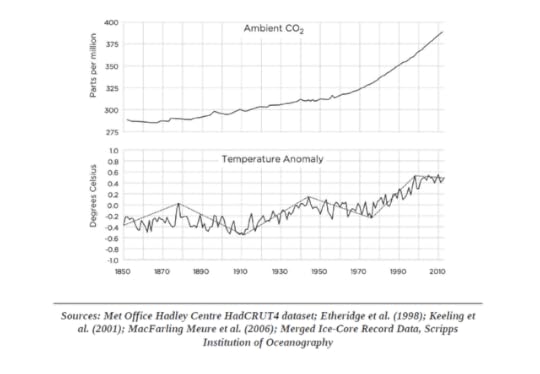
At the heart of the debate over fossil fuels is by what standard of value your ontological reference point lies. There is a conflict between those who use human life as their standard of value vs those who view upholding nature as their standard of value.
He writes:
The book features many different charts and graphs. In this one, the progress fossil fuel has allowed society is depicted. As you can see, they have exponentially improved just about every broad-based metric you can quantify:

I will conclude this review by saying that I found myself agreeing with pretty much all of what Epstein was saying here. He lays out a very compelling case. As countries and societies modernize, they will need access to more, not less energy, if they are to escape the entropy that conspires to drag them all down. As Epstein notes early on here - this energy needs to be 1) cheap, 2) reliable, and 3) scaleable. The only fuel that ticks all those boxes is fossil fuels. Michael Shellenberger writes more about this in his book Apocalypse Never: Why Environmental Alarmism Hurts Us All, as does Steven Pinker in his book Enlightenment Now: The Case for Reason, Science, Humanism, and Progress; both of which I would highly recommend to anyone reading this review.
Hopefully, in the future, more countries will be able to switch over to nuclear energy. But nuclear reactors are not cheap, and require qualified technicians to build, run, and maintain them, which are all factors that limit their usage currently. As well, some countries are now going backwards, and phasing out nuclear energy completely. *FACEPALM*
********************
The Moral Case for Fossil Fuels was an excellent look into the topic. I would encourage anyone triggered by the title to give the book a chance, and let the author lay out his case. The writing here is thoughtful, balanced, nuanced and detailed.
5 stars, and a spot on my "favorites" shelf.
The Moral Case for Fossil Fuels. With a title like this, I'm sure many people will be screeching after reading just it alone... A cursory glance at some of the top reviews here confirms as much.
I'll say right up front that I love reading well-thought-out books forwarding contrarian takes, to see where the author will take their argument. I have challenged (and subsequently changed) many of my previously held assumptions about the world by hearing and carefully examining reasoned arguments from people who held different opinions than myself.
As a general rule and not an exception, people have a tendency to succumb to groupthink, and that groupthink often becomes pathological if left unchecked. This is why it's always important to consider voices and works that can provide heterodox takes. When an issue hits its tipping point (as climate alarmism has), all the more reason to go back in for a careful examination of the fundamentals.
The author makes a bold claim here: If you value human life, then you should support the usage of fossil fuels. You should also support the increase in the usage of these fuels, which are cheap, abundant, and reliable. How does he justify such an unorthodox stance? More below.
Author Alexander Joseph Epstein is an American writer and commentator who advocates for the expansion of fossil fuels. He is the founder and president of the Center for Industrial Progress, a for-profit organization in San Diego, California.
Alex Epstein:
The book opens with a great intro, which effectively sets the pace for the rest of the writing that was to follow. The author writes with a lively, engaging style that doesn't struggle to hold the reader's attention. The book is very readable, and has a great flow. The audiobook version I have is also narrated by author; which is a nice touch I always appreciate.
The quote from the start of this review continues:
"...But, we are told, this cannot continue.
While it might be convenient to drive gasoline cars and get electricity from coal in the short run, and while we might have needed them in the past, the argument goes, in the long run we are making our climate unlivable, destroying our environment, and depleting our resources. We must and can replace fossil fuels with renewable, green, climate-friendly energy from solar, wind, and biomass (plants).
This is not a liberal view or a conservative view; it’s a view that almost everyone holds in one form or another. Even fossil fuel companies make statements like the one the former CEO of Shell made in 2013: “We believe climate change is real and time is running out to take real action to reduce greenhouse gas emissions.”3 President George W. Bush was the person who popularized the expression “addicted to oil.”4 The debate over our addiction to fossil fuels is usually over how dangerous the addiction is and how quickly we can get rid of it—not whether we have one."
Epstein mentions the fundamental problems inherent to society switching over to renewable energy:
"This is the challenge: finding a source of energy that is cheap, plentiful, reliable, and scalable. As we’ve seen, it’s a challenge that is incredibly difficult to overcome. Power from sunlight has the problems of diluteness and intermittency and so requires too many resources to concentrate and store in order to create an independent, scalable power source. And plants are a form of storing solar energy, but they don’t scale well because of the resources needed to grow them and the amount of land available to grow them on."
He notes that climate alarmism is not a new phenomenon, and points to widespread fears and predictions of doom and gloom that date back to the 70s:
"I understand that a lot of smart people are predicting catastrophic consequences from using fossil fuels... and I have studied their predictions extensively.
And what I have found is this: leading experts and the media have been making the exact same predictions for more than thirty years. As far back as the 1970s they predicted that if we did not dramatically reduce fossil fuel use then, and use renewables instead, we would be experiencing catastrophe today—catastrophic resource depletion, catastrophic pollution, and catastrophic climate change. Instead, the exact opposite happened. Instead of using a lot less fossil fuel energy, we used a lot more—but instead of long-term catastrophe, we have experienced dramatic, long-term improvement in every aspect of life, including environmental quality. The risks and side effects of using fossil fuels declined while the benefits— cheap, reliable energy and everything it brings—expanded to billions more people.
Epstein also addresses the assertion that increased Co2 levels cause temperature rise many times in the book. This quote sums up a decent chunk of it:
"Here’s a graph of the last hundred-plus years of temperature compared to the amount of CO2 in the atmosphere. We can see that CO2 emissions rose rapidly, most rapidly in the last fifteen years. But there is not nearly the warming or the pattern of warming that we have been led to expect. We can see a very mild warming trend overall—less than 1 degree Celsius (less than 1.5 degrees Fahrenheit) over a century—which in itself is unremarkable, given that there is always a trend one way or the other, depending on the time scale you select. But notice that there are smaller trends of warming and cooling, signifying that CO2 is not a particularly powerful driver, and especially notice that the current trend is flat when it “should be” skyrocketing.
Given how much our culture is focused on the issue of CO2-induced global warming, it is striking how little warming there has been."
At the heart of the debate over fossil fuels is by what standard of value your ontological reference point lies. There is a conflict between those who use human life as their standard of value vs those who view upholding nature as their standard of value.
He writes:
"This is the essence of the conflict: the humanist, which is the term I will use to describe someone on a human standard of value, treats the rest of nature as something to use for his benefit; the nonhumanist treats the rest of nature as something that must be served.
We always need to be clear about our standard of value so we know the goal we’re aiming at. Aiming at human well-being, which includes transforming nature as much as necessary to meet human needs, is a lot different from aiming to not affect nature. The humanist believes that transforming nature is bad only if it fails to meet human needs; the nonhumanist believes that transforming nature is intrinsically bad and that doing so will inevitably somehow cause catastrophe for us in the long run.
Because many of the people predicting dire consequences from fossil fuel use avowedly do not hold a human standard of value and because the vast majority of discussions on the issue are not clear about the standard of value being used, we need to always ask, when we hear any evaluation: “By what standard of value?”
The book features many different charts and graphs. In this one, the progress fossil fuel has allowed society is depicted. As you can see, they have exponentially improved just about every broad-based metric you can quantify:
I will conclude this review by saying that I found myself agreeing with pretty much all of what Epstein was saying here. He lays out a very compelling case. As countries and societies modernize, they will need access to more, not less energy, if they are to escape the entropy that conspires to drag them all down. As Epstein notes early on here - this energy needs to be 1) cheap, 2) reliable, and 3) scaleable. The only fuel that ticks all those boxes is fossil fuels. Michael Shellenberger writes more about this in his book Apocalypse Never: Why Environmental Alarmism Hurts Us All, as does Steven Pinker in his book Enlightenment Now: The Case for Reason, Science, Humanism, and Progress; both of which I would highly recommend to anyone reading this review.
Hopefully, in the future, more countries will be able to switch over to nuclear energy. But nuclear reactors are not cheap, and require qualified technicians to build, run, and maintain them, which are all factors that limit their usage currently. As well, some countries are now going backwards, and phasing out nuclear energy completely. *FACEPALM*
********************
The Moral Case for Fossil Fuels was an excellent look into the topic. I would encourage anyone triggered by the title to give the book a chance, and let the author lay out his case. The writing here is thoughtful, balanced, nuanced and detailed.
5 stars, and a spot on my "favorites" shelf.

November 14, 2014
It's easy to talk about our beliefs. Living them is a whole other matter. Al Gore whipped the world into a frenzy with An Inconvenient Truth. He then took his private jet back to his 16 room mansion, switched on all the lights, and then set all the oilfields in Kuwait on fire. (I might be mixing him up with someone else on that last one). I'd call that an inconsistent truth.
The point is this. How many self-professed environmentalists have taken the steps they've asked the world to take? They push for legislation to cap our use of oil and our carbon emissions. The smoking gun is, no one has imposed these caps on themselves. They enjoy the benefits of our oil-dependence right along with the rest of us. If I believed the world was going to end if I didn't do "x", then by golly, I hope I'd do "x".
Epstein says fossil fuels are good because the standard of living they’ve made possible. He counters the claims made by Gore and company. He makes a compelling case, and alarmists have a responsibility to this material.
Couple notes:
Two good measures for flourishing are life expectancy and average income. Both have skyrocketed as a direct consequence of fossil fuels.
Epstein accuses environmentalists of not weighing the benefits against the risks. They focus only on the risks.
Incidents of death from climate are down 98%
Environmentalists have it backwards. Were not causing our climate to be more dangerous, were making it more and more safe. This is a direct result of fossil fuels
Were fighting the very thing that makes our climate safer.
The point is this. How many self-professed environmentalists have taken the steps they've asked the world to take? They push for legislation to cap our use of oil and our carbon emissions. The smoking gun is, no one has imposed these caps on themselves. They enjoy the benefits of our oil-dependence right along with the rest of us. If I believed the world was going to end if I didn't do "x", then by golly, I hope I'd do "x".
Epstein says fossil fuels are good because the standard of living they’ve made possible. He counters the claims made by Gore and company. He makes a compelling case, and alarmists have a responsibility to this material.
Couple notes:
Two good measures for flourishing are life expectancy and average income. Both have skyrocketed as a direct consequence of fossil fuels.
Epstein accuses environmentalists of not weighing the benefits against the risks. They focus only on the risks.
Incidents of death from climate are down 98%
Environmentalists have it backwards. Were not causing our climate to be more dangerous, were making it more and more safe. This is a direct result of fossil fuels
Were fighting the very thing that makes our climate safer.
May 16, 2015
It is ironic to be reading this book on the day my provincial government released their climate change plan which calls for the eventual phase out of coal-generated electricity. The cheapest electricity in Alberta.
This book puts forth some interesting points. I particularly appreciated the premise of how much energy a typical American uses which is 186,000 calories per day which is equivalent to the calories to sustain 93 people! Without affordable energy where would our society be? The goal to strive for cleaner energy is nobel but based on the treatise in this book somewhat naive.
An interesting and thought-provoking read. I highly recommend it.
This book puts forth some interesting points. I particularly appreciated the premise of how much energy a typical American uses which is 186,000 calories per day which is equivalent to the calories to sustain 93 people! Without affordable energy where would our society be? The goal to strive for cleaner energy is nobel but based on the treatise in this book somewhat naive.
An interesting and thought-provoking read. I highly recommend it.
Displaying 1 - 30 of 397 reviews