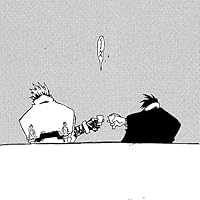
This one's weird, because it was published in 2021, set in 2014, and the characters and art style look like they're straight out of a 1970s detective drama. The hair, the clothes...I can almost hear it all coming off the page like some old classic cop show.
Takahashi has been drawing manga since the 1990s (starting out in shonen and eventually transitioning to BL), so maybe it's just an older style...but even the 90s feels a bit too modern. I wonder if it's just this one, or if all their art is like that.
Anyway, I didn't love the cover, and I thought the art inside might throw me off, but this ended up being a really interesting story. Does it entirely make sense...I mean, no. Asako resonating with the "echoes" of murder victims and manifesting their injuries on his own body is a really cool concept, but he lands in the hospital twice in this volume, due to blood loss from a simple stab wound to the back. What about more violent crimes, like dismemberment or something? It seems kind of careless to be dragging him around to crime scenes without medical teams on site.
But you have to handwave some of that, I guess, and focus on the important parts. Which are that (1) along with the injuries, he picks up the victim's emotions, memories, etc from their final moments. And (2) he's the one dragging himself to crime scenes, because he wants his weird, unsettling ability to mean something. To make a difference, by solving crimes and putting spirits to rest.
Unfortunately, he gets into a bit of a mess when his more experienced detective partner, Kuroiwa, takes him to a crime scene that turns out to be the spot where Kuroiwa's ex-wife was murdered. In her final moments, Mari had not only thought of Kuroiwa, but had died while thinking of having sex with him. That part is a little...I mean, would that really be something you think of while you're bleeding to death? But it, along with the continuing warmth of Mari's feelings, makes Asako pay more attention to his own feelings.
It turns out that he's in love with Kuroiwa...but it's absolutely pointless, because Kuroiwa's feelings are all still for Mari.
This makes the story nicely angsty, even though there are little hints that show Kuroiwa has some level of attachment to Asako, too. He and Mari aren't terribly similar, but they do have certain elements in common, including some important selfless bits that had drawn Kuroiwa to Mari in the first place. And I liked the scene where Asako unknowingly echoed Mari's words from the day she gave Kuroiwa their divorce paperwork...she was tired of being a burden to him, of having him shoulder everything in their relationship.
Kuroiwa panics for a second when Asako says the same thing, but it's been five years since the divorce; he's learned some things he should've done better back then. Like bringing Asako into the meal prep so they're doing things together.
They are living together, incidentally, since Kuroiwa feels responsible for attaching Asako to his ex-wife's case. Asako's special power has another element to it, which is that his resonance with the murder victim doesn't stop until the crime is solved and the criminal is brought to justice. (Does this make sense with Asako having this power as a child, too? I mean...again, no. But oh well.)
Anyway, while the investigation is underway, Kuroiwa is keeping Asako close to him, and sharing a bed (platonically, for now) at night, since physical contact with a living person keeps the echoes at bay. Nicely convenient...for the readers. Not so much for Asako's growing feelings.
This is a series that seems like it could've gone on for quite a while, but since it ends in two volumes, it must just be wrapping up Mari's murder. And then figuring out how the dynamic between Kuroiwa and Asako will change. It'll be interesting to see how that plays out in the remaining space.