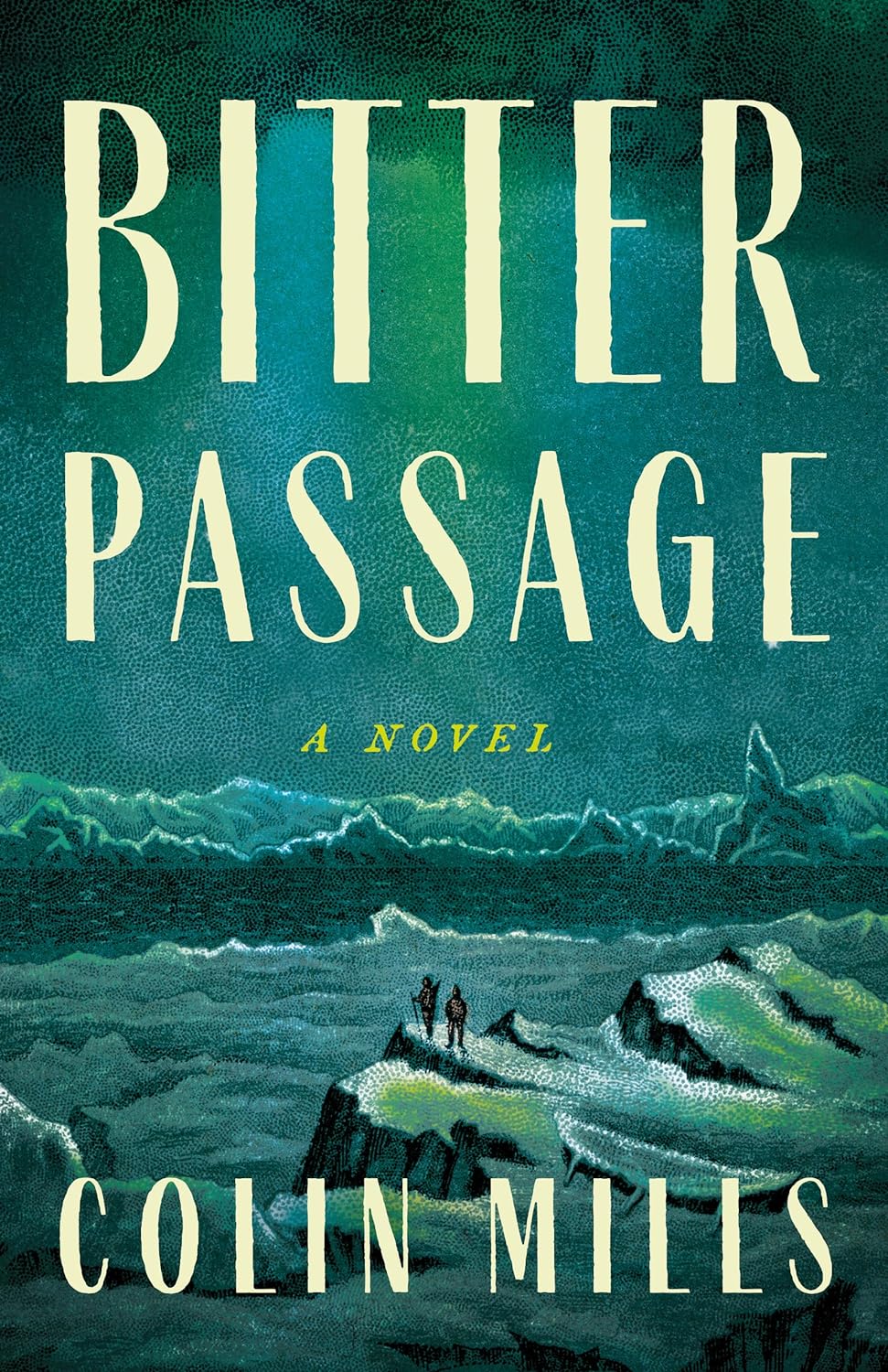
A nineteenth-century Arctic expedition descends into a chilling nightmare in a gripping and epic historical novel of discovery, rescue, deliverance, and survival by any means.
In May 1845, Sir John Franklin, commander of HMS Erebus and HMS Terror, departed England to seek a navigable route across the top of the Americas. He and his 128 men never returned.
Four years later, Royal Navy Lieutenant Frederick Robinson and Assistant Surgeon Edward Adams are determined to find the men missing in the Arctic. While they are united in purpose, they are divided in ambition. The pious and idealistic Adams strives to save his boyhood hero. Robinson hungers for promotion through the Admiralty ranks. Weathering a relationship as volatile as the icy, barren land upon which they trek, Robinson and Adams lead a team of seamen in search of the lost expedition. What awaits them is a struggle against not only the elements but each other as loneliness, starvation, and maddening isolation prove more chilling than the deadliest Arctic blast.
A harrowing novel set against the background of true events, Bitter Passage explores two men’s driving need for redemption and the lengths to which a desperate soul will go to survive.
I grew up in Brisbane. I spent a total of eighteen years living in Japan between 1986 and 2005, with brief stints in Singapore and London, before turning to creative writing.
If you, like me, have a merely healthy obsession with polar exploration in the 19th century, then Bitter Passage will be a book you want to read. And, for the most part, it was a decent enough way to pass the time. It’s a character-driven book about surviving in one of the most hostile landscapes on Earth, following two men who, to put it bluntly, do not like each other one bit, but are forced to depend on one another for survival. In searching for evidence of another expedition’s fate, they find themselves stranded and their only hope is to continue on across the ice. It’s a book that very successfully evokes that bleakness and the vastness of the landscape around the characters. I think if it’s let down anywhere, it’s that it doesn’t make you feel much for these men. I wasn’t that invested in their survival, to be quite honest, or their relationship and its development (or relative lack of? I feel that could have been done better). I read it to find out what happened, rather than feeling compelled by the plot itself. But, like I said, it was a good enough read and not one I regretted.
Netgalley ARC given in exchange for an honest review.
I described this book to my friend as "major Captain Robert Walton from Frankensteincore", which honestly is the most accurate description of this book I can give. Bitter Passage is reminiscent of the bleak, nihilistic tones of Frankenstein, and an excellent read for anyone interested in moral degradation of humans.
While I found the first ~30% of this book rather slow with indistinct characterisation, it grew on me the further Mills explored spiralling humanity and the futility of it all. This isn't a book I think I would usually read, but it was striking and contemplative, and something I would definitely recommend to any lover of the classics. 4/5 stars.
A very dramatic fictional account of a British Naval voyage to the Arctic to search for survivors of an earlier expedition that had searched for evidence of the fate of Franklin's 1825 expedition in search of the Northwest Passage. Containing circumstances based on fact fictionalized by the author using evidence available from other Arctic and Antarctic voyages.
Hard to read due to disturbing scenarios but still well done.
I found this a difficult book to read, the pacing was very slow and I didn't really connect with the characters. I was interested in reading this book to understand more about polar exploration but I found the descriptions of the landscape a bit lacking, it felt like I was only getting tiny glimpses of little specific bits. I spent a lot of time googling pictures of this area to try to ground my reading a bit more but I still found it very difficult. Which is a shame as this is a story so intrinsically linked to its location.
I thought the look into the extremes of the human psyche was interesting but I think I'd found them so unlikeable early on that I struggled to really empathise with them.
The historical research for this book seemed good, it is a book firmly rooted in the time period it is portraying. I don't know if this is just because I read the ARC e-book, but it would have been nice to have had a glossary of terms that are unusual to a modern reader, for example the use of the term "esquimaux", where a modern reader might be more familiar with "Eskimo" or "Inuit".
I think this would be a great book for those who are already very familiar with the time period and location but less so for a relative beginner to polar exploration.
Thank you to Colin Mills and NetGalley for the ARC.
tldr: if you have a completely healthy obsession with the Donner party, Frankenstein, Mt. Everest, The Revenant or the Mary Celeste, you'll want to pick this up immediately.
Cannibalism, colonialism, and climate change! The first 25% of this book is walking. The next 30-75% is walking a little faster and with a different goal. The last 25% is, again, walking, but to another place. The author does a great job of building tension and developing the characters in a way that makes you completely invested in what happens. This book will challenge you to look beyond the page to think about why humans do so many insane things in the name of fame. Even someone with zero knowledge of the real Franklin voyage will enjoy this, and it will have a big impact if you're looking for a nice, nihilistic read.
I joke about being God's toughest warrior when I have a stomachache, but starving in the barren wasteland of the North Pole is one of the worst deaths I can imagine. Very well done! I'm going to turn up my heat and take a hot shower 🧊
Although a very interesting subject, the pacing of this book was unfortunately too slow for me.
I found the characters very difficult to connect with and their development fairly surface-level. I also found the descriptions of the landscape fairly basic and found it very difficult to envisage.
I started this book with pretty high hopes, but it just fizzled out for me. The ratio of ‘interesting’ to ‘length’ was its downfall. I flew through the first half in about a day, but the second half dragged so much it took me about a week to get through. By the end, I was finishing it just to say I did, rather than actually wanting to, if you know what I mean.
This book is beautiful and brutal. I had a great time pulling up Arctic maps to follow along with their journey. I’m definitely inspired to learn more about the Arctic expeditions.
The pacing was very slow, thought, and I almost DNF’d because of it: there was nothing but walking for the first half of the book. The ending as well isn’t rushed as much as it feels unresolved, which was extremely unsatisfying considering everything that happened on the journey.
Overall a really interesting subject matter and I learned a lot!
Thank you to NetGalley, Colin Mills, and Lake Union Publishing for an advanced copy in exchange for an honest review.
Solid 4 stars. In 1845 two ships, Terror and Erebus, were sent on an expedition to find the Nort-West Passage. They were last seen in 1845 in Baffin Bay and then the ships along with the crew vanished. To this day we have no clue as to what happened. In the book, the British Admiralty decides to send a ship on a rescue mission. The mission is to find out what happened and bring the survivors home. Why did nobody think that these men could get into trouble, too? The author brilliantly describes the Arctic, its weather conditions, what it is like to be starving, and what it is like to be homesick. When a bunch of people must to spend a long time in close proximity, surrounded by a harsh environment with nothing to eat, what happens? How a person in charge can keep the people in order? The author understands that well. He also describes the historical and social context with a great understanding of the past. I'm adding Mr. Collin Mills to my list of interesting authors. It's a brilliant book and quite realistic.
Royal Navy Lieutenant Frederick Robinson and Assistant Surgeon Edward Adams are two of an expedition to find Sir John Franklin and the crews of HMS Erebus and HMS Terror, which hasn't been heard of for 4 years. But the Arctic is a terrible and unforgiving place, and they'll be lucky to survive, let alone find Franklin.
So I nearly quit this book a couple of times. It's pretty slow-moving, with lots of description of the landscape. But I finally got into it when I started reading more than just tiny bits and pieces - this is a book that needs a bit of momentum to become interesting. And the tense relationship between Robinson and Adams is the real highlight of this book. It's a good book (3.5 stars) but the reader will need to put forth some effort.
Sheesh. 300 pages of unrelenting misery. Starvation, scurvy, hypothermia, botulism, depression, loneliness, madness from years on the ice – and cannibalism. Historically, Sir John Franklin left England in 1845 to search for the elusive Northwest passage. He and his whole crew died, but crews kept setting out to find him. Eventually, more ships and men were lost looking for him than were lost in the original failed expedition. The novel is about one of the search teams. One of the characters remarked on the fact that if you die and lose all your men in a poorly planned adventure, you are likely to get a statue erected to you in a salute to your bravery and martyrdom for the cause of finding the passage. But if you return from a search with most of your men alive, you are only remembered for having failed to find the desired route, not for returning your crew to their families.
I think I went into this thinking it was a true or mostly true account and quickly figured out it wasn’t but I was already too far in to quit. Fun read anyways.
I got this book for free through the Amazon First Reads program. It's not my usual genre but I'm glad I read this. It was very good, even if the subject material was appalling and horrific. It took me a little bit to get into it (there were just a lot of names in the beginning to become acquainted with and I definitely got confused at times) but once I was into it, I found this to be a well written and incredibly memorable novel.
This book was based on true events! In the 1840's-1850's, England was searching for the fabled Northwest Passage -- a route through the Arctic seas that will take you from the Atlantic to the Pacific Ocean. Such a route would be incredibly useful for trade routes and whatnot. But Sir John Franklin's team has disappeared for 4 years now, and now our story begins with a new ship the Royal Navy has dispatched to find the missing ones. Our main characters are the Lieutenant Robinson, a man searching for a promotion to captain, and the ship's surgeon, Edward Adams, a very pious man who believe God has brought him here to find Sir Franklin.
Story sounds simple but this was a heavy read. Few novels I have read where the hopelessness, the desolation, the emptiness, the suffering and misery, is felt so keenly from the text. I found it emotionally taxing to read about these characters enduring incredible hardship and I definitely found it hard to read at night (actually, I avoided reading this at night) because the scenes in the latter half of the book kind of freaked me out, hah.
I know some people might dismiss this book as 'a group of people walk around in the Arctic for ages', and while I can't deny they do a lot of trudging through snow and ice, pitching tents, and hunting for food, I was never bored reading about it. In fact, most of the time, I was thinking, oh god how are they going to stay warm? Find food? Stave off infection and frostbite? Not kill one another because they're so irritable with one another? etc. They're not having an adventure, this is a rescue mission that's going poorly, in what feels like the lowest level of Hell. And I felt like it was scary at times too, not just because of polar bear attacks or whatever, but when they
If you like historical fiction with a dash of horror, this is for you!
(For the PopSugar 2025 Reading Challenge, this book fulfills prompt #43: Nature is the antagonist. If you got the book through Amazon First Reads, it will also fulfill prompt #10: A book you got for free.)
In 1845 an expedition led by Sir John Franklin set out to find the Northwest Passage. It disappeared. In later years a number of other teams set out to try to find what happened to Franklin and his men.
So much is fact, this novel focuses on a small party from the 1848 expedition. It’s led by two young officers (both based on real people), Lieutenant Robinson – keen for some achievement that will gain him recognition and promotion, and Assistant Surgeon Adams – driven by his strong Christian faith and admiration for Franklin. The two men are very different, but thrown together in the extreme Arctic conditions they come to recognise each other’s qualities.
It’s a story of relentless hardship, dragging their supplies by sledge, battling against the environment and struggling to eke out food supplies. It also raises a number of moral questions around the things that men will do in order to survive.
The subject matter means this will never be an easy read but it’s well written and researched with a storyline that will grip you more tightly as you progress.
Obtained free under the Kindle First Reads programme.
Started out pretty slow, wasn’t sure I would finish it. Difficult to follow the locations while reading it on a kindle as the map was in the beginning of the book and very small! Gets better farther along. I think this would make an outstanding movie.
Lieutenant Frederick Robinson and Surgeon Edward Adams are an unlikely pair with an important assignment- one close to each of their hearts. In 1848, Robinson and Adams have acquired a team of rugged sea-faring men tasked with finding and bringing back Sir John Edward and his 128 men that went missing four years prior while attempting to navigate a new trade route to the Americas.
Knowing their trek through the Arctic will be unkind to even those with the strongest resolve, the group sets out on their noble mission. Unbeknownst to one another, Robinson and Adams each have their own motives for undertaking this journey. Are they enough to stand the test of the elements and extreme isolation? Even their worst nightmares could not have prepared them for what they will find in that desolate space their souls will come to know as a spiritual wasteland.
I read a couple reviews before undertaking this book that mentioned it being "too slow." I didn't feel that way at all. I thought it was really well-paced for an outdoor thriller. There were a lot of interesting elements of the story that Colin Mills introduced- flashbacks to childhood and spouses at home, friendship, career, and the psychological test of harsh weather. With that being said, I think I could agree with someone if they said this was a "slow-burn" thriller. A good break from what I would normally go for, I give this four stars.
The writing in this book was impeccable. Never have I been so interested in a book about nothing. Kinda creepy, abysmal, but a page-turner nonetheless. If you have knowledge/interest in the northwest passage, it’s a good read. If you don’t, or are expecting some satisfying solution at the end, you’ll be disappointed. Definitely more about the journey than the destination. I liked it!
In his debut novel, Colin Mills masterfully weaves a gripping tale of survival, redemption, and moral deterioration set against the backdrop of one of history's most fascinating maritime mysteries - the disappearance of Sir John Franklin's 1845 Arctic expedition. Bitter Passage is a remarkable achievement that combines meticulous historical research with profound psychological insight, creating a narrative that is both historically authentic and deeply human.
Historical Context and Plot Synopsis
The story follows Royal Navy Lieutenant Frederick Robinson and Assistant Surgeon Edward Adams as they lead a sledge team south from Port Leopold in 1849, searching for Franklin's lost expedition. While both men share the same mission, their motivations couldn't be more different. Adams, driven by religious fervor and hero worship, seeks to rescue his childhood idol Franklin. Robinson, pragmatic and ambitious, sees the mission as his last chance for promotion in a peacetime navy.
What begins as a straightforward rescue mission evolves into a harrowing journey of survival and moral compromise. As the team ventures further south, they encounter increasingly disturbing evidence of Franklin's fate, forcing them to confront the terrible choices that desperate men make when faced with starvation and isolation.
Strengths and Literary Merit
Character Development
Mills excels at character development, particularly in his portrayal of the complex relationship between Robinson and Adams. The contrast between Adams' religious idealism and Robinson's practical ambition creates a compelling dynamic that drives much of the narrative tension. As their journey progresses, both characters evolve in unexpected ways, their initial convictions tested and transformed by their experiences.
The supporting characters are equally well-drawn, particularly:
- James Billings, the simple but loyal seaman - Samuel Honey, one of Franklin's surviving crew members - James Walker, whose presence adds a chilling dimension to the story's climax
Atmospheric Writing
The author's description of the Arctic landscape is exceptional. Mills creates an atmosphere of oppressive isolation and creeping dread, where the environment itself becomes an antagonist. His prose is precise and evocative, capturing both the physical and psychological effects of extreme cold, constant daylight, and crushing solitude.
Historical Authenticity
Mills' attention to historical detail is impressive. From the technical aspects of nineteenth-century Arctic exploration to the social and cultural context of the Victorian era, the novel feels thoroughly researched and authentic. The author skillfully integrates historical facts with fictional elements, creating a seamless narrative that respects the historical record while taking creative liberties where appropriate.
Areas for Improvement
Pacing Issues
The novel's middle section occasionally suffers from pacing issues. Some readers might find the detailed descriptions of sledge travel and daily survival repetitive, though these sections do contribute to the overall atmosphere of grinding hardship.
Character Motivations
While Robinson's character arc is well-developed, his initial motivation for the journey sometimes feels underdeveloped. His desire for promotion, while plausible, could have been given more psychological depth early in the narrative.
Themes and Symbolism
Moral Decay
The central theme of moral decay is handled with remarkable subtlety. Mills shows how extreme circumstances can erode moral certainties, leading even the most principled characters to commit acts they would have previously found unthinkable.
Faith and Doubt
Adams' religious faith serves as a fascinating lens through which to view the events of the novel. His struggle to reconcile his religious beliefs with the harsh realities he encounters adds depth to the story's exploration of human nature.
The Price of Ambition
Through Robinson's character, Mills examines the cost of ambition and the moral compromises people make in pursuit of recognition and advancement.
Writing Style and Technical Elements
Mills' prose style is precise and effective, avoiding melodrama while maintaining tension. His background in investment banking and his academic pursuits in creative writing are evident in his methodical approach to storytelling and his attention to detail.
Historical Fiction Elements
The novel succeeds admirably in its handling of historical fiction conventions. Mills manages to create suspense even though many readers will know the broad outlines of Franklin's fate. The author's note provides valuable context about the historical facts underlying the fiction.
Impact and Significance
Bitter Passage makes a significant contribution to the literature of Arctic exploration and survival. It stands alongside works like Dan Simmons' The Terror in its ability to use the Franklin expedition as a lens through which to examine human nature under extreme circumstances.
Final Assessment
Despite minor flaws, Bitter Passage is an impressive debut novel that succeeds both as historical fiction and as a psychological thriller. Mills has created a compelling narrative that explores profound questions about human nature while maintaining historical accuracy and narrative tension.
This is a lovely piece of writing, but I struggle a lot with novels where the fictional version of something is decidedly less exciting than the dozens of nonfiction accounts addressing the topic.
I guess I just wonder why this book exists, when we have loads of faithful accounts of real polar disasters and rescues that are far more successful at keeping the reader on the edge of their seat.
It’s a subject that has lent itself well to fiction in many instances, but doesn’t need to be fictionalized to be exciting, so if we’re not adding to either the thrill or the sense of place of it all, there doesn’t seem touch point.
If you just can’t get enough of polar disaster fiction, this is at least well written and atmospheric, and the author has done a very good job of trying to be authentic. But I was expecting something both more exciting and more imaginative, and I didn’t get either.
*I received an ARC of this book in exchange for an honest review.*
The author has wrapped his tale in juicy language and sweet lore. Mills spun a tale that will keep you moving along, just like the ice floes on the passage…never stopping, surprising you at once, and repeating the same picture again and again.
I loved the read for these reasons: the detailed descriptions of the Arctic weather, the terrain and the sudden changes. Second, his powerful descriptions of how a man changes in the freezing cold and the bitter solitude. And third, the statements of truth that are unavoidable and clear.
Try this one on for size:
“Once uttered, a lie can harden and become as durable as clay fired in a kiln. A man need only laugh and spin a yarn for a falsehood to become fact. It takes so little effort to make it true.”
Thank you to NetGalley, Lake Union Publishing and the author Collin Mills for an ARC of this book.
With historical fiction being my favorite genre, I was quite exited to read a story about Arctic exploration in the 1800s. What I was not expecting was how disturbing the story would be. Spoiler alert - don’t read this book while eating! There were times when I was so disgusted by what I read. However, the most astounding part of that is that this book was based upon true events. Yes, there was quite a bit of cannibalism in this story which historians believe truly happened during the Arctic expeditions based on markings found on the bones of recovered bodies.
Overall this was a well written and interesting tale, but one which was very difficult to read.
I’ve never read anything quite like Bitter Passage… Though fictional, it paints a brutal and hauntingly realistic picture of what some men endured during Arctic expeditions in the 1800s. Isolation, hunger, and the kind of cold that makes bones ache and skin rot. The harsh, desolate landscapes of the Arctic left men with no choice but to confront their most primal instincts. Once scurvy set in, death often followed. And when there was no game in sight and no help on the horizon, some were pushed to choices that defy comprehension. It’s a brutal reminder of how far desperation can stretch the human will to live. Would you do the unthinkable if it meant you could survive?
This was gruesome, dark and truly scary at some points. The descriptions of the land and nature were beautiful and could have easily made this book a pain to get through but it really emphasized how disturbing the story was in between these beautiful paragraphs. I will now be hyper fixating on the fact that this is based on true events!! I will also be having nightmares about scurvy, 4/5 ⭐️!!
** also if you read other people's reviews on "how slow" this book was and how much walking happens in the first half of the book. they're idiots and lack all common sense. that's literally the point of the book, the characters are walking hundreds of miles through the arctic. just an fyi so no one get's turned off by a lot of people's dumb reviews. it's worth pushing through the first 1/3 of the book to get to the meat of the plot**
I love stories written about this period in time. The HMS Erebus and Terror leave on a Polar Expedition in 1845. The captain and his crew - 128 souls - disappear.
Four years later Lieutenant Robinson and Assitant Ship Surgeon Adams beging looking for the lost party. The conditions they are searching in are extreme and they quickly run out of food. They find Terror, but what they find there will chill you to the bone!
I really enjoyed this book! I'll be honest, when I read this book I didn't know there was any connection to actual Arctic exploration until I completed the book and read the authors notes listing real connections to explorers during this time period. This book isn't just two royal navy men exploring the Arctic, but a true journey to find who they are as people. The lengths to which they will go in search of the truth but also to find who they really are.
I have always been fascinated by explorers and have had the pleasure to study them academically. The expedition of Sir John Franklin in 1845, to seek out the Northwest Passage in the Arctic has the extra mystery in that the two ships he took (HMS Terror and HMS Erebus) never returned and no messages from the crew ever arrived home. Four years after their disappearance, Franklin's wife and others organised many searches for the missing men, and this novel is a story about how such an event may have been.
The two main characters in this account are based on real people and they are very different. They often clash in their viewpoint, one admiring Franklin to hero status while the other aspires to professional recognition. They connect as they both want to find out what happened to the ships and crew. Their thoughts are shown in sharp contrast as the author jumps from one character to the next and fortunately there are only on a few characters in each scene. The crew members they refer to are names I recognise from historical accounts of the expedition, which makes the story have a genuine thread.
The first half of this book is very slow, with the men making their way through the challenges presented by the ice, descriptions of the landscape and their ailments as well as hunting the few animals that exist in this environment. After the the fifty per cent mark however, the story lifts through some discoveries and life and death situations. My reading patience pays off.
This is a well written if a tad tedious book at times, impeccably researched in historical information, although I'm not sure whether using the spelling 'Esquimaux' for the indigenous peoples makes it more authentic. A story about survival, guilt, loneliness and ambition, and how people can believe in a collective truth despite knowing otherwise.