

What do you think?

The White Bull
In the reign of Minos, King of the Cretans, the gods gave proof of their existence: a bull-headed man accompanied by his bronzen servitor strode forth from Neptune's realm. At last the gods had removed the veils that separated them from their worshipers... or had they?
Strangely enough, the Minotaur forswears all claim to divinity — and his metallic servant cannot speak at all. Instead, he comes to the Greeks bearing gifts of alien knowledge. But Daedelus at least will have cause to beware the teachings of The White Bull.
Strangely enough, the Minotaur forswears all claim to divinity — and his metallic servant cannot speak at all. Instead, he comes to the Greeks bearing gifts of alien knowledge. But Daedelus at least will have cause to beware the teachings of The White Bull.
323 pages, Mass Market Paperback
First published December 1, 1988
About the author
Fred Saberhagen
336 books508 followersFred Saberhagen was an American science fiction and fantasy author most famous for his ''Beserker'' and Dracula stories.
Saberhagen also wrote a series of a series of post-apocalyptic mytho-magical novels beginning with his popular ''Empire of the East'' and continuing through a long series of ''Swords'' and ''Lost Swords'' novels. Saberhagen died of cancer, in Albuquerque, New Mexico
Saberhagen was born in and grew up in the area of Chicago, Illinois. Saberhagen served in the [[U.S. Air Force]] during the Korean War while he was in his early twenties. Back in civilian life, Saberhagen worked as an It was while he was working for Motorola (after his military service) that Saberhagen started writing fiction seriously at the age of about 30. "Fortress Ship", his first "Berserker" short shory, was published in 1963. Then, in 1964, Saberhagen saw the publication of his first novel, ''The Golden People''.
From 1967 to 1973, he worked as an editor for the Chemistry articles in the ''Encyclopædia Britannica'' as well as writing its article on science fiction. He then quit and took up writing full-time. In 1975, he moved to Albuquerque, New Mexico.
He married fellow writer Joan Spicci in 1968. They had two sons and a daughter.
Saberhagen also wrote a series of a series of post-apocalyptic mytho-magical novels beginning with his popular ''Empire of the East'' and continuing through a long series of ''Swords'' and ''Lost Swords'' novels. Saberhagen died of cancer, in Albuquerque, New Mexico
Saberhagen was born in and grew up in the area of Chicago, Illinois. Saberhagen served in the [[U.S. Air Force]] during the Korean War while he was in his early twenties. Back in civilian life, Saberhagen worked as an It was while he was working for Motorola (after his military service) that Saberhagen started writing fiction seriously at the age of about 30. "Fortress Ship", his first "Berserker" short shory, was published in 1963. Then, in 1964, Saberhagen saw the publication of his first novel, ''The Golden People''.
From 1967 to 1973, he worked as an editor for the Chemistry articles in the ''Encyclopædia Britannica'' as well as writing its article on science fiction. He then quit and took up writing full-time. In 1975, he moved to Albuquerque, New Mexico.
He married fellow writer Joan Spicci in 1968. They had two sons and a daughter.
Ratings & Reviews
Friends & Following
Create a free account to discover what your friends think of this book!
Community Reviews
Displaying 1 - 14 of 14 reviews

July 1, 2024
This was fine for what it was but I've never been all that interested in myth retellings.

September 18, 2010
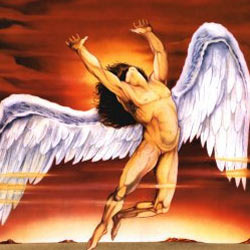
Contained in this book: the secret of the flight of Icarus! And how he went down like a lead zeppelin!
Fred Saberhagen is one of the 2nd tier of SF writers whose work appeals to me. He's not a household name, so I can't possibly rank him above "2nd tier", but at least among SF fans his creations (the Berserker series, the Swords series, the Dracula series, the Empire of the East series) are well-regarded if admittedly a bit under-appreciated.
Here is one of his lesser works: a stand-alone novel not part of any series (despite what the title blurb hints when referring to the Pilgrim series titles "Pyramids, After the Fact, and now The White Bull"). The Baen edition that makes that misleading assertion also exists alone as the singular time this work was published, so tracking down a copy may be tricky.
The novel appears to be an expansion of a 1977 novella with the same name, which may explain the abruptly unsatisfying ending. I definitely want to find the short version to read for comparison.
In general, this was a smart, quickly-paced, intriguing read. Saberhagen certainly was a master story-teller and even in one of his lesser-known works he delivers a satisfying yarn that appeals on multiple levels. The premise of the book is a retelling of the Daedalus and Theseus myths, including the minotaur, the labyrinth, Icarus' flight, and so on. Let the reader beware, however: the myths differ drastically from any version previously encountered, and the feats explained in the book are definitely science fiction (and not fantasy). This is a modernization (or a reboot, if you will) of these mythological legends.
The characters were engaging, the plot engrossing, and the tension positively engulfing at times. Saberhagen really made these ancient times come alive, and the advanced technology of Daedalus was explainable without being anachronistic. The White Bull, while seen by most commoners in the book as a god, was obviously of interstellar origins, and Saberhagen actually was quite skillful in making the Bull's character largely sympathetic (but never above suspicion) in the reader's mind.
My only complaints were Daedalus himself, as I couldn't always understand his choice of actions, and the undeniably crudely sloppy ending, which came across as a gimmick (if not outright deus ex machina) more than anything.
3.5 stars.
Fred Saberhagen is one of the 2nd tier of SF writers whose work appeals to me. He's not a household name, so I can't possibly rank him above "2nd tier", but at least among SF fans his creations (the Berserker series, the Swords series, the Dracula series, the Empire of the East series) are well-regarded if admittedly a bit under-appreciated.
Here is one of his lesser works: a stand-alone novel not part of any series (despite what the title blurb hints when referring to the Pilgrim series titles "Pyramids, After the Fact, and now The White Bull"). The Baen edition that makes that misleading assertion also exists alone as the singular time this work was published, so tracking down a copy may be tricky.
The novel appears to be an expansion of a 1977 novella with the same name, which may explain the abruptly unsatisfying ending. I definitely want to find the short version to read for comparison.
In general, this was a smart, quickly-paced, intriguing read. Saberhagen certainly was a master story-teller and even in one of his lesser-known works he delivers a satisfying yarn that appeals on multiple levels. The premise of the book is a retelling of the Daedalus and Theseus myths, including the minotaur, the labyrinth, Icarus' flight, and so on. Let the reader beware, however: the myths differ drastically from any version previously encountered, and the feats explained in the book are definitely science fiction (and not fantasy). This is a modernization (or a reboot, if you will) of these mythological legends.
The characters were engaging, the plot engrossing, and the tension positively engulfing at times. Saberhagen really made these ancient times come alive, and the advanced technology of Daedalus was explainable without being anachronistic. The White Bull, while seen by most commoners in the book as a god, was obviously of interstellar origins, and Saberhagen actually was quite skillful in making the Bull's character largely sympathetic (but never above suspicion) in the reader's mind.
My only complaints were Daedalus himself, as I couldn't always understand his choice of actions, and the undeniably crudely sloppy ending, which came across as a gimmick (if not outright deus ex machina) more than anything.
3.5 stars.

October 4, 2016
This novel could have a been amazing. The concept was fascinating - a story, told by Daedalus, about his exploits on Crete, why he built the maze, why he fashioned wings, how his son really died, and also bringing in other major Greek mythological characters such as Herakles, Ariadne, Theseus and several more. And not only, the idea that the Minotaur and the gods/demi-gods were actually . How did I not love this novel? I'll tell you.
It started off very strong. Daedalus, despite having a slave woman in toe, was a rather devoted father and a interesting character (for all of twenty pages). But he never really develops or changes. You just kind of follow him around, and he doesn't express emotions. He thinks his emotions a la "I was sad because my son died", but he never acts any different or changes his personality due to grief or success. He's a very flat character. And it's the same with everyone. Why would Ariadne run off with Theseus when she was the next ruler of Crete? Are we just to assume that all women take off after hot dudes? Stupid.
And then there was the lack of real focus on the Minotaur. We never really see his perspective or learn ANYTHING about his people. I mean, it's assumed that he's from a much more advanced society, but we never learn anything about him. And what's with the demi-Gods? Are they aliens too? Half aliens? What the hell.
The story also is kind of boring because Daedalus is a shitty narrator. As well as being very flat, he tells the story as if he's telling it orally to a group of people, but when you read that there's no inflection of tone, no dramatic pacing. It's boring.
The end is rushed, the plot is stupid, and there are weird comments here and there that were gross, like how Daedalus comments that a couple of Ariadne's handmaiden's weren't attractive enough to be considered "rape-able" by marauders. Lovely. Thanks for rating women on that scale (or on any scale, really; women aren't fucking livestock). Daedalus, you're a prick.
Anyway, I think the most amusing part about this book was when I looked over at my husband and saw him on his phone zooming in on the chassis of a 1995 Silverado with great concentration and I laughed at him (seriously, his hobby is looking at old cars and trucks on kijiji that he'll never buy), but then he raised his eyebrows and said "you're the one reading a book about a stupid Minotaur." Touché, husband, touché.
It started off very strong. Daedalus, despite having a slave woman in toe, was a rather devoted father and a interesting character (for all of twenty pages). But he never really develops or changes. You just kind of follow him around, and he doesn't express emotions. He thinks his emotions a la "I was sad because my son died", but he never acts any different or changes his personality due to grief or success. He's a very flat character. And it's the same with everyone. Why would Ariadne run off with Theseus when she was the next ruler of Crete? Are we just to assume that all women take off after hot dudes? Stupid.
And then there was the lack of real focus on the Minotaur. We never really see his perspective or learn ANYTHING about his people. I mean, it's assumed that he's from a much more advanced society, but we never learn anything about him. And what's with the demi-Gods? Are they aliens too? Half aliens? What the hell.
The story also is kind of boring because Daedalus is a shitty narrator. As well as being very flat, he tells the story as if he's telling it orally to a group of people, but when you read that there's no inflection of tone, no dramatic pacing. It's boring.
The end is rushed, the plot is stupid, and there are weird comments here and there that were gross, like how Daedalus comments that a couple of Ariadne's handmaiden's weren't attractive enough to be considered "rape-able" by marauders. Lovely. Thanks for rating women on that scale (or on any scale, really; women aren't fucking livestock). Daedalus, you're a prick.
Anyway, I think the most amusing part about this book was when I looked over at my husband and saw him on his phone zooming in on the chassis of a 1995 Silverado with great concentration and I laughed at him (seriously, his hobby is looking at old cars and trucks on kijiji that he'll never buy), but then he raised his eyebrows and said "you're the one reading a book about a stupid Minotaur." Touché, husband, touché.
August 10, 2024
Slow. There are so few good books published that I have to ration myself lest I read all my hard-won but tiny cache of good books in a day or so. So, I tried a second-hand book shop. I made it to page 49 of this Bull story and nothing much has happened. ‘Four years after…’ just blew me entirely out of this book. A story requires things to be happening, it should not just waffle on and on to meet some publisher’s deforestation quota.
It seemed worthwhile to try something left field: royals that collaborate with aliens etc. What’s not to love about kings and princes that beat us up on behalf of a non-Terrestrial power. Oh wait, that’s right, all Royal Families probably work for Gods of some kind. Unfortunately, this Daedalus is a plumber, and I believe Mario would do a better job. Fortunately, this same bookshop had two more Weather Warden books- stories that begin properly, on page 1.
It seemed worthwhile to try something left field: royals that collaborate with aliens etc. What’s not to love about kings and princes that beat us up on behalf of a non-Terrestrial power. Oh wait, that’s right, all Royal Families probably work for Gods of some kind. Unfortunately, this Daedalus is a plumber, and I believe Mario would do a better job. Fortunately, this same bookshop had two more Weather Warden books- stories that begin properly, on page 1.

November 27, 2025
A generous 3 stars. Most of the book was solid, but the final act waned somewhat. Still fun, and definitely has reignited my interest in Ancient Greece/Greek Mythology. A fun read, but unfortunately nothing incredibly interesting either!

January 13, 2026
Really, I'd put it at 3.5 but ...
A reimagining of the old myths through the eyes of Daedalus I found it more interesting than the current, bland and repetitive, crop retellings of stories, tales and myths. OTOH it is not one of Saberhagen's better efforts.
A reimagining of the old myths through the eyes of Daedalus I found it more interesting than the current, bland and repetitive, crop retellings of stories, tales and myths. OTOH it is not one of Saberhagen's better efforts.

July 1, 2025
It was an engaging book, that puts an interesting twist on the greek mythologies.

February 10, 2026
A fun and entertaining story of Daedalus and the Minotaur. The Greek mythology retellings of Icarus with some interesting science fiction elements. I enjoyed the narrative of an older Daedalus recounting the events that impacted him and the Minotaur. This was my first book by this author. It was a free read on audible and I’m glad I found it. I will definitely read again. Wish it hadn’t ended so abruptly but I really loved this one.

March 7, 2014
The White Bull tells the story of Daedalus and the Minotaur, with science fiction elements replacing the acts of the gods. It was fun to see the author stick to the mythology while coming up with explanations for the fantastical elements.
The book is narrated by Daedalus himself and I thought Fred did a good job portraying the older, wiser Daedalus narrating his earlier adventures.
The only real problem I had with the book is that it ended abruptly.
I enjoyed the book and will read others by Mr Saberhagen. I already have a couple of his Berserker books and his Empire of the East trilogy lined up.
The book is narrated by Daedalus himself and I thought Fred did a good job portraying the older, wiser Daedalus narrating his earlier adventures.
The only real problem I had with the book is that it ended abruptly.
I enjoyed the book and will read others by Mr Saberhagen. I already have a couple of his Berserker books and his Empire of the East trilogy lined up.

August 14, 2011
Strangely absorbing, yet ultimately pointless. Overall, the characterization was weak. I never felt connected to any of the characters. I never felt a sense of loss for any of the people who died because no genuine reason to believe in them ever was presented. The ending was abrupt, leaving me without a satisfactory conclusion-- it's like Saberhagen just got tired of writing and stopped right there.

February 18, 2009
A very far-fetched view of mythology. But a fun read.

May 3, 2023
A fun ride. Mythological scifi/fantasy.

June 5, 2010
I would have given it 4 stars, except that the ending was pretty weak.

July 1, 2012
Drab. Yuck. Boring. Didn't like it. Stick to Berserker or Lost Swords series. Bleh. =(
Displaying 1 - 14 of 14 reviews