Jump to ratings and reviews
Rate this book

The Evolution of Simulated Universes

Rate this book
With improvements in quantum computer processing, entire universes will someday be simulated inside computers...

In Mark Solomon's first work, On Computer Simulated Universes, he argued that all of us exist within a computer simulated universe. In his enlightening new book, Solomon contends that our own Universe is the product of selection and evolutionary forces. The author concludes that if our Universe is simulated, then the selection and evolution of simulated universes becomes inescapable. This book will expand your thinking on the nature of the Universe as well as prompt a reexamination of accepted notions of reality itself.

50 pages, Paperback

First published February 18, 2014

4 people are currently reading
185 people want to read

About the author

Mark J. Solomon

2 books5 followers
Mark J. Solomon (born 1969) is an American non-fiction writer, philosopher and published neuropsychologist.

In Solomon's first work, On Computer Simulated Universes (2013), he entertains just one central idea, that all of us exist within a computer simulated universe. In his second work, The Evolution of Simulated Universes (2014), the author contends that our Universe, not unlike our own human species, is the direct product of natural selection and evolutionary forces. He concludes that if our Universe is simulated, then the selection and evolution of simulated universes becomes inescapable.

Solomon attended Washington University in St. Louis, T.T.U., Tulane University & Brown University. He resides with his wife in North Carolina.

Ratings & Reviews

What do you think?
Rate this book

Friends & Following

Create a free account to discover what your friends think of this book!

Community Reviews

5 stars
7 (31%)
4 stars
5 (22%)
3 stars
2 (9%)
2 stars
5 (22%)
1 star
3 (13%)
Displaying 1 - 7 of 7 reviews
Profile Image for Manny.
Author 48 books16.1k followers
August 22, 2016
[Original review, Feb 27 2014]

I recently reviewed Mark Solomon's short book On Computer Simulated Universes , where the author sketches out his version of the idea that our universe could be a simulation created by some technologically advanced society. He goes on to elaborate the scenario by postulating that simulations can be nested to a great depth, creating what he picturesquely calls a "matryoshkaverse". The ideas are justified by referring to recent advances in quantum computing.

As I said in my review, the logical problem with the idea is that it will only work if a simulation can contain as much, or more, information than the original universe which contains it. Since quantum theory postulates that the universe contains a finite amount of information, that seems, on the face of it, impossible. In his new book, Solomon tries to argue that a simulation can in fact contain more information than the hosting universe. The key passage is the following:
One criticism of the Computer Simulated Universes hypothesis is the assertion that the amount of information contained within a newly created universe cannot be more than the universe that contains it. Regardless of the inherent nature and structure of information, this is not a valid criticism. When discussing the basic theory of evolution and natural selection within the context of animal species here on Earth, there is little difficulty accepting the fact that one particular organism could produce an offspring organism slightly more complex and contain slightly more information than its parent. The conspicuous reason for this is that the offspring organism and its parent organism both share a world that contains a much larger resource of information.

Just like in animal species, the amount of information contained within any newly created universe can contain more information than its direct parent universe. This is true because any universe and its parent universe are both contained within a larger universe within a series of nested universes, or matryoshkaverse. Thus, any particular universe can contain more information than its direct parent universe.
I do not accept this argument at all. If Universe-1 contains Universe-2, which in turn contains Universe-3, the claim that Universe-3 can be larger than Universe-2 by exploiting resources from Universe-1 surely negates the postulate that 3 is contained in 2. If a universe can reach higher up the chain, whatever does "contain" or "simulation" mean? How can a simulation reach outside itself, indeed reach outside the universe containing the machine running it? The analogy with animal species is misleading.

Having just read Deutsch's The Fabric of Reality and Tegmark's Our Mathematical Universe, I can see that there are some highly regarded scientists who also enjoy this kind of imaginative speculation. Solomon is in good company. But that doesn't make me any more likely to believe it.
____________________

[Update, Aug 22 2016]

The author, who seems like a nice guy, wrote to me a couple of weeks ago and asked if I'd changed my mind on the above: as he says, the "simulated universe" argument is currently quite popular. That is as may be, but I'm still unable to take seriously the idea that a simulated universe can be as complex as the one which contains it. And I'm not alone: Sean Carroll's latest blog post seems to regard this point as too obvious even to require detailed justification.

Of course, it's possible that physics is completely different from the way we believe it is; if our universe is indeed a simulation, that wouldn't be an unreasonable thing to expect. But, until we find some actual piece of evidence to support this line of reasoning, I'm still a sceptic.
Profile Image for Matt.
752 reviews625 followers
May 23, 2015
I'd like to start this review with a quote from the book:

"[...] it is still maintained that any object functioning within the physical laws of any particular universe does not have free will. This includes computer systems, human beings, planets and wine bottles. In terms of human beings, all behavior and cognition cannot appear out of thin air. Behavior and cognition must be the result of prior causes. This is because our brains obey the same laws of a cause and effect physical universe just like any other physical object. All events that occur in the universe are caused by antecedent events."


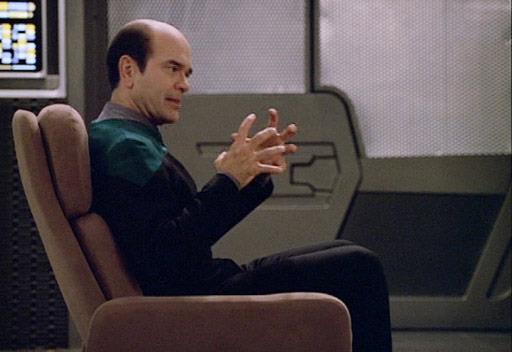
The Doctor from Voyager comes to similar conclusion [1]
"The more I think about it, the more I realize there's nothing I could have done differently; the primordial atom burst, sending out its radiation, setting everything in motion. One particle collides with another, gases expand, planets contract and before you know it we've got starships and holodecks and chicken soup. In fact, you can't help but have starships, holodecks and chicken soup - because it was all determined 20 billion years ago!"


If this is right then I had no choice but to include these quotes. But actually I think I had. So I disagree with the above statement from the book and since most if not all of this book is somewhat dependent on this statement I disagree with most if not all of this book.

So how come I gave this book the best possible rating? This is because the book made me think - a lot - and that's always a good sign. That's the best a book can do in my book. And I would like many people to read it (but read the predecessor On Computer Simulated Universes first) and encourage them to think about their respective realities.

One of the most pressing questions for me (apart from how to get my next meal and how to stay warm and dry and relatively safe) is the question whether or not I am free to do what I do. Are all of my actions predetermined by some force or physical "laws" or am I free to decide which turns I take on my path?

I would like to agree that any apple that ever fell from any tree or any Austrian that ever jumped out of the stratosphere down to Earth eventually landed there after a certain amount of time that can be pre-calculated with the help of some formula or physical law. But is this true for all apples and Austrians to come in the future? I frankly don't know. Maybe physical laws will change, and maybe those changes are random in nature. And if we were actors in a computer program that is running a simulated universe then maybe the creator of such a program has implemented some sort of choice-mechanism that kicks in every time we have to decide something and that runs independently from any physical "laws" (that are also implemented in the program) and is therefore not detectable and not explainable by such laws. Am I making sense? Ah, never mind.

One thing I think is true: In a deterministic universe, be it simulated or not, there can be no such thing as "intelligence". If each and every thing is predetermined then nothing deserves to be called intelligent. Also the words "randomness", "probability" and "progress" don't make sense in a universe like this. In fact "sense" doesn't make sense no more, because it would be indistinguishable from nonsense, if all participating particles merely flow along their predetermined paths. And what about "change" or "adaption" or even "evolution" itself? Those words would loose their meaning and become empty as well. I'm not sure about time. Is "time" a concept worth mentioning in a deterministic universe?

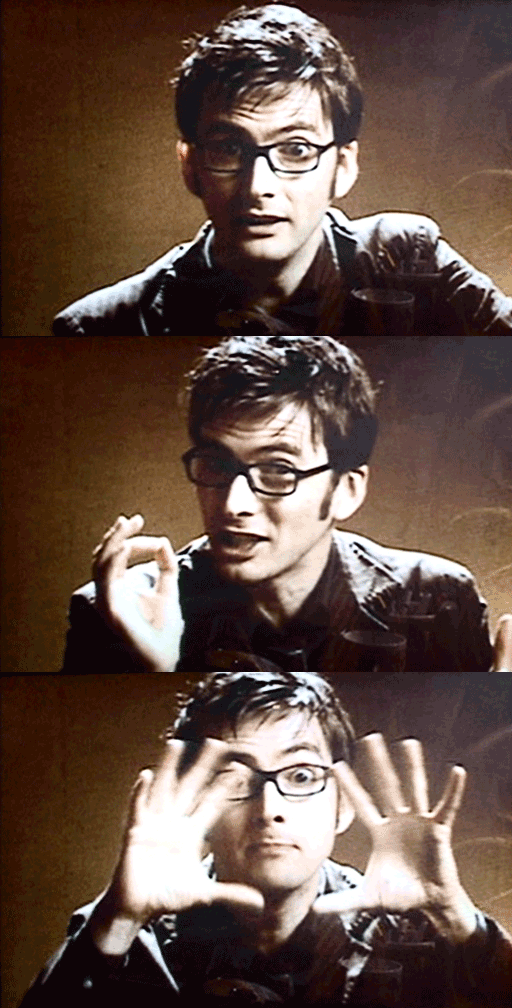
Another doctor, Doctor Who, explains what time is the best [2]

"People assume that time is a strict progression of cause to effect, but actually, from a non-linear, non-subjective viewpoint, it's more like a big ball of wibbly-wobbly, timey-wimey ... stuff."


[1] from Star Trek Voyager, Season 5, Episode 11 "Latent Image"; an episode I cannot recommend too much to watch
[2] from Doctor Who, Season 3, Episode 10 "Blink"; ditto

Creative Commons License
This work is licensed under a Creative Commons Attribution-NonCommercial-ShareAlike 3.0 Unported License.
Profile Image for David Rubenstein.
866 reviews2,786 followers
May 23, 2014
This is a short book--really just a long essay--where Mark Solomon contends that our universe might actually be a simulation. An advanced civilization may be capable of simulating a universe. Then, if the simulated universe progresses correctly, an advanced civilization may be able to simulate yet another universe, and so on and so forth.

I see some inconsistencies in this argument, or at the very least some incompletely thought out ideas. First, Solomon argues that the cascade of universes should evolve, similarly to biological evolution. As he points out, biological evolution is directionless--there is no hand guiding biological toward progressively "higher" creatures. Likewise for the simulated universes, there should be no purpose--no overarching direction. However, where is the DNA? Is the DNA in the structure of the civilization's universe? If a civilization tries an experiment by varying the physical parameters of a universe it simulates, then it is not a random mutation, but "purposeful".

I couldn't say that a simulation is impossible--who knows?--but with a quantum computer, it would require at least one elementary particle to "simulate" the full state of a particle in the simulated universe. So, even if a civilization devoted half of its own universe to a simulation, it could only simulate a universe half as big as its own. So, each successive simulation would be half as big as its "parent". At some point, the simulations would become too small to be considered as universes.

My main objection to this book is that the ideas it propounds are not original, and no new arguments are presented. I remember years ago reading Tipler's The Physics of Immortality: Modern Cosmology, God and the Resurrection of the Dead, and his hypothesis of the omega point. Nested simulated universes are discussed by many authors; just try Googling "nested simulated universes" and you will find numerous articles on the subject.

The idea of universe evolution is not new, either. Not too long ago I read the book A Universe from Nothing: Why There Is Something Rather Than Nothing by theoretical physicist Lawrence Krauss. This book describes a hypothesis, where multiple universes could evolve with physical characteristics similar to our own. Moreover, the hypothesis may be testable.

(Note: I received an e-book copy of this book, in exchange for an honest review.)
Profile Image for Jakep.
6 reviews
April 5, 2014
Occam's Razor says that simpler explanations are better than more complex ones. Solomon basically makes the case that if the theory of computer simulated universes is true, then a configuration of an evolution of simulated universes also has to be true. The case made is well-organised and highly rational.

Profile Image for Ivan Vuković.
89 reviews65 followers
April 4, 2014
The author asked me kindly to read this and I promised to write a review here, so...

First of all, this is way too short, waaaaaaay too short for a book, it's even short for a paper of this nature.

It is not the shortness itself that bothers me, because sometimes things can be written concisely and ideas can be exposed in not so many words, but nothing was really properly elaborated here and, unfortunately, I see no papers in references by the author on this topic.

I'd love to see these ideas worked out in detail and I'd like to see the math behind it, if only outside the book itself, this doesn't mean much without it.

The only reason why I give it two stars instead of one is because I found the idea interesting and worth pondering.
1 review
October 4, 2015
Solomon's two "books" were really just pamphlets (45 pages, large font, lots of white space, very wordy and repetitious but devoid of content). The second "book" was mostly a verbatim rehash of the first. I was very disappointed. The ideas were not at all new and have been better stated elsewhere. For serious treatment of the simulation arguments, start with these instead (and they're free):

Chalmers- http://consc.net/papers/matrix.html

Whitworth-
http://arxiv.org/ftp/arxiv/papers/080...
http://arxiv.org/abs/0801.0337

Arvan-http://goo.gl/OhwJjC

Bostrom- http://www.simulation-argument.com/si...
Profile Image for Eric Schleper.
6 reviews
August 22, 2014
I received this book through Goodreads giveaway.

The Evolution of Simulated Universes is a thought provoking short book. Mark Solomon starts with the initial assumption that we live in a simulated universe, more likely, withing a series of nested simulated universes. From this position Mark explores the different conditions that must naturally be met in order for a simulated universe to grow and evolve and in turn, simulate its own universes.

The book is not overly technical and the larger concepts are fairly easily grasped. Overall a short and interesting read.
Displaying 1 - 7 of 7 reviews

Can't find what you're looking for?

Get help and learn more about the design.