Born in Beverly, Massachusetts, Philip Gordon Wylie was the son of Presbyterian minister Edmund Melville Wylie and the former Edna Edwards, a novelist, who died when Philip was five years old. His family moved to Montclair, New Jersey and he later attended Princeton University from 1920–1923. He married Sally Ondek, and had one child, Karen, an author who became the inventor of animal "clicker" training. After a divorcing his first wife, Philip Wylie married Frederica Ballard who was born and raised in Rushford, New York; they are both buried in Rushford.
A writer of fiction and nonfiction, his output included hundreds of short stories, articles, serials, syndicated newspaper columns, novels, and works of social criticism. He also wrote screenplays while in Hollywood, was an editor for Farrar & Rinehart, served on the Dade County, Florida Defense Council, was a director of the Lerner Marine Laboratory, and at one time was an adviser to the chairman of the Joint Congressional Committee for Atomic Energy which led to the creation of the Atomic Energy Commission. Most of his major writings contain critical, though often philosophical, views on man and society as a result of his studies and interest in psychology, biology, ethnology, and physics. Over nine movies were made from novels or stories by Wylie. He sold the rights for two others that were never produced.
A sequel to When Worlds Collide is good, better some say heretically than the original , After Worlds Collide. When beloved old Earth is pulverized by a rogue planet a few hundreds humans escape in several spaceships from enemy countries, miraculously, and land on the smaller companion sphere, not the gigantic gas wanderer which killed us. From the frying pan into the fire would fit real well here, back to the novel . Planet Bronson Beta, named for the astronomer discoverer... late astronomer Sven Branson , he didn't make the passenger list, anyway the place has green skies, green seas but no fish, brown lands , over 600 days to orbit the Sun, fifty hour days, 25 hours both of light and darkness (but no one can sleep that long, sadly) . Weird, weird, those from Earth find evidence of a lost advanced civilization, the mysterious Other People, Earthlings hunt, they seek in the alien continent yet fail, the one billion inhabitants have vanished and records show, an unsolvable frustrating puzzle. Still uncovered roads detected of metal, strange machines, magnificent sophisticated glass domed cities however this causes wonder, where did they go? Dr. Cole Hendron leader of the Americans who built not one , but two space vessels nevertheless they separate in space he lands, the brilliant scientist unsure if Ransdell captain of the second craft made it. Daughter of great man Eve, an appropriate moniker but who is Adam? A couple of rivals from Earth, planets may change but when love is in the air though a bit green, David Ransdell the flyer, and number 2 in command here Anthony Drake a former man about town, never more, the city of New York doesn't exist. The object of their affection is beautiful, intelligent , influential, charming, not perfect but close enough. Survivors from Russia and Japan strange allies from Asia, another spaceship with rumors they also enslaved a British craft. This is really science-fiction the British being successful in launching rockets? Inevitable battles for supremacy the evil ones against the supposedly nicer humans. Planes found shaped like Ravens birds, dominate the war, the Other People were superb in technology and know -how. American love living in the alien citadel, Khorlu now called obviously Hendron, fabulous urban center which could house two million beings and their are other cities... virtually eerily empty. An underrated saga of space and survival in a could be future.
Philip Wylie and Edwin Balmer’s 1932 science fiction novel “When Worlds Collide” left its handful of survivors from Earth on a new planet, just waiting to be exploited colonized. It was inevitable that a sequel would follow. “After Worlds Collide” was published in 1934, originally appearing as a six-part serial in Blue Book magazine.
The first book was an exciting adventure fantasy that was, considering the time it was written, fairly decent in its attempt at scientific verisimilitude. It was, in fact, a fairly believable “what if” scenario of a rogue planet on a collision course toward Earth and what would result from such an event, both in terms of the scientific effects (tidal waves, drastic climate changes, earthquakes, volcanoes, etc.) and the socio-political effects (economic collapse, mass panic, riots, religious revivals, etc.).
Certainly, elements of the book were disturbing. The fact that all of the survivors (with one notable exception) were white, Caucasian, and hand-picked based on intelligence and scientific knowledge is, of course, at the very least, awkward by today’s standards and, at the most, racist. It would, perhaps, be accurate to call the sequel even more “racist”.
The plot of “After Worlds Collide” deals with the problems humanity would face on an Earth-like world, given a small (several hundred) group of humans set on repopulating their species. Added to this situation is the fact that an extinct ancient alien civilization once existed on the planet, leaving fully intact cities and technologies that are far beyond the comprehension of human knowledge. They were, however, evidently left behind for subsequent alien species, like humans, to use for their own benefit, assuming they were smart enough to figure out how to use them.
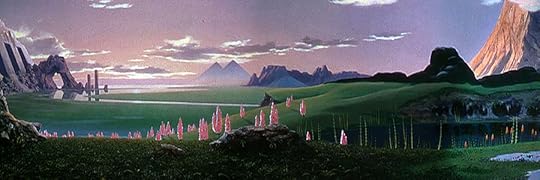
A matte painting used as an establishing shot at the end of the film "When Worlds Collide". Notice the structures to the left and the pyramids in the background, implying that an ancient alien civilization once existed on the planet.
Conflict arises when it is discovered that, prior to the destruction of Earth, another space ship---comprised of an international mix of German, Japanese, and Russian communists---landed ahead of the American space ship and has set up a communist paradise. These commie bastards are, of course, bent on planetary domination, and the existence of the American colonists puts a serious crimp in their plans. So, of course, war.
Contemporary critics who cry foul about the nationalistic, anti-communistic rhetoric within the novel are completely justified in their complaints. The nationalistic jingoism is, even by today’s standards, pretty ridiculous, although readers need to remind themselves that the book was published during a time of ridiculous nationalistic extremism in European countries as well as the United States. It was only a short seven years before the U.S. would join the fighting during World War II.*
The anti-communism in the novel is interesting, considering the popularity of communism during the 1930s. Stalin’s Russia would, during the war, become close allies with the U.S., but news of atrocities committed by the Stalinist regime were gradually coming to light at the time of the novel’s publication. Nearly two decades later, of course, the United States would be in the throes of a virulent anti-communist foreign policy, one which continues even today.
Tied into the anti-communist rhetoric of the novel, however, is a simplistic black-white worldview which lumps the socialist-communist foreigners into one big Axis of Evil, a nationalistic tendency that the U.S. has yet to discard. To many contemporary critics, of course, this has the appearance of racism, and, in some cases, it probably is. Not always, though, and while the purveyors of political correctness may take umbrage against this point, it is important to make the (albeit infinitesimal) distinction between nationalism and racism.
The book’s only “friendly” non-white is a Japanese character named Kyto, who is, at the start of the first book, a servant of the book’s main protagonist, Tony Drake. In the second book, it is discovered that Kyto was a Japanese spy all along, but he has had a crisis of conscience: he enjoys the carefree life of leisure that Americans possess, and he no longer wants to destroy it. Granted, the rogue planet succeeded in doing that anyway, so he really had nothing to lose by admitting this. Then again, he also had nothing to gain, since his own country was also destroyed.
Kyto’s portrayal is, in my opinion, less a racist caricature than it is a nationalistic one. His Japanese-ness, for lack of a better word, is both his downfall and saving grace. Kyto is, by nature of his race, the Other within the novel. He is permanently set apart because of his race, but he is never looked down upon because of it. On the contrary, the American survivors love him because he is seemingly loyal and devoted to his master, Tony.
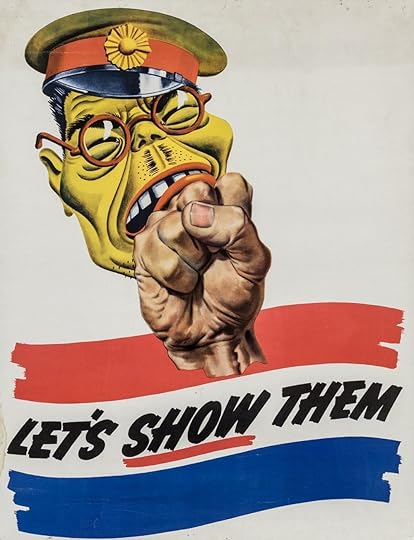
A truly egregious racist depiction of the Japanese, this World War II-era propaganda poster depicts a cartoonish version of Japanese prime minister Hideki Tojo being punched out by an American fist.
When it is discovered that Kyto was a spy, albeit an apologetic one, the reaction is quite unexpected. There is no question of Kyto’s disloyalty. He is forgiven, as he has proven himself to be a man of virtue. In this case, virtue or vice is not a condition of his race. In other words, Kyto’s being Japanese is not inherently inferior. His former allegiance to an evil government, however, is. That Kyto rebukes his former existence as a spy is what saves him. His Asiatic race is irrelevant.
Of course, it would have been interesting to see what would have happened if a black character was introduced to the story. Unfortunately, an obvious lack of any black characters in the story is telling in itself. Especially considering that the survivors are hand-picked based on intelligence.
To be fair, the authors do, at one point, bring up the unfairness of the selection process. It is interesting to note that one character, a woman named Marian, stows away on the space ship. She is humorously branded a “moron” several times in the book, due to her inferior intelligence. (To a contemporary reader, this may seem pretty funny, but “moron” was actually a scientific term for a person of sub-par intelligence, in the same way that “idiot savant” and “mentally retarded” have been used to describe persons of lower-IQ.) Ironically, Marian manages to do something extremely heroic in the end. Score one for the moron!
I’m still not convinced that Wylie and Balmer were complete racists. Mostly racists, maybe, but their views were probably no different than a vast majority of the American reading public at the time.
One thing that struck me, though, in the book as a defense of Wylie/Balmer’s subtle social consciousness is the reference to the ancient alien civilization. If speciesism is an extended form of racism, then Wylie/Balmer exhibited a pretty advanced anti-speciesist argument in creating a technologically superior ancient race of beings that foresaw their own extinction and took steps to leave their mark not in any selfish “We were here” display of grandeur but as a way to assist and prolong the lives of any other race of beings that were to follow them. That’s actually pretty impressive, if you think about it.
*4/30/2026 addendum: Thanks to assholes like donald trump and pete hegshit, ridiculous nationalistic jingoism is making a comeback.
At the conclusion of Philip Wylie and Edwin Balmer's classic sci-fi novel "When Worlds Collide" (1933), the Earth is spectacularly destroyed in a collision with the rogue planet that had been dubbed Bronson Alpha. Only 103 people, it would seem, managed to get off our world safely, aboard American scientist Cole Hendron's rocket ship, and land on the rogue planet's sister world, Bronson Beta. It is a marvelous cliffhanger of an ending, leaving the reader wondering just what might have happened to Hendron's other, larger rocket ship, carrying around 400 more prospective colonists; whether any other ships from other countries managed to get away safely; how the 103 are possibly going to survive on this long-frozen, now-thawing world; and, most intriguingly, whether the million-year-old relics scattered about could possibly indicate an ancient civilization...and perhaps alien survivors. Fortunately, for all readers, those answers were forthcoming, in the authors' follow-up sequel, "After Worlds Collide."
The first novel had originally appeared as a six-part serial in the 9/32 – 2/33 issues of the hugely popular, 15-cent "Blue Book Magazine," and nine months later, the sequel also made its debut there as a six-part serial, in the 11/33 – 4/34 issues, with its first appearance in book form the following year. Unlike the first novel, "After Worlds Collide" was fortunate enough to cop the cover illustration for one of its segments, in the December '33 issue. (The covers of those other five depicted now entirely forgotten tales of Foreign Legion, mid-ocean, Yukon, Arabian and Coast Guard adventure.)
"After Worlds Collide" picks up immediately following the events of the first book. All the characters we’d encountered earlier--Hendron; his scientist daughter, Eve; Eve's hopeful fiancé, Tony Drake; blustering French physicist Duquesne; British poet and ship's diarist Eliot James--are back, and wondering just what to do first to get themselves settled on this barren new world. It is difficult to encapsulate the plot of this sequel without giving away any of the book's numerous surprises, so let's just say that before long, Hendron & Company discover that Bronson Beta contains the perfectly preserved remains of five ancient cities, protected inside their hemispherical bubble domes against the absolute-zero cold of the planet's aeons-long journey across interstellar space. But the 103 survivors are soon alarmed by the appearance of one of the cities' lark-shaped flying vehicles winging over their encampment. Someone else, it would seem, is currently residing on Bronson Beta! Is it possible that Hendron's other ship, or some other craft from another nation, had also made the transit successfully? Or--an even more incredible thought--could some of the original inhabitants of the long-dead world possibly still be alive, after a million or so years?
If there were one word that would describe the totality of "When Worlds Collide" in a nutshell, that word would be "spectacle." The original novel dishes out one spectacular set piece after another, be it earthquakes, volcanoes, floods, the destruction of the moon or, ultimately, the pulverization of Earth itself. "After Worlds Collide" could not possibly hope to equal such spectacles, but does amply contain one quality that was much esteemed in all Golden Age sci-fi; namely, a sense of wonder. That sense of wonder is surely never greater than when Tony and Eliot manage to enter one of the five domed cities and explore the manifold marvels therein. The original book's central suspense was of course tied in with whether or not Hendron's people would make it off the Earth in time, and survive their journey through space. In the sequel, the suspense quotient is equally high, as our survivors contend with all the unknown elements of their new home world.
"After Worlds Collide" is indeed an almost perfect and seamless sequel, one that feels more like a Part 2 of a single, longish work. (Perhaps some enterprising publisher will see fit to release both parts in one volume in the near future.) As was the case in the first book, the sequel is pleasingly written, with a range of literary references (the Bible, the Pyramid Texts, Omar Khayyam, Shakespearean sonnets) that might surprise some readers. Regarding some of those Biblical references, it is amusing to discover that Hendron soon comes to think of himself as a latter-day Moses, leading his flock to the Promised Land; thus, the foes that the survivors eventually battle (I'm trying to be coy here) are given the nickname "Midianites"! Again, I really don't want to ruin any surprises for prospective readers, and "After Worlds Collide" does surely contain any number of such. (I love the one concerning Tony's obsequious Japanese manservant, Kyto.) Describing many of the book's outstanding set pieces would entail leaking spoilers, but I can say that one such exciting sequence comes early on, and features the fragments of our old Moon descending on Bronson Beta in one monstrous meteor storm, making for a very tough first day on their new world for Hendron and Company!
Good as it is, "After Worlds Collide" does come freighted with some minor problems. As was the case in the first book, some moments will surely strike the modern reader as dated; for example, the inclusion of the lyrics of the 1905 (!) hit song "So Long, Mary," and the one-time compliment "[he] is one of the whitest men I know." (Ouch!) The authors are also guilty of some unfortunate word choices, such as when they describe the colonists' personal belongings as a "melee of dunnage." (I believe they were probably going for a "mélange of dunnage," but who knows?) Dinitrophenol is spoken of as a kind of stimulating restorative after Hendron's people are knocked unconscious in a gas attack, but as far as I can determine, that chemical compound is used primarily as a pesticide! Wylie & Balmer also get some of their Bronson Beta geography mixed up here, first saying that the domed city of Danot is south of Hendron's people, and later implying that it is north. (It always bugs me when an author can't keep his/her details straight.)
But perhaps the most egregious fault of this sequel is that it draws to its conclusion way too abruptly. How wonderful it would have been had the authors continued on with their fascinating premise in a third, maybe even fourth or fifth book! As the sequel ends, Bronson Beta is about to approach Mars in its new elliptical orbit around the sun, before swinging back toward Venus. It would have been interesting to see how the colonists managed to cope with their new subfreezing and, later, roasting environments, when they occasionally emerged from their conveniently provided protective metropolises. Too, the entire question of the new morality that Book 1 suggested might have to be established on Bronson Beta (along with the abolition of the traditional institution of marriage) is left hanging in the air. (I am very curious now to read Wylie's 1951 fantasy "The Disappearance," in which all the women on Earth suddenly vanish, to discover his thoughts regarding the separation of the sexes and the dissolution of marriage completely!)
I suppose, though, that a novel can be guilty of worse things than leaving its readers wanting still more. The bottom line is that "After Worlds Collide" is a near perfect sequel, but one that is in need of two or three sequels itself. Still, you will be breathlessly flipping those pages; of that I’m pretty sure....
(By the way, this review originally appeared on the FanLit website at http://www.fantasyliterature.com/ ... a most excellent destination for all fans of Golden Age sci-fi....)
Completely unnecessary, boring, and even more racist and sexist than When Worlds Collide, After Worlds Collide is a prime example of an author(s) overreaching. While the previous novel had a satisfying ending, the idea of exploring the further adventures of the survivors was appealing in concept. Unfortunately the execution leaves a lot to be desired.
The struggle between the protagonists and other survivors from the former Earth could have been interesting had the book actually explored what the villains were doing on their side. Unfortunately, the reader is only allowed glimpses while the protagonists are left to debate pseudo science and simplistic philosophy, their racist tendencies apparent in almost every conversation.
The melodrama of the dialogue is toned down slightly from When Worlds Collide, however it still reads like an amateur soap opera. The role of women as breeding machines is especially difficult to read, their ability to contribute meaningfully to the new society insulted consistently.
While the history of the previous occupants of the new world is interesting, there's too little of it. In fact, a prequel describing the horrors that they faced would have been infinitely more interesting than the tripe presented here.
Overall, a failed novel, only remotely interesting to those who read When Worlds Collide. Some of these early SF "classics" makes one wonder how the genre endured.
Satisfying sequel to the excellent When Worlds Collide. One of the fascinating aspects of speculative fiction is that it largely immune to becoming dated. The intellects of Wylie and Balmer are engaged in the pursuit of what it might be like for humans to survive and begin to forge a civilization on a new planet. Insight into human behavior is needed for this task and it could have come at any period from great authors. Will humans continue to fracture, divide and fight wars of domination or can we all get along here on this new planet? What might an advanced civilization have left behind in their own quest for survival of a cataclysmic event? Interesting question that are pursued in this well written, tightly paced novel.
This is a second volume of either duology or trilogy – the difference is that original authors in 1933-1934 wrote only two, but way later, in 2011, another author added the third volume, The Terrans of Beta, which, according to reviews here is a disappointment. Therefore, I plan to stop on this one. The first book, When Worlds Collide, was a part of the monthly reading for May 2022 at The Evolution of Science Fiction group, and I and several other members decided to continue the series. My review of the first book can be read here.
The first book was an early post-apoc SF, this one tries another trope – a human colony on a new world. As it is common for the especially older SF, the planet is quite similar to Earth, air is breathable, plants are edible, and even the long-dead earlier inhabitants (about which we were hinted in the first book) were surprisingly human-like.
The main character is still Tony Drake, and there are other characters from the first book. Soon after appearing on a new planet a hundred of survived humans try vainly to pick anyone else on radio, start to discover artifacts of the long-gone race and one day even hear the sound of an incoming plane, but fail to see it. Are they the only survivors? What if there are others, who don’t want to share a planet with ‘our’ folk?
The story has some unexpected turns, even if generally it is a good old pulp. There are more pieces of sexism or racism, which sound not only cringy but strange: e.g. there is a young woman more than once classified as a moron, who, unlike the majority of humanity first is able to get a free ride on a ship, then behaves quite reasonably, but the opinion about her doesn’t really change. Also, the authors constantly worry that everyone wants to get “our women”.
The last chapter of the book sounds as if the authors got info that the series will be stopped, so instead of an action-dialogue sequence, there is a quick outline of who does what, quite unlike the rest of the book. It was an interesting 1930s SF, nothing deep or literary, but a good old adventure with attempts to imagine how a bright scientific future should look like.
After Worlds Collide seems almost an afterthought compared to When Worlds Collide. It is not nearly as compelling a novel and may have made a better movie to sequel the WWC movie than a novel. The story involves more politics and conflict than the science of surviving on a new planet by a small group of barely prepared humans from the USA. Other nation's groups that made it caused the conflict. Of course post-apocalyptic survival has been the subject of a legion of SF novels since. I would have liked to know was a couple of 1930s authors thought about how to do it.
This is a worthy successor to After Worlds Collide. One of the U.S. spaceships has escaped the destruction of earth and landed successfully on the rogue planet of Bronson Beta. But what happened to the other U.S. craft, and to those ships that attempted the same voyage from other countries on Earth? This novel follows the exploration of Bronson Beta by the new "colonists," the discovery of the remains of its past civilization, and the struggles of the community as they make the mental shift from short-term escape to long-term survival.
Aspects of this novel don't flow smoothly as they did in When Worlds Collide. There's a stronger focus on allegory with the world's religions (allusions to Biblical thought and ancient Egyptian belief, for example) that at times seems forced and falls flat. In addition, the novel has issues with pacing. The conclusion feels quite rushed and unsatisfying compared to the slow and effective build up to it.
That said, this novel delivers very well in other areas. The authors show how the political and ideological conflicts of Earth are transplanted to Bronson Beta. It seems quite ridiculous that one German-Russian-Japanese collectivist group seems so bent on domination, enslaving the British refugees and making war on the American communities (which include French, English, South Africans, and "free" Germans and Japanese, as well). The reader is tempted to point out that the humans have an entire world to themselves, after all. Isn't it large enough for all of them to have their own homes and coexist in peace? Wouldn't it make more sense for them to focus on surviving the various challenges nature provides and making life better for their offspring rather than fighting each other? But of course, that's the entire point. Much of the novel is less about life on Bronson Beta than life on Earth.
I recommend this to anyone who enjoyed When Worlds Collide.
The humans make it from Earth to Bronson Beta in their spaceships. They are there for weeks before discovering that there are other humans on the planet. The Russians and Asians have also landed and taken a group of English people into slavery. They control the heat and lights of the five beautiful cities on Bronson Beta. The Hendron group has their power shut off. The Russian/Asian group has control of the heat and lights and want the Hendron group to submit to them. The Americans have decided they will not. Five men secretly try to break into the large city where the Russian/Asian leaders are in order to take them out, but it’s one woman who takes out their leader all on her own. I’m glad I read this sequel, but I must say that I was very disappointed. I thought it was impossible that the humans would find million-year old empty cities just waiting for them on the surface of Bronson Beta, so, even though I cut the author a lot of slack because this was written in 1933, I still thought this story was pretty weak. I was also disappointed about the fact that as soon as the different human groups became aware of each other, they immediately decided to go to war. I would have much preferred that all of the groups get along.
A sequel which is in no way inferior to the first book. It starts where the first book stopped (huge cliffhanger by the way) and continues the amazing story about the end of the world as we know it! The writing style is in my opinion excellent, I could not stop reading. Again highly recommended! I only regret that the book is so short.
Despite all its faults - and there are many - this little duology was thought-provoking and interesting enough to hold my attention through both books. Published in the early 1930's there are all kinds of political, social, racial and gender-related issues throughout the narrative that would provide excellent material for discussion groups or literary study. However, since I read purely for pleasure these days I'm not going to attempt any in-depth comment here. The writing is somewhat erratic and there are far too many pretentiously obscure quotations - good editing would certainly have helped. On an entertainment level the books were sometimes melodramatic, sometimes laughable, sometimes tedious and sometimes enjoyable. On the whole they were worth reading and yes, I would recommend them to fans of classic sci-fi.
I really wanted to explore the whole post-apocalypse survival story written in the 1930s. And I understand society and culture were very different then. But I am just getting too annoyed at the whole women as breeding machines (and kind of the wish fulfillment of "look there are way more women than men, but that's ok - we men will do our duty"). There is a lot of racism as well. So, I think I'll continue to appreciate that this science fiction book was written almost 100 years ago, but stay distanced enough to not get mad.
This is a must after you've read "When Worlds Collide". Ideally, read this about a year after you finished "When Worlds Collide" so that you'll have time for that novel to settle in your mind and create a place for itself.
I liked this one more than the first. More suspense and sense of the unknown once they reached the new planet. The ending felt a bit rushed and abridged.
The sequel to a classic. An interesting exploration of how humanity might begin again on a new planet -- albeit one with a supportive environment -- after the Earth was destroyed. Worth reading as a very early science fiction best seller, and, of course, to see what happened next after the classic When Worlds Collide.
In the end, I rated the book 3 stars because, while it is an amazing work for 1933, I can't help reading it with modern sensibilities. I loved the exploration mysteries, the search for what happened to the race that had inhabited the planet a million years before, the exploration of a new world while worrying if it would enable the few survivors of earth to survive, and the recognition of the scientific uncertainties their plight reflected. I enjoyed the limited willingness to consider what rules and mores should apply when setting out on developing a new world, whether we should set aside old moralities and customs, any sense that the new settlers were just Americans, British, or German rather than just humans.
And there was a marvelous sense of wonder at new discoveries on Bronson Beta. I kept being reminded of Rendezvous with Rama, and realized that Arthur C. Clarke would have read this book in his youth and was likely influenced by it.
But some parts don't age well. Most of the science -- mainly biology, geology, and ecology in this book -- has aged pretty well, but the cultural perspectives haven't. Referring to "Japs" is very jarring, and stereotypes alive in the book are that Asiatics are inscrutable, while Russians and Germans (at least those that stayed in Germany) are brutes. It may be hard for me to put myself into 1933, and I'm pretty sure I don't want to. I found the portrayal of women much more disturbingly conventional that in the original When Worlds Collide, and could hardly recognize the scientist characters, who had been at most deists in the previous book, but now began to believe in the God of their fathers.
Perhaps it is as simple as that When Worlds Collide was "man against nature" and this book is more "man against man", but this is the weaker book. I might have to apologize for some of the stereotyping in When Worlds Collide, but the book does challenge the attitudes of its time, and it certainly was a thought-provoking classic. I'm glad I read this one (after re-reading the original book), just to see what the authors did with it. But When Worlds Collide will remain on my shelves as a classic, amazing for its time, and this one won't.
When Worlds Collide was a surprisingly good novel, so I had rather high hopes for the sequel. It picks up the story where the first book ended on the surface of Bronson Beta, and most of the characters are the same.
Our heroes were not the only survivors of the doomed Earth, but unfortunately not all of them were such nice and wholesome folks as Tony, Eve, Hendron & co. Thus, in addition to the struggle to survive in a harsh environment and the mysteries of Bronson Beta and its original inhabitants, we get a human conflict. The bad guys are just bad – we don’t really get to know much of them, except their vague political agenda (totalitarianism).
Although some of the main characters do not believe in a Christian God, the story takes a very biblical turn. It didn’t bother me too much and I suppose it was almost inevitable, but I could have lived without it.
Most of the book was really enjoyable if you like this sort of old scifi, but the ending bothered me. It seemed very rushed, and any teenager could have come up with a better, more plausible and more exciting finale. With a full-bodied ending my rating would have been higher. Also, the serialization of the novel manifested itself in the annoying repetition of the words “perhaps a million years ago” (or something very similar).
In addition to Eve, this time we get a couple of additional female characters, but one of them is labelled a “moron” without any real justification, and for the most part they don’t get to do that much. The Earth was a man’s world, and so is Bronson Beta. In addition, fairly early on one of the characters turns out to be much more than everybody had thought, but after that potentially very significant revelation, the character again disappears from the pages. That was rather disappointing.
Despite these shortcomings, those who read and enjoyed When Worlds Collide really should also read After Worlds Collide.
A solid follow up to the original, “When Worlds Collide”. Written in the early 1930’s, this is a highly imaginative story about what happens when multiple groups make the crossing to the new planet, Bronson Beta. Considering the times it was written, the rise of Naziism, the grown of communism, the Great Depression, the effort to split the atom, this story is a great example of harnessing all of that into a speculative science fiction story. Although a bit dated, an amazing read well worth your time… but read the first book first.
Follows on directly from When Worlds Collide with around 100 refugees from Earth arriving on the baby brother/sister of the planet that destroyed their former home. After Worlds Collide is, of course, quite dated - although there are some ideas that show great imaginary vision on Wylie's part.
As with many books (especially of the Sci-fi genre) written before the PC brigade stomped down on such things, elements of the story are quite sexist or racist. Unusually for a novel of this time, the weaker sex (tongue firmly in cheek) are given important roles in the tale. Characters of the female sex are also given some important roles...
In keeping with historical Sci-Fi tradition, the baddies are from the eastern end of Europe or further beyond. Some reviewers may call it racist, but having read a few older novels I find it amusingly quaint.
I do think that books such as the "Collide Series", for want of a better expression, are an important part of the Sci-Fi heritage and salute their authors for their vision and accept their lack of political correctness as part of the package. Many contemporary authors have been influenced by their less enlightened predecessors and that should be remembered.
However, like When Worlds Collide, After Worlds Collide is a somewhat wordy but well written Sci-Fi novel that is readable in its own right as well as being a fascinating curiosity. Potential reader should keep its age in mind and enjoy.
As a postscript, I'd like to add that my copy of this paperback was last seen on a sunbed on the beach in Cancun, Mexico where it had been left as a territory marker by my wife before a tropical storm arrived. At least I'd read it by then, otherwise I may have been a little annoyed...
I have the 1973 edition with the Zagorski cover (kinda hokey). Earth's survivors land on the lesser rogue planet that was the companion of the one that smashed into Terra. They immediately set about the task of survival, but discover that they aren't alone. I won't spoil the surprise. After that, it's one thing after another until the end of the story.
I had one complaint and that's the pontific speeches given by two of the "leaders" of the group. Long-winded and full of male bovine solid excrement. But then, this was written in 1933, so that may have been the norm for that time.
I haven't read the first book since several decades ago (the 50's or 60's?), but I remember when I read this one that it was heads and tails above the first for the young man that I was. I picked it up again last month and there are things in there I don't remember at all. After 50 or so years, that's understandable. And one thing I "remembered" isn't there.
In any case, I thoroughly enjoyed reading it again (except for the speeches).
Terrific sequel to When Worlds Collide, which left some plot threads unresolved. What happened to the other ships fleeing Earth? What awaits our heroes now? The sense of exploration and wonder is thick, interrupted by...well I'll say no more, only that I wish they had written further sequels to tell us more of this mysterious planet and its erstwhile inhabitants. Leave 'em wanting more I guess.
Wow! What an incredibly racist book. Also very repetitious. The ending seemed to be more summary. Read When Worlds Collide, but you can skip this sequel. It mostly consists of endless repetition of the same questions.
The first book (when worlds collide) was a great read, and kept me intrigued throughout the book. This book was, in my opinion, a step up from the first in the series. Extremely well written, imaginative, and captivating story.
I thought this was one of the best...next books ever. 1950's syfy, but it is really good, but read "When World's Collide". Mankind at his finest, and his worst.
Mamma mia che incredibile fatica finire questo libro!
Una grande delusione, in particolare se penso a tutto il potenziale a disposizione dell'autore. Philip Wylie riprende la storia da dove l'aveva lasciata nel primo romanzo della serie: la Terra è distrutta e un manipolo di umani si trova a colonizzare un nuovo pianeta, Bronson Beta. Wylie poteva affrontare mille discorsi, poteva parlare di Storia, Geografia, Psicologia, Società, qualunque cosa. E in effetti nella prima metà abbozza alcuni quesiti molto interessanti. Ad esempio: se un centinaio di umani arrivassero su un nuovo pianeta e le donne fossero in maggior numero, avrebbe ancora senso il matrimonio monogamico? Sarebbe meglio una poligamia? O un'altra forma di unione? Ma come reagirebbe la gente? Oppure: se un pianeta impiegasse 50 ore a ruotare sul suo asse, come si adatterebbero gli umani? Si tratta di una domanda per certi versi banale, ma in realtà insolita, visto che nella stragrande maggioranza della fantascienza e del fantasy si dà per scontata una giornata di 24 ore.
Insomma all'inizio il racconto non è male, ha dei misteri in serbo e un bel potenziale. Nelle prime fasi si dimostra almeno all'altezza del precedente, per quanto su basi diverse. Ma arrivati a metà, ecco il fattaccio.
Insomma ho impiegato mesi per finirlo. Molte promesse, nessuna mantenuta. Peccato davvero.
These two books - "When Worlds Collide" and its sequel "After Worlds Collide" - were so ridiculous in so many ways, and there's plenty to criticize, if you're inclined to. The dialogue was ridiculous. Some of the science was questionable at best, especially in the sequel - would a random planet drifting in from space really have the exact air mixture humans needed to survive, and foods they could eat, etc.? - and, like Clarke's "Rendezvous with Rama," you only get tantalizing glimpses of the aliens; you never actually get to meet one. John Varley's introduction is also perfect in so many ways, including in noting that the list of the few hundred people to survive the end of the world, chosen by the alleged greatest scientist on earth, was basically a selection from the American Social Register of 1932. Why was Tony Drake along, other than that he wanted to marry Hendron's daughter? He was a stock trader!! Bring another doctor, please!!
And yet...five stars. I can barely even explain it. Can the end of the world be "fun"? Maybe a little! It definitely kept me engaged and interested. The plot was well-paced and the flowery language sometimes actually worked, for subject matter as serious as the end of the world. It made me think - how would humanity react if the situation described actually happened? How would we truly face a cosmic catastrophe? The context in which this was written was also fascinating. It was the early 1930s, and already the authors were talking about atomic energy and space travel. There were also glimmers of the tensions that would lead to World War II there, too, both in the last days of the earth and on the new planet. And of course, the Other People, the lost civilization and exquisite tragedy of the new planet's original inhabitants.
I would just say, if you like post-apocalypse literature, give this a try. Extend grace to the authors on the occasional political incorrectness. This was the thirties, okay? Relax. Seriously. Also, if you do like the genre, this isn't the oldest example, but it is early, and it's interesting, if in no other way, for historical purposes. It's also readable and interesting with a plot that moves along and doesn't preach to me about politics or have some political agenda. Is that my only standard for novels now? Maybe, considering some of the crap that's come out the last decade. Five stars.
I enjoyed this book a lot, though maybe not quite as much as the first one. This book focuses entirely on the people who successfully escaped earth and their attempts at surviving in the new environment of the new planet, and the dangers they face along the way. A lot of standard post-apocalyptic themes are introduced here and though none of them are handled with a whole lot of depth, it's impressive to see the breadth of consideration that the authors had when writing this book (especially since they had so few other post-apocalyptic forebears to borrow from).
I was still impressed with the quality of it all and the writing was fairly good. I particularly enjoyed the overall grounding in science, considering it was written in the 1930s, though I felt the story meandered away from its stronger scientific grounding as the plot moved along.
My biggest complaint with this book was that it felt a bit more distracted and without focus, seeming to have sudden changes in tone and plot and theme. I enjoyed the first part of it most, seeing it as a more "survivalist" type of story and how they started in the early days. Even when they began to encounter the existence of others, it was interesting because of its mystery. When it transitioned from there, it was OK, though a bit more mundane, and the final ending seemed incredibly rushed without much of a finale (in large contrast to the first book). In addition to that, the book seemed less character-focused than the first one. There were times where the characters were the highlight, but it was more like the author toyed with it from time to time and then later gave up on that approach, rather than it being a central aspect to the book.
Overall though, it provided a good-enough follow-up to "When Worlds Collide", because I'm sure any reader would want to know *what happened next*. But if you're expecting the same solid tone and caliber of focused plot and character development as well as fairly strong reliance on known (or soon anticipated) science... then you'll be a bit more disappointed. Still not bad though and an enjoyable short read, especially for anyone who enjoys post-apocalyptic books and old-era science fiction.