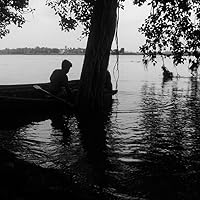
By Night The Mountain Burns recounts the narrator’s childhood on a remote island off the West African coast, living with his mysterious grandfather, several mothers and no fathers. We learn of a dark chapter in the island’s history: a bush fire destroys the crops, then hundreds perish in a cholera outbreak. Superstition dominates: now the islanders must sacrifice their possessions to the enraged ocean god. What of their lives will they manage to save?
Whitmanesque in its lyrical evocation of the island, Ávila Laurel’s writing builds quietly, through the oral rhythms of traditional storytelling, into gripping drama worthy of an Achebe or a García Márquez.
Juan Tomás Avila Laurel is Equatorial Guinea’s most important living writer, but he’s often been persecuted by his own state for his outspokenness regarding their blatant disregard of human rights. This week that disregard has turned dangerous, as Malabo’s infamous security forces have forced Avila Laurel, 48, into hiding for his work as activist. Avila Laurel had planned a sit-in protesting a recent wave of police brutality, and had requested official permission to stage the event, as required by national law. Soon after being denied the requested permission, Avila Laurel was informed that political party El Elefante y La Palmera [Elephant and Palm Tree], which had made the official request, had been declared dissolved by the Guinean government, and that he was one of several activists targeted for arrest without formal charges. The government crackdown centers on the political party El Elefante y la Palmera [Elephant and Palm Tree], known for its peaceful protests of police and government brutality, and is officially focused on the arrest of party founder Salvador Ebang Ela.
This is something really unusual. An unnamed male narrator describes events from his childhood on the island of Annobón, which lies off the west coast of Africa, south of the equator. I had never previously heard of this island. Through some strange mechanism of colonialism it ended up as part of the former Spanish Guinea, today’s Equatorial Guinea, although Annobón is very isolated from the rest of that country. Actually, it seems to be isolated from everywhere, and that plays a big part in this book. The author’s parents were themselves from Annobón and this novel was originally published in Spanish under the title Arde el monte de noche. Was the storyteller perhaps a relative of the author? Impossible for the reader to tell! At the end the narrator says he is not a writer and has only been able to tell his story because someone recorded him.
Reading the book is a actually little like sitting opposite someone who is telling you random stories from his childhood, without having prepared anything beforehand. The tale meanders – it curves away and then comes back on itself – and the author repeats things, making comments like “Did I mention that…?” I’ve made it sound like a chore to read but it wasn’t like that at all, I found it hard to put down. The narrator is capable of creating high drama. There was one section in particular that involved a dangerous sea journey by canoe, which I found quite tense.
Two themes really stand out in the book. One is of the precariousness of life on the island, and how the islanders are stuck in the most extreme poverty. They live by subsistence fishing and farming – basically the men fish and the women farm. The small size of the island, and its remoteness, mean that the inhabitants lack almost everything else. Whenever they see a passing ship the men head out to it in their fishing canoes and try to obtain things like kerosene, matches, rope, tobacco, or anything else they can lay their hands on. As might be imagined, spending much of your time fishing at sea in a frail canoe is not the most secure of lifestyles.
The second theme is the extent to which the lives of the islanders are governed by custom and by their folk beliefs around the supernatural. As so often in these communities, unhappy events are attributed to evil spirits, and it is women who are seen as manipulating these. Be warned that the book contains descriptions of some disturbing incidents. The "child's eye view" we are given means the scenes are described from the perspective of someone not fully understanding them.
Comencé esta novela en 2017, y la abandoné por encontrarla lenta y repetitiva. Este año, en búsqueda de una lectura serena, decidí retomarla, y creo que fue una muy buena decisión.
La novela está ambientada en una de las islas de Guinea Ecuatorial, la única colonia que tuvo España en el África Subsahariana.
El narrador es una hombre que cuenta recuerdos de su infancia en la isla, en la que habitan solamente dos hombres blancos, el representante de la Corona Española y el sacerdote. Lo más peculiar del ambiente, es que se trata de un lugar profundamente aislado, y sus habitantes tienen una idea muy vaga de la existencia de otros hombres en otros lugares. La forma de la narración se parece la de la narrativa oral, en la que cada historia se abre por asociación a otras, y por momentos hace dudar si en algún momento sabremos como concluye. Pero hay orden y lógica en esta forma de contar, y con mucho arte se vuelve al relato central, enriquecido por la asociación con los relatos paralelos; hay muchas repeticiones, que acentúan la importancia que tienen ciertos hechos y costumbres para el narrador. El miedo por los fenómenos de la naturaleza es constante; tanto los habituales (la noche, la luna) y caprichosos (tormentas, incendios). Y en su interpretación se mezclan creencias ancestrales con elementos del catolicismo; nadie puede sentir que el destino está en sus manos.
Una novela muy rica, si logramos sumergirnos en la forma de sentir la vida del narrador y de la gente de la isla. La forma de narrar me hizo acordar a El Hablador, de Vargas Llosa.
El autor nació en la pequeña isla de Annobon, de donde posiblemente extrajo el ambiente para esta novela, y se trasladó posteriormente a Malabo, capital de Guinea Ecuatorial donde desarrolló su carrera de escritor. En 2011 en medio de una huelga de hambre contra los abusos de la dictadura del presidente Teodoro Obiang, Ávila Laurel fue extraditado a España, lugar en el que reside actualmente (https://elpais.com/diario/2011/02/19/...).
There is something raw and unpolished about Laurel's account of life on a remote island off he coast of Equatorial Guinea, which is no surprise given his upbringing and the fact that the story is narrated from the perspective of a young man as he describes life on the small island of Annobón. Laurel's narrative style is fairly linear and straightforward, and is more influenced by oral storytelling than written storyteller, as Laurel explores not just life on the island, but also the impact that this had on him, from his grandfather's sickness, to the intermittent interruptions of violence against various women in the novel. The story isn't one which focuses so much on events and, aside from a catastrophic fire which engulfs the island, nothing much of note happens, rather the story acts as a paean to the daily rhythm of life on the island, of its customs and conventions, of the various people who populate it and their stories. Whilst the prose style can come across as raw and unpolished, the story nevertheless acts as a unique account of life in a country which we know little about. Overall 'By Night the Mountain Burns' is an interesting, if unspectacular read.
Fantastical childhood stories from a man who lived on a remote Atlantic Ocean island (Annobón, Equatorial Guinea).
This story is different from other African stories as there is an individual take on the local customs. The narrator retells his experiences but also adds in some doubts or concerns as though he was skeptical of his own story which adds to the credibility. Similar stories I have read fully indulge their own acceptance of miraculous events. This leaves room for wonder and you find yourself trying to close the gaps in a fun way.
The story is not so much focussing on one boy’s childhood but instead captures the biggest situations that occured involving the other people on the island as well as a few of his own. Some stories are very sad due to their hardships.
From what I can gather, which may be wrong, this book may have come about from a western visitor interviewing one of the locals and recording some of their oral history/stories.
I would recommend this book to everyone. It is an easy read. It winds up and down some emotions but is not too much. It is a good opportunity to read about how some people live on remote islands.
A beautiful book that unfurls the remote Atlantic Ocean island of Annobon page by page. The scenes, sights, smells, struggles and soul of the island fan out via an intricately detailed narration from a child’s perspective. The narration follows a meandering, stream of conciousness, repetitive style to perfectly capture the oral story telling tradition of Annobon. The stream of consciousness narration brings the childhood voice to the fore, reminiscent of Joyce’s Portrait of the Artist of a Young Man. I must confess that my linear literature background made reading this an additional challenge, but not an insurmountable one, and I am so glad I persevered. Ultimately it was such an honour to experience the novel and island life this way.
Daily island life in this novel is disrupted by a series of tragedies; hunger, forest fires, infant death and cholera. These tragedies are an entry point for the reader to gain insight into religion, superstition, relationships, gender, language, remoteness and marginalisation on the island. The explanations and reactions from the islanders to these tragedies reveal a unique blend of Catholicism with indigenous beliefs. Catholic saints are supplicated for forgiveness, whilst gifts are gathered and given to placate the sea king.
Relationships: The most obvious relationships explored are those between children and adults, men and women, the living and the dead. Children and adults tend to interact in a formalised manner, and adults are not questioned or held to account by the younger generation. This is most apparent between the narrator and his grandfather, and serves as a microcosm of the wider adult/youth relationship dynamic. The narrator often rhetorically questions the peculiar and cruel behaviour of adults, with such stunning childlike simplicity it is heartbreaking. An interesting observation; the only adult to be named in the book is Sabina – the woman who sees the dead.
Gender: The gender dynamics are fascinating, and a real indication of how women suffer, and are often used as scapegoats to explain away the island’s tragedies. Women going through the menopause are misunderstood as ‘she-devils’ and one particular woman is accused of having witch like powers leading to a most unfortunate end. Households without an adult male are at an automatic disadvantage, and depend on the mercy and goodwill of others. The recurrent simple childlike questioning and reasoning serve to further amplify the injustice.
Language: Language is exposed for its alienating, as opposed to unifying role. The narrator learns to read and write using language and images that have no meaning to him. This reminds us of how overlooked the residents of Annobon are, and how their marginalisation goes beyond pure geographic remoteness. In a subtle twist, the reader constantly experiences a sense of alienation as the narrator often reminds us that many of the words used in his language simply do not have a translatable equivalent in Spanish or English. I was constantly aware of the fact that I was reading a book that has been translated from Spanish, with the additional layer of the oral Fá d’Ambô foundation. Reading in three parallel lines, or perhaps more appropriately, three intertwined spirals.
This was a fascinating read – transported to the middle of the Atlantic Ocean, with the privilege of peering into Annobon island life. I am grateful for the added obstacle of reading in non-linear translation as it has made the book all the more compelling and memorable. The overall tone of the novel challenges the idyllic stereotype of happy-go-lucky paradise island life. In contrast, the young narrator’s continued sense of foreboding and fear illustrate the very real struggles and harshness of remote island living. In spite of this it is a truly enjoyable read that transports and transfixes the reader to a unique volcanic island in the Atlantic Ocean. Fellow armchair travellers, make sure you put this on your to-read list.
This is a semi-autographical account of a child living in the Equatorial Guinea island of Annobon. Late in the book it is revealed that the unknown narrator has been recorded and the book written from this. It reads like an oral history and it's rhythm of repeating phrases and events as well as the many diversions worked well. The book is full of the islander's culture and practices, an unwanted pregnancy, of missing fathers, canoe making, paddling, women working the fields, a cholera epidemic, the isolation of the catholic church, the lack of medical help, hunger and subsistence farming. Totally fascinating.
My book club chose this book for our visit to Equatorial Guinea, a small African country, which lies north of the equator and used to be a Spanish colony. However, the story of this book is actually set far from Equatorial Guinea, on an island in the Atlantic Ocean called Annobon, which lies south of the equator. The book is inspired by the author's childhood and doesn't have a clear plot. Instead, it recalls various, unusual things that happened on the island, and reads more like oral history of a very remote place. Despite the lack of plot, I quickly got used to the voice of the narrator, who is a child. He talks about two sisters, who accidentally created a fire on the island, which burned down the plantations and the food that people worked so hard to grow. The island is constantly lacking and the people are hungry. A series of unfortunate events follow. A cholera epidemic. Several horrific scenes, where women are killed due to superstitious beliefs by a frantic crowd in front of the entire village and even the priest, who doesn't bother to help. The narrator remembers the desperation for outside goods (especially tobacco) and the ships that passed by with white men, who only wanted to trade with local women (they had to climb aboard the ship and spend the night there). Because it's a child narrating the story, it isn't vulgar and many things are only implied. But one thing that is very clear is that women are the biggest victims on this island. He also recalls women, who were labeled as she-devils for bathing at night in the ocean and were ostracized by the community. He remembers the friend, who disappeared from the tree at the precipice and the ceremony for the king of the sea, in which the islanders hoped to bring an end to their misery. The canoemaker is also an important character and the story ends with the eight men, who got lost in the sea and only one returned. I wasn't too interested in the story of the narrator's grandfather, who is a very mysterious figure. The ending was too sudden for me, but overall, I really enjoyed this book for having such an authentic voice. This was written from the heart and the island comes to life in these pages. Tropical islands look so beautiful on photos and are stunning places. But often a lot of sadness and misery is hidden there.
The first really remarkable book I've read this year. For one thing, it's set on Annobón, a remote island that's part of Equatorial Guinea, the only African nation in which Spanish is an official language. I didn't even know that Annóbon existed before reading this book, and I suspect I'm not alone. But leaving aside the setting, the other remarkable thing about this book is its genre. It's the most persuasive example I've ever come across of a written text replicating an oral account. It's a continuous stream of stories, with repetitions, digressions, questions for the listeners, and a number of things the narrator forgets to tell us, sometimes remembering only at the very last minute, sometimes never, sometimes remembering and then deciding that we'd forgotten to tell us is actually something he'd rather keep secret. Paragraphs go on for pages and pages. Eventually, the text picks up this beautiful rhythm, almost like a song, so that it's hard to stop reading, and the repetitions become more like refrains. It felt exactly like listening to an amazing storyteller. It's so good that, even though many of the events recounted are quite sad, even horrific (the violent assault and murder of a woman believed to be a "she-devil" stands out), it's still hard to stop reading. Really, really good--highly recommended.
‘By Night the Mountain Burns’ recounts the narrator’s childhood memories of living on the small remote island of Annobón in the South Atlantic Ocean where the inhabitants deal with various crises including a bush fire and a cholera epidemic. The prose is based on the oral tradition of storytelling and features a great deal of repetition, rhetorical questions and meandering through different events with few breaks in the text in keeping with the narrator’s conversational tone. While I found this quite laboured at some points and it took a while for me to get used to the rhythm of the writing, the translation appears to maintain the authenticity of the oral tradition style very well. You can read my full review here
Aavistin jo kyllä alkusivuilta, että tämä ei ehkä ole ihan se kaikkein sopivin kirja, kun kaipaa jotain helppoa ja kevyttä lukemista, mutta jokin taika sai pitämään silti otteessaan ja vei hujauksessa puoleen väliin saakka. Afrikkalaiseen suulliseen kerrontaperinteeseen nojaava kirja ilman lukuja, kappeleita ja varsinaista punaista lankaa ei ehkä ollut tosiaan se helpoin pala, mutta sitäkin palkitsevampi kun tämän loppuun sai. Hieno ja monitahoinen teos, välillä tekee hurjan hyvää poistua länsimaisen kirjallisuuden kuplasta hieman kauemmaksikin.
and other stories publishing is interesting modern day subscription press http://www.andotherstories.org/ they have some very kickass authors out,, deborah levy , juan villalobos and now avila laurel, the very first? novelist of tiny island nation to be translated to english. this novel is author's memories/stories of what that island is like. there are a couple a mysteries that are never revealed. 1. what did he see in his grandpa's room? oh yes sure, he "says" he saw the water purifier that they donated to the sea-king sacrifice ceremony, but seems like he saw something else, but he won;t tell. frustrating. 2. where are all the men of the island? almost all the men are gone. only women, children, oldsters, and few young men. i fear they are either emigrated to find jobs, in mainland prisons for subversivenesses, or dead. but we never know. blurbs mention whitmanesque, traditional storytelling like achebe and garcia marquez..... i agree!
What a fascinating setting… a tiny island off the coast of Equatorial Guinea in the 1960s… so set apart from Western civilization yet so dependent on amenities which were rarely come by. The one thing that I didn’t like about this book was the repetitive writing style. I could appreciate that it was a purposeful style, and the plot did come across, but it got boring to read. It didn’t work for me.
This novel is an ode to his island in the Atlantic Ocean. Through this book, I liked discovering a culture I knew nothing about.
The writer/narrator addresses the reader, in the style of the oral tradition of his island. There are no real chapters. Like when you tell a story, one thing leads to the next, like a continuous flow of conversation.
Another entry in my 'books of the world' reading project, this one from the Spanish-speaking African country of Equatorial Guinea. I've found it difficult to rate authors who are imitating oral storytelling tradition as they generally don't adhere to a linear plot. The writing is repetitive and melodic, the story dramatic and dark.
I love books about places. The kind where you get lots of stories seemingly unconnected, except for the fact that they are all about the same small place, and in total gives an insight into what it's like to be from, or live in, this place. By Night the Mountain Burns is kind of like that, except that the stories are all clearly connected, since it's the recollections of a young boy. Events he's either experienced, witnessed or been told about. I just finished Audrey Magee's The Colony, and this is yet another book about an island in the Atlantic, though island life in Ireland and in Equatorial Guinea is, as expected, very different. The similarities is that food is whatever you can get, hopefully fish, and that the ocean can be treacherous. But on Laurel's island, superstition rules, a big mountain separates the villages and boys and girls are kept apart. Women tend the farms, men make canoes and go fishing.
Some of the stories in here were brutal, especially the detailed descriptions of the Cholera epidemic, and the memories of a woman being chased through the street, raped and killed, whilst everyone watched and did nothing, simply because she was accused of being a she-devil and causing a man's death, by magic. This image haunts the boy, and he feels she should not have been killed in this way, and the conclusion is good, though his reasoning is less than sound. There are also retellings of more common place happenings, that all gives a good glimpse of what it must have been like to grow up in this place. It's told in a rambling sort of way, it feels like we follow his thoughts wherever they lead, which is a bit back and forth. Told in a more poetic language, this could have been a brilliant novel, but as it is it's still a good and insightful read.
By Night the Mountain Burns was written by Juan Tomás Ávila Laurel who is a writer from Equatorial Guinea and was published in 2008. It recounts the unnamed narrator’s childhood on the remote island of Annobón, an island that is part of Equatorial Guinea I believe and is off the coast of Africa.
This is a novel told as if someone is writing down an oral account, so it’s style takes some getting used to. There are no chapters. Just meandering stories of what life was like on this island day to day and various tragedies that occurred such as a fire on a mountain, a cholera outbreak, and the brutal death of a woman.
Not only do I like traveling through time in my reading, but I do find it interesting to travel globally through my reading as well. This is a novel from such an out of the way place that I had never heard of before, therefore I was curious. While it was interesting reading about this place I had never heard of and a different culture, I didn’t really love it. The storytelling style was a bit repetitive. There was nothing to grab me about the story. What I got from it was that life on this island is harsh. That it’s a place where lots of tragedy has occurred, that it’s a difficult place to survive/have your basic needs met and that they have superstitions which really don’t seem to do anybody any good ( such as that menopausal women are she-devils 😳).
I don’t highly recommend this, but for those that are curious about a novel from such an out of the way place you may get something from it.
3.5/5 - This was a difficult read for me because of the writing. It felt very much like a story told orally, was basically without any breaks, jumped cascade-like from one sub-story to the next and next and then cascade-like back tto where the "main" story left off. Some parts were also very dragging because they were repetitive or too detailed for my liking. Even though I personally didn't enjoy this writing style, it felt deliberate and "natural" considering that this is a novel supposed to be told "through the oral rhythms of traditional storytelling". It really felt like that. Apart from the writing style, which I had to get used to, all the stories woven into this novel were interesting and sometimes even gripping. I liked how the author sometimes looked back critiqually at his experiences and how his / the main character's feelings and emotions as well as the atmosphere of certain scenes were always very pervading and palpable.
(2022 Around the World in 80 Books read for Equatorial Guinea)
Fantastic novel that recounts the narrators childhood experience of living on an unnamed island in the middle of the Ocean off the West African coast. He lives with his mother and her various sisters, his grandmother, his grandfather and no father. After the arrival of outsiders who take the fish, bring the islanders alcohol, food and candles, several tragedies hit the island including a cholera epidemic, the killing of a witch, the birth of a white baby and a fire. Themes of colonization, exploitation, being a child, family, community, religion, grief, shock and survival. The language is beautiful, the narrator naïve, repetitive and conversational.
I loved this book, written as if being told aloud to a third person. I could feel the narrator being dragged back to his childhood and the confusion he felt during a particularly horrific period on the island; a totally evocative tale capturing the setting, the way of life of the islanders and the weird way kids see things. Brilliant!
Toisteista ja junnaavaa turinointia kaukaiselta Atlantin saarelta. Paikallisen elämänmenon kuvauksessa kirja onnistuu hyvin, mutta mitään yhtenäistä tarinaa siinä ei ole, vaan muutamaa löyhästi toisiinsa (lähinnä ajallisesti) liittyvää anekdoottia kerrataan vähän kerrallaan sikin sokin yhä uudelleen ja uudelleen.
The author tells us of his youth on a island (Annobon) in the South Atlantic Ocean and his community and unique way of life. It was sometimes hard to follow as there's no chapters, nor is there always an clear theme to the storytelling. However, it does feel like you learn a lot about the island and the community and begin to understand their way of life as the author goes on. I found myself imaging what the island must look like and wanting to know more once I'd finished the book. It also feels like although there are no chapters, the authors thoughts follow like you're having a conversation, so you do end up following him on this journey.
Positiivisella tavalla erilainen kirja ja lukukokemus, kuin mihin olen tottunut. Teos kertoo erään pienen saaren ihmisistä, uskomuksista ja tapahtumista lapsen silmin tuoden kirjaan suullisen kerronnan perinteen. Tarina oli kiinnostava ja pidin siitä.
Tarinan seuraaminen oli kuitenkin hieman työlästä aiheesta toiseen hyppimisen vuoksi. Lisäksi kokonaiskuva jäi pirstaleiseksi ja laihaksi, vähän etäiseksikin, eikä kirjassa ollut varsinaista kliimaksia. Tavallaan tarinan idea ei ollut juonessa, joten näinkin sitä luki mielellään, mutta kuitenkin vähän tuntui siltä, että jotain jäi uupumaan. Ilmaan jäi liian monta kysymystä, sillä tässä oli aiheita, joihin olisin halunnut saada vastaukset!
Mutta aivan mahtavaa, että Fabriikki suomentaa erilaisia kirjoja. Näin omia lukutottumuksia on kiva laajentaa. Ja tämä on ehdottomasti teos, jonka lukemisesta olisi saanut enemmän irti, jos ei olisi niin tiukasti "länsimaalaisten kirjojen lukija".
Kiinnostava, haastava ja jotain kaipaamaan jäävä tiivistävät kirjan varmaan aika hyvin.
Early on this seemed to be a somewhat straightforward novel of childhood memories and island life, which isn't meant as a criticism because from the start the voice had me engaged with its sense of storytelling in an oral tradition. And that early impression was correct, it is a novel of island childhood and a child's limited view of adult secrets and mysteries, and it's a very good one. But what I really found exciting as I read was how the the narration withholds information, often repeatedly telling the reader what's being withheld, and creating a sense of inquisitive complicity about my own expectations for an "exotic" novel such as this, from a culture and place I've never read or known about before (quite literally, in this case: I wasn't even aware of the existence of this particular island and its distinct culture, never mind its literature, before reading the novel). Over the course of the book that became almost a gently antagonistic relationship between author/narrator and reader, which kept me thinking in a challenging and provocative way, and the fact that the story itself with its immersive sense of place was equally satisfying added up to a novel I deeply enjoyed.
A fascinating look into a different culture, as much in how the story's told as what it tells. The prose style perhaps takes some getting into - meandering, repetitive, some details promised that never materialise - but that voice is part of what makes the book the experience it is. And the repetitive style fixes some of the more abstract aspects in the mind. We never learn too much about the narrator, it's far more about the things he sees and remembers than himself, but that prose style injects the prose with character effortlessly. A good read, a vivid painting of life on "our Atlantic Ocean island".