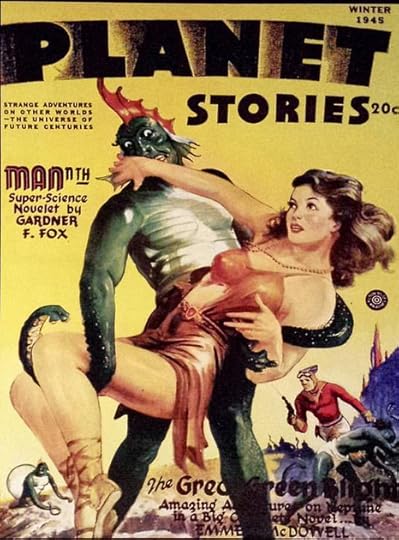
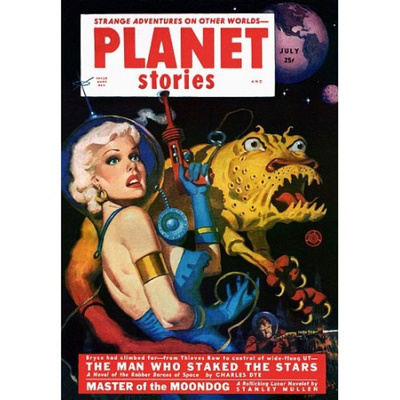
Un clásico de la ciencia ficción que propone la existencia de un número infinito de universos paralelos al nuestro, todos igualmente reales y verdaderos, donde son posibles todas las combinaciones imaginables: universos donde la geografía y la historia de la Tierra son radicalmente distintas de las que conocemos; universos donde el hombre ha llegado a las estrellas; universos donde ni siquiera existe la raza humana, y las flores o las aves son la forma dominante de vida.
Fredric Brown was an American science fiction and mystery writer. He was one of the boldest early writers in genre fiction in his use of narrative experimentation. While never in the front rank of popularity in his lifetime, Brown has developed a considerable cult following in the almost half century since he last wrote. His works have been periodically reprinted and he has a worldwide fan base, most notably in the U.S. and Europe, and especially in France, where there have been several recent movie adaptations of his work. He also remains popular in Japan.
Never financially secure, Brown - like many other pulp writers - often wrote at a furious pace in order to pay bills. This accounts, at least in part, for the uneven quality of his work. A newspaperman by profession, Brown was only able to devote 14 years of his life as a full-time fiction writer. Brown was also a heavy drinker, and this at times doubtless affected his productivity. A cultured man and omnivorous reader whose interests ranged far beyond those of most pulp writers, Brown had a lifelong interest in the flute, chess, poker, and the works of Lewis Carroll. Brown married twice and was the father of two sons.
Fredric Brown was a true ubermensch of the Golden Age of Science Fiction, and his short stories are still among the best ever written in the genre. I mean that. Best...Ever...Written.
What Mad Universe is one of only a handful of SF novels that he wrote, a tear-inducing shame given how bursting with amazing it is. What's so unique about this tale is that it's both classic pulp SF in its own right, while at the same time acting as an examination/critique of pulp SF stereotypes.
Double your pleasure...double your fun.
PLOT SUMMARY:
The main character, Keith Winton, is an editor for a publishing company that puts out various adventure and science fiction magazines. As the novel opens, Keith is attending a gathering at his boss’s estate at the same time that an experimental rocket is being launched to the Moon. Disaster...explosion...everyone killed...everyone EXCEPT KEITH, who was at the center of the blast. For Keith, the adventure has just begun as he's blown into a parallel universe straight out of the pulp SF magazines he edits.
Okay...I'm going to tread lightly around the plot from here on out to avoid major spoilers, so there will just be some general observations accompanied by fanboy gushing.
The world Keith finds himself in is eerily similar to the Earth he left, but he immediately begins to notice subtle differences beginning with the replacement of paper money with credit sheets. These differences become increasingly more shocking right up until the final "we're not in Kansas anymore, Toto" moment that removes all doubt from Keith's mind...along with all of the control from his sphincter.
Eventually, Keith learns that our universe and the one he's now in began to deviate in 1903, when a scientist working on his wife’s sewing machine (yes, you heard me correctly) accidentally discovered instantaneous space flight, allowing the exploration and colonization of the Moon and the other planets of the Solar System and beyond.
This invention has led to a whole mess of changes, many for the worse, between the universe Keith is familiar with and the one in which he is now stranded. Keith stumbles through this world and finds himself confronted by everything "pulpy" you can imagine from Bug-Eyed Monsters (aka BEMs), mysterious night time “mistouts” ruled by gangs of “Nighters,” alien insects bent on world domination, women in metallic, form-fitting bikini tops (as if you can have pulp without them), and a genius scientist/general named Doppelle and his mechanical sidekick MEKKY who are loved and worshipped by all the people of Earth.
THOUGHTS:
This book is brimming with the warm, toasty goodness of SF pulp.
It's feel good, it's comfort food, it's soft blanket curled around you in front of the fire science fiction that just makes you happy. There are not enough stories like this anymore.
One final item I want to mention from the story is Moonjuice. I'm not going to tell you what it does, and it's only discussed for about a page and a half of the whole book, but if they ever mass produce it, I am going to buy it by the gallon. It's one of those SF concepts that you just fall in love with and that stays written on your memory in indelible ink.
Read the book, you will understand why. YUM!!!
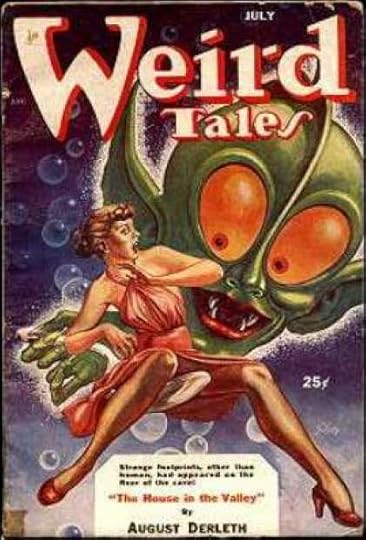
This is pulp SF at its most FUN and for fans of the genre I can't recommend it enough. That said, I think the story is engaging enough to appeal to just about any science fiction fan. So, in closing, you should read this. Now I leave you with one last wonderful picture from the glory days of science fiction.
This old classic SF deserves to be called a classic. :) Even now, it feels fairly unique and very interesting, a solid riff off of the golden age SF and a nearly seamless conjunction with alternate reality with all kinds of BEMs. (Bug Eyed Monsters).
SF in our universe, and Fact in the other. Aliens everywhere! War of the Worlds, Mars, Venus, Teleportation, Motherships, subjugation, it's all here.
So what is this professional in the SF field going to do when faced with a reality that is everything he'd been publishing?
Why not.... BE A HERO!?!
This happens to be one hell of a fun book! Full of low-types, shady individuals, telepathic entities, spaceships, and an infinity of universes.
I keep thinking that I should have read this EARLY EARLY in my first forays into SF. I would have immediately placed this one as one of my absolute favorites of all time if not just for nostalgia's stake, but because it's smooth and so cool. :)
As it is now, I'm just extremely happy to have finally gotten around to it and say to all of ya out there wishing you knew a very good early SF title to where you could dip your beak... This one is pretty damn fantastic and I think it holds up very well even now. There really isn't that many Golden Age SF I can truly say that about.
Or at least none that I can say that I unequivocally enjoyed from the first to the last pages without some sort of major or annoying complaint. :)
While the "science" in this science-fiction novel makes Philip K. Dick seem like Arthur C. Clarke, this was pure, non-stop entertainment. It has a light, humorous tone throughout, though this isn't like a Douglas Adams novel, but more like early PKD, only slightly more ridiculous and free-wheeling.
The basic gist is that there's a man, Keith, living in the very near future (at the time), who works as an editor for various sf and weird magazines that were so prevalent back in the day. On the same day that a rocket is going to land on the moon for the first time -- which is supposed to create a huge explosion of light so everyone can see it from the Earth -- Keith is suddenly transported from his boss's estate (where he was visiting) to....well, the same place, only everything's different.
In this new world, all the crazy things from his pulp magazines appear to be true. There are huge purple aliens walking the streets of Manhattan, interstellar wars are taking place in space, people use credits instead of cash, and every night there's a mysterious "mistout," where the very air is blackened to the point where no one can see more than a foot or two in front of them. Everyone stays indoors during these times, as there are roving bands of killers that are able to navigate the blackness. Keith slowly realizes that this is a very dangerous reality to live in, and he must figure out just what the hell is going on.
What Mad Universe was my first novel by Fredric Brown -- though I've read a handful of his shorts and short shorts -- and I will most definitely be reading more. I'd originally planned for one of his noir thrillers to be my first Brown read, and was nearly gutted to find my vintage copy of Here Comes a Candle vandalized with underlining throughout, which I cannot abide. So this was my second choice, and I'm glad I read it first, as it turned out that I really needed something absurd and fun, and this was perfect. At first my rationalist brain was annoyed by certain seeming plot-holes in this alternate reality, but Brown had a clever explanation that pretty much negates any and all nit-picks I or anyone else could have as far as the nonsensical aspects of parts of it.
Highly recommended for those into alternate world-type sf, and for those just looking for a fun, action-filled read.
Caught in the center of the explosion is Keith Winton, the editor of one of those fantastic pulp magazines that flourished in the 1930's and 1940'sAmerica. His own magazine is called "Surprising Stories" and specializes in planetary romance with lurid covers of scantily dressed young women chased by a BEM. (*)
From his post-Depression New York life, Keith Winton is thrown into a parallel universe where said bug-eyed monsters are freely roaming the streets. Other dangerous differences are revealed to him as he tries to make sense of this mad world that so closely resembles his own, yet knows space travel, has colonies on the Moon, Venus and Mars, and is fighting a terrible war against horrible creatures from Alpha-Centauri.
The only ray of sunshine in this parallel universe is the presence in the alternate New York of his crush from the real world, the beautiful Betty Hadley. Curiously, While Keith and the rest of the population dresses conservatively and in keeping with the standards of Old Earth, Betty is a 'space girl' and is wearing a more revealing costume:
Resolutely he looked at her costume instead of the parts of her that weren't covered by it. That helped a little. A damned little. [...] She was dressed, again, in the costume that she told him was the prerogative of a space girl. This time it was of white silk. Narrow - but marvelously twin-rounded white silk bra. Very short white silk trunks, so tight-fitting that they might have been painted on - and by the brush of a very great artist. And gleaming white patent-leather boots half-way up beautifully molded calves. Nothing else - except Betty Hadley, Betty Hadley's golden skin and golden hair; her wide blue eyes and soft red lips in a face more beautiful than an angel's.
Keith might be reconciled with his transplanted destiny, but alas, his Betty is engaged to the hero of this New World - Doppelle who looks like Errol flynn, leads Earth Space Defense against the Alpha Centauri monsters and is also the brainiest scientist on the planet. How could Keith compete with that? What Mad Universe has he landed on?
I haven't read many of Fredric Brown novels, but I am glad I discovered this gem from the early days of the science-fiction. The story combines the enthusiasm of the pioneers of space exploration with the tongue-in-cheek satire of the cliches and mannerisms of the fledging genre. How else could a warp engine be discovered by a man fiddling with his wife's sewing machine? And how else would it be possible for the Mooners to look like Sulley from "Monster's Inc."? Or for the lead lady be dressed like a pin-up drawn by Alberto Vargas? Or for a supercomputer to be a giant telepathic ball called Mekky?
Brown is careful to pay homage in his text to the first explorers of possibilities offered by science and romance : H G Wells and Edgar Rice Burroughs. But what I found particularly appealing is the inclusion into the story of elements from his other passion - noir crime novels - and autobiographical tidbits about what it means to be a writer and editor of pulp stories in the 1940's. Much of the book is told from the perspective of the runaway Keith, chased by police through the dark streets of New York, getting into trouble with the underworld and drinking 'moonjuice' in a seedy bar with a car thief. As somebody else will exclaim a couple of decades later :
"It's a Mad, Mad, Mad World!"
... yet such good fun to be a part of the adventure. I must check out more of these Astounding vintage stories.
Siguiendo con mi recorrido por la ciencia ficción elegí esta novela del autor Fredric Brown, publicada en 1949.
Inicia en 1954 con el lanzamiento del primer cohete a la luna 🌑, está primera intentona fracasa y el cohete se estrella en una casa de campo donde había presuntamente 12 personas pero solo aparecen 11 cuerpos.
Keith Wilson es el desaparecido, editor de una revista de ciencia ficción quien al momento del suceso estaba observando el cielo.
Keith en un pestañeo ve que ya no está cerca de la casa y empieza un viaje donde descubre que nada es lo que parece, y la tierra que conocía ya no existe como tal, sino que habita un lugar muy parecido pero con diferencias sustanciales.
Una novela con varias referencias a un mundo imaginado que se van descubriendo poco a poco y van siendo consecuentes con la trama, existe un toque de humor muy bien manejado, la ingenuidad del protagonista es fundamental para que todo cuaje, pues aunado a su torpeza lo hacen tener aventuras emocionantes pero también muy peligrosas, no faltan los villanos encarnados por unos seres de una galaxia lejana, y por supuesto hay amor y una búsqueda de regresar al mundo 🌎 como estaba.
Keith es un personaje simpático, extrañamente sin conflictos en la tierra normal, su trabajo lo apasiona, no tiene pasado tormentoso, se acaba de enamorar de una mujer hermosa y exitosa, todo esto lo pierde, su objetivo es poder recuperar su vida.
Me ha regalado un buen rato, aunque el único defecto es que Keith a veces desespera por ser un personaje algo torpe la inteligencia y pericia que muestra al final desentona un poco pero no echa a perder la experiencia.
A fun, unintentionally campy tale about a man trapped in an alternate universe. I love that Brown's vision of the future had Earthlings casually traveling to other planets, yet they still had to line up to use a phone booth. I definitely want to read more of this guy's stuff!
What Mad Universe appeared in abbreviated form in a 1948 issue of Startling Stories and was expanded to book format in 1949. Much of the humorous science fiction from that era has aged poorly, due to shifting social values and concerns, but this one by Brown is still a fun and funny romp. It's a recursive book that is essentially making fun of itself and, perhaps more importantly, the reader, but with a jovial, tongue-in-cheek air that's endearing rather than offensive. It's the story of a pulp science fiction magazine editor, Keith Winton, who's transplanted into an alternate reality where many things are the same, but many are different... many of the sci-fi trappings of the field are the accepted reality in his new world. He reads in the paper that General Eisenhower is commanding a war against Arcturus, but his big concern is that his girlfriend, Betty Hadley doesn't know him and says she's engaged to Keith Winton. It's a good story, with some good-natured pokes at the mystery and sf genres, and a good look at the social side of the field at the time.
Although better known for his (extremely brief) short stories, Frederic Brown was also an extremely accomplished novelist. The solidity of his prose style is remarkable: he was just a very good writer, able to express sometimes quite complex ideas very clearly indeed.
This novel was published in 1949 and it's a mark of how sophisticated the SF field was becoming in the hands of such writers as Brown (and Sprague de Camp and a few others) that they were able to twist their imaginations around to deal with the SF field itself. In its own way, this novel is a good example of critical fiction: a pre-postmodern work that affectionately lampoons the trops of props of pulp SF.
“…it seemed suddenly to Keith, a one-dimensional world. There was only a forward and backward in it as long as each of them—he and the unknown—groped their way along the building fronts. Like ants crawling along string they must meet and pass unless one of them turned.”
Purple monsters, mistouts, parallel universes, computer brains named Mekky: What kind of mad universe is this?
Brown’s What Mad Universe harkens back to the classic 50s sci-fi films, which oftentimes pitted humans against creatures and beings from the vast beyond, and Brown’s book seems to be as much of homage as well as a satire of this genre, with prototypes of the genre running rampant throughout the plot. While reading, I felt like I was in a prolonged episode of The Twilight Zone, and this made for quite an entertaining ride.
The plot involves Keith Winton, an editor for a science fiction magazine, being transported to a parallel universe when a rocket launch blast propels him into another dimension. Although there are many likenesses to the world he knows, he suddenly finds things are quite different, and he quickly becomes a fugitive on the run. Keith will try to stay alive long enough to find his way back to the world he knew….
This book is fun, imaginative, humorous and quite creative and clever. I also thought the “story within a story” aspect was quite ingenious. I probably liked the first half of the book—with the initial set up and conflict—a tad better than the second half. That is only a very minor flaw to an otherwise impressive book.
Over all, What Mad Universe very fun book and I’m looking to reading more from Frederick Brown.
echt brown: breakneck (abt. as much as the era got); mordant (at heart, a veiled, novel-length critical ouroboros on his own field, in which the pulp pleasures of the thing are [consciously] made indistinguishable from their juvenile misogynies); overstuffed (from the Nighters to the sadly attenuated “How to Moonlight As A Schlockmeister” tutorial, this could have gone in about five different episodic directions, each of which I’d have tuned in for); and light on its feet (actually v. funny to make paul gallico the author of the fawning biography of a war hero in this alternate universe). good stuff.
An ordinary guy and science fiction magazine editor is viewing the world-wide spectacle of Earth's first rocket to the moon. He passes out and wakes up in a parallel universe, suspiciously similar to the types of stories that he edits.
This was a fun, adventurous story with non-stop twists and some humor. Brown seemed to have had a good time satirizing the usual conventions of pulp fiction-era science fiction.
I read that Philip K. Dick was influenced by Brown. I can see that, although I've never read anything by PKD that's this upbeat.
I conjecture that Terry Pratchett and Douglas Adams were also influenced by this writer; there is a little bit of this book in Hitchhiker's Guide and Colour of Magic.
Read for the Horror or Heaven decades challenge: 1940s.
A charming golden-age sci-fi tale that isn't afraid to poke fun at its own genre (why, of course space girls are scantily clad. Why wouldn't they be?). Perhaps funniest of all, though (maybe unintentionally) is the fact that the main character is whisked away to a parallel universe where everyone wants to kill him and his main concern is that his parallel universe girlfriend is engaged to someone else.
Keith Winton, editor at a science fiction magazine, was answering a teen fan's letter when the first rocketship to the moon blew him away...
But where did he go? He asks for change and the cops try to shoot him, calling him an Arcturian spy. There are seven-foot purple monsters trying to destroy Earth. New York City shuts down each evening early to keep from having the city obliterated.
Luckily, an artificial brain, Mekky, befriends Keith, and together they will work to set things right.
ENGLISH: The best novel I have read by Fredric Brown, nearly at the level of his best three short stories (in my opinion; see my review here: https://www.goodreads.com/review/show...).
This book can be considered a possible precedent of the theory by Hugh Everett III about the quantum multiverse in time (officially called "ramifications of the quantum mechanics wave function"), although Brown's book never speaks about quantum theory, but it deals with a multiverse of this type. The novel was published 8 years before Everett's theory.
ESPAÑOL: La mejor novela que he leído de Fredric Brown, casi al nivel de sus tres mejores cuentos (en mi opinión, véase mi crítica aquí: https://www.goodreads.com/review/show...).
Este libro puede considerarse un posible precedente de la teoría de Hugh Everett III sobre el multiverso cuántico en el tiempo (oficialmente llamado "ramificaciones de la función de onda de la mecánica cuántica"), aunque el libro de Brown nunca habla de teoría cuántica, aunque se trata de un multiverso de este tipo. La novela se publicó 8 años antes que la teoría de Everett.
Para ver una descripción de los distintos tipos de multiverso, véase este artículo en mi blog: George Ellis y el multiverso
¿Dónde ha estado Fredric Brown todos estos años que hasta ahora no lo he encontrado? ¿En la Luna, en Marte, en Saturno? Sí, probablemente en Saturno. Nadie se queda tan cerca de la Tierra si no quiere que lo encuentren.
'Universo de locos' es necesario. Es necesario en mi estantería, en mi escritorio, en mi mesilla. Lo leería mañana otra vez, y pasado, y al otro. Me lo llevaría de vacaciones, a la playa, a la montaña, y hasta a un viaje espacial. Lo leería incluso conduciendo, pero eso sería, cuanto menos, peligroso.
Ahora, que os digo una cosa. Existe un universo en el que lo hago. En el que conduzco mientras leo este libro. Éste y otros libros. Y existe un universo en el que no tengo ni idea de quién es Fredric Brown. Y otro en el que ni siquiera existen los libros. Un universo en el que soy azul, y un universo en el que no he nacido. Hay un universo en el que yo soy Fredric Brown y Fredric Brown lee mis libros.
Hay universos para todo y para todos, y la forma en que el autor establece las bases de este pensamiento me parece formidable. No necesita mostrártelos todos para que te lo tragues. Simplemente lo crees. La ambientación es fantástica. Te la crees. Los personajes son maravillosos. Te los crees. A estas alturas, me creo todo lo que este señor me diga. Es más, quiero creer todo lo que me diga.
Porque quiero creer que existe un Keith Winton en el universo. En cualquiera de ellos.
Really enjoyable to find some real science fiction in the old style. I enjoyed it very much, and would recommend it to anyone looking for a good, quick read. Not so easy to find anymore, but worth it.
Holds up pretty well for a 70 year old homage to even earlier pulp fiction. In a 1950 review of the first edition, P. Schuyler Miller praised the novel as a "gleeful mulligan stew of well tried ingredients dished up with that all-important difference in flavor." I think my favorite bit was the Editor Keith's GF Betty, who's a Space Girl in the alternate universe. Space Girls wear a two-piece uniform: a skin-tight top and very short shorts. Keith asks Betty if spaceships here are very hot inside. Oh no, she replies, we wear clear plastic space suits over our outfits! Silly and fun. 3.4 stars.
-La sátira puede esconderse en cualquier rincón del humor -.
Género. Ciencia-Ficción.
Lo que nos cuenta. Un accidente durante la prueba de un cohete experimental transporta a nuestro protagonista, editor de ciencia-ficción, hacia una realidad paralela que presenta desarrollos técnicos mucho más avanzados (otros no tanto) y en la que estamos bajo la amenaza de los arturianos, alienígenas con malas intenciones.
¿Quiere saber más del libro, sin spoilers? Visite:
An interesting subtlety which I didn't glom onto the first time I read this: it's not actually what's in the scifi geek's brain, but what the editor guy imagines would be in there. lol The whole thing with the blackouts was very well thought out and extrapolated.
Up until I read this novel, I had only read a few of Frederic Brown’s short stories - some very short. He is funny, creative and very economical with wordage - many of his contemporaries, great authors of the long novel format such as Heinlein, Asimov and such claim that this is a most challenging thing to do and often cite Brown as the master of the short short form.
This, perhaps his most well know full length novel - my paperback edition has 205 pages - is ‘funny, creative and’ still ‘very economical with wordage’. It is a sort of Wizard of Oz type adventure story that is lighted hearted and entertaining - there are no big lessons to be learned here, no soap box ideals or insights, it’s just good pulp from one who knows the genre well. Printed above the title of my 1978 Bantam edition with intro from Philip Kyla’s (aka William Tenn) is, “THE TERRIFYING CLASSIC OF A MAN TRAPPED IN AN ALTERNATE REALITY”, well, I wouldn’t quite put it as “terrifying” exactly but our protagonist had one desperate hardship or jam to get out of after another which was exciting enough to keep this reader flipping pages.
The “writes what you know” rule is applied here as the protagonist, Keith Winton, is a pulp magazine editor and much of the business of magazine publication is featured here - which I found interesting.
Overall, this was a worthwhile read, deserves its praise as a pulp classic and will get me to read more of his work - primarily his short story compilations as he is not (based on this novel) a ‘big idea’ sort of writer.
¡Qué entretenido libro! Un clásico de la edad de oro de la ciencia ficción. Un punto de encuentro, en tono liviano, para muchos temas comunes de la literatura “pulp”. Muy bien logrado, envejece como el vino. Multiversos, aventuras, extraterrestres y máquinas de coser. Una mezcla explosiva. En mi opinión es saludable leer títulos históricamente aclamados, porque por algo son, efectivamente, aclamados. ¿Es lectura liviana? Sí. ¿Está bien escrito? Sí. ¿Entretiene? ¡Por supuesto que sí! Recomendado para todo lector de ciencia ficción que quiera ver cómo se construye una buena historia, loca y desordenada, con un personaje central que insiste en hacer todo sin mucho razonar sin dejar de ser totalmente querible y perdurable. El autor tiene muy buenos cuentos también, entre ellos uno que llevó a cierto capitán Kirk a pelear a charchazo limpio contra cierto malvado capitán gorn.
This is a well respected, classic sci fi novel that routinely makes it onto lists of the top books in the genre. It predates the Hugos or Nebulas, or it surely would have won some awards. So I was fairly surprised that I didn't actually enjoy it that much. It's the best novel-length work by a sci-fi author who is better known for his short stories… perhaps that should have told me something.
I suppose the problem is that I can't get enthusiastic about pulp-era science fiction. This is a satire of a pulp novel, written from the more enlightened perspective of the Golden Age of science fiction, in 1949. Because it's a parody, I can't very well critique it for being pulpy. The bug-eyed monsters, bikini-clad space girls, and New York thugs are all walking clichés… but of course that's the point. Anything I could point out as being poor writing or flat characterization could be defended as artful mimicry of the genre it's trying to satirize. That doesn't mean I have to enjoy it, though.
One interesting feature of the book is how very meta it is, for an era when sci fi was in no danger of being called post-modern. It's written from the point of view of a sci-fi editor, with winking, insider's caricatures of publishers, annoying fans, and writers.
I was also interested in this book's take on the parallel universe concept. While far from the first sci-fi work to feature parallel universes (a distinction generally credited to Murray Leinster's 1934 Sidewise In Time, but arguably belonging to H G Wells) this book nonetheless has a view of the multiverse not at all inconsistent with Everett's many-worlds hypothesis (sans the quantum details) that wouldn't be formulated for another 8 years. At the risk of a small spoiler, I'll point out that this many-worlds interpretation saved the book from one criticism. Initially, thinking it was more like an alternate history timeline in which , I thought it incredulous that in the presence of such a large change, most details were identical down to the names, addresses, and occupations of specific individuals. But with an infinite number of parallel universes, of course, none are impossible, and it turns out that there is a good (or at least plot-related) reason that this particular one is involved.
These interesting features notwithstanding, I can't claim to have actually enjoyed the book. From the stereotyped caricatures all the way through to the deus ex machina ending, it too much in common with books that are best avoided. Unless you're a fan of pulp sci fi in particular, I can't really recommend it.
I wasn't sure what to expect from this book before I read it. Classic sci-fi can be so hit or miss with me but I liked the description even though it was short. I listened to this one on audio and at first I didn't care for the narrator but after a while I got used to him, and he didn't bother me as much.
Anyway, I ended up enjoying this book. I liked the way the author added in old pulp fiction terms and ideas like the bug-eyed monster, and the woman in the space bikini. This book was written in 1949, so those things weren't so old when the book was written, but he leaned into them and kind of made fun of them in a way. It was cleverly done. And the whole working on a sewing machine leading to the accidental discovery of space flight was a pretty funny idea.
The only thing that I really didn't like about the book was the fact that the main character is so in love with this woman, but the only reason we are ever given is because she is so beautiful. That was a bit shallow, but then maybe it was done that way on purpose since this seems to be a homage to pulp fiction.
A rocket has been sent to the moon. It is equipped with a device to make a great flash so that people on Earth can see evidence of the landing. Unfortunately the rocket malfunctions, falls back to Earth, kills eleven people and Keith Winton who is at ground zero is sent to an alternate reality. A universe that has duplicates of many people, right down to the letters to the editor being exactly the same. It also has a habitable Moon, Venus and Mars, actual bug-eyed monsters that are attacking Earth, mistouts to protect big cities from Arcturian attacks, and many more amazing differences.
Keith is the editor of Surprising Stories. After he wakes up from the blast he no longer sees the house. In nearby Greenville he sees no Barton in the phone book. He picks up a copy of his magazine and tries to pay for it with a quarter. The shopkeeper is shocked to see a rare coin and gives him two thousand credits for it. When he tries to give the guy another coin the guy calls him an Arcturian spy and shoots at him.
With luck Keith makes it back to New York and after a harrowing night where he barely escaped with his life he starts reading about the history of this universe. There are daily shuttles to the moon, star travel and the war with the Arcs. A war that would be lost already if not for Dopelle.
Very fun read. Lots of action. The science isn't the greatest but who knows what works in that alternate reality. Humor, Keith says something about Betty's attire. She says the skimpy uniform is a distinction of being a space girl, just ordinary, what else could it be? Thoroughly enjoyable even after seventy years. Only a little change in the reader's mindset. Remembering a time when there weren't ubiquitous cameras, telephone books had people's addresses, etc.
This book is SF pulp mocking SF pulp! It was first published as a book in 1949. The writer of the introduction to the 1978 edition says it was first published in a magazine in 1948. It is the first time I had seen the acronym BEM (big-eyed monster) and did not learn what it meant until after I finished the book. As a spoof of SF pulp it will never go out of style.
Keith Winton, editor of the sci-fi magazine Surprising Stories, has fallen head-over-heels in love with Betty Hadley, editor of the romance magazine Perfect Love. They are both at their publisher's estate in Greenville, NY but Betty leaves early as she has to give a speech. Keith is pumped to see the signal made by the first-ever rocket to the moon when it touches down at 9:16pm. Well, due to a mechanical problem, the rocket never makes it to the moon but instead lands on his publisher's estate and explodes, killing everyone but Keith and destroying all the buildings on the estate. But Keith doesn't appreciate this because he comes to in an alternate universe, where instantaneous space travel has been going on for about 30 years and all those BEMs are not just bad cover art but real aliens. Keith bumbles along, almost getting himself killed or arrested a few times, as he tires to figure out what's going on.
This is quite a fun read, especially if you appreciate the spoof!
Keith Winton is an editor of pulp science fiction magazines. Things are going well...the job is good. His boss likes him. He's making headway in romancing a lovely editor of romance magazines. And then a freak accident from a failed rocket launch thrusts him in to a different reality...one that, upon further review, bares a striking resemblance to one of the space opera's from the stories he edits. Now Keith Winton has to try to survive in a world where he can be shot on sight for being an alien invader. Where the Earth is united in an intergalactic war. And he has to hope he can survive this mad universe and find a way home.
This is a re-read but, honestly, I didn't remember anything but the very basics of the story. This is a very early use of parallel universes and an explanation of the classic multiverse in SF. A good book and historically important. It breezed along, which was nice. I have seen this sometimes described as humorous and I have to wonder if that's solely on the basis of Brown's reputation for writing humorous SF. Because this is not a particularly funny book. It's light, but you're not getting anything like Brown's "Martians, Go Home." It is a recommended read, particularly if you are looking for seminal SF.
200119: well now i have read some pulp sf. enough to sort of enjoy this satire, i guess i still think of this in postmodern terms, as genre talking about genre, as familiar tropes subverted and maybe (i don’t know) scenes/characters scrambled in. is it possible to parody that which already parodies itself? ask about austin powers and james bond...
261110: i have not read pulp sf in its first time so the parody is of a type of lit i know only through critical work. this is ranked as best, incorporating the fans, the writers, the editors, the magazines, in a fantasy about itself. as for work of the sort it is a work about, i prefer the more serious sf work of 'galaxies' by malzburg, but this is fun, repeat: fun. it is written for fans of pulp who have read enough to recognize itself. i have read he influenced philip k dick, this is not dick at his best, but better than dick at his worst..,