Instruments of Torture is a compilation of eight short stories, each talking about a medieval torture device and brilliantly connecting it to modern-day torture. Each story starts with an explanation of that torture instrument. Then, story after story we see how forced physical torture of the past has become self-imbibed mental torture of the now, some times with exact correlation and some times with a subtle parallelism. I thought this dark, twisted & torturous correspondence of a singular concept with stories was ingenious.
With short stories, there is always a hidden theme that connects them together. Like in Murakami’s Men Without Women, there’s the constant loneliness which becomes its own character. In Bora Chung’s Cursed Bunny, we go beyond all realms of normalcy. In Jhumpa Lahiri’s Roman Stories, we quite literally have stories set in Rome. For all these novels, there is a direct relation to the theme. But, what makes Instruments of Torture unique is how loosely the theme of torture is connected in all the stories. When you start reading the story, you would not be able to imagine how it would end. Achieving such unpredictability with short stories is commendable!
The characterization in short stories of an average quality typically seems acceptable in most short stories. But, when it’s a topic like torture and the writing is without any dialogues, the characterization coming across the way it is intended needs courage. And, I loved the way every character was written, however short their arcs were and how the ending in most stories unleashed their real nakedness. Whether it was the boy with breasts, the star-crossed lovers, the model Indian wife or the society-approved couple. The author’s observations of basic human behaviour combined with the knowledge of Indian society and a pinch too much of intrusive thoughts becoming real has what made this into an incredibly horrifying yet an unputdownable book.
To top it all off, it is not just about horror or gore or torture, there is always a message. Firstly, it cleverly depicts how torture can be anything. It can be actual physical torture, yes. But, it can also be your routine that’s torture or your unhappiness or your decision or regrets. This underlying secondary torture plays hide and seek throughout the book, but when it’s prevalent, it speaks volumes. Secondly, something that goes hand-in-hand with torture is coping mechanisms – both healthy and unhealthy, which are also described well. Lastly, there are stories that make us realize the pivotal necessity of mental health resources, awareness of gender identity, inclusion towards LGBTQ+ community and promoting body positivity.
If you have read this review till now, you must have understood that this book is not for the faint-hearted. For 90% of the story, it’s a normal story, but that last 10% has the potential to destroy you. So, if you are sensitive to any of the triggers, I would suggest not reading this book. If you are a fan of horror and dark book, then you might like this one. If you want to read a very unique book by an Indian author, then you should pick this up. If you want to get out of a reading slump, this book is ideal. I don’t shy away from any genres as such and dark books don’t faze, so reading this was uncomfortable but also thrilling. I have rated Instruments of Torture by Aparna Sanyal at 4.5/5 stars!
What if the most terrifying torture wasn't inflicted on the body, but on the mind?
Instruments of Torture is a collection of eight dark short stories, each named after a medieval torture device.
Before every story, the author introduces the history and mechanics of the instrument itself, only to reveal how those same methods of suffering have evolved into psychological torment in the modern world.
Obsession, prejudice, guilt, identity, grief, and longing become the new instruments of torture, proving that the human mind is capable of creating prisons far more devastating than any medieval chamber.
What impressed me most was the originality of the concept. The historical context makes the parallels between every story and every physical and psychological suffering all the more unsettling.
The author allows discomfort to seep in gradually rather than relying on graphic horror. The result is this book of collection.
Although these are short stories, each one presents a distinct voice and leaves behind a lasting emotional impact.
Beneath the darkness lies thoughtful commentary on gender, mental health, social expectations, identity, and the invisible burdens people carry every day. The stories invite reflection as much as they evoke unease.
If you enjoy literary horror, psychological fiction, and stories that challenge the way you think about human suffering, Instruments of Torture is a uniquely crafted collection that deserves to be experienced.
Recently, short stories have been more of a hit than, say, novels. I ended 2023 with a banger that was The Secret Lives of Church Ladies by Deesha Philyaw and began the new year with Nishanth Injam’s marvellous collection The Best Possible Experience, and now this weird, twisted, and dark as an unlit room of a book, Instruments of Torture by Aparna Sanyal.
In my non-professional opinion, a successful short story is one that gives you just enough to sate you, paint a picture with splashes of colour, and characters that, within a few pages, come alive. We don’t need to know everything about them, just the essentials that would make them believable. And Sanyal manages to do it with every single story. It’s quite unbelievable.
Let me just say it here: it’s not for everybody. Some of the stories are incredibly disturbing, but to their credit, they never venture too far as to make us feel squeamish. I liked the fact that they were more concerned with the examination of darker subjects than shocking our mouths open.
And what can I say about the stories themselves? They were so inventive, unique, and sinister. Where The Judas Cradle and The Rack made me teary, The Spanish Booth and The Chastity Belt dispensed those sad clouds. Some of them were highly kinky, which I gobbled at an incredible pace. Except for the second story, which got ruined by its ending, everything else deserves a five rating.
The writing is beautiful. The images she captures with so few words are admirable. In The Judas Cradles, while describing an overgrown and unkempt piece of land and how the colony adjacent to it tried to protect itself from the rapid overtake of nature, she writes, “The colony was tied in with a lattice wood fence, mildewed and rotting with age but standing its ground stubbornly, as if forcefully corseting a virgin’s burgeoning bosom.” I mean, how can anybody come up with this analogy? And the entire book is filled with these tiny little gems like these.
One thing I will say and it has nothing to do with the stories themselves but rather with the production of the book. There was no table of contents. And this annoyed me since I never read a collection in chronological order. I like to read the ones that have the most interesting titles.
Delve into the labyrinthine corridors of the human psyche, where nightmares reign and the soul’s darkest secrets await revelation. Each tale in this collection bears the name of a medieval torture device, unveiling the intricate dance between psychological torment and its physical counterparts. From the anguish of a man subjected to experimental treatments to forbidden love flourishing in the shadows of sacred spaces, these stories offer a haunting reflection of the human condition. As characters teeter on the edge of society, they hold up a mirror to the reader’s subconscious, exposing the profound depths of torment and turmoil hidden within us all.
The composing is wonderful. The pictures the creator catches with scarcely any words are outstanding. She jumps straight into the chaos of character, love, and emotional well-being, and she does it with a crude genuineness that hits you squarely in the stomach. I cherished the one-of-a-kind methodology of naming every story after a middle-aged torment instrument, which, however not straightforwardly connected with the plot, suitably addresses the frightening and disrupting mental condition of the hero.
Be cautioned, this is not a light perused, it shocked me in every single imaginable way. The topic can be somewhat upsetting, and the characters’ processes are frequently frightening. Sanyal shrewdly opens the inward universes of the characters with flawless sympathy and awareness. What makes this book for me is its significant capacity to mirror the peruser’s inner mind’s fears and wants, holding up a mirror that urges thoughtfulness. If you’re searching for brief tales or fiction overall to make you think, this book is the ideal one for you!
Aparna’s *Instruments of Torture* kicks off with a trigger warning—a thoughtful touch I wish more books would include (#iykyk). This collection is filled with disturbing and deeply moving experiences that evoke disgust, anger, sadness, and ultimately a sense of gratitude for the ordinary lives we lead. These are exactly the kinds of books I find myself irresistibly drawn to.
The book is a series of short stories, each plunging us into the depths of horror. Each story is eerily named after a different torture device—like the Judas Cradle, the Spanish Boot, Scold’s Bridle, and the Chastity Belt. The chapter titles give just enough of a hint to brace ourselves for what’s to come, yet still leave room for surprise. I found myself captivated by the stories, often flipping back to the chapter titles to fully appreciate the cleverness of the narrative.
Aparna has masterfully handled a gruesome subject with a unique and creative flair, and I have to give her credit for that. Her writing is unapologetic, drawing readers into the raw, often uncomfortable truths of human existence. It gave me a little bit of Ottessa Moshfegh vibes—a writer I absolutely adore—so that’s high praise indeed.
This book left me with a racing heart, a clouded mind, and much to ponder long after I turned the last page.
This book is not for the faint-hearted, but if you think you can handle curling up with this mind-bending read, then we can definitely be best friends.
What a book this was!!! It’s definitely not for the faint-hearted. Honestly, all books should have a trigger-warnings page in the beginning like this one.
This is a collection of eight short stories, each tied to a medieval instrument of torture in a way you’d never predict — almost metaphorical, almost unsettling. It shows that real horror isn’t just gore and jumpscares, but the extent to which the darkness of the human psyche spills over, mirroring these medieval instruments of torture.
Surprisingly, it was fast-paced for me (saved me from a reading slump, actually). I finished it in three nights. Some stories made me uncomfortable, some heartbroken, some shocked… and a few even amused.
The characterisation is impressive; the range of characters and the emotions simmering underneath are revealed layer by layer as their stories progress.
The writing is beautiful and poetic. It doesn’t push the envelope too far or dramatise trauma for effect; it simply lets these stories be — raw as they are — which works well.
If you’re in a good headspace and can handle heavy themes, I’d absolutely recommend this. Mainly because it’s refreshing to see an Indian author take such a bold, risky route and create something so different from the usual.
Short stories sometimes serve as a respite from all the long form novels, and the onslaught of emotions! And this collection is just the right kind of wicked. As the name suggests, each chapter starts with a brief description of a mediaeval torture method/device, followed by a short story on the modern day torture brought mainly by all the broken minds.
I, personally, love reading all about twisted psyche and the byproducts of broken minds. There's a thrill to these stories, a vague idea of what people are capable of, in their darkest days. The grief touches each one of us differently.
These stories are a product of the trauma the society hands us, sometimes generational and every once in a while, from the people we love and hold dear. Twisted psyche, misguided notions of love and societal pressures, this collection has it all.
If you're looking for something refreshing and equally wild and wicked, this is the book you need. Sanyal's writing promises a world of nightmares and forms of eternal darkness that dwells within the
When a writer gives a trigger warning, one should listen.
This book contains stories that are very different from the genre I usually read. Each story dives deep into the human mind and explores themes of mental illness, tangible and intangible abuse, trauma, suicidal behavior, and the quiet violence people inflict upon themselves and others.
The writing is powerful and unflinching. The book speaks in the loudest possible manner and evokes tension through vivid, almost cinematic imagery. Every story leaves behind a trace of discomfort and reflection.
Irrespective of its daunting nature, I loved the book and would still recommend it. It will definitely destroy you but don’t we read for that, exactly?
Instruments of Torture is author Aparna Sanyal's mesmerizing literary venture that is unique in the way of its culmination process and remarks a gorgeous wordplay which will make you fall in love with her narration voice.
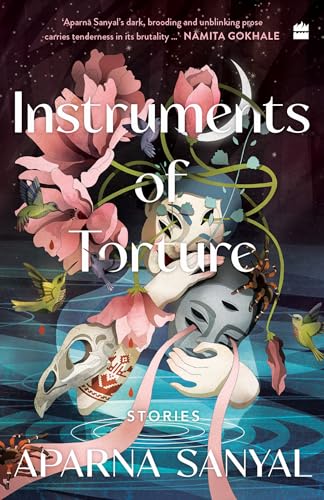
I stumbled upon her words. She was toying with words. Playing with words like she is playing fencing. And I can't praise the cover enough, it's tantalizing, brutal and shows artistic voice just like the content inside this book.
Darkness of heart and curves is a prominent topic of this book. The book talks about various historical instruments that are used for torturing; that meticulous research work presented with stories that depicted psychological suffering, and anguish that makes connection with each instrument portraying every individual's pain and helplessness making the book a compelling read eventually created a kaleidoscope of humanity.
Stories are perfectly mirror every torture instruments and that is an incredible idea to show how our society working, what lies at the edges of our vision that we couldn't connect yet. Characters bore impeccable dimensions which makes me astonished, they are very real and relatable yet very unknown from you and me. It forces us to think how much we know the people around us.
The first story of a dwarf boy made a voiceless cry, its' rawness is able to make scratch in your heart, another story of a beautiful and proudy wife is showing some confusion, a sublime nameless pain is painted brilliantly with a hinge of sarcasm. Everyone is different here, every pain is different but not difficult that you can't recognise.
Aparna Sanyal is playing with human complexities like a juggler. She seamlessly telling us stories that lets us experience the darkest torture chamber of the soul. Where rapacious dreams dwell and nightmares are forged. In these pages, the mind's darkness lies revealed.
If you love history and complexities in the human mindset then you must read this book. Don't miss it.
If you like short stories with vivid, unsettling imagery, And endings that leave your thoughts in reverie, Themes blending contemporary and medieval lore, Then this anthology's tales will leave you wanting more.
If "Dangers of Smoking in Bed" was a hit, You won't want to miss this literary trip.
Why must you read it? -Come for the horror & stay for the shocks -Twists at the end -How low can we fall? Find out.
In 'Instruments of Torture' humanity is at its rock bottom. If a God were to read this book, They would be inclined to razing the grounds of the earth free of the monstrosity humans have become. Namita Gokhale, as she claims on cover page, might have found tenderness in Sanyal' s stories, I didn't. These stories are not meant to be tender. They are meant to display a race at its rock bottom. Such depravity you will find here, you might end up stripping the skin off the corners of your nails. Humanity is a wretched creation that has played havoc with its hormones and emotions. And Sanyal shows it in all its naked debauchery. No tenderness for your bleeding heart here. Come for the horror and stay for the shocks. For almost every story ends with a twist. It's not abrupt though. Sanyal nurtures the twist, keeping it out of your gaze but it's there in the periphery. She fattens it gradually and slits its neck at the end, spalshing you with its literary inky blood.
So what are the stories about? They are about characters who need or want love, recognition, acknowledgement or just acceptance. A dwarf man-kid is injected with hormones by his parents so they don't have to feel shame displaying him about. A boy is forced to mock by his Gyenocmastia to satisfy the bullies. A couple goes through divorce just after attending marriage councelling. Years later, a man comes across his crush. Two brothers try to forge a bond that's doomed to fail. Intrigued? Find out more in the book. I am not going to tell you everything here.
Every story is a piece of clever and engaging storytelling but Sanyal trule shines in The Rack, The Phalaris Bull and The Iron Maiden. The Rack, the story that kickstarts the collection is a heartbreaking tale of an adopted boy who 'found a home with the couple, but could never find their hearts.' Sanyal writes: "The feeling of loss that dogged him every moment and that came out in his sudden bursts of anger and crying jags had a name too: his mother called it 'ingratitude', his father called it the nature of a bastard child." In a striking scene, Sanyal reveals the dry well that the mother has turned to, using a kajal pencil to line the undersides of the boy's eyes, the rough act making the baby bawl his head off. The dressing up of a baby for puja feels almost vulgar, the boy who's called an 'it' is now bedecked in holy yellows and reds.
But the writer comes to the rescue of mother, without judging her. About her she writes: "...Her marriage had long ago leached away any tender sentiment from her soul, and now this child demanded feelings that she did not possess. Raghu sought warmth where there was only winter, sought shade in a parched desert, and this left both mother and child constantly dissatisfied and suspicious of each other."
In The Phalaris Bull, a misshapen child weighs heavily on his mother's life. Rupak can't believe this is her child. This baby was supposed to be rainbow smiles and gossamer beauty. But it's: "...An already shrivelled thing, ready to desiccate to the touch like the husked cocoon of some plump butterfly that had since flown away." Himmat, the child, displayes a flint-lined heart: "To most regular pain, Himmat seemed immune. His mother's tears did not move him, nor did any of the oily supplement shots he got..." When the next child comes, he is like 'the insides of a mithai shop'. "Himmat had come to understand the unsaid but viral difference between maternal love and maternal duty." Himmat displays surprising affection towards his baby brother. But does it last?
Named after medieval torture devices, these stories explore the meaning and impact of the titles upon the lives of the characters that inhabit this world. These are the stories that subsume dry wells of despair and darkness. The author has rooted the stories deep in the human complexities. With every passing word, more darkness emerges, egging the reader on and on. The twists that comes are not abrupt but organic and cultivated.
Buy it this festive season to cleanse your reading palate of all the gossamery stories.
The Rack tells the story of a child adopted at birth who never truly finds love in the only home he knows. The book is gutting in its insightfulness, making it easy to feel Raghu’s deep pain and his gradual escape into his own inner world. It sheds light on the wrong reasons some people choose to adopt and the unfairly high expectations they place on a child. Ultimately, the story serves as a powerful reminder that a child should receive nothing but unconditional love and nurturing.
The Pillory follows a young boy and his obsessive fascination with a classmate who remains oblivious to his feelings despite their close friendship. He eventually attempts to escape this obsession by putting vast physical distance between them, only to encounter her again years later. When they finally reunite, she is in a vulnerable position, allowing him to take advantage of her situation and exert the control he always craved. The story serves as a chilling exploration of how unrequited fixation can transform into a dark desire for power.
The Judas Cradle is a heartbreaking story about young Henry, who discovers that his passion for a slightly older Brother of the Church is reciprocated. However, the heavy weight of societal judgment leaves both young men feeling diminished after every tryst, a path that ultimately leads to Brother Jose being excommunicated. While Jose faces the loss of his position, Henry is forced to endure a much darker reality, struggling against the crushing weight of hypocrisy and abuse.
The Spanish Boot brings to light two deeply ingrained aspects of Indian society: a preoccupation with external beauty that breeds superficiality, and a rigid arranged marriage system that often prioritizes those same shallow traits. The story highlights the friction that occurs when adults are forced into unions despite wanting more meaningful or different things from their life partners. Most unsettling of all is the character of Poornima, whose complete lack of emotional depth is portrayed as something truly frightening.
The Iron Maiden observes this institution of arranged marriage from a different perspective, focusing on the complexities of body image and sexuality. It examines these themes through the lens of Mohan, who is forced to deal with harassment as a curvy child before transforming into a muscled young man. The story highlights how physical transformation affects one's internal sense of self.
The Phalaris Bull explores the relationship between two young brothers: one twisted in both body and mind, and the other unaware and trusting. Their bond is seemingly not shaped by their mother’s vastly different feelings for them, a stark contrast between duty and love. This dynamic however leads to a dark climax, where one brother exacts a heartless and cruel revenge on both his sibling and his mother. The story provides a chilling look at how parental favoritism can fuel a lifetime of resentment.
The Scolds Bridle provides a harrowing look at medical neglect in a marriage. The husband of a woman struggling with depression decides he dislikes her personality, and convincing himself his wife is merely "spoiled," he cuts off her medication. When she spirals, his satisfaction turns to frustration; he dismisses her suffering as tantrums and withdraws his affection to "teach her a lesson." This cruelty leads to disastrous consequences, highlighting the tragic impact of ignorance in a relationship.
The Chastity Belt follows a village Casanova who becomes obsessed with a wild, unbridled midwife. Even after she rejects him for other lovers following a single encounter, his fixation only grows. To avoid an arranged marriage orchestrated by his mother, he takes a vow of chastity, finding that the voyeuristic relationship that eventually develops is all he truly craves. This story provides a strange and unsettling look at how rejection can twist desire into a permanent obsession.
This entire review has been hidden because of spoilers.
The world is a paradox. While on one hand, it is a beautiful, fulfilling place, on the other, it is filled with torture and misery. These two realities clash every single day and Aparna Upadhyaya Sanyal’s latest book of short stories, Instruments of Torture, is a perfect manifestation of it all.
Instruments of Torture is a collection of 8 short stories, each a metaphorical depiction of a medieval instrument of torture. From a little boy being plied with hormones to “cure” his dwarfism to a woman raised to see her beauty as currency to a classic story of sibling relationships but with a difference to how mental health issues are seen in Indian society – every story shows us the mental and physical torture that comes with society’s rigid rules, stereotypes, hypocrisies, gender roles, and patriarchal thinking. This book is more of a mirror to society than a solution bank, although it does show us how everyone has their own way of arriving at solutions that work for them.
What I Loved About It:
There are so many things about this book that I loved, least of which is the fact that every single one of these stories awakens a brand of righteous anger in you that has been dormant because of how quickly everything gets normalized in the world, even the bad things.
But reading these stories will make you uncomfortable. It is like stoking that fire, of looking unfairness in the face and feeling yourself float up because you’re so incensed at the truth that the world is indeed a cruel place.
And Aparna Upadhyaya Sanyal’s writing, the turns of phrases that she uses, the gorgeous, gorgeous language she uses to make her points – scathing in some places, loving in some, matter-of-fact in others – it’s like a little chameleon, her writing, shifting and moving as the story progresses.
Many authors say that they wrote what the stories demand of them, which is a beautiful way of connecting with the story one writes.
But Instruments of Torture feels very deliberate in the best way possible. You can feel the author’s intent in every sentence, in the way she connects those medieval torture devices to the psychological torments of the present. And that is what makes this book that much more beautiful. Severe in the heaviness of its subjects, yes, but beautiful.
What I Didn’t Like About It:
There’s not much I didn’t like about it. There was one place where it got a little draggy and another where I began to think that maybe the depiction of the child with deformities was playing into bad stereotypes. But while I think that the former is a legit, although tiny concern, the latter is, like I mentioned before, a mirror and not exactly a pat on the back to society.
Final Verdict:
Overall, I think that Instruments of Torture is yet another success story – or stories – from Aparna Upadhyaya Sanyal’s pen. If you’re looking for short stories or fiction in general to make you think, this book is the perfect one for you! Even otherwise, I’d recommend you read this collection because you just might find a favorite or 8 in there.
“The feeling of loss that dogged him every moment and that came out in his sudden bursts of anger and crying jars had a name too: his mother called it ‘ingratitude’, his father called it ‘the nature of a bastard child.”
Book - Instruments of Torture Author - Aparna Sanyal Pages - 200 Published - February 21 2024
⭐️⭐️⭐️⭐️⭐️/5 In a an anthology of eight short stories, Aparna Sanyal traces the paths of love, obsession, hate, and violence that have been laid out since time immemorial, and discusses the horrors these paths lead to. The blurb of the book very cleverly sets the stage for the book, keeping the veil untouched and the readers curious for what Instruments of Torture offers. The book has eight short stories, all of them titled after a certain torture equipment that was used in the olden times. Sanyal made sure to include a small description of the instrument, as they prove to be integral with the story later on. The Rack showed us how ungrateful and dirty parents can be, just because their child does not fulfil their list of criteria of appearance they deem beautiful. The story was a heart breaking narration of the young boy, whose life turned to hell the moment it began. Crass remarks on his height were made, he was fed numerous ‘height increasing’ medicines whose ads we can still spot on any newspaper’s classified section. The Rack was a tormenting reality lived by millions of children, who to this day, struggle to love themselves. The Phalaris Bull is the story of a a child born of severe health issues, and how his family left no stone unturned to make sure Himmat, the child felt at home. This story stirred something in me on a molecular level, as the story is something straight out of everyone’s scariest thought. The story ended on a note of utter bewilderment, horror, yet with a sense of cruel satisfaction. I was enamoured by how all the stories were a gesture towards love, though in forms that were sometimes twisted and sometimes misunderstood. The young boy who ended up loving a training pastor, the woman who never saw love other than the materialism it brought, the boy who loved his brother in the purest of forms.. it all made sense as Sanyal went on to torture them till the end of the book. Sanyal’s writing is brilliant, and kept me greedy for more. The stories are twisted, depressing, real, and sick in the head and I think it only made sense the way they did because of Sanyal’s writing. The crude intensity of the book might be difficult to handle for all, but that was the reason why I felt connected with the stories. Making its way on my list of the best books of 2024, Instruments of Torture is a harrowing tale of love, death and everything messed up with the world.
Instruments of Torture is a collection of eight nail-biting short stories that are dark and twisted. I started reading the book without reading the blurb and I finished it with satisfaction and a craving for more.
It is safe to say that all stories are my favourite as each story delved into the human psyche and brought up the sinister sides of their personality. My top three favourite stories are - The Chastity Belt, The Scold's Bridle and The Spanish Boot.
There's a couple who want to do everything to reverse their child's dwarfism. Two men who fall in love despite knowing the repercussions of their act. A man who is discovering his gender after he is married. Two brothers who are inseparable. One is a "healthy child" and another has cerebral palsy. The ending of this story will make you question a lot.
The names of the stories are based on torturing devices and their description is given at the start of the story. The stories can trigger for various reasons so read them carefully. I loved the concept, the writing and the brilliance shown through the narrative. The Author has shown the darkest side of humans and there's no lie about that. The stories revolve around the mental state of people who do things that are out of their control, sometimes because of particular disorders or sometimes their fantasies take control of their mind. Whatever the reason could be, each story is equally twisted and engaging.
I loved the presentation of mental health disorders and other genetic disorders especially and how they are viewed in our society. By labeling them as "problems/drama/defect", we take away the opportunity for further discussion and understanding.
The human mind is a complex thing. It's unpredictable and full of chaos. The stories are the best representation of that. I haven't read much in this genre where the stories usually have a psychological thrill and you don't know what to expect next.
This book was surprisingly a refreshing break for me which also ended my reading slump. The writing is impeccable and it will not leave you until you finish the story. If you want to read something dark and shocking then this is the book to go for.
As a crime fiction lover, storytelling that goes beyond chilly is nothing very new… rather; I never expect a book which doesn’t call itself a thriller rattle me. Emotionally and spiritually (in a way).
I stood corrected when I opened the package and Instruments of Torture was delivered… and it didn’t stop with such an intriguing cover image, rather opening the book was a supernova moment.
The pages filled with gruelling scenarios and one uncomfortable story after another, only to make me knock on reality of today and look into the mirror along the way.
What stayed with me wasn’t shock value. It was the unsettling intimacy with which Sanyal writes her characters. They aren’t heroes or villains. They’re painfully human. People carrying secrets, regrets, impossible choices, and the kind of emotional scars that don’t heal simply because time has passed. At times, I found myself judging them, only to realize a few pages later that I understood them. That realization is again- uncomfortable, and I think that’s exactly the point.
There is a quiet elegance to Sanyal’s prose. She doesn’t rush to explain or comfort the reader. Instead, she lets the silence between words do as much work as the sentences themselves. The stories linger because they trust you to sit with ambiguity. Not every ending offers closure, but almost every ending leaves an emotional echo.
What I appreciated most was how the collection refuses to sensationalize suffering. Pain isn’t presented as spectacle; it’s presented as something deeply personal, often ordinary, and therefore far more devastating. The horror here isn’t supernatural. It’s psychological. It’s social. It’s rooted in the everyday ways people betray, abandon, manipulate, and misunderstand one another.
That said, this isn’t a collection for readers looking for fast-paced thrills or neatly wrapped conclusions. It demands patience and emotional openness. Some stories resonate more powerfully than others, but together they create a mosaic of the human psyche at its most vulnerable and most fractured.
As Sharks of Shark Tank India often bet on founders of the start-up, I did the same in Aparna's writing.
Last time when I read "Circus Folk & Village Freaks" her way of witnessing the world and expressing it through her words, I found it unforgettable. And I was sure her upcoming books would never let me down. I'm glad it turned out to be true!
"Instruments of Torture" by Aparna Upadhyaya Sanyal is a collection of short stories. Each story in this book is named after a medieval torture device. But don't let the historical references fool you – these tales are deeply rooted in the modern world, tackling some heavy stuff.
For example, the story is about this guy who's forced to undergo hormone treatments just to fit society's idea of normal. Or the forbidden love affair that brews in the most unlikely of places. As you read through each story, you start to see these connections between past and present, and let me tell you, it's eye-opening.
What really got to me was how these characters, pushed to the fringes of society, hold up a mirror to our own struggles and insecurities. It's like looking into the darkest corners of your own mind and seeing all the stuff you'd rather keep buried.
But here's the thing – as uncomfortable as it might be, it's also kind of liberating. Because by confronting these harsh realities head-on, we're forced to reckon with them. And that's where the real power of storytelling comes in.
Aparna Upadhyaya Sanyal doesn't hold back. She dives straight into the messiness of identity, love, and mental health, and she does it with a raw honesty that hits you right in the gut. And let me tell you, it's refreshing.
So, if you're looking for a book that'll make you think, that'll challenge your assumptions, and maybe even change the way you see the world, "Instruments of Torture" is definitely worth a read. Trust me, you won't be disappointed.
"In this world we walk on the roof of hell gazing at flowers."
When I came across this book, I was instantly intrigued by both the title and the cover. They carried a sense of mystery that compelled me to pick it up.
This book is a collection of stories that dives deep into the human psyche, exploring its darkest corners and most unsettling possibilities.
Now, if you're thinking this is just another collection of dark psychological stories, think again. What disturbed me wasn't merely the events unfolding in the stories, but the chilling realization that the emotions, thoughts, and situations portrayed could exist much closer to reality than we would like to believe.
One of the most fascinating aspects of the book is its structure. Each story is named after a medieval torture device, and the narrative is carefully crafted to reflect the psychological essence associated with that device. Every chapter also has an introduction to the particular instrument, adding an extra layer of context and intrigue.
I must appreciate the originality behind this concept. Conceiving something so unconventional is impressive in itself, but handling such sensitive and disturbing themes with maturity and restraint deserves genuine praise.
The stories are dark, raw, and thought-provoking. Rather than relying on shock value alone, they encourage readers to confront uncomfortable aspects of human nature and society. That being said, this book comes with several trigger warnings. I would strongly recommend checking them beforehand, as some themes may be distressing for certain readers.
However, if you enjoy psychological fiction that challenges your comfort zone and leaves you reflecting long after you've finished reading, this is a book you should definitely consider picking up.
"He found their preening, self-conscious behaviour insipid and was turned off by their willingness or passivity."
Aparna Sanyal's "Instruments of Torture" delves into the shadowy recesses of the human psyche, exploring the darkest chambers of the soul. Each of the eight stories in this collection is named after a medieval torture device, serving as a metaphor for the psychological torment experienced by the characters. These tales reveal the grim reality of human suffering, both physical and mental, as shaped by societal norms and personal demons.
Sanyal's narratives masterfully blend elements of magical realism with deeply insightful storytelling. The stories traverse through a landscape of narcissism, jealousy, revenge, obsession, and forbidden love. Each story is a vivid portrayal of individuals marginalized by society, grappling with internal and external conflicts. From the poignant tale of a man being administered hormones to 'cure' his dwarfism, to a love affair blossoming in a forbidden sanctuary, Sanyal's characters are tormented by the expectations and prejudices imposed upon them.
The collection addresses critical issues such as mental health and sexual exploration, woven intricately into the narrative fabric. The stories expose the psychological and emotional anguish inflicted by rigid societal norms, stereotypes, and patriarchal ideologies. Sanyal does not offer solutions but rather holds up a mirror to society, reflecting its deepest flaws and the silent suffering of its people.
"Instruments of Torture" is a powerful tapestry of human experiences, baring the complexities of psychological distress and its tangible impacts. Sanyal's fearless exploration of taboo topics and her empathetic portrayal of her characters make this collection a compelling and thought-provoking read. The book challenges readers to confront the harsh realities of societal expectations and the profound effects they have on individuals.
Have you ever read a book that's not very long, yet stays with you for a long time? Not because it's shocking but because it unsettles you and keeps you thinking about it long after you've finished reading. Instruments of Torture was one such book for me.
This is a collection of eight short stories that explores themes like grief, trauma, obsession, identity and the many other invisible wounds people carry.
The titles of each story are historical torture devices, as the title of the book suggests—Instruments of Torture. At the beginning of every story, we're introduced to a medieval instrument of torture. Yes, I know that sounds disturbing, but stay with me. The stories themselves aren't about physical torture, instead, each device becomes a symbolic reflection of the emotional or psychological torment experienced by the characters and at times ref, reflects society they live in. It's such a unique and brilliant concept.
The writing is absolutely beautiful! I love it when Indian authors embrace rich, literary prose that remains poetic without feeling difficult. The author doesn't try to exaggerate the pain or soften it. She simply lets the stories exist and that’s what makes them so impactful.
Despite the heavy themes, the book is fast-paced. The stories feature people of different ages, genders and backgrounds, yet every character feels real. My favourite story from the collection was The Pillory.
❝ In front of their faces, notes of dust gathered into swirls. The swirls grew and pulsated—the colours within them went from gold to cerulean to mustard to gold and then the swirls became butterflies.❞
This book is disturbing, uncomfortable and makes you to ssit withe difficult emotions. But if you're looking for Indian fiction that explores a unique theme with beautiful writing and psychological depth, Instruments of Torture is definitely worth reading.
Instruments of Torture is an amazing original short-story collection I have read recently. Instead of just being medieval torture devices, Sanyal makes them metaphors for the emotional pain, psychological pain and social pain that continues to afflict people to this day. It is a collection that is disturbing, contemplaive and hard to forget. Every one of the eight stories is based on a different kind of pain. They build links between instruments of torture used throughout history and contemporary suffering like loneliness and identity issues. Also, guilt, prejudice, abuse and emotional pain. Most fascinatingly, these parallels seem to unfold quite organically. The tales aren’t a series of shock value one after the other. Instead, they are about the scars people bear which society and people do not notice. The narrative is poetic, captivating, and filled with emotions. Every character in the story has their own weaknesses, fears and strengths. The themes are dark, yet it is still a meaningful collection. Despite being uncomfortable, the book's acceptance of the human condition is a demonstration of kindness. It reminds the reader most scars are invisible. With the author’s literary elegance and psychological insight, the story continues after it has ended.This book is not a light or comforting read. Readers should be aware that this text contains troubling themes. For readers who can appreciate brave literary fiction that probes the inner landscape with integrity and depth, this collection is deeply rewarding. To sum up, Instruments of Torture is a courageous one, which brings out the point to show that history and symbol could coalesce to tell stories of our contemporary life. A noteworthy collection that seeks to make the reader contemplate the various kinds of suffering, often overlooked in the face of visible and tangible pain.
a unique context in the form of a short story collection. 8 instruments of torture used, 8 stories metaphorically giving shape to them! At the start of each story, each instrument has been given a short introduction which I think is the much needed cherry on the cake!
An enthralling exploration of the human psyche, delving deep into the intricacies of twisted desires and psychological turmoil across its eight stories, the collection unveils various facets of the human condition, where peculiar obsessions and mental struggles take precedence. Each story is a direct metaphorical representation of medieval torture devices, in form of the psychological state endured by the protagonists. Whether it's the torment of a child subjected to experimental treatments in an attempt to cure his dwarfism, the clandestine love flourishing within the confines of a sacred place only to be violently shaken into tough physical understandings, a beauty queen understanding that love transcends physical beauty, a metaphysical love between a couple and others - each narrative unveils the profound impact of ones raw emotions and concealed motivations that drive their actions.
What distinguishes this book for me is its profound ability to reflect the reader's own subconscious fears and desires, holding up a mirror that compels introspection. Through the eyes of the marginalized and the tormented, also conceited and delusional I should say, Sanyal weaves a narrative that lingers long after the final page is turned.
Commendations again to the author for fearlessly addressing themes that delve into the darkest recesses of the human soul and must add body too. I really loved her last book and this one I think seals up the deal in her research, writing and striking a strong chord!
"Instruments of Torture" by Aparna Upadhyaya Sanyal presents a gripping anthology of short stories, each titled after medieval torture devices. Yet, these narratives transcend mere historical allusions, delving into contemporary themes with exquisite finesse. Sanyal's prose is vivid, drawing readers into unsettling realms that send shivers down their spines. Her mastery of storytelling, particularly in magical realism, is evident in the rich narratives and well-developed characters, despite the brevity of each story.
The collection seamlessly blends magical realism with insightful storytelling, navigating through landscapes marked by narcissism, jealousy, revenge, obsession, and forbidden love. Sanyal fearlessly tackles issues like mental health and sexual exploration, weaving them into the fabric of her narratives. It's a tapestry of human experiences, laying bare the complexities of psychological anguish and its tangible impacts - from the tale of the boy crippled with jealousy, to parents blinded by apartheid and the lover clouded by his carnal desires - Sanyal bares it all!
Each story serves as a haunting exploration of the human psyche, from the torment of experimental treatments to the secrecy of illicit love. Sanyal's unflinching examination of our inner darkness is both thought-provoking and unsettling, urging readers to confront their own complexities.
While not for the faint-hearted, "Instruments of Torture" offers a compelling reading experience that is both unique and profound. Sanyal's narrative skill shines as she fearlessly confronts uncomfortable truths, leaving readers spellbound and deeply moved. This collection cements Sanyal's status as a master storyteller in the realm of dark fiction, appealing to fans of works like American Horror Story.
Instruments of Torture: A Descent into the Psychological Underworld
Prepare to be unsettled. "Instruments of Torture" isn't your typical dark novel. It forgoes creaking floorboards and shadowy figures for a deeper kind of terror: the exploration of the human psyche at its most vulnerable.
The book delves into the darkest recesses of the mind, using medieval torture devices as metaphors for the psychological torment we can inflict upon ourselves and others. Each story, named after a specific instrument, unveils a character grappling with a profound internal struggle. Be it the societal pressures that warp a person's sense of self, or the forbidden desires that lurk beneath the surface, "Instruments of Torture" holds a mirror to the uncomfortable truths we often hide.
The author's ability to draw connections between physical torture and its psychological counterparts is what elevates this collection. The reader isn't simply witnessing graphic acts; they're forced to confront the lasting emotional wounds inflicted by shame, prejudice, and a relentless pursuit of normalcy.
Be warned, this is not a light read, it surprised me in all possible ways. The subject matter is can be mildly disturbing, and the characters' journeys are often harrowing. But for those seeking a literary exploration of the darkest corners of the human experience, "Instruments of Torture" offers a chilling and thought-provoking read.
I absolutely loved it, I never thought a book like this could exist, so glad that I picked it up! Definitely recommended.
A set of captivating short stories that pierce your mind and connect you to your subconscious.
•• INSIGHT: Short stories, that are named after medieval torture devices, transcend the initial modes of torture and bring you face-to-face with their psychological implications in the modern world.
•• REVIEW: The book is truly a mirror into one’s subconscious. The instrument of torture in each story has its implications in a new manner. This scattered nature of writing kept me hooked and on the lookout for the metaphor that was used for the device in every story. The author’s writing style reflects her deep understanding for the dark corners of the human mind. The story that I liked best was, ‘The Judas Cradle’. Overall, a must read for all the readers who want to delve deep into the twisted minds of the modern era.
•• STRENGTH: 1. Excellent storytelling was employed throughout the course of the book. 2. The language used in the book was spot-on. It is not easy per se, due to the extensive vocabulary used. 3. The title and the cover page also suit its contents aptly. 4. The fast pace of the stories is another point that commends the penmanship of the author.
•• WEAKNESS: The initial connection behind the torture device and the story was a little confusing but it all became clearer with the number of stories that I read.
•• AGE GROUP: 18+
•• TARGET READERS: The perfect book for the readers who are looking for some meaning to be derived from their reads.
Instruments of Torture is a collection of short stories by Aparna Sanyal where each story is named after a torture device used during medieval times.
Are you already horrified? Don't be! There is nothing literal about torture in this book. Rather, it is the psychological manipulation and social pressures which eventually suffocate individuals that the author highlights in her book.
My favorites were The Pillory, The Judas Cradle, The Spanish Boot, and The Chastity Belt. Each of this brought to fore the disturbances in the mind such as excessive greed, lust, and other malice which exist beneath the surface of seemingly ordinary people.
"...And the boy with the dry eyes and burnt heart learnt slowly but gladly that you could love even a whiff of the wind if it wished you well."
See how beautiful the prose is. Beneath such lyrical prose, hides the sinister intent of the characters.
Or, in another story, the author's magnificent prose brings her readers to an anti-climax such as this: "The next day she signed the divorce papers. Poornima the beauty queen, standing proud and tall on stilettoed stems, finally bowed down. She had finally been defeated. Defeated by plainness in this, the most important contest of her life."
Additionally, despite being short stories, they feature fully fledged-out characters and plot.
Overall, I had a great time reading this unusual set of short stories and will recommend this book to anyone looking for literary horror that delves beneath the psyche.